“Burning Fever, Frozen Secrets: The Night the Mafia Boss Finally Saw the Family He Left Behind”
Part 1: The Woman They Thought Had No One
“Ma’am, if you don’t know the father’s medical history, then maybe you should have thought about that before bringing a child into an emergency room alone.”
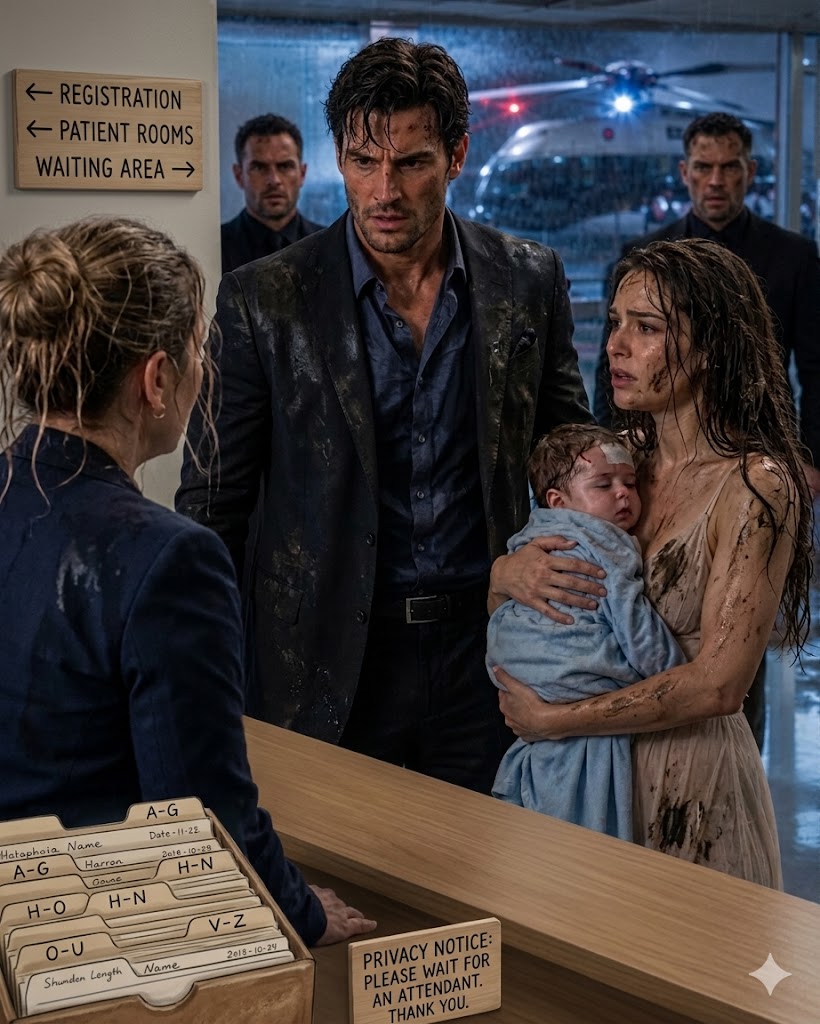
The words did not come from a doctor. That was what made them worse. They came from a woman in a navy blazer with a plastic hospital badge, standing under the flickering fluorescent lights of Boston General’s pediatric intake desk while rainwater dripped from Lauren Grant’s hair onto the polished floor. Luca was burning in her arms, seven months old and terrifyingly quiet, his tiny body limp against her chest, his dark lashes stuck together from fever sweat.
The emergency room went still for one cruel second. A nurse looked away, busy with a chart. A father holding a sleeping toddler stared down at his phone, retreating into the digital safety of someone else’s life. Somewhere behind the double doors, a monitor beeped with the sharp indifference of a machine that did not care who could afford to be sick.
Lauren did not cry. That was the first thing people misunderstood about her. They mistook her calm for weakness, her silence for guilt, her wet clothes for failure, and her trembling hand for incompetence. They saw a single mother with a cheap diaper bag slipping off her shoulder, an olive-green blouse soaked through by the October rain, and a baby whose father was not listed on the intake paperwork. They did not see the woman who had once sat across from Manhattan’s most dangerous businessmen and read contracts like loaded weapons. They did not see the woman who had survived Giovanni Moretti.
Fifteen months earlier, Lauren had walked away from marble floors, private elevators, crystal chandeliers, charity galas, bodyguards who pretended not to listen, and a husband who could fill a room without raising his voice. She had left New York with two suitcases, a law degree, a broken heart, and the exhausted dignity of a woman who had finally realized that luxury could still feel like a cage. A month after the divorce, she learned she was pregnant. And she told no one. Not Giovanni. Not his high-priced lawyers. Not the women who still whispered about her at fundraisers as if she had failed at being beautiful enough to keep him.
She moved to Boston, took a corporate legal job that paid just enough to keep her tired, and built a life out of daycare invoices, secondhand furniture, microwaved bottles, grocery-store flowers, and prayers whispered over Luca’s crib at midnight. Luca had his father’s eyes. That was the hardest part. Every morning, when he looked at her with those solemn, dark eyes, she saw Giovanni’s attention, Giovanni’s silence, Giovanni’s danger. But Luca’s laugh was hers. His stubborn little fists were hers. His need was entirely his own. That was how she kept going—one bottle, one bath, one court filing, one overdue bill at a time.
Then came the fever. By six o’clock that Friday night, Luca’s temperature was 103.2. By six-twenty, his crying had faded into a weak whimper that scared Lauren more than screaming ever could. By six-thirty-five, she was running through freezing rain toward her car, whispering, “Stay with me, baby. Please stay with me.” She drove to Boston General in eight minutes. It should have taken twelve. She ran red lights and did not care.
The triage nurse understood instantly. One look at Luca’s flushed face and unfocused eyes, and the room became motion—scrubs, questions, a pediatric crash cart rolling closer. A nurse took Luca from Lauren’s arms while Lauren’s fingers resisted before her brain caught up.
“Age?”
“Seven months.”
“Medication?”
“Infant acetaminophen. Two hours ago.”
“Father present?”
The question hit like cold water. Lauren hesitated. The administrator, Marla Hensley, Patient Accounts Supervisor, noticed. She stood with the stiff posture of a person who had mistaken proximity to authority for authority itself.
“Ms. Grant, there are forms you need to complete. If the father is unknown or unavailable, we need that stated clearly.”
“He’s not unknown.”
“Then write his name.”
Lauren looked toward the double doors where they had taken Luca. “I need to see my son.”
“The hospital still requires accurate information.”
“My baby is sick.”
Dr. Sullivan, a young, tired-eyed physician with wire-rimmed glasses, appeared then. “Ms. Grant? I’m concerned about meningitis. I need complete medical history. Yours and his father’s. Blood type, immune issues, genetic conditions, anything relevant.”
Lauren’s throat closed. “I don’t know his father’s history.”
Marla made a soft, theatrical sound behind her. “Ms. Grant, before we bring in uninvolved parties, you should understand that if there are inconsistencies in parental documentation, social services may need to be notified.”
Lauren turned slowly. “My son’s father is Giovanni Moretti.”
Marla’s eyes widened by a fraction. A phone buzzed in the waiting room. Lauren’s hand shook as she dialed the only number she remembered, the one she had burned into her memory to avoid calling. She dialed. One ring. Two. Three. A voice answered, low and rough.
“Who is this?”
“Giovanni,” she whispered, her voice cracking. “It’s Lauren. Our son is in the hospital. I need your history. Right now.”
There was a sudden, sharp intake of breath on the other end. “Where are you?”
“Boston General.”
“Give the phone to the doctor.”
He did not ask if she was lying. He did not ask for proof. He simply stepped into her life again with the weight of a freight train. But as Lauren handed the phone to Dr. Sullivan, a notification pinged on her own screen. It was an anonymous message from an unknown number: He shouldn’t have come back to Boston, Lauren. And neither should you.
Part 2: The Return of the King
Dr. Sullivan listened to the phone with a mounting sense of bewilderment, his eyes darting between Lauren and the receiver. He scribbled notes—AB negative, surgical history, rare markers. When he finally ended the call, he looked at Lauren with an expression that had shifted from professional curiosity to something closer to fear.
“He was very thorough,” the doctor said, handing the phone back. He didn’t ask how she knew Giovanni Moretti. He seemed to have instinctively realized that some questions in this hospital would be better left unasked.
Marla Hensley, however, was not so easily cowed. She stepped forward, her badge catching the light. “I’ll need to see proof of guardianship, Ms. Grant. A man like that… this could be a custody matter. We don’t want the hospital caught in the middle of a legal firestorm.”
“He’s a father, not a lawyer’s case file,” Lauren snapped, though her legs felt like they were dissolving.
“We’ll see,” Marla murmured, turning back to her computer.
Lauren retreated to the waiting area, sliding into a plastic chair. She felt every gaze in the room. They saw a woman in a wet blouse, but they sensed the tension radiating off her like heat. The air in the ER felt suddenly ionized, charged with the approaching force of the man she had spent fifteen months hiding from.
Outside, the storm had intensified. Thunder rattled the reinforced glass of the lobby. Then, the rhythmic, heavy thudding began. At first, it was just a vibration, a subsonic pulse that didn’t belong to the ambulance sirens or the hospital generators. It was a rhythmic, calculated mechanical beat.
The people near the automatic doors looked up. A sleek, matte-black helicopter was hovering just above the hospital roof, its searchlight cutting a jagged path through the sheets of rain.
“Is that a medevac?” a nurse asked, peering through the glass.
“No,” Dr. Sullivan muttered, checking the window. “That’s not a medical flight.”
Lauren didn’t look. She knew. Giovanni Moretti didn’t fly commercial. He didn’t take Ubers. He arrived like a catastrophe. The hospital went into a low-level lockdown, doors sliding shut with a hiss, guards moving toward the elevators. Lauren watched as the lobby doors finally opened, not for an emergency patient, but for a man who looked like he had stepped off a battlefield.
Giovanni crossed the emergency room floor with the terrifying, unhurried pace of a predator who had found his prey. He was wearing a charcoal coat, his hair slicked back with rain, his face a landscape of restrained agony. He didn’t look at the receptionists. He didn’t look at the gawking patients. He looked directly at Lauren.
He didn’t speak. He didn’t shout. He simply stood before her, and the sheer gravity of his presence made the entire ER staff shrink back.
“Where is he?” Giovanni asked. His voice was not the voice Lauren remembered. It was stripped of its usual smooth command; it was gravel, it was desperate, it was broken.
“They’re… they’re running tests,” Lauren whispered, standing up. She was inches shorter than him, but she held her ground, a veteran of his particular brand of war.
Giovanni reached out, his hand hovering near her face before he pulled it back, a flicker of restraint that looked painful. “You took him,” he said, the accusation laced with a terrifying awe. “You took my son.”
“I took him to keep him alive,” Lauren retorted, her eyes flashing. “You told me children were liabilities, Giovanni. You told me they were targets.”
“They are,” he agreed, his eyes darkening. “And that is why you should have told me the second you knew. You think you protected him, Lauren? You just hid him from the only man who could actually keep him safe.”
Marla Hensley, emboldened by the sheer chaos, chose this moment to intervene. “Sir, you cannot be here. This is a secure intake area.”
Giovanni didn’t turn. He kept his eyes on Lauren. “Chen,” he said without looking back.
A man in a sharp suit appeared at his elbow. “Yes, sir?”
“Buy the hospital,” Giovanni said.
“Sir?”
“Buy it. Now.”
The ER went silent. Not a beep, not a breath. Lauren watched as Chen pulled out a phone, already dialing, his face as stone-cold as his employer’s. Marla’s face turned the color of the hospital walls.
Part 3: The Price of a Hospital
The hospital, which had felt like a fortress of bureaucratic indifference ten minutes ago, was now the staging ground for a takeover. Chen was on the phone, his voice a low monotone of corporate acquisition, while Marla stood frozen behind the desk, her badge hanging crookedly from her blazer. She had tried to wield the power of the institution, only to find that the institution was about to have a new master.
“This is impossible,” Marla whispered, her hand trembling as she reached for her phone, perhaps to call a superior who was currently being outbid in real-time.
“Nothing is impossible,” Giovanni said, his voice finally shifting toward her, “when you possess the right kind of liquidity.”
He turned his back on the intake desk, dismissing Marla with the same ease he would a stray thought. He looked at Lauren, and the mask of the ruthless titan slipped, revealing the terrified father underneath. “Take me to him,” he said.
“He’s in isolation,” Dr. Sullivan said, stepping forward. He looked intimidated but determined. “We have protocols, Mr. Moretti. Even if you own the building, the medical staff decides who enters the pediatric ward.”
Giovanni surveyed the doctor, not with hostility, but with an intense, microscopic focus. “I don’t want to interfere with the treatment, Doctor. I want to stand on the other side of the glass. I want to see that he is breathing.”
The doctor hesitated, then nodded toward the double doors. “One person. No exceptions.”
Giovanni started to follow, but Lauren blocked his path. “You’re staying here,” she said, her voice firm. “You don’t get to walk in and take over the ward. You don’t get to scare the nurses. You don’t get to turn my son’s recovery into a tactical operation.”
Giovanni looked at her, his eyes searching. “You think I’m going to hurt him?”
“I think you don’t know how to be a father,” she said. “I think you only know how to be a boss. And Luca needs a father right now.”
He stopped. The words landed like a physical blow. He looked around the ER—the sick, the dying, the tired nurses, the flickering lights. He realized he was in a world where his money was a currency of exchange, but his humanity was an unproven commodity.
“Show me,” he said. “Show me how to be one.”
“Then wait,” she said.
They stood in the hallway, two people who had once shared a bed and a life, now separated by a mountain of secrets and the fragile, burning body of their child. The guards stood at the periphery, a perimeter of black-clad men who looked like they were waiting for a command that would never come. Outside, the helicopter’s blades continued to turn, a low, ominous vibration that shook the windows of the hospital, reminding everyone inside that the storm hadn’t stopped—it had just moved indoors.
Part 4: The Glass Barrier
The pediatric isolation ward was a corridor of quiet desperation. Every room held a small, fragile life battling an unseen enemy. Lauren led Giovanni to the viewing window of Luca’s room. Inside, the monitors flickered, the rhythmic, electronic heartbeat of their son providing the only sound.
Giovanni stopped dead. He placed his hands against the cool glass, his fingers spread wide, as if he were trying to push through the barrier to reach the boy inside. He looked at Luca—the tiny frame, the IV lines, the pale skin—and his face crumbled. It was a brief, unguarded moment of total devastation that Lauren hadn’t thought him capable of.
“He’s so small,” Giovanni whispered, his voice trembling.
“He’s strong,” Lauren replied. She leaned against the wall, her energy finally starting to ebb. The adrenaline was fading, and the sheer exhaustion of the last seventy-two hours began to take its toll. “He’s been fighting this fever for two days. He’s a fighter.”
“He’s my son,” Giovanni said, turning to her. The raw, desperate hunger in his eyes was almost too much to bear. “How could you hide him from me, Lauren? How could you let me live for fifteen months without knowing he existed?”
“Because you said children were targets!” she shouted, her voice echoing in the hallway, drawing the wary look of a passing nurse. She lowered her voice, the anger burning in her throat. “You told me you’d never bring a child into your life because you couldn’t guarantee their safety. I gave you the safety you wanted, Giovanni. I gave you a life without a liability.”
He took a step toward her, his expression a storm of regret. “I was wrong. I was a fool. I built an empire to protect the things I loved, but I didn’t realize that in guarding the perimeter, I was pushing the life inside the walls to leave.”
The electronic monitor in Luca’s room let out a sharp, rhythmic chirp—a sign that his heart rate was spiking. They both turned back to the window. Dr. Sullivan was moving inside the room, checking the oxygen levels, his face taut.
“He’s struggling,” Lauren said, her hand reaching for the glass.
Giovanni’s hand covered hers. His skin was warm, a sharp contrast to the cold glass. “He’s going to be okay,” he said, not as a command, but as a plea to the universe.
Suddenly, Lauren’s phone vibrated in her pocket. She pulled it out, expecting a hospital update. Instead, it was an image—an anonymous message, just like before. It was a photo of her and Giovanni standing at the viewing window, taken from the inside of the hospital, perhaps from a security camera feed. The caption read: The father is in the cage. Now we start the hunt.
Lauren’s blood went cold. “Giovanni,” she whispered, handing him the phone.
He looked at the image, then back at the double doors. He didn’t blink. He just tapped his comms. “Chen. Secure the perimeter. We have a breach.”
Part 5: The Hospital Under Siege
The transition from a hospital to a battlefield was instantaneous. Chen’s voice crackled in Giovanni’s ear, reporting that the emergency exits were being monitored and that security staff had been compromised. The hospital was no longer a place of healing; it was a trap.
“They’re inside,” Giovanni said to Lauren, his eyes turning to the hallway. He looked at her with a calm, terrifying resolution. “Go into the room with the doctor. Lock the door. Do not come out until I give you the code.”
“Giovanni, no!”
“Lauren, look at me.” He grabbed her shoulders, his grip firm. “This is not about the company. This is about them thinking they can come into a room where my son is and take him. They want to turn this hospital into a hunting ground? Fine.”
He signaled to two of his men, who stepped forward with weapons drawn—not the heavy artillery of a war zone, but the sleek, concealed weaponry of a tactical detail. They moved with a silent, lethal grace that terrified the few staff members still in the hallway.
Lauren didn’t want to leave him, but she looked at Luca’s room, then back at the darkened hallway. She slipped into the isolation suite, locking the door behind her. Dr. Sullivan looked at her, his face pale. “What’s happening?”
“Stay away from the window,” Lauren said, moving to Luca’s side. She touched his burning cheek, whispering, “You’re safe. Your father is here. And he’s going to make sure no one touches you.”
Outside, the lights in the ward flickered and died, plunging the hallway into emergency red. The backup generators hummed, casting long, distorted shadows on the walls. She heard the sound of heavy boots on the linoleum, a rhythmic, military cadence that didn’t belong in a pediatric wing.
She held Luca close, her own heart providing the steady rhythm for his survival. She heard the muffled bark of a suppressed weapon, the dull thud of a body hitting the floor, and the low, authoritative voice of Giovanni coordinating his men. He was fighting for his son, but for the first time, Lauren realized he was also fighting to prove that he had been worth saving.
Suddenly, the handle of the isolation door rattled. Someone was trying to get in.
Part 6: The Breach
The rattle turned into a rhythmic, forceful pounding. The door frame groaned under the pressure. Lauren backed away, holding Luca, her eyes darting to the emergency medical cabinet, looking for something—anything—to defend them with.
“Open the door, Ms. Grant,” a voice called out from the hallway. It was Marla Hensley, but the professional veneer was gone, replaced by a shrill, desperate edge. “Open it, or they’ll kill us all!”
“Who is with you, Marla?” Lauren screamed, her voice cracking.
“They’re the people who own this town, Lauren! They don’t want the child! They want the father, and if you don’t open the door, they’re going to blow it off the hinges!”
Lauren knew she couldn’t open the door. If she did, they would take Luca as leverage. She looked at the window overlooking the ambulance bay. It was a drop of twenty feet, onto a concrete surface. She scanned the room, finding a stack of heavy, foam-padded mattresses used for patient recovery.
“Doctor,” she whispered, grabbing the physician’s arm. “Help me move these against the door. We have to barricade it.”
“They have weapons, Lauren!”
“And we have a child who needs to live.”
Together, they heaved the mattresses against the frame. The door buckled, the metal hinges screaming as a breaching ram hit the wood. The room shook, glass vials shattering on the floor. Lauren retreated to the corner, shielding Luca’s face with her body.
Outside the door, a firefight erupted. She heard the distinct, sharp cracks of suppressed gunfire, the sound of glass breaking, and a man’s scream. It was Giovanni’s men—they were holding the hallway, but they were outnumbered.
“We need to get out of here,” Sullivan said, his face illuminated by the flickering red emergency lights. “There’s an air vent behind the linen closet. It leads to the service elevator.”
“Go,” Lauren said, forcing him toward the closet.
As they scrambled toward the back of the room, the door finally gave way. The frame splintered, and a man in a black mask stepped inside, an automatic weapon leveled at the room. He didn’t look at the doctor. He looked at the baby.
Lauren turned, her body a shield, waiting for the end. But the bullet never came. Instead, the man in the mask went rigid, his knees buckling as a single, perfectly placed shot from the shadows behind the door sent him to the floor.
Giovanni stepped into the room, his clothes scorched, his face a mask of primal fury. He didn’t look at the fallen assassin. He looked at Lauren, then at the child in her arms.
“Get him out,” he said.
Part 7: The Final Stand
The service elevator was the only way out, a metal cage that groaned under the weight of the moment. Giovanni ushered Lauren and Sullivan inside, but he didn’t follow. He stood at the threshold, the red emergency lighting casting him in a silhouette of pure, terrifying authority.
“What are you doing?” Lauren cried, gripping the elevator’s control button.
“I’m the target,” Giovanni said. “As long as I’m here, they won’t stop. Chen has a vehicle in the parking garage. He’ll take you and Luca to the safe house in Vermont.”
“No!”
“Lauren, look at him.” He pointed to Luca, whose breathing had stabilized, the fever finally beginning to break. “He needs a future. I’ve spent my life creating a past that keeps people in danger. Tonight, I end it.”
He pressed the close button, the metal doors sliding shut on the image of the man who had traded his soul for an empire, only to rediscover it in the eyes of his son.
The elevator plunged to the basement. When the doors opened, Chen was there, his face bloodied, his suit ruined. “Let’s go, Ms. Grant.”
They reached the garage, the air thick with the smell of gasoline. They piled into a nondescript sedan and peeled out into the night. Lauren looked back, but the hospital was just a silhouette against the storm. She didn’t know if Giovanni was alive. She didn’t know if she would ever see him again.
But as the miles racked up, she felt the silence of the last fifteen months finally lifting. She had been hiding from a monster, only to realize the monster was a man who would burn the world to keep his son safe.
Two days later, at the safe house in Vermont, a knock came at the door. Lauren grabbed the heavy iron poker from the fireplace, her heart pounding. She opened the door, expecting the end.
Giovanni stood there. He was bruised, his arm in a sling, his clothes rumpled, but he was alive. He stood on the threshold, a man who had left an empire behind to be a father. He didn’t step inside until she nodded.
“The empire?” she asked.
“Gone,” he said. “The debt is paid.”
He looked at Luca, who was sleeping in the crib, and then at Lauren. “I don’t know how to do this,” he whispered. “But I have the rest of my life to learn.”
Lauren looked at him, realizing the cage she had fled wasn’t the luxury, but the fear. She had finally walked out into the light. She opened the door wide, and for the first time, their family was finally, truly, whole.









