A Billionaire Family Mocked the Black CEO’s Daughter — Seconds Later, Their $750M Deal Collapsed
Part 1: The Torn Invitation
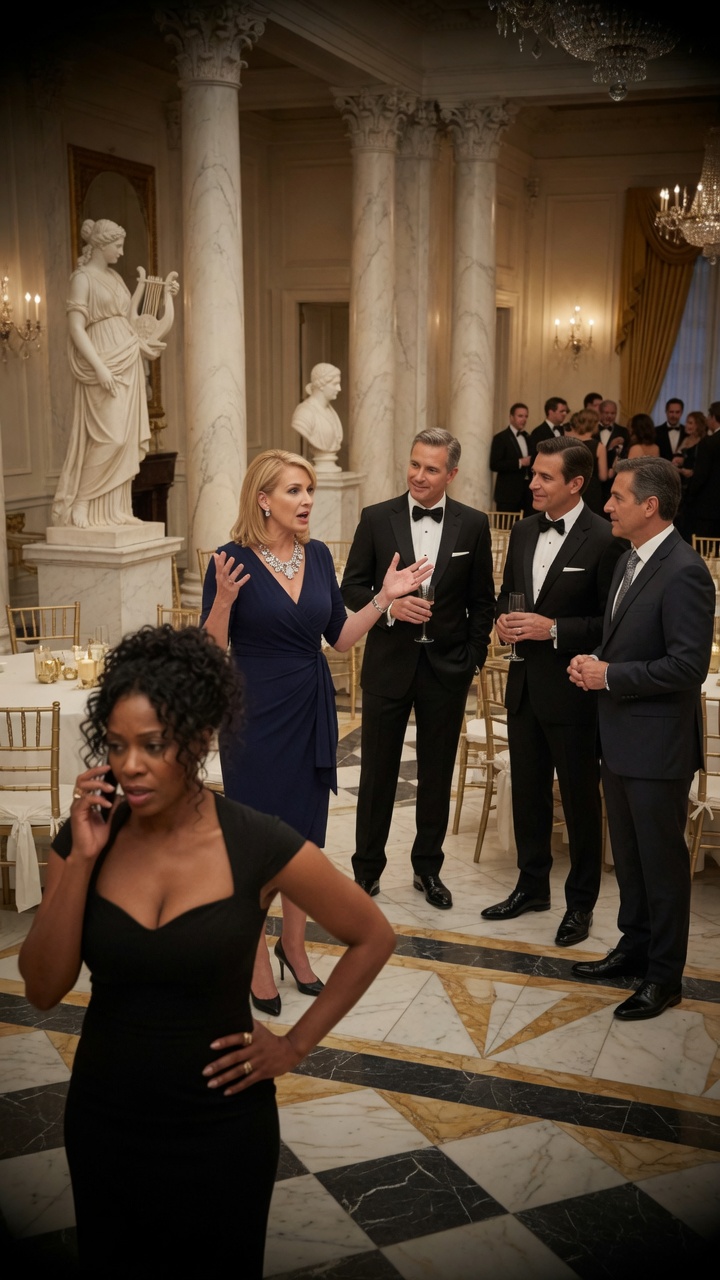
The marble floor of the Metropolitan Museum of Art felt colder than usual, or perhaps it was just the sudden, biting chill of humiliation that did it. Zara stood motionless as the Ashford family—Victoria, Richard, Camila, and Preston—formed a designer-clad circle around her. They were like sharks in a feeding frenzy, their phones held high, capturing every flicker of emotion on her face.
“Get this trash out of here before she embarrasses us all,” Victoria Ashford had hissed, shoving Zara backward.
Zara stumbled, her simple black dress catching on the edge of a champagne table. Preston, the family’s golden-boy influencer, immediately zoomed his camera in, his smirk wide and cruel. “This is going straight to TikTok, guys. Poor girl actually thinks she belongs here.”
Camila snatched the invitation from Zara’s hand, waving it above her head like a trophy. “Look, everyone! Someone’s playing dress-up with a fake ticket.” With a sharp, practiced motion, she ripped it in half. The paper fluttered to the floor like dying birds. The sound of tearing paper seemed to echo off the high, vaulted ceilings, signaling the start of a public execution of Zara’s dignity.
Security guards were closing in, their faces tight with professional discomfort. Zara didn’t run. She didn’t scream. She simply knelt, her hands trembling as she began to collect the torn fragments of the card that had been her entry to the gala. Two hundred elite guests—the titans of New York high society—paused their conversations to watch. It was the best entertainment they’d had all evening.
“Ladies and gentlemen,” Victoria announced, her voice dripping with the kind of theatrical concern that only the truly wealthy can master. “We have a gate-crasher situation. Some people simply don’t understand the meaning of exclusive.”
Preston kept his camera steady, his commentary rapid-fire for his growing audience. “Guys, you’re witnessing peak delusion right here. When ‘keeping it real’ goes horribly wrong.”
Zara kept her head down, her fingers brushing the cool marble. She felt every stare, every whispered jab, every lens pointed at her like a weapon. She knew who she was, and she knew the weight of what was in her clutch, but for a moment, the crushing pressure of the room made her feel as small as they wanted her to be.
Just as the head of security, James Patterson, reached her, Zara stood up. She held the torn paper in her palm. Her eyes weren’t filled with the tears they expected; they were clear, dark, and startlingly calm.
“I understand there’s been some confusion about my presence here tonight,” she said, her voice steady enough to carry to the edge of the circle.
Camila laughed into her phone, her thumb hovering over the ‘share’ button on her Instagram live stream. “Girl, there’s no confusion. You don’t belong here. This isn’t a community center fundraiser.”
But then, a movement in the back of the crowd caught Zara’s attention. A distinguished elderly man—Judge Catherine Morrison’s husband—was recording the entire scene, and his expression wasn’t one of amusement; it was one of dawning, horrified realization. Dr. Sarah Washington, a surgeon whose reputation was beyond reproach, leaned toward her husband. “This doesn’t feel right, Charles. They’re being unnecessarily cruel.”
The tension shifted. The air grew thinner. Zara felt her phone buzz against her thigh, a persistent, rhythmic vibration. She knew who it was. The caller had been trying to reach her for twenty minutes.
“Ma’am,” Patterson said, his voice dropping an octave as he sensed the changing mood of the room. “I need to verify your invitation status for tonight’s event. Right now.”
Zara looked at the Ashford family—the architects of her downfall—and then she looked at her phone. She knew that if she made this call, the life she had tried to lead in secret would be gone. She knew that the polite, quiet world she inhabited would be replaced by the firestorm of her father’s influence.
“Actually,” Zara said, her voice dropping into a tone that silenced the nearby socialites. “I think it’s time I made a phone call.”
She pressed the call button. As the phone rang, the room grew so quiet you could hear the distant hum of the museum’s climate control. Victoria narrowed her eyes, sensing—perhaps for the first time—that the power dynamic in the room was not what she thought. The phone connected.
“Hi, Dad,” Zara said, her eyes locked on Victoria. “Yes, I’m still at the Met Museum. Actually, I think you should know what the Ashford family really thinks about our community.”
Part 2: The Echo of the Past
The phone call was like a stone dropped into a still lake. The ripples were immediate.
“Dad, they tore up our foundation’s invitation,” Zara continued, her voice crystal clear. “Called it fake. Said I was—what was the phrase, Preston?—worthless trash that needed to be removed before I embarrassed everyone.”
Preston Ashford’s phone shook violently in his hands. He watched his TikTok stream’s comment section shift from mockery to sheer panic in real-time. Wait, what? Is she serious? Marcus Williams has a daughter? This family is about to be destroyed.
Richard Ashford, who had been aggressively ignoring his phone, finally looked at the screen. Seventeen missed calls from Marcus Williams—the CEO of Williams Tech. The same Marcus Williams whose $750 million partnership was the only thing standing between Richard’s company and bankruptcy. Richard’s face turned the color of stale ash.
“Marcus Williams,” Richard whispered, the words catching in his throat. “The Marcus Williams?”
“The same one,” Judge Morrison said, her voice ringing out as she finished a quick search on her phone. “CEO and founder of Williams Tech Corporation. Net worth, twelve point seven billion. Forbes list.”
The room became a vacuum. The elite guests, who had been laughing moments before, now looked like they wanted to vanish into the marble floor. Dr. Elizabeth Harper, the museum director, checked her tablet with trembling fingers, her eyes widening as she cross-referenced the donor records she had been too lazy to verify earlier.
“The Williams Foundation,” she gasped. “Platinum sponsor. One hundred thousand dollars.”
Victoria Ashford reached for Richard’s arm, her grip desperate, her perfectly manicured nails digging into his suit jacket. “Tell me this isn’t happening. Tell me that’s not actually the Marcus Williams whose partnership saves our entire empire.”
But it was.
Marcus Williams, the man who owned the future of tech, was the man on the other end of that phone line. And he was currently being told exactly how his only daughter had been treated by the Ashford family.
“Dad,” Zara said into the phone, “they want to remove me from the charity gala that our foundation sponsors. The museum where we donated over two million dollars last year alone.”
Victoria finally found her voice, though it sounded like a dying bird. “Please, Zara… there’s been a terrible, horrible misunderstanding. We had no idea—”
Zara didn’t even look at her. She just walked toward the center of the hall, the torn fragments of her invitation still held in her hand. The circle of sharks had turned into a line of shivering, terrified statues.
“Victoria,” Zara said, her voice dropping into a register of cold, mature authority. “You just spent forty minutes telling two hundred people that I was worthless trash who didn’t belong in civilized society. You filmed it. You broadcast it. You made my humiliation the evening’s main attraction.”
She stopped a few feet from Victoria. “What exactly did you think was going to happen when the truth came out?”
Preston desperately tried to end his TikTok stream, but his sweat-slicked fingers couldn’t find the buttons. His audience—now over 150,000 strong—was watching the exact moment the Ashford legacy began to burn to the ground. Camila had already killed her Instagram live, but the damage was irreversible. Hundreds of screen recordings were already populating the servers of the internet.
Dr. Harper rushed forward, her tablet held out like a shield. “Ms. Williams! Zara! I am so deeply, profoundly sorry. There has been a terrible mistake.”
“Actually, Dr. Harper,” Zara said, not turning her gaze from Victoria, “there has been no mistake at all. Everyone here has seen exactly who the Ashford family really is when they think nobody important is watching.”
The crowd murmured in agreement. The tide had turned completely. The very people who had been laughing moments ago were now scrambling to disassociate themselves from the Ashfords. Socialites, lobbyists, and corporate donors were backing away, their phones tucked into their purses, as if they were trying to scrub the night from their own digital history.
Zara’s father, Marcus Williams, was apparently on his way. The museum staff knew it, the Ashfords knew it, and every person with a phone in the room knew it. The air was heavy with the scent of an ending—the end of a social career, the end of a partnership, and the beginning of a reckoning that would make the Ashford name a cautionary tale for decades.
Part 3: The Billionaire Arrives
The heavy brass doors of the museum echoed like a thunderclap as they were pushed open. Marcus Williams entered the room with the force of a hurricane. He was six-foot-two, impeccably dressed in a charcoal Tom Ford suit, flanked by two men who looked like they’d come straight from a government agency.
The room grew so silent you could hear the distant hum of the HVAC system. Marcus didn’t shout. He didn’t rush. He simply walked, his eyes scanning the room with the clinical detachment of a man surveying a battlefield. When his gaze landed on his daughter, the granite lines of his face softened for a fraction of a second.
“Zara, are you all right?” he asked.
“I’m fine, Dad,” she replied, her voice steady. “Just… educated.”
Marcus turned his attention to the Ashford family. Richard was visibly sweating; Victoria looked ready to collapse.
“Richard,” Marcus said, his voice deceptively pleasant. “I received an interesting phone call from my daughter. Something about your family’s approach to community relations.”
Richard tried to step forward, his hands raised in a pathetic attempt at a handshake. “Marcus, please. There’s been a terrible misunderstanding. My family had absolutely no idea who Zara was. We were just… we were just following the security protocols!”
“Security protocols?” Marcus’s eyebrows arched. “Is that what you call tearing up an invitation and calling my daughter ‘trash’?”
Dr. Harper tried to intervene, her voice shaking with panic. “Mr. Williams, I am mortified. The museum takes full responsibility—”
“Dr. Harper,” Marcus interrupted, his eyes never leaving Richard, “you are not responsible for the Ashford family’s behavior, but you are responsible for how your institution responds to it.”
He turned to Richard. “Let’s discuss some numbers, shall we? Ashford Industries’ current debt load is 1.2 billion. Your stock price is down seventy-three percent this year. Your quarterly losses are eighty-nine million.”
Richard’s face drained of color. These were private internal figures—financial blood that was supposed to be hidden from the public.
“Without our partnership,” Marcus continued, his tone clinical, “your company has approximately sixty-seven days before bankruptcy. With it, you projected a return to profitability within eighteen months. Past tense, Richard. Projected.”
Preston stood in the corner, his phone still live, the screen showing his own face—the face of a boy who had just realized his family’s wealth was not a shield, but a suicide note.
“Sir, shall I read the social media documentation?” Marcus’s assistant asked, holding a tablet.
“Please.”
“Preston Ashford’s TikTok account. Four videos posted tonight. Combined viewership, three hundred and forty-seven thousand and climbing. Content includes calling Ms. Williams ‘trash,’ ‘delusional,’ and suggesting she doesn’t belong in civilized society.”
Preston’s mouth hung open. His followers were abandoning him by the thousands every second, the comments section becoming a graveyard for his career.
“Camila Ashford’s Instagram live,” the assistant continued, her voice cold. “Broadcast to forty-three thousand viewers. Content includes mockery of Ms. Williams’s appearance and encouragement of public humiliation.”
Victoria tried to speak, but her voice was a thin, raspy whisper. “Marcus, please. I made a terrible mistake. I had no idea…”
“Stop,” Marcus said. His voice wasn’t loud, but it cut through the room like a blade. “Victoria, you didn’t mistake my daughter’s identity. You saw a young woman and decided she didn’t deserve basic human dignity. You made that decision in front of two hundred witnesses. You filmed it. You broadcast it.”
He looked around the room, meeting the eyes of the other donors and socialites. “Is this the culture of this institution? Because if it is, the Williams Foundation will be pulling every cent of our support immediately.”
“No!” Dr. Harper cried. “That is not who we are!”
“Then prove it,” Zara said, stepping forward. “Because right now, this is exactly what everyone in this room thinks you are.”
Part 4: The Boardroom Storm
The emergency board meeting was convened at 10:00 p.m. in the museum’s private executive wing. It wasn’t the kind of meeting the Ashfords were used to—no catering, no polite small talk, no soft chairs. It was an interrogation.
Marcus Williams sat at the head of the table, his demeanor shifting from the concerned father to the ruthless businessman. Richard, Victoria, and the museum’s entire board of directors sat opposite him, looking like prisoners awaiting sentencing.
“We are here to discuss the Ashford Partnership,” Marcus began. He didn’t waste time. “The Board of Directors for Williams Tech has reviewed the video evidence. They have reviewed the public sentiment. They have reviewed the ethics clause in our contract.”
“Marcus,” Richard said, his voice desperate. “We can issue a press release. We can apologize. We can fire whoever was responsible for the security error.”
“You are the ones responsible,” Zara said from the corner of the room. She was sitting with Evelyn, a lawyer who had once been a judge and now specialized in corporate accountability.
“Richard,” Marcus said, ignoring his daughter for a moment, “do you understand that this is not a PR issue? This is a fundamental misalignment of values. Your family has made the Ashford name synonymous with systemic bigotry. My board cannot associate with that. Not for $750 million. Not for any amount of money.”
Victoria began to cry. Not the theatrical tears she’d used earlier, but real, jagged, terrifying sobs. “Our company will go under,” she said. “Thousands of employees… families…”
“You should have thought about them before you decided to make my daughter’s humiliation a form of social media entertainment,” Marcus said.
Zara watched them. She felt a strange, detached pity. These people had lived their entire lives behind a wall of money, believing that the rules that applied to everyone else were merely suggestions for them. Now, the wall was crumbling, and they had no idea how to survive in the open air.
“There is only one way forward,” Marcus said, placing a document on the table. “I am not pulling the partnership yet. But the terms are being rewritten.”
Richard grabbed the paper, his eyes scanning the text. His breath hitched. “Probationary? Quarterly reviews? Independent diversity audits?”
“You will demonstrate change, or you will lose everything,” Marcus said. “You have eighteen hours to begin the process, starting with the public accountability measures my daughter outlined.”
“You’re asking us to submit our company to an independent audit?” Victoria asked, her voice incredulous.
“I’m asking you to prove you’re human,” Zara said. “And if you find that too difficult, then I suggest you start preparing for the bankruptcy proceedings.”
The board members looked at each other. They were terrified of Marcus, but they were more terrified of the Ashford family’s toxicity dragging the entire museum down with them.
“We accept,” Richard said, his voice hollow. It was the sound of a man signing his own death warrant. Or perhaps, a man being forced to grow up for the first time in his life.
“Fine,” Marcus said, standing up. “My team will be in touch at 8:00 a.m. sharp. Do not be late.”
He walked out of the room, Zara following closely behind him. As they left, the silence in the boardroom was total. The Ashford family sat there, surrounded by the wreckage of their own ego, finally realizing that the world they had dominated for fifteen years had moved on without them.
Part 5: The Ripple Effect
The news of the board meeting leaked before midnight. By sunrise, the Ashford stock price had plummeted another 15%.
But the impact wasn’t just financial. It was social. Every brand that had sponsored the Ashford family’s events, every charity that had relied on their donations, every socialite who had climbed the ladder using their connections—they all began to distance themselves.
It was a social contagion. Being seen with an Ashford was now a guarantee of public scrutiny, and nobody in New York was willing to risk their own brand for a family that had been caught on camera acting like monsters.
Zara went back to her own life, but it had changed. She wasn’t just a donor’s daughter anymore; she was the face of a new wave of corporate accountability. She was inundated with messages—not just from the elite, but from everyday people who had faced the same kind of casual, systemic cruelty and had been told they were “too sensitive” or “delusional” when they spoke up.
She spent her days reading their stories. They were heartbreaking.
“I was told I didn’t belong in my office because of my accent,” one woman wrote.
“I was called a ‘quota hire’ by my supervisor,” wrote another.
“I was escorted out of a restaurant because my appearance didn’t fit the ‘vibe,'” said a third.
Zara realized that what happened to her at the Met wasn’t an anomaly. It was a symptom. And the Ashford family had become the unwitting poster children for a disease that was finally being diagnosed.
She met with Dr. Washington and Judge Morrison for lunch.
“You’ve started something, Zara,” Dr. Washington said. “People are talking. Really talking. They’re demanding the same kind of accountability from their own firms, their own schools, their own local leaders.”
“I just wanted them to apologize,” Zara admitted.
“You got a lot more than that,” the Judge replied. “You got a national conversation.”
But the Ashfords were still struggling. Richard and Victoria had retreated to their penthouse, their social lives completely erased. The “social emergency” Victoria had declared was now a permanent state of exile.
One afternoon, Preston Ashford reached out to Zara via a mutual contact. He asked to meet. Zara agreed, mostly out of morbid curiosity. They met in a quiet, neutral coffee shop. Preston looked different—no designer labels, no phone in hand. He looked like a college student who had just failed a major exam.
“I’m sorry,” he said. He didn’t say it like an influencer; he said it like a human being. “I thought it was a joke. I didn’t think about who you were. I just thought… I thought I could use you to get more likes.”
“You did use me,” Zara said. “For 347,000 likes.”
“I know.” He looked down at his hands. “I’m deleting the account. I’m starting over.”
“Starting over to do what?”
“I don’t know. Maybe something that doesn’t involve humiliating people.”
Zara didn’t forgive him—not then, and not fully—but she saw a flicker of genuine reflection. It wasn’t the epiphany of a saint, but it was the start of a person. And that, she realized, was more than she had expected.
Part 6: The Summit
Six months later, the Metropolitan Museum’s annual report was published. The marble hall that had hosted the incident now hosted the Williams-Ashford Corporate Responsibility Summit.
It was the most exclusive ticket in New York—not because of the price, but because of the content. 300 business leaders were present. The Ashford family sat in the front row. They wore simple, dark clothing. No diamonds. No designer labels. They spent the morning listening to experts on implicit bias, equity, and institutional reform.
Dr. Elizabeth Harper stood at the podium. “Six months ago, this institution was the site of a profound failure. Today, we are here to celebrate a catalyst for change.”
Victoria Ashford stood up. She walked to the microphone, her hands steady, her expression humble. She didn’t look like the woman who had torn up an invitation; she looked like a woman who had been forced to look in the mirror for the first time in her life.
“I cannot undo what I did,” she began. “But I can spend the rest of my life ensuring it never happens again. Not by me, not by my family, and not in any organization we influence.”
She shared her findings—her visits to community centers, her work with diversity consultants, the uncomfortable truths she had discovered about her own upbringing. She didn’t ask for forgiveness; she asked for accountability.
Richard Ashford followed, presenting data—not marketing fluff, but cold, hard statistics. Diversity hiring numbers, supply chain audits, employee retention rates. He spoke about the business case for justice, about how inclusivity wasn’t just a moral imperative, it was a competitive advantage.
Zara watched from the back of the room, her father by her side.
“They’re actually doing the work,” Zara whispered.
“They have to,” Marcus replied. “The cost of not doing it is higher than they can afford.”
The summit concluded with a commitment ceremony. Company after company signed the Metropolitan Accord, pledging to implement rigorous bias training, independent audits, and concrete diversity goals.
The incident that was meant to crush Zara had instead become a global standard for corporate behavior. It was the ultimate irony. The Ashfords had tried to make her “nothing,” and in the process, they had built her into a leader who forced them to become something better than they ever were.
Part 7: The Lasting Echo
Two years later, Zara Williams stood before the United Nations Human Rights Council in Geneva. At twenty-seven, she was the youngest person ever to deliver the keynote address on corporate accountability and social justice.
“Two years ago,” she said, looking out at the delegates, “I was publicly humiliated by people who judged me solely on my appearance. Today, that incident has sparked a global movement that has transformed how businesses approach diversity, equity, and inclusion.”
Behind her, screens flashed with the data of the Metropolitan Accord—over 1,200 companies worldwide had adopted the protocols. Discrimination complaints were down. Hiring diversity was up. And more importantly, the culture of “hiding in plain sight” had been dismantled.
The Ashford family had survived the storm, but they were not the same. They had become advocates, their family foundation funding the very initiatives that Zara had fought for. It was a strange, complicated peace—a reconciliation born not of love, but of necessity and the relentless pressure of the truth.
As Zara walked out of the assembly hall, she saw a young woman waiting by the door. It was a student—someone who had seen the videos, read the reports, and felt inspired.
“Ms. Williams?” the girl asked. “Thank you. Because of what you did, my university started a diversity scholarship. I’m the first one in my family to get a degree.”
Zara felt a warmth spread through her chest. This was the real victory. It wasn’t the billions, it wasn’t the corporate partnership, and it wasn’t the humiliation of the people who had tried to hurt her. It was the way her life had become a bridge for others.
She left the UN and walked toward the shores of Lake Geneva. The water was a piercing, beautiful blue, reflecting the sky. She pulled out her phone and checked her messages. A text from Richard Ashford: Another successful diversity audit today. We’re still learning, but we’re committed.
She smiled and typed back: Keep going.
She realized then that her life hadn’t been defined by that night at the Met. It had been defined by the choice she made when the invitation was torn to pieces. She could have walked away. She could have stayed quiet. Instead, she had held her ground, and in doing so, she had forced the world to change its shape around her.
She was no longer the girl from the Third Ward who had to fight for her seat at the table. She was the woman who had built a better table—one where everyone, regardless of their last name or their dress, was finally invited to sit.
The story of the torn invitation had become a legend, a viral moment that had refused to fade, but for Zara, it was simply the day the real work began. And as the sun set over Geneva, she was ready for whatever was coming next. Because she knew one thing for certain: truth is an unstoppable force, and it always finds its way to the light.