A millionaire see his maid being humiliated on a blind date with only $5 and her life change forever
Part 1: The Invisible Employee
The sprawling Whitfield estate in Los Angeles was a palace of polished marble, soaring ceilings, and crystal chandeliers. For Sophia Torres, it was simply a place of work. At twenty-six, she had spent four years as a housekeeper, moving through the vast, hollow rooms with a feather duster and a quiet, practiced invisibility. She knew the texture of the mahogany desks, the precise temperature of the wine cellar, and the exact placement of every artifact. But to James Whitfield, she was just another piece of the household machinery.
James was a man of cold, efficient grace. He was a titan of business, a man who lived on the edge of high-stakes conference calls and rapid-fire deals. Their interactions were confined to the professional: “Good morning, Sophia,” or “Please ensure the guest room is ready for the investor.” He was a man who seemed to own the world, yet lived in a gilded cage of his own making, his life an endless, sterile rotation of meetings.
Sophia, meanwhile, lived in the shadows. She sent most of her earnings home to San Diego, where her mother lived in a cramped apartment and her brother worked toward an engineering degree. Her own life was a series of long shifts and solitary bus rides. Tonight, however, promised a rare flicker of something different.
Her best friend, Carmen, had insisted. “You’re young, beautiful, and you’re wasting your life polishing James Whitfield’s silver, Sophia!” Carmen had pushed a dress into her hands—an emerald green gown, a thrifted treasure that looked like it had been spun from moonlight. Sophia stood before her cracked bedroom mirror, smoothing the fabric with trembling hands. She had applied the cheapest lipstick she could find, her heart hammering a frantic rhythm against her ribs.
It was her first real date. She had met Ryan on an app two weeks ago. He was kind, funny, and—for the first time—didn’t seem to care that she was a housekeeper. When he suggested the Golden Rose, an elegant downtown restaurant, she felt a dangerous, intoxicating flutter of hope. Maybe this was the moment she would stop being invisible. Maybe tonight, someone would finally choose her. As she climbed into her old, battered car, the fog began to roll in, wrapping the city in a cold, uncertain blanket. She didn’t know that the restaurant she was driving to would become the epicenter of a life-altering collision—not with Ryan, but with the man who owned the very floor she scrubbed every day.
Part 2: The Table for Two
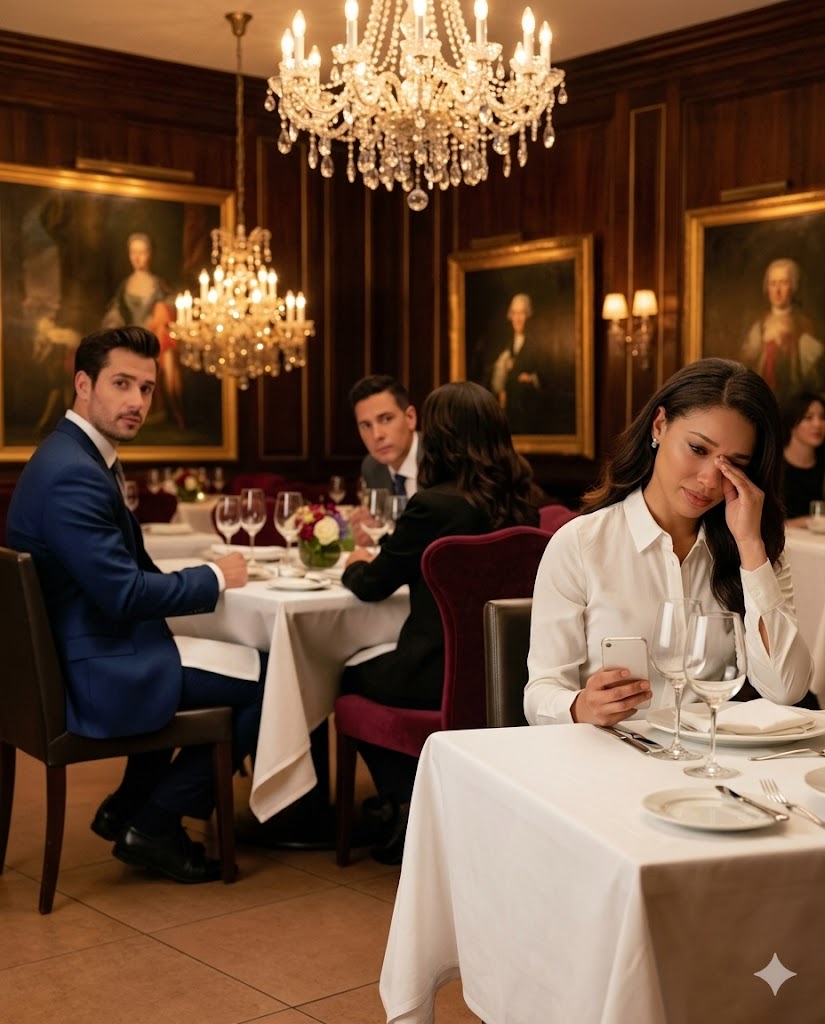
The Golden Rose was a jewel box of warm light, its entrance flanked by couples who moved with the effortless confidence of the wealthy. Sophia stepped inside, her heart sinking as she took in the expensive fabrics and shimmering jewelry of the other diners. She felt instantly out of place, a stain of ordinariness on a velvet canvas.
A waiter led her to a window table, his smile professional and cold. She sat down, clutching her small purse which contained exactly eight dollars—the remainder of her bank account after rent. Eight o’clock came and went. Sophia checked her phone every sixty seconds, the screen’s glow highlighting her deepening anxiety. Other diners glanced her way—not with malice, but with a kind of clinical assessment that made her feel like a smudge on a windowpane.
By 8:30, the waiter had returned twice, his patience thinning. By 8:45, her phone buzzed. She opened the message from Ryan. “Sorry, but I don’t think this will work out. You’re not really what I’m looking for. Good luck.”
The rejection hit her like a physical blow. She sat frozen, the humiliation washing over her in hot, suffocating waves. She had been foolish to dream, foolish to think she could step outside the margins of her own life. She began to gather her purse, desperate to escape before she shattered into a thousand jagged pieces.
What she didn’t know was that in the far corner of the restaurant, James Whitfield was sitting alone. His business dinner had been canceled an hour ago, leaving him to nurse a meal and a stack of contracts. He had been staring at his paperwork, trying to disconnect from the world, when a flash of emerald green caught his eye.
He didn’t recognize her at first. The woman at the window looked vibrant, elegant, and heartbreakingly vulnerable. When she turned, the light caught her profile, and recognition struck him like a thunderbolt. It was Sophia. His housekeeper. The woman who had quietly kept his home in order for four years. He watched her check her phone, saw her posture collapse, and witnessed the precise moment her hope died. A sudden, sharp pain flared in his chest—a feeling so foreign and intense that he stood up without thinking, his chair clattering loudly against the floor.
Part 3: Crossing the Rubicon
James walked toward her table, his movements fueled by an instinct he didn’t recognize. He had spent years building walls around his emotions, focusing solely on the bottom line. But seeing Sophia in pain cracked the mortar of his fortress.
When he reached her table, Sophia was halfway out of her seat, her eyes blurred with tears. She froze when she saw him, her hand gripping the edge of the table. “Mr. Whitfield?” she whispered, her voice fracturing.
“Sophia,” he said, his voice softer than he had ever heard it. “May I sit down?”
She looked around, mortified, as if she were being caught in a crime. “I was just leaving, sir.”
“Please don’t,” James heard himself say. “Not yet. Not like this.”
There was something in his tone—a genuine, unvarnished human quality—that stopped her. She sank back into the chair, clutching her purse. James sat down across from her, the space between them suddenly feeling charged with electricity.
“I saw what happened,” he said quietly. “Someone stood you up.”
Sophia’s cheeks burned. “I suppose I was foolish to think tonight would be different.”
“Different from what?”
“From every other time,” she murmured, unable to meet his eyes. “I’m not the kind of woman men choose, Mr. Whitfield. I’m the kind they overlook.”
James felt a surge of anger toward the man who had abandoned her, and an even greater anger toward himself for having overlooked her for four years. “You’re wrong,” he said, his voice firm. “And the man who stood you up tonight is a fool.”
Sophia looked at him then, really looked at him, and for the first time, she saw a man rather than an employer. James Whitfield was looking at her with a raw, searching intensity that made her breath catch.
“Why are you here?” she asked, her voice steadying. “Why did you come over?”
James paused. He wanted to say it was for business, for propriety, for some reason that made sense in his cold, rational world. But the truth was simpler and far more dangerous.
“Because I couldn’t stand to see you hurt,” he said, his voice thick with an honesty that terrified him. “Because for four years, you’ve been in my home, in my life, and I’ve been too blind to really see you. Until tonight.”
The air between them seemed to vibrate with unspoken potential. Around them, the restaurant continued its rhythm, but their table felt like an island in a vast, dark sea.
Part 4: The Shared Truth
They ended up ordering dinner, and the barrier between employer and employee began to erode with every passing minute. James signaled the waiter before Sophia could object, his confidence in paying for the meal a stark contrast to her own meager savings.
“Tonight, let’s forget about everything else,” James said, leaning forward. “Just be two people sharing a meal.”
As they ate, the conversation shifted from the polite, distant pleasantries of the mansion to the deep, unspooling threads of their pasts. Sophia spoke of her mother, the woman who cleaned houses to put food on the table, and her brother, who was studying engineering. She spoke of her dreams—the neighborhood bakery she hoped to open one day, the simple joy she found in the act of baking bread.
James listened, his eyes locked onto hers. He had spent his life listening to people who wanted things from him—investments, funding, influence. He had never listened to someone who just wanted to share the story of their life.
“My dream,” Sophia said, her voice warm, “is just to have a place where people feel welcome. A place where kindness is the currency.”
James felt his throat tighten. “What about you?” she asked. “What do you want beyond the boardrooms?”
The answer came from a place he’d kept locked away. “I think I’d want to be a teacher,” he admitted. “My grandfather was a teacher. He was the happiest person I ever knew. I think I chose the wrong life.”
“Then why don’t you change it?” she asked simply.
“Because it’s not that easy. There are expectations, responsibilities…”
“Maybe,” she interrupted, “but there’s always a way to feed your soul.”
The realization hit him: here was a woman who had every right to be bitter, every right to hate the hand life had dealt her, and yet she possessed a wisdom he had never been able to afford. She saw him not as a CEO, but as a man who had lost his way.
“I see you, James,” she whispered, reaching across the table and placing her hand over his.
It was a small gesture, but it held the weight of a world changing. When the check came, he paid it without a second thought. As they walked to her car, the cool L.A. night air felt like a benediction. He leaned down and kissed her forehead—a chaste, respectful gesture that felt like the beginning of something monumental.
“I’ll call you tomorrow,” he said. “We’ll figure this out.”
She nodded, her eyes bright with a mixture of wonder and terror. As she drove away, James stood in the parking lot, his phone buzzing with ignored business calls. He looked at the device, then turned it off. For the first time, the work didn’t matter. Only the woman in the emerald dress did.
Part 5: The Gala and the Storm
The Beverly Hills charity gala was the pinnacle of the social season, a night of diamonds, flashbulbs, and shifting allegiances. James had decided to bring Sophia, a choice that he knew would be viewed as an act of war by his family and the board of directors. He watched her across his study as she prepared, her hands steady, her resolve unwavering.
When they arrived, the entrance was a gauntlet of cameras. The flashing lights were like lightning in a storm, and Sophia flinched slightly before James took her hand, his grip reassuringly tight. “We can leave if you want,” he said.
“No,” she said, lifting her chin. “I’m tired of hiding.”
They walked into the ballroom, the crowd parting like a sea. James saw the whispers, the sharp glances, and the blatant contempt of his peers. His mother, Eleanor, intercepted them before they had even taken ten steps.
“James, darling,” she said, her voice dripping with ice. “Who is your little friend?”
“Mother,” James replied, his voice calm and lethal. “This is Sophia Torres, the woman I love.”
The room seemed to go silent. Sophia stood tall, her eyes meeting Eleanor’s with a dignity that made the older woman look small. “I love your son, Mrs. Whitfield,” Sophia said softly. “Not for his status, but for the man he is.”
The air was electric. People were filming them, their phones up, eyes wide with the spectacle. Eleanor’s face went white, her mask of composure slipping. “This is a phase,” she hissed. “It ends tonight.”
“It doesn’t,” James said, turning to the room. “It’s just beginning.”
His sister, Amanda, pushed through the crowd, laughing. “Finally, James! Someone who isn’t a plastic mannequin!”
The support from Amanda didn’t stop the storm, but it broke the silence. Sophia felt the sting of the world’s judgment, the biting words of the press, and the cold ostracism of their circle. But as she held James’ hand, she felt something more powerful: the knowledge that they had crossed a line they could never step back from. They were no longer playing the game; they had started their own.
Part 6: The Ultimatum
The fallout was swift and punishing. The Whitfield board of directors called an emergency session, the tension in the boardroom thick enough to choke on. They demanded he end the relationship or step down as CEO.
James stood at the head of the long table, the weight of a three-generation legacy pressing down on his shoulders. He thought of his grandfather, the teacher, and he thought of Sophia, who had taught him what it meant to actually live.
“I won’t give her up,” James said.
“Then you’re finished,” the chairman replied.
James walked out of the building as the midday sun hit the pavement, feeling as though he had just shed a heavy, suffocating coat. He went straight to Sophia’s house. She was waiting for him, having heard the news through the grapevine.
“You lost it all because of me,” she said, her voice trembling.
“I lost a job,” he corrected, pulling her close. “I didn’t lose my life.”
They had no plan. They had no idea where the money would come from or what the future held. But as they sat in the quiet of her small, sunlit living room, James realized that for the first time in his adult life, he felt a profound, exhilarating sense of freedom.
The media circus continued, the headlines brutal, but within the small, intimate world they had carved out, everything was still. He began working on his own ventures, smaller projects that actually interested him, and Sophia continued her work, refusing to be driven out by the scandal.
Their lives were no longer measured by the opinions of the board or the approval of the society matrons. They were measured by the quiet moments: the shared meals, the conversations, the way they looked at each other in the morning sun. They were proving that love wasn’t a transaction, and that the things you build with your own hands are the only things that truly belong to you.
Part 7: The New Horizon
Six months later, the press had largely moved on to the next scandal, leaving James and Sophia to build their own reality. James had started teaching history at the local community college, finding a joy he had never known in the corporate world. His students loved him—he was the professor who told them that history was not just dates and maps, but stories of people who had fought, loved, and changed the world.
Sophia’s bakery had become the heart of the neighborhood. It was always warm, smelling of cinnamon, yeast, and fresh coffee. On Saturdays, James would stand at the counter, a flour-dusted apron tied over his casual clothes, serving people who had no idea he was a former billionaire. He loved it.
On their wedding day, the sun was bright, and the garden was filled with the people who had stood by them—Amanda, Sophia’s mother, and a handful of loyal friends. As James placed the delicate sapphire ring on Sophia’s finger, he felt a sense of completion that went beyond any merger or acquisition.
“Marry me,” he had whispered, “not for what we were, but for what we are.”
“Yes,” she had replied, her voice filled with a promise that resonated through the garden.
They stood together, two people from disparate worlds who had collided and created something stronger than the sum of its parts. The world still had its rules, its class barriers, and its cynical expectations, but James and Sophia had learned the most important lesson of all: that being seen, truly seen, by another person, is the only wealth that matters.
As they walked back toward the reception, a young couple—perhaps on a first date—watched them from the edge of the garden, holding hands. They looked at each other with the same wonder that had sparked at the Golden Rose. James caught their eyes and smiled. The legacy was shifting. The old ways were fading. And in the soft glow of the afternoon light, the only story that mattered was the one they were writing together—a story of two people who had stopped performing for the world and had finally started living for themselves. The bakery would be busy on Monday, the classes would be difficult, and life would continue to throw its challenges, but they were ready. They had everything they needed, and the horizon ahead was finally clear.