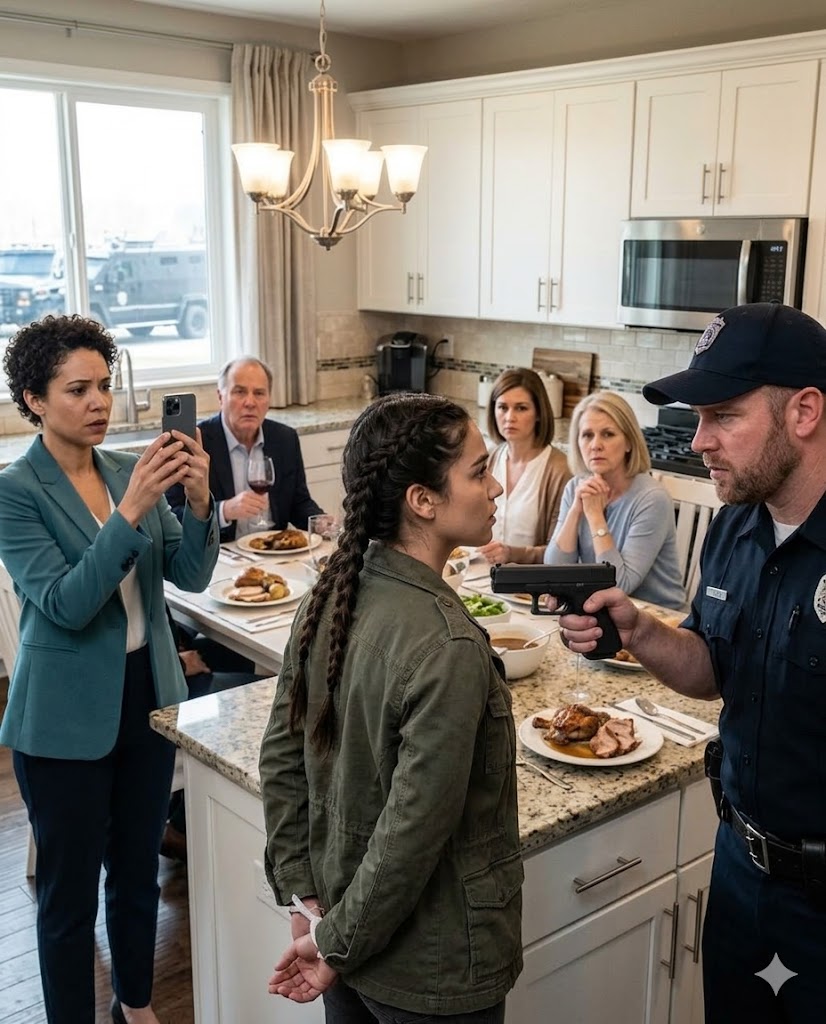
Abusive Cop Stepfather Bullying His Stepdaughter Has No Idea Her Last Call Is Connected Directly To The Pentagon!
Part 1: The Breach at the Threshold
“Officer Vane,” I said, my voice dropping into a flat, mathematical register that cut cleanly through the low hum of the idling diesel engines outside, “before you decide whether to pull that trigger, you should know who is listening on this line.”
The cold steel muzzle of Silas Vane’s service Glock remained pressed firmly against my left temple, but the swaggering local cop’s thumb faltered against the slide lock. For a fraction of a second, the absolute, unearned certainty that had defined his face for fifteen years fractured into a look of raw, unvarnished confusion. He didn’t drop the weapon, and he didn’t ease the pressure against my skull, but his eyes darted toward the high kitchen window where the bright amber strobes of the approaching armored convoy were already bouncing off the white tile backsplash.
Outside, the quiet, manicured suburbs of Oakhaven were coming apart in a succession of deep, mechanical roars. The heavy growl of five blacked-out BearCat armored vehicles rolled under the linoleum floorboards, rattling the gold-rimmed wineglasses on the dinner table where their guests sat paralyzed.
Linda, my mother, let her smartphone dip three full inches, her thumb accidentally hitting the screen lock as the federal notification banner froze her device. The screen glowed a harsh, digital blue against her pale face, displaying the mirrored encryption log that she couldn’t delete. The mean, bright smile she had worn while calling me a secretary had vanished entirely, her lips parting into a dry, hollow line of absolute shock.
“Silas…” she whispered, her voice cracking as she took a panicked step backward toward the pantry shelves. “Silas, my phone… it’s not letting me close the app. It says it’s a locked federal asset tracker.”
“Shut up, Linda!” Silas snapped, his chest heaving beneath his uniform shirt as he tried to regain control of the room by sheer volume. He didn’t look at her; his eyes were locked onto mine, searching the gray neutrality of my face for a single sign of the terrified eighteen-year-old girl who had left this house with a single suitcase fifteen years ago. “She’s bluffing. She didn’t make a call. Nobody’s on the line.”
“The Pentagon’s Global Command Suite has been on this line since thirteen fifty-seven, Officer Vane,” I said, my voice remaining level, steady, and entirely devoid of the fear he was demanding from me. “Every threat syllable you have uttered since fourteen zero-two has already been logged, tagged, and forwarded to the Department of Justice under a Level-One tactical response mandate. You have exactly four seconds before my entry team takes the front door off its hinges.”
Mr. Calder set his wineglass down on the mahogany table with a sharp, heavy click that sounded exactly like a judge’s gavel in the absolute silence of the room. He looked at Linda’s sister, whose fork was still suspended halfway to her mouth, the gravy cooling on the tines. Neither of them spoke. The neighbors Silas had invited to witness his grand display of domestic discipline had suddenly discovered they had eyes, and those eyes were fixed on the black tactical silhouettes currently moving across the front lawn.
“Get away from the windows!” Silas roared at the table, his swaggering local authority returning in a desperate, defensive flash. He yanked my cuffed wrists upward, the steel teeth of the handcuffs digging hard into the skin of my wrists, using my body as a physical shield between himself and the kitchen entryway. “I’m a sergeant in this township! This is my jurisdiction! Nobody moves a muscle in my house!”
The front door didn’t just rattle under the next knock.
With a deafening, explosive crash of splintering oak and tearing iron screws, the entire front entryway of the Oakhaven house was blown inward by a hydraulic breaching ram. The sound shattered the glass panels of the hallway cabinets, sending a shower of fine crystal across the rug. Before the echo of the blast could clear the air, the kitchen was flooded by a dozen men wearing matte-black ballistic armor, tactical helmets, and carrying short-barreled assault rifles equipped with high-intensity laser sights.
The red laser lines sliced cleanly through the cheap cigar smoke hanging near the curtains, dancing across the roast beef, the saltshaker, and finally locking onto the center of Silas Vane’s forehead.
“Federal tactical response team!” a voice boomed through a megaphone from the hallway—a deep, unyielding baritone that made Linda scream and drop her phone onto the linoleum. “Drop the weapon! Drop the weapon and step away from the General!”
Silas froze, his entire body going rigid as the reality of the laser dots registered against his skin. His service weapon remained pressed to my temple, his finger trembling violently against the trigger guard as he looked at the massive, unyielding wall of black armor currently filling his dining room.
“You’re… you’re military,” Silas stammered, his face turning a sickening shade of gray as his eyes tracked the tactical insignia on the lead operator’s chest. “You can’t execute a domestic arrest… this is illegal… I’m local law enforcement…”
The lead operator didn’t answer him with an argument. He didn’t lower his rifle a single inch. He stepped aside, clearing the pathway through the splintered hallway, as a tall man in a crisp, dark blue dress uniform stepped into the light of the kitchen. It was Master Sergeant Miller, my personal senior communications aide from the Pentagon Command Suite. He carried a heavy leather briefcase clutched against his ribs and a pair of industrial bolt cutters in his right hand.
Miller didn’t look at Silas. He didn’t look at the screaming mother near the pantry. He walked straight toward me, his boots crunching on the broken glass, stopped exactly two feet away, and brought his hand up to his brow in a flawless, crisp military salute.
“General Thorne,” Miller said, his voice level and steady in the middle of the chaos. “The War Room has verified the secure feed. The tactical perimeter is fully locked down. May I clear the restraints, ma’am?”
Part 2: The Decoupling of Authority
I kept my shoulders loose, my eyes locked onto the gray stone of Silas Vane’s face as the bolt cutters clicked against the steel links of the handcuffs. With a sharp, metallic snap, the heavy chains fell away from my wrists, hitting the kitchen counter with a dull clatter. I rubbed the red, circular indentations left in my skin, my breathing remaining perfectly synchronized, while Silas took two slow, unsteadied steps backward until his spine struck the edge of the refrigerator.
His service Glock was no longer pressed to my skull; it lay flat on the granite countertop where the lead tactical operator had stripped it from his paralyzed fingers.
“Linda,” my mother stammered from her corner near the pantry, her fingers clawing at the shelves as she looked at the dark blue dress uniform of Master Sergeant Miller. “Maya… what is this? Who are these people? You… you told us you were doing data entry work for the logistics branch in Frankfurt.”
“I told you I was working in tactical response coordination, Mother,” I said, my voice smooth, flat, and entirely devoid of the childhood silence they had used to discipline my tone for seven years. “You simply chose to translate the word coordination into secretary because it fit the narrative you and Silas required to keep this room small.”
I walked over to the dining table, my bare feet quiet on the hardwood floorboards. The neighbors, Mr. and Mrs. Calder, were trying very hard to melt into the upholstered backing of their chairs. Mr. Calder’s hand was still hovering near his water glass, his face completely pale under the ceiling fan lights.
“Mr. Calder,” I said, stopping near his shoulder. “I suggest you and your wife take your coats and leave through the rear exit. The regional US Attorney’s office will be contacting your residence tomorrow morning to log your formal depositions regarding the unlawful restraint and threat language you witnessed at fourteen zero-two.”
He didn’t answer me with a word. He stood up instantly, grabbed his wife’s trembling hand, and the two of them hurried through the glass patio doors into the damp grass of the lawn, completely ignoring the fact that they were leaving their roast beef behind.
Silas was breathing in short, shallow gasps now, his uniform belt creaking as he looked at the red laser dots that remained fixed on his chest panel. The swaggering local cop who had driven his patrol car through Oakhaven like he owned the asphalt was entirely gone. In his place stood a forty-eight-year-old man who had suddenly realized that the tiny town sandbox he had built his terror inside was sitting in the middle of a federal firing range.
“This is a setup,” Silas muttered, his voice dropping into a desperate, defensive rasp as he looked at Master Sergeant Miller. “I’m an officer of the peace. I was executing a standard domestic intervention. She was acting erratic… she reached for an asset—”
“Officer Vane,” Miller interrupted, pulling a thick, certified document packet from his leather briefcase and laying it flat on the kitchen table right next to the gravy boat. “At fourteen zero-two, your device logged an automated query through the national law enforcement database, attempting to flag General Thorne’s residential tracking numbers under a generic municipal warrant. That query immediately triggered a red-flag alert at the Pentagon Command Suite. You didn’t execute an intervention; you executed a high-level breach of federal security protocols during a live command window.”
Miller turned his face toward me, his posture completely rigid. “General, the Chief of Staff is currently holding the secure satellite link open in the mobile command unit outside. He wants to know if you require immediate transport back to the capital, or if we are clearing the local department’s files first.”
I looked at my mother, who had dropped to her knees on the linoleum floor to pick up her smartphone. The screen was still flashing the encrypted federal warning banner: PROPERTY OF US GOVERNMENT — DATA PACKET IMMUTABLE. She looked up at me through the strands of her dyed hair, her eyes wide with a mixture of terror and a strange, sudden realization that her daughter was no longer an asset she could manipulate for her own comfort.
“Maya…” she wept, her hands shaking against the tile. “I’m your mother. I raised you in this town. I didn’t know… we didn’t know you had reached this level of authority. You should have told us.”
“I tried to tell you three times during the holiday letters, Linda,” I said softly, looking down at her. “But you kept returning the envelopes unopened because the return address didn’t contain a husband’s name to justify my life. You valued Silas’s badge more than my voice, because his badge allowed you to feel safe while he ruined everyone else in this house.”
I turned back to Silas, my gray eyes fixing onto his face with the absolute, freezing weight of a command decision already made.
“Master Sergeant,” I said, reaching down to pick up the heavy silver bolt cutters from the counter. “Have the entry team secure Officer Vane’s service vehicle outside. We are driving down to the county precinct precinct right now. I want to see exactly who in his department has been authorizing his ‘discipline’ for the last fifteen years.”
Part 3: The Precinct Audit
The ride down the main boulevard of Oakhaven was defined by the deep, pressurized silence inside the armored SUV. I sat in the rear passenger seat, my faded gray hoodie looking completely out of place against the black leather upholstery and the glowing multi-screen communications tactical suite mounted between the front seats. Outside the reinforced glass windows, the neat, trimmed hedges and white vinyl fences of the suburbs rolled past in a blur of gray afternoon light. The neighbors were standing on their porches, their faces small and anxious as they watched the five blacked-out BearCats roll in perfect, synchronized formation toward the commercial district.
Master Sergeant Miller kept his eyes fixed on his display monitors, his fingers moving smoothly across the keys as he authorized the data streams.
“The county sheriff has just been pinged on the secure circuit, General,” Miller noted, his tone entirely professional. “He was at a municipal charity dinner three miles south. His vehicle has turned around; he’ll meet our arrival at the front desk within four minutes.”
“Good,” I said, looking out at the passing storefronts. “Have the legal unit pull every internal internal complaint log filed against Silas Vane’s badge between 2012 and today. I want to see every single notation that was marked as ‘administratively resolved’ by his captain.”
We pulled into the gravel lot of the Oakhaven Police Precinct at exactly 14:22. The precinct was a modest, red-brick building that tried to look commanding behind two white pillars, but it looked incredibly small, almost fragile, against the heavy steel weight of our tactical convoy. The local desk officer—a young man named Harris who looked like he hadn’t completed his second year on the force—stood behind the glass partition of the lobby, his fingers freezing over his radio console as a dozen armed federal operators cleared the double entry doors.
“Who… who is in command here?” Harris stammered, his hand flying instinctively toward his leather holster before a red laser dot appeared on his desk blotter.
“General Maya Thorne,” Miller said, stepping up to the counter and laying his federal identity packet flat against the glass panel. “Clear the secure line to your command suite immediately, Officer. We are taking digital control of your station’s server array for an active security audit.”
Before the boy could answer, the rear service doors of the hallway swung open with a loud thud, and Sheriff Thomas walked into the lobby. He was fifty-something, with a wide, weathered face and a silver badge pinned to his khaki uniform shirt. He looked like a man who spent his entire life managing local traffic disputes and small-town property lines, and he was completely unprepared for the wall of black ballistic armor filling his front entrance.
“What is the meaning of this intrusion?” Thomas demanded, his voice rising with volume as he tried to project authority, though his eyes were darting frantically toward the strobes outside. “This is a municipal police station. You have no legal warrant to seize our files without a state mandate—”
“Sheriff Thomas,” I said, stepping forward from the shadow of the entry doors, pulling the hood of my gray sweatshirt back from my temples to let him see the clean, stitched wound above my eyebrow. “Fifteen years ago, when I was eighteen, I sat in that exact blue plastic chair in your corner office. I came here to file a formal domestic safety complaint against your sergeant, Silas Vane. I showed you the green bruises on my shoulders where he had slammed me into the utility door because I had used a scholarship packet without his permission. Do you remember what you told me that morning, Thomas?”
The old sheriff froze, his hand dropping from his leather belt as his gray eyes locked onto my face. The administrative confidence drained from his features so fast his skin turned the color of wet chalk.
“You… you’re Linda’s girl,” he whispered, his voice cracking into a thin wire of sound. “The one who went into the army logistics branch.”
“I am General Maya Thorne, Sheriff,” I said, my voice cutting through the lobby like a cold wind. “And fifteen years ago, you told me that a young girl shouldn’t try to ruin a good officer’s family reputation over a little ‘household discipline.’ You told me to go home, pack my suitcase, and apologize to my stepfather for my tone. You filed my complaint sheet inside the basement paper shredder because Silas Vane was useful to your department’s county voting quotas.”
I walked directly up to the glass partition, my fingers tapping the counter wood.
“Now,” I continued softly, “your useful sergeant has just spent ten minutes pressing a loaded service weapon against a four-star General’s skull inside a registered federal command window. Every single file, every email, every internal discipline voucher your captain has cleared for him over the last decade is currently being downloaded into the Pentagon’s legal loop. You aren’t managing a precinct anymore, Thomas. You are standing inside the evidence locker of a federal conspiracy trial.”
Part 4: The Exposure Metric
The communication suite inside the precinct’s main administrative office hummed with a cold, digital efficiency as my technical team systematically uncoupled the local servers from the county grid.
Sheriff Thomas sat heavily in his own high-backed leather chair, his silver badge looking strangely tarnished under the harsh fluorescent lights of the room. He didn’t look at the computer screens where his station’s files were being indexed; he kept his eyes locked flat on the dark wood of his desk blotter, his hands clasped tightly together to hide the visible tremor in his fingers.
“Darius,” Thomas muttered, his voice barely clearing his lips as he looked up at me. “Silas… Silas has a terrible temper. Everyone in the department knows he’s a hard man when the stress gets high. But he’s a loyal officer. He’s kept the streets of this township clear for twenty years. You can’t let a single domestic dispute destroy an entire life’s record.”
“He didn’t execute a domestic dispute, Sheriff,” I said, leaning my hands flat against the mahogany frame of his desk, my gray eyes holding his gaze with absolute, unyielding focus. “He executed an armed assault against an active command officer of the United States Armed Forces. He didn’t keep the streets clear; he cleared the margins so he could operate his private cruelty without a single witness saying a word in public. And you gave him the blueprint to do it.”
Master Sergeant Miller pushed the office door open, a fresh printout ledger clutched in his hand. He didn’t offer a polite greeting to Thomas; he stepped straight to my side, his posture rigid.
“The forensic accounting team has just verified the secondary data streams, General,” Miller said, his baritone voice level and steady. “Between 2018 and last Tuesday, Officer Silas Vane received twelve distinct cash deposits into a private security account registered under a shell company called Vane Logistics LLC. Every single deposit was executed by a local commercial developer named Mercer—the same developer whose municipal building contracts were authorized by the Sheriff’s zoning board without a public hearing.”
I let out a short, cold breath, my fingers tracing the edge of the ledger sheets. “So the local badge wasn’t just a tool for domestic terror, Thomas. It was a tool for municipal procurement. You cleared his internal complaints because he was the middleman for your development percentages.”
Thomas closed his eyes, his head dropping forward until his chin touched his collar badge. He didn’t try to offer a smooth explanation, and he didn’t call his legal team. The simple small-town authority he had used to manage the Oakhaven population had completely run out of leverage against the industrial weight of a federal tracking grid.
Before I could issue the next command sequence, the main lobby doors of the precinct rattled under a heavy impact from the outside.
I walked out of the office into the red-brick corridor, my boots quiet on the linoleum, and looked through the thick glass panels of the lobby partition. A large, expensive white luxury SUV had pulled into the gravel lot, parking across two restricted spots. The door threw open, and a man in his early fifties stepped out into the November wind. He wore a high-end camel hair coat over a tailored Italian suit, his hair slicked back with an expensive product, his face red with an immediate, unbridled fury as he marched straight toward the entry double doors.
It was Grant Mercer—the chief executive of Mercer Construction and the primary financial force behind the town’s development sector.
He didn’t see the black BearCats parked near the brick columns; he didn’t notice the dozen armed federal operators currently standing in the lobby with tactical rifles. He shoved the front door open, his voice booming across the red-brick room like he owned the entire municipality by right of purchase.
“Thomas!” Mercer shouted, his fingers slamming against the concierge desk glass. “Where is Vane? My assistant tells me his patrol unit just had its corporate access codes revoked from the municipal site. What the hell is going on with the server array? I’ve got an investment closing in ninety minutes!”
He stopped mid-sentence as he finally took in the wall of black ballistic armor standing in front of him. The red laser lines from the lead operator’s rifle immediately clicked alive, a single dot centering precisely on the lapel pin of his expensive camel hair coat.
Part 5: The Alignment of the Ledger
Grant Mercer took a single, unsteadied step backward toward the glass door frame, his hand flying instinctively to the leather strap of his briefcase as the red laser dot warmed his wool lapel. The slick, corporate arrogance that had defined his stride when he crossed the parking lot seemed to evaporate from his features, his lips parting into a hollow line of shock as his eyes tracked the tactical insignia of the federal entry unit.
“What… what is this?” Mercer stammered, his head turning frantically to find Sheriff Thomas, who was standing in the office doorway behind me, his badge low. “Thomas, who are these people? Why are there military vehicles blocking my commercial transport routes outside?”
“Mr. Mercer,” I said, stepping into the center of the lobby, my faded gray hoodie pulled tight around my neck. “Your commercial transport routes have been officially frozen under a Title-Eight national security preservation order. I suggest you set your briefcase down flat on that blue plastic chair before my lead operator decides your movements constitute a physical threat to this station.”
He looked at my face, his eyes narrowing as he tried to find the connection between a woman in a worn sweatshirt and the dozen automatic weapons currently pointed at his chest. “Who the hell are you? I’m the primary corporate developer for this entire county. I have an investment meeting with the state infrastructure board—”
“I am General Maya Thorne, Mr. Mercer,” I said, my voice smooth, flat, and carrying the absolute, unyielding clarity of a commander who had spent a decade analyzing international supply line fraud. “And your investment meeting with the state board has just been removed from the calendar. Two minutes ago, the federal wire portals verified that your holding company executed three separate cash transfers to a private account owned by Silas Vane under the description of ‘consulting retainers.’ Those retainers were paid on the exact dates the Oakhaven precinct shredded the toxic environmental complaints filed against your new concrete plant layout.”
Mercer’s mouth opened, but no sound came out of his throat. He looked down at the briefcase clutched in his fingers, his knuckles turning white as he realized the structural ledger of his entire business had been downloaded into a federal command file while he was driving down the highway.
“This is domestic overreach,” Mercer whispered, his voice shaking with a desperate note of panic as he looked at the camera lenses mounted on Master Sergeant Miller’s technical rig. “You can’t just seize a private corporation’s internal documents over a local retaining voucher. I have legal representation—”
“Your legal representation is currently being processed at the federal courthouse downtown, Mr. Mercer,” Master Sergeant Miller said, stepping forward with his tablet screen illuminated in green text lines. “The wire transfers were routed through an institutional command portal that is subject to federal banking anti-corruption statutes. Your assets have been frozen to prevent capital flight, effective as of fourteen ten.”
I turned my back on him completely, looking at the young desk officer, Harris, who was still standing behind his glass screen like a frozen statue.
“Officer Harris,” I said levelly. “Where exactly is Silas Vane being held right now?”
“He’s… he’s downstairs in the holding cell three, ma’am,” the boy stammered, his fingers flying to his keys. “The captain put him down there after the ram hit the house door. He… he hasn’t been logged into the public book yet.”
“Bring him up to the main squad room, Harris,” I ordered, walking toward the heavy steel security gate that led to the back offices. “And have the transport units prepare the line. We are moving this entire station’s senior staff out of Oakhaven before the sun goes down behind the pines.”
Part 6: The Squad Room Verdict
The squad room of the Oakhaven Police Precinct was a depressing space defined by its limitations—cheap particleboard desks, gray linoleum floors caked with old winter salt, and a single television screen in the corner playing a local news loop with the sound turned entirely off.
Silas Vane sat in the center of the room, his wrists secured to the iron ring of a heavy interrogation bench by a fresh pair of heavy-duty tactical zip-ties. His uniform shirt was torn at the shoulder from the entry struggle, his silver badge removed from his chest panel, leaving nothing but a dark, rectangular outline of lint and broken threads on the khaki fabric. The swaggering local cop looked smaller now, his shoulders hunched forward, his face pale and smudged with grease under the harsh, unshaded fluorescent tubes.
I walked into the room slowly, my boots quiet against the linoleum. Master Sergeant Miller followed three steps behind, setting a fresh digital recording unit flat on the desk in front of Silas’s bench.
“You think you’re important now, Maya?” Silas muttered, his voice dropping into a low, bitter snarl as he raised his gray eyes to meet mine. He tried to force a short, jagged laugh out of his throat, but the sound died quickly in the absolute, quiet room. “You brought a dozen automatic rifles into a small town precinct because your pride couldn’t handle a little family correction. You’re still just Linda’s girl beneath that fancy uniform title. You’re still the kid who had to ask my permission to use the kitchen key.”
I stood perfectly still, my hands tucked into the front pocket of my gray hoodie, looking down at his face with the clinical, detached focus of a surgeon analyzing a broken valve.
“I didn’t bring this tactical unit here because of my pride, Silas,” I said softly, my voice carrying that low, unyielding force that forced the room to lean toward it. “I brought them here because for fifteen years, you and Sheriff Thomas operated under the illusion that power belongs to whoever carries the loudest voice and the heaviest boot inside a dark room. You genuinely believed that because the neighbors stayed silent, and because Linda laughed at your cruelty, the rest of the world was completely blind to your record.”
I reached out, my hand steady as I flipped the screen of Miller’s tablet around so he could see the green text files scrolling down the display.
“These are the internal incident logs from the regional logistics depot where your father worked his double shifts, Silas,” I said levelly. “I spent two hours yesterday afternoon tracing the old employment lines. It turns out his heart didn’t give out from simple labor exhaustion at sixty-one. His heart failed because your captain’s family development firm had quietly stripped his retirement pension package from the ledger two months prior to cover an unvouched cash deficit in the precinct’s building fund. You spent twenty years serving the exact same systematic corruption that killed your own father, simply because his badge gave you the privilege of turning the violence downward onto a fourteen-year-old girl who couldn’t protect her own skin.”
Silas froze, his mouth opening slightly as the digits on the tablet screen registered in his memory. The small, bitter arrogance that had held his jaw tight all afternoon seemed to dissolve completely from his features, his chest heaving under his torn uniform shirt as the historical architecture of his own life’s lie was laid bare before him.
“You… you didn’t know about that,” he whispered, his voice cracking into a raw, helpless gasp. “The file was sealed by the state board.”
“Nothing is sealed from a federal command sweep, Silas,” I said, turning my back on his bench as the heavy steel security door clicked open behind me.
My mother, Linda, stepped into the squad room, escorted by two black-armored operators. She had been given a clean blanket from our transport vehicle to wrap around her shaking shoulders, her hair still tangled, her eyes bloodshot and swollen from hours of silent weeping in the transport cabin. She looked at Silas clutched to the iron bench, then looked at me standing beneath the ceiling lights, her fingers tightening around the wool fabric.
“Maya…” she whispered, her voice a thin wire of absolute desperation. “What is going to happen to our house? What is going to happen to our name in this town?”
“The house is being placed under an asset preservation lien by the federal court tomorrow morning, Linda,” I said smoothly, looking her in the eyes without a single second of childhood evasion. “And the name… the name Oakhaven gave you is finished. You are going to pack your suitcases tonight under the supervision of Master Sergeant Miller’s unit, and you are going to move into a state-monitored residential facility outside the county line until the grand jury finishes logging your deposition text.”
I walked to the doorway, my hand resting flat against the steel frame paneling, before turning back to face the entire room one final time.
“Master Sergeant,” I ordered, my voice dropping into that final, permanent command register. “Have the transport vehicles pull up to the front pillars. We are closed here. It’s time to move these people out of my hometown.”
Part 7: The Command Clean
The dawn over the Oakhaven valley broke with an uncharacteristic, brilliant silver light that Monday morning, the freezing winter mist rising slowly from the trimmed hedges and clean sidewalks of the suburban streets.
I stood on the front wooden porch of the house where I had spent seven years learning the silence of survival. I wore my clean, dark green four-star General’s dress uniform now, the silver stars on my shoulders catching the sharp glare of the rising sun, my medals a solid, heavy block of metallic weight against my chest panel. My posture was rigidly straight, completely uncoupled from the memory of the eighteen-year-old girl who had run down these steps into the rain.
The front yard was no longer choked with the quiet symmetry of suburban landscaping.
A fleet of five black BearCats and three federal transport vans were parked in a perfect, synchronized line across the gravel driveway, their diesel engines releasing long, white plumes of condensation into the chilly morning air. The neighbors were standing at the edge of their lawns, their arms wrapped tightly around their torsos against the wind, their faces wide with an absolute, breathless awe as they watched the final operational clearance of the Vane estate.
Master Sergeant Miller walked down the broken steps of the hallway, carrying my father’s old wooden footlocker under his left arm—the single personal asset I had left inside the house before I joined the logistics branch in Frankfurt. He stopped exactly two feet from my boots, brought his hand up to his brow in a crisp salute, and set the locker inside the rear transport cabin.
“The server wipe at the precinct is completely finalized, General,” Miller reported, his baritone voice level and steady in the crisp air. “The state attorney’s office has officially assumed total administrative control of the county’s police files. Silas Vane and Sheriff Thomas have been checked into the federal holding suite downtown without a single administrative bottleneck.”
“And my mother?” I asked, looking down at the small black lens sewing into my uniform button.
“She’s clutched inside the second transport van, ma’am,” Miller replied, his eyes tracking the pine ridge. “She has signed the absolute disclosure waivers. She won’t be returning to the Oakhaven grid.”
I took a long, measured breath of the cold southern air, the smell of damp grass and wood smoke filling my lungs. The house behind my back felt incredibly small now—a tiny, fragile cage of rotten wood and peeling paint that had lost its power to punish my tone or command my breathing. The microwave clock that had tracked the minutes of my unmasking was dead, the power lines to the kitchen cleared by our engineering unit hours ago.
I walked down the porch steps, my leather dress boots striking the dirt with absolute, unyielding authority. I didn’t look back at the splintered entry door, and I didn’t care about the small-town history that Silas Vane had attempted to write across my temple with a loaded service Glock. I climbed into the rear passenger seat of the lead armored vehicle, the heavy steel door closing with a pressurized, muffled click that shut out the ambient noise of the suburbs forever.
The phone mounted on the tactical suite between the seats buzzed once with a silent notification, the screen illuminating a secure text line from the Chairman of the Joint Chiefs: OPERATION OAKHAVEN AUDIT COMPLETE — COMMAND SPACE SECURE — PROCEED TO THE PENTAGON WAR ROOM.
I reached out my hand, clicked the power switch off, and dropped the device flat into my leather briefcase. As the five black engines growled into gear, pulling the tactical convoy smoothly away from the gravel driveway and toward the interstate bypass, I leaned my head back against the leather cushion, my breathing remaining perfectly low, perfectly steady, and entirely free.
The kid from Bankhead’s legacy had been cleared from the ledger sheets, the useful sergeant was inside his iron frame, and General Maya Thorne was finally, completely, going back to the world where real power lived.