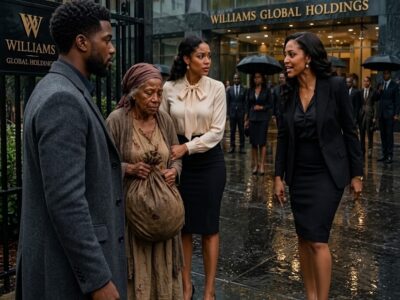
After a chance encounter, Emily finds herself drawn into a world of impossible choices, buried secrets, and unexpected redemption. As dangerous loyalties begin to crack, a powerful man must decide whether to protect the empire he built or risk everything for the chance to become someone better.
Part 1: Six Words in the Dark
The coffee cup hadn’t even finished its journey when the diner went entirely silent. It wasn’t the ordinary, comfortable quiet of a slow Tuesday night on the edge of the city, but the kind of suffocating stillness that feels like the world has suddenly run out of air. Twelve people sat completely frozen at their tables. A trucker near the grease-stained window stopped chewing his burger mid-bite, his fork hovering inches from his plate. An elderly couple in the corner booth reached for each other’s hands beneath the laminated menus, their fingers locking without either of them realizing they were doing it. Behind the kitchen pass, the cook, a mountain of a man named Reuben who had survived two brutal tours overseas and never flinched at a sound, set down his metal spatula with agonizing slowness. He did not look at his grill. He went very, very still.
Emily Carter stood exactly where she had been standing when the shouting began. Her right hand still gripped the black plastic handle of the half-empty glass coffee pot, while her left rested flat against the chipped Formica edge of the counter. The heavy ceramic mug Vincent Moretti had hurled was gone, but its path was immortalized behind her. A thick, dark ribbon of steaming brown liquid was running down the faded yellow wallpaper in a slow, jagged line, dripping steadily onto the cracked linoleum tile floor three inches from her right ear. A few hot drops had splattered onto the starched sleeve of her light blue uniform. She didn’t look down at them. She didn’t look at the broken shards of pottery resting on the floor. She kept her eyes locked on his.
Vincent Moretti was a man other men crossed the street to avoid. At sixty-one years old, he carried himself with the heavy, predatory confidence of an apex predator that had never known a cage. He had sharp, silver hair at his temples that contrasted sharply with his dark, tailored overcoat—a coat that cost more than Emily earned in three months of double shifts. He didn’t move like the regular patrons of the Ridgewood Diner. He inhabited space the way a king inherits a kingdom. Two of his men, thick-necked and dressed in matching dark suits, stood like stone pillars by the front entrance, their backs to the glass. A third stood near the blinking neon glow of the jukebox, his arms folded loosely over his chest, scanning the room the way a wolf watches a field full of sleeping sheep.
Everyone in the city knew the Moretti name. They knew it the way they knew which dark alleys to avoid after midnight, or the way they knew not to touch a hot iron stove. You didn’t need to be burned twice to learn the lesson. The Moretti family owned the docks, the local council, the construction unions, and half the concrete blocks that made up the city’s skyline. They were a force of nature, an institutional terror that people simply accepted as a condition of living in this valley.
“I asked you a simple question, girl,” Vincent said, lowering his voice until it was a low, guttural growl that was somehow infinitely worse than his shouting. “Do you have any idea who I am?”
Emily set the glass coffee pot down on the heating element behind her. She did it slowly, deliberately, ensuring the small, metallic click of glass against the warmer was the only sound cutting through the hum of the old refrigerator.
“I know exactly who you are,” she said. Her voice didn’t shake. It didn’t pitch upward with the frantic, pleading energy that Vincent was used to hearing from people who owed him money or mercy.
“Then you know what happens to people who waste my time,” Vincent murmured, leaning his large hands on the counter, his massive gold signet ring catching the harsh fluorescent light above.
A younger waitress named Dana, who had only been on the job for three weeks, was standing near the pie display case. She let out a small, terrified whimper and took a frantic step forward, her hands clutched to her apron as if she were about to throw herself between them, to apologize on Emily’s behalf, to beg for the diner’s safety. Emily didn’t turn her head, but she lifted her left hand just an inch, a silent, authoritative command that made Dana freeze in her tracks.
This was the moment. Every person clutching their breath in that room understood the script. This was the part where the waitress was supposed to drop her chin, look at her orthopedic shoes, and let the tears fall into the apron. This was the part where she was supposed to scramble for a rag with trembling fingers, wipe up the mess, brew a fresh pot of premium roast, and pray to whatever god she believed in that the monster would simply walk out the door without breaking anything else. That was how the world worked. That was how it had always worked for twenty years.
But Emily Carter was thirty-four years old, and she had spent the last twenty-four months watching her mother’s body fail in small, agonizingly cruel increments in a living room that smelled of rubbing alcohol and rented medical equipment. She had spent the last eleven months arguing with health insurance administrators who answered the phone with bright, synthesized voices only to tell her, paragraph by paragraph, that the only drug capable of keeping her mother’s heart beating was experimental and therefore completely uncovered. She had exactly nine dollars and fifty cents an hour to her name, a mountain of past-due notices in a kitchen drawer she could no longer bear to open, and a exhaustion so deep it felt like it had settled into her marrow. She had not slept more than four hours a consecutive night since the previous winter.
Somewhere in the course of the last few weeks, the part of her that was capable of being afraid had simply run out of fuel. It had quietly, completely died.
So she did not lower her eyes. Instead, she leaned forward across the counter, placing both of her palms flat against the cold Formica, bringing her face close enough to Vincent Moretti that she could smell the expensive tobacco and old leather on his coat. She looked him dead in his amber, unblinking eyes, and in a voice that was perfectly calm, almost gentle, she said six words.
“Shout at me again, and I’ll end you.”
The man by the jukebox let out a short, disbelieving bark of a laugh, the sound slicing through the silence like a jagged blade. One of the stone-faced men by the glass door instantly reached inside his heavy wool jacket, his fingers wrapping around something dark and metallic hidden beneath the silk lining.
But Vincent Moretti did not move. He did not laugh. He did not give the nod his men were waiting for. He simply stood there, his breath catching in his throat, staring at the woman in the faded blue uniform as if she had just materialized out of the floorboards. For the first time in four decades, the reliable, predictable presence of fear was missing from a room he occupied. And Vincent Moretti knew, with the terrifying instincts of a lifelong hunter, that the woman looking back at him wasn’t bluffing.
Part 2: The Smell of Fear
Vincent didn’t take his eyes off hers. He had spent his entire adult life learning to read the subtle chemistry of human terror. He could smell it on a man’s skin before the first word was spoken; he could see it in the rapid, involuntary pulse at the hollow of a throat, the microscopic tremor at the corner of a lip, the way a person’s weight shifted instinctively toward the nearest exit. Fear was the currency he traded in. It was the mortar that held his entire empire together. It was logical, it was manageable, and it was absolute.
But as he looked into Emily’s eyes, he found nothing but an empty, icy plain. There was no defiance born of pride, no reckless adrenaline of a fool trying to be a hero. There was only the cold, clear certainty of someone who had already looked into the worst corners of existence and found nothing left to lose.
“What did you say?” Vincent whispered. It wasn’t a threat. The words came out flat, almost wondering, as if he were trying to translate a foreign language he had never heard before.
“You heard her, boss,” the man by the door said, his voice dropping into that professional, transactional register used right before a body hits the pavement. “You want me to take care of this?”
“No,” Vincent said, his eyes never leaving Emily’s face. His hand came up, a sharp, flat gesture that cut through the air. “Nobody touches anything. Stand down.”
The men by the door looked at each other, their professional certainty fracturing for a split second before they returned to their stone positions. The diner remained locked in its strange, gold-lit vacuum. The coffee continued its slow, muddy descent down the wallpaper behind the counter. The old couple in the booth hadn’t untangled their fingers. Reuben stood by his grill, his large hand resting on the handle of his spatula like a soldier waiting for the whistle to blow.
“You don’t know who you’re talking to, girl,” Vincent said finally, his voice returning to its normal volume, though the edge was gone, replaced by a strange, investigative curiosity.
“I think I do,” Emily said, her voice remaining low and steady, pitched just for the two of them. “I think you’re a man who is very used to people looking at the floor when you enter a room. And I think you’ve gone so long without anyone telling you no that you’ve actually started to believe the world belongs to you.”
She straightened up, lifting her palms from the counter, her posture rigid. “It doesn’t. It just rents you a little bit of space while you’re loud enough to take it. Now, you broke my mug. That’s two dollars on the inventory sheet. You want another cup of coffee, or do you want your check?”
Someone at the middle table—a young guy in a delivery uniform—let out a sound that was either a stifled sob or a gasp. Vincent Moretti stared at her for what felt like an hour, but the clock on the wall only ticked ten times. His face remained an unreadable mask of lines and old scars, but then, very slowly, his right hand reached inside his tailored overcoat.
Dana flinched, her hands flying to her mouth, expecting the flash of steel or black polymer.
Instead, Vincent pulled out a slim, dark alligator-skin billfold. He opened it with two fingers, extracted a crisp, clean hundred-dollar bill, and laid it flat on the counter between them. He didn’t drop it. He placed it down and smoothed it out with his thumb, twice, with an odd, methodical precision.
“For the cup,” he said, his voice devoid of anger. “Keep the change.”
Then he turned on his heel. He didn’t look at the trucker, he didn’t look at the old couple, and he didn’t look at his men. He walked out the glass door, the small brass bell above the frame ringing once, then twice, as his men scrambled to open the door and follow him into the rain-slicked dark. Outside, the headlights of three large, black SUVs flashed to life, their engines roaring simultaneously before the convoy pulled away from the curb, disappearing into the city lights.
The diner exhaled all at once, a collective, ragged sound like a single living creature finally remembering how to breathe.
Dana was across the floor before the taillights had even vanished round the corner. “Oh my god, Emily! Are you completely out of your mind? Do you know who that was? Do you have any idea what he does to people?”
“I know who he is,” Emily said quietly. She reached under the counter, pulled out a gray microfiber rag, and turned her back to the room. She began to wipe the coffee from the yellowed wallpaper, her strokes even, her movements systematic.
Only she knew that beneath her apron, her heart was slamming against her ribs with such violent force that she felt a bitter wave of nausea rising in her throat. Her knees felt like water, and the skin of her arms was covered in goosebumps, but she didn’t let the rag shake. She kept wiping until the wall was clean.
Part 3: The Thirty-Minute Tremor
Reuben came out from behind the stainless-steel pass forty minutes later, after the delivery guy had left and the trucker had paid his bill in silent, hurried singles. The diner was empty now, the neon “Open” sign buzzing with its low, monotonous hum against the glass window. He had a clean white apron on, and his large, hairy forearms were crossed over his chest as he stood by the register, watching Emily count the till.
“Emily,” he said, his voice a low, heavy rumble that filled the empty booths. “That man owns judges. He owns the chief of police. He owns people who could make this whole block disappear if it suited them. People who talk to Vincent Moretti the way you did tonight don’t usually show up for their next shift.”
“Then I guess I’ll have an interesting Thursday,” Emily said. She tried to smile, to make it look like the kind of tough, working-class banter they exchanged when the dinner rush got too heavy, but her voice cracked just slightly on the word week.
Reuben noticed. He didn’t say anything, but he reached across the counter and placed a large, heavy hand on her shoulder. It was a solid, grounding weight, the touch of someone who had seen the worst the world had to offer and knew when a person was holding themselves together by a single thread. For three seconds, Emily let herself lean into that hand, letting the tension drop from her neck, before she pulled away with a forced smile and picked up the broom.
“Go home, Emily,” Reuben said gently. “Dana and I can close up the registers. You’ve done enough for one night.”
“Thanks, Reuben,” she whispered.
That was the part nobody saw. The regulars would tell the story in the bars down the street for months—the legendary tale of the five-foot-four waitress who had looked the devil in the eye and made him pay for a broken mug. They would talk about her courage as if it were a shield. But nobody saw her forty minutes later, sitting in the cab of her fifteen-year-old sedan in the dark, far corner of the gravel parking lot.
She had her forehead pressed hard against the cold vinyl of the steering wheel, her hands shaking so violently she couldn’t align the ignition key with the slot. She sat there in the dark, her chest heaving with silent, delayed sobs, whispering over and over into the empty car, “What did I just do? What did I just do?”
Because Emily Carter was not brave. Not the way the trucker thought, and certainly not the way the neighborhood gossip would frame it by morning. She was simply exhausted. There is a vast, dangerous territory between courage and the moment a human being simply runs out of room to back down, and she knew exactly which one she had been running on tonight.
She had a mother named Ruth lying in a rented hospital bed in the living room of their third-floor apartment, a mother whose skin had turned the color of old parchment and whose breath came in dry, whistling gasps that kept Emily awake every hour of the night. She had a brother, Leo, who hadn’t called from his life out west in three long years, not even when their father died. She had exactly two hundred and eleven dollars left in her savings account, and a stack of invoices from the medical supply company that she had begun burying under old magazines because the numbers made her eyes blur. If Vincent Moretti decided to use his power to break her, there was no version of her life that could withstand the impact. She was a house built of twigs, waiting for the wind.
She finally got the key to turn, the engine catching with a rough, metallic rattle, and she drove through the empty streets, her eyes fixed on the yellow lines of the road. When she unlocked the apartment door, the apartment was quiet save for the rhythmic, low hiss-click of the oxygen concentrator in the corner.
Ruth was awake. She was propped up against three pillows, her thin silver hair illuminated by the small brass lamp on the side table. The room smelled of lavender soap and the faint, sweet bitterness of the herbal tea Emily made her every morning.
“You’re late, baby,” Ruth said. Her voice was a thin, paper-dry whisper, a ghostly echo of the vibrant, booming voice that had filled Emily’s childhood with laughter.
“Long night at the diner, Ma,” Emily said, dropping her keys on the table and walking over to sit on the edge of the mattress. She took her mother’s hand, her fingers careful to avoid the blue bruising around the IV site on her wrist. “How are you feeling? Did the nurse come by at four?”
“Like a woman who is going to outlive every resident at the clinic who ever told her to prepare her will,” Ruth said, a tiny spark of the old fire moving behind her clouded eyes. She squeezed Emily’s fingers with what little strength she had left. “You look gray, Emily. You’re working too hard. You’ve always had that stubborn streak—your father used to say you’d rather break in half than bend an inch for a strong wind.”
Emily looked down at their joined hands, her mother’s skin so translucent she could see the tiny, branching network of veins beneath. “Ma,” she whispered, her voice dropping into the quiet space of the room. “I think I might have done something incredibly stupid tonight.”
Ruth raised one thin eyebrow. “You? Never. You’re too sensible for that.”
“There was a man at the counter. A bad man. The kind people don’t talk back to,” Emily said, her throat tightening. “He was shouting. He threw a cup. And I… I didn’t back down. I told him if he did it again, I’d end him.”
Ruth was silent for a long time. The oxygen machine filled the space between them—hiss, click, hiss, click. Then, slowly, she reached up with her left hand, her fingers trembling as she placed them against Emily’s cheek.
“Good,” the old woman said softly, her voice firming for a second. “I didn’t raise you to look at the floorboards when a bully enters the room. Whatever comes next, Emily, you remember that you stood up straight. Nobody can take that away from you.”
And Emily, who had not allowed herself to cry in front of her mother in two years because she knew her tears were a weight her mother’s heart couldn’t support, felt the water come anyway. Hot, silent tears ran down her face, wetting her mother’s papery fingers as she pressed her cheek into the palm, holding on as if the world outside were already tearing at the door.
Part 4: The Lone Patron
She didn’t sleep. She lay on the narrow corduroy couch three feet from her mother’s bed, her eyes wide, staring at the patterns the streetlights threw through the cheap blinds onto the water-stained ceiling. Every time a pair of headlights moved down the avenue, she watched the light sweep across the room, waiting for the car to slow down, waiting for the crunch of gravel in the alley below, waiting for the heavy, uniform knock of men who had no faces and no names, men sent to make an example of the waitress who didn’t know her place.
But the night remained ordinary. The morning arrived in a gray, wet fog that smelled of the nearby river.
By Thursday afternoon, the diner was back to its regular rhythm. The story of the Moretti mug had already gone through three iterations among the morning mechanics, each version making Emily sound more like an action star than a tired woman who had simply reached her limit. She ignored the looks. She took the orders, she cleared the plates, and she kept her eyes on her checks.
Then, at exactly four o’clock, during the dead hour when the lunch crowd had vanished and the dinner shift hadn’t begun, the brass bell above the door gave a sharp, clean ring.
Emily looked up from the silverware tray she was sorting.
Vincent Moretti walked in.
He was entirely alone this time. There was no black convoy at the curb, no heavy-set men in charcoal suits blocking the entrance, no expensive overcoat draped across his broad shoulders. He wore a simple, dark charcoal wool sweater and dark slacks. Without his retinue, without the theater of his power, he looked… smaller. He looked like an ordinary sixty-one-year-old man who spent too much time in his own head, his silver hair neatly combed back against a scalp lined with age.
The three people in the diner—an old guy at the counter and two teenagers in the far booth—went completely silent. Dana, who was resetting the register tape, turned white as a sheet, her fingers freezing on the plastic keys.
Vincent walked straight to the counter. He didn’t look at the booths or the menu board. He sat down on the stool directly across from Emily’s station—the exact same stool he had occupied forty-eight hours before. He placed his large, liver-spotted hands flat against the Formica and looked at her.
“I’d like a black coffee,” he said. His voice was quiet, stripped of the growl from Tuesday night. “Made however you want to make it. I won’t complain about the temperature.”
Emily looked at him for five long seconds. The silver spoon she was holding clinked against the tray as she set it down. She turned her back to him, took a clean ceramic mug from the shelf, filled it to the brim from the fresh pot, and set it down on the counter directly in front of him. She didn’t offer the sugar; she didn’t offer the cream.
Vincent wrapped both of his massive hands around the warm ceramic. He didn’t lift it to his lips. He just sat there, staring down into the dark, swirling surface of the liquid.
“I didn’t sleep last night,” he said quietly, his eyes fixed on the coffee.
“Funny,” Emily said, picking up her wiping rag from the sink. “Neither did I. I kept waiting for your friends to come visit my apartment.”
“They’re not coming,” Vincent said, lifting his head to meet her gaze. His amber eyes were clear, devoid of the predatory film that usually covered them. “I came here to tell you that myself. Nobody is coming to your house. Not last night, not tonight, not next week. You can stop looking at the door, Emily.”
She stilled, her hand tightening around the damp cloth. She didn’t say thank you. She didn’t say anything. You didn’t survive in her neighborhood by trusting the promises of men who kept politicians in their ledger books.
“You want to know why I came back here alone?” Vincent asked, turning the mug slowly in a circle, a small, rhythmic motion that seemed habitual.
“Not really,” Emily said, though she didn’t walk away.
A tiny, fleeting shadow of a smile moved across Vincent’s mouth—a rough, unused expression that didn’t match the history on his face. “Twenty years,” he murmured. “Maybe twenty-five. It’s been that long since anyone in this valley looked at me the way you did on Tuesday night.”
He leaned in slightly, his voice dropping into that quiet, investigative tone. “Do you know how people look at me, girl? They look at my shoes. They look at my hands. They look at the exit sign over the door. They look anywhere but my eyes, because they’re terrified that if our eyes meet, I’ll see something inside them that I don’t like. They think I’m a machine that operates on blood and ledger sheets.”
He lifted the mug, took a slow, deliberate sip of the hot coffee, and set it back down in the center of the Formica. “But you looked right at me. You told me you’d end me. A woman who makes nine dollars an hour and couldn’t end a houseplant if I gave you a week to do it.” He shook his head, his voice filled with a strange, dark wonder. “And the worst part is… for one second, standing in this greasy little kitchen, I actually believed you. That’s the part I can’t figure out. I believed you.”
“Maybe you should,” Emily said, her voice dropping into that same cold, steady register that had cleared the room on Tuesday night.
Vincent let out a sudden, rough laugh—a real laugh that sounded like an old engine that hadn’t been started in a decade, rusty and loud. “Maybe I should,” he agreed, looking around the diner at the cracked blue vinyl of the booths, the faded black-and-white photographs of long-dead local baseball teams on the wall, the menu board with the missing plastic letters that didn’t quite line up. “What’s your name, girl?”
“You don’t get my name,” Emily said, her posture softening just enough to resume her wiping.
“Why not?”
“Because names are for people who’ve earned them,” she said, looking him dead in the face. “You broke my mug, and then you threw a hundred-dollar bill at me like I was a transaction you could pay to go away. That’s not a man I give my name to. That’s just a name on a news report.”
Vincent nodded slowly, his eyes dropping back to his coffee as if he were filing her words away into some dark, internal archive. He finished the mug in three long swallows, stood up from the stool, and reached into his pocket.
Emily’s jaw tightened instinctively, her shoulders squaring for the flash of the alligator wallet, the hundred-dollar bill, the show of weight.
Vincent saw the shift. He stopped his hand mid-motion. He looked at her, then slowly pulled his fingers out of his pocket, leaving the leather fold behind. Instead, he reached into his front slacks, pulled out two crumpled single bills and four quarters—the exact, precise price of a regular coffee on the menu board—and laid them neatly in a row on the counter.
“For the coffee,” he said quietly. “Just the coffee.”
Then he turned and walked out the door, the brass bell ringing once as he disappeared into the golden afternoon light, walking alone toward an ordinary sedan parked by the curb.
Part 5: The Leash and the Hand
By the second week of November, Vincent Moretti had become a regular feature of the three-o’clock lull. He came in twice, sometimes three times a week, always during that gray, quiet hour when the diner felt like it was floating between the shifts. He didn’t sit at the counter anymore; he took the corner booth by the window, the one where the stuffing was coming out of the vinyl in a long white tuft. He would order the meatloaf or the pot roast—plain, heavy, working-class food that a man with his resources had no business eating—and he would eat it with the slow, methodical appreciation of someone who hadn’t tasted home cooking in forty years.
And every time, after she cleared his plate, he would look at the bench across from him and say the same word: “Sit.”
“I’m on the clock,” Emily would say, her hand clutched to her order pad.
“Dana’s got the registers, and there’s nobody here but the guy reading the paper,” Vincent would reply, his voice flat but stubborn. “Five minutes. I’m a paying customer. I’m paying for the time.”
And she would sit. She sat because her feet ached, because the smell of the meatloaf disarmed her more than his men ever could, and because she was beginning to realize that the most dangerous man in the city was also the loneliest soul she had ever encountered.
“I have a daughter,” Vincent said one afternoon, his eyes fixed on the small metal fork he was turning over and over between his fingers. “Her name is Sophia. She’s thirty-one. She hasn’t spoken to me, hasn’t answered a letter, hasn’t let her lawyers release an address in four years.”
Emily didn’t say she was sorry. She knew he would hate the noise of it. “Why did she leave?”
“She found out what I do,” Vincent said simply, his voice dropping into that cold, clear register he used when he was being completely honest. “Not the version in the papers with the real estate holdings and the logistics company. She found out how the concrete gets poured. She looked at me across a dinner table and told me she’d rather have a ghost for a father than a monster. She has a little boy now. My grandson. His name is Mateo. I’ve never seen him. I found out he existed because she sent a Christmas card to my personal attorney—not to me, to the office—just so he’d know I wasn’t going to find them.”
“Good for her,” Emily said, her voice flat.
Vincent’s head snapped up, his eyes narrowing, the amber fire flaring behind his lids. “Good for her?”
“You wanted me to say something soft because you’re an old man with an empty house,” Emily said, leaning her elbows on the table, her gaze steady. “But I’m not going to. I think your daughter’s smart. I think she looked at her baby and decided he wasn’t going to grow up believing that fear is the only way a man gets to be important in this world. I think she’s braver than you’ve ever been, Vincent. Walking away from every dollar you own took more guts than you used to build it.”
The fork stilled in his hand. For three seconds, Emily felt the temperature in the booth drop into that old, dangerous zone, the space where the king remembered his crown and the waitress remembered her vulnerability. But then Vincent let out a low, shuddering breath, his shoulders dropping two inches.
“You know what’s funny, Emily?” he muttered, using her name for the first time—he had learned it from Dana, though Emily had never officially given it to him. “That’s the only true thing anyone’s said to me since the winter of ninety-eight. Every man in my office, every lawyer on my payroll, they spend their days telling me exactly what they think I want to hear. They’ve been doing it so long I forgot what a human voice sounds like.” He shook his head slowly. “You just told me my grandson is better off without my blood in his life, and I want to thank you for it. What is wrong with me?”
“You’re lonely,” Emily said simply, sliding out of the booth and picking up his empty plate. “That’s all this is. You’re the king of a city built on garbage, and you’re so lonely you’re driving across town to eat eight-dollar meatloaf because a waitress yelled at you over a broken cup. You don’t want to own me, Vincent. You just want one person on this earth to talk to you like you’re a man instead of a ledger sheet.”
She walked away, her sneakers squeaking on the tile, but she felt his eyes on her back until the kitchen doors swung shut. When she came out twenty minutes later to clear the booth, he was gone. But beneath the chrome salt shaker, folded into a tiny, tight square, was a two-hundred-dollar bill.
Emily didn’t think. She grabbed the bill, pushed through the double glass doors, and chased him out into the cold, gravel parking lot where his sedan was idling.
“Take it back,” she said, catching him before he could pull the door shut. She shoved the paper through the open window, her fingers rigid. “We talked about this. I bring you meatloaf, you leave me a five, maybe a ten if the service was fast. You don’t leave two hundred dollars unless you’re trying to buy an option on my behavior next week. That’s a leash, Vincent. I don’t wear them.”
“It’s not a leash, Emily!” Vincent snapped, his voice rising with a rare, human frustration that made him look completely ordinary. He clutched the steering wheel with both hands, his knuckles turning white. “It’s just a tip. I’m trying to do one decent thing. One clean thing in a whole month. Do you have any idea how long it’s been since I gave someone money just because I wanted to help? Take the money. Don’t take it. Burn it for all I care. I just wanted to do it.”
He slammed the door shut and pulled out of the parking lot, the tires spitting gravel against the rusted dumpster. Emily stood there in the cold November wind, holding the crumpled bill in her fist. The worst part—the part that frightened her more than his men ever could—was that she believed him. He wasn’t trying to trap her. He was trying to use her to prove to himself that he still had a soul.
She kept the money. She drove home and slid it into the kitchen drawer with the past-due invoices, and it sat there among the yellow envelopes like a small, heavy stone.
Part 6: The Edge of the Cliff
The numbers didn’t care about her pride. By the final week of November, the cardiac specialist Emily had managed to get on the phone through a charity liaison delivered the verdict with that clinical, terrible gentleness that doctors use when they are out of options. Without the new, targeted drug therapy—a treatment that required an upfront payment of eleven thousand dollars for the first cycle—Ruth’s heart would simply stop. It wouldn’t be a dramatic catastrophe; it would be a slow, quiet fade, a gradual dropping of the oxygen levels until she didn’t wake up from her afternoon sleep.
“We’re talking weeks, Emily,” the doctor said over the crackling line. “Maybe two months if her kidneys hold out. I’m sorry. I wish the state program covered the infrastructure for this kind of therapy, but it doesn’t.”
Weeks. Maybe two months.
And eleven thousand dollars sitting on the other side of a phone call she had forbidden Vincent Moretti to make.
She sat at her kitchen table for three hours after the call, her head resting on her arms among the past-due notices, listening to the monotonous, steady hiss-click of the oxygen machine from the living room. She pulled out her phone. She opened the contact list. She didn’t have his number. She had spent two months refusing his name, refusing his help, refusing his presence, and now she sat there with a useless piece of plastic in her hand, realizing that her clean, unblemished pride was going to cost her mother her life. She felt an absolute, crushing weight settling on her chest, a suffocation worse than anything her mother was enduring.
She went to work on Monday like a machine with oil in its gears. When she brought Vincent his black coffee at three o’clock, she set the mug down so hard the liquid sloshed over the rim, dark and bitter against the white ceramic.
Vincent didn’t lift the cup. He looked at her face, his eyes tracking the dark violet circles under her lids, the tight, rigid set of her jaw. “What happened?” he asked.
“Nothing.”
“You’ve got the exact same look on your face that I had the morning my mother died in that tenement in ninety-six,” Vincent said, his voice dropping into that deep, authoritative growl. “Don’t tell me nothing. Sit down, Emily.”
She sat. She didn’t mean to, but her knees simply failed her, her weight dropping into the vinyl booth across from him. She clutched her hands together in her lap so he wouldn’t see them shaking.
“The doctor called,” she said, her voice flat, completely scraped clean of any emotion. “He says weeks. Maybe two months. The drug is eleven thousand dollars, and the insurance company sent the final rejection notice this morning. They said her age makes her a poor candidate for long-term recovery metrics.” She let out a short, dry sound that was supposed to be a laugh but came out as a sob. “Metrics. That’s the word they used for my mother’s life.”
Vincent went very still. He didn’t reach across the table. He didn’t offer a platitude. “And you still won’t let me make the call to the clinic director?”
“I don’t know what I’ll let you do anymore,” Emily whispered, her voice cracking as she pressed the heels of her hands hard against her eyes, hating herself for breaking down in front of him, hating the weakness of it. “I’ve spent two weeks telling myself that a clean, free death is better than a life that belongs to a monster. And then I sit by her bed at four in the morning and listen to her struggle for air, and I think… who am I protecting? Her, or just my own stupid ego? Am I going to let my mother die in that living room just so I can feel superior to you when I count the register?”
“Listen to me, Emily,” Vincent said.
His voice was entirely different from anything she had ever heard from him. The weight was gone, the predatory steel was gone, the king had vanished. There was only an old man sitting in a faded booth, his hands folded loosely on the Formica.
“I’m going to pay for the treatment,” he said, his words slow and distinct. “Every dollar. Every round. For as long as her heart needs to beat. And I will never, not once, not next month, not ten years from now, ask you for a single thing in return. No favors, no packages behind the counter, no blind eyes for my trucks. You will never owe me a single copper cent. You have my word as a man.”
“Your word,” Emily choked out through her fingers. “I know what your word is worth to the city, Vincent.”
“I know what I am to the city,” Vincent said, his face tightening, a rare, raw honesty showing through the lines of his mouth. “But you… of all the people alive in this valley, you’re the only person I’ve never lied to, because you’re the only one who would look through it in a second. Let me do this, Emily. Let me save your mother and ask for nothing. Let that be the one clean link in a chain full of dirty ones. Don’t let her die so you can feel clean. She raised you better than that. You told me she raised you to stand up straight. Standing up straight doesn’t mean refusing every hand that’s offered. Sometimes it just means knowing the difference between a hand and a chain.”
Emily dropped her hands from her face. Her eyes were red, the tears running cold down her cheeks, but she looked at him with a piercing, agonizing clarity. “Why?” she whispered. “Why does this matter so much to you?”
“Because you’re the only person in twenty years who looked at me and didn’t see a monster,” Vincent said, his own voice turning rough and thick at the edges. “You saw a man. And monsters can’t be saved, Emily… but men can. You gave me the chance to find out I’m still a man. Let me give you your mother. It’s not a leash, girl. It’s a thank you.”
He had used her name, then her title, holding the words like precious things. Emily clutched the edge of the table, her chest heaving, the entire weight of her two-year battle collapsing into the small space of the booth.
“Okay,” she whispered, the word muffled and broken. “Okay. For her. Not for me. For her.”
“For her,” Vincent agreed quietly.
He pulled his phone from his sweater pocket right there in front of her. He didn’t step away into the alley, he didn’t whisper into the receiver, he didn’t use the shadow channels. He dialed a direct number, waited three seconds, and when a voice answered, he spoke with the flat, absolute authority of a king giving an edict.
“This is Moretti,” he said. “I have a patient for the cardiac program at St. Jude’s. Ruth Carter. I want the targeted therapy authorized today. Pay for everything—the best private room, the best specialists, the best transport. Send the baseline paperwork to the Ridgewood Diner tomorrow morning at nine. No questions, Anthony. Just get it done.”
He hung up the phone and set it on the table. He looked at Emily, his face filled with a quiet, pale peace that looked like the first light of dawn. “Tomorrow,” he said. “The lawyer will bring the signatures. Your mother starts on Thursday.”
He stood up from the booth, reached into his pocket, and laid down exactly three dollars—the price of the coffee and a normal tip—and walked out into the cold evening air without looking back.
Part 7: The Inheritance of Fear
The man in the gray suit arrived at exactly nine o’clock the next morning, carrying a slim leather folder and an expression of professional blankness that belonged to a corporate machine. He asked for Emily by her full name, laid the documents on the counter, and walked her through the initializations in a low, efficient voice.
“Mr. Moretti has established a direct trust for the medical bills,” the lawyer said as she signed the final page. He capped his pen, picked up the folder, and looked at her with a fleeting spark of curiosity. “You should be careful, Miss Carter. I’ve been with the family for nine years, and I’ve never seen him open a trust without an asset exchange on the backend. People in the organization have noticed he’s backing out of old arrangements. They’re getting nervous. And in our world, nervous people do dangerous things.”
He left with a small nod, and Emily stood there, the cold ink on her fingers feeling like a brand.
The treatment worked. Within three weeks, Ruth could sit up in her private room at St. Jude’s without her chest heaving for air. She complained about the salt-free broth, she demanded the difficult crossword puzzles from the morning paper, and her voice returned to that strong, laughing cadence Emily had feared was lost forever.
But Vincent Moretti didn’t come back to the diner. The corner booth sat empty for twenty-one days.
Then, on a dark Tuesday night, fifteen minutes before closing, the brass bell gave a sharp, violent ring.
Emily looked up from the registers, expecting the gray sweater, the silver temples, the quiet patron.
It wasn’t Vincent.
A man through his early thirties walked in, broad-shouldered and dressed in a dark, expensive leather jacket that smelled of new rain. He had Vincent’s amber eyes, but the humanity had been completely scooped out of them, leaving behind nothing but the cold, hungry architecture of a wolf. He sat down on a stool directly across from her station, his movements lazy and deliberate.
“You’re Emily,” he said. It wasn’t an inquiry.
“Who’s asking?” Emily asked, her left hand sliding beneath the counter, her fingers wrapping around the handle of the metal ice scoop just to have something solid to hold.
“Marco,” the man said, a thin, white smile moving across his lips as he turned an empty coffee cup over and over between his fingers—the exact same gesture Vincent used. “Marco Moretti. I think you know my father.”
The air in the diner turned to ice. Dana behind the pie case went completely rigid.
“I know a man named Vincent,” Emily said, her voice remaining level through pure force of will. “He buys coffee here. That’s the extent of my knowledge.”
“That’s not the extent of it, girl,” Marco said, his smile widening into something predatory and ugly. “My father’s built a kingdom that takes a hard hand to keep from falling apart. And lately, that hand’s gone soft. He’s pulling his capital out of our shipping operations, he’s closing down our collection houses, he’s talking to people who wear federal badges. You don’t get to be done in our family. You know what happens to men who decide they’re done?”
“I wouldn’t know,” Emily said.
“They get replaced,” Marco whispered, leaning closer, his amber eyes burning with a dark, unstable light. “He spent thirty years teaching me how to be strong, how to read fear, how to rule this city. And now he’s spending his afternoons in a roach motel diner because a waitress yelled at him? He paid eleven thousand dollars for your mother’s heart out of a personal account and opened no ledger on you? My father has never given a gift in his life without a chain attached to it. So I came to see what was so special about this counter.”
He looked her up and down, his eyes filled with a deep, insulting contempt. “I’m looking, and I don’t see it. I see a tired woman in a cheap uniform. And I’m not going to let you talk him into burning down everything I’m supposed to inherit because he found a conscience at the bottom of a coffee mug.”
He stood up from the stool, buttoning his jacket, his shadow falling long across the counter. “Stay away from my father, Emily. If he comes here, you tell him the kitchen’s closed. If he calls, you drop the receiver. This is the only time I’m going to ask nice.”
He laid a fifty-dollar bill on the counter, turned, and pushed through the glass doors, disappearing into the dark where two other men were waiting for him on the sidewalk.
Emily stood frozen behind the Formica, her breath coming in short, rapid gasps. The fifty-dollar bill sat between her and the empty room like a live grenade. She understood now, with a sickening, sudden clarity, what she had done. She hadn’t just saved her mother; she had pulled the monster out of Vincent Moretti, and in doing so, she had left him completely defenseless in a world that only respected the claws. She had signed his death warrant, and his own son was the one holding the pen.
Three days later, Vincent walked back into the diner.
He looked terrible. He had lost weight, his dark wool sweater hanging loose from his broad shoulders, and his skin had turned the dull color of concrete. He sat in the corner booth, his hands folded on the table, waiting for her.
Emily didn’t bring the coffee pot. She walked straight to the booth and sat down across from him before he could say a word. “Marco came here,” she said flatly.
Vincent closed his eyes for a split second, a look of profound, ancient exhaustion passing over his face. “I know. I found out last night. I’m sorry, Emily. He had no right.”
“He told me you’re talking to the feds, Vincent,” Emily said, her voice dropping into a desperate whisper. “He said you’re liquidating the businesses, that you’re leaving people exposed. Is it true? Are you in danger?”
Vincent opened his eyes. He looked at her with that absolute, unblemished honesty that had become their only language. “Yes,” he said simply.
“Then stop,” she pleaded, her fingers reaching across the table before she could stop them, her voice cracking. “Go back to being what you were. Call your partners. Tell them it was a mistake. Be the monster again, Vincent, if it keeps you safe. I can’t carry this. I can’t know that my mother’s life was bought with your execution.”
Vincent smiled—a small, genuinely beautiful smile that reached his amber eyes, smoothing away the scars for a brief, transcendent second. He reached his hand out, his fingers stopping an inch from hers, keeping that respectful, holy distance they had built between them.
“You don’t mean that, girl,” he said softly. “You’re the one who told me you’d rather lose your mother free than keep her on my chain. You think I didn’t hear that? I spent forty years on a chain, Emily. I built it link by link, and I called it an empire. But the minute I did that one clean thing for your mother… the minute I gave a gift without a leverage sheet… I found out what it feels like to be a human being instead of a name in a police report. And I can’t go back. I can’t unknow the truth, even if it kills me.”
“It’s not fair,” Emily sobbed, the tears blurring the gold light of the window. “The minute you become someone worth saving is the exact minute they come to put you in the ground.”
“That’s the joke of it, isn’t it?” Vincent murmured. “I was untouchable when I was rotten. Now that I’m trying to be good, I’m a dead man walking.” He took a deep breath, his jaw tightening. “But I didn’t come here to make you cry. I came to tell you that I’m making the final turn tomorrow. The federal prosecutor is drawing up the protection papers. I’m giving them everything—every name, every location, every offshore channel. In exchange, they’re putting me somewhere Marco and the others can’t ever reach. A small house. A new name. A life where nobody knows who I am.”
“Can you do that?” Emily asked, her throat tight.
“If I make it through the night,” Vincent said. He looked at her, his eyes wet. “There’s one more thing, Emily. The piece I didn’t tell the lawyers. My son… when the board asked who was going to handle the old man before the feds took him… Marco volunteered. My own boy raised his hand.”
The words hit Emily like a physical blow to the stomach. “Your own son?”
“The boy I made in my own image,” Vincent said, his voice hollow, sounding like it was coming from the bottom of a well. “God forgive me, I built a wolf, and now he wants to eat the shepherd to take the field. That’s the bill for forty years of rottenness, Emily. But I’m not going to let him win by making me too ashamed to live. I’m making the call to the federal agents tonight, from this diner. They’ll have an extraction team here in twenty minutes.”
“Tonight?” Emily whispered.
“Right now,” Vincent said, pulling the phone from his pocket.
But as his fingers touched the glass screen, the brass bell above the front door gave a loud, violent clatter.
Marco Moretti stood in the threshold.
Behind him were the two men from the sidewalk, their hands hidden inside their dark leather jackets. The lazy, arrogant smile was entirely gone from Marco’s face, replaced by a flat, gray mask of absolute finality.
“Going somewhere, Pop?” Marco said, his voice carrying through the empty diner like a gunshot.
Vincent stopped. He didn’t drop the phone. He slowly stood up from the booth, his broad shoulders squaring, his spine straightening until he looked like the king he had spent forty years pretending to be. He stepped out into the aisle, putting his body between Marco and the counter where Emily was standing.
“Marco,” Vincent said, his voice returning to that deep, terrifying baritone that had ruled the valley for decades. “You shouldn’t be here.”
“No, you shouldn’t be here,” Marco said, taking three slow steps into the room, his boots clicking against the linoleum. “You should be at the office fixing the contracts. Instead, you’re in a three-dollar diner saying goodbye to a waitress. I told her to stay away from you, Pop. I guess neither one of you knows how to listen to orders anymore.”
“Send your men outside, Marco,” Vincent ordered, his eyes turning into slits of amber fire. “This is between a father and a son. They don’t need to see this.”
“They’re staying,” Marco hissed.
“Send them outside!” Vincent roared, the sound shaking the glass pie display, the old, monstrous authority filling the room like smoke. “Or do you need two grown men holding your coat before you can look your own father in the eye?”
Something twitched violently in Marco’s jaw. For one split second, the professional killer vanished, and the little boy who had spent thirty years starving for his father’s approval showed through the cracks of his face. He jerked his chin once toward the glass door. The two men behind him hesitated, then slowly stepped back out onto the concrete sidewalk, closing the door behind them, their dark silhouettes silhouetted against the streetlights.
“There,” Marco said, his voice tight. “We’re alone. Now what, Pop?”
“Sit down,” Vincent said, gesturing to the booth he had just vacated. “We’re going to talk like men. You came all this way to do a job. The least you can do is sit across from me while you try to find the nerve to do it.”
Marco hesitated, the old conditioning of a son bared to his father’s command pulling at his muscles. Then, with a stiff, rigid motion, he walked to the booth and slid into the vinyl seat. Vincent sat down opposite him.
Emily didn’t run into the kitchen. She didn’t hide behind the pass. Her hands were cold, but her mind had gone into that strange, crystalline space that had saved her twice before. She walked over to the coffee machine, took two clean ceramic mugs, filled them from the pot, and walked steadily over to the booth. She set one cup in front of Vincent and one in front of Marco, the dark liquid steady within the rims. Neither man looked at her, but neither man stopped her. She stepped back three feet, her back against the counter, her eyes fixed on the two Morettis.
“You volunteered, Marco,” Vincent said quietly, his voice hollow. “That’s the part that stays in my throat. They asked who could handle the old man, and you raised your hand.”
“You’re falling apart, Pop,” Marco said, his fingers wrapping around the hot mug, his knuckles white. “You’re talking to people with badges. You’re pulling our cash out of the construction accounts, leaving everyone exposed. If your house of cards falls, half the city goes to state prison. I volunteered because if it has to be done… I wanted it to be quick. I wanted it to be family. I wanted it to be done with some goddamn respect instead of the animals they would have sent if I said no!” His voice cracked, an old, raw grief leaking out of his throat. “You think I want this? You think this is what I wanted for my life? You did this! You decided to blow up the world, and you left me holding the fuse!”
“I left you a kingdom built on garbage, Marco,” Vincent said, his voice breaking now, the old king completely dismantling himself in front of his child. “And you’re angry because I’m taking it back before you can inherit the crown. You’re not mad that I’m getting honest, Marco. You’re mad because I figured out it was worthless before you got your turn to be feared.”
“It fed us!” Marco roared, his fist slamming down onto the Formica table, the coffee jumping out of the mugs, dark and hot against the laminate. “It gave you everything! It gave me this city, this name! You don’t get to spend thirty years turning me into a monster and then look at me like I’m disgusting because I learned the exact lesson you taught me!”
The words hung in the air like iron weights. Emily saw Vincent flinch as if he had been struck with a pipe. The old man looked down at the spilled coffee on the table, his face collapsing into lines of deep, unmitigated sorrow. Because his son had just told the absolute truth.
“You’re right,” Vincent whispered.
Marco blinked, his head tilting. “What?”
“You’re right,” Vincent said, lifting his eyes, the amber flooded with tears now. “I made you. I held your hand when you were six years old and I showed you how to look at a man until he looked at the floorboards. I was proud of you because you learned it faster than I did. I taught you that everything is a transaction, that weakness is a sin, and that fear is the only currency that doesn’t lose value. I taught you to volunteer to kill your own father, Marco… because I told you that’s what strength looks like. So no… you’re not the monster. I am. You’re just the thing the monster made in his garage. And I am so, so sorry.”
The diner went dead quiet. Marco stared at his father as if the old man had begun speaking in a foreign tongue. Outside, the two men on the sidewalk shifted restlessly, sensing the shift in the room’s temperature through the glass but unable to read the words.
“Don’t,” Marco choked out, his voice turning small, his fingers shaking against the ceramic mug. “Don’t do that, Pop. Don’t get soft on me now. That’s not how this works. I know how the world works.”
“I’m done with how the world works,” Vincent said, leaning forward across the spilled coffee. “You want to know why I changed, Marco? Your sister wanted to know before she ran. The answer is standing right behind that counter. She yelled at me over a cup of coffee. The first night I came in here, I threw a tantrum like the important man I thought I was. And she leaned across that counter and told me she’d end me, and she wasn’t afraid. And I realized… I had spent forty years surrounded by people who would rather cut their own throats than tell me no. Not one person in forty years ever told me the truth about myself.”
He pointed a shaking finger toward Emily. “She told me the truth every day for two months, Marco. She told me I was lonely. She told me Sophia was right to run. She told me I had ruined you, but that there was still time to not ruin a three-year-old boy named Mateo who has my blood in him but doesn’t know my name. Nobody’s told me the truth in twenty years, Marco. And it turns out… the truth was the only thing I actually wanted. And I built an empire specifically designed to make sure nobody could ever give it to me.”
Marco turned his head slowly, his amber eyes locking onto Emily. He looked at her faded uniform, her plain apron, her steady hands flat against the counter. He looked at her with a desperate, frantic investigative search, as if trying to find the hidden machinery that had broken the most feared man in the state.
“You did this,” he whispered to her. “You broke him.”
“I didn’t break him, Marco,” Emily said softly, her voice carrying through the empty booths like a quiet bell. “I unbroke him. He was already broken when he walked through that door two months ago. He just had everyone in this city too terrified to tell him the pieces were missing.”
“Shut up!” Marco snapped, but the venom was gone, replaced by the panic of a drowning man. His hands were flat against the table now, and they were visibly trembling. “You don’t know anything about us. You don’t know what this costs. People are going to die because of his conscience. Maybe me. You think the families won’t come for me the second he flips? There’s no version of this where I walk away clean. He’s dragging me into the ground with him whether I do this job or not!”
And Emily realized, looking at the young man’s frantic, sweating face, that Marco wasn’t here out of greed. He wasn’t here for the Moretti crown. He was here because he was terrified. He was running on the exact same ancient, reliable fear that his father had built his life on—the terror of being powerless against the monsters above him. He thought killing his father was the only way to keep his own head above the rising water.
Vincent saw it too. He had spent a lifetime reading fear, and he recognized his own design.
“Marco,” Vincent said, his voice dropping into a gentle, soft baritone. “Look at me. Forget the families. Forget the men on the sidewalk. Forget the ledger books. Look at your father.” He waited until his son’s eyes came up, wet and desperate. “I can get you out. Both of us. You think I’m talking to the feds to save my own skin? I’m talking to them to save yours. The deal I’m signing tomorrow… it doesn’t happen unless you walk out clean with a new life, same as me. I told the agent I won’t give them a single name, won’t log a single warehouse, unless my son gets the same immunity, the same extraction. That’s the only deal on the table. You and me, Marco. Gone. Somewhere they can’t ever find us. No kingdom, no fear, no chains. A small life, but a clean one.”
Marco stared at him, his mouth open slightly. “You’re lying to me.”
“I have never once lied to her,” Vincent said, nodding toward Emily. “Ask her if I lie. And I’m telling you in front of her, so she can hold me to it, that I would rather have a son alive in a small house mowing a lawn than a son who inherits everything I built and dies young and terrified like every man in our line. I want you to live, Marco. Not as my heir… as my son. There’s a difference, and it took me sixty years and a waitress to learn it.”
The two men outside the glass door were moving now. Emily saw them through the window, their heads leaning together, one of them pulling a phone from his pocket, his face turning sharp and urgent. They were running out of time. The clock on the diner wall clicked over to 10:42 PM.
“They’ll know,” Marco whispered, his voice disappearing into nothing. “I came here to do a job. If I walk back out and tell them the old man talked me out of it, they’ll put both of us in the ground before dawn.”
“Then we don’t walk back out,” Vincent said, his eyes flashing with a sudden, tactical light. He pulled his phone from his pocket. “I make the call to the extraction team right now. Tonight. The agent’s been waiting for three weeks for me to commit. He can have federal cars here in twenty minutes. We don’t leave this diner as your job and my execution, Marco. We leave it together, under federal escort. We move the calendar up to right now.”
Emily watched the son look at the father across the spilled coffee. She watched thirty-one years of resentment, fear, hunger, and the desperate need for safety war across Marco Moretti’s face. She understood that she was an observer to the most important conversation of their lives, and that no word from her could tip the scales. She had given Vincent the truth; it was up to him to give it to his son.
“Sophia’s boy,” Marco said suddenly, his voice cracking. “You said he was three?”
“Mateo,” Vincent said, his voice thick. “She named him Matteo after my father. The one decent thing she kept from our family.”
“I have a nephew named Mateo,” Marco murmured, looking down at his hands as if the words were foreign objects he didn’t know how to carry. “And I’ve never seen him either.”
“No,” Vincent said. “You haven’t, because your sister looked at both of us and made the right call. But Marco, we don’t have to stay the men she ran from. We get out, we get clean, we get years—and maybe someday, a long time from now, we earn the right to meet a little boy who doesn’t have to be afraid of his own blood. I want that, Marco. God help me, after everything I’ve done, that’s all I have left. To be a man my grandson wouldn’t have to run from. You could have that, too. You’re young. You’ve got time. Don’t spend it being the monster I made you. Be the man you could have been if you’d had a better father.”
And Marco Moretti, the killer heir, the golden boy of the underworld, put his face into his large hands on the cracked Formica table and let his shoulders shake. He cried silently—the brutal, ragged crying of a man who had been taught since childhood that tears were a death sentence.
“Make the call, Pop,” Marco whispered into his palms. “Make the call before I change my mind. Make it now.”
Vincent didn’t hesitate for a single microsecond. He dialed the direct number, stood up from the booth, and stepped three feet away. His voice was calm, clinical, and absolute as he spoke into the line.
“Anthony,” Vincent said. “It’s happening tonight. Right now. Both of us—me and my son, Marco. Send the cars to the Ridgewood Diner on the avenue. You know the one. No retinue, no security. Just come and get us. We’re clean.”
He listened for five seconds, nodded once, and said, “Twenty minutes. We’ll be here.”
He hung up and turned back to the booth, a profound, silver peace settling over his face. “Twenty minutes,” he told Marco. “They’re coming. Stay in the booth, both of you. We just have to stay alive for twenty minutes.”
But through the window, Emily saw the two men on the sidewalk step away from the curb. The man with the phone had finished his call, and both of them were reaching inside their leather jackets, their eyes fixed on the booth with an unmistakable, deadly focus. They weren’t waiting for Marco to come out. They had already received their new instructions from the house.
“Vincent,” Emily said, her voice dropping into that cold, sharp register. “The men outside. They know.”
Vincent looked through the glass, his face hardening instantly into that old, terrifying mask—but it was different this time. He wasn’t protecting an empire or a ledger sheet; he was standing between the world and his son.
“Get in the back, Emily,” Vincent commanded, his voice returning to that authoritative growl. “The kitchen. Now. This isn’t your fire.”
“No,” Emily said, stepping out from behind the counter, her light blue uniform loose at her shoulders but her spine perfectly rigid. “You don’t get to send me away, Vincent. I’m the one who told you to take the hand. I’m not going to hide among the dishwashers while you find out if it holds.”
She looked at the glass door. The handle was already turning.
The brass bell gave a sharp, final ring as the two men stepped back into the diner. The larger one—a man named Sal who had served the Moretti family for thirty years—looked at Marco’s wet face, the phone in Vincent’s hand, and the spilled coffee on the table. His expression turned flat, heavy, and certain.
“Marco,” Sal said, his hand remaining inside his wool jacket. “What are we doing here?”
“I changed my mind, Sal,” Marco said. He stood up from the vinyl seat, stepping out into the center aisle, placing his broad shoulders directly between the guns and his father. It was the first protective, unselfish thing Emily had ever seen him do. “We’re done. The whole thing’s over. Walk away, Sal. There are people coming—the kind with federal badges—and you don’t want to be standing on this linoleum when they show up.”
“You called the feds,” Sal said, his voice filled with a cold, disbelieving disgust. “You and the old man both. After everything the house did for you. They told us the old man had gone soft, but we didn’t think you’d flip with him, kid.” His fingers moved beneath the wool line of his coat. “You know I can’t let you walk out that door. You know what they’ll do to my family if I let a rat leave this room.”
“Sal,” Vincent said, stepping up beside his son, shoulder-to-shoulder, two Morettis standing together for the first time in thirty years. “You’ve known me since the docks in eighty-eight. You know how many men I’ve put in the ground for doing exactly what you’re thinking about doing right now. Think about the math, Sal. The feds are twelve minutes away. Walk away right now, and you’re just a guy who left an empty diner. Stay, and you’re a guy who committed an execution in front of a witness with federal cars on the wire. Walk away, Sal. For your own sake. Walk away.”
Emily stood perfectly still behind the counter, her fingers holding the edge of the Formica until her knuckles went blue. She watched the calculation move across Sal’s heavy, lined face—the exact same war of fear against fear, survival against survival, that had just played out in the booth. The clock on the wall ticked: 10:46 PM.
And then, out in the damp night air, faint but growing distinct through the river fog, a sound cut through the silence.
Sirens.
Emily heard them first, her ears trained by two years of listening for the microscopic changes in her mother’s breathing in the dark. Sal heard them a second later. His head turned toward the glass window, his hand half-hidden inside his jacket freezing on the fabric.
“They’re early, Sal,” Vincent said softly, his voice steady as iron. “Or you’re out of time. Same thing. Last chance. Walk away.”
For three full seconds, nobody in that gold-lit room breathed. The sirens grew louder, their high, rhythmic wails bouncing off the concrete buildings of the avenue, coming fast from the south corridor. Two Morettis stood shoulder-to-shoulder in the center aisle; a waitress stood her ground by the registers, refusing to shrink; and a professional killer stood in the doorway with his fingers on the edge of a choice that would either end three lives or save his own.
Sal looked at Marco, then at Vincent, then at Emily. The calculation inside his head finally broke. The math came out the same way it always did when the feds were twelve blocks away.
“I was never here,” Sal said, his voice flat and dead. “Neither of you saw my face tonight.”
He grabbed the younger gunman by the leather sleeve of his jacket, wrenched the door open, and the two of them vanished into the gray dark of the parking lot. The bell above the door gave one sharp, frantic ring, and then the door swung shut.
Vincent’s legs went out from under him. Not with a dramatic collapse, but slowly, as if the invisible wires that had held his massive frame upright for forty years had been cleanly severed. He sat down hard on the vinyl bench of the booth, buried his gray face in his large, scarred hands, and his shoulders shook with a silent, shuddering release.
Marco stood over him for a long, awkward moment. He was thirty-one years old, a killer trained to inherit an empire of fear, and he had never once in his life been taught how to comfort his father. He stood there, his hands twitching at his sides, before he slowly, stiffly, slid into the booth beside the old man. He reached out and placed one large hand flat against his father’s trembling back. Vincent reached up, his gold signet ring scraping against his son’s sleeve, and clutched Marco’s hand, holding on like a man who had finally found land.
Emily stood by the counter and let the silence sit. She didn’t move toward them. She didn’t offer a rag or a word. She let them have the first honest, unleveraged transaction of their lives across a cracked Formica table. She felt like an intruder in a holy place, a witness to a resurrection she had no right to see, but she also knew, deep down in her tired bones, that this was exactly why she had been standing in this diner for two years.
The federal agents crashed through the door ninety seconds later. The quiet vanished into an explosion of noise, movement, bright windbreakers, flashing gold badges, and short, clipped commands. A man with a notepad and a federal radio came straight to the counter, his eyes scanning the room. “Mr. Moretti? Are you secure? Is anyone hurt?”
Vincent stood up, wiped his face with the back of his sleeve, and looked at the agent. In that movement, Emily watched him become something completely new: a cooperative, ordinary man, someone who was willing to surrender forty years of being feared in exchange for the simple, beautiful chance to be nobody at all. The wheels of the federal machine were already turning; the extraction cars were idling at the curb, their red and blue lights painting the cracked tiles of the diner in pulsing ribbons of color.
An agent with a serious face sat across from Emily in the corner booth to take her statement. She gave it in pieces, her voice steady as she described a thrown cup, six words, and weeks of meatloaf and pot roast. The agent kept looking at her with a strange, analytical confusion, unable to understand how this thirty-four-year-old waitress in a faded uniform had become the epicenter of the largest federal cooperation case the district office had seen in fifteen years.
When the papers were logged and the room was full of official people sealing off the alley, the agent told Emily she could go home. He said they would be in touch through her mother’s liaison at the hospital if they needed her to verify the signatures.
She looked across the room. Vincent was standing near the exit, flanked by two armed guards, his dark sweater loose around his neck. He caught her eye, whispered something to the guard at his shoulder, and the man nodded, stepping back to give him a single minute.
Vincent crossed the linoleum floor one last time, stopping at the edge of her station.
“So this is it,” Emily said, her hand resting on the silver register.
“This is it,” Vincent said. His gray, concrete face looked lighter than it had since she met him, a deep, quiet peace settling into the lines around his eyes. “They’re moving us to a safe house tonight. I won’t know the state, and even if I did, I couldn’t write. The man you knew is officially dead on the books as of eleven o’clock tonight, Emily. Vincent Moretti stays in this diner on Ridgewood Avenue. Some ordinary old man wakes up tomorrow morning in a town I can’t pronounce. I think I’m okay with that. I think I’ve been waiting for Vincent Moretti to die for a long time.”
“Your daughter,” Emily said, her throat tightening with an unexpected, sudden ache that she hadn’t anticipated. She had spent two months wishing this man would stop coming to her station, and now the realization that the corner booth would be empty forever opened a cold, strange void in her chest. “Sophia. The boy. Will you ever see them?”
“The agents say it’s possible down the line,” Vincent said, his voice thickening with a rare emotion. “A supervised registry. A neutral meeting after the trial is over. A chance, Emily. That’s more than I had in October. In October, I was an old monster with a son who wanted to kill him and a daughter who had buried his memory. Tonight, I’m walking out that door with my son alive at my side, a maybe on the ledger for my grandson, and a whole life I didn’t think biology allowed me to have. That’s because of you. All of it. Because a waitress wouldn’t look at the floorboards for a cup of coffee.”
“You did it, Vincent,” Emily whispered. “Not me. I just poured the coffee and told you the truth. You’re the one who made the call. You’re the one who stood by your son when the guns came through the door. What you did with the truth was entirely yours.”
Vincent reached inside his coat pocket. Emily tensed instinctively, her shoulders tightening out of old habit, expecting the alligator fold, the bills, the financial weight, the show of power.
But he didn’t pull out the wallet. He extracted a plain, unsealed white envelope and held it out to her across the Formica.
“Before you say no,” Vincent said quickly, his hands steady as he pressed the paper into her fingers. “There’s no money in it. I know better than that now. You taught me that money is just another way of making people look at their shoes. It’s a letter to a man I’ve known for nine years—a real lawyer, a clean one who runs a medical foundation in the city. They handle the infrastructure costs for families who are getting crushed by insurance rejections. Legitimate, above-board, funded by private donations that nobody logs for leverage. I’ve been a quiet donor there for a decade—one of the few things I did that didn’t fit the Moretti image.”
He closed her fingers around the white paper, his touch light and dry. “That letter introduces you as someone I vouch for. Your mother’s targeted therapy is secure through the foundation’s trust going forward, regardless of where the feds put me or what happens to my names. No chains, Emily. No leashes. Just a foundation doing what it’s built to do. And… there’s a job description inside, too, if you want it. Administrative work at the clinic office. Helping other families do the math when the bills come out wrong. A real salary, real benefits, real work that means something at four in the morning.”
He took two slow steps back toward the door, his eyes lingering on her face. “You can throw it in the dumpster outside. You’ve earned the right to throw anything with my name on it into the trash. But this one’s clean, Emily. I swear it on the only thing I have left worth believing in. It’s clean. Take the hand, girl. I’m allowed to say that to you now. You’ve said it to me enough times. Take the hand.”
Emily looked down at the white envelope clutched in her fist. She thought about the version of herself who, two weeks ago, had chased an SUV across a gravel parking lot to shove two hundred dollars through a window because everything felt like a chain. She thought about the difference between an institution that buys your behavior and a hand that reaches out from the dark to pull you onto solid ground. She thought about the lessons she had given him, and how beautifully he had just handed them back to her.
“A foundation,” she murmured. “Helping people who are getting crushed.”
“People exactly like you were in October,” Vincent said, his voice soft but proud. “Drowning in the middle of a room, doing everything right, and getting broken anyway. You’d be magnificent at it, Emily. You know exactly what the numbers feel like when they lie. You’d fight for them the way you fought with me.”
He smiled—a wide, genuine smile that used every line on his face—and turned toward the waiting guards. “Take care of yourself, Emily Carter.”
“You too, Vincent,” she whispered.
She watched him walk to the entrance. Marco was already there, his head held high, his leather jacket dark against the flashing lights outside. As Vincent reached the threshold, the son did something that Emily would carry in her memory until the day her own heart stopped: Marco reached out his right arm, solid and clear, and dapped it around his father’s broad, tired shoulders. The heir who had volunteered to kill his father was now holding him up as they stepped out together into the cold, wet night. Neither one of them was a monster anymore. They were just two men trying to learn how to walk down a sidewalk without anyone being afraid of them.
At the edge of the glass, Marco stopped for a fraction of a second. He looked back at Emily across the empty tables, his killer’s mask completely scrubbed away, leaving behind nothing but a tired, terrified, strangely young face.
“He was right about you,” Marco said, his voice carrying through the hum of the register. “I came here to see what was so special. I get it now. Take care of yourself.”
And then the double doors swung shut. The brass bell gave one last, bright ring, and the two Morettis vanished into the back seat of a black government sedan that pulled away from the curb, its sirens silent as it disappeared into the river fog, leaving the city behind.
Emily Carter never saw either of them again. That was the cold, hard reality of the choice, and she made her peace with the silence of it. There were no hidden postcards from small midwestern towns, no mysterious packages delivered to her door, no shadow messages through the lawyers. The silence was the only proof she had that the deal had held—that Vincent Moretti had managed to die on Ridgewood Avenue so an old man could wake up somewhere else and learn how to mow a lawn without a guard standing by the fence. It meant the maybe with his grandson was still out there, floating in the future, waiting to become real.
Her mother lived. That was the anchor Emily clutched through the long winter that followed. Ruth’s heart responded to the targeted therapy with a stubborn, fierce resilience that left the clinic residents scratching their heads. By the time the maples in the park turned gold and scarlet, Ruth was out of the rented hospital bed, sitting in her old wingback chair by the living room window, complaining about the quality of daytime television and demanding Emily bring her the Thursday crossword puzzles—the hard ones that required the small dictionary.
“Are you ever going to tell me where the money came from, Emily?” Ruth asked one evening, her eyes fixed on the grid of black and white squares. “The real story about that bad man who was trying to find his soul?”
“Someday, Ma,” Emily said, sitting on the footrest with a cup of tea between her hands. “Not yet. It’s a long script.”
“Did he make it?” Ruth asked, her voice soft but clear. “Wherever he was running to?”
“I think so,” Emily said, looking out the window at the yellow streetlights of the avenue. “I think the kind of man who can turn around in a doorway and stand by his son when the world is ending is the kind of man who keeps changing. I have to believe that, Ma. It’s the only math that makes sense.”
Emily took the job at the foundation. She spent two weeks looking at the white paper, and then she walked into the brick office near the courthouse and met the clean lawyer with the steady eyes. She watched the people clutched in the vinyl chairs of the waiting room—frightened women with manila folders, single fathers doing the calculus of chemotherapy on the back of receipts, ordinary people who had done everything right and were still being crushed by a world that didn’t know their names. She knew the look of them down to her nerves. She had seen it in her own mirror for two years.
She started the following Monday. She left the Ridgewood Diner with a tearful hug from Dana and a heavy, gravelly handshake from Reuben, who told her he’d known since the night of the broken mug that she was meant for something larger than refilling the premium roast.
She was magnificent at the work. Vincent had been right about that, too. She didn’t accept the form rejections from the insurance companies. She didn’t let the corporate administrators hide behind paragraph codes. She would lean across her polished wooden desk, place her hands flat against the grain, and look at the representatives through the screen with a cold, diamond-sharp certainty that made them re-open the files. She fought for them because she knew exactly what the silence of a kitchen drawer felt like when the math came out wrong.
A year after the night everything broke, a new client sat across from Emily’s desk. She was a young woman, maybe twenty-four, her face gray with exhaustion, clutching a stack of blue hospital invoices in her lap as if they were evidence of a crime. She was wringing her fingers, her voice a trembling, frantic whisper as she apologized for taking up Emily’s time, apologized for needing the foundation’s resources, apologizing the way people do when the world has spent a long time teaching them that their survival is an inconvenience to the ledger sheet.
Emily Carter leaned forward across the desk, her light gray blouse smooth, her posture rigid, her amber-handled pen resting in the center of the blotter. She looked the young woman dead in her terrified eyes, and in a voice that was perfectly calm, gentle, and absolute, she spoke.
“Stop apologizing,” Emily said. “You did everything right, and the world tried to break you anyway. That is not your fault. And you don’t ever have to look at the floorboards in this office. Not here. Now, give me the numbers. Let’s see what we can unbreak today.”