Billionaire Heiress Dressed Like A Poor Cleaner To Ruin Blind Date, Then This Happened
Part 1: The Weight of Expectations
Ogi Anukam sat alone in her father’s sitting room, staring at the polished glass table in front of her. Everything around her looked expensive, almost sterile. The chairs were upholstered in imported velvet, soft and wide enough to swallow a person whole. The curtains were heavy, blocking out the frantic pulse of the city, and the marble floor shone like a dark, still pool of water. On the wall, framed photographs captured her father, Chief Benson Anukam, shaking hands with governors and international diplomats. Anyone who entered this house would assume Ogi had no reason to be sad. But that was precisely the problem. People always looked at what surrounded her; they rarely looked at her.
She was the only daughter of a man who equated success with total control. Chief Anukam loved his daughter in the way a gardener loves a prize-winning orchid—he nurtured it, but he also trimmed it to fit the shape he desired.
“Ouchi!” her father’s voice boomed from the hallway, cutting through the silence.
“Yes, Daddy,” she replied, her posture stiffening.
Chief Anukam entered, his presence filling the room with an authority that left no space for dissent. He didn’t sit; he stood by the fireplace, his demeanor heavy with the gravity of a man about to deliver a directive. “We must discuss your future. This is for the good of the family. The time has come to explain the arrangement.”
Ogi felt her heart sink. “The arrangement.” The phrase was a familiar poison.
“I have spoken with Chief Nosu. His son is back from abroad. His name is Bumma. I want you to meet him tomorrow.” He paused, his eyes narrowing as he sensed her resistance. “He is responsible, educated, from a good family. His father and I have known each other for years. This is not one of those boys who will waste your time.”
“Daddy, another blind date?” she asked, her voice tight.
“Don’t say it like that,” he scolded.
“But that is what it is,” she countered, finally meeting his gaze. “A meeting with a man you want me to marry.”
“I want you to know him first.”
“I don’t want to know him like this.”
“It is not about what you want,” he said, the finality in his tone echoing off the marble. “It is your duty. You are not a child. Marriage is not only about feelings. Family matters. Character matters. Background matters. Future matters.”
“I know all that,” Ogi said, her voice trembling. “But what about what I want?”
“You will thank me one day,” he promised. It was the standard refrain for every decision he made for her. Before he could elaborate, Mama Ngozi, Chief Anukam’s elder sister, bustled into the room. She was a woman who moved through life as if every room were a stage she had been hired to judge. Having heard the tail end of the conversation from the hallway, she didn’t wait for an invitation to weigh in.
“What is your problem again?” she demanded, her voice sharp. “Do you know how many women are praying for this kind of opportunity? You sit there with that tired face as if this is a burden. You must learn to be grateful.”
“Auntie, I said I don’t want another arranged meeting,” Ogi whispered, desperate for an ally.
“Arranged meeting?” Mama Ngozi huffed. “In our time, some women did not even see the man until the wedding day. You people of nowadays want love to fall from the sky like rain.”
“Times have changed,” Ogi insisted. “I am not saying love should fall from the sky. I am only saying I want to choose.”
“Choose?” Mama Ngozi laughed, a dry, dismissive sound. “You think this is a game? And what have your choices brought you so far?” She moved closer, her tone shifting from sharp to patronizing. “My daughter, pride is not good. You are beautiful, yes. Your father has money, yes. But time does not wait for any woman.”
Ogi looked from her aunt to her father and felt the walls closing in. To them, she was a lucky girl in a gilded cage. To her, she was a prisoner with a life sentence.
“I will go,” Ogi said, the words tasting like ash. Chief Anukam relaxed, his mission accomplished, while Mama Ngozi beamed as if she had just won a war. But Ogi’s voice was flat when she added, “I will meet him.” She did not say she would behave. She did not say she would give him a chance. And deep inside, she had already started thinking of how to make sure the meeting failed, a plan born of desperation and the burning need for a choice that was truly her own.
Part 2: The Parallel Struggle
In another part of the city, in a house just as opulent as the Anukams’, Bumma Nosu was having an almost identical argument. He was the only son of Chief Raymon Nosu, a man whose ego was as vast as his business empire. Bumma was handsome, quiet, and possessed a serious mind that didn’t align with his father’s relentless pursuit of social advancement. He stood in the private sitting room, his hands stuffed deep into his pockets, his face tight with the effort of holding back an explosion.
Chief Nosu sat in a massive leather chair, watching his son with eyes that had seen too many deals and not enough humanity. “You will attend the meeting tomorrow,” he stated.
“Daddy, I don’t want this,” Bumma said, his voice strained.
“You have not even met the girl,” the Chief countered.
“That is the point. I don’t know her.”
“You will know her when you meet her.”
“So, because you and her father are friends, I should start looking at her as my future wife?”
“Watch your tone,” the Chief warned. “I am not trying to disrespect you, but I don’t want to marry a woman chosen through business friendship.”
Bumma’s mother, Mrs. Nosu, a woman who treated her family’s image like a delicate piece of porcelain, sat beside her husband. “Bumma is from a good home,” she said, her voice smooth. “Her father is respected. She’s educated. What exactly is your problem?”
“My problem is that nobody is asking what I want,” Bumma shouted. “All of you are saying the same thing these days. What about what is wise? I want someone who will love me when there is no money attached, no family name, no business connection—just me.”
“My son, poverty is not a romantic movie,” his father said dismissively.
Bumma’s jaw tightened. “Nobody is asking you to marry poverty. We are only asking you to meet a decent girl.”
“You are asking me to meet a girl because her father is useful to this family!”
“Enough!” Chief Nosu rose, his presence dwarfing the room. Bumma looked at both of them, his parents, and felt a crushing sense of isolation. They didn’t understand, or worse, they understood and didn’t care. To them, Ogi was an asset; to him, she was a stranger being forced into his life like a line item in a ledger.
“I will go,” Bumma said, the words heavy and resentful. Mrs. Nosu looked relieved, and Chief Nosu gave a single, satisfied nod.
As Bumma walked out, the air in the house felt stale. He had never met Ogi Anukam, but he already hated her. He imagined her to be one of those girls who smiled for cameras, pampered and entitled, looking down on anyone who wasn’t born into their rarefied circle. He didn’t know that at that same moment, Ogi also hated him, sight unseen. Both of them were being pushed toward the same table, and both were already strategizing their own exits, unaware that the game they were playing was about to become far more complicated than a simple failed date.
Part 3: The Call to Rebellion
Later that night, the city lights flickered across Ogi’s bedroom walls. She reached for her phone, her fingers trembling as she dialed her best friend, Amaka.
Amaka picked up on the second ring. “Hey, your voice already sounds like trouble.”
“My father has arranged another blind date,” Ogi said, dropping onto her bed.
“Yes? Again? With who this time?”
“Bumma Nosu. Chief Nosu’s son.”
Amaka was quiet for a moment. “I’ve heard the name. Rich family. Of course, they can never bring somebody ordinary.”
“I’m tired, Amaka,” Ogi confessed. “I’m tired of men coming around because of my father. I’m tired of sitting across from strangers who know my family accounts before they know my heart. They smile too much, talk too sweetly, and act humble, but the moment they think they have a chance, they start talking about empires and legacy. Nobody asks if I’m happy.”
“So what do you want to do?”
“I want this one to fail,” Ogi said, a spark of resolve in her voice.
“How?”
“I’m going there dressed as a cleaner.”
Amaka was silent for a long beat. “Please tell me you are joking.”
“I am serious.”
“Ogi, that is not a small thing. You want to disguise yourself as a cleaner?”
“Yes. Why? Because I want to see him when he thinks I am nobody. Let him see me as a poor girl cleaning tables. If he insults me, I will know he’s proud. If he ignores me, I will know he’s like the rest.”
“And if he’s kind?” Amaka asked.
Ogi paused. She hadn’t let herself think about that. “Then,” she said, her voice faltering, “then the plan will become complicated.”
“You should care, Ogi,” Amaka warned. “Lies don’t stay small for long.”
“I am not doing it to hurt anybody.”
“That is what people always say before everything scatters.”
“Amaka, I just want to know the truth for once.”
“The truth does not always come through tricks.”
“I know, but this is the only way I can think. Will you help me get the uniform?” Amaka hesitated, then sighed. “I am warning you while helping you, there is a difference.”
As they hung up, Ogi felt a surge of nervous energy. The plan was reckless, perhaps even immature, but it felt like the first breath of freedom she’d had in years. She didn’t know that Bumma, at that exact moment, was making a phone call of his own—a call that would mirror her own desperation.
Part 4: The Mirror of Deceit
Bumma didn’t sleep that night. His father’s words—Poverty is not a romantic movie—echoed in his ears. He was angry, but he also realized he was cornered. If he went as himself, the date would be another orchestrated display of status. He picked up his phone and called Musa, his personal assistant and only friend.
“Musa, I have a problem,” he said, skipping the pleasantries.
“I hope no one died,” Musa joked, though his voice betrayed his anxiety.
“I need you to do something for me. Tomorrow, you will dress well and go to the blind date as me.”
Musa went silent. “Pretend to be you? A billionaire’s son? Even the way I drink water will expose me! My normal is not the same as your normal.”
“You don’t need to be me,” Bumma countered. “You only need to sit at the table, talk small, and observe the girl. I’ll be there, but I won’t be myself. I’ll be one of the security guards.”
“You’re joking, sir.”
“I’m not. Watching from a distance is the only way to see the full picture. If she’s proud, she’ll show it when she thinks nobody important is watching. And if she’s actually nice…” Bumma trailed off, unable to finish the thought.
“Rich girls are never nice when they think you’re beneath them,” Musa said skeptically.
“You haven’t met this one,” Bumma said, his mind already drifting to the potential results of his experiment.
“I’ll send you the suit,” Bumma added. “And the shoes. If you wear your own, my family name will fall before you even open your mouth.”
Musa laughed, but he understood the assignment. Bumma hung up, his heart pounding with the thrill of the deception. He wanted to test Ogi, to see if her family’s wealth had curdled her soul. He didn’t know that Ogi was simultaneously planning to test him, using the exact same logic. They were two people who claimed to hate lies, both preparing to dive headfirst into the biggest deception of their lives.
Part 5: The Night of Masks
The hotel restaurant was an oasis of soft lighting and clinking crystal. It was the kind of place where money felt like oxygen. At the entrance, Yakubu, the head of security, was bustling about. He was a man with sharp eyes and a serious face who believed that, if you watched a person long enough, they would eventually show you exactly who they were.
Bumma arrived shortly after, dressed in a borrowed security uniform. He’d had his own tailor provide the shirt, and it fit him with a precision that caught Yakubu’s eye. “New officer?” Yakubu asked, his gaze lingering on the polished boots. “Who sent you?”
“Mr. Femi from Admin,” Bumma replied, keeping his voice steady.
“You don’t look like security,” Yakubu muttered, but he had bigger fish to fry. “Go stand near the restaurant entrance. Don’t talk unless spoken to.”
Bumma obeyed, his eyes immediately scanning the room. A few minutes later, Musa arrived, looking utterly miserable in Bumma’s most expensive suit. He sat at the reserved table, crossing his legs so high he looked like he was about to topple over. He tried to mimic the gestures of the wealthy, nodding at people who weren’t looking his way and signaling the waiter with an over-the-top flourish. Bumma watched from the corner, fighting the urge to walk over and slap his friend’s hand away.
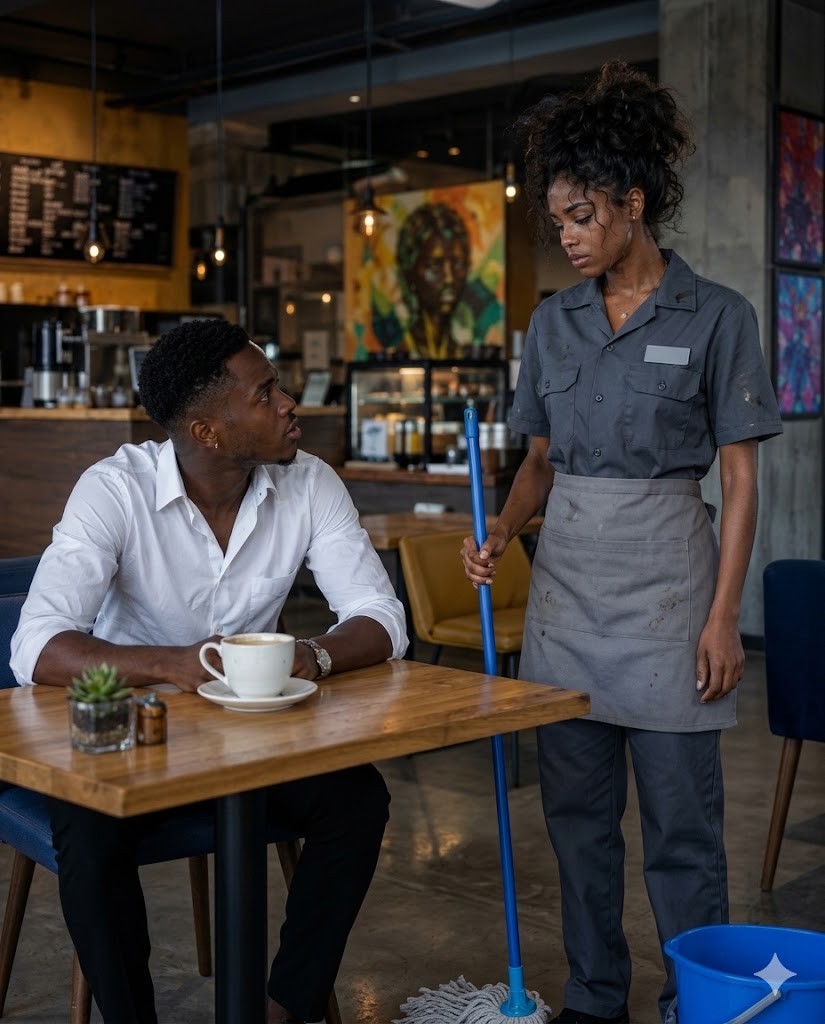
Then, the back door opened, and a woman stepped in. She wore a faded cleaner’s uniform that was far too large at the waist. She pulled her hair back into a severe bun and scrubbed her face clean of makeup. It was Ogi. She gripped a mop handle as if it were a weapon. She began working near the reserved area, her eyes locked on the man she believed was Bumma Nosu.
The stage was set. The billionaire was dressed as a guard, and the heiress was dressed as a cleaner. Both were waiting for the other to reveal their arrogance. As the first course was served, Musa—the fake Bumma—leaned back and said to a passing waiter, “Make sure the champagne is chilled. My father doesn’t tolerate mediocrity.”
Ogi, mopping nearby, felt a surge of satisfaction. He’s exactly as I expected, she thought. Proud, shallow, and entitled. She didn’t notice the security guard in the corner booth, watching her with an expression that was far too intense for a man supposed to be standing watch. The lie was working, but as the night progressed, Ogi felt the sting of the class divide she was pretending to occupy. A passing patron bumped her, and when she apologized, he sneered, “People like you don’t know your place.”
She waited for Musa to speak up, but he stayed silent, looking at his menu. Ogi’s heart hardened. She had her answer. Or so she thought.
Part 6: The Interrupted Lie
The dinner was an agonizing performance. Musa sat at the table, trying to embody the persona of a man who owned the world, but he was failing spectacularly. He was nervous, sweating, and saying things that made everyone at the table cringe. But Ogi, cleaning just feet away, didn’t see a nervous young man; she saw a man who felt superior to everyone around him.
The man who had bumped into Ogi earlier returned, and this time, he was even more aggressive. “You’re in the way again!” he shouted. “Can’t you do your job?”
Ogi bowed her head. “I’m sorry, sir.”
“Typical,” the man scoffed. “Rich people pay for this place, and they hire trash to clean it.”
Bumma, standing guard by the door, couldn’t take it anymore. He stepped out of his designated zone. “She didn’t bump into you,” he said, his voice cold and commanding. “You walked into her. She apologized. You’re the one making a scene.”
The man turned, red-faced. “Who are you to tell me what to do? You’re just security!”
“It concerns me if someone is being blamed unfairly,” Bumma said, his gaze unwavering.
Ogi stood still, the mop handle clutched in her hand. She looked at the security guard, surprised. He didn’t know her. He didn’t know her family name. He didn’t know she was the heiress he was supposed to be testing. He just saw a person being mistreated and decided it was enough.
The man huffed and stormed away, unable to deal with the quiet pressure Bumma exerted. Ogi turned to thank him, but her words died in her throat. She looked into his eyes and felt a strange, inexplicable recognition. Kind eyes, she thought. He has kind eyes. Bumma felt it, too. He stared at her, seeing beyond the faded uniform, past the soot, past the performance. He saw a woman who was standing her ground in a place that didn’t want her. It was the first honest moment of the night.
But then, the spell broke. A woman named Kemi—Ogi’s cousin—entered the restaurant. Kemi was a woman who lived for the shine of others, and she recognized Ogi immediately, despite the uniform. She watched Ogi look at the security guard, and her eyes lit up with malicious glee. She didn’t know what the game was, but she knew that a billionaire’s daughter dressing as a cleaner was a story worth weaponizing. She walked over to the table where Musa sat, her smile predatory. “Good evening,” she said, catching Musa’s attention. “I am close to Ogi. I’m here to represent the family.”
Musa, believing her to be the bride, signaled her to sit. Kemi sat, her eyes darting to Ogi in the corner. She began to weave a tale, her voice low and poisonous. “Let me tell you the truth, Bumma. Ogi is spoiled, difficult, and too protected. She’s not the girl you want.”
Ogi heard every word. Her satisfaction that the plan was working was rapidly being replaced by the sickening realization of her cousin’s treachery. She wasn’t just being tested; she was being hunted. The date hadn’t failed; it had spiraled into something much, much darker.
Part 7: The Final Mask Falls
The tension in the restaurant was becoming suffocating. Kemi continued to spin her web, poisoning Ogi’s reputation while Musa, convinced he was a billionaire, ate it up with a smug, oblivious nod. Ogi stood by her bucket, the reality of her cousin’s betrayal burning in her chest. She had wanted to test Bumma, but she had invited the wolves into the fold.
Bumma, standing guard, saw the whole scene. He saw Kemi’s malicious smile, he saw Musa’s ignorance, and he saw Ogi’s pain. The game was no longer a test; it was a disaster. He stepped toward the table, his composure finally snapping.
“Enough,” he said, his voice echoing through the dining room.
The restaurant fell silent. Musa looked up, startled. “I am just getting to know her, man. She’s family.”
“She’s not family,” Bummer said, gesturing to Kemi. “She’s a viper.”
Kemi stood up, her face flushed with indignation. “Who do you think you are? You’re just security!”
“I’m the man who sees exactly what you’re doing,” he replied. He turned to Ogi, who had walked toward the table, her face set with a cold, quiet anger.
“I heard everything, Kemi,” Ogi said, her voice steady. “I heard how you tried to manipulate this man to hurt me. I’m not the spoiled, difficult girl you think I am. I’m the girl who is finally done with your games.”
The restaurant crowd turned. The illusion was shattering. Musa, realizing his position, tried to retreat, but Bummer blocked his path. “You’ve done enough pretending, Musa,” he said.
The truth exploded in the middle of the dining room. The “billionaire” was a nervous assistant in a borrowed suit. The “cleaner” was the daughter of one of the city’s wealthiest men. The “cousin” was a malicious saboteur.
Bummer looked at Ogi. They had both come here to test the world, to see if love could survive a lie, only to find that the lies had nearly destroyed them.
“I’m not a security guard,” Bumma admitted to the room.
“And I’m not a cleaner,” Ogi added.
They stood in the center of the chaos, two people who had stripped away their worlds to find each other, only to realize that the wreckage was the only place they could truly begin. And as the families—the Chief and the parents—began to pour into the restaurant, drawn by the news of the scandal, Ogi reached out and took Bummer’s hand. The mask was gone. The truth was ugly, painful, and terrifying. But it was finally theirs.
The doors burst open, and Chief Anukam stood there, his face white with rage, his gaze locked on his daughter. The game was over. The real life was beginning, and neither of them knew if they were strong enough to survive it.