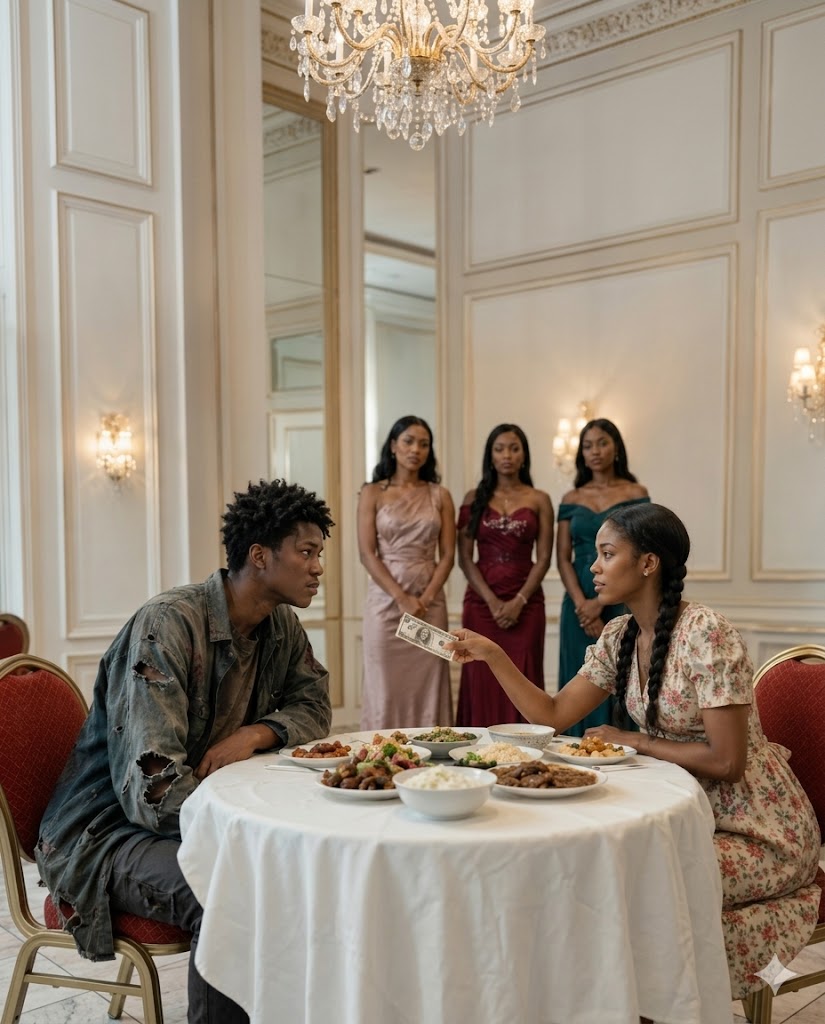
Billionaire PRETENDS To Be A Homeless Beggar To Test Women On Blind Dates
Part 1: The Hollow Mansion
Obina Johnson had everything. His life was a sprawling landscape of steel and glass—big buildings, expensive cars lined up like soldiers in his climate-controlled garage, and private jets that felt like taxis. In the rooms of Johnson Global Industries, people stood up the second he walked through the door. They clapped when he gave a speech. His phone was a vibrating weight against his hip, a constant tether to billions of dollars, endless deals, and a level of influence that made him feel like a god in a tailored suit. People feared him. Some, in their own desperate way, worshiped him.
But deep inside, Obina was suffocating. He was tired of the fake smiles that didn’t reach the eyes. He was tired of women who treated his heart like a venture capital investment, looking for the highest return on their romantic interest. The world called him brilliant and untouchable, but in the quiet of his mansion—a place so large he had rooms he hadn’t stepped foot in for months—the silence was deafening. The lights were always on, the security was always tight, but his heart felt like a lightless void.
Every night, he lay in a bed soft enough to be a cloud, staring at the ceiling, haunted by the same stinging question: Does anyone love me for me?
Then, there was Amaka. She had been his anchor, or so he thought. She was smart, charming, and possessed an infectious kindness that made him believe, for the first time, that he could be loved without a price tag. He had given her his heart. He had bought a ring—a custom-cut diamond that caught the light like a trapped star. He had even begun to envision a future that didn’t involve quarterly reports or hostile takeovers.
That dream turned to ash on a rainy Tuesday morning. He had arrived at the office early, intent on surprising her with breakfast. He walked into his own suite, and the surprise was on him. He found Amaka pressed against his chief financial officer, their laughter dying the moment he appeared in the doorway.
“Obina trusts me too much,” Amaka had whispered, not even bothering to fix her blouse. “That is his problem.”
Obina didn’t scream. He didn’t fire them in a rage. He simply turned around and walked out. That day, something in him snapped, a clean break that cauterized his remaining capacity for trust. He canceled the wedding, fired the CFO, and locked himself in his mansion for six days. No one saw him. Not even his assistant. People assumed he had gone abroad, but he was home, nursing a wound that felt like it had been carved by a scalpel.
Was I not enough for her? If I was poor, would anyone choose me?
That night, as the rain poured outside and thunder shook the reinforced windows, Obina stood by the glass, looking at his own reflection, a billionaire who felt like a ghost. He whispered to the empty room, “I’m going to find out.”
He turned around, picked up his phone, and called Enozi, his most trusted aide. “Moi, sir, are you all right?” she asked, her voice tight with concern.
“Get me an old shirt, torn trousers, and slippers,” Obina commanded. “No designer clothes, no watch, no car. I want to look like a man who has absolutely nothing.”
Enozi stayed quiet for a long second, processing the madness, then whispered, “Yes, sir.”
Obina Johnson had made up his mind. He was going to pretend to be a homeless beggar, not to play a game, but to strip away the gold-plated armor of his existence and see if, beneath all the noise, a single soul could see the man behind the money.
Part 2: The Mask of Poverty
Obina didn’t rush. He knew that if he suddenly appeared on the street as a homeless beggar, someone might recognize the billionaire face that graced every business magazine. He decided to take it slow. He stopped shaving, letting his beard grow thick and coarse. He shed his suits, trading them for old t-shirts, worn-out jeans with holes in the knees, and rubber slippers that scuffed against the concrete. He ditched his wristwatch, his smartphone, and his security detail.
He left his mansion before sunrise on a Tuesday, while his housekeepers were still asleep. He packed a small, grimy bag and headed to a rundown part of town where the neon lights of the city didn’t reach. The room he found was a shoebox—the walls were peeling like dead skin, the windows had no curtains, and the mattress smelled of decades of dust. But he didn’t complain. He wanted to feel the grit.
Every day, he walked the streets. He found work pushing heavy wheelbarrows at the local market, helping carpenters carry lumber, and occasionally washing mud-streaked cars for loose change. He got paid in crumpled, damp cash—tiny notes he folded into his pocket. No one knew his name. No one knew his bank balance. He was finally invisible. And strangely, that invisibility felt like freedom.
At night, Obina sat on the edge of his old bed, looking at the torn calendar on the wall, thinking about the life he had left behind. He was learning who he was when he wasn’t a CEO. He was finding a version of himself that didn’t need to be worshipped or feared.
Back in the city, Enozi was working in the shadows. She trusted Obina, even if she couldn’t understand why he wanted to experience the depths of society’s struggles. She used elite dating apps to arrange blind dates for him, telling each woman the same, carefully crafted story: You’re meeting a man who used to have a good life but lost everything in this hard economy. He’s doing manual labor now, starting over, and trying to survive.
None of them knew he was Obina Johnson. The test had begun, and he waited in cheap diners, sat in plastic chairs by the roadside, and braced himself for the disappointment he was sure would follow. He wanted to know: could real love survive the absence of status?
The first date came on a Thursday. Obina was nervous, his hands fidgeting on the table at a small, loud buka that served jollof rice and suya. Nika arrived in a bright pink dress, her makeup perfect, her nails long and shimmering. She took one look at him, then scanned the room as if hoping she were in the wrong place.
“You’re the one?” she asked, her voice flat.
“Yes,” he said, trying to smile. “Thank you for coming.”
She sat down, her face already twisted in a grimace of disdain. “I thought this was a prank. You actually invited me here? To a place like this?”
“It’s quiet. I like the food.”
“I can’t do this,” she sighed. “Next time, please dress like a human being. Not like someone who just woke up in a gutter.”
She didn’t even touch the water the waitress brought over. She stood up and walked away, her heels clicking angrily on the concrete. Obina sat in silence. He paid the bill, his heart sinking. He had expected rejection, but not this level of vitriol. He walked home in the dark, the city lights feeling colder than they ever had from the window of his jet. Was he really so unrecognizable without his wealth?
Part 3: The Price of a Smile
The second date was more tactical. Her name was Enkiru, a lawyer who wore her ambition like a second skin. She met him at a roadside spot where pepper soup was served in rusted steel bowls. She was sharp, confident, and dangerously calculating.
“You said you do manual work?” she asked, her eyes never leaving his face.
“Yes. Daily labor, mostly.”
“Do you have savings? Property? What did you study?”
Obina answered each question with carefully practiced half-truths. She didn’t offer a smile. She didn’t offer a kind word. She simply took notes on a small pad, her interest purely analytical. She was evaluating him like a depreciating asset.
“I’ll call you,” she said, finishing her meal before he’d even taken three bites. She never did.
Then came the third one. Uu. She was soft-spoken, polite, and seemed to listen with an intensity that made Obina’s breath catch. They talked for hours about growing up poor and the struggle for dignity. He thought, Maybe this one is different. She walked him home that night, hand in hand, and the contact felt like a spark of hope.
The next morning, his phone lit up. “Hey, love. I didn’t want to ask, but I’m in a tough spot. My rent expired and I have nothing in the house to eat. Even a small help would mean a lot. I really believe in us.”
Obina stared at the screen until the letters blurred. Less than twenty-four hours after meeting, and she was already testing the waters of his wallet. It wasn’t love. It was hunger for what she thought he might have.
That night, Obina sat outside his room, the moon hanging full and indifferent in the sky. Dogs barked in the distance. He felt a bone-deep exhaustion. He thought about all the women, all the fake smiles, all the calculated interest. Maybe there was no such thing as true love. Maybe he was doomed to be nothing more than a bank account to every person he met.
He thought about packing his bags and returning to the mansion. But then, as he stood to go inside, he saw her.
She was running across the road, trying to dodge a sudden downpour, holding an umbrella in one hand and a nylon bag of produce in the other. She wore a simple lilac blouse and black trousers, her hair covered in a scarf to protect it from the deluge. She saw him sitting under the leaking tin roof of the tailor shop and stopped.
She didn’t look at him with fear or judgment. She looked at him with concern. “Sir, you’re getting wet,” she said.
Obina looked up, shivering. “I’m okay.”
She didn’t move. She opened her nylon bag and pulled out a small plastic container. “It’s rice and beans,” she said, offering it with both hands. “I cooked it for myself, but please, eat. You look hungry.”
Obina took it slowly, his hands trembling. He hadn’t asked for food; he hadn’t begged. He had just been sitting there. She took off her own colorful wrapper—a long, vibrant piece of fabric—and gently placed it over his shoulders.
“This is dry,” she said. “You’ll fall sick like this.”
“Thank you,” he whispered, the words feeling heavy and real.
“I’m Chidinma. And you?”
“Obina.”
“Nice to meet you, Obina.”
She didn’t wait for a tip. She didn’t ask what he did for a living or where his parents lived. She simply walked away into the rain, leaving him there with a bowl of warm rice and a feeling in his chest that felt suspiciously like light.
Part 4: The Sewing Shop Sanctuary
The rain didn’t stop that night; it hammered against the tin roof of Chidinma’s tiny sewing shop, a rhythmic, drumming sound that felt like a heartbeat. Obina stayed, huddled under the shelter of the shop’s overhang, his damp clothes beginning to dry in the humid air. Chidinma hadn’t asked him to leave. She had simply gone inside, and he could see her through the glass window, bent over a sewing machine, the needle flying back and forth in a steady, hypnotic motion.
He watched her for hours. She was focused, her brow furrowed in concentration, her hands moving with a grace that spoke of years of practice. She was a woman who didn’t just survive; she created. She stitched life back into torn fabric, and in doing so, she seemed to be stitching her own life together as well.
Around midnight, she opened the door. The shop smelled of cedar, thread, and the faint, sweet scent of tea. “If you want,” she said, her voice soft against the rain, “you can stay by the shop till the rain stops. It’s not much, but it’s dry and safe.”
Obina hesitated. He wasn’t supposed to get close. He wasn’t supposed to let the mask slip. “I don’t want to intrude,” he said.
“It’s not an intrusion,” she said. “My house is just around the corner. I’ll bring you food.”
Over the next few weeks, the sewing shop became his sanctuary. He helped her carry heavy rolls of fabric, he sorted spools of thread, and he learned how to operate a manual sewing machine with a care he had never applied to a project before. He became a fixture in her evening, a silent, steady presence in the corner of her shop.
He learned that she was a nursery school teacher during the day, a woman who gave her patience to children who had no one else to believe in them. She was fire and grace, a woman who had seen hardship and hadn’t allowed it to harden her heart.
One evening, as they folded wrappers and laughed at a crooked zipper he had failed to align, Obina looked at her. She was illuminated by the single bulb above her desk, her face glowing with a quiet, inner strength.
“You know,” he said, testing the water, “I’m actually a billionaire, right?”
Chidinma chuckled, not even looking up from her work. “Whether rich or poor, a kind man is still a treasure.”
Obina smiled. It was the first time in his life he had revealed his true status, and she hadn’t even blinked. She didn’t want his money. She didn’t want his influence. She wanted the man who sat in her shop and struggled to learn how to sew.
But the peace was precarious. Back at the Johnson mansion, Enozi was working feverishly to hide his absence, but the corporate sharks were beginning to circle. The board of directors at Johnson Global was asking questions, and the press was starting to wonder why their untouchable CEO had disappeared off the face of the earth.
“Sir,” Enozi whispered over the phone one night, her voice frantic. “The board is demanding a public statement. If you don’t reappear, they’re going to declare you unfit to lead.”
Obina sat in the sewing shop, surrounded by fabric, and looked at Chidinma, who was humming a lullaby to herself. He realized that the test had evolved. It was no longer about finding out if someone could love a poor man. It was about whether he could hold onto the only person who had ever made him feel real while the entire world he had built tried to drag him back into the gilded cage of his own wealth.
Part 5: The Test of the Gala
The pressure to return was mounting. Obina’s parents had returned from their business trip in London, and they were furious. They had learned of his disappearance and were currently tearing the mansion apart in a desperate search for him. Meanwhile, Chidinma’s family—loud, opinionated, and fiercely protective—had decided that their daughter’s life needed an upgrade.
Chidinma came to the shop one day, looking troubled. “My mother has been urging me to bring someone home. There’s a celebration this weekend, her fiftieth birthday. Everyone will be there—aunties, uncles, cousins, and the questions.”
Obina looked up. “What kind of questions?”
“When will you marry? Where’s the man? Are you sure you’re not hiding someone?”
Obina chuckled, the sound feeling more natural every day. “I know those questions too well.”
“I was wondering,” she said, her eyes shy, “would you come with me? Just pretend to be my fiancé? I’d rather go with someone I’m familiar with than lie again.”
Obina felt a jolt of pure, terrifying happiness. “I’d be honored.”
They arrived at the family compound on a Saturday morning. The yard was a riot of color, jolof rice steaming in giant pots, meat sizzling on open grills. Chidinma’s older sister, Ife, a bank manager with a sharp tongue and an even sharper fashion sense, met them at the gate. She looked at Obina’s simple button-down shirt and dusty trousers, her nose wrinkling in distaste.
“This is him, Chidinma? This is your fiancé?”
Chidinma didn’t let the insult land. “Yes, Ife. Meet Obina.”
Ife didn’t smile. She looked through him. “You couldn’t find someone more sophisticated? Someone who didn’t look like he borrowed his clothes from a bus driver?”
Obina stood silent, a quiet, steady presence. He had spent his life surrounded by people who judged him by his name or his assets, but this felt different. It felt like a test he had to pass for her, not for the world.
As the party progressed, Uche—Chidinma’s ex-boyfriend—made an appearance. He was a man dripping in Johnson Group gear, walking with a swagger that made Obina’s teeth ache. He was loud, arrogant, and clearly used to being the center of attention.
“I heard you’re engaged,” Uche announced, his eyes fixed on Chidinma. “This him?”
Chidinma nodded, her hand slipping into Obina’s. “Yes, this is Obina.”
Uche laughed, a grating sound. “From the look of things, Chidinma’s taste hasn’t improved. I thought you were upgrading, but it looks like you went from an SUV to a bicycle.”
The table erupted in nervous laughter. Chidinma’s mother, a woman who valued success above all else, looked at Obina with undisguised contempt.
“Obina,” she said, her voice sharp. “What exactly do you do for a living?”
Obina looked at his plate. “I do little things here and there.”
“So, no job, no land, no car. How exactly are you going to take care of my daughter?”
Obina didn’t defend himself. He didn’t pull out a business card or announce his billions. He simply folded his napkin, stood up, and looked at Chidinma. “I want what’s best for her,” he said.
As he walked out, he knew he had failed the test of the family, but as Chidinma followed him out, he realized he had passed the only test that mattered: hers. But just as they reached the car, a black SUV pulled up, and his mother stepped out, her face a mask of cold, controlled fury.
“I saw the news,” she hissed. “I saw you with this… this seamstress. You are the heir to the Johnson empire, Obina. Do you have any idea how much damage this is doing to our reputation?”
Part 6: The Ultimatum
The atmosphere in the mansion, once a cold sanctuary, was now a battlefield. Obina’s mother stood in the living room, her posture rigid, her eyes blazing with a heat that usually signaled a corporate takeover. His father, Chief Johnson, sat in his high-backed chair, watching the scene with the detached, weary eyes of a man who had already seen how this story ended.
“This can’t happen, Obina,” his mother said, gesturing to the tablet on the table where photos of Chidinma and Obina were displayed—the same photos that were currently burning up the internet. “She is not from our world. She is a seamstress. She has no influence, no pedigree, no understanding of the weight of the Johnson name.”
“She has something you don’t,” Obina said, his voice quiet but echoing through the high-ceilinged room. “She has a heart. She has the capacity to love a man who has nothing. Isn’t that what you told me you wanted for me, Papa? A woman who loved me for who I am?”
His father turned his gaze toward the window. “I wanted you to find a partner, not a burden. A woman who can stand beside you as you lead this company. She isn’t prepared for the life you have to live.”
“Then I will change the life,” Obina said, his voice rising. “I am tired of the power, the politics, and the people who worship the money rather than the man. I choose Chidinma. And I choose to be the man who is worthy of her love, not the man who is defined by a balance sheet.”
His mother stepped toward him, her face twisting in frustration. “You are the heir. If you don’t marry the Senator’s daughter, you forfeit your inheritance, your board seat, and your future in the industry. You will be nothing, Obina.”
Obina didn’t flinch. “Then I will be nothing. Because ‘nothing’ with Chidinma is more than ‘everything’ with you.”
The room went deathly silent. His father stood up, his face unreadable. “You are a fool, my son. You are throwing away generations of work for a whim.”
“It’s not a whim,” Obina said, turning toward the door. “It’s the first honest thing I’ve ever done.”
He left the mansion, the heavy door slamming behind him with the force of a final goodbye. He drove back to the small community school where Chidinma taught, his heart pounding. When he arrived, he found her sitting on the steps, grading papers, the soft light of the setting sun casting long shadows across her face.
She looked up, her expression changing from surprise to a gentle, heartbreaking relief. “You’re here.”
“I’m here,” he said, walking toward her.
“Did you… did you walk away from it all?” she asked, her voice a fragile hope.
“I walked away from the cage,” he said, taking her hands in his. “And I realized that as long as I was standing in that mansion, I was never going to be free. But with you… I think I finally understand what ‘home’ means.”
She stood up, her eyes bright with tears. “Obina, you have so much to lose.”
“I have nothing to lose,” he said, “because you are all I ever needed to gain.”
They embraced on the quiet steps of the school, the world outside waiting to tear them apart, but in that small, shared space, they were invincible. However, as they pulled away, they saw a group of reporters waiting at the school gates, their cameras aimed, their questions already forming in the air.
“They followed me,” Chidinma whispered.
“Let them,” Obina said, taking her hand. “Let them see the truth for once.”
Part 7: The Unbroken Horizon
The wedding of the century took place in the heart of the village where Chidinma grew up. It wasn’t the sterile, cold affair of the high-society world; it was a vibrant, messy, beautiful celebration of life. The village gathered in the park, the air smelling of grilled meat and jasmine. The music was live, rhythmic, and soulful.
As Chidinma walked down the aisle, her white dress flowing like water, the world seemed to hold its breath. She looked like a queen—not because of the crown she wore or the wealth she now held, but because of the woman she had become through every trial.
Obina stood at the altar, tears in his eyes, his heart fuller than it had ever been in his time as a billionaire. When he took her hands, he knew he wasn’t just marrying a woman; he was marrying the truth.
“Chidinma,” he said, his voice clear and resonant. “You found me when I was nothing. You loved me when I had nothing. I promise to love you, protect you, and stand by you every day of forever.”
She wiped her tears and whispered, “Obina, the day I gave you a plate of food, I never imagined you would give me your whole heart in return. With you, I am home.”
When they kissed, the doves were released, a flock of white taking flight against the clear blue sky. The fireworks erupted, a shower of color over the village that had watched them fall and rise. It was a victory, but the real victory was in the life they were building—the sewing academy, the clinic support, the simple, quiet moments of coffee on the terrace.
Years later, their daughter, Amara, ran across the green lawn, chasing a puppy. Obina stood on the patio, watching them. He wasn’t wearing a suit or a watch. He was a father, a husband, and a man who had realized that legacy wasn’t what you left behind, but who you held when the world went dark.
His parents, humbled by the strength they had once rejected, were sitting nearby, watching their grandchild with an awe that had finally replaced their cold ambition. They had lost their heir to the Johnson empire, but they had gained a family.
As the sun began to dip, casting long, golden shadows across the garden, Chidinma walked up behind him and wrapped her arms around his waist.
“You know,” she whispered, her chin resting on his back. “He has your stubbornness.”
“And your beautiful heart,” Obina replied, turning to kiss her forehead.
The story of the billionaire beggar and the seamstress had become more than just a headline; it had become a reminder that no matter how dark the world gets, love—real, honest, stubborn love—is the only light that never fails. And as they walked toward their house, the house that was now a sanctuary of light, they knew they had finally, truly, found their way home. The legacy wasn’t in the buildings or the shares; it was in the laughter of their child, the touch of their hands, and the promise that they would never again have to walk through the world alone. They had found the truth, and in that truth, they had found everything they would ever need.