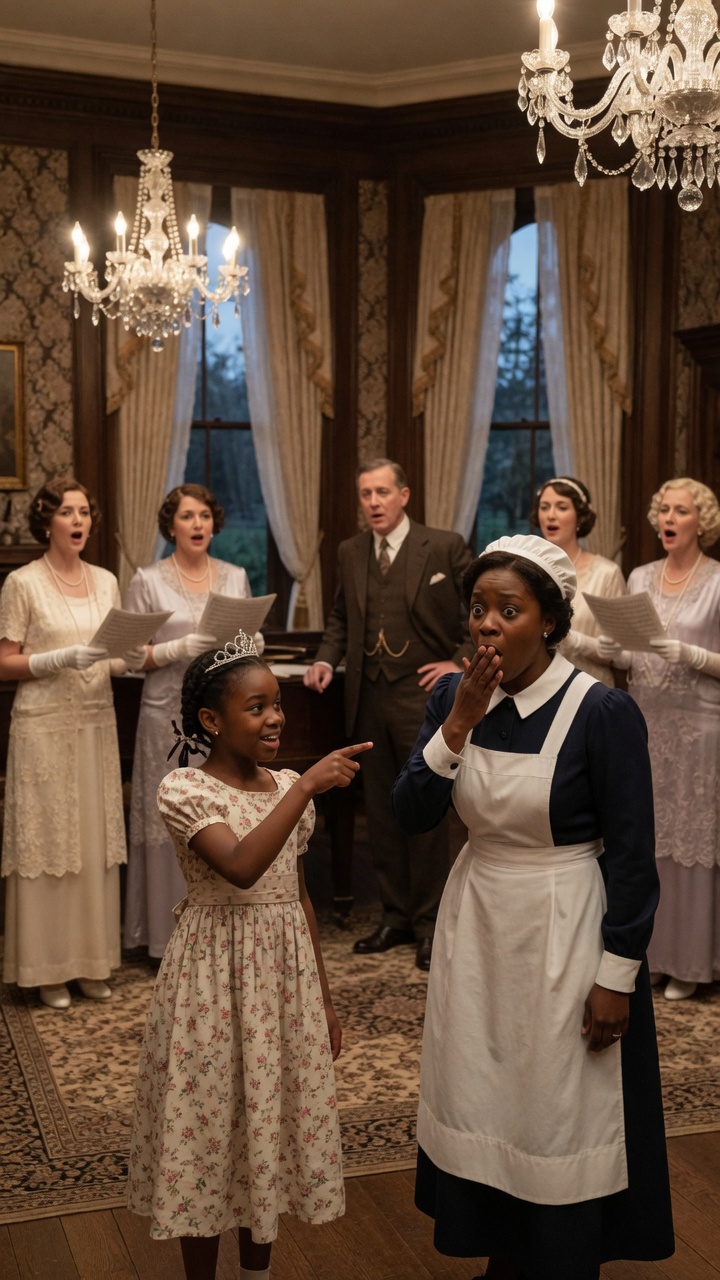
Billionaire Told the Little Black Girl to Choose a Nanny, but She Chose the Black Maid
Part 1: The Invisible Choice
“Go on, Annie. Choose one. That’s why they’re here.”
Daniel Harrington’s voice was calm, steady, and entirely devoid of the warmth that usually comes with a father speaking to his child. Five women stood in a line a few steps away. Each was dressed neatly, each held a leather-bound folder, and each wore the same polite, professional smile that signaled a practiced ability to manage a household. They had come for the same position: Nanny to Annie Harrington, the seven-year-old adopted daughter of a billionaire. It was the kind of job that came with a high salary, a beautiful room in a beautiful house, and a future recommendation that could secure their careers for years.
“Go on,” Daniel said again, his patience clearly thinning. “You can talk to them, then you choose one.”
Annie looked at the women. One smiled wider and gave a small wave. Another bent slightly at the knees to look less tall, less intimidating, a tactical maneuver meant to signal “child-friendly.” But Annie simply shook her head.
“No.”
Daniel looked down at her, his brows knitting together. “No? What do you mean, ‘no’?”
“I don’t want to choose them.”
A small, suffocating silence followed. One of the women, sensing the tension, stepped forward with a warm, practiced expression. “Hi, Annie,” she said softly. “My name is Laura. I heard you like drawing. I love drawing, too. Maybe later you can show me your drawings.”
Annie looked at her, but her face remained a mask of polite indifference. “No, thank you.”
Another woman stepped forward smoothly, as if this were all part of a scripted plan. “I used to take care of a little girl who was six, just like you,” she said. “Every night we read stories together. I do very funny voices when I read. You would like that.”
Annie shook her head again. “No, ma’am.”
A third woman smiled kindly. “Why don’t you come stand with us for a moment? You can ask us questions. Then you can decide.”
The women spoke gently, kindly, like people who knew exactly how to win children over. They moved a little closer, forming a soft half-circle around Annie. From the doorway, Sarah Johnson, the housemaid, watched quietly. She held a folded cloth in her hands, her knuckles white. She did not step forward; this was not her place.
Annie looked at the five women, her gaze lingering on each for a heartbeat. Then, she turned. Without asking permission, she walked past all of them. She crossed the room, her small boots making almost no sound on the hardwood, ran the last few steps, and wrapped her arms around Sarah’s waist.
“I choose her,” Annie said, her voice clear.
Sarah froze, the cloth falling from her grip. “Annie, baby, I…”
“I choose Miss Sarah,” Annie said again, holding tight.
Behind them, the air in the room changed. The five women looked at one another, and this time their smiles did not come back the same way. The veneer of professional kindness had cracked, revealing a sharp, calculating resentment.
Daniel walked toward them slowly, his presence commanding the space. “Annie,” he said, his voice dropping into that tone that expected immediate compliance. “Miss Johnson is not one of the choices.”
“Yes, she is,” Annie said, still holding Sarah’s hand now. “She’s my choice.”
One of the women let out a small, sharp breath and stepped forward again, her smile thinner than a razor blade. “Annie,” she said gently, “Miss Sarah is very busy with housework. She cleans. She does laundry. She helps in the kitchen. She wouldn’t have enough time to be a full-time nanny.”
Another woman nodded. She leaned slightly toward Annie and spoke in a low, conspiratorial voice, as if sharing something profound. “And sometimes, people who work in houses like this try to be very close to the child because they want to keep their job. It’s not always appropriate.”
A third woman added, “We just met you today, Annie, so we wouldn’t lie to you. But in big houses, sometimes staff forget their place and try to act like family. That can be confusing for a child.”
They all spoke softly, kindly, reasonably—the way adults spoke when they wanted to sound right. Annie listened without interrupting. Her small hand stayed in Sarah’s. When they stopped, Annie spoke, her voice calm.
“That’s not true.”
Annie looked from one woman to another. Her eyes were serious, possessed of a gravity that did not look like a child’s eyes at all. “You just came here today,” Annie said. “You don’t know Miss Sarah. You don’t know me. But you’re already saying bad things about her.”
One of the women tried to smile again, but it was a grimace. “We’re not saying bad things, sweetheart. We’re just explaining.”
“You’re saying she’s pretending,” Annie countered. “But she’s not pretending. She takes care of me when no one is looking.”
No one spoke. The silence was heavy, filled with the discomfort of adults realizing a child had dismantled their social maneuvering. Annie continued, her voice still calm, still clear. “When I was sick, she stayed with me all night. When I’m scared at night, she comes and sits with me. When I can’t sleep, she braids my hair so I feel better. She does that when nobody tells her to.”
She looked at the five women again. “You just came today,” Annie repeated. “But you already said she’s pretending and forgetting her place. That means you don’t tell the truth. If you say bad things about someone you don’t even know, then later, when you work here, maybe you will say bad things about me, too. Or about my dad. And maybe you won’t tell the truth then, either.”
Daniel felt something shift inside his chest. He watched his daughter, realizing that the “structure” he was so desperate to provide was being challenged by a child who valued kindness above credentials.
“I don’t want a nanny who lies,” Annie concluded. “I want the one who takes care of me.”
Part 2: The Impossible Demand
One of the candidates, the one in the navy suit, straightened, clearly offended. “Mr. Harrington,” she said, her voice dripping with condescension. “The child is too young to understand professional boundaries.”
Annie looked at her, then back at her father. “I understand who is kind.”
Daniel closed his eyes for a brief moment, then opened them. When he spoke, his voice was calm but firm—the voice of a man reestablishing control. “Annie,” he said. “Mrs. Johnson is a housemaid. She is not trained as a nanny. She cannot take this position. You need to choose one of the five nannies I brought here.”
Annie did not let go of Sarah’s hand.
“I’m not choosing them,” she said.
“You will choose,” Daniel replied, his brow furrowing. “I will give you until tomorrow morning. But you will choose one of them.”
Annie nodded slowly, but she did not move away from Sarah. She just said one more thing, very quietly: “I already chose the one who stayed.”
Annie stood beside Sarah near the doorway, her small hand wrapped tightly around the older woman’s fingers as if someone might try to separate them if she let go for even a second. The air in the room was electric, the tension hummed against the walls.
“Annie,” Daniel said, his tone controlled. “Go upstairs and think about what I said. Tomorrow morning, you will come downstairs and choose one of the five nannies.”
Annie looked up at him. “I already chose,” she said.
“You chose someone who is not an option,” Daniel replied, his voice tightening.
“She is an option,” Annie said. “You just don’t want her to be.”
Daniel exhaled slowly, the sound long and weary. “Mrs. Johnson has a job in this house already. She cannot just change positions because you say so.”
Annie was quiet for a moment, thinking in that serious, rhythmic way she always did when adults said something that did not make sense to her. “That’s how it worked when I got sick,” she said.
Daniel’s eyes flickered, the memory of her fever-ridden nights playing behind his gaze.
Annie continued, still holding Sarah’s hand. “Nobody told her to stay with me that night. Nobody told her to sit with me when I was hot and scared, but she did it anyway. So that means sometimes people can choose to do a different job if they want to.”
She turned, ready to walk away, but paused to add, “If this moment touched your heart, please like this video and tell me in the comments where you are watching from. And if you believe real love is shown through actions, not words, subscribe to the channel and stay with us for more emotional stories.”
Sarah lowered her eyes. “Annie, baby, it’s not that simple.”
“It is simple,” Annie said softly. “You take care of me. That’s what a nanny does.”
Daniel felt the conversation slipping into a place he could not control. He made the situation formal, resorting to the only language he truly mastered—business. “Tomorrow morning,” he repeated, “you will come downstairs and choose one of the five candidates. That is final.”
Annie nodded once, but she did not let go of Sarah’s hand. “I will come downstairs,” she said. “But I’m still choosing Miss Sarah.”
Sarah gently touched Annie’s shoulder. “Sweetheart, you should go upstairs now. Are you in trouble?” Annie asked, her voice hitching.
Sarah forced a small, strained smile. “No, baby. I just have work to do.”
Annie looked at her carefully, with the suspicion of a child trying to detect a lie. They had said Sarah was pretending, that she was just acting like family. Annie wanted to know if Sarah was one of the liars.
“They said you were pretending,” Annie said quietly. “They said you were trying to act like family.”
Sarah’s face did not change, but something in her eyes dimmed. “People say a lot of things,” she replied gently. “They don’t know you.”
“They just got here,” Annie said, “and they already said bad things about you. That means they don’t tell the truth.”
Sarah did not answer that. Annie stepped a little closer to her. “I’m not changing my choice,” she said in a small, firm voice. “Even if Daddy makes me choose again. I’m still going to choose you.”
Part 3: The Weight of Choice
Sarah looked down at the child for a long moment, the conflict raging behind her eyes. Then she knelt slowly, bringing herself eye-to-eye with the little girl who had become her entire world.
“Annie,” she said softly. “Sometimes in life, you don’t get to choose who stays. Sometimes other people decide that for you.”
Annie shook her head immediately. “Then I’ll just keep choosing again.”
Sarah’s eyes filled with something she refused to let fall. She reached out and smoothed Annie’s hair. “You are a very stubborn little girl,” she said.
Annie nodded. “Yes, ma’am.”
For the first time that day, Sarah almost laughed. From across the hall, Daniel watched them. He had not meant to stand there listening, but he found himself unable to walk away. He watched the way Annie stood close to Sarah, the way her small hand kept reaching for the woman’s sleeve, the way Sarah automatically rested her hand lightly on Annie’s back—a quiet, protective gesture that looked so natural it did not seem practiced at all. Daniel tried to remember the last time Annie had held his hand like that. He could not.
“Mrs. Johnson,” he said finally.
Sarah stood up immediately and turned slightly toward him. “Yes, sir.”
His voice returned to the tone of an employer giving instructions. “Please finish your duties for the afternoon. And for now, try not to confuse Annie about what is going to happen.”
Sarah understood what he meant. “Do not encourage the child. Do not let her believe this is possible.”
“Yes, sir,” she said quietly.
Annie looked from one adult to the other. “She’s not confusing me,” Annie said. “I’m not confused.”
Daniel looked at his daughter. “Annie, I know she’s the maid.”
Annie said, “I’m not a baby. I know she cleans and does laundry and helps in the kitchen.” Annie paused, then added, “But she also takes care of me when nobody tells her to. That’s why I choose her.”
Daniel did not respond right away. Annie continued, still holding Sarah’s hand. “If they can say things that are not true on the first day,” Annie said, “then maybe later they will say things that are not true about me, too. Or about you. I don’t want a nanny who says things that are not true.”
Daniel felt something in his chest tighten again—the same uncomfortable feeling he had felt earlier. The feeling that this situation was not following any rules he understood.
“I am not changing my choice,” Annie said one last time. “You can make me pick someone tomorrow, but I will still choose Miss Sarah every time.”
That night, the Harrington house felt larger than usual. It was a strange thing how a house could change without moving a single wall. The same long hallways, the same tall windows, the same soft carpets that swallowed footsteps—yet everything felt different. The invisible lines had been breached.
Annie sat at the small table in the breakfast room, her legs swinging slightly, her dinner barely touched. Mrs. Graham, the house manager, had prepared baked chicken, green beans, and mashed potatoes—the kind of meal meant to be comforting, predictable, proper for a child. Annie pushed the potatoes around with her fork.
“You need to eat a little more,” Mrs. Graham said gently.
“I’m not very hungry,” Annie replied.
From the doorway, Sarah watched quietly, a dish towel folded over her arm. She was not supposed to stand there during dinner; that was not part of her duties. But she had noticed Annie had eaten almost nothing at lunch, and something in her would not let her stay in the kitchen.
Daniel entered a moment later, loosening his tie. He had spent the last two hours in his office on conference calls, discussing numbers large enough to change cities, sometimes entire industries. He was good at those conversations. He understood those worlds. But when he saw Annie sitting at the table, small and quiet and not eating, he felt that same unfamiliar discomfort again.
“How much has she eaten?” he asked.
“Not much, sir,” Mrs. Graham answered carefully.
Daniel pulled out a chair and sat across from his daughter. “Annie, you need to eat.”
“I’m not hungry,” she said again.
He studied her for a moment. “Is this because of what happened this afternoon?”
Annie looked down at her plate and did not answer. Daniel leaned back slightly. In business, silence was a tool. With Annie, silence felt like a wall.
“Not eating is not going to change my decision,” he said calmly.
Annie looked up at him. Her eyes were not angry. They were just steady. “I know,” she said.
“Then why aren’t you eating?”
Annie thought about the question. Seriously, the way she always did. “Because when people don’t listen to me, my stomach feels closed.”
She said, “Miss…”
Mrs. Graham looked down quickly, pretending to adjust the silverware. Daniel did not know what to say to that. Annie picked up her fork and took a small bite, as if she understood that this was the only part of the situation she could control—whether or not she ate, whether or not she slept, whether or not she changed her mind.
Part 4: The Architect of Safety
After dinner, Annie went upstairs for her bath. Sarah ran the water and tested it with her wrist the way she always did, adding a little cold, then a little more hot until it was just right.
“You don’t have to do this,” Sarah said quietly as Annie sat on the edge of the tub. “One of the new nannies can do bath time tomorrow.”
Annie looked at her. “But I don’t want one of the new nannies tomorrow.”
Sarah sighed softly. “Your father thinks they’re more suitable.”
Annie slid her feet into the warm water. “Suitable means they look right to him,” she said. “Not that they take care of me.”
Sarah looked at her, surprised again by the way Annie’s mind worked. “You’re too young to talk like that.”
Annie shrugged a little. “I listen when adults talk. They just think I don’t understand.”
Sarah almost smiled, but the smile faded quickly. “Miss Sarah,” Annie said after a moment. “If I choose you tomorrow, and Daddy says no again… will you still be here?”
Sarah’s hands paused on the towel she was folding. “I work here,” she said carefully. “So yes, I’ll still be here.”
“That’s not what I mean,” Annie said. “I mean, will you still be mine?”
The question was so quiet, so careful, that it felt like something fragile being placed into Sarah’s hands. Sarah sat down slowly on the closed toilet lid, suddenly very tired. “I was never anybody’s again after my little girl died,” she said softly. “I just worked and worked and tried not to remember too much.”
Annie leaned her head slightly against Sarah’s arm. “You can be mine,” she said, “and I can be yours.”
Sarah closed her eyes for a moment. “Annie,” she said, her voice thick but controlled. “People like me don’t get to belong to people like you. That’s just the way the world is.”
Annie frowned. “That’s a bad rule.”
“Yes,” Sarah said quietly. “Sometimes it is.”
When Annie was in bed later that night, Daniel came to her room. He did not usually handle bedtime—that had always been someone else’s responsibility—but tonight, he stood in the doorway for a moment before knocking lightly.
“Can I come in?” he asked.
“Yes, sir,” Annie said.
He walked in and sat on the chair near her bed, looking slightly out of place, like a man visiting someone else’s house. “I heard you didn’t eat much,” he said.
“I ate enough,” Annie replied.
They were quiet for a moment. “Annie,” Daniel said. “Do you understand why I want you to choose one of the five nannies?”
“You think they’re better,” Annie said.
“I think they are trained,” Daniel corrected. “I think they know how to raise a child properly. Structure, education, discipline. Those things matter.”
Annie listened carefully. “Miss Sarah knows how to take care of a child,” Annie said. “That’s different.”
“How?”
Daniel opened his mouth, then closed it again. He searched for a clear, adult explanation—something logical and solid.
“Because she works for the house,” he said finally. “Not for you.”
Annie thought about that for a long moment. Then she asked, very quietly, “When I had a fever, was she working for the house or for me?”
Daniel did not answer.
“When she sits with me at night when I’m scared, is she working for the house or for me?” Annie continued.
Daniel looked at his daughter. Really looked at her, and saw that she was not trying to be difficult. She was trying to understand the rules of a world that did not make sense to her.
“I am not changing my choice,” Annie said softly. “You can make me pick someone tomorrow, but I will still choose Miss Sarah every time.”
Daniel let out a slow breath. In his world, decisions were made with the head, not just the heart. He looked at Annie, and for the first time, he wondered if his head had been wrong all along.
Part 5: The Uncomfortable Truth
Daniel sat in his study long after Annie was asleep. He held a cup of black coffee, but it had long since gone cold. He kept thinking about the same question Annie had asked the night before: Was Sarah working for the house or for Annie? He had built his life on clear definitions. Titles mattered; positions mattered; lines mattered. If people stayed in their roles, everything worked. When people crossed lines, things became messy—unpredictable, difficult to control. But children did not understand lines. They understood presence.
At 7:30 a.m., Mrs. Graham knocked lightly on his study door. “Good morning, sir. The candidates have arrived again.”
Of course, they had. Professional people were always punctual when opportunity was involved. “I’ll be down in a moment,” Daniel said.
When he entered the main sitting room, the five women were already there, seated, their folders neatly arranged on the coffee table. They stood when he walked in.
“Good morning, Mr. Harrington,” one of them said brightly.
“Good morning,” he replied. “Thank you for coming back. We understand this is an important decision.”
“Yes,” Daniel thought, but not for the reasons you think. “Annie will be down shortly,” he said.
Upstairs, Annie was sitting on the edge of her bed while Sarah brushed her hair slowly, gently dividing it into two even sections before braiding.
“You don’t have to braid it so tight,” Annie said.
“If I don’t braid it tight, it won’t stay neat for school,” Sarah replied.
“I don’t care if it’s neat.”
“I do,” Sarah said softly. “When you walk out into the world, I want you to look like someone who is cared for.”
Annie was quiet for a moment. “I am cared for.”
Sarah’s hands paused for just a second in Annie’s hair, then continued braiding.
“Miss Sarah?” Annie asked.
“Yes, baby.”
“I’m going to choose you again.”
Sarah closed her eyes briefly. She had known this was coming, but hearing it said out loud made her chest feel tight. “Your father may be very angry,” she said carefully.
Annie shrugged a little. “He’s not really angry. He’s just not listening yet.”
Sarah almost smiled at that—not listening yet, as if listening were something that would happen eventually, like spring after winter.
“You have to be respectful when you talk to him,” Sarah said.
“I will,” Annie replied. “But I’m not changing my answer.”
Sarah finished the braid and tied the ribbon carefully. Then she turned Annie gently so they were face-to-face. “Why are you so sure?” Sarah asked quietly.
Annie looked at her like the answer was the easiest thing in the world. “Because you stayed.”
Sarah felt something break and mend at the same time inside her chest. She reached out and smoothed Annie’s hair. “You are a very stubborn little girl,” she said.
Annie nodded. “Yes, ma’am.”
For the first time that day, Sarah almost laughed.
From across the hall, Daniel watched them. He had not meant to stand there listening, but he found himself unable to walk away. He watched the way Annie stood close to Sarah, the way her small hand kept reaching for the woman’s sleeve, the way Sarah automatically rested her hand lightly on Annie’s back—a quiet, protective gesture that looked so natural it did not seem practiced at all. Daniel tried to remember the last time Annie had held his hand like that. He could not.
“Mrs. Johnson,” he said finally.
Sarah stood up immediately and turned slightly toward him. “Yes, sir.”
His voice returned to the tone of an employer giving instructions. “Please finish your duties for the afternoon. And for now, try not to confuse Annie about what is going to happen.”
Sarah understood what he meant. “Do not encourage the child. Do not let her believe this is possible.”
“Yes, sir,” she said quietly.
Annie looked from one adult to the other. “She’s not confusing me,” Annie said. “I’m not confused.”
Daniel looked at his daughter. “Annie, I know she’s the maid.”
Annie said, “I’m not a baby. I know she cleans and does laundry and helps in the kitchen.” Annie paused, then added, “But she also takes care of me when nobody tells her to. That’s why I choose her.”
Daniel did not respond right away. Annie continued, still holding Sarah’s hand. “If they can say things that are not true on the first day,” Annie said, “then maybe later they will say things that are not true about me, too, or about you. I don’t want a nanny who says things that are not true.”
Daniel felt something in his chest tighten again—the same uncomfortable feeling he had felt earlier. The feeling that this situation was not following any rules he understood.
“I am not changing my choice,” Annie said one last time. “You can make me pick someone tomorrow, but I will still choose Miss Sarah every time.”
Part 6: The Architect of Home
That afternoon, the house felt as if it were waiting for something. Even the staff moved more quietly, as if they understood that a decision was forming somewhere in the walls—in the office, in the mind of the man who owned the house and everything in it, except perhaps the heart of the child upstairs.
Annie sat on the floor of the library with her coloring pencils spread out around her. The library was one of the few rooms in the house that felt warm all the time—dark wooden shelves, soft lamps, thick carpet, and a large armchair near the window where Sarah sometimes sat in the evenings to mend small things that did not need to be thrown away.
Annie was drawing three figures on a piece of paper. One tall, one small, one in between. She colored the small one with a brown crayon. The tall one in a dark blue suit. The one in between, she colored in soft gray.
Sarah noticed the drawing when she came in to dust the shelves. “That’s a nice picture,” she said.
“That’s our family,” Annie replied without looking up.
Sarah did not ask who was who. She already knew.
“Miss Sarah,” Annie said after a moment. “If Daddy says no again… will you still be here?”
Sarah stopped where she was standing, a serving spoon still in her hand. “No, baby,” she said gently. “I eat later.”
“Why?”
“Because I’m working.”
Annie looked up from her drawing. “When I get older, will you still be my person?”
Sarah’s hands paused on the towel she was folding. She looked at the child, who was so certain, so steady, so unwilling to trade love for something that looked better on paper.
“You can live in a house near mine,” Annie said, “and you can come over and tell my kids to eat their vegetables.”
Sarah laughed softly. “We’ll see about that.”
Annie kept drawing. “Because you’re not just my nanny,” she said. “You’re my person.”
Sarah’s eyes filled, but she blinked the tears away quickly. “People say a lot of things,” she replied gently. “They don’t know you.”
“They just got here,” Annie said, “and they already said bad things about you. That means they don’t tell the truth.”
Sarah did not answer that. Annie stepped a little closer to her. “I’m not changing my choice,” she said in a small, firm voice. “Even if Daddy makes me choose again. I’m still going to choose you.”
Sarah looked down at the child for a long moment. Then she knelt slowly so they were eye-to-eye. “Annie,” she said softly. “Sometimes in life, you don’t get to choose who stays. Sometimes other people decide that for you.”
Annie shook her head immediately. “Then I’ll just keep choosing again.”
Sarah’s eyes filled with something she did not let fall. She reached out and smoothed Annie’s hair. “You are a very stubborn little girl,” she said.
Annie nodded. “Yes, ma’am.”
For the first time that day, Sarah almost laughed. From across the hall, Daniel watched them. He had not meant to stand there listening, but he found himself unable to walk away. He watched the way Annie stood close to Sarah, the way her small hand kept reaching for the woman’s sleeve, the way Sarah automatically rested her hand lightly on Annie’s back—a quiet, protective gesture that looked so natural it did not seem practiced at all. Daniel tried to remember the last time Annie had held his hand like that. He could not.
“Mrs. Johnson,” he said finally.
Sarah stood up immediately and turned slightly toward him. “Yes, sir.”
“I’d like to ask you something,” he said, “and I want an honest answer.”
“Yes, sir.”
“If I offered you the position Annie wants you to have, would you take it?”
Sarah stared at him, completely unprepared for the question. “Sir, I… I don’t think that would be appropriate.”
“That’s not what I asked,” Daniel said gently. “I asked if you would take it.”
Sarah looked down at the towel in her hands. “Sir, there are people who are trained for that kind of position. People who know how to handle schooling schedules, activities, travel, tutors.”
“You’ve been handling her for years,” Daniel interrupted quietly.
Sarah did not answer.
“I reviewed the house reports,” Daniel continued. “You’re the one who makes sure she eats when she refuses to eat. You’re the one who knows which nights she can’t sleep. You’re the one who noticed she was getting sick before anyone else did. You’re the one she goes to when she’s afraid.”
Sarah’s hands tightened slightly on the towel. “That may be,” she said softly. “But that doesn’t change what I am in this house.”
Daniel looked at her for a long moment. “And what is that?”
Sarah hesitated, then answered in a voice that was calm but carried years of understanding in it. “I am someone who works here,” she said. “Not someone who belongs here.”
Daniel thought about Annie’s drawing—the three figures holding hands. Annie thought she belonged here. Sarah thought she didn’t. And he, the man who owned the house, was finally realizing that maybe the rules were the problem, not the people.
Part 7: A Permanent Home
The house began to change in small ways after that night. Not the walls, not the furniture, not the paintings, or the long, polished hallways. Those stayed the same. But the way people moved inside the house began to change slowly, quietly—like furniture being rearranged one inch at a time.
On Monday morning, Annie came downstairs for breakfast and found Sarah already at the table with a small notebook open in front of her.
“What’s that?” Annie asked, climbing into her chair.
“A schedule,” Sarah said. “School days, homework time, reading time, bedtime. Your father said I should make sure your days are organized properly now.”
Annie looked impressed. “You look very official.”
Sarah smiled. “I suppose I am now.”
Daniel entered a few minutes later, reading emails on his phone. He stopped when he saw Sarah sitting at the table with the notebook. “Good,” he said simply. “I was hoping you would start planning her weeks.”
Sarah nodded. “I want to make sure she has time for reading every night. And drawing. She likes drawing when she’s thinking.”
Daniel glanced at Annie. “She does that when she’s thinking?”
“Yes, sir,” Sarah said.
When Daniel returned to the office later that morning, his assistant informed him that he had a lunch meeting at the club with two business partners and their wives. It was the kind of social lunch that was half business, half reputation—the kind that mattered in ways no one wrote down.
At lunch, one of the men asked, “So, I heard you’re looking for a new nanny.”
“I was,” Daniel replied.
“And find someone good?”
Daniel took a sip of water. “Yes, I did.”
“From that agency in New York?” the man asked.
“No,” Daniel said. “From my own house.”
The man frowned slightly. “What does that mean?”
“It means the person who was already taking care of my daughter is now officially the one taking care of my daughter,” Daniel said calmly.
One of the wives tilted her head. “You promoted someone from inside the house?”
“Yes.”
“To nanny?” she asked.
“Yes.”
There was a small pause at the table. Not rude, not openly disapproving, just the kind of pause that happens when people are trying to decide how to react to something that does not fit their expectations.
“Well,” one of the men said carefully, “loyalty is important in staff.”
Daniel nodded. “Yes, it is.”
He did not explain further because he knew that if he said, She’s the one who stayed with my daughter when she was sick, the conversation would become uncomfortable for people who preferred to think of care as something that could be hired and replaced.
That evening, when Annie came home from school, she ran into the kitchen where Sarah was cutting vegetables.
“I got a gold star in reading,” Annie announced.
“That’s because you practiced,” Sarah said, smiling.
“And because you made me read even when I didn’t want to,” Annie said.
“That, too,” Sarah replied.
Annie leaned against the counter. “Are you happy?”
Sarah stopped cutting vegetables for a moment. “About what, baby?”
“About being my nanny?”
Sarah set the knife down and wiped her hand slowly. “Yes,” she said. “I am.”
Annie nodded, satisfied. “Good, because I’m very happy you’re my nanny.”
That night, after Annie was asleep, Daniel found Sarah in the laundry room folding small shirts. You don’t have to do laundry anymore, he said. That’s not your responsibility now.
Sarah folded one more shirt before answering. “I know, but I’ve been doing this for nine years. It feels strange to walk past a basket and leave it there.”
Daniel leaned against the doorway. “Are people treating you differently?”
Sarah thought about that. “Some are, some aren’t. That’s all right. People need time.”
“Are you uncomfortable?” he asked.
Sarah shook her head slowly. “No, sir. Not uncomfortable. Just aware.”
“Aware of what?”
“That I am standing in a place I wasn’t standing in last week,” she said. “And I need to make sure I stand there properly.”
Daniel nodded. He understood that in his world, when you moved into a new position, everyone watched to see if you deserved it.
“You do stand there properly,” he said.
Sarah looked at him, surprised by the certainty in his voice. “I didn’t give you this position because Annie asked,” Daniel said. “I gave it to you because you were already doing the job. You were just doing it without the title.”
Sarah looked down at the small shirt in her hands. “My mother used to tell me something,” she said quietly. “She used to say, ‘Do the work as if someone is watching, even if no one is.'”
Daniel nodded. “Someone was watching,” he said. “I just didn’t realize it was my daughter.”
They stood in the quiet laundry room for a moment.
“Sir,” Sarah said after a moment. “Can I ask you something?”
“Of course.”
“Why did you change your mind?”
Daniel thought about that question for a long time before answering. When I was ten years old, he said finally, the nanny who raised me disappeared in one day because my father decided I was too old for her. No goodbye, no explanation. That was how things were done.
Sarah listened quietly.
“I learned something that day,” Daniel continued. “In houses like this, people who love you are sometimes treated like they’re temporary, replaceable, interchangeable.”
He looked at Annie’s room. “I decided I didn’t want my daughter to grow up in that kind of house.”
Sarah’s eyes filled, but this time she did not look away. “Then she chose the right father, too,” Sarah said softly.
Daniel did not answer right away. He just stood there in the quiet hallway, looking at his daughter sleeping peacefully while the woman who had once been listed as house staff sat beside her like she had always belonged there. And for the first time in many years, Daniel Harrington felt like he had made a decision that would not appear in any business report, any financial statement, or any newspaper, but might be the most important decision of his life.
The house was still big. The world outside was still the same. There were still people who believed in titles and positions and who belonged where. But inside that house, something had changed forever because a six-year-old girl had chosen the person who stayed. And this time, for once, the adults had listened.