Billionaire Wife Left Him When He Went Broke.The Street Food Vendor He Helped 10 Years Ago Showed Up
Part 1: The Bench in the Park
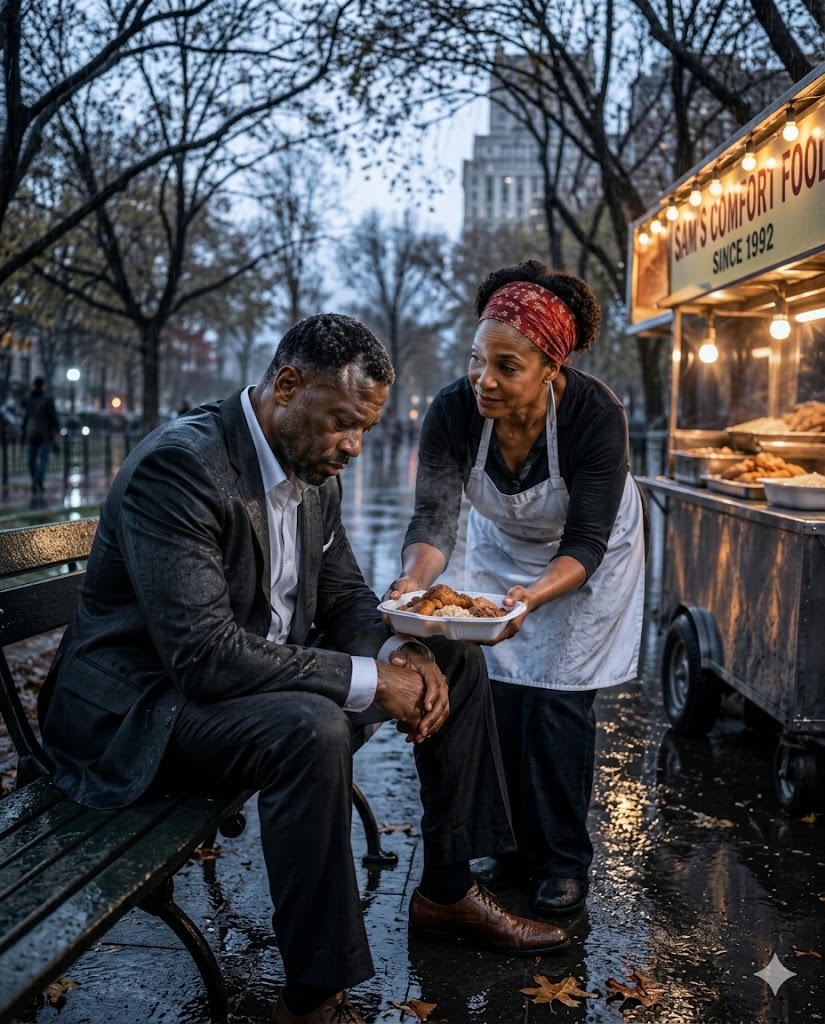
Marshall Oay sat on the third bench from the north entrance of Marcus Garvey Park in Harlem. He had been sitting there for 19 days, same bench, same time, 4:00 in the afternoon, when the light came through the trees at an angle that made everything on the path look like it was trying to leave. He was 56 years old. He was wearing a charcoal suit that had cost $420 when he bought it. The jacket had not been pressed in weeks. The collar had gone soft. The shirt underneath was clean but wrinkled in the way that happens when you wash something in a sink and hang it on a doorknob to dry. His shoes were Italian leather, but the left heel was worn down on the outside edge from the way he walked. He had not shaved in two weeks.
His hands were folded in his lap. He was not reading. He was not looking at a phone. He was looking at the path in front of him—the way people look at things when they are not really seeing them.
The food cart came down the path from the south entrance. It moved slowly. One wheel had a pull to the left that made the woman pushing it adjust her grip every few steps. The cart was steel and white with a handwritten sign on the side: Fried chicken, rice, and beans. Sweet tea. The letters were painted in red by someone who had taken their time with each one.
The woman pushing it was Naen Thibodaux. She was 44 years old. She wore a white apron over a dark shirt, and her hair was tied back with a cloth the color of cayenne. She had been selling food in this park for three years. She knew the regulars. She knew the bench sitters. She knew the ones who had money and the ones who did not. And she fed both, because that is what her grandmother had done.
She saw the man on the third bench and she slowed the cart. She did not stop right away. She looked at him. She looked at his hands. She looked at the suit. She looked at his face. She stood still for a moment with both hands on the cart handle. She knew that face. She had seen it once, ten years ago, on a sidewalk in New Orleans on a day when she had $40 left and a daughter who had not eaten since the morning before. She had seen that face step out of a black car, walk toward her folding table, order a plate of food, and eat it standing up on the curb like it was the best thing he had tasted in years.
She said his name—not loudly, not like a question. She said it the way you say a word you have been carrying for a long time and finally have a reason to put down.
Marshall looked up. He did not recognize her. She did not expect him to. She had been one meal on one sidewalk on one afternoon a decade ago. He had been the man who changed her life with a handwritten note and $1,400. He never asked to be repaid.
She pulled a container from the cart: fried chicken, rice, beans. She set it on the bench beside him. She did not explain it. She did not say anything else. She just set it down and stood there. He looked at the container. He did not open it. He sat with it beside him the way you sit with something you are not sure you deserve.
The last time Naen had cooked for Marshall Oay was ten years ago in New Orleans when she had $40 to her name and a daughter who had not eaten since the morning before. She did not forget. She had spent ten years not forgetting.
Marshall Oay grew up in a two-bedroom apartment on Holly Street in Bedford-Stuyvesant, Brooklyn. His father, Eugene Oay, had come from Accra, Ghana, in 1971 with a trade certificate in plumbing and $600 in a cloth pouch his mother had sewn into the lining of his suitcase. Eugene got work within two weeks. He never stopped working after that. Marshall’s mother died when he was nine—pneumonia that started as a cough, she said, was nothing, and turned into something that filled her lungs in eleven days.
Eugene did not remarry. He did not slow down. He worked 14 hours a day fixing pipes and toilets and boilers in buildings across Brooklyn, came home every night, made dinner, and checked Marshall’s homework at the kitchen table with pipe grease still under his fingernails.
The kitchen table was where everything important happened in that apartment. Where Eugene told Marshall about Ghana, where he explained how money worked. Where he showed him the pay stubs and the bills side by side every month and said, “This is what comes in and this is what goes out, and the difference is what keeps you alive.”
Marshall learned to read a balance sheet before he learned to drive. He went to City College, finance, graduated with no debt because Eugene had put $40 a month into a savings account for 18 years without missing once. $40 a month. Marshall did the math later. His father had given up coffee and lunch for 18 years to make that number work. He never told Marshall. Marshall found the deposit slips in a drawer after Eugene had a stroke at 71.
Marshall started in commercial real estate. Small deals: a duplex in Crown Heights, a 4-unit in East New York. He understood something most developers his age did not: there was money in affordable housing. Not the kind of money that made magazine covers—the kind that built slowly and lasted. He learned the tax credit system. The federal government offered tax credits to developers who built housing for low-income tenants. The credits were worth more than the rent. A developer could build 200 units, charge rents that working families could actually pay, and make a return through the credits that banks and investors would buy.
It was not charity. It was a business model that happened to serve people who needed serving. He explained it to his father once over dinner. Eugene listened carefully. Then he said the only thing he ever said about Marshall’s business.
“So you make money by building homes people can afford?”
Marshall said yes.
Eugene nodded. “That is the only kind of building worth doing.”
Marshall built Oay Capital Partners from a one-room office on Fulton Street in Bed-Stuy. One assistant, one phone line. He grew it over 22 years into one of the largest affordable housing developers in the northeastern United States. 1,400 units across New York, New Jersey, Connecticut, and Pennsylvania. His name was in the Wall Street Journal twice. His face was in Black Enterprise three times. He sat on boards. He gave speeches. He hired people from the same blocks where his father had fixed pipes.
He married Simone Reeves when he was 33. She was 29, a corporate attorney at a firm on Park Avenue. She was smart and precise, and she spoke about ambition the way Marshall’s father spoke about work—like it was not optional, like it was what you did because the alternative was unacceptable. Marshall admired her because she reminded him of himself: driven, clear-eyed, unwilling to settle.
They married in a small ceremony in Fort Greene Park. Eugene was there. He shook Simone’s hand and said, “Welcome to the family,” and went home early, because he had a job in Flatbush at 6 in the morning. Marshall did not see the difference between someone who admired what he built and someone who admired what he was worth. By the time he understood the difference, it had cost him everything.
Part 2: The Sidewalk of Dreams
Ten years before Marshall Oay sat on that bench in Harlem, Naen Thibodaux was standing on a sidewalk on Ursulines Avenue in the Tremé neighborhood of New Orleans with a folding table, a two-burner gas stove, a cast-iron skillet, and a recipe her grandmother had written on the back of a church bulletin.
She was 34 years old. Her daughter, Jolene, was six. Jolene was sitting on a folding chair behind the table with a coloring book and a cup of water that had been her lunch because there was nothing else that morning. Naen had $40 in her apron pocket. She had spent $31 of it on chicken thighs, oil, flour, and seasoning. She had $9 left. If she sold enough plates to cover tomorrow’s supplies, she could keep going. If she did not, she would have to figure out something else—and she did not have something else to figure out.
The chicken was almost done. The oil was the right temperature. She could tell by the sound her grandmother had taught her—that you do not need a thermometer. You listen when the oil stops talking and starts whispering, It is ready. She had six plates left when the black car pulled up. It was a Lincoln Town Car. Clean. The kind of clean that meant someone else washed it. A man stepped out—tall, dark suit. He looked like he was between meetings. He stood on the sidewalk and looked at the table and the handwritten sign and the skillet, and he did not move for a moment. Then he walked over.
He ordered one plate. $8.
Naen served it in a Styrofoam container with a plastic fork and a napkin. He stood right there on the curb and opened it and ate. He did not sit down. He did not walk away. He ate standing three feet from the stove and did not say anything until he was halfway through.
“Who taught you this?” he said.
“My grandmother,” Naen said. “She’s still cooking. She passed four years ago.”
He nodded. He finished the plate. He looked at the table. He looked at the stove. He looked at Jolene on the folding chair behind the table with her coloring book. He reached into his jacket and put $200 on the table.
Naen looked at the money. “That is too much,” she said.
“It is not enough,” he said.
She pushed the money back toward him. He put his hand flat on the table over the bills and looked at her. Not smiling, not performing, just looking at her the way you look at someone when you are trying to say something that does not fit into words. He took his hand off the money and walked back to the car. He did not give his name. He did not take a receipt. He got in the car, it pulled away, and Naen stood there with $200 on a folding table on Ursulines Avenue and her daughter behind her and the oil still whispering in the skillet.
Three days later, a lawyer called. A man named Marshall Oay had paid six months of rent on a fixed stall at the French Market in the French Quarter. He had also put a deposit on commercial kitchen equipment—a prep table, a fryer, a proper ventilation hood. Total cost covered: $1,400. No conditions, no contract, no repayment terms. There was a note handwritten on plain paper. The lawyer read it to her over the phone: The food was worth more than what I paid. This is the rest. Naen did not have his number. She did not have his address. She had a note and a stall at the French Market and equipment she could not have afforded in five years of saving. She kept the note. She folded it into a square and put it inside the recipe her grandmother had written on the back of that church bulletin. She carried both for ten years. She never saw Marshall Oay again. She did not know where he lived. She did not know the name of his company. She had a face and a voice and a handwritten sentence and ten years of remembering what it felt like when someone believed your food was worth more than what they paid. She did not forget. She built everything that came after on the foundation of not forgetting.
Part 3: The Inside Job
Vernon Ashford joined Oay Capital Partners in 2012 as chief financial officer. He was 42 years old. He had spent 15 years in commercial real estate finance and he understood capital structures the way a locksmith understands doors. Every lock had a mechanism. Every mechanism had a weakness. Vernon had built his career on knowing where the weakness was.
Marshall hired him because the company had outgrown what Marshall could manage alone. 1,400 housing units, $380 million in assets under management, federal tax credit allocations, state compliance requirements, bank relationships across four states. Marshall needed someone who could handle the numbers while he handled the buildings and the people and the communities those buildings served.
Vernon handled the numbers. He handled them carefully. He handled them in ways Marshall did not fully see. It started in 2018. Vernon began redirecting development capital away from affordable housing projects and into luxury condominium developments in Manhattan and Westchester County. He did not tell Marshall. He did not need to. The corporate structure gave the CFO authority over fund allocation within approved project categories. Vernon created new project categories. He approved them himself. He filed the paperwork under names that sounded like the affordable housing work Marshall had always done: Harlem Gateway, East River Commons—names that suggested community.
The projects behind those names were $2 million condominiums for people who had never set foot in the neighborhoods the names came from. Vernon used Oay Capital’s credit lines to finance these developments. He secured bank loans against the company’s existing portfolio. And buried inside the loan covenants were personal guarantee clauses that tied Marshall’s name and personal assets to the debt.
Marshall signed the annual filings. He read the summaries Vernon prepared. He did not read the covenants. He did not read the guarantee clauses. He trusted his CFO. That is what you do when someone has managed your money for 10 years and every number has always been right.
When the luxury market tightened in 2023, the condominiums did not sell. The loans came due. The banks called the guarantees. Marshall’s personal assets—the house in Greenwich, Connecticut, the investment accounts, the retirement fund—all of it was collateral for debt he had not known he was carrying.
Vernon had moved his own assets into his wife’s name two years before the market turned. His exposure was zero. Marshall’s exposure was everything. The lawyers explained it to Marshall in a conference room on a Tuesday afternoon. They used words like leveraged exposure and personal guarantee liability and cross-collateralization. What they meant was that Vernon had used Marshall’s name to borrow money Marshall did not know about for projects Marshall had never approved.
And now every dollar Marshall had ever earned was owed to banks that did not care how it happened. Marshall lost Oay Capital Partners. He lost the house in Greenwich. He lost the investment accounts. He lost the retirement fund. He lost 22 years of building something that was supposed to serve communities and found out it had been hollowed out from the inside by a man who understood mechanisms and weaknesses and had found both in Marshall’s trust.
Simone filed for divorce 11 days after the company collapsed. She did not ask Marshall how he was doing. She did not ask what had happened. She called her divorce attorney before she called her husband. The prenuptial agreement she had drafted herself 18 years earlier protected everything she had brought into the marriage and everything she had earned independently. She had written that document when they were in love. She had written it like a lawyer, not like a wife. The difference became clear the morning she served the papers.
Dorian Oay, 24 years old, MBA from Columbia, called his mother first. He did not call his father. Simone controlled the educational trust she had set up for Dorian when he was three. The trust held $1.8 million. Dorian understood where the money was. He chose accordingly. He did not call his father for four months.
Marshall walked out of the house in Greenwich with one suitcase. A rental car. $3,200 left in a personal checking account that Vernon’s restructuring had missed because it was too small to notice. Everything else was gone. The company, the house, the accounts, the wife, the son, the name that had once meant something in every room he walked into. He drove to New York. He checked into a rooming house on 125th Street in Harlem, $180 a week. He did not know anyone in the building. He did not know anyone on the block.
He had spent 22 years building affordable housing and had never once sat inside a room that cost $180 a week and felt like it. He had built homes for thousands of families. Now he was paying weekly for a bed and a sink and a window that looked out onto a fire escape.
Part 4: The Currency of Kindness
The room on 125th Street was on the third floor of a building that had been a boarding house since 1986. The hallway smelled like floor cleaner and something fried from two doors down. The room itself was small: a single bed pushed against the wall, a dresser with one drawer that stuck, a window that looked out onto a fire escape, and across the alley to another window where someone had taped a bed sheet as a curtain. The bathroom was shared, down the hall, second door on the left. The shower had two temperatures: cold and almost cold. The walls were thin enough that Marshall could hear the subway pass underneath the building every eight minutes—he counted. He had nothing else to count.
He paid $180 a week. Cash. The landlord was a woman named Mrs. Okonkwo who lived on the first floor and collected rent on Mondays in an envelope slid under her door. She did not ask questions. She did not make conversation. She took the envelope and nodded. And that was the transaction.
Marshall did not eat on a schedule. Some days he bought a coffee and a roll from the bodega on the corner. Some days he did not eat at all. Not because he could not afford to—he had $3,200 he could eat—but he just did not think about it. Eating required deciding where to go and what to order, and those were decisions that belonged to a person who had a life organized around other decisions. Marshall did not have those other decisions anymore.
He walked to Marcus Garvey Park every afternoon. Same entrance, same path, same bench—the third one from the north side under a tree that gave shade until about 4:30 and then let the sun through in long strips across the pavement. He sat there from 3:00 in the afternoon until the light changed. He watched the joggers. He watched the mothers with strollers. He watched the food vendors set up in the morning from his window and pack up in the evening from his bench.
He had spent 22 years in rooms where people waited for him to speak. Conference rooms, boardrooms, hotel ballrooms where his name was on the program, and 400 people sat in chairs arranged in rows waiting for him to tell them what he saw that they did not. He had been Marshall Oay. The name meant something. It opened doors. It filled rooms. It made phones ring. Now the phone did not ring. He checked it out of habit. There were no messages, no missed calls, no calendar notifications. The screen was empty the way a room is empty after everyone has left and nobody has come back.
He did not know what to do with his hands. He did not know what to do with his hours. He had built a company that employed 340 people and managed 1,400 homes. And now he sat on a bench and watched pigeons land on the path and take off again. And he understood for the first time that he had never learned who he was without the company. The company had been the answer to every question: Who are you? What do you do? Why are you here? The company answered all of it. Without the company, the questions had no answers, and Marshall sat with them every afternoon on the same bench in the same park and did not know what to say.
On the 14th day, a man with a hot dog cart parked near the north entrance handed him a bottle of water. Marshall had not asked for it. He had not spoken to the man. The man just walked over and held it out and said, “You look like you need it,” and went back to his cart.
Marshall held the bottle in both hands for 20 minutes. He did not open it right away. It was the first time in weeks that someone had spoken to him like a person—not like a debtor, not like a case number, not like a name on a filing, but like a man sitting on a bench who looked like he needed water.
He called his father that evening. Eugene was 82 years old, still living in the apartment on Holly Street, still sharp, still waking up at 5:00 in the morning out of habit, even though he had not worked in six years. Marshall told him he was in Harlem. He did not tell him why. Eugene did not ask. He asked one question.
“You eating?”
Marshall said yes.
Eugene said, “Then you are fine.”
That was the whole call. He had been sitting on that bench for 19 days when the food cart appeared. You already know who she is. You already know who he is. But neither of them knew what the other had become. Naen Thibodaux had not stayed on that sidewalk in Tremé. The stall at the French Market that Marshall had paid for became the foundation of everything she built after. She ran it for six years. She hired two people. She built a lunch crowd that lined up before the market opened. Jolene grew up behind that counter, doing homework on a folding chair between the fryer and the register.
Then Hurricane Ida came through in August 2021. The market flooded. The equipment was destroyed. The stall was gone. Insurance covered part of it, but not enough. Naen spent three months cleaning up and filing claims and sleeping on her sister’s couch in Baton Rouge before she made a decision. She was not going to rebuild in a place that could be taken by water again. She was going to go somewhere the ground did not flood.
She moved to New York—Harlem. She bought a used food cart from a man in the Bronx for $2,800. She got her permits. She started selling on 125th Street and in Marcus Garvey Park—the same food, the same recipe, the same chicken her grandmother had taught her and that Marshall Oay had tasted once on a sidewalk a decade ago.
Jolene was 16 now, on a roll at Frederick Douglass Academy. She wanted to study biology. She wanted to go to college. Naen did not talk about that part out loud because talking about it made it feel like a promise, and she had learned not to promise things she could not yet pay for. Naen did not tell Marshall any of this the first day. She did not tell him the second day, either. She set the food down. She said, “Same time tomorrow.”
He nodded. She came back. Day two: a container of rice and beans and chicken. She set it on the bench. She left. Day three, the same. Day four, he opened the container before she walked away. She noticed but did not say anything. Day five, he said, “Thank you.” Two words, the first words he had spoken to her since the day they met again. Day six, she sat on the bench beside him for a few minutes. Neither of them said anything. She got up and went back to the cart. Day seven, he ate the food while she was still there.
She watched him eat. The chicken was cayenne and honey and something sweet underneath that he could taste but could not name. Something that reminded him of a kitchen he had never been in. Something that tasted like the kind of food that gets passed down not in cookbooks, but in hands. He did not know he was tasting a recipe written on the back of a church bulletin in 1974. He did not know the woman sitting beside him had carried that recipe across ten years and a hurricane and a move to a city where she knew nobody. He only knew the food tasted like it had been made by someone who meant it.
Part 5: The Forensic Turn
Day eight, he started talking. He told her about Vernon, about the loans, about the guarantee clauses he had signed without reading, about Simone and the prenup and the 11 days, about Dorian and the phone call that never came. He told her all of it, sitting on that bench with an empty food container between them and the afternoon light coming through the trees.
Naen listened. She did not interrupt. She did not offer advice. She did not say she was sorry. When he was done, she was quiet for a while. Then she asked one question.
“Do you still have the records?”
Marshall looked at her. He did not understand the question at first. “Records of what?”
She said it again. “The financial records from your company. Do you still have them?”
He did. He had a portable hard drive in his suitcase at the rooming house. He had kept copies of everything. Every quarterly report, every loan document, every fund allocation. He had kept them the way you keep things when you do not know what else to do with them. Not as evidence, not as strategy—as habit. The same habit that made him check his phone for messages that were never coming.
“I know someone,” Naen said.
Clarence Abrams was 62 years old. He had an office on Adam Clayton Powell Boulevard. He wore reading glasses on a chain around his neck and he ate fried chicken from Naen’s cart every Tuesday at 12:15. He had been doing this for three years. He was particular about the breast piece. He always asked for extra hot sauce. He always paid exact change and told Naen the chicken was better than his mother’s, and that if she ever repeated that, he would deny it.
Clarence was a forensic accountant and attorney specializing in white-collar financial fraud. He had spent 30 years following money through the kinds of structures that were designed to make money disappear. Shell companies, offshore trusts, nominee directors. He understood them the way a plumber understands pipes. You find the source. You trace the flow. You find where it leaks.
Naen brought Marshall to Clarence’s office on a Thursday. She did not call ahead. She brought two containers of chicken and walked in and set one on the reception desk and carried the other to Clarence’s door and knocked.
“Mr. Abrams, this man needs five minutes.”
Clarence looked at Marshall. He looked at the chicken. He waved them in. Marshall opened the hard drive on Clarence’s desk and showed him the files—the fund allocation reports, the loan covenants, the project filings. Clarence read through them slowly. He put his glasses on. He took them off. He put them on again. He did not speak for 22 minutes. Then he looked up.
“This is not bankruptcy,” Clarence said. “This is theft. There is a difference. And the difference is prison time.”
He explained it in plain language. When someone takes a company into debt through bad decisions, that is failure. When someone takes a company into debt by redirecting funds into shell projects, forging allocation reports, and burying personal guarantee clauses in loan covenants that the CEO never approved, that is fraud. The first one is a business matter. The second one is a federal matter. The line between them is intent. And the documents on that hard drive showed intent on every page.
Clarence took the case, not out of charity. He took it because this was the kind of case he had been waiting for—the kind that involved enough money and enough paper trail to make a career. And because Vernon Ashford was the kind of man Clarence had spent 30 years training to catch. He made one phone call that afternoon.
The call went to a senior enforcement attorney at the SEC regional office in New York. Her name was not important. What was important was that she had been building a file on irregularities in the affordable housing tax credit market for three years and had not been able to find a victim willing to come forward with documentation.
Most victims of financial fraud do not know they are victims. They think they failed. They think the market turned. They think they made bad decisions. They do not think someone stole from them because the theft was designed to look like misfortune. Marshall had the documentation. Clarence had the expertise. The SEC had the jurisdiction.
The investigation moved fast. Within 48 hours of Clarence submitting the initial filing, a forensic audit team was assigned. They began tracing the fund flows from Oay Capital Partners through a web of seven shell companies registered in Delaware. The companies had names that sounded legitimate: Northeast Development Holdings, Atlantic Community Partners, Harlem Gateway LLC. Behind every name was a mailbox and a registered agent and nothing else.
Vernon Ashford had moved $47 million through these entities over five years. He had used the money to purchase luxury properties in his wife’s name and in the names of associates who existed only on paper. He had also convinced three other investors to pledge personal assets as collateral for developments that were never built. The total exposure across all victims was $180 million.
The investigation reached Simone six weeks after it began. The forensic team found a trust. It had been created four years before the divorce. It was managed by Vernon. It held $2.3 million of Simone’s personal assets. The trust was referenced in the prenuptial agreement she had written herself, the same prenup that protected her when she left Marshall.
The connection was not proof that Simone had participated in the fraud, but it was proof that Simone knew Vernon, that she had entrusted her own money to him, that she had created a legal structure that kept her assets safe while her husband’s assets were being used as collateral for loans he did not know about. The timing was not a coincidence. The structure was not an accident. Simone hired a criminal defense attorney three days after the SEC contacted her. She did not call Marshall. She did not call Dorian. She called a lawyer.
Part 6: The Architect of Change
Dorian Oay found out through a news article. A brief item in the Wall Street Journal about an SEC investigation into Oay Capital Partners and related entities. He read the article twice. He saw his mother’s name in the second paragraph. He saw the trust. He saw the dates. He sat with his phone in his hand for a long time. Then he called his father.
For the first time in four months, Marshall picked up on the second ring. He did not say hello. He waited. Dorian did not speak for 10 seconds. The silence was the kind that happens when someone is trying to find the right sentence and realizing there is no right sentence.
“Dad,” he said. “I didn’t know.”
Marshall closed his eyes. He did not say it was okay. He did not say he forgave him. He said, “I know.” And he meant it. He had spent 22 years building housing for families, and he understood that the structures people build to protect themselves are not always the structures that keep them safe. Dorian had protected himself by choosing the parent with the money. It had been a calculation. Marshall did not blame him for the math. He blamed himself for building a life where the math was all that was left to do.
Simone Reeves had hosted a Saturday brunch at her apartment on the Upper West Side every month for nine years. Twelve women, same table, same caterer, same flowers in the center—peonies in spring, dahlias in fall. She sent the invitations by email on the first Monday of every month, and the replies came back within hours. Always yes. Always twelve.
The month after the SEC investigation became public, she sent the invitations. She ordered the flowers. She had the caterer prepare for twelve. She set the table herself that morning. Twelve plates, twelve glasses, twelve linen napkins folded the way she had learned from a magazine 15 years ago.
Nobody came. Not one reply, not one apology, not one message saying something came up. Twelve empty chairs around a table set for twelve. Simone sat at the head of that table for 40 minutes before she stood up and began clearing the plates herself.
The New York State Bar Association opened a review of her license three weeks after the SEC filing. The trust she had created with Vernon as manager was not illegal on its own, but the timing and the structure raised questions that her firm did not want to answer on her behalf. Whitfield and Associates, where she had been a partner for 11 years, released a statement that said Simone Reeves was no longer affiliated with the firm. They used the word affiliated, the way you use a word when you want to make it sound like the person was never really there in the first place.
Her license was suspended, pending investigation—not revoked, suspended. The difference mattered legally. It did not matter practically. No client would retain an attorney whose name appeared in a federal fraud case filing. The phone stopped ringing the same way Marshall’s had. Slowly at first, then all at once.
Vernon Ashford was arrested on a Wednesday morning in his office on Park Avenue. He was wearing the same suit he had worn to a charity gala the Saturday before. He was escorted out through the lobby. The receptionist watched. The security guard held the door. A photographer from the Journal was already on the sidewalk. Vernon did not look at the camera. He looked at the ground, the way people look at the ground when they are calculating what comes next and realizing the calculation has stopped working.
Simone called Marshall on a Thursday evening. His phone lit up on the counter in Naen’s kitchen where he had been helping prep for the next morning. He saw the name on the screen: Simone Reeves.
He looked at it for a long time. The phone rang six times. He did not pick up—not because he was angry. He had been angry months ago. The anger had come and stayed and then left the way weather leaves. What replaced it was nothing. He had nothing left to say to her. Not because she had hurt him—she had—but because the person she had hurt no longer existed. The man who needed Simone’s approval. The man who confused admiration with love. That man had disappeared somewhere between the bench in the park and the food cart and the seven days of silence that Naen had given him without asking for anything in return.
He put the phone face down on the counter and went back to chopping onions. Simone was not a villain. She was something harder to name than that. She was a woman who had married a version of a man. And when that version disappeared, she did not know how to stay. She had never loved Marshall. She had loved what Marshall represented: the rooms he opened, the tables she sat at because of his name, the version of her own life that his success made possible. When the success was gone, there was nothing underneath to hold her there. That was not cruelty. That was emptiness. And emptiness is its own punishment because nobody has to deliver it. It just arrives.
Part 7: The Seeds of Tomorrow
Marshall started working at the food cart on a Monday. Naen did not ask him to. He showed up at 5:00 in the morning when she was loading the cart and started carrying trays without saying anything. She looked at him. She did not say no.
He did not know how to fry chicken. He did not know the oil temperature. He did not know how long to let the flour sit before dredging. Naen showed him once. Then she let him fail. He burned the first three pieces. She threw them out without comment. He got the fourth one right. She nodded. That was the entire training program.
The food cart operated under a mobile food vending permit from the New York City Department of Health. The permit cost $200 every two years, but the waitlist was 10 years long. Naen had bought hers secondhand from a vendor who retired. She paid $1,800 for the permit alone. The cart itself was another $2,800. Insurance, propane, supplies. On a good day, she cleared $700 after expenses. On a bad day—rain or cold or a street closure—she cleared nothing and still owed for the food she had prepped.
Marshall had managed a portfolio worth $380 million. He had signed checks that were larger than Naen’s annual revenue. He had sat in rooms where people discussed deals worth more than every food cart in New York City combined. And he had never once understood what it took to earn $700 standing over a fryer in 90-degree heat on a Harlem sidewalk for 11 hours. He understood it now. He understood it by doing it. By standing next to Naen and watching her work and seeing that every dollar she made was connected to a physical act. Flour on her hands, oil on her apron, sweat on her forehead. There was no spreadsheet between her effort and her income. No abstraction, no leverage, just a woman and a skillet and a line of people who came back because the food was real.
Street food vendors in America are among the most resilient small business operators in the country. They survive weather and permits and competition and theft and equipment failure. And they do it on margins that would make a Wall Street analyst walk away from the table. Naen was one of 53,000 permitted food vendors in New York City. She earned her living in one of the most competitive sidewalks in the world, and she did it every single day.
Jolene came to the cart after school most days. She sat on an overturned crate and did her homework while the line formed. One afternoon, she looked up from her textbook and said, “Mister Marshall, can you help me with this?”
It was a personal finance assignment. Budgeting, income and expenses, savings goals—the kind of assignment that teaches 16-year-olds what money means before they have any. Marshall sat down on the crate next to her. He took the worksheet. He read through it slowly. Then he began explaining—not the way he had explained tax credit structures to investors, not the way he had presented at conferences. He explained it the way his father had explained money to him at the kitchen table on Holly Street.
“This is what comes in. This is what goes out. The difference is what keeps you going.”
He spent 45 minutes on that worksheet. He drew diagrams on the back of a napkin. He used Naen’s cart as an example. Revenue, cost of goods, fixed costs, variable costs, profit margin. He made it real. He made it specific. He made it something a 16-year-old could hold in her hands and use. He had never done that for Dorian. He had paid for Dorian’s MBA, but he had never sat down beside his son and explained how money actually worked in a voice that was patient and slow and meant for one person. He had been too busy building, too busy managing, too busy being Marshall Oay to be Dorian’s father.
He sat on that crate next to Jolene and taught her what his own father had taught him and what he had failed to teach his own son. And he understood for the first time that the note he had written 10 years ago was more true than he had known. The food was worth more than what I paid. It was worth more than $1,400. It was worth more than $2.1 billion. It was worth a second chance at learning what mattered.
Naen had given him a plate of chicken. He had given her a stall at a market. And now, 10 years later, she had given him something no amount of money could purchase. She had given him a reason to get up in the morning that had nothing to do with a balance sheet. The restitution came through on a Friday. Clarence called Marshall at the rooming house and told him to come to the office. Marshall walked from 125th Street to Adam Clayton Powell Boulevard, 12 blocks. He could have taken a cab. He walked. He had gotten used to walking.
Clarence had a folder on his desk. Inside was a summary from the federal receiver. Vernon Ashford had been convicted on 14 counts of wire fraud, six counts of securities fraud, and three counts of money laundering. His assets had been seized and frozen. The total recovery from all seized assets was $61 million, distributed across all identified victims based on documented losses. Marshall’s share was $23 million.
Clarence explained the math. The total documented fraud was $180 million across multiple victims. Full restitution was not possible. It never is in cases like these. The money gets spent. The money gets hidden. The money gets moved to places where the law cannot reach it fast enough. $23 million from $180 million was better than most fraud victims ever see. Most get pennies on the dollar. Most get nothing.
Marshall sat with the number $23 million. Three years ago, that was the budget for the annual client dinner at his company. He had spent more than that on a single development project. It was not $2.1 billion. It was not close. But he was not the same man who had needed $2.1 billion. He was a man who had learned to fry chicken and chop onions and teach a 16-year-old how to balance a budget on the back of a napkin.
$23 million to that man was something different. It was enough. He looked at Clarence. “How much do I need to do what I am thinking of doing?”
Clarence leaned back. “What are you thinking of doing?”
Marshall told him.
Clarence sat with it for a while. He took his glasses off. He put them back on. “That would work,” he said.
The building was on Frederick Douglass Boulevard between 125th and 126th, a former garment warehouse, three stories, 12,000 square feet. It had been empty for four years. The owner was a holding company based in Connecticut that had been trying to sell it for three years at a price nobody in the neighborhood could meet. Marshall knew how to read a building. He knew how to read a market. He knew what a property was worth when the seller had been waiting too long and the carrying costs were eating into the holding company’s returns. He offered $1.4 million. The asking price was $2.1 million. The holding company took it within a week because $1.4 million now was better than $2.1 million that had not come in three years.
He had the plans drawn up in six weeks. Not by a corporate architecture firm, by a woman named Gail Okafor who ran a small practice on Lenox Avenue and who understood what the neighborhood needed because she had lived in it for 30 years.
The Thibodaux-Oay Community Kitchen: a food hall on the ground floor with 14 vendor stalls. A shared commercial kitchen on the second floor available to permitted vendors who could not afford their own equipment. A business incubator on the third floor offering mentorship, accounting support, and access to small business banking for food entrepreneurs who had never had a bank account in their business name.
The model was simple. Low fixed costs for vendors, shared infrastructure, professional support for people who knew how to cook but did not know how to file taxes or negotiate a lease or build credit. The kind of support that turns a food cart into a food business. The kind of structure that Marshall had spent 22 years building and housing and had never thought to build in food.
He showed Naen the plans on a Tuesday evening. They were sitting at her kitchen table. Jolene was in the next room doing homework. Marshall unrolled the blueprints and laid them flat between the salt shaker and the napkin holder.
Naen looked at the plans. She looked at the layout. She looked at the name printed across the top of the page. She did not say anything for a long time.
“You are putting my name on a building,” she said.
“Your food put me back on my feet,” Marshall said. “Your name goes first.”
Thibodaux-Oay, not Oay-Thibodaux—her name first, his name second, the way it should have been from the beginning, because she was the one who had shown up with a plate of food and asked nothing in return. And that is the kind of thing that deserves to go first.
Naen looked at the plans again. She put her hand flat on the paper the way Marshall had put his hand flat on the table over the $200 on a sidewalk in Tremé ten years ago. The same gesture, different decade, different city, same meaning.
Marshall established a scholarship fund for the children of food vendors in Harlem. Small $5,000-a-year enough for four full-tuition scholarships at CUNY colleges. Jolene was the first recipient. The acceptance letter came from Hunter College, Biology-Pre-med track. She read it at the kitchen table. She looked at her mother. Naen looked back at her daughter. Neither of them said anything. The letter sat on the table between them next to the blueprints and the salt shaker and the napkin holder, a kitchen table in a Harlem apartment where everything real was happening.
Dorian Oay showed up on opening day. He did not call ahead. He did not text. He took the train from Penn Station to 125th Street and walked four blocks north to Frederick Douglass Boulevard and stood on the sidewalk outside the Thibodaux-Oay Community Kitchen with his hands in his pockets and looked at the sign. His father’s name was on it. Second, after Thibodaux.
Dorian stood there for a while reading it. He had grown up seeing his father’s name first on everything—on the company, on the letterhead, on the building directory of every office they had ever visited. Oay Capital Partners. Oay first, always first. Not here. Here, his father’s name came second. Behind a woman Dorian had never heard of, behind a name he could not yet pronounce.
He stood on that sidewalk and looked at the sign and understood something he had not understood six months ago when he chose his mother’s money over his father’s phone call. The man who needed his name first on everything was gone. The man inside this building had chosen to put someone else’s name ahead of his own. That was not weakness. That was something Dorian did not have a word for yet.
He walked in. The ground floor was full. 14 vendor stalls. The smell of frying oil and spices and rice and roasted peppers filled the room from wall to wall. People were eating at long communal tables. People were standing in line. People were talking to the vendors through the open windows of each stall like they had been doing it for years, even though the doors had only opened that morning.
Dorian found his father in the kitchen behind Naen’s stall. Marshall was wearing a white apron. His sleeves were rolled up. There was flour on his hands and oil on the front of the apron, and he was standing over a fryer, lowering chicken into the oil with a pair of tongs, the way someone does it when they have done it enough times to stop thinking about it.
Dorian stood in the doorway. Marshall looked up. He saw his son. He did not say anything. He looked at him for a moment, then he turned back to the fryer.
Dorian stood there for two minutes. The oil crackled. The exhaust fan hummed. Naen moved past him carrying a tray and did not stop. Nobody told him to come in. Nobody told him to leave. He walked to the counter. He picked up an apron from the hook on the wall. He put it on. He stood next to his father. He did not say sorry. He did not explain. He just stood there.
Marshall did not look at him. He handed him the tongs. They worked side by side for the rest of the afternoon, frying chicken, plating orders, wiping down the counter—not talking, not needing to. The kitchen was loud and hot and full of the kind of work that does not require conversation. The kind of work that Eugene Oay had done every day on Holly Street, fixing pipes next to his son, not talking about love, just being there, showing up with your hands, and staying until the work was done.
That was how the men in the Oay family repaired things. Not with apologies, not with speeches, with presents, with labor, with standing next to someone and doing the work beside them until the silence between you stopped being empty and started being enough. Simone did not come. She did not call. Her story had ended in an apartment on the Upper West Side with 12 empty chairs and a table set for people who were never coming back.
Not everyone returns. Not every thread gets tied. That is not a failure of the story. That is the story.
Dorian stayed until closing. He helped stack the chairs. He helped mop the floor. When the lights were off and the kitchen was clean and the building was quiet, he stood outside on the sidewalk with his father. Neither of them spoke for a while. The street was dark. The sign above the door was lit from underneath: Thibodaux-Oay Community Kitchen.
“I like the name,” Dorian said.
Marshall looked at the sign. “She earned it,” he said. That was all. They walked to the subway together. Dorian went south. Marshall went north—two blocks to the rooming house on 125th Street where he still lived because he had not yet decided where to go next, and because the room had become familiar, and familiar was something he had learned not to waste.
Vernon had his lawyers. Simone had her prenup. Dorian had his trust fund. Naen had a food cart and a ten-year-old handwritten note folded inside a recipe written on the back of a church bulletin. Every one of those things was a kind of protection. Every one of those things was designed to keep something safe.
The lawyers protected Vernon until they could not. The prenup protected Simone until there was nothing left to protect. The trust fund protected Dorian until it became the reason he stopped calling his father. The note protected Naen in a different way. It did not protect her money. It did not protect her assets. It protected something that has no line item on a balance sheet. It protected her belief that a stranger could be kind without wanting something back. And she carried that belief for ten years through a hurricane and a move to a new city and three years of pushing a food cart through rain and summer heat and winter cold on the sidewalks of Harlem.
And when she saw the man who had written that note sitting on a park bench with nothing, she did not calculate what he was worth. She calculated what he needed: a plate of food, a seat at the table, someone to show up tomorrow and the day after that, and the day after that, without asking why.
The people who leave when you have nothing were never there for you. The people who show up with a plate of food and ask nothing in return? Those are the ones who were always there. You just could not see them when the room was full. You only see them when the room is empty. And they are the only ones still standing in the doorway.
Some people build their lives around what they can protect on paper. Marshall learned the hard way that the things worth protecting do not fit on paper. They fit in a kitchen. They fit in a handwritten note. They fit in a church bulletin recipe that travels from New Orleans to Harlem inside a folding chair and a cast iron skillet and a woman who never forgot.
If someone showed up for you after ten years, not because they owed you, not because they wanted something, but because they remembered what you did when they had nothing, would you trust it, or would you keep looking for the structure that told you how to understand it? Marshall Oay had $2.1 billion and lost it. He had a wife who left in 11 days. He had a son who chose the money. He had a partner who stole everything. And the person who saved him was a woman he had met once on a sidewalk in New Orleans who remembered what he had done with $200 and a handwritten note and who showed up with a plate of chicken ten years later and said, “Same time tomorrow.”
The truth is not in the buildings you own or the checks you sign. The truth is in the people who stay when the money leaves. The truth is in the hands that help you up the stairs when the weight is too much to carry alone. The truth is in the soup, the chicken, the tea, and the quiet rhythm of someone showing up, day after day, just because they meant it.
Marshall sat on the bench on 125th street one last time before going to his room. The city was moving, the lights were coming on, the world was spinning in its relentless, chaotic way. He looked at the food cart, Naen packing up for the night. He looked at the community kitchen sign. He stood up, walked over, and picked up a piece of cardboard from the sidewalk. He looked at the mess of the street, the discarded life he had once managed with such ease. He realized he didn’t need to count the pigeons or the steps or the dollars anymore. He just needed to be there. And for the first time in his life, he knew exactly what that meant. He wasn’t the man on the bench anymore. He was the man in the kitchen, and he was home.