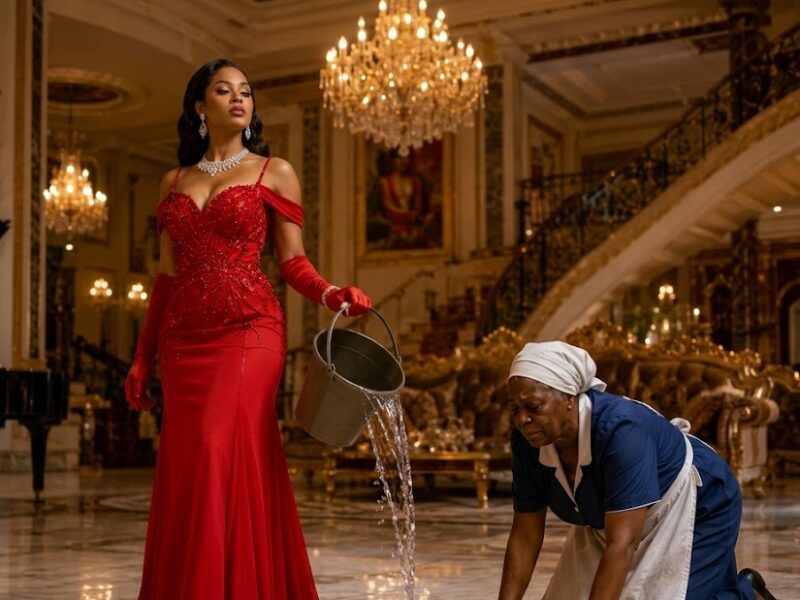
Billionaire’s Mother PRETEND To Be A Maid In Her Son’s Mansion To Test His Fiance
Part 1: The Outcast’s Seed
The air in the village of Obodo was thick with the scent of burning palm fronds and the heavy, unforgiving dampness of the rainy season. Here, life seemed deceptively simple, painted in the vibrant green of cassava leaves and the rich, red clay of the earth. But beneath this rustic beauty lay a bedrock of iron-clad traditions. In Obodo, mistakes were not merely frowned upon—they were carved into a family’s name, passed down like an incurable sickness, and rarely, if ever, forgiven.
Zikora stood in the shadow of the old iroko tree, her heart fluttering like a trapped bird. She was eighteen, with skin the color of dark honey and eyes that still held the soft, unblemished light of childhood. Opposite her stood Ema. He was tall, his shoulders broad from working his father’s farm, his smile the only thing that could make the harsh village rules melt into insignificance.
“You are the only girl for me, Zikora,” Ema whispered, his hands warm as they cupped her face. He looked at her with an intensity that made her breath catch. “One day, everyone in this village will call you my wife. I promise you.”
Zikora leaned into his touch, her lips curving into a gentle, hopeful smile. “Then I will wait for that day, Ema. No matter how long it takes.”
But promises made in the dark have a way of shattering when the light of reality hits them.
Only three months later, the sky above Obodo was gray and weeping. Zikora sat on the low stool in her mother’s kitchen, her hand resting flat against her stomach. Her fingers trembled. Inside her, a tiny heartbeat had begun—a quiet, terrifying secret that threatened to tear her world apart.
“A baby,” she whispered to the empty room, her voice shaking. “How will I tell Ema? What will Papa say?”
That evening, she met Ema by the riverbank, away from the prying eyes of the village elders. The rushing water sounded like a warning. When she took his hand and whispered the truth, she watched the color drain from his face. The warmth in his eyes died, replaced by a cold, panicked distance.
“A baby?” Ema recoiled, ripping his hand away as if she had burned him. “No. No, Zikora, this cannot be. I am not ready to be a father. I cannot do this!”
“Ema, please,” Zikora pleaded, tears spilling over her lashes as she reached for him. “We love each other. We can face this together. Our parents will understand if we stand together.”
“Are you mad?” Ema hissed, stepping back toward the darkness of the forest. “My father will disown me! I have a future, Zikora! I want nothing to do with you or that baby. Do you hear me? Nothing!”
“Ema, please do not leave me!” she cried, her voice cracking as she fell to her knees in the wet mud. “Please!”
He did not look back. He ran into the shadows, leaving her alone with the sound of the rising river and the crushing weight of her despair.
When Zikora returned home, her secret could no longer be hidden. The quiet dread in her eyes and her sudden sickness spoke louder than any confession. Her father, Papa Nnadozie, a man whose respect in the village was built on rigid adherence to custom, stood before her in the small living room. His face was carved from stone.
“Zikora,” he barked, his voice vibrating through the mud-brick walls. “Leave this house before morning.”
“Papa, please!” Zikora sobbed, throwing herself at his feet. “I have nowhere to go! The night is dark, and the rain is heavy!”
“How can a young girl like you get pregnant in my house?” her father roared, turning his back on her. “You have dragged our name through the mud! You brought shame to this family! In this village, we do not harbor loose women!”
Zikora looked up at her mother, Mama Chinwe, who stood in the corner of the room. Her mother’s face was wet with tears, but her hands were tied by the suffocating customs of their people. She could not speak against her husband. She could only watch as her only daughter was cast into the wild.
Realizing there was no mercy to be found under the roof that had raised her, Zikora slowly stood up. She wiped her face, a sudden, cold resolve hardening inside her chest. She packed her few belongings into a small cloth bundle.
“Mama, I am going,” Zikora said, her voice hollow. “May God keep you.”
“Who will marry a girl like that?” she heard her father’s bitter voice echo as she stepped over the threshold and into the dark, pouring rain.
She walked away from the only home she had ever known, her feet slipping on the muddy path. As the village of Obodo faded into the distance behind her, she clutched her stomach.
“Baby,” she whispered into the howling wind, “it is just you and me now. I don’t care what they say. I will keep a mother’s love for you, even if the whole world turns its back on us.”
Part 2: Sweat, Tears, and the Unseen Father
Years in the bustling, chaotic town of Enugu did not soften the edges of Zikora’s life, but they made her strong. She lived in a cramped, single room in one of the poorest quarters, where the walls smelled of damp concrete and kerosene. She took whatever work she could find—scrubbing the floors of wealthy merchants, washing heaps of heavy clothes until her fingers bled, and carrying heavy basins of water on her head.
“We need someone strong to clean the warehouse,” a harsh-faced market supervisor said one morning, pointing to a dark, cluttered storage space. “Clean there too, and don’t expect extra pay.”
“I will do it,” Zikora said, her voice steady. She grabbed the heavy broom, her muscles aching from exhaustion, but her eyes locked on the small wooden crate in the corner where her baby lay wrapped in a faded cloth.
Every evening, after the long hours of backbreaking labor, she would sit on the wooden step of her shack, cradling her son. She had named him Chinedu—God leads.
“Please buy, Ma,” Zikora would call out at the market square during her afternoon shifts, holding up a tray of sweet, bright oranges. “The oranges are sweet. Give me four, a customer would say, handing her a few crumpled notes.”
The memory of his birth still burned in her mind. She had been alone in a small, poorly lit room with a local midwife. The pain had been a physical storm, but she had screamed through it, praying for only one thing. Please let my child be safe. And when the midwife had held up the crying infant, whispering, “It is a boy,” Zikora felt a love so profound it healed every scar her village had left on her.
“We will manage, my son,” she told him as she counted the meager coins she earned from the oranges. “Just don’t cry too much today. Tomorrow will be better. It must be better.”
As Chinedu grew, Zikora worked even harder to put him through school. She bought him books, even when it meant she had to go to sleep on an empty stomach. She watched him study by the dim light of a kerosene lamp, his small face intense with concentration.
“Chinedu, stay near me,” she would remind him when the market grew too crowded.
During these hard years, a kind-hearted carpenter named Okoye tried to court Zikora. He was a good man, but he could not understand the fierce, protective wall she had built around her son.
“Zikora, you work too hard,” Okoye told her one evening, standing outside her door. “I want to marry you. I want to take care of you. But I can’t compete with your son for your attention. You care for him too much. He is all you see.”
Zikora looked at Okoye, her eyes calm but resolute. “He is my child, Okoye. If you cannot love him as I do, then you will never love me fully. My son comes first.”
Okoye left, and Zikora turned back to her son, pullng him into her arms. “It is okay, my son. Mama is here. I will do everything for you. You will grow up strong and successful.”
One afternoon, when Chinedu was ten years old, he came home from school with a quiet, heavy look on his face. He sat down at the small wooden table, his schoolbag resting on his knees.
“You’re back,” Zikora said, smiling as she poured him a bowl of warm beans. “Mama,” Chinedu said, his young voice quiet. “Yes, my dear. How was school today?”
Chinedu hesitated, his fingers tracing the edge of his textbook. “Mama… do I have a father?”
Zikora’s heart stopped. She had known this day would come, but the physical pain of the question still caught her off guard. She sat opposite him, taking his small, rough hands in her own.
“You do have a father, Chinedu,” she said softly, her voice steady despite the trembling in her soul. “But he isn’t with us. He left a long time ago, even before you were born.”
“Why did he leave us?” Chinedu asked, his eyes searching hers for answers.
“When I found out I was going to have you,” Zikora explained, “I told your father. His name is Ema. At first, I thought he would be happy, but he wasn’t. He said he wasn’t ready to be a father and wanted nothing to do with me or the baby. After that, my parents disowned me, and I had to leave the village. I haven’t seen Ema since, and I don’t know where he is.”
Chinedu looked down at their joined hands. Then, he looked up, his young face showing a maturity far beyond his years. “It’s okay, Mama. You’re the best parent I could ever have. I will always be here for you. I will try my best to be enough.”
Years later, when Chinedu was a young teenager, Zikora was walking through the busy streets of Enugu when she saw a face she thought she had buried in the past. It was Ema. He was older, dressed in expensive clothes, walking alongside a woman and two young children.
Zikora’s breath caught. She stood frozen as he noticed her. For a second, a look of pure panic crossed Ema’s face. He stepped away from his family, walking quickly toward Zikora.
“Zikora,” Ema whispered, his eyes darting around the crowded street. “It’s been a long time. Who… who is that boy with you?”
Zikora pulled Chinedu closer to her side. “This is Chinedu. He is your son.”
Ema’s expression hardened. “Zikora, please. I am married now. I have a family and a respectable position. Please do not bring up the past. I am happy where I am.”
“But Chinedu deserves to know his father,” Zikora said, her voice rising with a mixture of old pain and current anger. “He is a good boy, and he needs to know who you are.”
“I am sorry,” Ema said coldly, turning his back on them. “Pretend you did not see me today. Please, Zikora, just stay away from me.”
As Ema walked back to his wealthy family, Chinedu looked at his mother, his jaw clenched. “Mama, let him go. I don’t need him. I promise I will make you proud. You are my whole world.”
Zikora wiped her tears, nodding as she held his hand. “And you are mine, my son.”
Part 3: The Golden Empire and the Shadow of Cynthia
The passage of time transformed Zikora’s tears into a glorious harvest. Chinedu did not merely try his best; he conquered his circumstances. He spent his nights buried in textbooks, studying by the dim glow of whatever light he could find, determined to lift his mother out of the poverty that had defined her youth.
“Read your books well, my son,” Zikora would whisper, gently placing a hand on his shoulder as he studied late into the night. “I will make you proud, Mama,” he would reply, his eyes bright with determination. “Don’t sleep on your book.”
“I want to finish this chapter first, Mama,” Chinedu would insist, rubbing his tired eyes.
And he did. Chinedu graduated at the top of his class, earning a scholarship that launched him into the world of technology. Zikora remembered the day she stood in the principal’s office, her hands trembling as she handed over the last of her hard-earned savings.
“Mama, please write his name well,” she had told the administrator. “The fee is complete.”
“Keep making your mother proud, young man,” the administrator had said, looking at Chinedu with admiration.
“Thank you, sir,” Chinedu had replied, his voice filled with a quiet, unshakeable confidence.
Now, Chinedu was the CEO of Evergreen Tech Solutions, a multi-million Naira payment gateway system that was revolutionizing small businesses across West Africa. The cramped, single room in the slums of Enugu was a distant memory. They now lived in a sprawling mansion in Lagos, surrounded by security guards, lush lawns, and polished marble floors.
“Eat before this computer eats you, my son,” Zikora said one evening, walking into Chinedu’s home office with a plate of fresh fruit.
Chinedu laughed, his fingers flying across his keyboard. “Just five minutes, Mama. This new software will help small businesses manage their payments faster. I built this myself.”
“You built this yourself?” Zikora asked, her eyes wide with pride.
“Yes, Mama. With a small, dedicated team.”
Zikora looked around the massive room, her heart swelling. “So, this is all yours, Chinedu?”
“It is ours, Mama,” Chinedu said, standing up and pulling her into a warm hug. “Everything I have belongs to you. You did not waste your tears on me.”
But as Chinedu’s empire grew, so did the interest of those who loved the gold but cared nothing for the sweat that earned it.
“Chinedu, you are too serious,” a smooth, melodic voice said from the doorway.
It was Cynthia. She was stunning—tall, slender, with skin polished to a perfect glow, and dressed in a bespoke silk gown that whispered of wealth and sophistication. She was a rising fashion designer in Lagos, a woman who walked into rooms as if she owned the air everyone breathed.
“Mama, I am listening,” Chinedu said, smiling as Cynthia walked in, her heels clicking sharply against the marble floor.
Zikora watched Cynthia from the corner of her eye. Her maternal instincts, sharpened by years of surviving in the harsh markets of Enugu, flared with a quiet, persistent warning.
“Mama, there is someone I’ve been seeing,” Chinedu had told her a few weeks prior. “Her name is Cynthia. We’ve been together for a while now. She’s amazing—beautiful, confident, and sophisticated. I think she is the one.”
“You’ve never mentioned her before, Chinedu,” Zikora had noted. “Why haven’t you brought her to meet me?”
“She’s been very busy with her fashion brand, Mama. Her schedule is packed. But I promise you’ll meet her soon.”
Now, standing in the office, Zikora saw the way Cynthia looked at Chinedu—and the way she pointedly ignored the older woman standing beside him.
“This is beautiful, Chinedu,” Cynthia said, her voice dripping with sweetness as she looked at a new prototype tablet on his desk.
“Only the best for you, Cynthia,” Chinedu said, his eyes filled with a blind, desperate adoration. He reached into his pocket, pulling out a small, velvet box. “These past few months have been the best of my life. You’ve brought joy and excitement into my world, and I can’t imagine my future without you. Cynthia… will you marry me?”
Cynthia gasped, her hands flying to her mouth, though her eyes remained calculating and cool. “Chinedu! Yes! Of course I will!”
“I love you, Chinedu,” she whispered as he slipped a massive diamond ring onto her finger.
Later that evening, after Cynthia had left, Zikora sat with Chinedu in the main living room. The silence between them felt heavy, a stark contrast to the joy her son was currently feeling.
“Chinedu,” Zikora said quietly. “Are you sure she cares for you… and not just your money?”
Chinedu sighed, a look of irritation crossing his face. “Mama, please. I know you are worried, but Cynthia is successful in her own right. She said yes because she loves me.”
“My son has suffered too much to marry wrongly,” Zikora said, her voice filled with a mother’s deep anxiety. “Beautiful and sophisticated is not enough, Chinedu. I need to see her heart. I don’t want to judge her before I meet her properly, but something feels off.”
“I promise you’ll see how wonderful she is, Mama,” Chinedu said, trying to reassure her. “We are engaged now, and she will be spending more time here.”
“I hope you are right, my son,” Zikora murmured, her eyes dark with a sudden, protective resolve. “But I need to know for sure. I cannot let a woman without a soul destroy everything we have built.”
She looked at her son’s happy face, realizing that words would never convince him. She needed proof. She needed to see who Cynthia was when she thought no one of importance was watching.
“Chinedu,” Zikora said slowly, a plan forming in her mind. “If you truly want me to support this marriage, you must let me do something. I want to test Cynthia.”
Part 4: The Maid and the Secretary
The grand mansion in Lekki was silent, save for the soft, methodical hum of the central air conditioning. Zikora stood in the kitchen, dressed in a faded cotton wrapper and a simple headtie. She looked like a typical housemaid, her hands worn from years of labor, her face devoid of any jewelry or makeup.
To the world, and especially to Cynthia, she was now “Nenna,” the new maid Chinedu had hired from the village.
“Treat her like the new maid, Chinedu,” Zikora had instructed her son. “No mistakes. If she has a good heart, she will treat a servant with kindness. If she is hollow, her true colors will show.”
“Mama, I don’t like this,” Chinedu had protested, his heart heavy with guilt. “How can I let my own mother serve us like a maid?”
“For your future, my son, I can endure this,” Zikora had replied, her voice unyielding.
Cynthia had officially moved into the mansion for a few weeks to finalize the wedding plans. From the moment she arrived, she carried herself like a queen ruling over peasants.
“Welcome, Cynthia,” Chinedu said, leading her into the foyer where Zikora stood with her head bowed. “This is Nenna, the new maid. She’ll take care of things around the house.”
Cynthia didn’t even look at Zikora’s face. She threw her expensive designer leather bags onto the floor. “Okay, baby. Can someone take my bags upstairs? And Nenna, or whatever your name is, be careful with that brown one. It is very expensive.”
“Yes, Ma,” Zikora whispered, picking up the heavy bags.
The days that followed were a grueling showcase of Cynthia’s arrogance. She would yell across the house for the simplest things, her voice sharp and filled with disdain.
“Nenna! Bring me some water!” Cynthia would demand, lounging on the plush sofa.
“Your water, Ma,” Zikora would reply, serving the chilled glass on a tray with her head bowed. Cynthia would snatch it without a word of thanks, eyes glued to her phone.
One afternoon, Cynthia was reviewing some fashion sketches in the dining room. Zikora was quietly dusting the nearby cabinet.
“Nenna, your dress yesterday was very beautiful,” Zikora said, attempting to start a simple, friendly conversation to test her response.
Cynthia’s head snapped up, her eyes wide with disbelief and offense. “Nenna, just do your work. Do you honestly expect me to reply to your village conversation? Know your place.”
Zikora quietly bowed her head. “I am sorry, Ma.”
Later that evening, at dinner, Cynthia pushed her plate away with a loud scowl. “Nenna! Why is this food cold?”
“I’m sorry, Ma,” Zikora said, stepping forward quickly. “I will warm it up right away and bring it back warm.”
After Zikora left the room, Chinedu looked at Cynthia, his brow furrowed. “Cynthia, don’t you think you were a bit too harsh on her? She’s an older woman.”
Cynthia laughed, a hollow, dismissive sound. “She’s just a maid, Chinedu. These poor people, if you treat them too nicely, they start feeling at home and get lazy. You shouldn’t feel bad about holding them accountable. It’s the only language they understand.”
Chinedu looked down at his plate, his mother’s warnings echoing in his mind. Mama was right to worry, he thought, a cold knot of doubt forming in his stomach.
In stark contrast to Cynthia’s darkness, a light was quietly shining at the Evergreen Tech headquarters.
Blessing, Chinedu’s executive secretary, was always the first to arrive at the office. She was a simple, lovely young woman with a warm smile and an unshakeable work ethic. She carried herself with a quiet grace that had nothing to do with expensive designer clothes.
“Blessing, you are early again,” the front desk receptionist noted one morning.
“There is a lot to prepare before the boss comes in,” Blessing replied, her fingers already busy sorting through files.
“Good morning, Evergreen Tech Solutions,” she would speak into her headset, her voice professional and welcoming. “Please hold for a moment.”
When Chinedu walked into his office, Blessing was already waiting with his schedule and a warm cup of coffee.
“Good morning, sir,” Blessing said, handing him a blue folder. “The investor meeting starts in twenty minutes. The file was missing one page, but I checked the database and arranged it for you.”
“Thank you, Blessing,” Chinedu said, looking at her with genuine appreciation. “You never miss anything.”
“I am just doing my job, sir,” Blessing said, her cheeks flaring with a shy, beautiful blush before she turned to leave.
Outside his office, Blessing leaned against the wall, her heart hammering against her ribs. Why does my heart always behave like this? she thought, closing her eyes. Stop dreaming, Blessing. He is wealthy, successful, and far above you. To him, you are only his secretary. Just do your work.
One afternoon, Zikora was walking near the local market when three young men cornered her in a dark alley, demanding her purse. She had cried out for help, terrified, when a young woman had suddenly intervened, shouting that she had already called the police and raising a massive wooden plank. The thugs, startled by her bravery, had fled.
“Thank you, my dear,” Zikora had gasped, her hands shaking as she gripped her savior’s arm. “I don’t know what I would have done if you hadn’t stepped in.”
“It’s nothing, Ma,” the young woman had replied, her voice sweet and soothing. “Are you okay? Do you live nearby?”
“Yes, I live just a few streets away,” Zikora said. “My name is Zikora.”
“I am Blessing,” she had replied, walking Zikora all the way to her destination to ensure her safety.
Now, sitting in the kitchen of the mansion, Zikora remembered that encounter. She had asked around and discovered that Blessing worked at Evergreen Tech.
She helped me without knowing who I was, Zikora thought, her heart warming. She has nothing to gain from a poor old woman, yet she gave her kindness freely. Cynthia has beauty, but Blessing has a heart.
Part 5: The Venom in the Glass
The tension inside the Lekki mansion was reaching a quiet, suffocating peak. Zikora, continuing her role as “Nenna,” watched every movement Cynthia made. The designer’s cruelty was no longer just annoying—it was becoming systematic.
“Old woman, can’t you move faster?” Cynthia snapped one afternoon, tapping her foot as Zikora swept the grand hallway. “You’re so slow. It’s like watching a snail. I don’t even know why Chinedu keeps you here.”
“I am sorry, Ma,” Zikora said, her voice soft but steady. “I will be faster.”
“Nenna, you forgot to clean this glass door yesterday,” Cynthia continued, pointing a manicured finger at a spotless pane. “You’re so old and lazy. Do your job properly next time, or I’ll make sure Chinedu fires you.”
Zikora looked up, her eyes holding a deep, ancient wisdom. “I could be your mother, you know. I am not so young anymore. Just be a little more patient with me, Ma.”
Cynthia let out a sharp, mocking laugh. “My mother could never be a poor, disgusting maid like you. So, stop acting like you’re anything important, and do your job!”
Before Zikora could reply, the front door opened, and Blessing walked into the foyer, carrying a thick leather folder. Chinedu had forgotten a crucial contract for an afternoon meeting and had sent his secretary to retrieve it from his study.
Blessing stopped, her eyes widening as she saw Zikora in her maid clothes, being yelled at by Cynthia.
“You!” Blessing gasped, recognizing Zikora instantly as the woman she had saved near the market. “I didn’t know you worked here!”
“Yes, my dear,” Zikora said quickly, giving Blessing a subtle, warning look. “I got employed here as a maid recently.”
Cynthia’s eyes narrowed as she looked at Blessing. “Nenna, what are you doing standing there? Get back to work!” She then turned her glare to Blessing. “And you, who are you? Why are you gossiping with my maid?”
“I am Blessing, Mr. Chinedu’s secretary,” Blessing said, her voice firm but polite. She looked at Zikora, then back at Cynthia. “And excuse me, Miss, but don’t you think you are being a bit too harsh? She hasn’t done anything wrong. She is an elder.”
“And who are you to tell me how to talk to my staff?” Cynthia hissed, stepping closer. “You’re just a secretary. You don’t understand how things work here. This woman is paid to do her job, and if she can’t handle criticism, she should leave.”
“I am someone who believes in treating people with respect, no matter their position,” Blessing said, her eyes shining with a quiet, unyielding courage. She turned to Zikora. “Ma, if you ever want to leave this place, you are welcome to come and stay with me. No one deserves to be treated like this.”
Cynthia scoffed, turning her back. “Mind your own business, little Miss Charity. You are overstepping your boundaries.”
“Kindness is never out of bounds, Miss Cynthia,” Blessing said quietly. “Maybe you should try it sometime.”
“If you’re done playing the hero, you can leave now,” Cynthia snapped. “I have better things to do than argue with a secretary.”
Zikora watched Blessing walk toward the study, her heart swelling with an absolute, profound certainty. This girl is gold, she thought. She defended a poor maid, risking her own job, simply because it was the right thing to do.
But the storm was about to take a far more sinister turn.
Later that afternoon, Zikora was folding laundry near the guest restroom when she heard Cynthia’s voice through the door. Cynthia was on a phone call, her tone frantic and hushed.
“I am pregnant, and I cannot tell Chinedu because we’ve never been intimate!” Cynthia whispered harshly into the phone. “It’s all because of that ridiculous advice from his traditional mother. ‘Wait till marriage,’ he says! Who does that in this day and age?”
Zikora froze, her breath catching in her throat. She leaned closer to the door, her heart hammering wildly.
“I can’t lose Chinedu,” Cynthia continued, her voice cold and calculating. “He is my golden ticket. If I lose him, I lose everything. What do you mean, ‘put something in his drink’? Are you serious? If I don’t act fast, he might start asking questions about my sudden weight gain. Fine. I’ll do it tonight. He’ll be home late and tired. I’ll slip something in his drink, get him in the mood, and make it happen. He’ll never know the child isn’t his.”
Zikora stepped back into the shadows, her mind reeling with horror. Not my son, she thought, her hands shaking with a mixture of terror and white-hot fury. I will not let this wicked woman destroy my son’s life.
That evening, the house was dark and quiet. Chinedu returned home late, his shoulders slumped from a long day of investor meetings. He sat at the dining table, rubbing his temples.
“You look exhausted, baby,” Cynthia said, her voice smooth and sweet as she walked in, holding a glass of dark, rich juice. “Let me get you something to drink. It will help you relax.”
“Thank you, Cynthia,” Chinedu said, reaching for the glass. “I really need this.”
“Just relax, baby,” Cynthia whispered, a small, triumphant smirk playing on her lips as she watched his hand close around the glass.
“Chinedu, wait!”
A sharp voice shattered the quiet of the dining room. Zikora strode into the room, her eyes blazing, her hand reaching out to slap the glass out of Chinedu’s hand. The glass shattered against the marble floor, the dark liquid spilling like blood across the white tiles.
Part 6: The Fall of the Mask and the Ultimate Trial
“Nenna!” Chinedu gasped, jumping back from the table in shock. “What are you doing? Have you lost your mind?”
“Chinedu, you cannot drink that!” Zikora cried, her voice trembling but powerful.
Cynthia’s face contorted in a mask of pure, vicious rage. She lunged toward Zikora, her fingernails clawing at the air. “What is wrong with this crazy old woman? Chinedu, this is none of her business! She has been nothing but trouble since the day she got here! Kick her out of this house right now!”
“It is my business, Cynthia,” Zikora said, her voice dropping to a dangerous, steady register. “Because I know exactly what you put in that glass.”
“What is she talking about, Cynthia?” Chinedu asked, his eyes darting between his fiancée and the spilled liquid on the floor.
“She’s lying!” Cynthia screamed, her voice cracking in panic. “She’s an old, senile maid who is trying to accuse me of nonsense! Chinedu, fire her now!”
“I have tolerated enough insults for the sake of this test, Cynthia,” Zikora said, reaching up to slowly untie her headwrap and wipe the simulated dust from her face. She stood tall, her posture commanding and regal. “But I cannot stay silent while you try to poison my son.”
Cynthia froze, her eyes widening in sheer, paralyzing confusion. “Your… your son?”
“Cynthia,” Chinedu said, his voice flat, his face pale as the truth finally laid itself bare. “This is Madame Zikora. She is my mother. And this entire housemaid routine… it was all a test.”
Cynthia took a step back, her breath coming in short, terrified gasps. “No… no, Chinedu, please. It’s not what it looks like…”
“I heard you on the phone, Cynthia,” Zikora said, stepping forward. “I heard you confess that you are pregnant with another man’s child. I heard you call my son your ‘golden ticket.’ And I heard you plan to drug him tonight so you could claim the baby is his.”
“No! That is a lie!” Cynthia shrieked, looking at Chinedu with desperate eyes. “Chinedu, please! She is trying to ruin us! I love you!”
Chinedu reached into his pocket, pulling out his phone. His face was a mask of cold, unyielding stone. “I installed security cameras with audio in the guest hallway last week, Cynthia. After you treated ‘Nenna’ so poorly, I began to have my doubts. I have the entire recording of your phone call saved on my server.”
He turned the screen toward her, playing the clear, recorded audio of her voice calling him a “golden ticket” and planning the drugging.
Cynthia’s jaw dropped. The sophistication, the beauty, the confidence—all of it melted away, leaving only the raw, ugly shape of her greed.
“I trusted you,” Chinedu said, his voice cracking with a deep, quiet heartbreak. “I thought you loved me for who I am. But you wanted my wealth, and you were willing to drug me and force another man’s child on me just to keep it.”
“Chinedu, please!” Cynthia threw herself at his feet, grabbing his trousers. “I can change! I only did it because I was scared of losing you!”
“Love doesn’t involve manipulation and lies, Cynthia,” Chinedu said, stepping back and pulling his legs away from her grip. “You have shown your true colors, and they are nothing but selfishness. Pack your things and leave my house immediately. Security will escort you out.”
“Chinedu! Please!” Cynthia sobbed as two burly security guards entered the dining room, gently but firmly lifting her up and guiding her toward the door.
When the heavy front doors finally closed behind her, the silence in the mansion was absolute. Chinedu fell into a chair, burying his face in his hands. His shoulders shook as the weight of the betrayal washed over him.
“I almost married her, Mama,” he whispered, his voice broken. “I don’t know what I would have done if you hadn’t stepped in.”
Zikora walked over, sitting beside him and pulling his head onto her shoulder, just as she had done when he was a crying baby in the slums of Enugu. “I only want what is best for you, my son. You deserve someone who will love you for your soul, not for your bank account.”
Weeks passed, and the wound in Chinedu’s heart began to heal, but it left behind a thick layer of cynicism. He became quiet, throwing himself into his work, his eyes filled with a constant, questioning doubt.
“Mama,” Chinedu said one evening as they sat on the balcony. “How do I ever know if someone truly loves me for who I am? Cynthia said all the right things, but look how that ended. How can I trust anyone again?”
Zikora looked at her son, her mind returning to the brave, kind girl who had saved her at the market and defended her in the foyer.
“Chinedu,” Zikora said gently. “Sometimes, the right person is already in your life. You just need to see them clearly. Have you thought about Blessing?”
“Blessing?” Chinedu blinked. “She is my secretary, Mama.”
“She was kind to me when she thought I was a poor market woman,” Zikora said. “And she defended me against Cynthia, risking her own job, when she thought I was just a defenseless maid. She has nothing to gain from a servant, Chinedu. That is true character.”
“But what if I am wrong again, Mama?” Chinedu asked, his voice filled with fear. “What if she is just better at hiding her greed?”
Zikora smiled, a sudden, wise spark in her eyes. “If you really want to know her heart, Chinedu… then test her the right way. See how she reacts when the wealth and the luxury are completely gone.”
Part 7: Truth, Triumph, and the Circle of Grace
The news hit Lagos like a sudden, violent thunderclap. Evergreen Tech Solutions, the golden tech empire of Chinedu Nnadozie, had reportedly collapsed overnight due to bad investments and a sudden security breach.
“The company has collapsed,” workers whispered in the corridors of the office. “Everything is gone.”
In his office, Chinedu sat behind his desk, his face haggard, his tie loose. He looked like a man whose world had been reduced to ashes. He called a general meeting of the staff.
“I am sorry,” Chinedu told the gathered employees, his voice hollow. “I used all my private savings trying to save the company, but it was not enough. I cannot keep any of you employed. The banks are seizing my assets, including the mansion.”
Gasps and murmurs filled the room. Within hours, the office was empty. Employees packed their bags and left, eager to find other jobs. Even Chinedu’s closest friend, James, whom he had helped launch multiple businesses, turned his back.
“James, I need your help,” Chinedu had called him. “Things are falling apart.”
“Chinedu, I’m sorry,” James had replied coldly. “I have my own issues to deal with right now. It’s best if we keep our distance for a while.”
Chinedu sat alone in his darkened office, a bitter smile on his face. Everyone left, he thought. When the gold was shining, they were thousands. Now that the fire is out, I am alone.
The door to his office opened quietly. It was Blessing. She wasn’t carrying her bags. Instead, she carried a warm food flask and a notebook.
“Blessing,” Chinedu said, looking up in surprise. “Why are you still here? The company is gone. I don’t even have a job or a salary to offer you.”
“I know, Chinedu,” Blessing said, her voice filled with a soft, steady warmth. She walked over, placing the food flask on his desk. “I brought you dinner. I knew you would forget to eat when you are worried. And I brought some ideas.”
She opened her notebook, showing him neat, handwritten pages of business strategies. “You can start small again. Offer tech consulting first. Use your skills. The money may be gone, Chinedu, but your brain did not disappear. I will help you rebuild.”
“Blessing,” Chinedu said, his voice trembling. “Why are you doing this? You have nothing to gain from a failed man.”
Blessing looked at him, her eyes shining with a pure, unadulterated sincerity. “Because I don’t care about your money, Chinedu. I’ve loved you since the first day I saw you. Not because of your wealth or your success, but because of who you are—your kindness, your determination. You inspired me from the very start. I’ll always stay beside you.”
Chinedu stood up, his heart swelling with a joy so profound it washed away every trace of his past pain. He walked around the desk, taking her hands in his.
“Blessing,” Chinedu said, a soft, emotional laugh escaping his lips. “I have to confess something to you. The bankruptcy… the collapse… none of it is true.”
Blessing blinked, her breath catching. “What?”
“I faked it,” Chinedu said, his eyes filled with tears of gratitude. “After Cynthia, I was so blind, so afraid of being used. My mother and I created this test to see who would stay when the gold disappeared. I am so sorry for lying to you, Blessing. I don’t deserve your forgiveness, but you have shown me what real, pure love looks like.”
Blessing stared at him, a mixture of shock and relief crossing her face. Then, she let out a soft laugh, her eyes wet with tears. “You really hurt me, Chinedu. But… I forgive you. Just promise me, no more tests.”
“Never,” Chinedu swore, kissing her hands. “I promise.”
The next day, the grand gates of the Lekki mansion opened once more. The lawns were green, the security guards stood at attention, and the marble foyer was immaculate.
Chinedu led Blessing into the living room, where Zikora stood waiting, dressed in her beautiful, regal lace wrapper and gold jewelry.
“Blessing,” Chinedu said, his voice filled with pride. “This is my mother, Madame Zikora.”
Blessing gasped, her eyes wide as she recognized the maid she had defended. “You… you are his mother? I thought you were Nenna!”
Zikora walked over, pulling Blessing into a warm, maternal embrace. “I was Nenna, my daughter. And you defended me when you thought I was just a poor, powerless maid. You saved me in the market, and you stayed with my son when you thought he had nothing. You are the partner I have prayed for Chinedu to find.”
“Thank you, Mama,” Blessing whispered, her tears falling onto Zikora’s shoulder.
Chinedu stepped forward, kneeling on one knee on the polished marble floor. He held up a small, elegant box containing a simple, beautiful ring. “Blessing, you have been my light in the darkest times. Will you do me the honor of being my wife?”
“Yes, Chinedu!” Blessing cried, nodding happily. “Yes, I will!”
The wedding of Chinedu and Blessing was not a loud, chaotic Lagos affair. It was held in a beautiful garden, filled with the scent of white roses and the soft, joyful music of a local choir.
Zikora sat in the front row, watching her son slip the ring onto Blessing’s finger. The priest’s voice echoed through the warm afternoon air: “I now declare you husband and wife.”
Twenty-three years ago, she had been cast out into the cold, weeping rain of Obodo, disowned and broken. She had raised her son with her sweat, her tears, and her blood. And now, she stood in the bright, golden light of their triumph, surrounded by love, truth, and absolute peace.
“Mama,” Chinedu said, walking over with his beautiful bride beside him. He took his mother’s hand, placing a gentle kiss on her brow. “Thank you for everything. You are my strength.”
“My work is done, my son,” Zikora said, her face glowing with a radiant, eternal beauty. “Now, go and build a life full of love, honesty, and peace.”









