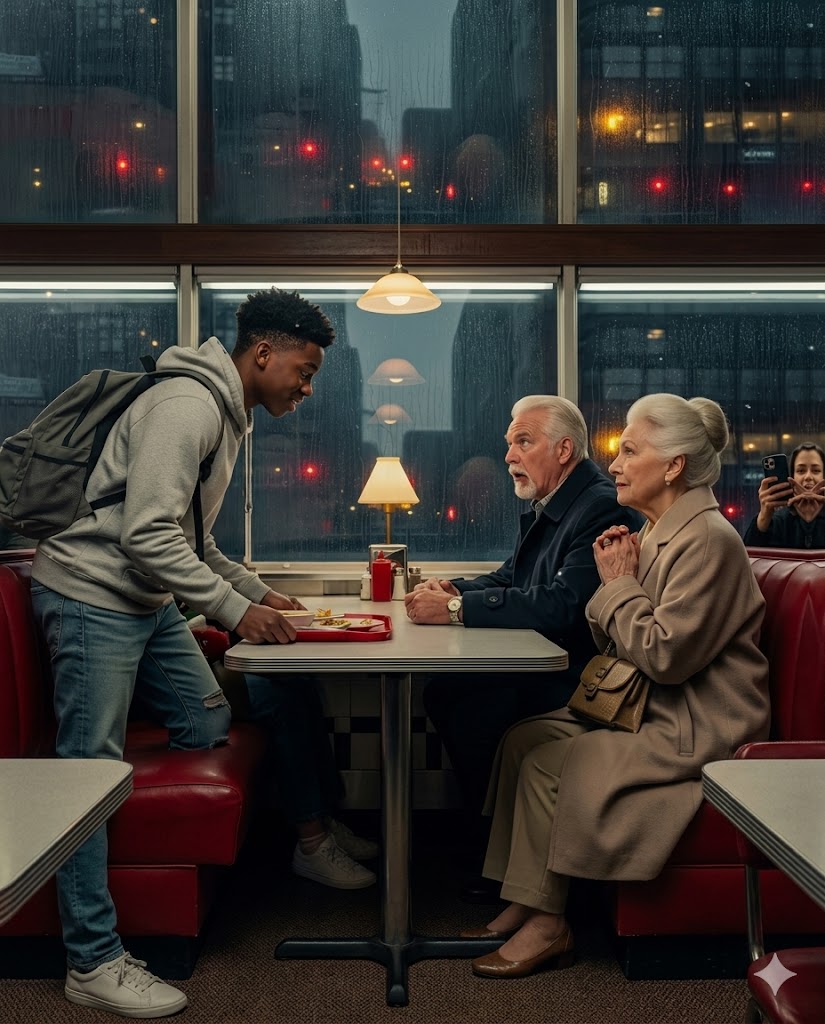
Black Boy Sacrificed His Meal for an Old Couple’s — Next Day, a Millionaire Knocked on His Door
Part 1: The Weight of a Meal
The fluorescent lights of Murphy’s Diner hummed with a low, agonizing buzz that seemed to vibrate through Darius Johnson’s very bones. He stood at the sink, the mountain of plates in front of him a testament to his reality. At seventeen, his world was bounded by soapy water, the scent of industrial cleaner, and the ticking clock that governed his meager eight-dollar-an-hour wage. He moved with a practiced, hollow efficiency, his hands calloused and raw, his mind constantly occupied by a singular, gnawing question: How much more for the rent?
Through the small window above the dish pit, Darius watched the parking lot. He saw families bundling into minivans for school, business people striding to their cars with their phones pressed to their ears, and teenagers laughing as they headed to their first periods. They existed in a universe that felt worlds away from the one where he navigated potholes, duct-taped windows, and the fragile health of his grandmother, Miss Ruby.
Miss Ruby was seventy-three, a woman whose spirit was iron but whose lungs were paper. Back at the sagging house on Elm Street, she would be listening for the front door, pretending to sleep when he left for his pre-dawn shift because she couldn’t bear to let him see her worry. She was his entire world, and every dish he scrubbed was a brick in the fortress he was desperately trying to build to keep her safe.
When his shift ended at 7:15 a.m., he didn’t head home. He headed to Roosevelt High, a crumbling brick monument to neglected dreams. But inside those walls, Darius shed his skin. He wasn’t the dishwasher anymore; he was the student with the highest GPA in his grade, the kid who devoured scholarship pamphlets like they were life-saving medicine. Mrs. Patterson, his English teacher, watched him eat his peanut butter sandwich at lunch while he pored over university brochures.
“You have a gift, Darius,” she told him one afternoon, her voice thick with conviction. “Don’t let the circumstances of today dictate the trajectory of tomorrow.”
“I can’t afford tomorrow,” he replied, though the pamphlets remained open on his lap.
After school, he returned to Murphy’s for the evening shift. It was a grind that broke most people, but Darius had a secret: he was saving. For three days, he had skipped the cafeteria lunch, walked the three miles to work to save the bus fare, and denied himself even a soda. Tonight, he would do something he had never done before. He would buy a full meal from the menu. He would sit at a table. He would eat like a customer.
As he reached for his tray, his movements stalled. At Table 6—the corner booth usually reserved for romance—sat a couple who clearly didn’t belong in Murphy’s. An elderly white couple, shivering in soaked designer wool. The woman’s silver hair dripped onto a coat that cost more than his entire house. The man sat ramrod straight, clutching an antique gold pocket watch as if it were an anchor. They had ordered coffee, nothing more, and they were nursing the cups as if they were a life raft in a sea of indifference.
Darius watched as the woman opened her purse for the fourth time, her movements growing frantic. She dumped the contents—tissues, glasses, mints—on the table. No wallet. No money. Her husband frantically patted his coat, his face turning a sickly shade of pale. They were stranded, soaked, and humiliated. He moved to leave, their dignity fractured, but the storm outside raged with a predatory intensity.
Darius’s burger and fries sat on the counter, the smell of savory beef calling to his empty stomach. Three days of sacrifice sat on that tray. He looked at the couple, at the way the woman’s shoulders slumped, and felt a sudden, inexplicable shift in his chest. He didn’t think about his rent. He didn’t think about the three miles he’d have to walk home in the dark. He just knew.
Part 2: The Choice of a Lifetime
Darius didn’t think; he simply acted. He grabbed the tray, the heat of the burger radiating against his palm, and walked across the checkered linoleum toward Table 6. Sandy, the evening waitress, hovered nearby, her face tight with the silent resignation that always accompanied customers who couldn’t pay.
“Folks,” Darius said, his voice dropping into the quiet, respectful tone he used for Miss Ruby. “This one’s on me tonight.”
The couple froze. Harold, the man, looked up. His blue eyes were piercing, sharp enough to cut glass, but they softened as they scanned Darius’s worn work clothes and the grease-spattered apron. Margaret, his wife, blinked back tears.
“Oh, sweetheart,” she breathed, her voice trembling. “We couldn’t possibly.”
“Please,” Darius insisted, sliding into the booth without invitation. “My grandmother always says kindness is the only thing that multiplies when you give it away. I’m Darius.”
Harold extended a hand. It was steady, strong, and felt strangely calloused for someone dressed in such finery. “I’m Harold. This is my wife, Margaret.”
They talked. Not about the car or the storm, but about life. Darius found himself opening up about Roosevelt High, his dream of studying business administration, and his quiet, fierce devotion to Miss Ruby. For an hour, the diner ceased to exist. Harold listened with an intensity that made Darius feel, for the first time, like he wasn’t invisible.
“You work hard,” Harold noted, his gaze lingering on Darius’s rough hands. “And you tutor for free? Why?”
“People need help,” Darius replied, shrugging. “And I have the time.”
“Time is the only thing we never get back,” Harold mused.
When Pete’s tow truck arrived to pull their Mercedes out of the mud, the mood changed. Harold and Margaret stood up, their grace restored. As they reached the door, Harold turned back. “Darius Johnson,” he said, rolling the name around in his mouth. “You’ve done something very rare tonight. We don’t forget kindness.”
He didn’t leave a tip. He left a napkin with his contact information written on it, treating it like a high-stakes bond. As they disappeared into the night, Darius sat back down, his hunger gone, replaced by a strange, humming curiosity. He hadn’t just fed two strangers; he felt like he had participated in a secret performance.
The next morning, the diner was different. Sandy couldn’t stop talking about them. “They were acting like they were conducting an investigation, Darius! Who walks into a Murphy’s looking like royalty and forgets their wallet?”
“Just bad luck,” Darius said, though his gut told him otherwise.
“Funny thing,” Sandy added, lowering her voice. “Pete said when he got to their car, the battery was disconnected on purpose. Like they wanted to be stranded.”
Darius frowned. “Why would anyone do that?”
“Beats me.”
The mystery burned in his mind all through his morning shift, but it took a backseat to the call he received at noon. Principal Martinez, a man who never summoned students to his office without cause, was on the line. “Darius, you need to come in. Immediately.”
When he arrived, Harold and Margaret were already there, sitting in the office with official-looking blueprints sprawled across the desk. The principal looked at Darius with wide, bewildered eyes. “Darius, do you know these people?”
“I know them,” Darius said, his heart hammering against his ribs.
Harold stood, his presence now commanding the small office. “Darius, we’ve been watching you for three days. Your grades, your work history, your neighbors, your grandmother.”
He tapped the blueprints on the desk. “We’re building a foundation, and we need someone who understands that kindness isn’t just a sentiment—it’s a strategy.”
Darius stared at the papers. It was a proposal for a massive community development center, and his own name was printed at the top. His head spun. “Is this real?”
“The question,” Margaret said, her voice steel, “is not whether it’s real. The question is, are you ready to lead it?”
Part 3: The Blueprint of Dignity
The office was so quiet you could hear the distant roar of the city outside. Darius looked from the blueprints to Harold, then to Margaret, and finally to Principal Martinez, who looked like he was witnessing an alien landing.
“You’ve been watching me?” Darius asked, his voice barely a whisper.
“We’ve been assessing you,” Harold clarified, his pale eyes searching Darius’s face. “The diner last night was the final phase of a three-day evaluation. We needed to see if you would give what you couldn’t afford to lose to people who couldn’t pay you back. You didn’t hesitate.”
Darius felt the floor beneath him shift. The burger. The three days of saved bus fare. The walk home in the dark. It hadn’t just been an act of charity; it had been a crucible.
“Why me?” Darius managed to ask, his voice catching. “There are thousands of kids with higher test scores, better backgrounds…”
“Test scores measure knowledge,” Margaret interjected, her posture radiating elegance and command. “They don’t measure the capacity for empathy. We are launching a $25 million initiative to revitalize this neighborhood. We don’t want a project manager who treats this like a portfolio item. We want a director who treats it like home.”
She gestured to the blueprint of a facility that looked like something from a dream—a medical clinic, a library, a high-tech job center, all where the Riverside Mall had rotted for a decade.
“It’s not just a center,” Harold added. “It’s a firewall against the kind of poverty that keeps your grandmother struggling. But it only works if the person running it knows the names of the people living on Elm Street.”
Darius looked at his own reflection in the office window. He looked like the same dishwasher from Murphy’s, but his posture had changed. The weight of his debt—$150,000 of it—suddenly seemed like a small number compared to the scope of this vision.
“I have school,” Darius reminded them, his voice gaining strength. “I can’t run an organization and attend college.”
“That’s why the scholarship is full-ride,” Margaret said, sliding a contract across the desk. “And the internship program is designed to integrate your coursework with the construction of the center. You won’t be choosing between your future and your community. You’ll be building them simultaneously.”
Principal Martinez cleared his throat. “Darius, if you take this, the school district has agreed to fast-track your independent study credits. We want this to happen.”
Darius looked at the contract. The starting salary listed was more than his entire family had earned in five years. He thought of Miss Ruby. He thought of the duct-taped windows. He thought of the shame he felt every time he had to count coins to see if he could afford milk.
“I need to tell my grandmother,” he said.
“She already knows we’re coming,” Harold replied with a cryptic smile. “We had a lovely conversation with her this morning while you were in class. She’s… a remarkable woman.”
The shock hit him again. They had been to his house? They had talked to Miss Ruby? He felt a strange blend of violation and relief.
“She didn’t tell me,” Darius said, his heart racing.
“She knew you had to discover this on your own terms,” Margaret said, her voice softening. “She’s been waiting for someone to recognize who you really are, Darius. She told us she’s been praying for this.”
Darius signed the paper. As the ink hit the page, he felt the air leave the room—not in panic, but in the release of a breath he had been holding for seventeen years. He stood up, but as he turned to leave, a thought struck him.
“Wait,” Darius said, turning back. “If the car trouble was staged… if the whole thing was a test… then the money you couldn’t find in your wallet… it wasn’t lost?”
Harold laughed, a dry, sharp sound. “Oh, we had the money. We wanted to see what you’d do if you thought we were truly destitute. Anyone can be kind to a billionaire. It takes a different kind of human to be kind to an elderly couple who have nothing.”
Darius nodded, understanding the stakes. He walked out of the office, his heart beating in sync with a future he was still trying to visualize. As he hit the hallway, his phone buzzed. It was an unknown number. He answered it.
“Mr. Johnson? This is the foreman of the Riverside Mall site. We’ve got a problem with the foundation pouring. We need the director on-site.”
Darius straightened his back. “I’m on my way.”
Part 3: The Architecture of Hope
The Riverside Mall site was a wasteland of concrete and rebar, a scar on the landscape that had festered for years. But today, it was a beehive of activity. As Darius pulled up in his beat-up Ford, he saw the yellow machinery of the Whitmore Foundation chewing through the debris.
He didn’t feel like a dishwasher. He felt like an architect of change. The foreman, a burly man named Gus, met him at the gate, wiping grease from his forehead. “Darius, glad you’re here. The soil samples aren’t matching the projections. If we start the foundation now, we might face settling issues in three years.”
Darius stepped into the muddy pit. He thought of the construction shifts he had worked in the summers, the way he’d watched foundations fail because of corners cut in the name of speed. He knelt, scooping up a handful of damp, dark earth. He examined it, comparing it to the geological surveys he’d been reading late at night.
“The drainage,” Darius said, pointing to a low-lying area. “It’s pooling here. We need to divert the groundwater before we pour. If we hit this with concrete today, the pressure will crack the slab within a season.”
Gus stared at him, surprised by the technical grasp. “You sure, kid?”
“I’m sure.”
For the next four hours, Darius wasn’t a student. He was a manager. He coordinated with the engineering team, adjusted the drainage plans, and managed the crews with a calm confidence that silenced the doubts of older workers. He wasn’t bossy; he was informed. He knew the cost of failure, and he wasn’t going to let this foundation be another “broken dream” in the neighborhood.
By the time the sun began to set, the plan had been adjusted. The foundation was safe. As he packed his things, Gus clapped him on the back. “Good call, Boss. Saved us a lot of trouble later.”
“Call me Darius,” he said, smiling.
Driving home, he felt the hum of the city differently. The neighborhoods he usually navigated as a survivalist now felt like a map of potential. He saw the apartment complex with the potholes and thought about the community road-repair initiative the center would fund. He saw the kids at the abandoned shopping mall and thought about the youth leadership program he was planning to launch.
He reached the house on Elm Street, but he didn’t head inside immediately. He stood on the sagging porch, listening to the hum of the neighborhood. He thought about the day he had given away his last meal. He realized then that kindness hadn’t just been a test; it had been a signal. And he had finally answered the call.
He walked inside. Miss Ruby was sitting in her recliner, her breathing easier than he had seen it in months. “The center,” she said, her voice clear. “Is it really happening?”
“It’s happening, Grandma,” he said, taking her hand. “And you’re going to be the first one to visit.”
“I don’t need a medical clinic for me, Darius,” she whispered, her eyes shining. “I need one for the mothers on this block who are terrified every time their baby gets a fever.”
“They’ll have it,” he promised.
But as he moved to make her tea, his phone vibrated with a message that stopped his heart. It was a photo—a picture of him at the construction site, taken from a distance. And beneath it, a chilling caption: “The site is vulnerable, Darius. Are you sure you’re the right person to build it?”
The sense of euphoria shattered. He wasn’t just building a center; he was stepping into a war. Someone didn’t want the mall replaced, and they were watching his every move.
Part 4: The Shadows of the Mall
The photo of him at the site wasn’t just a threat; it was a map. Someone had been watching him, documenting the construction process with the same level of obsessive detail he had used for his case files. The terror he had felt as a delivery driver returned, but this time it was tempered by something else: an instinct for defense.
He didn’t show the message to Miss Ruby. He retreated to his room, locking the door, and opened his laptop. He accessed the foundation’s secure portal, tracking the recent activity of the shell companies associated with the development center. He saw hundreds of micro-transactions—tiny, invisible attempts to reroute funds, sabotage vendor contracts, and delay equipment deliveries.
Someone is bleeding us dry from the inside, he realized.
He reached out to Harold immediately. “We have a leak,” he told the billionaire. “Someone is sabotaging the foundation’s logistics. They’re tracking my movements at the site.”
Harold’s response was immediate and gravelly. “I suspected as much. Stay put. We’re deploying an independent security audit. Do not, under any circumstances, reveal that you know about this.”
The next week was a dance of deception. Darius went to the site, acted the part of the oblivious director, while his foundation’s internal auditors combed through the digital infrastructure. It was like working on a car engine while the vehicle was moving at eighty miles an hour.
He had to maintain the charade for the sake of the center. If he let on that he knew, the saboteur might vanish, and he needed to know who was trying to destroy the foundation.
One afternoon, he found the source—not in a person, but in a piece of code. A hidden script within the foundation’s supply chain management software that was quietly inflating prices and diverting a small percentage of funds to an offshore entity. He didn’t delete it. He mirrored it, tracing the origin point back to a server located in a small, obscure firm in the suburbs—a firm owned by none other than the project’s primary contractor.
The betrayal was local. The contractor who had promised to help revitalize the neighborhood was the one siphoning its resources.
Darius felt a cold, sharp anger. He wasn’t a child anymore, and he wasn’t a dishwasher who could be ignored. He was a director. And he was going to turn this sabotage into a trap.
He scheduled a meeting with the contractor, feigning ignorance. “We need to expand the foundation’s budget for the next phase,” he told him, his voice trembling just enough to be convincing. “We need to divert another $2 million for ‘operational infrastructure.’ Can you handle that through your channels?”
The contractor’s eyes lit up. “Of course, Darius. I can definitely make that happen.”
“Good,” Darius said, his heart hammering against his ribs. “The transfer will be initiated on Friday.”
As he left the office, he knew he had just given the saboteur exactly enough rope to hang themselves. But as he stepped outside, a dark sedan pulled to the curb, and the window rolled down. A man sat in the driver’s seat—a man Darius recognized instantly. It was the same man who had cornered him after the fire fifteen years ago.
“You’re making a mistake, Darius,” the man said, his voice flat. “You’re playing a game you don’t understand. Stay in your school. Stay with your center. If you touch this contract, you won’t just lose the foundation. You’ll lose everything.”
The car sped away before Darius could speak. The man from the fire—he was behind this. And he had been for fifteen years.
Part 5: The Master’s Gamble
The encounter with the man from the fire left Darius shaken, but not paralyzed. The realization that his past and his present were inextricably linked shifted his entire perspective. This wasn’t about a community development center; it was about the original sin of his neighborhood—the fire that had been meant to burn Evelyn Carter out of existence.
He called Harold, his voice tight. “The man from the fire… the one who told me to disappear… he’s back. He’s running the sabotage.”
Harold was silent for a long time. “I suspected he was involved, but I didn’t think he had the reach to touch you.”
“He’s been watching me for fifteen years, Harold. Waiting for me to become something worth silencing.”
“Then we change the game,” Harold said. “If he wants to play with shadows, we’ll shine a light on them so bright he’ll have nowhere to hide.”
The foundation’s plan became a multi-layered counter-intelligence operation. They wouldn’t just stop the sabotage; they would use it to expose the entire network behind the original fire. Darius continued his performance, acting the part of the naive, ambitious director, while Patricia and a team of forensic accountants mapped the flow of the stolen funds from the foundation into the accounts of the people who had orchestrated the “accident” fifteen years ago.
The Friday transfer was the pivot point. Darius initiated the $2 million transfer—a phantom sum that was being routed directly into a decoy account monitored by federal agents.
He met with the contractor, his palms sweaty, his heart racing. “The transfer is done,” he said. “The funds are in the infrastructure account.”
“Excellent,” the contractor said, already on his phone, signaling his partners.
Within minutes of the transfer, the entire offshore network activated, attempting to pull the funds into a final, untraceable shell company. But they didn’t know about the trapdoor. The moment they touched the money, the software locked, tracing every hop, every proxy, every single IP address involved in the routing.
As the digital net closed, Darius felt a strange sense of liberation. He wasn’t just a boy from Elm Street who’d gotten lucky; he was the person who was finally closing the door on the trauma that had haunted his life.
But then, his phone buzzed. Another picture. This one was of Miss Ruby sitting on their porch, unaware of the lens focused on her. “Tick tock, Darius. Are you ready to see what happens when the foundation falls?”
The threat wasn’t to him. It was to the one thing that made his life worth living. He had to act, and he had to act now. He didn’t wait for Harold’s permission. He grabbed his keys, knowing that the trap for the saboteur might be a trap for him as well. He had to get to Miss Ruby.
Part 6: The Eye of the Storm
Darius’s drive home was a blur of adrenaline and cold calculation. He ignored the speed limit, ignored the rules of the road, his mind entirely focused on the frail, silver-haired woman sitting on that sagging porch. If the man from the fire was going after Miss Ruby, then the rules of the game had fundamentally changed.
He screeched into the driveway just as a dark vehicle was pulling away from the curb. He didn’t think about the risk—he lunged out of his car and sprinted toward the porch. “Grandma!” he shouted, his voice echoing off the houses on Elm Street.
Miss Ruby was sitting exactly where he left her, but she wasn’t alone. A man in a nondescript suit was standing near the edge of the steps, his back to Darius.
“Don’t move,” Darius commanded, his hand darting into his pocket to find the phone he had been given to trigger the security team.
The man turned. It was not the man from the fire. It was someone much younger, someone he hadn’t seen before. The man looked at Darius, his expression bored. “Relax, Parker. We’re just delivering a message.”
“What kind of message?”
“The kind that says you need to cancel the Friday audit.”
Darius didn’t wait. He clicked the button on the phone. Within seconds, a black SUV roared around the corner, its tires screeching as it boxed in the dark vehicle that was trying to speed away. Men in tactical gear erupted from the SUV, their movement disciplined and frighteningly efficient. The man on the porch didn’t try to fight. He simply raised his hands, a smirk dancing on his lips.
“You really think this stops it?” he asked.
“It stops you,” Darius said, breathless.
As the security team secured the area, Evelyn Carter herself emerged from the back of the SUV. She looked out of place in the working-class neighborhood, her presence a magnet for every eye on the street.
“Are you all right?” she asked Miss Ruby.
Miss Ruby, ever the matriarch, looked at Evelyn with unimpressed, sharp eyes. “I’m fine, dear. But I’d appreciate it if you kept your drama off my lawn.”
Evelyn almost smiled. She turned to Darius. “The team traced the signal from the warehouse back to a rental unit three blocks from here. They found the entire operation.”
“Is it over?”
“It’s just beginning,” she said. “Now that we have them in custody, we can start asking the questions that lead to the man from the fire.”
Darius looked at the house he had grown up in, the place he had tried to protect by being small and invisible. He realized that the protection had only kept him in the dark. By stepping into the light, by letting the world see him, he had finally gained the power to defend the things he loved.
But as he turned to help Miss Ruby inside, he noticed a small, folded piece of paper tucked under the doorframe. He picked it up. It was a photograph—not of him, not of the site, but of the center as it would look when it was finished.
On the back, written in the same precise handwriting as the note in the restaurant: “Construction begins at dawn. Make sure the foundation is solid.”
Part 7: The Foundation of Legacy
Construction began at dawn, but it wasn’t just physical labor. It was a total restructuring of the neighborhood’s future. The Darius Johnson Community Development Center rose from the ashes of the old mall like a testament to the fact that integrity could indeed build empires.
The medical clinic opened its doors, staffed by local nurses and visiting specialists, providing care for the mothers who had once had to travel miles for basic treatment. The job training center became a hub of energy, where veterans, students, and unemployed neighbors learned the skills that led to real, sustainable careers.
One year later, the center was the heartbeat of the community. Darius, now a scholarship student at State University, managed the daily operations. He wasn’t a dishwasher anymore; he was a leader, a mentor, and a force of nature.
He sat in his office—a space that overlooked the thriving playground and the bustling library—and looked at the photograph of Miss Ruby that sat on his desk. She was healthy, vibrant, and no longer dependent on the oxygen tank that had once defined her life.
There was a knock at the door. It was Harold and Margaret. They walked in, looking like a regular couple visiting a grandson, but there was a new energy in their stride.
“We’ve been reviewing the first-year metrics,” Harold said, sliding a document across the desk. “The foundation’s goals weren’t just met—they were doubled.”
Darius looked at the numbers: the people served, the jobs created, the lives improved. “It wasn’t just me,” he said.
“It was the community,” Margaret agreed. “You gave them the resources, but they were the ones who built the future.”
“What’s next?” Darius asked.
“What do you want it to be?”
Darius looked out the window at the kids playing in the park, the neighborhood transformed from a place of “broken dreams” into a cradle for new ones. He realized he didn’t want to expand to another city or build a bigger empire. He wanted to deepen the roots here.
“We build another center,” Darius said. “A vocational training program for the local high school. We don’t just teach jobs; we teach ownership. We help them start their own businesses.”
Harold smiled, the sharp, calculating edge of his gaze replaced by something that looked remarkably like peace. “That sounds like a legacy.”
As the Whitmores left, Darius picked up his phone. He had a meeting with the local board to discuss the new program. As he walked out into the thriving center, he felt the weight of his father’s old work clothes—figuratively—and the lightness of his own purpose. He walked through the library, greeted by neighbors who now saw him not just as a neighbor, but as a symbol of what they were capable of.
He was Darius Johnson, and he had built a foundation that no fire could ever touch. He was the one who had finally turned the crooked wing into a flight path. And as the sun hit the golden logo on the front of the center, he knew he was exactly where he was supposed to be.
He stood in the lobby, greeting a young woman who looked exactly like he did when he was seventeen—exhausted, hopeful, and searching for a way forward.
“Welcome,” he said, his voice ringing with the quiet, unshakable power of a man who had survived the dark. “What can we build together today?”