Black Wife Never Let On She Spoke Fluent French — Until She Heard What He Said Behind Closed Doors
Part 1: The Invisible Wife
The marble floors of the Ashford mansion were cold, even in the height of a Manhattan summer. Stella Foster stood in the center of the foyer, her reflection caught in the polished surface of a console table she hadn’t chosen, in a house that refused to know her name. She had lived here for three years, yet she was as much a part of the architecture as the twenty-foot ceilings or the imported velvet drapes.
Vivian Ashford, Grant’s mother and the iron-willed matriarch of the Ashford Wine Group, drifted past her without a glance. Vivian stopped, her heels clicking a sharp rhythm on the stone, and turned to address Grant. She didn’t speak to Stella; she waved a hand at her, a dismissive gesture that felt less like a greeting and more like shooing a stray animal from a porch. She spoke in French—fluid, sharp, and dripping with disdain.
“It is exhausting, Grant,” Vivian said, her tone as cold as the marble. “The way she carries herself. It’s like watching a child try to play house in an empire.”
Grant Ashford, heir to the luxury wine fortune, leaned against the banister and laughed. It was a soft, indulgent sound. He didn’t defend his wife; he didn’t even look at her. He merely smirked, sipping a glass of vintage Bordeaux.
Stella stood still, her posture poised, her expression a mask of practiced neutrality. She placed her glass down on the side table with a faint clink. “Dinner is lovely tonight, Vivian,” she said, her voice soft and steady.
There was no answer. Not even a flick of the eyes. To them, she was a statue that had accidentally learned how to speak.
But beneath the surface, the silence in the room was a lie. Stella heard everything. Every slur, every cutting critique of her background, every sneer disguised as a French pleasantry. She understood it all. She had always understood. Three years of being swallowed whole by this family, three years of being a prop for their board meetings and a centerpiece for their galas.
She walked toward the stairs, her pulse steady despite the fury coiling in her gut like a serpent. She reached the landing and headed toward her daughter’s room. Lily, only two years old, was the only thing in this house that was truly hers. As she passed the door to the library, she heard her husband’s voice from inside, low and urgent, still in French.
“She’s just the image, Mother. The board wants the optics, we give them the optics. It’s a transaction. Nothing more.”
Stella stopped, her hand hovering over the doorframe. That sentence didn’t just hurt; it tore something wide open. She wasn’t a wife; she was a billboard. She thought of the day they met, the way Grant had looked at her with such feigned devotion, and the way she had foolishly believed in the life they were building.
She turned away from the library and walked into the nursery. She needed to breathe. She needed to remember who she was before the Ashfords turned her into furniture. She reached into her pocket and felt the cold, hard outline of her phone. Tomorrow was Sunday. The weekly brunch. Fourteen seats, white linen, and the same game of pretending she couldn’t understand a word they said. She was keeping count. Every insult was a tally mark on her soul, and she was waiting for the final one to break the dam.
Part 2: The Sunday Brunch
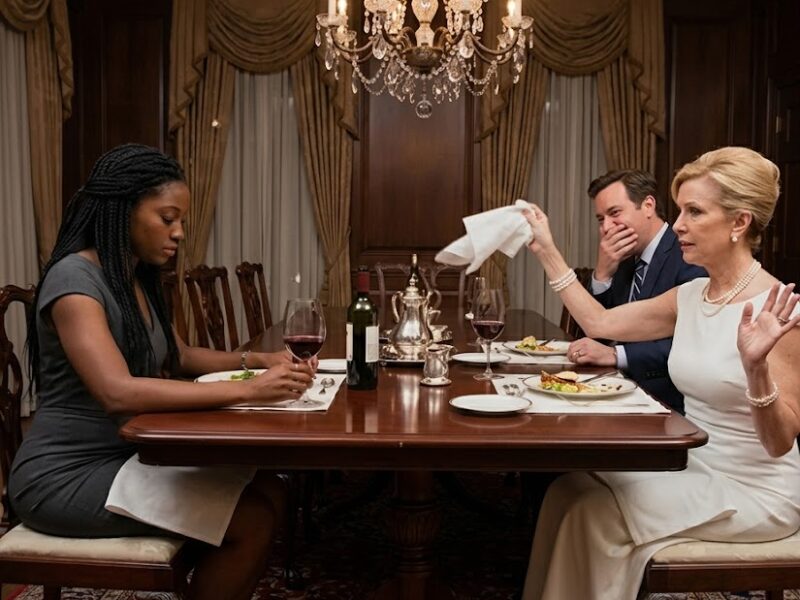
Sunday morning arrived with the stifling formality of a funeral. The dining room was bathed in golden light, but the air felt thin. Fourteen chairs sat around the mahogany table, and every single one was filled with the icy elite of the Ashford social circle.
Vivian sat at the head of the table, looking like a queen overseeing a court of sycophants. Beside her sat Colette, Grant’s younger sister, who possessed all of her mother’s malice and none of the social grace. Stella sat near the end, sipping her orange juice, her face a serene, unreadable canvas.
Vivian leaned over to Colette, not bothering to lower her voice. She didn’t have to; in this room, Stella was a ghost.
“Watch how she holds the glass,” Vivian remarked, her French impeccable. “You can take the girl out of the ghetto, but you can never take the ghetto out of the girl.”
Colette stifled a laugh behind her linen napkin. “Does she ever suspect, Mother? Does she ever wonder why we only speak French in her presence?”
Vivian smiled, a thin, cruel line. “Please. She can barely read a menu in English. She’s decorative, Colette. Like the flowers. You don’t ask the flowers if they understand the conversation.”
Grant entered the room then, leaning down to kiss his mother’s cheek. He sat beside Stella, but he didn’t reach for her hand. He didn’t ask what was funny. He simply started in on his breakfast.
Stella spread butter on her toast. Her movements were slow, measured, and agonizingly deliberate. Beneath the table, her left hand pressed hard against her thigh. Her knuckles were white, her heart rate steady as a drum. She wasn’t just listening; she was cataloging.
You think I’m an illiterate child, she thought. You think I’m a charity case you can discard once your African expansion is secure.
She remembered the prenup. She had signed it without reading it, trusting the man who whispered promises of forever. She knew better now. That document wasn’t a contract of marriage; it was a leash. And she had handed them the end of it.
After the meal, as the guests drifted toward the conservatory, Stella slipped away to her bedroom. She locked the door—a small rebellion, but one that felt like a victory. She reached into her closet, behind a row of designer handbags, and pulled out a worn, spine-cracked French novel.
It was a treasure, filled with her own margin notes in perfect, sophisticated French. She lay on the bed and began to read aloud, the words flowing from her tongue like water. It was a release, a return to the person she was before the mansion.
Then, she picked up her phone and dialed a number in New Orleans. Her grandmother answered on the second ring, her voice warm, rough, and sounding like home.
“Everything is moving into place, Grand-mère,” Stella whispered in French Creole, the stiffness of her posture finally breaking. She laughed, a genuine sound that didn’t belong in this cold, marble house. She talked about Lily, about the way the child clapped when she heard music, but she didn’t say a word about what Vivian had said at the table. Some burdens were too heavy to share. She carried them so the people she loved didn’t have to.
She hung up, pulled out a leather journal, and added a date and a time to a list that was growing longer by the day. She heard a car pull into the driveway. Grant was home early. She shoved the journal behind the bags just as the door handle rattled. The mask went back on.
Part 3: The Library of Secrets
The door opened and Grant stood there, his jacket thrown over his shoulder. He saw the novel on the nightstand. His eyes narrowed, then transformed into that condescending, pitying smile he reserved for her.
“Trying to learn, Stella?” he chuckled, picking up the book and flipping through the pages. He didn’t see the complex annotations. He didn’t see the depth of her analysis. He just saw a book, and to him, it was a toy she was trying to play with. “That’s adorable. Maybe stick to the tabloids, hmm? Don’t strain yourself.”
He dropped the book on the bed and walked out without a backward glance. He never looked close enough to see the truth.
That evening, the house was tense. Margot, the housekeeper, was in the nursery, cleaning while Stella fed Lily. Margot, believing herself to be in a house of deaf ears, spoke into her phone.
“Madame Vivian says the black one is not to be in the sitting room tomorrow,” Margot said, her voice loud and grating. “She is an embarrassment. She says to lock the room if she tries to enter. Can you imagine? A mother-in-law locking a room to keep out her own son’s wife?”
Margot laughed. “Three years and she still cannot say a proper hello in French. She is not even pretty enough to justify the trouble anymore. The novelty is gone.”
Stella didn’t flinch. She wiped Lily’s chin with a cloth, her touch gentle, her heart a frozen block of ice. Her jaw tightened just once—a tiny, invisible ripple in her perfect composure. She finished feeding her daughter, burped her, and tucked her into the crib, kissing her forehead with a tenderness that defied the ugliness surrounding them.
Then, she walked to the closet. She opened the leather journal. She wrote down every word Margot had said, the time, the date, and the tone. Her handwriting was elegant, precise, and utterly devoid of emotion.
When she was finished, she walked downstairs to set the table for dinner. The table where they would laugh in a language they were certain she couldn’t touch.
Stella Foster had cracked that language before she was six. She remembered the house in New Orleans—the leaking roof, the leaning porch, the stack of books everywhere. Her grandmother, who had fled Haiti in 1962 with nothing but a language, had taught her how to survive.
Language is a weapon, baby girl, her grandmother had told her the night before her wedding. Never show it before the right moment.
Stella had carried that advice like a loaded gun for three years. She had spent two years teaching English in Lyon, she spoke Italian, she knew Spanish, and she dreamt in Creole. She was a master of tongues in a house of fools.
She set the silverware, her eyes distant. Philipe Renault, the wine mogul from Bordeaux, was coming to dinner tomorrow. He was a man of tradition and intelligence. If anyone would notice the cracks in the Ashford facade, it would be him. Stella felt a strange, electric anticipation. The moment her grandmother had promised was drawing near.
Part 4: The Dinner of Lies
The restaurant in Midtown was an oasis of hushed elegance. There were no prices on the menus, no need for them in a place where wealth was measured in legacy, not currency. Philipe Renault sat at the head of the table, his presence commanding. He had been the exclusive partner of the Ashford Wine Group for over a decade. This dinner was the cornerstone of their future.
Grant wore his best navy suit, and Vivian was draped in pearls that cost more than a small home. Stella wore a simple, black, understated dress. It whispered elegance, but they treated her like a coat check.
“This is my wife, Stella,” Grant introduced her, his voice breezy. “She’s… decorative.”
He smiled at Philipe, inviting him to join the joke. Philipe, however, didn’t smile. He shook Stella’s hand, his eyes lingering on hers with an unnerving intensity. “A pleasure, Madame.”
Vivian didn’t waste a second. She leaned toward Philipe, switching to French immediately. “Don’t bother with her,” she said, her tone dismissive. “She’s here for the optics. We needed a more inclusive face for the new markets. You know how it is—diversity, optics. Grant found her.”
Philipe’s jaw shifted. He looked at Stella, who sat with her hands folded in her lap, a faint, polite smile on her face.
“Honestly,” Grant added in French, “she’s easier to manage than our staff. Doesn’t ask questions, doesn’t read the contracts. She signs whatever I put in front of her.”
The main course arrived. The air smelled of truffle and expensive, aged oak. Philipe turned to Stella, ignoring the chatter of the Ashfords. “Do you enjoy wine, Madame Foster?” he asked in English.
Stella felt the urge to speak. She wanted to dive into the technicalities of tannin structures, soil composition, and the nuance of left-bank blends. She could have dismantled their entire business model in three sentences. She could have shown them exactly who she was.
She bit her tongue, swallowing the words. “I like the red ones,” she said, her voice small and sweet.
Grant laughed, clapping his hand on the table. “See? Adorable.”
Vivian rolled her eyes and went back to business. But Philipe didn’t turn away. He watched Stella for a long, heavy second—the way a jeweler examines a stone everyone else has mistaken for glass. He said nothing, but a shift had occurred. A seed of suspicion had been planted.
On the ride home, Grant loosened his tie. “You did well. Didn’t embarrass me.”
Stella looked out the window, watching the city lights blur. “I try,” she said, the edge in her voice buried deep.
But the drip of poison continued. At the country club, at the Hermes store, in the halls of their own home—everywhere she went, the insults fell. And everywhere, she was listening. She was a ghost in her own life, recording every humiliation, every lie, every instance of their cruelty. She was waiting for the gala. Three hundred guests, the press, the partners—it was the perfect stage.
Part 5: The Architecture of Destruction
The house was empty. It was Tuesday, and the silence felt heavy, like the calm before a hurricane. Stella sat in the nursery, feeding Lily, when she heard the voices from the home office. The door was ajar, the light spilling into the hallway.
Grant and Vivian were speaking French, their voices low and sharp.
“The Africa contract closes next month,” Vivian said. “Once the funds are secured, we move forward with the divorce. No delays.”
“The lawyers have everything drafted,” Grant replied. “She won’t see it coming. The prenup is airtight. She signed it like a child handing over a permission slip. She doesn’t even know about the offshore accounts in Zurich and the Caymans.”
Stella stood in the hallway, her back pressed against the wall, her phone recording. Her hands were perfectly steady. She felt no shock, no grief—only the cold, surgical focus of a strategist.
“And Lily?” Vivian asked. “Full custody. We argue she’s unfit. No income, no education, no family support. She’s a woman from the projects with no connections. We’ll paint her as unstable.”
Grant laughed. “Marrying her was a charity case that went too far. A pretty face from the gutter. Useless for everything else. At least she gave me the girl.”
“I need a vacation just to recover from having her at my table,” Vivian spat. “After the divorce, you’ll never have to see her again.”
Stella waited until they changed the subject to quarterly projections before she stepped away. She walked to the bedroom, locked the door, and dialed Eleanor Hayes, a high-asset divorce attorney who didn’t know the meaning of the word ‘impossible.’
“I have the evidence,” Stella said, her voice clear and hard. “Everything. The offshore accounts, the plan, the custody strategy.”
Eleanor’s voice was cool, efficient. “New York is a one-party consent state. The recording is admissible. And if we prove fraud regarding the prenup, we can burn their entire empire to the ground.”
“There’s a gala in three weeks,” Stella said. “The Ashford Foundation annual event. Everyone who matters will be there.”
“What are you thinking?”
“I’m thinking it’s time to show them what I’ve been rehearsing.”
Over the next three weeks, Stella moved through the mansion like a ghost. She accessed Grant’s computer—he hadn’t even bothered to lock it, such was his contempt for her intelligence. She screenshotted the transfers. She forwarded the emails. She built a case that was airtight, undeniable, and utterly devastating.
She called Philipe Renault one last time. “I need your help,” she said.
“I am listening, Madame,” he replied, his tone one of deep, abiding respect.
He connected her with an investigative journalist who had been looking for a crack in the Ashford wall for years. Stella didn’t just have a story; she had a map of their corruption. She stood before her mirror, seeing a woman who was no longer a shadow, but a storm waiting to break. The broken clock was about to strike midnight, and the Ashfords were about to be exposed to the light of truth.
Part 6: The Gala of Truth
The ballroom at the Midtown hotel was a palace of crystal and gold. Three hundred guests filled the room, a sea of diplomats, executives, and journalists. Vivien stood at the podium, looking radiant in a white gown that cost a fortune. She spoke of legacy, of vision, and of the Ashford family’s commitment to culture.
Stella stood near the front, wearing a dress of striking, unapologetic red. It wasn’t the muted, invisible color she had been instructed to wear. It was the color of a warning.
Vivien turned to her, a rehearsed, pitying smile on her face. “And of course, my daughter-in-law, Stella. Proof of our generous spirit. We opened our doors to someone from a different world. Someone without education, without language.”
Laughter rippled through the room—polite, cruel, and rhythmic. Vivien basked in it. She expected this to be just another night of performative dominance.
Stella stepped toward the stage. The murmurs began. Grant half-rose from his chair, his face twisting in confusion. Vivien’s smile froze, turning into a mask of sudden, frantic realization.
Stella reached the podium. She adjusted the mic. She didn’t look nervous. She looked like she owned the room.
“Thank you, Vivien,” Stella said, her voice flowing into perfect, Parisian-accented French. The room fell into a silence so heavy it felt like lead. “Thank you for the introduction. And thank you for three years of speaking freely in front of me, because I understood every single word.”
Vivien’s face drained of color.
“I understood when you called me a decorative vase,” Stella continued, her voice surgical, cutting through the silence. “I understood when you said I smelled like the streets. I understood when you called my grandmother’s language—the language of a Haitian woman who raised me—a ‘savage tongue.'”
She turned to the Italian executive. She switched to Italian, fluent and effortless. “Good evening. It is a pleasure to finally speak to you directly.”
The executive sat his drink down, his mouth hanging open. She switched to Spanish, turning to the delegation. She spoke for a minute, their faces shifting from shock to absolute, mesmerized respect.
Then, she switched to English, her voice ringing out across the ballroom. “My name is Stella Foster. I hold a degree in French literature from Howard University with highest honors. I have understood every conversation in this house for three years.”
Grant lunged forward. “Stella, stop! This isn’t the place!”
“Sit down, Grant,” she commanded. He didn’t sit, but he froze, stunned by the sheer force of her presence.
Stella pulled a folder from under the podium. She clicked a remote, and the projection screen behind Vivien filled with documents. Bank statements, emails, offshore transfers in Zurich and the Caymans.
“Three weeks ago,” Stella said, her voice echoing in the dead-silent room, “I overheard my husband and his mother discussing their plan to divorce me and seize custody of my daughter by painting me as unfit. They discussed the very assets they’ve hidden from this company and from the law.”
The room didn’t gasp. They just stared, a slow, creeping horror spreading across their faces like ink. The journalist Philipe had introduced stood at the back of the room, recording every detail. Philipe Renault stood up, and he began to clap. Slow, deliberate, echoing.
Then, one by one, the room stood up. The Ivorian CEO walked to the stage, taking Stella’s hand. “We have been talking to the wrong person, Mrs. Foster,” he said.
Security guards dragged a shouting, sputtering Grant out the side exit. Stella stood alone on the stage, the red of her dress burning in the light, the room finally seeing her for exactly what she was: a powerhouse.
Part 7: The New Beginning
The aftermath was a tsunami that wiped the Ashfords off the corporate map. By noon the next day, the story had broken across every major headline in the country: Behind the Label: The Ashford Empire Built on Fraud and Exploitation.
The stock dropped 41 percent. Board members fled. Vivien was voted out of her own foundation, her reputation in tatters, her cruelty documented in their own emails. The court case was a formality—Eleanor Hayes destroyed their defense in thirty minutes. The prenup was voided on grounds of fraud, and Stella was awarded full, sole custody of Lily.
When the judge issued the ruling, she had looked at Grant’s lawyers and said, “The only instability here was the marriage.”
Six months later, Stella stood on the balcony of her new apartment in Brooklyn, the city skyline glowing with the orange light of the sunset. Foster Global Consulting was already a massive success. Her clients were the elite of the international market—the same people who had once ignored her, now vying for her counsel.
She had hired a team of brilliant, multilingual people—people who had been told they didn’t belong in the rooms where decisions were made. She had established the Claudet Foster Language Fellowship, a scholarship for young students like her, providing them with the support she had had to fight for.
The phone rang. It was her grandmother. They talked for an hour, their conversation a beautiful, flowing river of Creole and French.
“I always knew you’d pick the right moment, baby girl,” her grandmother said, her voice filled with pride.
“I was just waiting for the perfect time to speak,” Stella replied, smiling.
She hung up and looked down at Lily, who was sitting in her lap, watching the city lights with wide, curious eyes. Stella began to hum, then to sing—the old lullaby, the one that had carried her family across oceans, through poverty, and into this life.
She sang it loudly, clearly, and with a voice that was finally free. No one told her to stop. No one ever would again. She was the architect of her own destiny, and she was just getting started. The room, the table, the seat at the end—they were things of the past. She had walked out of the shadows and into the center of her own light, and she was never going back.









