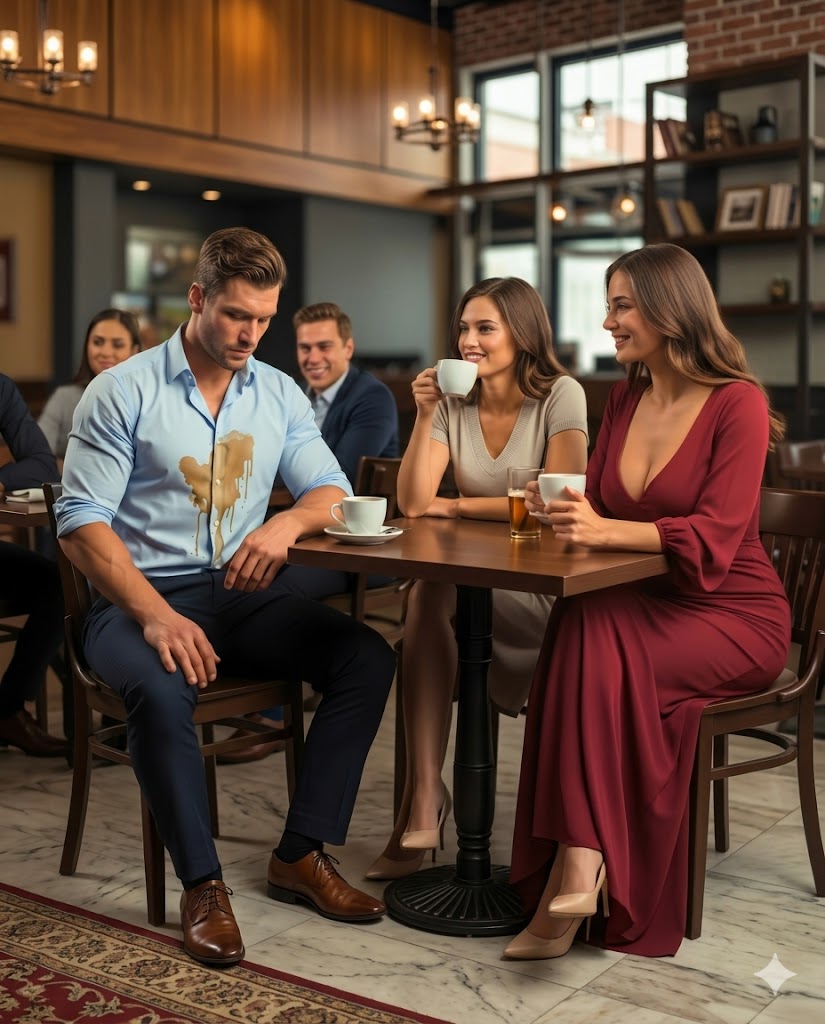
Bully Mocked a Single Dad in a Café — Until He Moved Like a Delta Force Legend
Part 1: The Silence of the Watcher
The morning had started like any other Saturday at the small, neighborhood cafe. It was a local haunt—the kind of place where the coffee was strong, the pastries were fresh from a bakery two blocks away, and the regulars had their own designated corners. The noise level was typical: voices overlapping in a dull hum, the hiss of the espresso machine, and the clinking of ceramic against saucers.
Ethan Cross sat in the corner booth, his back firmly to the wall. It was an old habit, one he hadn’t bothered to break even though he had been a civilian for nearly a decade. From this vantage point, he could see the entrance and every face that entered the room without turning his head. He was forty-four, lean and unremarkable, wearing a faded gray Henley and jeans that had seen better days. To anyone passing by, he looked like just another man nursing a black coffee, trying to kill a Saturday morning.
The watch on his left wrist was the only thing that hinted at a different history. It was military-issue, scratched, heavy, and functional—the kind of gear a man kept not because it was stylish, but because it had survived everything he had.
His phone buzzed on the table. He glanced down. A text from his daughter, Lily. She was twelve, and she was the anchor of his entire existence. Don’t forget. Pick up at 3:15. Love you, Dad.
Ethan typed back with one hand, his thumb moving with practiced ease: I won’t forget. Love you too.
He set the phone down and looked out the window. Lily was the reason he was still anchored to the world. She was the reason he had walked away from everything else when his wife, Sarah, had succumbed to cancer six years ago. Raising her alone had been the hardest mission of his life. There were no manuals, no tactical briefings, and no backup teams. Just him and a little girl who used to cry in the middle of the night, asking questions he didn’t know how to answer. He had learned. He had braided hair, learned the names of every classmate, and sat through endless soccer games, always present, always steady.
The cafe started to fill up. Families with strollers occupied the middle tables; college students spread out laptops and textbooks; a line formed at the counter. The noise level rose, but Ethan filtered it out, a skill honed by years of focus. He was finishing his coffee when Miller walked in.
Everyone who frequented this cafe knew Miller. He was the kind of man who made sure you did. He was tall, broad-shouldered, and wore a leather jacket that was far too heavy for the mild weather. He moved through the room like he owned the air, speaking over people, cutting in line, and demanding attention. Most people simply moved out of his way. Confrontation was expensive, and Miller was known to be a man who enjoyed the cost.
Miller scanned the room, his eyes scanning for a target, and they landed on Ethan. Something in Miller’s posture shifted—a lazy, bored sort of malice. He changed direction, his stride deliberate. He didn’t look where he was going. He walked directly toward the corner booth where Ethan sat.
Ethan saw him coming. He didn’t move. He didn’t reach for his phone, and he didn’t tense his muscles. He sat perfectly still, his hands resting on the table.
Miller didn’t stop. He turned his body at the last second and slammed his hip into the corner of the table. The impact was violent. Ethan’s heavy ceramic mug tipped over, splashing black coffee across his shirt and pooling on the table surface.
Miller stepped back, grinning. It wasn’t an apology. It was a challenge.
“Whoa,” Miller said, his voice booming for the entire cafe to hear. “My bad, man. Didn’t see you there.”
Ethan looked down at the coffee soaking through his Henley, then up at Miller. The cafe had gone quiet. The college students looked up from their screens; the mother at the next table pulled her toddler closer. Ethan didn’t yell. He didn’t jump up. He simply sat there, his eyes locking onto Miller’s. The stare was cold, empty of fear, and cut through the ambient noise like a razor.
“You should probably clean that up,” Miller said, the grin not leaving his face.
Ethan didn’t reach for a napkin. He just kept looking at Miller, and in that silence, the cafe seemed to hold its collective breath. Who was this man who didn’t back down?
Part 2: The Geometry of Conflict
The silence in the cafe was thick enough to choke on. Miller stood his ground, waiting for the explosion. He wanted the scene; he wanted the validation of an audience. Ethan, however, remained an enigma. He didn’t show the expected signs of a man who had just been provoked. There was no flushing of the face, no frantic movement of the hands, no indignant stuttering.
“I asked you a question,” Miller said, his voice rising, sensing the eyes of the patrons. “Are you deaf? I said clean it up.”
Ethan rose slowly. He didn’t rush. He stood to his full height, his movements controlled, efficient, and strangely rhythmic. He was not a large man by comparison—Miller had at least forty pounds of muscle and ego on him—but Ethan stood with a center of gravity that suggested he was bolted to the floor.
“You’re a man who likes to make messes,” Ethan said. His voice was low, devoid of any tremor. “I’m a man who prefers things clean.”
Miller stepped forward, invading Ethan’s personal space, his chest puffed out like a bantam rooster. “What are you going to do about it?”
Ethan didn’t blink. He felt the familiar, distant hum of his combat instincts, but he suppressed them. He wasn’t in a combat zone; he was in a neighborhood cafe. He was a father who had promised his daughter he would be there at 3:15.
“I’m going to tell you to walk away,” Ethan said. “This is your last chance.”
Miller laughed, a harsh, grating sound. He turned to the room, mocking Ethan’s restraint. “Hear that, folks? The tough guy wants me to walk away.” He leaned in closer, his breath smelling of bourbon and cheap tobacco. “You don’t get it, do you? I don’t walk away. I stay until I’ve finished the job.”
He shoved Ethan. It wasn’t a playful nudge; it was a deliberate, violent shove against his sternum. Ethan stepped back, his boots finding a solid anchor. He didn’t retaliate. He simply stood, his expression turning into something that made the air feel suddenly sharp.
“You’re making a mistake,” Ethan said.
“Am I?” Miller countered. He swung his right hand back, a telegraphing hook that was as clumsy as it was aggressive.
The room erupted. Sarah, the barista, gasped, her hand flying to her mouth. The older man in the flannel shirt, who had half-risen from his chair, was held back by his terrified wife.
Ethan didn’t move backward. He moved in.
He shifted his weight onto his left foot, letting the looping punch sail past his ear by a fraction of an inch. His right hand darted out, not to strike, but to control. He caught Miller’s wrist and twisted, using the man’s own momentum to spin him. In a fluid, devastatingly simple motion, Ethan hooked his leg behind Miller’s calf and pressed his palm into the joint of the shoulder.
Miller went down hard, the wind leaving his lungs in a sharp whoosh as he hit the linoleum. Before he could scramble up, Ethan was on him—not with violence, but with pinning, absolute control. He pressed a thumb against a nerve cluster behind Miller’s ear, a spot that turned the giant into a writhing, helpless child.
“I told you,” Ethan whispered into the man’s ear, loud enough for those nearby to hear. “I prefer things clean.”
Miller roared, thrashing, but he was pinned by physics and decades of muscle memory. The cafe was frozen. The college student with the phone, who had been recording, slowly lowered the device. The air was charged with the electricity of the struggle, but it dissipated as quickly as it had arrived.
“You have ten seconds to get out of this cafe and never come back,” Ethan said, standing up and stepping away, allowing Miller to scramble to his feet. “If you do, you walk out of here without an ambulance. If you don’t, I promise you, you’ll be leaving in one.”
Miller stumbled to his feet, his face a mask of purple rage and absolute confusion. He looked at the room, expecting support, but found only cold, judgmental stares. He looked at Ethan, who stood with his hands at his sides, breathing perfectly evenly, as if he’d just stood up from a nap.
Miller didn’t try again. He turned and bolted for the door, the bell jingling with a frantic, lonely sound as he disappeared onto the street.
The cafe remained silent for a long moment. Ethan turned toward the counter, his shirt still stained with coffee, his face a mask of neutral stillness.
“Sorry about the mess,” Ethan said to Sarah, the barista.
He didn’t wait for an answer. He walked out the door, the cool morning air hitting his face. He felt the cold iron of the military watch on his wrist. He was forty-four, he was a single father, and he was terrified. Not of Miller—but of the fact that the old man inside him, the one he’d tried to kill, had just woken up.
Part 3: The Call of the Past
Ethan didn’t go straight home. He drove his old, reliable truck toward the city park, a place where he could sit in the car and watch the world without being part of it. His heart was still beating too fast—a rhythmic, combat-ready pulse he’d spent six years trying to lower.
The altercation with Miller had been a test, and he had failed to pass it silently. He had left the cafe and brought the “old” Ethan into the light. He thought about Lily. He thought about the promise he’d made to Sarah before she passed. Keep her safe. Keep her away from the violence. Be the man she deserves.
He had succeeded in being that man for years. He’d kept his hands clean. He’d avoided confrontation. He’d lived in the quiet, mundane safety of middle-class fatherhood.
But a man like Miller didn’t care about promises. He didn’t care about the quiet life.
Ethan’s phone buzzed. It wasn’t Lily. It was a private number, one he hadn’t seen in half a decade. He looked at the screen, his thumb hovering over the decline button. He knew that if he answered, the life he had built—the life of the gentle, hair-braiding father—would likely cease to exist.
He answered.
“Cross,” a voice barked. It was gravelly, cold, and unmistakably military.
“You’re retired, Commander. I don’t answer to you.”
“I’m not calling as your commander, Ethan. I’m calling as a man who knows that you’re the only one who can track down the Klov network before they hit the mainland.”
“I told you I was out. I have a daughter.”
“And she’s going to be in the middle of a war zone if we don’t shut this down,” the voice said. “Klov isn’t just selling weapons anymore. He’s looking for leverage. He’s looking for people like you.”
Ethan looked at his reflection in the rearview mirror. He looked older than forty-four. He looked like a man who had seen the end of the world and was trying to build a picket fence around it.
“I’m not coming back,” Ethan said, but his voice lacked the conviction he needed.
“You don’t have to come back to the service,” the voice urged. “But you need to protect what you built. Because he’s coming for you, Ethan. He saw the video.”
“What video?”
“The one at the cafe. You’re viral, Ethan. You broke a man in three seconds flat. The whole world thinks they know who you are now. And so does Klov.”
The line went dead.
Ethan stared at his reflection, the reality of the situation dawning on him. He had spent years being invisible, and in one moment of defending himself, he had made himself a target. The quiet life was over. The secret was out.
He looked at his watch. 2:00 p.m. He had an hour before he had to pick up Lily.
He started the truck. He had to prepare. He had to figure out how to keep his daughter safe when the ghost of his past had finally tracked him down to a local coffee shop.
As he pulled away from the park, he saw a black sedan sitting at the entrance, the engine idling, the driver watching him. He didn’t panic. He just turned the steering wheel and headed in the opposite direction, his mind already working through the tactical layout of the city.
He was going to pick up his daughter at 3:15. And heaven help anyone who tried to stop him.
Part 4: The Anatomy of a Father
The drive to Lily’s school was a study in controlled anxiety. Ethan kept to the side streets, checking his mirrors every thirty seconds, his brain dissecting the movements of every vehicle behind him. It was an old rhythm—the scanning, the assessing, the constant threat assessment—that had been dormant for so long it felt like a foreign language being spoken by his nervous system.
He pulled up to the school gates at 3:12 p.m.
The kids were pouring out in a chaotic, colorful flood of backpacks and shouting. He watched them with a fierce, possessive love. His eyes found Lily in the crowd. She was walking with a friend, her face animated, her hands moving in rapid, graceful arcs of sign language.
When she saw the truck, she lit up. She broke away from her friend and ran toward him, her face a portrait of unblemished joy.
“Dad!”
Ethan stepped out of the truck, the tension in his shoulders dropping instantly as she threw her arms around him. “Hey, bug. How was your day?”
She signed rapidly, her hands moving like hummingbirds. We learned about volcanoes. I think I want to build one.
“We can definitely build a volcano,” he said, signing back.
As he buckled her into the passenger seat, he scanned the perimeter again. The black sedan from the park was nowhere to be seen, but he knew they were out there. They had to be. If Klov wanted him, he wouldn’t use a front door. He would use the things Ethan loved most.
“You okay, Dad?” Lily signed, her eyes fixed on his face. She was observant—too observant for a twelve-year-old.
“Yeah, just tired from work,” he lied, forcing his face into a mask of normalcy.
“You look like you’re thinking about the ‘Before Times,'” she signed.
Ethan felt a sharp ache in his chest. She used that phrase for the dark nights when he would wake up shouting. “Just thinking about dinner, Lily. What do you want?”
She gave him a list, the mundane reality of a grocery run helping to ground him. He drove to the store, parked in the furthest corner of the lot, and walked in, keeping Lily close.
He moved through the aisles, his eyes constantly moving. He saw a man by the produce section who seemed to be loitering too long. He saw a delivery truck idling near the loading dock with no driver in sight.
It was paranoia, perhaps, but in his world, paranoia was just another word for survival.
“Dad?” Lily signed. “You’re doing that thing again.”
“What thing?”
“The thing where you don’t hear me because you’re watching the doors.”
He knelt down, smoothing her hair. “I’m sorry, Lily. I just want to make sure we’re safe.”
“We’re always safe with you,” she signed, her expression fiercely trusting.
The weight of that trust was heavier than any mission he had ever been assigned. He had chosen this life to protect her, but he realized now that he had been living in a dream. You couldn’t hide from a man like Klov, and you couldn’t build a picket fence around the truth.
He finished the shopping and headed back to the truck. He checked the tires, the undercarriage, the interior. Everything looked fine, but he knew better than to trust appearances.
As he pulled out of the parking lot, he saw the black sedan again, parked two rows back. It didn’t follow him. It just sat there, the engine idling, the windows tinted a solid, impenetrable black.
They knew where he lived. They knew his schedule.
He didn’t head home. He drove to a hardware store, bought a few supplies he needed, and then took the long, winding road to the local park.
“Are we playing?” Lily asked.
“No, just need to change something,” he said, turning into a secluded lot.
He spent the next hour working on the truck, his hands moving with the precision of a master mechanic. He wasn’t just fixing it; he was upgrading it. He reinforced the frame, checked the fuel lines, and installed a small, unobtrusive secondary tracker of his own.
He was done playing the role of the civilian. If they wanted a fight, they were going to get one—but it was going to be on his terms.
Part 5: The Line in the Sand
The night at home was a masterclass in domestic tension. Ethan put Lily to bed, tucking the quilt around her shoulders and checking the locks on her window—not once, but twice. He sat in the living room, a kitchen knife tucked into the waistband of his jeans and a heavy iron poker from the fireplace resting within reach.
He didn’t watch TV. He didn’t read. He sat in the armchair, the room dark, his eyes fixed on the front door.
Every creak of the floorboards, every rattle of the wind against the siding, every distant sound of the city felt like an intrusion. He was waiting.
He thought about the cafe. He thought about Miller, the bully who had been so easy to dismantle. He realized now that Miller had been a test—a way for the universe to see if his instincts were still sharp, if the soldier was still there, hiding under the skin of the father.
He had passed the test. He was ready.
Around 1:00 a.m., he heard it—a subtle, almost imperceptible sound of a lock being picked. It wasn’t the brute force of an amateur; it was the calculated intrusion of a professional.
Ethan didn’t move. He let the intruder enter, let the front door swing open just an inch. He could see the silhouette of a man moving into the hallway, a figure clad in dark tactical gear, moving with the silent, predatory grace of a predator.
Ethan waited until the man was three feet from the armchair.
“You’re in the wrong house,” Ethan said, his voice flat.
The man spun, a handgun raised, but Ethan was already in motion. He didn’t jump; he exploded upward, a coiled spring released. He caught the man’s wrist, twisted, and sent the gun clattering across the hardwood floor.
The struggle was brutal, silent, and fast. The intruder was trained, clearly elite, but he was fighting a man who had survived the most violent corners of the world. Ethan slammed the man into the wall, pinning him with a forearm against the throat.
“Who sent you?” Ethan demanded.
The man struggled, his face purpling, then gave a sharp, mocking laugh. “Klov sends his regards, Cross. He says he’s going to enjoy taking everything from you—starting with her.”
Ethan’s grip tightened. The mention of Lily made his world go white. He didn’t think; he reacted. He delivered a swift, concussive blow to the man’s temple, and the intruder slumped to the floor, unconscious.
Ethan stood over him, his heart rate steady, his breathing controlled. He was breathing the same air he’d breathed in Fallujah, in Kandahar, in the killing fields of his youth.
He checked the man’s gear. A burner phone, a set of keys, a map of the local area. He looked at the map. It had Lily’s school circled.
The cold rage that had been building for days finally breached the surface. They weren’t just coming for him; they were coming for his daughter.
He dragged the intruder out to the back porch and tied him securely to a pillar. He then called Miller—the only person who knew who he really was.
“Miller? It’s Ethan Cross. I have one of Klov’s men on my porch. If you want a lead, get here now. And for God’s sake, keep it quiet.”
“Cross? You’re alive?”
“Barely. Get here.”
He went back inside, washed his hands, and went to check on Lily. She was still fast asleep, her breathing steady, her face peaceful. He looked at her and felt the terrifying truth of his existence. He couldn’t be just a father anymore. He was a guardian.
And if he had to burn the world down to keep her safe, he was finally ready to strike the match.
Part 6: The Tactical Shift
Miller arrived at the house twenty minutes later. He was alone, his face pale as he stared at the man tied to the porch pillar. He looked at Ethan—really looked at him—and the sneer he’d worn in the cafe was entirely gone.
“You’re Cross,” Miller whispered, his voice stripped of all its bourbon-soaked bravado. “The guy from the ‘lost’ missions.”
“I’m a guy who just wants to be left alone,” Ethan said, his voice cold enough to freeze blood. “But that’s not going to happen. This is your chance. Take him, take the map, and get out of my life.”
Miller looked at the map, at the circle around Lily’s school. He looked back at Ethan, his expression shifting from shock to something resembling reverence. “He’s targeting the school, Cross. He’s going to use the girl as a lure.”
“I know,” Ethan said. “And I’m going to be there waiting.”
“We can’t authorize a raid,” Miller said, his voice tight. “But I can give you the tactical support you need. I have contacts in the local PD, people who won’t ask questions if we say it’s a national security matter.”
“Do it,” Ethan said.
For the next twenty-four hours, the house was a nerve center of tactical planning. Miller proved more capable than he looked, coordinating with a team of off-the-books operatives who operated in the spaces between local law enforcement and federal intelligence.
They weren’t just planning a defense; they were planning a counter-strike.
“We need to lure him out,” Ethan explained, pointing to the map. “He’s obsessed with me. He won’t hit the school until he’s sure I’m there and that I’m exposed.”
“So, we give him what he wants,” Miller said. “A target.”
“Exactly,” Ethan said. “We make a show of sending Lily to school tomorrow. We make a show of me being there. And then, when he strikes, we hit him from three different directions.”
It was a risky, beautiful piece of tactical deception. The stakes couldn’t be higher. If they miscalculated, Lily would be in the middle of a war zone. If they hesitated, they would lose everything.
That night, Ethan sat in the living room, his daughter sleeping soundly down the hall. He didn’t feel the fear anymore. He felt a sharp, crystalline focus.
He had learned one thing in the service: fear is just a distraction from the objective. His objective was Lily’s life, and he would let nothing—not a rogue mercenary, not a corporate bully, not even his own conscience—stand in the way.
He packed his gear. He checked the weapons he had kept in a hidden floor safe. He practiced the movements of the strike, the timing of the intercept, the geometry of the takedown. He was a machine again, a tool of precision.
But as he moved through the room, he saw a drawing Lily had left on the coffee table. A stick figure of a man and a girl, holding hands, with a massive, wobbly sun in the corner.
He stopped. He touched the paper.
He was doing this for her, yes. But he was also doing it because, for the first time in his life, he had something that meant more than the mission. He had a family. And he would defend that family until his heart stopped beating.
The morning air was thick with the scent of damp earth and coming rain. The trap was set.
Part 7: The Final Stand
The school day started with a deceptive normalcy. Lily was dropped off by Miller, who played the part of the concerned neighbor perfectly, keeping an eye on the perimeter while Ethan watched from a parked van down the street.
Every parent, every teacher, every student was a potential threat.
“Target is moving,” the radio crackled in Ethan’s ear. “Three vehicles. Coming from the west.”
“Hold,” Ethan whispered, his grip on the steering wheel white-knuckled. “Wait until they engage.”
The vehicles—heavy, dark SUVs—pulled up to the school gates. Men in tactical gear swarmed out, moving toward the playground with terrifying, practiced speed. It was a shock-and-awe tactic, designed to seize control before anyone could react.
But Ethan had expected it.
“Now,” he said.
The trap sprang.
Miller’s team emerged from the surrounding woods, their presence a blur of motion. The kidnappers were outflanked, outgunned, and outmaneuvered in seconds.
But the fight wasn’t over.
A figure emerged from the lead SUV—tall, scarred, with the cold, dead eyes of a man who had nothing left to lose.
Victor Klov.
He didn’t run. He didn’t surrender. He moved straight toward the playground, a pistol in his hand, his eyes locked on Lily.
Ethan didn’t wait for permission. He bailed out of the van, his feet hitting the pavement with the force of a hammer. He ran, his lungs burning, his legs moving with a speed that defied his age.
“Klov!” he shouted.
The mercenary spun, his pistol leveled at Ethan’s chest.
Ethan didn’t stop. He dove, rolling across the asphalt, the bullet grazing the sleeve of his jacket. He came up in a crouch, his own weapon drawn, his aim perfect.
“It ends here, Victor!”
Klov laughed, a sound that held all the bitterness of the last three years. “It never ends, Cross! As long as we’re both breathing, it never ends!”
“I’m finished,” Ethan said, his voice calm. “I’m not the soldier you fought back then. I’m a father.”
He fired.
The shot was clean, precise, and final. Klov slumped to the ground, his pistol falling from his hand. The fight left him as quickly as the light left his eyes.
The silence that followed was absolute, save for the sirens approaching in the distance.
Ethan dropped his weapon and ran toward the playground. Lily was there, safe behind the teachers, her eyes wide with shock. He scooped her up, burying his face in her hair.
“I’m here,” he whispered. “I’m here.”
The police, the military, the chaos—it all faded into the background. For the first time in six years, the weight was gone. The ghosts were buried. The war was over.
He carried Lily to the truck, the sun breaking through the clouds, bathing the world in a warm, forgiving light.
“You did it, Dad,” she signed, her hands soft against his chest.
“Yeah, bug,” he said, pulling away from the school and heading home. “I did.”
He didn’t look back at the playground. He didn’t look back at the chaos. He kept his eyes on the road, the truck moving steadily toward a future that was finally, unequivocally, his own.
He had walked away from the war, but he had finally won the only battle that mattered. He was a father, he was a protector, and he was home.
And as the city woke up around them, oblivious to the drama that had played out at the school gates, Ethan felt a peace that he knew would last for the rest of his life.
He was just a man with a daughter, and that was enough to change the world.