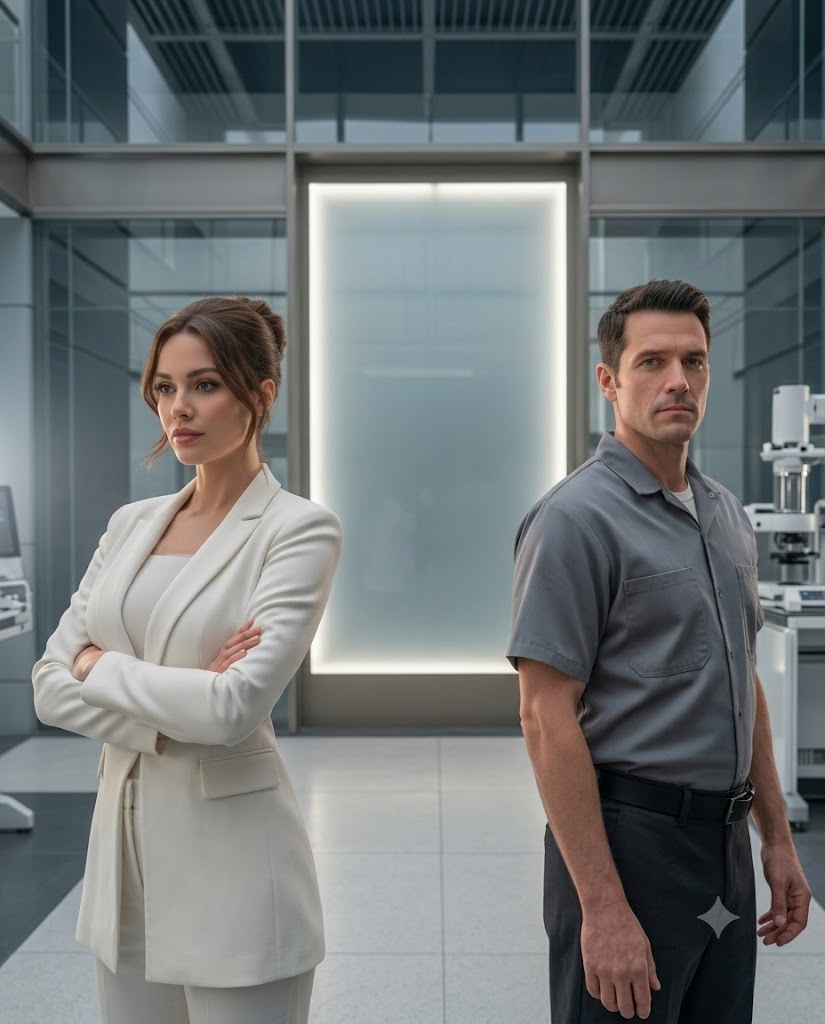
CEO Married the Janitor — Unaware He Was a Former Elite Special Forces Commander
Part 1
The heels of my Italian leather pumps echoed against the cold marble of the Atlas Defense Technologies lobby, a sharp, unforgiving rhythm that matched the ice in my veins. I strode through the gleaming atrium, my navy pencil dress and crisp white blazer a stark contrast to the muted, sterile earth tones of the Austin headquarters I now commanded. Employees scattered from my path, their nervous whispers trailing behind me like shadows.
Six weeks had passed since my father’s suspicious yacht accident, and barely three weeks since the board of directors revealed the devastating stipulation in his will. Marry within thirty days, or lose your controlling interest in the company. Thirty days to find a husband. The absurdity of it made my jaw clench. Joseph Donovan had built this defense empire from nothing, teaching me every single aspect of the business, grooming me since I was a child to take his place. And yet, in death, he had bound me to an archaic, patriarchal condition that threatened to rip everything I had worked for out of my hands.
I stepped into the private executive elevator, pressing the penthouse button. My assistant, Vanessa, had been running candidates all morning.
“The VP of marketing is divorced, attractive enough, and already cleared for classified information,” Vanessa had suggested, tapping her tablet.
“Too ambitious,” I had dismissed him instantly. “He’d never accept a temporary arrangement without demanding a piece of the company.”
“The chief financial officer?” she countered.
“Too connected to the board. He’d report every move I make straight to Blackwood.”
I needed someone with zero stake in Atlas. Someone who understood the meaning of discretion. Someone I could easily control.
By evening, after tearing through seven potential husband candidates and finding fatal flaws in each, the crushing weight of the inheritance clause, the grief of my father’s death, and the ticking clock of my sanity drove me to the brink. I escaped to a small dive bar miles from the corporate district, a dark, sticky place where no one would recognize the ice queen of Atlas Defense.
Several drinks in, my carefully maintained composure slipped. The alcohol burned, but not as much as the suffocating fear of failure. In my vulnerable, clouded state, I noticed a quiet man sitting alone at the far end of the bar. He had observant, steady eyes that seemed to anchor the chaotic room.
I slid onto the stool next to him, my defenses completely shattered, and vaguely vented my predicament to a stranger. He listened without judgment, his calm demeanor a stark contrast to my emotional tempest.
“Sometimes the most impossible problems have the simplest solutions,” he said. His voice was a low, gravelly rumble that cut right through the ambient noise.
I studied him, taking in the broad shoulders beneath a simple gray t-shirt, the strong hands wrapped around a whiskey glass, and a faint, thin scar cutting through the stubble along his jawline. His eyes held the hyper-vigilant watchfulness of a predator in disguise.
Suddenly, an aggressive patron stumbled over, invading my space and grabbing my arm. Before I could even draw breath to snap, the stranger moved. With terrifying, startling efficiency, he applied a precise wrist lock. There was no wasted motion, no dramatic brawl—just absolute, controlled expertise that forced the aggressor to his knees with a whimper, apologize, and stumble away.
“Where did you learn to do that?” I breathed, my heart hammering, moving closer to the warmth of his body.
He shrugged, his expression locking back into an impenetrable mask. “Here and there. You pick things up.”
The rest of the night dissolved into a dangerous blur of confessions and electric connection. It ended with an impulsive, reckless invitation back to my high-security penthouse.
Morning brought harsh clarity, a blinding headache, and the shock of my life. I woke up to find the stranger standing by my floor-to-ceiling windows, silhouetted against the Texas dawn. As he turned, I realized with a jolt of recognition why he looked so familiar. He was part of the maintenance staff. He was the quiet janitor I had passed in the hallways of Atlas a hundred times without a second glance.
But as I stared at his military-straight posture and the quiet authority radiating from his frame, a cold realization washed over me. Something didn’t add up.
Part 2
Most CEOs in my position, discovering they had spent the night with a facility janitor, would have panicked, called security, or thrown the man out with a hefty hush-money payment. But I didn’t see a scandal. I saw a brilliant, twisted opportunity.
A man with no social connections, no corporate ambitions, and no wealth. An invisible failure, or so I assumed, who could be easily managed, controlled, and compensated for a year of his time.
I leaned against the bedroom doorframe, folding my arms. “You’re Logan Hayes. Maintenance.”
He didn’t flinch. “I am.”
“You heard my problem last night,” I stated, cutting straight to the point. “You need money. I need a husband. One year. We live strictly separate lives, minimal interaction, separate quarters, and absolute discretion.”
Logan considered me with those unreadable, dark eyes for a long, agonizing moment. The silence stretched until he finally nodded, offering one simple condition. “No background checks beyond the standard employment screening I’ve already cleared.”
I frowned slightly. “Why? Something you want to hide?”
“Everyone has things they’d rather leave behind,” he replied evenly.
Assuming he just had a minor criminal record, a bad debt, or a messy breakup in his past, I waved it away. “Agreed.”
We married quietly just three days later at the county courthouse. Logan wore a surprisingly well-fitted, albeit borrowed, suit. I wore a simple white sheath dress that betrayed nothing of the cold business transaction actually taking place. As the judge pronounced us married, and we signed the binding documents, neither of us noticed the man hiding his camera across the street, nor the encrypted text message he immediately punched into his phone: Target has changed patterns. New variable introduced.
My sudden announcement of marriage sent shockwaves through the Atlas boardroom the following Monday. The board members exchanged deeply skeptical glances as Logan stood quietly beside my desk, wearing his first and only designer suit.
Marcus Blackwood, my father’s oldest friend and the chairman of the board, stood up to greet us. His eyes narrowed as he studied my husband. “Quite the whirlwind romance, Rachel,” he remarked, his handshake with Logan lingering far too long, as if he were physically weighing the man.
Logan met his intense gaze with practiced blandness, giving absolutely nothing away. “When you know, you know,” I replied, forcing a bright, unbothered smile and resting my hand possessively on Logan’s arm.
The tension in the room dissipated. The inheritance clause was legally satisfied, and the board members settled back into their leather chairs, their own power positions secured. Only Blackwood seemed troubled, his sharp eyes flicking to Logan’s deliberate, balanced movements as we navigated the meeting.
To maintain appearances and satisfy the strict clauses of my father’s will, Logan moved his meager belongings into my sterile, ultra-modern penthouse. I immediately established the ground rules: separate bedrooms, separate lives, and zero interference in my corporate affairs.
Logan complied without a single word of pushback. In fact, to my utter bewilderment, he insisted on keeping his janitor job. “I prefer to earn my keep,” he told me simply when I offered him a generous monthly allowance to stay at home or out of sight.
I chalked it up to the stubborn pride of a simple man. I had no idea that Logan’s insistence on scrubbing Atlas’s floors was a tactical cover. He needed unfettered, round-the-clock access to the building to investigate his own dark suspicions about my father’s empire.
Part 3
Our first few weeks together established a strange, quiet rhythm of careful avoidance. I was a machine, rising at five every morning for a punishing fitness routine before diving into fourteen-hour workdays. Logan, conversely, worked odd night shifts, moving silently through the empty corridors while my executive team stayed late working on classified defense contracts.
Yet, in the rare moments our paths crossed at the penthouse, I found myself deeply disconcerted by Logan’s eerie efficiency. He observed and adapted to my erratic habits without ever needing to be told. When I came home suffering from debilitating insomnia, a perfect, steaming cup of chamomile tea materialized on my nightstand. When I skipped meals during intense, stressful system launches, nutritious, high-protein dinners quietly appeared in my office mini-fridge.
He required nothing in return. He explained absolutely nothing. His quiet, unshakable confidence was both deeply comforting and fiercely irritating to a woman who prided herself on needing no one.
The cracks in our superficial arrangement began to show late one Thursday night. I returned to the penthouse earlier than anticipated, my key sliding into the lock with a soft click. I walked into the dark living room and froze.
Pale moonlight spilled across the floorboards. In the center of the room, Logan was doing precise, one-armed military push-ups. His movements were so fluid, so mechanically perfect, that they appeared entirely effortless. The raw, coiled power in his back and shoulders was terrifying.
He heard my breath hitch and stopped instantly. He rose to his feet in a single, fluid motion, his grace completely incongruous with his supposed blue-collar station in life.
“You’re home early,” he said, his voice level.
“What are you doing?” I demanded, my eyes scanning his physique.
“Staying fit,” he replied smoothly, picking up a towel. “Helps me work better.”
I let the confrontation drop, but a cold seed of suspicion took root in my mind. I filed this inconsistency away with the dozen other little anomalies I had begun to notice. Janitors didn’t move with the lethal grace of an apex predator. Janitors didn’t possess the chilling calm of a ghost.
But I was too buried under the avalanche of corporate warfare to dig deeper. The annual military gala was approaching, and the future of Atlas depended on securing the new drone targeting contract.
The night of the gala, disaster nearly struck. The stress of the high-profile event—filled with skeptical generals, demanding board members, and ruthless tech partners—triggered a wave of acute social anxiety. I stood frozen in the holding room, my chest tightening, unable to face the crowd. The ice queen was about to shatter in front of the entire defense industry.
The door opened and Logan stepped in. Without a word of judgment, he smoothly stepped into the role of host. As I watched from the shadows, his unexpected, encyclopedic knowledge of advanced military protocols and defense counter-measures utterly charmed the skeptical generals. He deflected questions with the ease of a seasoned diplomat.
I was simultaneously deeply grateful and furiously humiliated by being upstaged. As soon as the generals moved away, I confronted him in the service corridor, my temper flaring. “You severely overstepped your boundaries tonight, Logan. I didn’t ask you to play the hero.”
“You were drowning,” he said, looking down at me, his face a mask of calm. “I just kept you afloat.”
“I don’t need rescuing!” I snapped, my pride stinging.
“Everyone does, sometimes,” he responded softly. For a fraction of a second, something resembling deep, ancient pain flickered in his dark eyes before his expression snapped back to neutral.
Before I could demand to know what demons he was hiding, he turned and quietly retreated toward the exit, leaving me with the unsettling, gut-wrenching feeling that I had just glimpsed a terrifying reality beneath my husband’s fake persona.
Part 4
The morning after the gala, I woke up determined to put Logan out of my mind. He was an anomaly, a contract husband, a convenient prop to satisfy my dead father’s will. Nothing more.
I arrived at the Austin headquarters early, diving into the network logs to prep for the drone contract finalization. That was when I noticed the anomalies. For the last three months, there had been tiny, almost imperceptible security gaps in Atlas’s internal networks. Encrypted communications were bypassing official firewalls, and mysterious shipments of hardware were leaving our secondary warehouses, matching patterns that felt eerily illicit.
Unbeknownst to me, Logan was conducting a parallel investigation on the ground. During his night shifts, he utilized his janitor access to slip into restricted basement archives. He found massive discrepancies in financial records dating back to the months before Joseph Donovan’s fatal yacht accident. Prototypes were being secretly manipulated, and classified algorithms were leaking through carefully concealed digital backdoors.
Logan became aggressively, suffocatingly protective of me. He seemed to know I was in danger, shadowing my movements without explanation. My CEO arrogance flared; I’d built my career on control, yet found myself increasingly relying on this quiet man’s tactical instincts. When I finally cornered him in the penthouse to demand answers about his late-night absences and cryptic warnings, he offered only vague assurances. The professional and personal boundaries we had drawn began to violently blur.
Three months into our bizarre marriage, I finally secured the lucrative Department of Defense contract for the revolutionary drone targeting system. It was the crowning achievement of my career, cementing my position as the undisputed CEO of Atlas.
To celebrate, the board insisted on a high-profile, black-tie event at headquarters. Military officials, tech moguls, and local politicians packed the grand ballroom. I wore a striking, backless royal blue gown, finally feeling like I had stepped fully into my father’s shoes.
Logan, maintaining his janitor cover, stood near the service entrance. From his peripheral vantage point, his highly trained eyes cataloged the room, instantly picking up on irregularities. The catering staff seemed to have unauthorized access to secure staging areas. Private security guards were positioned in blind spots. And one guard near the VIP exit was exhibiting highly abnormal breathing and micro-movements.
It was a total breach of protocol. It triggered the lethal hyper-vigilance that had kept Logan alive through a hundred black-ops wars he had left behind.
As I took the stage, the microphone feedback hummed. I smiled, looking out at the crowd, ready to deliver my keynote.
Out of the corner of my eye, I saw the suspicious security guard break formation. His hand dropped inside his heavy wool jacket, his fingers wrapping around the grip of a suppressed pistol.
Logan didn’t hesitate. He abandoned his cover identity in a fraction of a second.
He exploded through the crowd, his boots tearing across the polished floor. He reached the podium just as the assassin drew his weapon. Logan threw himself in front of me, his arm deflecting the barrel.
Crack. The suppressed gunshot echoed, and the bullet grazed Logan’s bicep, spraying hot crimson across my blue gown. Before the screaming crowd could even process what was happening, Logan moved. With terrifying, brutal military efficiency, he disarmed the assassin, struck a precise pressure point, and neutralized the threat, slamming the man to the marble floor.
I stood paralyzed, clutching the podium. The unassuming, quiet janitor I had married had vanished. In his place stood an apex predator—lethal, commanding, and absolutely terrifying in a crisis.
By the time the panicked internal security detail swarmed the ballroom, weapons drawn, Logan had already melted back into the shadows of the service wing, leaving me standing alone in the chaos, staring at my bleeding podium, unable to answer the police’s frantic questions.
Part 5
I didn’t go to the hospital. I didn’t call the police chief. I took the private elevator straight to the penthouse, my hands trembling, my mind spinning wildly out of orbit.
I pushed the penthouse doors open and followed the faint smell of copper and antiseptic into the master bathroom. I found Logan sitting on the edge of the white tiled tub, his tuxedo jacket discarded. He had a medical kit open, a curved suture needle in his hand, actively stitching his own bicep where the bullet had grazed him.
Dark blood smeared the pristine tiles, but his hands didn’t shake. His breathing remained eerily, inhumanly controlled.
“Who are you?” I demanded, my voice cracking, adrenaline and absolute terror colliding in my chest.
Logan didn’t look up. He pulled the suture tight, tying off a knot with practiced ease. “I told you. Logan Hayes. Maintenance.”
“Don’t lie to me!” I screamed, slamming my hand against the bathroom doorframe. “You took a bullet for me like a secret service agent! You took down a trained killer in three seconds flat! Janitors don’t know how to calculate entry wounds and apply field surgery! Who are you?“
He finally looked up, his dark eyes locking onto mine, heavy and devoid of fear. “I have some experience with corporate security.”
“That wasn’t corporate security!” I stepped closer, pointing a shaking finger at his bleeding arm. “That was… that was an execution. You are military. High-level intelligence. Special forces.”
He slowly stood up, towering over me, a terrifyingly imposing figure in the bright bathroom lights. “The attempt on your life tonight isn’t a random mugging, Rachel. It’s connected to the discrepancies you found in the Atlas network. Someone inside this company wants you dead.”
The world tilted violently on its axis. The man I had married for convenience, the man I had treated as an inferior, had been quietly navigating a warzone inside my own company.
“You’ve been lying to me since the day we met,” I accused, my anger trying to mask the suffocating fear gripping my lungs.
Logan finished wrapping a bandage around his arm and tossed the bloody gauze into the trash. “Not lying, Rachel. Just not sharing every detail of my past. There’s a difference.”
“Not to me,” I countered coldly.
But the heat was rapidly draining from my voice, replaced by the sickening, grudging acknowledgment that without his lethal intervention, I would be lying in a pool of my own blood on the ballroom floor.
Before we could continue the confrontation, the encrypted satellite phone sitting on my vanity buzzed frantically. It was the direct line to the server mainframe.
“Go,” I answered, putting it on speaker.
“Ms. Donovan!” my IT director yelled, panic bleeding through the line. “We’ve got a catastrophic breach! Someone is actively downloading the classified weapons targeting algorithms from the mainframes! They’re bypassing the physical overrides!”
My stomach plummeted. The traitors were making their final play.
Despite the profound mistrust now fracturing our relationship, I had no choice. I looked at Logan, the bullet hole in his shirt, the sweat on his brow. “Come with me. Now.”
We sprinted back down to the secure sublevels of headquarters. When we reached the emergency command center, Logan didn’t hesitate. He pushed the IT tech out of the chair, his fingers flying across the encrypted keyboard with an expertise no blue-collar worker could ever possess.
Working alongside our surviving security team, he began to trace the cyber-attack. As I watched the green code cascade across the monitors, the terrifying certainty crystallized in my mind: Nothing about this man is what it seems. He navigated through deep, encrypted military subnets with the arrogant confidence of a ghost hacker. He identified the attack patterns, outmaneuvering the hostile intruder and predicting their next keystrokes with uncanny, terrifying accuracy.
Finally, the trace completed. The IP address pinged back.
The data wasn’t going to a foreign cartel or a rival tech firm. It was routing to a terminal inside the building.
To a specific office on the executive floor.
Marcus Blackwood.
My father’s oldest friend. My most trusted adviser. The man who had bounced me on his knee when I was a little girl.
Part 6
I stared at the name glowing on the terminal screen, my breath catching in my throat. Blackwood. The man who had been running the board alongside my father for thirty years.
“No,” I whispered, shaking my head, backing away from the desk. “No, that’s a system error. Marcus was my father’s brother. He helped me consolidate my shares after the funeral.”
Logan stood up, placing a heavy, grounding hand on my shoulder. “People like Blackwood don’t work alone, Rachel. If he’s compromised, half the board is, too. I’ve seen these intelligence patterns before.”
“Where exactly have you seen these patterns?” I pressed, spinning around, crossing my arms defensively, my CEO authority attempting to reassert itself. “You need to tell me the truth, Logan. Right now. No more games.”
Logan’s dark eyes locked onto mine, measuring the weight of the moment, calculating exactly how much of the abyss to show me.
“I worked in intelligence assessment for a long time,” he said quietly, his voice dangerously level. “Classified special operations. Sable Phoenix unit. That’s all I can say right now.”
Sable Phoenix. The name sent a chill down my spine. It was a phantom black-ops unit, legendary in the defense sector for handling threats that couldn’t be resolved through conventional military channels.
I reluctantly agreed to proceed with caution. We couldn’t go to the authorities; if Blackwood had compromised the board, the police were a liability. Utilizing Logan’s surprisingly adept cybersecurity skills, we bypassed the main networks and hacked into my late father’s private, air-gapped servers in the basement archives.
What we found in those encrypted directories made my blood run cold.
There were digital ledgers and offshore communication strings proving a systematic sale of classified Atlas weapons technology to hostile international buyers. It was a massive treason plot, and the paper trail indicated it had begun months before my father’s “accidental” yacht death.
I stared at the monitor, the pieces clicking together with devastating clarity. My father hadn’t died by accident. He had discovered Blackwood’s treason, and Marcus had eliminated him to seize control of the company.
But there was a secondary folder on the drive, labeled Phoenix Containment.
When Logan saw it, a visible current of tension rippled through his stoic facade. He stared at the screen, his jaw clenching so hard a muscle ticked. Ensure Phoenix containment remains priority. Neutralize Phoenix assets. Before I could question his visceral reaction, the security alarms in our makeshift command center shrieked. The heavy steel blast doors began to lower.
“We’ve been compromised,” Logan growled, instantly shedding his avuncular husband persona.
Three heavily armed, professional operators dropped from the ventilation shafts into the hallway. They wore unmarked tactical gear and moved with the terrifying, synchronized precision of tier-one military killers. They were hunting us.
“Move!” Logan barked. All pretense of the submissive janitor was dead. In his place stood a hardened combat commander.
He pulled me through the labyrinth of the maintenance corridors, his tactical instincts taking over. “Stay three steps behind me. Step where I step. Freeze when I signal,” he commanded, his authority so absolute and ingrained that my brain didn’t even consider arguing.
We rounded a corner, and an assassin stepped out, leveling an assault rifle. Logan didn’t draw his pistol. He calculated the ricochet echo pattern in the concrete corridor in a split second, pushed me violently behind a reinforced bulkhead, and returned fire, neutralizing the threat with terrifying speed.
Another attacker rushed us with a combat knife. Logan absorbed the man’s momentum, disarmed him, and applied a brutal, precise chokehold, rendering the killer unconscious in under five seconds. The controlled, surgical violence was mesmerizing and horrific.
He guided me out into the freezing Austin night, leading me not to my penthouse, but to a heavily fortified, off-grid safehouse buried in the industrial sector. Logan had constructed it entirely off the books.
I stood in the center of the spartan room, surrounded by encrypted comms arrays, tactical weapons crates, and medical supplies, realizing my simple janitor husband had been preparing for a warzone since the day I met him.
“You’re Commander Hayes,” I said, my voice trembling, looking at the man wiping blood from his knuckles. “The leader of Sable Phoenix. And my father didn’t just stumble onto this… he specifically requested you.”
Logan didn’t deny it. He set his weapon down, walking over to the kitchenette. “Your father knew the board was dirty. He reached out to my former chain of command for an extraction audit.”
“And marrying me?” I asked, a deeper, more agonizing hurt piercing through the adrenaline. “Was that part of your mission parameters? A way to get inside my father’s company?”
Logan stopped. He turned to look at me, his dark eyes stripped of all tactical armor, revealing raw, unvarnished truth. “No, Rachel. That was unexpected. An opportunity for closer access, yes… but it wasn’t planned.”
He took a deep breath, looking at me with an intensity that made my breath hitch. “Marrying you was a tactical variable. But falling in love with my target? That wasn’t in the mission parameters at all.”
Part 7
The safehouse felt suddenly small, suffocatingly intimate. The confession hung in the freezing air, short-circuiting my brain. The untouchable, ice-cold CEO of Atlas, and the phantom commander of Sable Phoenix. We were two broken, guarded souls trapped in a web of international treason.
Before I could process the seismic shift in my heart, the secure monitor on the wall pinged. It was a live feed from my penthouse suite. Marcus Blackwood and a private hit-squad were tearing my home apart. Worse, they were unearthing miniature listening devices planted in my personal vanity, my desk, my clothes.
“They’ve been watching me all along,” I whispered, a wave of profound violation crashing over me. The realization that my most private moments, my tears over my father, my vulnerabilities, had been piped directly to my enemies made me physically ill.
Logan crossed the space between us in a heartbeat. He gripped my shoulders, his touch warm, heavy, and grounding.
“But they didn’t see you, Rachel,” he said, his voice a low, fierce promise. “Not the real you. I’ve watched you too, these last months. I see the steel beneath the armor. They have no idea who they’re dealing with.”
The absolute sincerity in his eyes bypassed every defense I had spent a decade building. Anger, adrenaline, and months of suppressed, fiery attraction violently ignited. In the shadows of the safehouse, we crossed the line. It wasn’t a contract marriage anymore; it was a collision of two desperate forces, an intimate encounter that stripped away every facade.
Afterward, in the quiet aftermath, Logan shared fragments of his past—the crushing weight of classified warfare, the ghosts he carried. And I, for the first time in my life, laid bare the paralyzing grief of my mother’s death, my father’s cold expectations, and the suffocating isolation of running a defense empire.
“I haven’t trusted anyone since my parents died,” I whispered into the dark, my face pressed against his chest. “Not fully. Not even my father, toward the end.”
“Trust is a luxury in our worlds,” Logan replied, his calloused fingers tracing absent patterns on my bare shoulder. “But sometimes, it’s also a necessity.”
The uneasy truce was tested at dawn. The alert systems shrieked again. Blackwood was making his final, desperate gambit. He had scheduled an emergency board meeting for ten a.m. to present fabricated evidence of treason, officially vote me out as CEO, and take full control of Atlas’s classified missile systems.
“He’s accelerating his timeline,” Logan said, pulling on a tactical vest. “He knows we accessed the offline server archives last night.”
“What’s our play?” I asked, the ice queen hardening back into a highly strategic CEO. I looked at the weapons, then at my suit jacket. “We don’t run. We don’t hide. We take the fight to him. Openly.”
Logan stared at me, a slow, proud smile touching his lips. “As you command, Commander.”
At exactly ten a.m., the heavy mahogany doors of the Atlas boardroom swung open. I walked in, head held high, wearing my power armor. At my side was Logan, no longer in a janitor’s uniform, but wearing a bespoke charcoal suit that did nothing to disguise the lethal military bearing of a Sable Phoenix operative.
Marcus Blackwood sat at the head of the table. His momentary, panicked shock at seeing me alive quickly morphed into a slick, avuncular smile. “Ah, Rachel. We were just discussing some severe security breaches. And I see you’ve brought… your husband?”
“My head of internal security,” I corrected, my voice ringing like a bell across the silent table. “Given recent attempts on my life, I think the board will forgive the extra protection.”
Blackwood stood up, tapping a laser pointer against the projector screen. He immediately went on the offensive, displaying forged emails and doctored network logs, painting me as a rogue CEO selling targeting algorithms to foreign pass-throughs. The board members began to murmur, casting terrified, skeptical glances at the chairman.
I didn’t flinch. I let him hang himself with his own narrative.
“Those are incredibly grave accusations, Marcus,” I said when he finally paused for breath. “Fortunately, my husband is a trained intelligence assessor.”
I plugged a drive into the main terminal. Instead of my supposed treason, the monitors lit up with the contents of my father’s private server—certified wire transfers from Blackwood’s shell companies to known arms dealers, offshore bank accounts in the Caymans, and the surveillance logs proving Marcus had sabotaged the navigation systems on my father’s yacht.
The boardroom erupted into chaos.
“This is a fabricated coup!” Blackwood shrieked, his polished mask completely disintegrating, his face turning an ugly, mottled purple. “She’s covering her own treason!”
He slammed his fist onto a panic button embedded in the mahogany.
Instantly, the building-wide security lockdown engaged. The thick blast doors slammed down, red emergency strobes cut through the gloom, and sirens howled. Blackwood’s loyal private security detail breached the perimeter of the boardroom, assault rifles raised.
“Secure the exits! Eliminate the targets!” Blackwood screamed, retreating behind his heavily armed mercenaries.
What followed was a short, brutal war within the Atlas complex. Logan coordinated with the few internal security guards still loyal to my father while I utilized my master admin override codes to blind Blackwood’s tactical teams, turning the smart-building against the traitors.
We fought our way through the red-lit corridors, descending toward the subterranean server core—the heavily reinforced nerve center of Atlas where Blackwood was attempting to purge the remaining evidence and upload his backdoor deletion protocol to the Pentagon servers.
We breached the server room doors. Blackwood stood at the central terminal, a pistol shaking in his hand, a frantic expression on his face.
“I was weak, just like you, Rachel!” Blackwood yelled over the shrieking server fans, his fingers smashing keys to initiate the system self-destruct. “Brilliant with tech, but naive about power! There is more money in selling to both sides than merely defending one!”
He raised the pistol, aiming directly for my heart.
Logan moved with the terrifying, inhuman speed of a tier-one operative. He threw himself in front of me.
Bang. The gunshot was deafening. A dark, rapidly expanding bloom of crimson soaked through Logan’s charcoal shoulder. He staggered, but didn’t fall. With a feral growl, he crossed the room, disarmed Blackwood, and incapacitated the traitor with a single, brutal strike to the jaw, knocking him unconscious against the server racks.
Sparks rained down from the ceiling. The terminal was flashing a fatal countdown. Self-destruct sequence initiated. Evacuate. Blackwood had rigged the mainframes to blow.
“Rachel, go!” Logan coughed, clutching his bleeding shoulder, his knees buckling. “The facility is going to blow. Save yourself!”
I looked at the exit, then at the man I loved bleeding out on the concrete. The instinct to run, to save my own skin, warred with the agonizing realization that if I left, the data would burn, the traitors would win, and my father’s legacy would be reduced to ash.
I didn’t run.
I dropped onto the terminal next to Logan. Using my absolute highest administrative clearance, my technical brilliance kicked into overdrive. I bypassed the physical deletion sequence, diverting the core data streams, and created an emergency uplink, shooting the uncorrupted treason files directly to an air-gapped federal server at the Department of Defense.
The download bar hit 100% just as the secondary cooling units began to explode.
Grabbing Logan by his good arm, half-dragging, half-carrying his heavy frame, I threw us through the blast doors into the escape tunnels seconds before the server core became an inferno.
Six months later, the sky over Austin was clear and bright.
Atlas Defense Technologies had undergone a radical, painful, and beautiful transformation. With Blackwood’s conspiracy fully exposed by the data I had beamed to the Pentagon, I had purged the board, restructured the company, and returned transparency to our core values. We still built weapons, but they were shields, not swords—defensive systems, interceptors, and advanced threat-detection grids that my father would have been proud of.
The Atlas headquarters had been rebuilt, its security protocols overhauled under the direct supervision of the Department of Defense. Logan, his true, illustrious military background declassified and recorded, had assumed his rightful role as Atlas’s Director of Security.
Our marriage, born in a cold county courthouse as a cynical business transaction, had dissolved into something sacred. We held a small, private ceremony on the manicured lawns of our new home outside the city, officially replacing our contract with genuine vows.
Today was the dedication of the new Joseph Donovan Memorial Research Wing. I stood at the podium, looking out at the dignitaries, the board, and my employees. Sitting in the front row, wearing a sharp suit that hid the faint scar on his shoulder, was Logan.
I smiled, looking down at my speech. “My father believed in building shields, not swords,” I announced, my voice carrying across the plaza. “Today, we are proud to announce the Sable Phoenix Initiative—a security protocol ensuring no Atlas defense system can ever be compromised, backdoor-exploited, or turned against the innocent.”
The crowd erupted into applause. After the ribbon-cutting, a reporter pushed through the crowd, holding a microphone.
“Ms. Donovan, the name ‘Sable Phoenix’ has a fascinating history. What does it represent to Atlas?”
I looked down at Logan. He stood up, walking toward the stage, offering me a soft, breathtaking smile that only I was privileged to see.
“It represents rising from the ashes, stronger than before,” I told the reporter, taking my husband’s warm, calloused hand in mine. “Something both Atlas, and my personal life, have quite a bit of experience with.”
Later that evening, as we stood on our balcony overlooking the expansive Texas landscape, my tablet pinged. A routine security alert. A tiny, encrypted ping originating from a proxy server in Eastern Europe—a digital fingerprint matching Blackwood’s deceased associates.
Logan looked over my shoulder, reading the decrypted string of code. A familiar, dangerous spark ignited in his dark eyes.
I turned into his chest, wrapping my arms around his waist, feeling the steady beat of his heart.
“Mission parameters?” I teased, echoing his own words from the safehouse.
Logan wrapped his arms around me, pulling me flush against him. “The best operations,” he murmured softly, leaning down to press his lips against mine, “always involve unexpected variables.”









