Every Beautiful Woman Failed to Impress the Mafia Boss—Then He Heard the Maid Sing
Part 1: The Hollow Empire
Declan Knox stood on the mezzanine of his limestone estate, the Nox manor, watching the spectacle below with cold, detached eyes. Five hundred guests packed the ballroom, a sea of silk, diamonds, and hollow laughter. They were the city’s elite, the syndicate’s power players, and every single one of them would slit his throat if they saw an opening. Declan was thirty-five today, a milestone that, according to his second-in-command, Arthur, required a spectacle.
Arthur leaned against the mahogany railing, swirling his champagne. “She’s a Romanov on her mother’s side,” he noted, gesturing toward a woman in a crimson dress near the ice sculpture. “Twenty-four, speaks four languages, and hasn’t taken her eyes off you.”
Declan looked down. The woman offered a practiced, deliberate smile, her posture impeccable. It was a calculated seduction. Declan felt nothing but a profound, aching boredom. “Tell her to go home, Arthur,” he said, his voice a low, gravelly baritone.
“Are you out of your mind?” Arthur sighed. “What are you looking for? A saint? They don’t exist in our tax bracket.”
“I’m looking for someone who isn’t a transaction,” Declan replied, setting his glass on a passing tray. “I look at her and I see a ledger. She wants the protection of the Nox name; her father wants our supply lines. It’s business.”
The room felt suffocating. It smelled of greed, roasted duck, and floral perfume—a scent that had defined his life for a decade. He had built an empire out of blood and concrete, turning his father’s crumbling organization into a fortress. But the higher he climbed, the more the world flattened out. Everyone was a mannequin in designer clothes.
“I’m going to my office,” Declan announced.
“The five families are downstairs, Declan. Leaving is an insult,” Arthur warned.
“Tell them I have a headache,” Declan snapped, his voice carrying the steel that kept violent men obedient. He walked away, his heavy footsteps muffled by the Persian rugs, desperate for a moment of quiet away from the plastic reality of his own wealth.
Part 2: The Ghost in the Machine
Three floors down, in the dimly lit service corridors, Clary Davies was on her hands and knees. The ballroom’s rhythmic thud vibrated through the floorboards, a constant, muffled reminder of a world she didn’t belong to. Clary didn’t care about the party; she cared about the scuff marks on the baseboard near the laundry chute. She sprayed industrial cleaner, the sharp smell of bleach burning her nostrils, and scrubbed until her knuckles ached.
Clary was twenty-six, though the dark circles under her eyes made her look far older. She wore an oversized gray polo with the estate’s cleaning logo and rubber-soled shoes that squeaked against the linoleum. Her brown hair was yanked back into a messy knot secured by a broken plastic claw clip. She glanced at her watch: 11:45 p.m. Fifteen minutes left. Then, a forty-minute bus ride to her cramped apartment in the Narrows, four hours of sleep, and her second job at a diner.
It was a punishing existence, but she had no choice. Her brother, Tommy—a well-meaning but reckless idiot—had borrowed twenty thousand dollars from a loan shark affiliated with the Nox Syndicate. With interest, the debt had ballooned to fifty thousand. When they broke Tommy’s arm, Clary had stepped in. She hadn’t begged; she had slammed her savings on a butcher shop table and offered to work it off.
“Hey, Clary,” a voice called out. Maria, a kitchen worker, leaned against the doorframe. “You’re still scrubbing? Leave it. The boss never comes down here. He lives in the clouds.”
“If I leave it, the supervisor docks my hours,” Clary rasped. “I can’t afford that, Maria.”
“You work too hard for people who don’t even know you exist,” Maria sighed, handing her a napkin wrapped around two dinner rolls. Clary stopped scrubbing, the tension in her chest easing as she took the food. She was a ghost here. She cleaned the messes of gods, invisible and safe. Invisibility was the only way to survive. But tonight, a wrong turn would shatter that safety forever.
Part 3: The Melancholy Melody
Declan didn’t make it to his office. He wandered into the East Wing, an area currently undergoing renovations. It was quiet here, cool, and smelled of sawdust and plaster. The antique rugs were rolled up, and the moonlight spilled across the bare floorboards, casting long, sharp shadows. He leaned against a window, looking out at the black Atlantic, feeling like a machine left running too long without oil.
“What are you looking for?” he asked himself, his thoughts drifting back to his childhood on a fire escape in a cramped brick apartment. Back then, life was dirty, but it was real. Now, everything felt like plastic.
Then, he heard it. It wasn’t a loud noise, but a voice drifting down the hall. Someone was singing. It wasn’t the polished, autotuned perfection of the hired entertainment downstairs; it was raw, raspy, and wavering. Declan moved silently down the corridor, his leather shoes making no sound against the wood.
The song was an old folk tune about miners in the dirt—a melancholy melody about burying the dead and waiting for a train that never arrived. The singer’s voice cracked on a high note, a physical break heavy with profound grief. It sounded like exhaustion. It sounded like heartbreak.
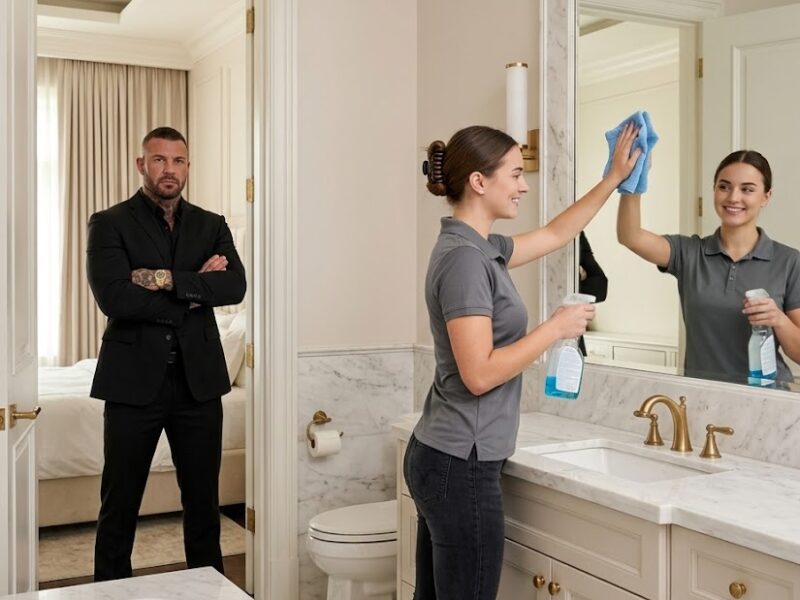
He nudged the door to the master guest suite open a fraction. The bathroom was vast, marble and gold. Standing in front of a vanity mirror was a woman in a baggy gray polo and cargo pants, her hair a messy nest. She was wiping the mirror in rhythmic circles, unaware of her audience. In the reflection, he saw her face—pale, tired, devoid of makeup. She wasn’t classically beautiful, but as she sang the next line, she closed her eyes, letting her head drop forward. The sorrow filled the room, wrapping around Declan’s chest. It was the most devastating thing he had ever heard.
Part 4: The Unmasking
Declan let out a breath, the fabric of his suit rustling against the doorframe. The sound was microscopic, but in the echoing marble room, it sounded like a gunshot. The singing stopped instantly. Clary spun around, clutching her spray bottle like a shield, her eyes wide with the raw, unfeigned terror of a cornered animal.
She saw a man standing in the doorway—tall, broad-shouldered, wearing a suit that cost more than she made in three years. He looked like the man who owned the house. Clary’s stomach dropped.
“I… I’m sorry,” she stammered, her voice small. “I thought the wing was empty.”
Declan didn’t say anything. He stepped into the room, his physical presence sucking the oxygen out of the air. He looked at her raw, bleeding knuckles, then at her eyes. “Don’t apologize,” he said softly.
“I’m just finishing the mirrors. I’ll be out of your way in two minutes, sir,” she said, hunching her shoulders to make herself smaller.
“What were you singing?” he asked.
“Nothing. Just… noise. I’m sorry to disturb you.”
“Look at me.” It wasn’t a shout, but a level command. Clary lifted her chin, her eyes filled with fear and a deep, smoldering exhaustion.
“What’s your name?”
“Clary.”
“Who do you work for, Clary?”
“The cleaning service, sir. I’m just part of the night crew.”
Declan took another step forward. He looked at the girl with the bleach-stained hands and the voice that had just cracked his ribs open. He thought of the Romanov aristocrat downstairs and then back to this tired, real woman. “You’re not on the night crew anymore, Clary,” he said, his voice a low rumble. “You’re mine.”
Part 5: The Ledger of Blood
The next morning, Declan sat in his office, staring at a manila folder Arthur had dropped on his desk. “Her name is Clary Davies,” Arthur said, irritated. “Twenty-six, no criminal record, works two jobs, lives in the Narrows. She’s a nobody.”
“Why does a ghost work eighty hours a week?” Declan asked.
“She’s digging her way out of a grave,” Arthur replied, pointing to a line on the report. “She has a brother, Tommy. He lost twenty grand at our tables. Russo holds the paper. The debt is fifty-two thousand. Russo broke the kid’s arm, and the sister agreed to pay it off. Every dime she makes goes to Russo, and by extension, to you.”
Declan closed the folder. The irony was bitter. He was the monster at the top of the pyramid, getting richer off the pennies squeezed from a terrified girl scrubbing his floors.
“Call Russo,” Declan said softly. “Have him here in twenty minutes. And bring me his ledger.”
When Frankie Russo arrived, Declan didn’t waste time. “Turn to the Davies account,” he ordered. He looked at the red ink columns, the interest, the sheer predatory greed on display.
“She works in my house, Frankie,” Declan whispered. “She scrubs the floors I walk on. You put a liability in my home to line your own pockets.”
Declan stood, his movement graceful and terrifying. He weighed a brass letter opener in his palm. “You endangered the head of this family for fifty thousand dollars of street money.”
“Declan, please, I didn’t think!” Russo stammered.
“I know you didn’t,” Declan replied. He turned to Arthur. “Pay Frankie his original twenty thousand out of the main vault. The interest is void.” He then ripped the Davies page out of the ledger. “If you ever go within five miles of her or her brother again, I will bolt you inside an oil drum and drop you off the pier. Are we clear?”
Part 6: Severing the Ties
Declan brought Clary to the East Wing. She sat on the edge of a massive four-poster bed, staring at the sage walls and the view of the ocean, terrified. She had been sitting there for three hours, still in her gray polo. She felt like a rat locked inside a jewelry box.
When Declan entered the room, he didn’t advance. He stood near the threshold. “You’re a free woman, Clary. The debt is settled.”
“People like me are never free around people like you,” she replied, her voice trembling. “What do you want? Is this a trade?”
“I don’t buy women,” he said quietly. “And I don’t force them.”
“Then why am I here?”
“I saw you last night,” he said, looking out at the gray water. “You were the only real thing in a house full of plastic. I didn’t like the idea of you scrubbing floors to pay for a mistake my people engineered.”
“You don’t get to play God just because you decided to turn the machine off for one day,” she retorted.
Declan nodded. “You’re right. I built the machine. I broke your brother’s arm. I put the bleach in your hands. I own all of it. I’m a violent man, Clary. But you are safe here. You can walk out that door, or you can stay.”
“Why would I stay?”
“Because you’re tired,” he said gently. The words hit her like a physical blow. She was exhausted—so unbelievably tired.
“If I stay, what is my job?”
“Nothing. Eat, sleep, walk in the gardens. Sing if you want to.”
“No,” she whispered. “I only sing when I’m miserable.”
“Then my goal is to never hear you sing again,” he replied, leaving her alone in the quiet.
Part 7: The Anchor
Three days later, Clary was going insane. Stillness felt like a trap. She navigated the labyrinth of the estate to find the kitchens, wanting to see Maria. But when she pushed through the heavy doors, she found Benny—one of Russo’s collectors—looting a prep tray.
Benny saw her and grinned. “Look who moved up in the world. The little scrub brush. Didn’t realize Knox was into charity cases. What did you do? Polish his—?”
“Benny,” a voice cut through the air like a razor blade. Declan stood in the doorway, his eyes fixed on Benny.
In a blur of motion, Declan slammed Benny into a steel counter. “That woman,” Declan snarled, his voice a guttural growl, “is untouchable. You do not look at her. You do not speak to her.” He threw Benny to the floor and wiped his knuckles with a handkerchief. “Drag him out of my house.”
Clary stood in the silence, her heart hammering. She stepped around the spilled food and reached out, gently grasping Declan’s wrist. She looked at his bruised knuckles. “You’re bleeding,” she said.
“Come upstairs,” Clary commanded. “I’ll clean it.”
In the bunker-like slate bathroom, she wrapped his hand in gauze. “You shouldn’t have done that,” she said quietly. “It makes you look erratic.”
“I’m not a white knight,” Declan said. “I’m a criminal.”
“I know,” she replied, looking up at him. “The men I knew used violence to make me small. You used yours to build a wall around me. It’s terrifying, realizing the most dangerous man in the city is the only person who has ever made me feel safe.”
Declan reached out, his hand tilting her face up. “I will never make you small. You have my word.”
Later, they returned to the Narrows to confront Tommy. When Tommy proved he was still the same selfish, desperate man, Clary finally saw him for what he was. She walked away, leaving her past behind.
Back in the private quarters, the fire cast flickering shadows. Declan poured two whiskeys. “To dead weight,” he said.
“To dead weight,” Clary echoed. She stood by the window, the waves crashing below.
“You don’t owe me anything,” Declan said. “If you want to leave, I’ll buy the ticket.”
“I don’t want a ticket,” Clary said, moving closer. “I spent my life being useful to everyone else. Here, I don’t have to be useful to be visible.”
Declan pulled her against him, his heartbeat steady and rhythmic. “Sing for me,” he murmured.
Clary closed her eyes. She didn’t sing the folk song of miners and cold bones. She sang a smoky, jazz standard about midnight trains and rain on a tin roof—a song for a woman who was finally, for the first time, free.