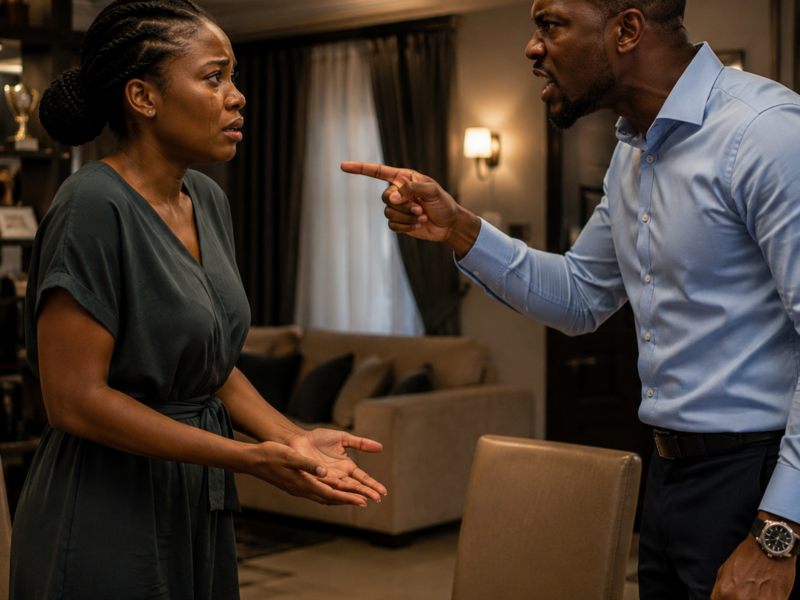
From Abused Wife to CEO: The Day She Took Everything Back
Part 1: The Weight of the Morning
“God, I’m so tired. Please, just give me the strength to make it through today.”
I whispered the prayer into the cold, gray dawn, my forehead pressed against the scarred wooden door of our kitchen pantry. My legs felt like lead, and the heavy, lingering ache in my lower back was a constant reminder that my physical threshold had been surpassed months ago. I was drowning in the invisible currents of a life I no longer recognized.
“Ajoa! You had better hurry up with my food. I need to get to work.”
Kofi’s voice boomed from the living room, sharp and impatient, cutting through the quiet morning like a jagged blade. I didn’t need to look at the clock to know he was already irritated. He started every day with a countdown, as if his morning routine were a high-stakes military operation.
“I’m trying, Kofi,” I called back, my voice strained. “I’m almost done with the eggs. Give me one more minute.”
“You always have excuses,” he snapped, his footsteps heavy as he paced the hardwood. “Your breakfast should have been ready ten minutes ago. And bring me water. I’m already late.”
I stood there for a heartbeat, my eyes closing. The exhaustion was so total it felt like a sickness, a deep, cellular depletion that sleep didn’t seem to touch. I moved to the sink, the cold water stinging my fingers as I filled a glass. I brought it to him, my hands trembling ever so slightly.
“Hurry up,” he muttered, not even looking at me as he took the glass. “I don’t have all morning to sit around waiting for you to get your act together.”
I turned back to the kitchen, the words sticking in my throat. I was so incredibly tired. “I’m just… I’m really tired today, Kofi,” I said, a small, involuntary confession slipping out.
He stopped, the glass half-raised to his lips. He turned slowly, his eyes narrowing into slits. “What did you just say?”
My stomach dropped. I realized too late that I had spoken a truth that didn’t belong in this house. “Nothing,” I rushed to say, my heart rate spiking. “I just… I’m sorry. Please, never mind.”
“Better,” he said, setting the glass down with a thud. “Remember who you are talking to. I am the man of this house. You submit to me. I speak, and you obey. I made you who you are today, Ajoa. I took you in, I provided for you, and I am the reason you have a roof over your head. So, do what I tell you, or I will take you back to your parents and show them exactly what kind of failure they raised.”
The threat hung in the air, cold and suffocating. It wasn’t the first time he’d said it, and I knew deep down it wouldn’t be the last. I retreated to the kitchen, my breath coming in short, sharp bursts. I was a ghost in my own home, a servant disguised as a wife. And as I plated his food, I couldn’t help but wonder if this was the sum total of my life’s worth.
He left ten minutes later, the slam of the front door vibrating through my bones. I slumped into a chair, the silence of the house pressing down on me. I had a busy day ahead, but my body felt like it was made of sand. I had survived another morning, but the victory felt like a defeat. I caught my reflection in the window—hollow, pale, and fading.
Is this really what marriage is supposed to feel like?
I didn’t have the answer. I didn’t even have the energy to ask the question aloud. I just stood up, cleared his plate, and started the cleaning. The cycle had to continue. The cycle always continued. But as I scrubbed the stove for the second time that morning, a small, dangerous thought flickered in the back of my mind. What if I just… stopped? What if I didn’t get up tomorrow?
The thought terrified me, but it also tasted like air. I pushed it down, burying it under the mountain of chores, but I knew it was there, waiting for me to find it again. And somewhere across the city, the wheels were already beginning to turn, unbeknownst to me, in a way that would force me to confront that question much sooner than I ever imagined.
Part 2: The Silent Burden
The walk to the bus stop was a blur of gray concrete and distant city noise. Every step felt like wading through deep water. My job as a junior clerk at a consulting firm was the only place where I felt even a shred of normalcy, mostly because people there didn’t expect me to be a “wife”—they just expected me to be efficient.
“Good morning, Ajoa,” my supervisor, Mr. Okoro, greeted me as I sat at my desk. “You look like you haven’t slept in a week. Is everything alright?”
“Good morning, sir,” I managed a thin smile. “I’m fine, really. Just a long week.”
He looked at me for a second longer, his eyes searching, then nodded and walked away. He was a kind man, the type who believed that a workplace should be a sanctuary rather than a battlefield. I envied that perspective. In my home, the battlefield was the kitchen, the bedroom, and the dining room.
Lunchtime arrived, and I found myself sitting on a park bench, staring at a sandwich I had no appetite for. My friend, Ada, sat down beside me, her eyes immediately zeroing in on my face. She was the one person who saw through the “I’m fine” mask I wore every day.
“Hey,” she said softly, touching my arm. “You okay? You’ve been quiet all week. You barely eat anymore. What’s going on?”
I looked at her, and for a second, the pressure behind my eyes threatened to break the dam. “It’s just… marriage stuff,” I whispered, the words feeling heavy and shameful.
“What kind of ‘marriage stuff’?” she pressed, her voice dropping into a protective register. “Kofi has been difficult lately?”
“Difficult doesn’t cover it, Ada,” I said, a bitter laugh escaping my lips. “If the food is five minutes late, he shouts. If I tell him I’m tired, he says I’m lazy and useless. If I try to talk back, even just a little, he says I’m being disrespectful. It feels like I’m walking through a minefield every single day.”
Ada leaned in, her eyes wide with concern. “Does he help you at all? Does he do anything around the house?”
“Help me?” I repeated, the irony stinging. “That man won’t even carry his own plates to the sink. I wake up before sunrise, I cook, I clean, I go to work tired, and when I come home, I’m expected to keep working. When did I stop being a wife and become a servant? Is this really what marriage is supposed to feel like?”
“Marriage is a partnership, Ajoa,” Ada said, her voice firm. “It is not slavery. You are his wife, not his maid. You deserve respect, and you deserve peace. If you keep accepting this behavior, he’s going to think it’s normal. He may never realize he’s hurting you unless you draw a hard line.”
I felt a surge of panic. “But I love him, Ada. And regardless of how he treats me, I’m supposed to honor him. I took a vow before God. I’m supposed to submit to my husband, right? Maybe I just need to pray harder. Maybe one day he’ll change.”
Ada looked at me with such profound sadness that it made my heart ache. “And what if he doesn’t, Ajoa? You don’t deserve to live like this. You’re fading away right in front of me.”
“I shouldn’t have discussed this with you,” I said, standing up abruptly. The shame was suffocating. “I’m sorry. I shouldn’t be complaining about my home life.”
“Don’t apologize for opening up,” Ada said, but I was already walking away. I needed to get back to the office, to the safety of the work, to the numbness of the routine.
That evening, I arrived home with the dread of a prisoner returning to a cell. I had prepared a stew, carefully adding extra meat this time to appease his complaints. As I served it, he barely glanced at me.
“How was work today?” I asked, trying to sound cheerful.
“Stressful,” he replied, his tone dismissive.
I took a deep breath. “Our supervisor actually praised me today, Kofi. He said I handled the difficult clients really well. I… I just thought maybe you’d be happy for me.”
He looked at me, his eyes cold and devoid of any warmth. “Happy for what? Small office work? Do you think that’s some big achievement? Without me, you wouldn’t even have that job, Ajoa. So, don’t start feeling important because somebody praised you for doing the bare minimum.”
I felt the light go out inside me. I had been so proud. I had worked so hard. But he had reduced it all to dust.
“I wasn’t trying to feel important,” I whispered, turning to go to the kitchen.
“Next time, add more meat to the stew,” he called after me, his voice dismissive. “This portion is too small.”
I stood in the kitchen, the familiar coldness creeping in. I felt small, pathetic, and trapped. I had tried everything. I had prayed, I had apologized, I had submitted. And yet, the cycle just tightened around my throat. I couldn’t see a way out, and the fear that this was my life—for the next forty, fifty years—was a terrifying shadow that loomed over everything I did.
Part 3: The Breaking Point
The next few days passed in a haze of forced smiles and whispered apologies. I was walking on eggshells, avoiding any topic that might trigger his anger. The house was clean, the food was hot, and the silence was absolute.
But beneath the surface, the pressure was mounting. One morning, as I prepared for work, he cornered me in the hallway, his face dark with a new kind of intensity.
“I didn’t like the way you spoke to me at the dining table the other day,” he said, blocking my path to the door.
I felt the familiar spike of terror, but I tried to remain calm. “So, what do you want me to do, Kofi?”
“Apologize,” he demanded.
I stared at him. “Apologize? For what?”
“For your attitude,” he barked. “I am a man, and I don’t need to apologize to my wife for wanting things done my way. You were disrespectful.”
My hand gripped the handle of my purse until my knuckles ached. “I’m sorry, Kofi. Is this the reason why you called me into the hallway? If you don’t have anything better to say, I’m going to work.”
“Don’t you dare walk away from me,” he yelled, grabbing my arm. His grip was firm, bruising. “You don’t get to decide when a conversation is over. You are going to apologize, and you are going to mean it.”
“Please, Kofi,” I pleaded, my voice trembling. “I’m already late.”
“At your age, you still think you have a say in this house,” he spat, letting go of my arm with a shove. “Next time, you will think twice before you try to act like you’re equal to me.”
He slammed the door to his office, leaving me alone in the hallway. I felt a tear slide down my cheek, but I wiped it away quickly. I didn’t have time for this. I grabbed my bag and hurried out, but as the door clicked shut behind me, the thought of returning that night felt like a death sentence.
I worked through the day in a robotic daze. My mind was a loop of his voice, his threats, his coldness. During a break, I went to the bathroom and stared at myself in the mirror. Who was this woman? Where had the bright, ambitious girl gone? I had traded my dreams for a cage.
I left the office early, not because I wanted to, but because I felt a sudden, inexplicable need to be anywhere but home. I walked until my feet ached, finding myself outside a small church I had passed a hundred times but never entered. I sat on the back pew, the quiet of the sanctuary offering a brief respite from the noise of my life.
Bishop Francis walked by, his eyes catching mine. He sat down a few pews away, his expression kind. “Ajoa, my daughter, you don’t look all right. What’s troubling you?”
I didn’t mean to, but the dam broke. “Bishop, I don’t even know where to begin.”
“Take your time,” he said, his voice soft. “I’m listening.”
I poured it all out—the anger, the control, the constant feeling of being a failure, the crushing weight of the chores, and the silence that had replaced our love. When I finished, I was shaking, the confession hanging in the air like a physical burden.
“Marriage can be difficult sometimes,” the Bishop said, his voice measured. “Every marriage goes through seasons. Men carry different pressures, and sometimes they don’t express it well.”
“So what should I do?” I asked, looking for a sign, a hope, anything.
“Continue praying,” he advised. “Be patient. Give him grace. I’m not saying your pain isn’t real, but don’t make any rash decisions. God will change his heart.”
“I’ve been praying for months, Bishop,” I said, a flicker of resentment rising. “I don’t know how much more I can take.”
“I’ll call him,” the Bishop said gently. “I’ll speak with him personally. Perhaps hearing another perspective may help.”
“You think he’ll listen?” I asked, hope struggling to breathe.
“We can only try,” he said. “And we’ll continue praying.”
I left the church feeling a little lighter, but the doubt was still there. I had prayed. I had been patient. And yet, the cage remained. That evening, when I arrived home, I knew things were about to reach a breaking point. I had told the Bishop. I had opened the door to the outside world, and I knew Kofi would not take kindly to his business becoming “church business.”
The house was dark. I walked inside, my heart hammering. “Kofi? I’m home.”
He walked out of the living room, his face dark with a fury I hadn’t seen before. “Where were you?”
“I… I went to church,” I said, my voice barely a whisper.
“To church?” he repeated, his voice dangerously low. “Or should I say you went to discuss me with the pastor?”
The room felt like it was shrinking. The trap had snapped shut.
Part 4: The Demon’s Cage
“You went to discuss me with the pastor?” Kofi’s voice was a low, guttural growl that made the very air feel heavy.
I stumbled back, clutching my bag to my chest. “I was only seeking advice, Kofi! I was hurting, and I didn’t know where else to turn!”
“Advice?” he scoffed, his eyes burning. “So now, complete strangers get to know what happens inside my house? My private life is now fodder for his sermons?”
“Bishop Francis isn’t a stranger!” I cried, the desperation rising in my throat. “He’s been our family advisor for years!”
“That is not the point,” he yelled, stepping into my personal space. “Do you have any idea how embarrassing it was to receive that call? Who do you think you are, dragging my business into the church?”
“I wasn’t trying to embarrass you!” I pleaded. “Every time I try to talk to you, you get angry, you walk away, or you tell me to be quiet. I just needed someone, anyone, to help me understand how to make this marriage work!”
He paused, a cruel, mocking smile appearing on his face. “So now, I’m the problem. I’m the one you have to gossip about to get your way.”
“That’s not what I’m saying!” I shouted, my courage finally reaching a breaking point. “I’m saying I’m drowning here! I’m saying I’m tired, I’m unhappy, and I don’t know how to reach you!”
He took another step forward, his shadow engulfing me. “You didn’t need help. You needed to do what you were told. You had to go and turn me into a topic of discussion.”
“I didn’t!”
“You disrespected me, Ajoa. And you know what happens when you disrespect me.”
I turned to run toward the bedroom, needing the safety of a closed door, but he was faster. He grabbed my shoulder, spinning me around. “Oh no, you don’t. We aren’t finished.”
“Kofi, please,” I begged, tears streaming down my face. “I can’t take this anymore.”
“I don’t care what you can take,” he said, his voice devoid of any humanity. “You crossed the line today. I wasn’t trying to hurt you, but you need to be taught a lesson. You will face the consequences for this.”
He shoved me toward the kitchen, his hand firm and unforgiving. He marched me to the door, opened it, and pushed me inside. The sound of the lock turning was the loudest thing I had ever heard.
“I will be back when I decide you’re ready to act like a wife,” he said through the closed wood.
“Kofi! Please! Don’t do this!” I pounded on the door, but the sound of his receding footsteps was the only reply.
I was trapped. The kitchen, once my sanctuary, was now a prison. I fell to the floor, the cold tile pressing against my skin. I was alone, hungry, and terrified. I had prayed for help, and I had been told to be patient. I had tried to talk, and I had been punished.
I sat there in the dark, the reality of my life finally crystallizing. He didn’t love me. He owned me. And as long as I stayed, he would continue to break me until there was nothing left.
Hours passed. The house was silent. I didn’t have my phone; it was in my bag in the living room. I was completely cut off from the world. I thought about the Bishop, I thought about Ada, I thought about my mother. I realized then that I had been waiting for someone to save me, but the only person who could save me was the woman sitting on this kitchen floor.
I stood up, my legs shaky. I walked to the window. It was small, reinforced glass, but it was a window. I looked out into the night. I wasn’t going to wait for him to decide I was “ready.” I was going to find my own way.
I looked around the kitchen, my eyes landing on a heavy metal spoon. I walked to the back door, the one that led to the small garden. It was locked, but the hinge looked old. I had been cleaning this house for years, scrubbing the rust, oiling the hinges, making sure everything was perfect for him. Maybe that perfection was my only chance.
I began to work on the hinge. It was grueling, back-breaking work, but every turn of the screw was a reclamation of my life. My hands bled, my muscles screamed, but I didn’t stop. I wasn’t just fixing a hinge; I was dismantling the cage.
When the last screw finally came loose, I pushed the door open. The night air rushed in, cool and sweet. I didn’t look back. I stepped out, the dark garden welcoming me like an old friend. I was free. I was terrified, I was exhausted, but for the first time in years, I was mine.
I didn’t know where I was going, but I knew I wasn’t staying here. I began to run. I ran toward the main road, toward the lights of the city, toward the possibility of a life where I didn’t have to apologize for existing.
But as I reached the edge of the property, I heard a car pulling into the driveway.
His car.
He was back. And I knew, with a certainty that chilled me to the marrow, that he would be coming for me the second he realized I was gone.
Part 4: The Escape into the Night
The gravel crunched under the tires of his car. The lights swept across the garden, catching the open door of the kitchen. I scrambled into the shadows of the tall shrubs, my heart drumming against my ribs like a trapped bird.
“Ajoa?”
His voice was thick, unnatural. He must have been drinking. I crouched lower, my breath hitching in my chest. If he found me now, there would be no more apologies. No more discussions.
“Ajoa! Answer me!” He kicked the back door open, the sound echoing through the garden.
I waited until his footsteps moved into the house, until the sound of him tearing through the living room told me he was looking for me inside. Then, I didn’t wait. I bolted. I leaped over the low garden fence and sprinted toward the distant glow of the streetlights.
I didn’t look back. I ran until my lungs felt like they were filled with broken glass. I found the main road and hid behind a bus shelter, watching the cars pass, too terrified to hail one. How could I explain this? Who would believe me? A woman in her nightgown, alone in the middle of the night.
I remembered Ada. I had to get to Ada.
I started walking, sticking to the shadows, my mind racing. I needed a phone. I needed help. I saw a gas station a few blocks away, the neon sign buzzing in the dark. I approached it cautiously, my heart pounding.
I saw a payphone—a relic from another time, but right now, it was my lifeline. I had a few coins in my pocket from my work bag. I dialed Ada’s number, my fingers shaking.
“Hello?” she answered, her voice sleepy.
“Ada,” I sobbed. “It’s me. I… I got out.”
“Ajoa? Oh my God, what happened? Where are you?”
“I escaped. He locked me in, but I got out. He’s looking for me.”
“Stay where you are,” she commanded, her voice turning into steel. “I’m coming. Give me the address of the gas station. Hurry.”
I gave her the location and collapsed onto the cold metal bench of the bus stop. I was shaking, the adrenaline wearing off, the cold finally seeping into my skin. I waited for what felt like an eternity, every passing car triggering a fresh wave of panic.
Then, headlights appeared. A familiar car pulled up to the curb. It was Ada. She jumped out, her face a mask of concern and fierce protectiveness. She ran to me, wrapping her arms around me.
“I’ve got you,” she whispered. “You’re safe now. No one is going to hurt you.”
We climbed into her car, and she sped away from the area, not looking back. We drove in silence for a while, the city lights becoming a blur. I started to cry, the tears finally flowing freely. I was free. I was actually free.
“He’s going to find us, Ada,” I said, my voice trembling.
“Let him try,” she said, her hands gripping the wheel. “He doesn’t have a clue what he’s dealing with. You are not going back there. You are not his property, Ajoa. And I’m going to make sure he understands that.”
We pulled up to a small, unassuming motel on the edge of the city. She helped me inside, got me a fresh towel, and sat with me until I finally fell asleep. I dreamed of cages and keys, but when I woke up, the sun was streaming through the window, and I was still free.
I walked to the bathroom and looked in the mirror. I looked exhausted, beaten, and scared. But there was something else in my eyes—a flicker of life. I wasn’t just Ajoa, the disappointment. I was Ajoa, the woman who had dismantled her own prison.
I knew the battle wasn’t over. Kofi would be searching. The family would be calling. But I also knew I had an ally in Ada. And for the first time, I felt like I had a future.
“You’re awake,” Ada said, walking in with two cups of coffee.
“Yeah,” I said, taking the cup. “I’m awake.”
“What now?” she asked.
I took a sip of the coffee, looking out at the morning sky. “Now, I start over.”
But just as I said it, a dark car pulled slowly into the motel parking lot, cruising down the row of rooms, its windows tinted and ominous. My heart froze. He had found us.
Part 5: The Confrontation
The dark sedan cruised past our window, its presence heavy and suffocating. I gripped the curtain, watching it turn the corner and disappear.
“Is that him?” Ada whispered, her face pale.
“I think so,” I said, my voice barely a thread. “How did he find us?”
“I don’t know,” Ada said, her hands flying to her phone. “But we need to move. Now.”
We gathered our things in a flurry of panic. We didn’t bother checking out; we just threw our bags into her car and peeled out of the parking lot. We drove for hours, heading north, away from the city, away from everything I knew. I felt a strange sense of liberation in the flight. Every mile we put between us and the city felt like another layer of the cage being shed.
“Where are we going?” I asked, looking at the unfolding landscape.
“My cousin has a place in the mountains,” Ada said. “It’s small, it’s hidden, and he’ll never think to look for you there.”
The drive was long, the silence between us filled with the weight of what I had left behind. I thought about the house, the clothes, the photos. I had left it all. I had walked out with nothing but the clothes on my back and a heart that was finally, truly mine.
“You did the right thing,” Ada said, sensing my hesitation. “Don’t ever doubt that. A marriage that destroys you isn’t a marriage. It’s an execution.”
I nodded, the truth of her words resonating in my soul. I was still scared, but the fear was different now. It was a sharp, focused fear, not the paralyzing terror of the cage. It was the fear of a traveler stepping onto unknown ground.
We arrived at the cabin as the sun was setting. It was a rustic, beautiful place, nestled in a valley, surrounded by ancient trees. The air was cool and crisp, tasting of pine and earth. It was everything the city was not—peaceful, quiet, and profoundly indifferent to the drama I had escaped.
“Stay here,” Ada said, handing me a set of keys. “Take as long as you need. I’ll make sure no one finds this place.”
I looked at the keys, the weight of them promising a new beginning. “Thank you, Ada,” I said, my voice thick. “I don’t know how to repay you.”
“By living,” she said, hugging me. “By finally living the life you deserve.”
I watched her drive away, the silence of the valley rushing in to fill the space. I walked into the cabin, the floorboards creaking under my feet. It was small, but it felt like a palace. I had a bed, a kitchen, and, most importantly, I had a door that I could lock from the inside.
I spent the next few days in a daze, sleeping, eating, and just existing. I didn’t worry about the cooking. I didn’t worry about the cleaning. I didn’t worry about being “a good wife.” I was just… Ajoa.
One afternoon, I was sitting on the porch, reading a book, when I heard a rustle in the trees. I stiffened, my heart leaping into my throat. Kofi?
I stood up, ready to run, ready to disappear into the woods. A figure emerged from the shadows. It was a man, tall and rugged, wearing a flannel shirt and work boots. He looked like a local.
“Sorry to disturb you,” he said, his voice deep and calm. “I’m the neighbor. I just wanted to welcome you to the valley.”
I relaxed, my breath returning to me. “Oh. Thank you. I’m Ajoa.”
“Mark,” he said, tipping his cap. “If you need anything—firewood, groceries, a jumpstart for your car—just give a holler. We look out for our own here.”
“I appreciate it,” I said, a small smile forming. “It’s been a while since I’ve been in a place where people look out for each other.”
“Well, you’re here now,” Mark said, his eyes kind. “And here, you don’t have to apologize for existing.”
His words hit me like a physical weight, but in a good way. I stood there, looking at this stranger who had offered me more kindness in five minutes than my husband had in six years. I realized then that the world was bigger, warmer, and more generous than I had ever allowed myself to believe.
I wasn’t just a prisoner who had escaped. I was a person who was beginning to heal. And as I watched Mark disappear into the woods, I knew that the cage wasn’t just a place I had left; it was a mindset I had finally, permanently, dismantled.
Part 5: The Fragile New Normal
Weeks turned into months, and the valley began to feel less like a hiding spot and more like a home. I took a job at the local library, a quiet, sanctuary-like place where the only demands were to organize books and answer simple questions. For the first time, my day wasn’t defined by someone else’s moods or someone else’s hunger.
Mark, the neighbor, became a fixture in my life. He’d stop by with fresh firewood, or a basket of apples from his orchard, or just to chat about the local gossip. He never asked about my past, never pressed me for the “truth” behind my sudden arrival in the mountains. He just existed alongside me, a steady, unwavering presence that made the silence of the valley feel less like an absence and more like a gift.
I started painting. It was something I hadn’t done since I was a teenager. The colors of the mountains—the deep, velvet greens of the pines, the sharp, brilliant blues of the sky—found their way onto canvases I bought at the local art supply shop. I felt a part of myself that had been buried alive slowly, achingly, begin to return to the surface.
“You’ve got a real eye for light,” Mark said one afternoon, looking at a painting of the valley at dawn.
“I just paint what I see,” I said, not looking up from my brush.
“Most people don’t see anything,” he said, his voice warm. “They’re too busy worrying about where they’re going. You… you really look at things.”
I felt a flush creep up my cheeks. “Maybe I’m just making up for lost time.”
One evening, Mark stopped by with a bottle of wine. “Thought you might want to celebrate,” he said.
“Celebrate what?”
“Six months,” he said, his smile bright. “Six months since you arrived.”
I took the bottle, my hand trembling slightly. Six months. It felt like a lifetime. “Thank you, Mark.”
We sat on the porch, the stars beginning to twinkle over the valley. We talked about everything and nothing—the weather, the trees, the books I was reading. It was the easiest conversation I’d ever had. There was no judgment, no criticism, no demand for me to be anything other than who I was.
“I used to think that love was something you had to earn,” I said, the words slipping out into the night. “That you had to perform for it, work for it, suffer for it.”
Mark was silent for a long time. “Love isn’t a chore, Ajoa. It’s a choice. And if someone makes you work to be loved by them, then they don’t deserve the effort.”
I looked at him, the moonlight catching his features. I realized then that he was the mirror I needed to see myself clearly. He didn’t treat me like an object; he treated me like a person. And that realization made me want to cry, but not from sadness—from gratitude.
But just as the night felt perfectly, blissfully calm, the landline in the cabin—the one I had stopped using months ago—began to ring.
My heart froze. I hadn’t given this number to anyone but Ada.
I walked inside, my steps heavy, the ringing sounding like a gunshot in the silence. I picked up the phone.
“Ajoa?” It was Kofi.
I didn’t say a word. The sound of his voice sent a shockwave of terror through my system, my breath catching in my throat.
“I know where you are,” he said, his voice a low, threatening hiss. “I found the local library records. Don’t think for a second you’ve escaped me. I’m coming for you, Ajoa. And when I get there, you’re going to wish you’d stayed in that cage.”
The line went dead.
Part 6: Facing the Storm
I stood there in the dark, the phone clutched in my hand as if it were a venomous snake. The silence of the cabin, which only moments ago had felt like peace, now felt like a warning. He had found me. The cage wasn’t locked anymore, but the hunter was still on the trail.
Mark stepped into the room, his eyes scanning my face, the phone, the tension that had instantly drained the life from the room. “What is it?” he asked, his voice tight.
“He found me,” I said, my voice barely audible. “Kofi. He’s coming.”
Mark moved instantly, his protective instincts kicking in. He didn’t ask questions; he didn’t tell me to be patient. He just moved. “Grab your bag. Everything you need to take with you.”
“Where are we going?”
“Somewhere he can’t follow,” he said, grabbing a heavy duffel bag from the closet and tossing it to me. “We’re going to my brother’s place. It’s even deeper in the mountains. He won’t find you there.”
“I can’t keep running, Mark,” I said, a wave of weariness washing over me. “I’m so tired of running.”
“You aren’t running away anymore,” Mark said, looking me in the eye. “You’re running toward your own life. And I’m going to make sure you get there.”
We drove through the night, the mountains rising up around us like dark, silent sentinels. Every headlight in the rearview mirror felt like a threat, every curve in the road a potential trap. But beside me, Mark was calm, his hands steady on the wheel.
“He thinks he still owns you,” Mark said, his voice a low, grinding growl. “He thinks he can just show up and drag you back. He’s about to find out how wrong he is.”
I looked at him, feeling a surge of strength that I hadn’t possessed before. I had the keys, I had the cabin, and I had Mark. I had the truth.
“He doesn’t own anything,” I whispered. “He never did.”
We reached the second cabin before dawn. It was even more remote, hidden deep within a valley, a place that felt forgotten by time. We went inside, and I collapsed onto the bed, the exhaustion finally catching up to me.
“Sleep,” Mark said, pulling the blanket up over me. “I’ll watch the road.”
I fell into a deep, dreamless sleep. When I woke up, the sun was already high in the sky. I heard noises from the kitchen—the clinking of pots, the smell of fresh coffee, the quiet, rhythmic sound of someone humming.
I walked into the kitchen and found Mark cooking breakfast. He looked up, his smile wide and genuine. “Morning. I thought you’d sleep for another day.”
“I needed it,” I said, my voice soft. “Thank you.”
“Don’t thank me,” he said, handing me a cup of coffee. “I’m just doing what needs to be done.”
I sat at the table, watching him cook. It felt so normal, so right, that it was easy to forget the dark storm that was raging just outside our lives. But I knew the storm wasn’t gone; it was just waiting.
“What happens when he gets here?” I asked.
“He won’t,” Mark said, his tone final. “Because when he does, he’s going to find out that he’s not just dealing with you anymore. He’s dealing with all of us.”
I looked at him, feeling a flicker of something new—hope. I had spent so long believing I was alone, that my life was a private, secret prison. But I had people. I had Ada, I had the Bishop, I had Mark.
“I’m ready,” I said, my voice steady. “Let him come.”
The day felt different. I wasn’t waiting for the crash; I was preparing for the aftermath. I started drafting a document—my account of everything that had happened. Every threat, every lie, every moment of control. I was going to be ready.
I heard a car pull into the driveway.
I stood up, my heart pounding, but I didn’t hide. I walked to the window and looked out. It wasn’t Kofi.
It was the police.
My heart stopped. What had happened?
I walked to the door, my hand on the lock. Mark stepped in front of me, his eyes sharp. “Stay back,” he said.
I watched as he went to the door and opened it. Two officers stood on the porch.
“Are you Ajoa Mensah?” one of them asked.
“Yes,” I said, stepping forward.
“We’re here because of an emergency call from your friend, Ada,” the officer said. “She says your husband Kofi is currently at the church, threatening the pastor and demanding to know your location.”
My blood ran cold. “The pastor? Why the pastor?”
“He says the pastor was the one who encouraged you to leave,” the officer said.
I felt the ground tremble beneath my feet. This was it. The storm had finally reached the shore.
Part 7: The Final Reckoning
The ride to the church was a blur of blue lights and sirens. My heart was a frantic drum, every beat a prayer that I wasn’t too late. Kofi was at the church, and he was out of control. The very man I had once loved, the man I had vowed to honor, was now tearing apart the one place I had gone for help.
“Stay in the car,” Mark said, his voice hard as we pulled into the church parking lot. “I’m going in.”
“I’m coming with you,” I said, my hand on the door handle. “He came here for me. I’m not letting him hurt anyone else.”
Mark looked at me, seeing the steel in my eyes, and nodded. “Alright. But stay behind me.”
We entered the sanctuary, the heavy wooden doors groaning as we pushed them open. The space was empty, save for Kofi, who was standing at the altar, his face contorted with a rage that looked more like insanity than passion. He was holding the pulpit, his knuckles white.
“Where is she?” he screamed, his voice echoing in the vaulted ceiling. “Tell me where she is, or I’ll burn this place to the ground!”
The Bishop stood at the front, his posture calm, his eyes fixed on Kofi. “Kofi, stop this. This is a house of God.”
“I don’t care about your God!” Kofi yelled, picking up a heavy candle holder and throwing it against the wall. It shattered into a thousand pieces.
“Kofi,” I said, stepping into the light.
He spun around, his eyes widening. “Ajoa! You! Where have you been?”
“I’m done, Kofi,” I said, my voice clear and unwavering. “I’m done being your slave, I’m done being your punching bag, and I’m done living in your cage.”
He lunged toward me, but Mark stepped in, his tall frame blocking him completely. “Stay back,” Mark said, his voice a low growl.
Kofi stopped, his chest heaving. “This is my wife! You have no right to interfere!”
“She’s not your wife anymore,” Mark said. “She’s a free woman. And if you take one more step toward her, you’re going to find out just how ‘free’ you’re going to be in a holding cell.”
The police officers followed us in, their guns drawn, the metal clicking sharply in the silence. “Drop the weapon, sir!” one of the officers shouted.
Kofi froze. He looked around the room—at the police, at Mark, at me, at the Bishop. The reality of his situation finally hit him. He wasn’t the man of the house anymore; he was a desperate, angry man who had lost everything because he couldn’t control his own arrogance.
He dropped his hands, his face collapsing into a mask of pure defeat.
The officers moved in, cuffing him, their voices muffled as they read him his rights. I watched the scene with a strange, detached calm. It was over. The cage was broken.
As they led him away, he looked at me one last time. There was no apology in his eyes, no remorse. Just a cold, lingering hatred. “You’ll never be happy, Ajoa,” he whispered as they pushed him past. “No man will ever want a woman who destroys her own home.”
I looked at him, then back at the altar, then at the life I had just stepped into. “I don’t want a man who destroys my life,” I said, my voice steady. “I want a home that builds me up.”
He disappeared into the back of the police cruiser, the red and blue lights flashing against the stained glass windows.
I stood there, the silence of the church enveloping me. It wasn’t the silence of the cage. It was the silence of a new beginning.
“You did it,” Mark said, standing beside me.
“We did it,” I said, turning to him.
The Bishop walked over, his eyes misty. “I am sorry I didn’t see the truth sooner, Ajoa. I am sorry I told you to stay.”
“It’s okay, Bishop,” I said. “I had to find my own strength to leave.”
We walked out of the church, the morning sun breaking through the clouds. The world looked different—brighter, clearer, full of possibility. I had survived the storm. I had torn down the cage. And for the first time, the future was entirely my own.
I walked to Mark’s truck, feeling the grass under my feet, the air in my lungs. I was free. I was Ajoa, and I was just getting started.
If this story reminded you of your own strength, share it with someone who needs to know they aren’t alone. And don’t forget to follow for more. #Freedom #SelfWorth #BreakingTheCage #AjoasStory









