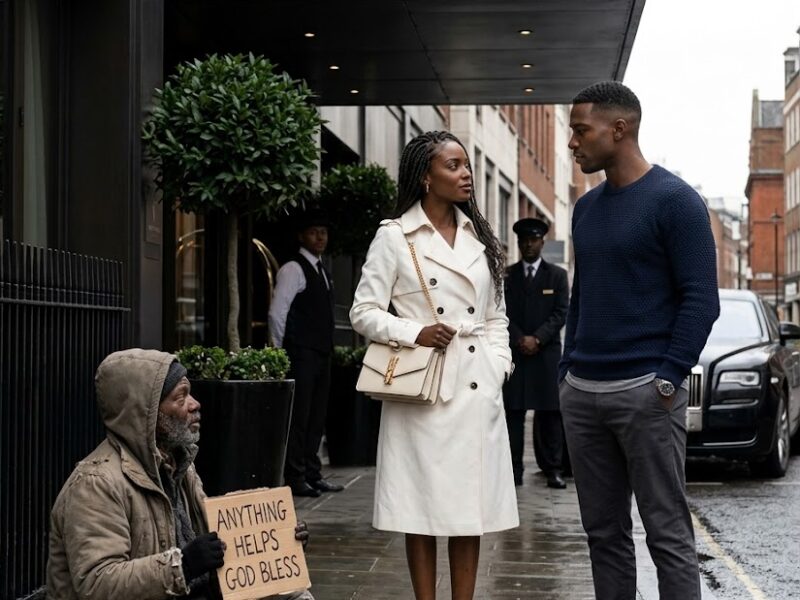
He Disguised Himself as a Beggar to Test His Fiancée, What She Did Shocked Everyone
Part 1: The Alchemy of Dirt
Before our wedding day arrived, I had never felt real dirt under my fingernails. Not the kind that settles permanently into the microscopic cracks of your skin and refuses to leave, no matter how hard you scrub with luxury soaps. I mean the kind of dirt that transforms you into a ghost. The kind that makes total strangers instinctively look away, shifting their gaze to the horizon before your shadow can touch theirs.
My name is Adrien Cole. On a freezing, overcast Tuesday morning, I stood behind an abandoned auto body shop three blocks away from the West Bridge Mall, staring into the cracked glass of a broken side mirror.
The man looking back at me had sunken, hollow cheeks. A coarse gray beard had been unevenly glued along his jawline using theatrical adhesive. He wore a stained brown wool coat that was at least two sizes too large, its cuffs frayed into gray threads, and a pair of split-sole boots that let the freezing dampness of the concrete seep straight into his socks.
No one in the city would ever recognize the man in the mirror. Not the journalists who had placed my face on the covers of business magazines, not the high-society grooms whose viral wedding invitations had become the most coveted ticket among the city’s elite families, and certainly not Richard Cole—the unyielding, multi-billionaire founder of Cole Dominion Holdings.
Most importantly, Vanessa Hart would not recognize me.
I rubbed a small chunk of charcoal beneath my eyes, blending it into the fake wrinkles until the transformation was absolute. The wedding was exactly nine days away. Nine days before five hundred guests would gather beneath thousands of white roses and gold chandeliers to watch Vanessa look into my eyes and promise to love me for better or worse.
But lately, a cold, persistent question had begun to rot my peace of mind. I had started wondering whether she truly understood the heavy, mathematical meaning of worse.
A black SUV pulled quietly into the narrow, garbage-strewn alley behind me, its engine idling with a low, expensive hum. Marcus, my private driver and the only human being in the city who knew what I was doing, stepped out of the vehicle. A deep, heavy worry was folded across his features.
“Sir,” Marcus said, his voice a low whisper that barely cleared the sound of the rain. “This is absolute madness. If your father discovers you’re missing from the executive suites for a domestic experiment, he will restructure the core shares before noon.”
I tightened a piece of rough twine around the torn canvas backpack resting on my shoulder. “No, Marcus,” I said, my voice dropping into a flat, clinical register that sounded entirely foreign even to my own ears. “This isn’t madness. This is structural clarity.”
Marcus looked at the damp rags clinging to my frame, then looked straight into my eyes. “Clarity can destroy a man just as efficiently as a lie, Adrien.”
I didn’t answer him. I couldn’t. Three weeks earlier, at our magnificent engagement dinner, I had walked out of the banquet room to collect two fresh glasses of champagne from the service cart. As I neared the corridor, I overheard Vanessa laughing with her bridesmaids. It wasn’t a cruel laugh. That would have been significantly easier to handle; rage is a clean emotion. It was a soft, polished, incredibly expensive laugh.
One of her bridesmaids, Celia, had leaned in and whispered, “Girl, imagine if Cole Dominion collapsed tomorrow. Imagine if Adrien lost every single dollar to his name.”
Vanessa had paused. It was only for half a second—a microscopic lag in her breath—but I heard it through the drywall. Then she had said, “Adrien is simply not the kind of man who loses everything.”
The room had erupted into musical, easy laughter. I had stood in the dark corridor, the cold champagne flutes freezing my fingers, feeling a terrible, icy dread crawl straight down my spine. She hadn’t said I would still love him if he were in the dirt. She hadn’t said money holds zero relevance to our vows. She had simply stated, with absolute, terrifying certainty, that I was legally and structurally protected from ruin.
Since that night, every single smile she gave me felt like a deposition. Every kiss felt like a piece of evidence I couldn’t fully catalog. I hated myself for the doubt. Vanessa had never once pressed me for diamonds; she had never demanded a larger house in the hills, and she had never flaunted my family’s name to the press. But love possesses a strange, volatile enemy: fear. And fear doesn’t require an explicit proof to build a wall; it only requires a single crack in the foundation.
By ten o’clock that morning, I was seated flat on the freezing concrete outside the main entrance of the West Bridge Mall. An old, crumpled paper cup rested between my boots, and I watched the wealthy world move past, completely unaware that the billionaire prince was measuring their souls.
A teenager dropped a few copper coins into my cup without looking at my face. A mother pulled her young daughter closer to her skirt as they hurried past my shadow. Two executives in custom wool suits stepped cleanly around my split-sole boots as if I were nothing more than spilled water on the marble.
“God bless you, son,” an old man whispered, setting a wrapped sandwich beside my knee before shuffling into the terminal. “Keep breathing.”
Those words hit my chest significantly harder than they should have.
At noon, the overcast sky darkened further, and I shifted my position toward the luxury boutique district three blocks away. My heart was pounding so violently against my ribs that I almost reached for my phone to call Marcus to end the experiment. I felt like a coward.
And then, a sleek white sedan pulled cleanly to the curb.
The passenger door opened, and Vanessa stepped out onto the pavement. She wore a simple, cream-colored wool dress, her hair pinned back in a neat, unhurried knot, her emerald-cut engagement ring flashing brilliantly beneath the sudden break in the clouds. She looked beautiful, entirely calm—mine.
Beside her strode Celia, her maid of honor, speaking rapidly while scrolling through a tablet. Vanessa laughed softly at something Celia said, but the sound died instantly as her eyes swept across the sidewalk, swept across the crowd—and stopped dead on me.
I lowered my head, my fingers gripping the paper cup until my joints ached. Her footsteps slowed against the stone.
“Vanessa, don’t stop,” Celia said, her heels clicking sharply as she pulled at her arm. “The wedding planner has been waiting twenty minutes. We’re late.”
But Vanessa was no longer walking. Her long, elegant shadow fell completely over my torn shoes.
Part 2: The Scar on the Thumb
For one long, absolute breath, neither of us moved. The city noise seemed to die down into a low, underwater hum. Vanessa stood perfectly still in the center of the sidewalk, the wind catching the edge of her cream dress, her eyes fixed on the gray beard glued to my jaw.
“Sir,” her voice came softly above me, entirely devoid of the high-society distance I had expected. “Are you hungry?”
I lifted my face just enough for the woman I loved to look directly into the pupils of a man she believed was a total stranger. Her eyes searched my features—not deeply, not with the intense, beautiful intimacy she used when we were sitting by the fireplace in the penthouse, but carefully enough to evaluate whether the flesh before her was dangerous, desperate, or completely invisible.
My throat tightened into a suffocating knot. I had spent three days blueprinting this exact interaction inside my head. In my imagination, I was a cold, clinical auditor executing a private character test with perfect emotional distance. But imagination is a dishonest machine. Looking up at her from the pavement, all I wanted to do was stand up, rip the theatrical hair from my face, and beg her to forgive me for ever letting fear enter our house.
“Vanessa, please,” Celia hissed, stepping between us and lowering her voice into a sharp whisper. “We cannot initiate a charity project today. Look at his coat—it’s filthy.”
Vanessa ignored her completely. The paper cup trembled slightly in my hand as I forced my voice down into a broken, raspy baritone. “Yes, ma’am,” I lied, the words scraping against my tongue like gravel. “I… I haven’t eaten a solid meal since yesterday morning.”
A shadow crossed Vanessa’s face—quick, private, and heavy. She unzipped her leather purse.
Celia let out a loud, dramatic sigh of disgust. “There are certified municipal organizations for this specific sector, Vanessa. You cannot personally save every single vagrant sitting on the shopping pavement. It’s an asymmetric expenditure of time.”
Vanessa ignored the remark, her fingers pulling a folded bill from her wallet. It was a crisp one-hundred-dollar bill. Too much capital for a random stranger; too little to serve as a structural proof of love. She bent down slightly to drop it into the cup, but as her hand neared the paper, her movement stopped dead in mid-air.
Her dark eyes fell directly onto my right hand.
My heart completely stopped. I had forgotten about the scar. Running across the base of my right thumb was a thin, distinct white line—the permanent remnant of a glass bottle I had broken at a small coastal tavern the exact night I proposed to her. We had spent four hours laughing about my clumsiness in the emergency room while she cried and called me an absolute reckless idiot.
I tried to curl my fingers beneath the sleeve of the oversized coat, but it was already too late. Vanessa’s gaze lingered on the white line, her brows drawing together into a sharp, unreadable knot.
“Your hand,” she said, her voice dropping into a quiet, guarded register.
“Old cut, ma’am,” I rasped, pulling my arm completely back into the shadow of the wool. “From the rail yards.”
She stayed perfectly still on the stones. Behind her spine, the city continued its chaotic, indifferent rotation. A municipal bus hissed its air brakes; a child cried near the parking meters. The entire world moved forward, completely unaware that my entire future was balancing on the edge of a single microscopic scar.
Celia grabbed Vanessa’s elbow with an aggressive, firm yank. “The boutique doors lock at one, Vanessa. Let’s go.”
Vanessa slowly placed the hundred-dollar bill inside my cup. She didn’t drop it casually from her height; she knelt slightly, ensuring the paper settled flat so the wind wouldn’t lift it away, treating my assumed identity with a level of dignity that made my throat ache.
“Please get something warm to eat,” she said softly, her voice gentle but explicitly guarded. Not intimate. Not suspicious. Not enough to clear the fear from my lungs.
“Thank you, ma’am,” I whispered.
She stood up to leave, and a volatile mixture of immense relief and bitter disappointment crashed together behind my ribs. But as she turned her back to the wall, a sudden, violent gust of November wind lifted the heavy edge of my oversized coat, exposing the silk lining near the interior pocket. I had failed to tear the inner fabric properly when I bought the garment from the thrift shop.
Celia saw it first. Her sharp eyes narrowed into two slits of cold suspicion. “Wait, Vanessa. Stop.”
Vanessa paused, looking back over her shoulder. Celia stepped closer to my position on the pavement, evaluating my rags with the intense, diagnostic distrust of a woman who loathed deception just as much as she loathed poverty.
“That coat,” Celia said, her voice dropping into a sharp, clinical tone. “Where exactly did you get a garment with that specific structural lining?”
I lowered my chin, keeping my face in the shadow of the canvas pack. “Found it, ma’am. In an alley near the docks.”
Celia let out a short, mocking laugh. “Of course you did. An imported wool blend left in a trash bin.” She turned to Vanessa, folding her arms over her chest. “He’s clearly running a commercial scam, Vanessa. Look at the data. The boots are split, but that coat belonged to real capital once. He’s pretending.”
Those words landed against my chest significantly harder than I anticipated. Not because I cared about Celia’s evaluation, but because I had spent three days building a lie, and I still felt wounded when someone questioned the reality of the man I was pretending to be.
Vanessa’s jaw tightened, her skin turning pale in the cold air. “Even if he is running a scam, Celia,” she said, her voice dropping into a low, absolute baritone that silenced her friend instantly. “The hunger is still a biological reality. A man doesn’t sit on freezing stone at noon unless something inside his house has completely failed. Let’s go inside.”
Celia looked completely stunned. “You are truly unbelievable, Vanessa.”
Vanessa turned her face back to look at me one final time. For one dangerous, terrifying second, I thought she was going to call out my name. I thought she had recognized the specific way I held my breath when I was in pain—the part of my soul that no gray beard or charcoal shadow could ever hide from her.
Instead, she reached back into her purse and pulled out a small, plain white business card. It wasn’t cash. It was the address of the Hope Haven Community Center on the lower east side.
“I volunteer at this facility on Thursday afternoons,” Vanessa said, her voice steady and clear. “They serve a hot lunch at one o’clock, no questions asked. Go there, sir. Tell the intake desk that Vanessa sent you.”
Celia’s expression went completely dark. I stared down at the white card resting in my dirty palm.
Vanessa volunteered at a homeless shelter.
She had never mentioned that detail to me. Not once in two full years of candlelit dinners, international holiday trips, late-night corporate breakfasts, and absolute personal confessions. She had completely hidden that quadrant of her life from the man she was preparing to marry.
My mind gripped the discovery like a weapon. Why keep it a secret? Was she performing kindness today because Celia’s lens was focused on her face? Did she prefer secret charity because the image of nobility flattered her ego? Or had she kept something entirely pure hidden away from the cold, corporate world I inhabited?
“Thank you,” I rasped.
She nodded once, a sharp administrative gesture, and then Celia pulled her through the heavy glass doors of the bridal boutique. I remained seated on the freezing stone long after the glass had closed behind her white dress. The hundred-dollar bill sat in my cup, the white shelter card rested in my hand, and for the very first time since I had blueprinted this test, I felt an absolute, suffocating terror of what the final answer might be.
Part 3: The Architecture of the Sanctuary
By four o’clock in the afternoon, the sky over the city had turned into a dense, iron-gray sheet of low hanging clouds, and the luxury shopping district had taken on an impatient, aggressive velocity.
Office clerks sprinted past my position on the pavement, their collars turned up against the freezing mist; bridesmaids stepped cleanly around my split-sole boots, holding their satin garment bags high above the damp concrete. A man wearing a corporate red tie told me to get a job without even slowing his stride to see if I was human. Every single interaction taught me something ugly about the world my father’s capital had shielded me from since birth. When you possess money, the city studies your face to discover how to please you; when you look poor, the city studies your face to discover how to avoid your shadow.
Across the avenue, the black SUV pulled quietly to the curb. Marcus remained behind the wheel, his eyes tracking my position through the dark glass. That was our explicit protocol: if I touched my left ear twice, he would execute an immediate physical intervention; if I stood up and walked toward the vehicle, the character test was officially over.
I didn’t move. Because Vanessa had not finished dismantling my expectations.
At precisely five o’clock, the glass doors of the bridal boutique opened, and Vanessa emerged onto the sidewalk entirely alone. No Celia, no wedding planner—just her, holding a thick white legal folder tightly against her chest, her face carrying a heavy, troubled expression. She stood under the awning, her eyes immediately scanning the sidewalk, searching the crowd—not for Adrien the executive, but for Richard the beggar.
I lowered my chin into the stained collar of my coat as her shadow neared the wall.
“You’re still sitting here,” she said, her voice dropping into a quiet, unhurried register.
I let my shoulders hunch deeper into the bricks. “Nowhere else to go, ma’am.”
She hesitated for three seconds, her fingers tightening over the white folder, and then she executed a choice that completely shattered the corporate protocol of her social tier. She gathered the skirt of her cream dress and sat flat on the damp concrete sidewalk directly beside my split-sole boots.
The future heiress of the Hart estate—the woman who was supposed to spend her afternoon evaluating floral layouts and tasting expensive tiers of wedding cake—had lowered her body onto the stone beside a filthy stranger while the city shoppers stared at her back in absolute horror. My chest tightened so violently I forgot to cycle the air through my lungs.
“People are looking at your dress, ma’am,” I rasped, keeping my face turned away. “They don’t like the alignment.”
Vanessa kept her eyes fixed on the traffic moving down the avenue. “I mind that the looking is significantly easier for them than the helping,” she whispered.
The sentence was so absolutely Vanessa, yet so completely foreign to the high-society woman I thought I knew, that the foundations of my doubt began to fracture. I glanced at her profile through the fake hair of my beard. “Your friend… the short one… she didn’t like my template.”
“Celia doesn’t like any variable she cannot control with an administrative metric,” Vanessa said, a soft, dry edge entering her voice. “Like beggars. Like reminders of the reality below the tower.”
“Reminders of what, ma’am?”
She pressed the white folder tighter against her sternum. “That comfort is nothing more than a fragile piece of glass, Richard.”
A sudden, sharp memory opened up behind my eyes. The very first night I had met Vanessa, she wasn’t wearing diamonds. She was standing near the emergency exit of a high-stakes hospital fundraiser, wearing a plain navy dress while the city’s donors were praising their own generosity over flutes of champagne. I had categorized her as another hollow society asset until I watched her slip out of the ballroom to sit on the stairs with an old cleaning woman whose ankle had swollen from the shift. Vanessa had removed her own high heels and waited in the dark corridor with that woman until the ambulance drivers arrived.
That was the exact character I had fallen in love with. So why had I allowed a single careless sentence from a wedding dinner to poison two years of empirical evidence? Because love is rarely defeated by an act of open betrayal; more often, it is dismantled by a private fear pretending to be wisdom.
“What is your name, sir?” she asked suddenly, her dark eyes turning to scan my jaw.
I swallowed hard, my brain scrambling for data. The first name that cleared my throat was my father’s. “Richard,” I rasped.
Her eyes softened instantly, a pale, private grief breaking through her features. “That was my late father’s name.”
I knew. Of course I knew. Richard Hart had passed away when she was seventeen, his shipping firm collapsing into bankruptcy less than a month after his funeral. Vanessa rarely spoke about his life, but whenever his name entered a conversation, her voice altered its resonance as if the grief still lived directly beneath her tongue.
“He was a kind man, ma’am?” I asked quietly.
She offered a sad, fleeting smile toward the traffic. “He tried to be, Richard. He tried very hard.”
Before I could push past the boundary of that sentence, her phone began to vibrate violently inside her purse. She pulled the device out, and the name illuminated across the screen before she could turn the glass away from my angle: Mother.
Vanessa’s spine went entirely rigid. She stood up quickly, stepping two feet away to answer the call. “Hi, Mom. Yes, I am still outside the boutique district.”
I kept my chin tucked into my chest, but every single cell in my body was listening to the transmission.
“Yes, I saw the revised guest list for the banquet hall,” Vanessa said, her voice low but carrying a hard, unyielding density. “No, Mom. We are not removing the Hope Haven choir from the program. Because I personally invited them. Because their names matter to me just as much as the board directors.”
Another pause followed, her jaw line turning into granite under the gray light.
“No, Mom,” Vanessa hissed into the receiver. “Adrien doesn’t need to approve every single human body that enters the church doors. I don’t care what Celia reported to your office. I am entirely done being ashamed of the people who helped me survive the winter.”
The line went dead with a sharp click. Vanessa stood completely motionless under the streetlamp, her fingers trembling against the glass of her phone. She wiped a single, silent tear from under her right eye before turning back to face the pavement where I sat. I looked away instantly, my heart pounding against my ribs like a trapped bird.
She walked back to my position slowly. “I’m sorry, Richard,” she whispered.
“For what, ma’am?”
“For how people talk in this city when they believe a person doesn’t belong at the table,” she said.
The words entered my lungs quietly, finding a locked room I had kept sealed since my college years. My father had raised me among men who measured human worth exclusively by the architecture of ownership—land lines, corporate shares, luxury vehicles, and systemic influence. Even their kindness was organized into tax-deductible foundations and photographed from the best marketing angle. But my late mother, before the illness took her, used to sit on the edge of my bed and whisper, “Adrien, the only time capital tells the truth about your soul is when it leaves your hand without an audience.”
I had completely forgotten her voice. Arrogance rewards forgetfulness.
Vanessa looked down at the white white card still clutched in my dirty fingers. “You didn’t visit the shelter today, Richard.”
“No, ma’am,” I rasped. “Why not?”
The honest answer almost cleared my teeth: Because I was waiting for you to finish your layout. Instead, I lowered my chin. “Maybe I didn’t believe the promise on the paper.”
She nodded slowly, entirely unbothered by the insult. “I understand. People in nice clothes promise help all the time because it costs them zero capital to sound kind.”
A low roll of thunder echoed over the bay. Vanessa checked her custom watch, then executed a decision I saw land on her face before she even opened her mouth. “Come with me, Richard.”
My heart violently struck my ribs. “Where, ma’am?”
“To the Hope Haven center,” she said, her face an unyielding wall of resolve. “The lunch shift is over, but we are sorting the winter donation crates in the basement. I need a strong set of hands, and I pay thirty dollars an hour in cash. No paperwork required.”
I stared up at her cream dress, the air freezing in my throat. This was absolutely not part of my blueprint. The test had been simple: sit outside her standard routines, record whether she ignored me, mocked me, or threw a coin, and collect enough data to silence the fear in my head. But following her meant entering a parallel life she had hidden from me—a world where my real face could be exposed, a world where the character test might turn around and judge the groom instead of the bride.
“I can’t go with you, ma’am,” I rasped, pulling my pack closer.
Her brows drew together into a sharp line of confusion. “Why not?”
“I don’t… I don’t go into closed buildings with strangers,” I lied.
The absolute ghost of a genuine smile touched her mouth, her amber flecks catching the yellow streetlamp light. “Good, Richard. That means you still possess the survival instinct.”
She reached into her legal folder and removed a heavy, sealed brown paper bag I hadn’t noticed earlier. She set it down flat on the stone beside my paper cup.
“I bought this from the Italian cafe down the avenue while Celia was looking at the veils,” Vanessa said softly. “It’s a proper meal, Richard. Roasted chicken, wild rice, fresh vegetables, and a clean bottle of water. I calculated that you might refuse the shelter gates. Some people do.”
“Why would they refuse a warm room, ma’am?”
“Because sometimes,” she whispered, her dark eyes looking straight through my fake gray hair into the dark spaces of my soul, “accepting help from a person in a clean dress feels too much like a total surrender of your dignity. Eat the chicken.”
Before I could form an answer, a massive black sedan pulled sharply to the curb, its tires screeching against the wet stone. The rear window rolled down with a smooth, electronic hum.
Eleanor Hart—the severe, brilliant matriarch of the Hart family estate—stared out from the leather cabin, her face possessing the kind of high-society beauty that had completely forgotten how to be warm to a human being.
“Vanessa,” the old woman said, her voice cutting through the damp air like a whip.
The baseline of the street changed instantly. Vanessa stood up slowly, but she didn’t step away from my split-sole boots. “Mom. I thought you were at the country club lines.”
Eleanor’s cold eyes passed over my stained brown coat with an expression of open, biological disgust. “Get into the rear seat of this vehicle immediately, Vanessa. Your wedding rehearsal files are sitting on my desk.”
“I’ll come to the estate later, Mom,” Vanessa said, her voice remaining perfectly calm.
“No,” Eleanor snapped, her fingers tightening over her gold walking cane. “You will come right now. Celia called my office from the boutique. She reported that you were sitting flat on the concrete sidewalk with a dirty vagrant.”
The word vagrant struck Vanessa significantly harder than it struck me. Her shoulders went entirely rigid under her cream dress. “He is a man, Mom. His name is Richard.”
“He is a public safety problem, Vanessa!” the old woman hissed, her diamonds catching the glare of the headlamps. “He is not your social responsibility!”
“That specific sentence,” Vanessa whispered, her voice dropping into a dangerous, low register that made the drivers look away, “is the exact reason I invited the shelter choir to sit in our front pews, Mom. I am entirely done letting your circle decide who doesn’t exist.”
Part 4: The Discovery of the Choir
The air inside the Hope Haven Community Center smelled of thick vegetable soup, fresh-baked sourdough bread, cheap laundry detergent, and old floor wax. The building was an aging, three-story brick structure tucked tightly between a commercial pharmacy and a dark Gothic church on the lower east side. The plaster walls were chipped into long gray lines, the chairs around the dining floor were an mismatched collection of plastic and old wood, and the linoleum bore decades of deep scratches.
But as I stepped through the inner doors, still wearing the oversized coat and the split-sole boots, the space held a density that my father’s capital could never buy. It held warmth.
A group of local children were laughing near a shelf of old library books; an elderly veteran wearing a faded service cap was playing checkers with a young volunteer in an apron; two women were methodically folding donated winter jackets by the radiator. Nobody in that room looked important on paper; everybody looked absolutely necessary to the person sitting next to them.
I took a seat in the furthest corner of the hall, keeping my chin tucked into the collar of my coat, my gray beard shadow hiding my face from the light. Marcus had parked the SUV around the block, his phone running on a high-priority alert line.
Vanessa was already at work in the kitchen wing. She had taken off her high heels, replacing them with a pair of simple white sneakers she pulled from an employee locker, and her expensive cream dress was entirely covered by a stained white volunteer apron. She had tied her dark hair back with a rubber band. Nobody applauded her arrival; nobody stood up to offer a corporate vote of thanks. They simply handed her a massive metal ladle, and she began stirring the soup pot with the fluid, practiced efficiency of someone who had cleared this specific line a hundred times before. She belonged to the room.
A gray-haired woman carrying a tray of clean bowls walked over to my corner booth, a warm smile wrinkling her skin. “You must be the Richard person.”
Every muscle in my body locked into an iron frame. “My name, ma’am?”
She laughed softly, setting a steaming bowl of vegetable broth down on the wood table between us. “Vanessa called the intake desk from her mobile phone twenty minutes ago, son. She told us a gentleman might come through the entrance gates looking exceptionally nervous, pretending he wasn’t hungry, and using a false pride to reject the bread.”
I stared into the dark broth, the air freezing in my throat. She called ahead. This wasn’t a spontaneous gesture of public performance to impress Celia; this was a systematic, planned follow-through. She had been tracking my survival baseline even while sitting inside her mother’s luxury sedan.
“Eat the soup, Richard,” the old woman said with a long look of maternal patience. “We don’t deal in charity lines here; we deal in dinner. The text said you haven’t cleared a tray since yesterday.”
“Thank you,” I rasped, picking up the heavy metal spoon with a shaking hand. I didn’t need the nutrients, but refusing that bowl would have been an act of violence against the dignity of the people who had prepared it.
As I sat there alone, I watched Vanessa through the service portal. She moved between the tables with total ease, remembering the names of the children, noticing which elderly guests required an extra blanket from the radiator line, kneeling flat onto the scratched linoleum without checking if the concrete was staining her cream hem. None of it looked rehearsed. She wasn’t altering her resonance because an audience was focused on her face; she was executing a lifestyle.
“She’s a good kid, isn’t she?” the elderly veteran sitting at the adjacent checkerboard leaned over, his voice a low rattle.
I cleared my throat. “You’ve known her long, sir?”
“Four years now,” the old man said, moving a black plastic piece across the board. “She showed up here during the winter after the Hart shipping firm collapsed. Her family name went completely red in the papers, the mother fled to the country clubs, but this kid… she stayed on the avenue. She helped my granddaughter secure her educational scholarship forms last spring. She doesn’t just pass out the soup once a year to look noble for the cameras; she keeps the signature steady.”
Four years. The numbers hit my head like a physical blow. I had known Vanessa Hart for exactly twenty-four months. That meant she had been fully integrated into the survival baseline of this shelter long before my family’s name had ever entered her life. She hadn’t hidden this world from me because she was ashamed of it; she had hidden it because she was protecting it from the cold, corporate calculation that defined my social tier.
Across the dining floor, Vanessa suddenly raised her head, her dark eyes sweeping the room until they locked onto my corner booth. I lowered my face instantly, but I was a microsecond too late. She frowned, unfastened her white apron, and walked straight across the linoleum toward my table, her white sneakers silent against the floor.
“You haven’t touched the bread, Richard,” she said softly, standing two feet away from my coat.
“I’m… I’m fine, ma’am,” I rasped, my green eyes fixed on the grain of the wood.
“No,” Vanessa said, setting a fresh, warm roll down beside my bowl. “You’re pretending again. I’ve spent two years surrounded by exceptionally wealthy, proud men, Richard. I know exactly what a face looks like when it’s trying to hide its true requirements behind a mask.”
I let out a short, choked breath that was almost a laugh. If she only knew the truth of that sentence.
“Hunger isn’t the most difficult line to admit to a stranger, Richard,” she whispered, her hand resting lightly against the back of the empty chair.
“What is the hardest line, ma’am?”
“Admitting that you actually require another human being to stay with you in the dark,” she said.
Before I could form a response, a young volunteer named Tyler came sprinting out of the rear administrative office, holding a metal clipboard and a silver pen. “Miss Vanessa, I need your signature on the monthly clearance ledgers before the bank lines close at five.”
Vanessa flinched, her posture instantly shifting into an explicit display of discomfort as she looked around the crowded dining floor. “Keep your voice down, Tyler. Bring the papers to the rear desk.”
“The accountants said it’s mandatory to log the origin of the scholarship line this quarter, Vanessa,” Tyler said, his voice dropping into a hurried whisper that carried clearly across the quiet corner. “The board needs to record where the capital for the Hart Family Education Fund actually originates.”
Vanessa snatched the clipboard from his fingers, her face turning pale as she signed the bottom lines with a frantic speed. “It originates from a private equity liquidation line, Tyler. It doesn’t require a family name on the public board. Settle the entries.”
She turned back to look at me, but I had already seen the top item on the ledger page before she could flip the paper over.
Hart Family Education Fund – Primary Grantor: Vanessa Hart (Personal Trust Account #412).
The room seemed to tilt slightly on its axis. Vanessa had liquidated her own private inheritance trust—the final capital her father had left her after the bankruptcy—to fund the educational lines of the children in this shelter. She had completely stripped her own financial safety net to keep these doors open, while letting me believe she was just a “comfortable” society girl who needed my family’s name to guarantee her future status. She wasn’t a suspect; she was the only completely honest person I had ever met in my life.
Part 5: The File in the Cardigan
The community center closed its heavy front doors at precisely eight o’clock in the evening, the rain outside turning into a steady, freezing sleet that coated the brickwork in ice. The volunteers were turning off the overhead halogen lamps, the room sinking into a deep, long shadow line.
I slipped out through the side delivery gate before Vanessa could return from the kitchen locker. Marcus pulled the black SUV around the dark corner of the avenue, the passenger door opening with a soft click.
“Home, Adrien?” Marcus asked through the mirror, his face tight with exhaustion.
I didn’t answer him. I sat low in the rear leather seat, looking through the tinted glass at the single streetlamp across the avenue. Vanessa emerged from the front doors, her hair pinned back up, her cream dress looking damp and wrinkled under the cold light. She stood entirely alone on the concrete curb, waiting for a transit line, her shoulders bent under the weight of her white folder.
Her phone buzzed in her palm. She answered it instantly, her voice dropping into a desperate, raw whisper that carried through the open window of my vehicle.
“No, Mom… don’t you dare send Celia to his office,” Vanessa wept into the line, her fingers tightly gripping her coat collar. “Do not tell Adrien a single syllable about the liquidation lines. I’ll settle the final interest payments with the bank myself before Friday. If he finds out the truth about our family’s debt footprint before the wedding day… everything will fall apart. He’ll think I married his name to clear my father’s grave.”
The line went dead. She set the phone in her purse, her shoulders shaking as she let out a long, ragged sob in the dark.
“Marcus,” I whispered, the air leaving my lungs like a freezing stone. “Keep three cars between us and her line. Don’t turn on the headlamps.”
“Adrien,” Marcus said softly, his hand resting on the gear stick. “You’ve already found your clarity today. The girl is gold. Why are you still running the file?”
“Because she’s hiding a debt that’s about to destroy her, Marcus,” I said, my voice dropping into an absolute, clinical density. “And I need to know who holds the paper.”
The next morning, the gray sleet had cleared into a cold, biting dawn. I woke up after two hours of absolute insomnia inside a small executive apartment my firm maintained near the financial center. I had scraped the theatrical beard from my face, the adhesive leaving my skin raw and red under the bathroom mirror. Adrien Cole looked back at me—the billionaire prince, the executive director, the groom—yet inside my marrow, I felt like the lowest beggar on the avenue.
By noon, I had configured the disguise one final time, the rags and the charcoal shadows slipping over my skin like a second identity. Marcus parked the SUV four blocks away from the Botanical Gardens where Vanessa had scheduled her final layout consultation with the floral designers.
I rounded the corner of the stone path, my split-sole boots silent against the damp pine needles.
Vanessa was sitting alone on a stone bench near the rose pavilion. Her grand wedding planning binder lay completely closed beside her knee, her fingers tracing the edge of her purse. She looked entirely hollowed out, like an actress waiting for the curtain to rise on a play she no longer wanted to perform.
A shadow fell across the gravel path. An older woman reached the bench—a woman of sixty-five with severe silver hair, dressed in a simple, faded blue wool cardigan that had seen years of careful repair. Her face carried the calm, unhurried discipline of a retired schoolteacher.
Vanessa stood up instantly, throwing her arms around the old woman’s neck with an absolute, desperate physical intimacy that held zero high-society performance.
“Margaret,” Vanessa whispered into her collar. “Thank you for clearing the transit line today.”
The old woman stepped back, her fingers gently tracing Vanessa’s pale cheekbone. “You look completely exhausted, my darling child. You’ve been carrying the weight of his father’s ledger lines for far too long.”
“I’ll clear the final sequence, Margaret,” Vanessa said, forcing her voice into a level register. “The wedding contract will stabilize our shipping credits with the city board.”
Margaret reached into the deep pocket of her blue cardigan and pulled out a heavy, sealed white document envelope. The paper looked old, the edges yellowed by time. “I found these files inside your father’s desk vault this morning, Vanessa. I thought the liquidation attorneys had seized them during the bankruptcy sweep.”
Vanessa stared at the white paper, her breath catching in her throat. “The original bridge logs… I thought they were completely destroyed by the state court.”
“I couldn’t let them throw your childhood into the incinerator, Vanessa,” Margaret said softly, her voice carrying a quiet, terrifying conviction. “But… you cannot carry this paper into his house, my child. Adrien deserves the absolute truth about what happened on that river road twenty-two years ago.”
Vanessa lowered her eyes, her lips trembling under the gray light. “If I tell him the mathematical reality of that night, Margaret… he won’t look at my face with love anymore. He’ll look at me and see nothing but the blood on his mother’s gown. I cannot lose him. I love him too much.”
My heart violently struck my ribs, the air freezing behind my teeth. The river road. Twenty-two years ago. That was the exact date printed on my mother’s death certificate.
Part 6: The Secret of the Bridge
Margaret turned her back to the rose pavilion, walking slowly down the stone path toward a small, quiet cafe near the garden exit lines. I followed her shadow through the glass doors, my split-sole boots squeaking against the polished wood floor, my canvas pack tucked tight against my ribs.
She took a small corner table by the window, ordering a single pot of black tea. I sat flat in the wooden booth directly behind her spine, our heads separated by nothing more than a thin leather cushion partition.
She pulled an old leather wallet from her cardigan pocket, opening the plastic window to look at a small, fading photograph. I leaned my shoulder against the leather, my green eyes focusing on the glass reflection. The picture showed a teenage version of Vanessa Hart—her hair falling wild around her shoulders, her face covered in dirt—standing beside a much younger version of Margaret outside a rural hospital wing.
The cafe door clicked open, the brass bell ringing loudly. An elderly man with sharp, military posture and gray hair stepped through the threshold, walking straight toward Margaret’s table.
“Margaret,” the man said, sliding into the opposite chair. “You took the early transit line today.”
“Daniel,” Margaret sighed, setting her tea down without a sound. “I’ve just delivered the remaining bridge logs to the girl. She’s sitting in the rose pavilion right now, completely paralyzed by her own memory.”
Daniel frowned, his thick brows drawing together into a sharp line of concern. “She’s still running the penalty loop in her head after twenty-two years, Margaret? The wedding is next week. She should be focusing on the corporate seating charts, not the blood on the asphalt.”
“Guilt doesn’t care about a corporate calendar, Daniel,” Margaret whispered, her voice carrying a deep, somber resonance that filled the quiet booth behind her. “She was only seventeen years old when the car went through the guardrail on that rainy night. I’ve told her a thousand times—she didn’t cut the brake lines, and she didn’t choose the storm. But every single time she looks at Adrien Cole’s face… she sees the executioner’s bill.”
“She promised her father on his deathbed that she would protect the Cole family’s peace of mind,” Daniel said, taking a slow breath. “Richard Cole spent two decades using his corporate foundations to humiliate her father’s shipping lines because his pride required a villain to blame for his wife’s death. If Adrien discovers that his own mother didn’t die in an isolated traffic variance—that she died throwing her own body into a freezing river to pull a seventeen-year-old Vanessa Hart out of a sunken cab—the Cole empire will level whatever is left of our lives.”
The crystal coffee cup slipped from my fingers, crashing against the mahogany table with a loud, violent shatter. The brown liquid pooled across the wood, dripping onto my oversized coat, but the physical reality of the room had completely ceased to exist inside my brain.
My mother.
The official narrative my father had fed to the press for twenty-two years was an absolute fabrication. He had told me she died in an isolated, single-vehicle accident caused by a mechanical failure on a rainy bridge. He had spent two decades funding anti-poverty foundations and corporate charities from the right marketing angle, while secretly executing a systematic financial execution against the Hart family shipping firm because he blamed their daughter for her survival.
Vanessa hadn’t hidden her inheritance to trick my ego; she had spent four years funding the homeless shelter and the children’s hospital clinics because she believed her own physical life was a debt she owed to my mother’s memory. She had looked at the billionaire prince and seen the child of the woman who had died so she could breathe the air today.
My phone buzzed violently in my pocket. It was an urgent text message from Marcus, the letters glowing red across the screen: “Adrien, clear the perimeter right now. Your father’s security detail just intercepted our vehicle tracking logs. Richard Cole knows about the disguise. He’s heading to your sector with an enforcement line.”
I stood up from the booth, my legs feeling loose and uncalibrated beneath my rags. I didn’t look back at Margaret or Daniel. I pushed through the cafe doors into the freezing mist, my split-sole boots sprinting toward the Botanical Gardens rose pavilion. The corporate game was over. The character test had completely reversed its direction, and the groom was the only guilty soul left on the field.
Part 7: The Spill of the Archive
The air inside the glass rose pavilion was suffocatingly hot, thick with the scent of damp earth and blooming white flora. Vanessa sat on the stone bench, her head buried in her palms, her cream dress trailing in the gravel lines.
Suddenly, the heavy glass double doors of the pavilion were pushed open with an aggressive, structural bang.
Richard Cole—the seventy-year-old billionaire patriarch of Cole Dominion Holdings—strode into the green space. He wore a flawless, custom-tailored dark overcoat, his gold walking cane striking the stone path with a loud, absolute authority that drove the junior floral designers from the room in five seconds. Behind his shoulder paced Celia, her face an unreadable monument of pure corporate calculation, her tablet running on a live security network line.
“Miss Hart,” my father said, his voice a low, terrifying baritone that filled the hollow glass dome. “We can dispense with the high-society pleasantries today. The wedding rehearsal files have been canceled by my board of directors.”
Vanessa stood up slowly, her skin turning completely white as she recognized the unyielding mask of the Cole family empire. “Mr. Cole… I don’t understand the compliance variance. Adrien’s office cleared the registry forms yesterday morning.”
“Adrien hasn’t cleared a single file in three days, Miss Hart,” my father hissed, stepping closer until his shadow completely swallowed her cream dress. “He’s been missing from our headquarters since Tuesday morning. He’s been running an idiotic, domestic experiment inside your district—disguising his face as a common street beggar to measure your financial loyalty before the signature day.”
Vanessa’s dark eyes went completely wide, her breath catching in her throat as a sudden, sharp wave of pure horror hit her features. “Disguised… as a beggar? Richard… the man with the gray hair near the boutique?”
“Yes,” Richard Cole snapped, pulling the heavy, yellowed document envelope from his coat pocket—the exact archive Margaret had delivered to her an hour ago. “My security teams intercepted your intermediary’s transit line ten minutes ago. I have the original bridge logs from twenty-two years ago in my hand, Miss Hart. I have the data.”
He held the white paper up into the white glare of the glass ceiling. “I discover that you intended to enter my family’s house while hiding a structural secret that could completely liquidate my son’s psychological peace of mind. You brought the blood of my late wife into our corporate capitalization table.”
Daniel and Margaret came running through the pavilion doors, their faces wet with rain, but my father’s guards immediately blocked their path with an iron wall of physical enforcement.
“You had absolutely zero legal right to seize those files, Richard Cole!” Daniel shouted against the guards. “The bridge logs are private property under the Hart estate liquidation charter!”
“I have every right when an ungrateful girl intends to use her survival to secure a multi-billion-dollar marriage title with my son!” my father roared back, his voice vibrating with a cold, absolute malice that shook the glass frames. He turned back to glare at Vanessa. “Does Adrien understand the mathematical reality of that river road, Miss Hart? Will you look him in the eye during the vows and tell him his mother died because your father’s brakes failed on the asphalt?”
Vanessa dropped to her knees against the stone gravel path, her hands clutching her purse against her chest, her face a monument to complete, unmitigated heartbreak. Not because her name was being exposed to a billionaire’s board—but because the man she loved had been standing on the concrete sidewalk for three days, wearing rags, measuring her soul like an auditor while she was trying to protect his memory from the dirt.
“Please, Mr. Cole,” she whispered, her voice breaking into a ragged sob that cut through my chest like a razor line. “Do not tell him… I’ll sign the waiver… I’ll leave the city lines tonight… empty-handed… just let him keep his mother’s peace of mind. He loves her memory too much to look at my face and see the river.”
“Richard Cole never softens a corporate line for an ungrateful story, Miss Hart,” my father said, opening the envelope to pull out the old accident photographs. “If you do not sign the non-disclosure liquidation forms right now… I will publish these bridge logs on the front pages of every financial daily before the market opens tomorrow morning.”
“No!” the word exploded out from the rear of the rose pavilion—not a raspy, broken beggar’s shriek, but my own voice, clear, powerful, and ringing with an absolute, lethal density.
I stepped out from behind the massive palm planters, my oversized brown coat trailing in the dirt, my fake gray beard hanging crookedly from my jawline where the rain had loosened the adhesive lines hours ago. I snatched the gray hair from my face, throwing it violently onto the stone path, and wiped the charcoal shadows from beneath my green eyes with the back of my hand.
The billionaire prince stood in the center of the green dome, his split-sole boots clicking sharply against the gravel as he marched straight toward the head of the horseshoe table. My father froze, his jaw dropping open in a split-second of pure, unadulterated shock as he looked at the rags of his only son. Vanessa slowly raised her face from the dirt, her eyes locking onto my real pupils through her tears, her lips parting as a long, breathless shriek of raw agony cleared her teeth.
The entire room went completely, terrifyingly silent. The accident photographs slid from my father’s paralyzed fingers, spilling across the white stones of the path—old pictures of a twisted guardrail, a swollen gray river, and a beautiful, dark-haired woman whose face I would recognize if I were completely blind.
My mother.
I knelt down in the gravel beside Vanessa’s cream dress, my fingers warm and steady as I picked up the old white papers from the dirt, looking into the eyes of the woman who had spent twenty-two years carrying the ceiling of my house on her back while I was too proud to ask her name.
“Adrien…” she whispered, her fingers reaching out to touch the wet wool of my sleeve, her voice carrying a deep, final lag of total domestic defeat. “You… you were the man on the stone.”
I pulled her body up from the gravel, locking my arms around her waist with an absolute, unyielding strength that left zero room for the fear to exist inside our perimeter anymore. I looked across the spilled archive at my father, my green eyes flashing with an absolute, murderous intensity that made the multi-billionaire step back a half-pace into his guards.
“The character test is officially over, Father,” I whispered into the silence of the glass dome. “And Cole Dominion is about to find out exactly what happens when the Queen takes the field.”









