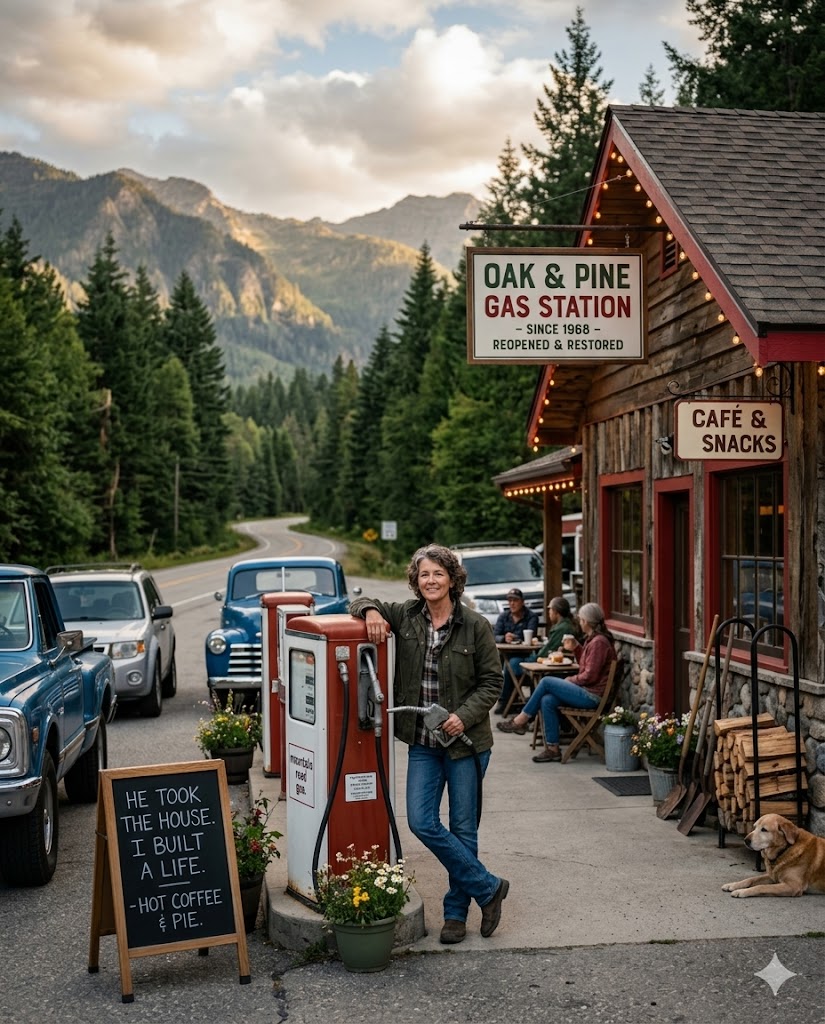
He Divorced Her at 58 and Took the House — So She Reopened Her Father’s Forgotten Gas Station…
Part 1: The Hollow Victory
The courtroom smelled like floor polish and stale, recycled air. Ruth Macklin sat in a rigid wooden chair, her hands folded tightly in her lap, while a judge read the settlement terms into a microphone that made his voice sound tinny and distant. Dennis wasn’t there. He’d sent his attorney, a man named Felton in a charcoal suit who spent the entire proceeding checking his watch, clearly annoyed by the inconvenience of Ruth’s presence.
Some men take your house. Some men take your name. Dennis Macklin had taken thirty-three years of her life and called it a “fair split.” Ruth signed where Felton pointed—four signatures, two initials—and just like that, her marriage was reduced to a stack of documents in a manila folder.
“This is the asset schedule,” Felton said, sliding a single sheet across the polished table. “The Brier Creek property, all savings, vehicles, and the entire investment portfolio remain with Mr. Macklin per the terms of the agreement. You retain the Ford pickup, your personal effects, and the real property located at Route 11, Goshen County.”
“The real property,” she repeated softly. It was the gas station her father, Earl, had owned. She hadn’t seen it in over a decade; it was a relic on a mountain road she barely remembered how to find. Dennis’s lawyers had appraised it at a mere $14,000, a rounding error on his balance sheet, and they’d let her keep it without a fight.
Ruth picked up the small cardboard box from under the table. Inside were the meager offerings Dennis had left on the kitchen counter: a jewelry box her mother had gifted her, a photo album from their daughter Connie’s childhood, and a chipped mug that said World’s Best Mom. Thirty-three years, and this was all that fit in a single box.
She walked to the parking lot and set the box in the bed of the truck. The 2006 Ford was a mechanical headache with 160,000 miles and a passenger door that refused to latch. Dennis had bought it for a landscaper who quit after two weeks; it had sat in their driveway ever since, until Ruth started using it for mundane errands.
She sat behind the wheel for a long time, staring at the empty courthouse. She had nowhere to go. The house on Brier Creek was officially Dennis’s, though it had ceased to be her home years ago. She had no apartment, no job, and no friends that weren’t essentially Dennis’s associates. With $211 in her checking account, she felt the crushing weight of her fifty-eight years.
She pulled the deed from the folder on the passenger seat. It was old, creased from years in a clerk’s filing cabinet. Macklin Gas and Service, Route 11, Goshen County. Her father had left it to her when he died twelve years ago. She’d driven down for the funeral, spent three days sorting through his things, locked the door, and never returned. Dennis had told her the property wasn’t worth the taxes, and Ruth, conditioned to agree, hadn’t argued. She had spent thirty-three years learning that Dennis earned and she agreed.
She turned the ignition. The engine coughed, sputtered, and finally settled into a rough, rhythmic idle. She pointed the truck south toward the Blue Ridge Mountains. As the interstate gave way to two-lane highways and then cracked county roads, Ruth felt the suburban numbness begin to thaw. The mountain air smelled of damp leaves, wood smoke, and the deep, enduring scent of soil and rock. She remembered these roads from her childhood summers, back when she was just Earl’s girl, learning to check tire treads and listen to the soul of an engine.
The road curved around a massive granite outcrop, and there it was: Macklin Gas and Service. It was smaller than her memories, a single-story cinder block building with a flat roof and two rusted gas pump islands. Kudzu had claimed the south wall, and the hand-painted sign had faded into a ghostly relic. A window was cracked, sealed with dried duct tape.
The front door resisted, but eventually turned with a gritty, stubborn click. Inside, the air was thick with dust and the silence of a decade. Her eyes traced the wooden counter, the pegboard, and the old mechanical register. Beside it sat Earl’s wire-rimmed reading glasses, one temple bent, resting on a half-finished crossword puzzle.
She picked them up. They were a time capsule. She walked to the back, to the small repair bay, and finally up the narrow, creaking staircase to the apartment where Earl had lived. The space was cramped but preserved—the bare mattress, the two-burner stove, and a refrigerator that hummed to life as if waiting for her return.
Ruth sat on the mattress, her heart echoing in the silence. She was fifty-eight, broke, and alone. But as she watched the ridge lines turn a deep, bruised purple in the twilight, she realized for the first time that she wasn’t crying. The grief had been spent in the guest bedroom of a house that was never hers. Now, there was only the mountain. And as she looked down at the dark, waiting station, she realized she had stumbled upon a secret that would change everything.
Part 2: The Keeper of Debts
The station felt different in the dimness, less abandoned and more… expectant. Ruth walked behind the counter, her fingers trailing over the wood, feeling the grooves left by years of hard labor. Her hand hit a seam in the paneling beneath the register—a deliberate, hidden latch. She pulled, and the wood scraped away to reveal a shallow cavity.
Inside was a leather journal, a small metal lockbox, and a bundle of envelopes tied with kitchen twine.
Ruth’s hands trembled as she lifted the journal. It was worn smooth where Earl’s calloused thumbs had held it for thousands of entries. She opened it to the first page, dated September 14th, 1981. Lent Tom Hendris $200 for the electric bill. Told him to pay when he can. He won’t be able to, but that’s all right.
She turned the page. Fixed Carol Dunar’s transmission, charged $30 for parts, nothing for labor. She’s raising three kids alone. Good kid.
Page after page, entry after entry. Names, amounts, reasons. Every loan, every free repair, every bag of groceries surreptitiously left in a neighbor’s truck bed. It was a record of quiet, sustained kindness that he had never mentioned to his own daughter.
She opened the metal box. Inside lay $412 in small, crumpled bills, a set of keys she didn’t recognize, and the original deed to the property. Finally, she untied the twine around the envelopes. They were thank-you notes. One from a woman whose family would have lost their farm without Earl; another from a man who said Earl’s $50 loan got him through the worst month of his life.
As she read, Ruth felt the distance between the father she thought she knew and the man who lived in these pages. She found an entry from three years before his death. Ruth called today. Sounded tired. That husband of hers is spending again. I just hope she knows the door is open.
Ruth closed the journal, pressing it against her chest. She sat on the cold concrete floor, reading by the fading light until the last word vanished into the dark. Her father hadn’t just been pumping gas; he had been the backbone of this valley, holding families together when they hit their lowest points, all while never asking for a single ounce of credit.
She stood up, her legs stiff. She climbed the stairs to the apartment, lay on the bare mattress, and for the first time in thirty-three years, she fell asleep without worrying about Dennis’s temper.
The next morning, she woke to the sound of birds and the smell of ancient dust. She spent the morning cleaning, sweeping the main room until the concrete floor looked respectable. She washed the windows with vinegar found under the sink, the light streaming in to illuminate the space.
Around noon, she ventured into the repair bay. It was a cathedral of labor. The hydraulic lift, the pegboard, the tools—all organized with military precision. She found a groove on the workbench she had carved as a child with a screwdriver, and a sudden, sharp laugh escaped her throat. She wasn’t just a divorcee in a gas station; she was Earl Macklin’s daughter.
She was startled by the sound of tires on gravel. A white pickup truck pulled up, steam venting from the hood like a dying dragon. A young man climbed out—lean, sunburned, grease-stained, and looking defeated.
“Radiator,” he said, staring at the engine. “Hose blew. I’ve got a spare, but no tools.”
Ruth looked at the young man, his eyes guarded and wary, as if he expected to be turned away. “I’ve got tools,” she said, nodding toward the bay. “Pull it in if it’ll make it that far.”
He looked at her, then at the station, his expression calculating. “I can pay for the bay time.”
“I didn’t ask for money,” Ruth replied firmly. “Pull it in.”
His name was Jesse Rowan. He moved with a quiet, efficient grace that suggested he’d spent a lifetime in shops like this. As they worked, Ruth realized he was sleeping in his truck, living the precarious, transient life of a young man with no safety net. When the job was done, Ruth didn’t just let him go.
“I’m reopening this station,” she said, the words catching her by surprise. “I need someone who can turn a wrench.”
Jesse hesitated, his hands dirty and his gaze steady. “I’ll think about it.”
“Coffee is on at seven,” Ruth said. “If you decide, show up.”
Part 3: The Weight of the Past
Jesse arrived at 7:00 a.m. sharp. They established a rhythm immediately—Ruth managed the counter and the growing list of repairs needed to make the place functional, while Jesse took over the bay. Hank Dawson, their nearest neighbor, became a fixture, showing up with lumber and knowledge, helping to rebuild the porch and fix the sagging gutters.
Each day, Ruth learned more about her father’s shadow. People would stop by, bringing small tokens—a casserole, a bag of groceries, a story of how Earl had saved their farm or fixed their car for free. She realized that she wasn’t just fixing a building; she was re-entering a community that had been waiting for the Macklin name to return.
However, the peace was shattered three weeks later when an envelope arrived from Felton and Associates. Dennis was suing. His lawyers claimed Ruth had failed to disclose the “true value” of the station—citing a speculative highway expansion plan. They wanted to reopen the settlement to grab their “fair share” of the potential windfall.
Ruth sat at the counter, her stomach churning as she read the legal threats. She had no lawyer and no money to hire one. Connie called later that night, pushing her to sell.
“Mom, it’s not worth the fight,” Connie urged. “Dad says the land is worth ten times what you appraised it at. Take the money and start over.”
“It’s not about the money, Connie,” Ruth said, her voice steady. “It’s about what he’s trying to take.”
Ruth didn’t know how to fight a man like Dennis, a man who viewed the law as a weapon and life as a series of hostile takeovers. But she remembered the filing cabinet. She spent the next two days obsessively combing through Earl’s records, searching for anything—a deed, a will, a note—that could anchor her ownership.
She found it on the third day: the original deed from 1971 and Earl’s notarized will, clearly documenting that the station had been a sole inheritance, never commingled with marital assets. It was a clean break, provided she could find someone to present it to a judge.
Hank intervened, putting her in touch with a retired attorney from Barton who owed Earl a debt of gratitude. When the attorney looked at the documents, she didn’t just smile; she looked relieved. “This is a nuisance claim,” she told Ruth. “Dennis is betting you’ll fold before you even reach the courtroom. But if we show this documentation, the motion will be dismissed with prejudice.”
But even with the legal path clear, the emotional toll was mounting. Dennis arrived in person a few days later in a silver SUV that looked like a spacecraft against the backdrop of the dusty station.
“Nice little project, Ruth,” he sneered, looking at the fresh paint. “You know the land is worth millions. Don’t be stubborn.”
“It was never about the value to you, Dennis,” Ruth said, standing her ground on the porch. “It was always about the control. You got the house, the savings, and the life you wanted. Why are you here?”
“I want what’s fair.”
“You want to win,” Ruth corrected. “But for the first time in thirty-three years, you’re not playing against a version of me that wants to keep the peace. You’re playing against a woman who has nothing left to lose.”
Dennis stared at her, his scripted arguments stalling. He had driven four hours expecting the wife who would crumble at a sharp word. That woman was gone. He left in a spray of gravel, his face twisted in a mixture of confusion and cold, calculated rage.
Part 4: The Anonymous Debt
Jesse was working in the bay when Ruth returned from her confrontation. She didn’t say much, but he could see the tension in the way she moved. He’d been working through Earl’s filing cabinet, organizing the mess, when he came across a specific folder labeled Rowan.
He pulled out the note—a simple slip of paper in Earl’s handwriting: Clara Rowan surgery fund. $3,200. Don’t let her know where it came from.
Jesse sat on a milk crate, the paper trembling in his hand. His grandmother had told him that story his entire life—the mystery of the anonymous donor who had saved her life when the family had nothing.
“He never met me,” Jesse whispered when Ruth walked in. “He never knew I existed. But he’s the reason I’m here.”
Ruth sat on the concrete floor, the silence of the repair bay feeling like a weight lifted. They weren’t just two people fixing cars anymore; they were the continuation of something that had started decades ago.
“That was Earl,” Ruth said softly. “He didn’t need the credit. He just needed the work to be done.”
The following week, Connie returned, this time bringing her children. Watching her daughter and grandchildren walk the same ground she had as a child, Ruth felt a profound sense of continuity. The station was no longer a tomb of memories; it was a living space where the next generation was learning how to hold a wrench and check a tire.
Connie watched Jesse work with the children, her initial skepticism softening into something like awe. “You’re different, Mom,” she said later that night. “I don’t know what happened, but the woman who walked out of that courtroom is not the one standing in front of me.”
“I spent thirty-three years agreeing because it was easier,” Ruth confessed. “I’m done agreeing.”
The hearing was set for Wednesday. Ruth drove to the courthouse, her heart drumming a frantic rhythm. The attorney met her on the steps, calm and prepared. The judge was a man who looked like he’d seen a thousand divorce settlement disputes and had no interest in seeing another.
The hearing was brief. The attorney presented the deed, the will, and the chain of title. When Felton tried to argue about “speculative future value,” the judge cut him off.
“The property was never marital, Mr. Felton,” the judge said, closing the folder. “The motion is denied. This matter is closed.”
Dennis was waiting on the courthouse steps. He looked tired—not the tired of a busy man, but the weary realization of someone who had just lost a battle he thought was already won.
“When did you become this person?” he asked, his voice devoid of its usual arrogance.
“I always was,” Ruth replied. “You just never looked.”
Part 5: The Lit Light
When Ruth pulled back into the lot, the sky was darkening, the mountains turning from blue to black. Jesse was locking the bay doors, and Hank was leaving a fresh stack of firewood by the wall.
Ruth walked to the breaker panel behind the counter. She found the switch labeled Sign and flipped it. Outside, the hand-painted sign—Macklin Gas and Service—flickered, then glowed with a warm, steady light against the night. It was faded, yes, but it was on.
The station had truly come back to life. In the months that followed, the rhythm of the valley returned. People came from all over to have their cars fixed by a man who treated every bolt with reverence, and to sit on a porch where they were never expected to buy anything they didn’t need.
Ruth learned the names and the stories of everyone in the valley, becoming the new keeper of the ledger—not of debts, but of needs. When a neighbor’s lights flickered, she found a way to help. When a car ran poorly, she told Jesse to prioritize the repair. She was building a life that Earl would have recognized, a life measured by the quality of the coffee and the number of people who knew they had a place to go.
One afternoon, a young woman in a dusty minivan pulled in, three children in the back. She was clearly struggling, her fingers counting coins in her purse.
“I need some gas,” she said, her voice shaking.
“I’ll get it,” Ruth said, filling the tank. She noticed the low tire and topped it off, too. When the woman reached to pay, Ruth shook her head. “Pay it next time you’re through. I’ll be here.”
The woman broke down, her hands trembling on the steering wheel. “Why?”
“My father used to say the same thing,” Ruth replied, smiling.
It wasn’t a big life. It wasn’t a wealthy life. But it was hers. She had learned that usefulness was the only currency that actually mattered in the mountains.
Part 6: A New Inheritance
The valley began to change, not because of a highway, but because the station remained a center of gravity. Connie started visiting more often, her own life shifting as she observed the simple, honest work her mother was doing. The children grew, their hands getting dirtier and their understanding of the world deeper.
Jesse continued his studies, his quiet competence turning him into the best mechanic for three counties. He wasn’t just working; he was thriving. He’d found a sense of belonging in the dust and the grease of the bay.
Ruth realized that the cardboard box from the courthouse had contained the wreckage of her old life, but the gas station held the blueprint for her new one. She wasn’t just Earl’s daughter anymore; she was the steward of his legacy.
The station was busy, but never loud. It was a place of quiet transactions and steady hands.
One evening, as she sat on the porch with Hank, he looked at her. “You ever miss the house on Brier Creek?”
Ruth watched the headlights of a distant truck winding up the mountain pass. “That house wasn’t a home, Hank. It was just a storage unit for things I didn’t care about.”
She thought of Dennis, likely in his sterile, quiet mansion, measuring his success by his bank balance, and she felt a sudden, sharp pity for him. He had won the house, but he had lost the ability to see what he actually owned.
Part 7: The Keeper of the Light
As the seasons shifted from summer to autumn, the mountains became a riot of gold and copper. The station was the heart of the valley, a beacon on Route 11 that refused to go dark.
Ruth sat behind the counter, reading the final entries in Earl’s journal. She had read them all, but she found herself coming back to them, finding new wisdom in the way he had lived. She kept the station open, not because she had to, but because she saw the way people looked when they pulled into the lot—the relief of finding someone who would help without judgment.
Jesse came in, wiped his hands, and poured a cup of coffee. He sat on the stool, looking at the crossword puzzle that had sat on the counter for over a decade.
“You ever going to finish it?” he asked.
Ruth looked at the half-filled squares, the ink long since dry. She picked up a pen. “Some things,” she said, “don’t need to be finished. They just need to be honored.”
She left the last few squares blank, placing the pen back on the counter.
That night, as she locked up, the sign shone brightly, reflecting off the damp asphalt of Route 11. She stood on the porch, listening to the wind move through the trees, the sound of the mountains she now knew by heart.
She was fifty-eight, a woman who had walked out of a courtroom with nothing, and had found everything. She had found a purpose, a community, and a legacy that could never be appraised by a lawyer or divided by a judge.
She turned off the lights, climbed the stairs, and as she drifted off to sleep, she knew exactly who she was. She was Ruth Macklin, the daughter of Earl, and for the first time in her life, the door was truly open.