HE DUMPED HER AT THE ALTAR — SHE MARRIED THE DYING BILLIONAIRE
Part 1: The Broken Bow and the Red Lights
The rain over Lagos did not fall; it commanded. It was a torrential, blinding downpour that turned the asphalt of the Victoria Island highway into a black, reflecting mirror, fracturing the neon pink and gold lights of Quillocks nightclub into jagged streaks of blood and oil. Inside the vehicle, the air conditioning hummed a low, metallic note, completely unable to cool the burning weight pressing against Edna Okafor’s ribs.
Six years. If six years of her life could be measured, it would be measured in the bruises on her mother’s hands and the systematic, crushing baseline of her own silence. For six years, she had been chained to the name Tobichukwu Babs—the golden boy of the old-money Lagos elite, the heir to an oil infrastructure fortune that could buy half the real estate in Banana Island without a single board meeting.
“I know, Lila,” Edna said, her voice dropping into a flat, diamond-sharp register as she clutched her phone. Her fingers were locked around the plastic casing so tightly her knuckles were white beneath her skin. “I have watched all six years. My mother told me my entire job on this earth is to land a rich man. Not to play the violin. Not to accept the conservatory offer in London. Not to have a soul. Today was supposed to be the end of all of it. My engagement day.”
Lila’s voice came over the speaker, frantic, raw, and completely panicked over the roar of the rain against the glass. “Edna, stop waiting! Tobe is not coming to the registry house! What? No… he said he would be here at ten, but he’s at Quillocks right now. Chioma posted a video on her Instagram stories just thirty minutes ago. He’s in the VIP lounge with her today, Edna. You have not even slept with this man after six years of rules, and she is already in his bed today!”
“I am going to Quillocks,” Edna whispered.
“Edna, do not go and beg him!” Lila screamed over the line. “Do not give that girl the satisfaction of watching you break on the floor!”
“I am not going to beg,” Edna said, her brown eyes locking onto the heavy iron gates of the nightclub as the driver pulled up to the curb. “I am going to end it in front of him. In front of her. Today is the last day. Pray for me.”
She slammed the car door open, stepping straight into the freezing deluged avenue. She didn’t have an umbrella; she didn’t have a shawl. She wore her formal engagement lace—a pale, ivory gown that instantly heavy with the black mud of the street as she marched past the security checkpoint.
“Miss, you can’t go in!” the massive bouncer shouted, his palm coming out to block the corridor. “Private lounge event!”
“Get out of my way,” Edna hissed, her voice carrying a cold, terrifying authority that made the guard’s fingers hesitate on his earpiece. “I am going in.”
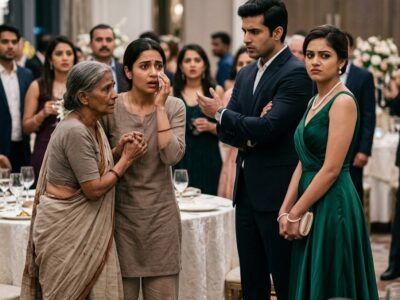
She pushed past him, her wet lace dragging against the velvet ropes as she entered the throbbing, dark interior of the club. The air inside smelled of expensive cognac, tobacco smoke, and the heavy, sickening scent of champagne. Near the center VIP booth, surrounded by a court of sycophants, sat Tobichukwu Babs. A gorgeous, light-skinned girl named Chioma Adele—the senator’s daughter—was leaning against his shoulder, her diamond bracelets catching the strobe lights.
“Ah, Edna,” Tobe said, his voice lazy, unbothered, and completely dripping with the arrogance of a man who believed every door in the country was opened by his family’s checkbook. He didn’t stand up. He lifted his glass of cognac toward her. “You came. In the rain?”
“I came in the rain,” Edna said, her voice cutting through the bass of the music like a scythe.
Chioma let out a short, high-society giggle, dabbing at her lips with a napkin. “Baby, is she not going to catch a cold? Somebody get this one a towel.”
The sycophants erupted into a sharp, synchronized laughter that filled the dark space around the booth.
“Nobody bring any towel,” Edna commanded, her gaze remaining fixed on Tobe’s face. “Today is our engagement day, Tobe. The families are waiting at the civic hall. And you are here. With her.”
Tobe leaned back against the leather cushion, his eyes narrowing into cold, dismissive slits. “Yes, Edna. I told you before—you brought this on yourself. Six years you have been chasing me. Six years of your mother begging my father for contracts. And now you want to come into my club and make demands? I gave you a clear choice: calm down, drop that foolish music, or I find somebody who actually knows how to treat a man like a Babs. And look… I found somebody.”
Edna looked at his gold watch, then down at the wet floor boards. The six years of keeping her hands clean, of letting her mother lock her violin in the closet, of swallowing her own blood to buy her family’s way out of poverty—it all collapsed into the dirt of the club floor.
“Tobe,” she said, her voice dropping into an absolute, chilling stillness. “I have one thing to say to you. We are finished.”
The booth went quiet for a fraction of a second before Tobe let out another loud, derisive laugh. “Finished? Okay, Edna. Go home. Take a warm shower. Call me tomorrow when the rain stops.”
“No,” Edna said, her chin lifting as she backed away toward the exit corridor. “I will not call you tomorrow. I will not call you ever again. Anybody who wants you can have you. I am done. Six years of my life are gone, but you are free. She is free. Enjoy each other.”
“Edna! You are being so dramatic!” Tobe shouted after her, his voice tightening with a rare flash of irritation as she reached the doors. “Come back here!”
Chioma caught his arm, her red lips curving into a triumphant smile. “Do not worry, Tobe. She will call you tomorrow. She always does. And if she does not… then she’s a complete fool.”
Part 2: The Cane and the Invitation
The taxi ride back to the Yaba tenement flat was a silent descent into a volcano. Edna stood outside her family’s front door, her ivory engagement lace ruined, her hair dripping cold river water onto the concrete landing. She could hear the high-pitched, frantic pacing of her mother inside before she even turned the key.
The moment the lock clicked, her mother, Mrs. Bisola Okafor, lunged into the small hallway. She still wore her expensive, starched asoke meant for the registry photographs, but her face was twisted into a terrifying mask of rage and desperation.
“Where is that girl?” she screamed toward the empty parlor. “She’s late again! The Babs family called me twenty minutes ago saying the reservation was canceled!”
Then her eyes locked onto Edna’s wet, mud-stained figure.
“Edna, come here,” her mother hissed, her fingers locking around the thick wooden cane she kept hidden behind the umbrella stand—the same cane she had used three years ago when Edna tried to mail her application to the London Conservatory. “I said come into the sitting room right now! What did you do?”
“Mommy, please let me change first,” Edna whispered, her body trembling with a delayed, icy chill.
“Into the sitting room!” Bisola roared, dragging her by the lace sleeve into the small, humid parlor. “What did you do at the bureau, Edna? Why did Tobe’s father cancel the transfer?”
“He was at Quillocks, Mommy,” Edna cried, her voice cracking as she stood against the wall. “He was at Quillocks with another woman. On our engagement day. In front of everyone.”
Bisola did not drop the cane. She didn’t even blink. “And what exactly did you expect? Men cheat, Edna! Rich men cheat more! That is exactly what the oil money is for! You go to the club, you smile for the cameras, you sit in the engagement photograph, and you deal with the side-woman quietly in the bedroom! The exact way I dealt with your father’s women for twenty years before he died and left us with nothing! That is what a real wife does!”
“Mommy, we were not even married yet!” Edna shouted back, her brown eyes filling with an ancient, defensive fire.
“That is worse!” Bisola shrieked, the wooden cane striking the tile floor with a deafening crack. “You have not even locked the estate in, and you are already losing him to Chioma Adele—the senator’s daughter! I warned you for two years, Edna! I told you to stop sitting in your room playing that useless violin of yours as if music will buy you a four-bedroom house in Banana Island! You will go back to Tobichukwu Babs today. You will call him right now on speaker, and you will apologize for your behavior!”
“No, Mommy,” Edna said, her spine straightening until her posture was perfectly rigid. “I am not calling him.”
Bisola raised the cane, her face dark with blood. “Edna! Do you think I raised you for this? Do you think I survived your father’s bankruptcy and cleaned floors in Lagos for you to be prideful? The Babs family is our only way out of this hell! Old Lagos money! If you marry into that house, my suffering has not been for nothing. I will break your hand today, Edna! I have done it before, and I will do it again if you touch that phone!”
Edna didn’t step back. She lifted her left hand, the skin still marked by the faint, silver scars of old canes, and looked her mother dead in the eye. “You will not touch my hand, Mommy. Not this time. Not ever again. I am not calling Tobichukwu. I am not going to the registration. I am not apologizing. It is finished.”
“Edna!” Bisola screamed, her voice breaking into a frantic, desperate sob. “If you walk out of that door today, I will disown you! Do you hear me? If you walk out, do not ever come back to this house!”
“Then I will not come back,” Edna said softly.
She turned on her heel, walked into her tiny bedroom, and grabbed her violin case and a single canvas bag of clothes. She didn’t look at the parlor; she didn’t look at the portraits of her father. She walked out the front door into the rain, the brass latch clicking shut behind her like a gunshot.
She was standing on the wet pavement outside the block, her violin case clutched to her chest, when a sleek, silver town car pulled up to the curb. A young man in a pristine gray suit stepped out, holding a large black umbrella over his head. He bypassed the local traders and walked straight toward her, his face locked in an expression of absolute professional neutrality.
“Good afternoon, ma’am,” he said, bowing slightly. “My name is Henry Cole. I am the personal assistant to the Nosu family. The Chief Chidi Nosu family of Banana Island. We have been searching for you, Miss Edna Okafor. The master wants to see you immediately.”
Part 3: The Billion-Naira Vault
Edna stood beneath Henry Cole’s black umbrella, the water from her dress pooling around her simple canvas shoes. The name Nosu moved through the wet street with the weight of an institutional monolith. The Nosu family didn’t just own oil corridors; they owned the banks, the real estate trusts, and half the maritime shipping terminals in West Africa. They were old, absolute wealth—the kind that didn’t advertise on Instagram because they owned the telecomm networks themselves.
Before she could clear her throat to reply, the security door of the tenement block burst open. Her mother, Bisola, ran out onto the concrete steps, her starched asoke disheveled, her eyes wide with a frantic, sudden calculation as she saw the silver town car and the suited assistant.
“Edna! Edna, come out here!” Bisola shouted, her voice changing pitch instantly as she ran down the stairs. “Who are you? What do you want with my daughter?”
Henry Cole didn’t look at Bisola. He kept his eyes fixed on Edna’s pale face. “Miss Okafor, my name is Henry Cole. I am the private representative for Chief Chidi Nosu. I wonder if we could speak privately inside the vehicle.”
“Speak here, mister!” Bisola cut in, her fingers reaching out to grab Henry’s sleeve. “I am her mother. Her business is my business.”
“Speak here, Henry,” Edna said, her voice remaining in that cold, flat register she had found at the club. “My business is completely private from this house now.”
She turned her eyes to her mother, her gaze icy and entirely devoid of fear. “Mommy, this man came to see me, not you. Please give us the road.”
Henry opened the heavy rear door of the town car, sealing them away from the rain and her mother’s shouting into a quiet, leather-scented vacuum. He pulled a thick manila folder from his leather brief case and laid it flat on the armrest between them.
“Miss Okafor, I will be brief because time is not a luxury our house possesses,” Henry said, his voice systematic and rapid. “The Chief Nosu family has been searching for a specific legal bride for their only son, Mr. Chidi Nosu. Mr. Chidi had a catastrophic car accident two years ago in London. His spinal columns and legs have not fully healed, he suffers from severe, chronic pain, and the neurological team has given him between six months and two years left to live. Most likely less.”
Edna clutched her violin case against her knees. “And why me? There are a thousand society daughters in Lagos who would line up for the Nosu registry.”
“This will sound strange to a modern mind, but our house still honors the ancient parameters,” Henry said, tapping a document stamp. “The family priest consulted the birth charts and ancestral alignments of many young women across the delta. Yours matches Mr. Chidi’s perfectly. He has requested you specifically after reviewing your registry profile from the National Music Championship of four years ago.”
“He has seen me?” Edna whispered. “What is the baseline offer?”
“One billion naira paid into your personal ledger account the microsecond the marriage certificate is signed,” Henry said, his voice completely unbothered by the number. “A four-bedroom luxury penthouse in Ikoyi placed in your name permanently. A second commercial property in your mother’s district if you wish to settle her baseline. Full medical insurance and an ironclad position named in his private will at a level appropriate to the Chief’s widow. You will have total financial sovereignty.”
Edna looked through the tinted glass window. Outside, her mother was standing in the downpour, her starched asoke ruined, her mouth moving in a frantic, silent pleading against the rain.
“So,” Edna said, her voice low and steady as iron. “I am marrying a dying man.”
“Yes,” Henry replied.
“And I will be a legal widow within two years.”
“Most likely, Ma.”
“And I will never have to ask my mother or Tobichukwu Babs for a single cent or an apology for the rest of my life.”
“Never, Mrs. Nosu. You will be completely untouchable.”
Edna slid her phone from her pocket, deleted her Instagram profile, and turned her face toward the front seat. “Mr. Cole, where do I sign the papers?”
Part 4: The House of Pain
The penthouse on Alfred Rewane Road rose thirty stories into the Lagos skyline, a monolith of black glass and steel that looked over the entire expanse of Ikoyi and the lagoon beyond. When the private elevator doors slid open into the foyer, the air didn’t smell of incense or wealth; it smelled of sterile antiseptic, cold air conditioning, and the heavy, stagnant stillness of a tomb.
“Mrs. Nosu,” the private nurse said, bowing her head deeply as Edna stepped out of the car, her canvas bag still in her hand. “Welcome to the estate. A word of warning before you enter the master’s suite, Ma. He does not like to be touched by women. He has refused his nutrition trays for two days, and his neurological pain score is at its maximum today. Please stay near the door.”
“I understand,” Edna said flatly.
She walked down the long, carpeted corridor, her footsteps silent against the wool. The master bedroom was vast, the floor-to-ceiling windows showing the rain beating against the glass three hundred feet above the city. In the center of the room, sitting entirely upright in a motorized steel wheelchair with his back to the window, was Chidi Nosu.
He was thirty-four years old, broad-shouldered, with sharp, aristocratic features that had been hollowed out by two years of grinding, industrial pain. His hair was cut close, a faint surgical scar crossing his left temple into his hairline, and his eyes—a deep, burning amber—were fixed on the gray clouds outside like two stones. He didn’t turn his chair when she entered.
“Henry told me you signed the non-disclosure agreements,” Chidi said, his voice a low, gravelly baritone that sounded like it hadn’t been used for anything but orders in months. “Welcome to your prison, Mrs. Nosu.”
“Thank you, Mr. Chidi,” Edna said, setting her violin case down by the mahogany wardrobe. “I’ve lived in smaller rooms.”
“You came from a flat in Yaba with a cane-marked wrist and an ivory dress that smelled of mud,” Chidi said, his voice flat but carrying a sharp, investigative clarity that made her look up. “I know the script, Edna. Your mother wanted the Babs oil money, and you wanted a door that didn’t require an apology. I bought your signature to stop my grandmother from bringing society girls into this room to watch me drown. Do not look for affection under this roof. You have your penthouse; I have my silence.”
Edna didn’t lower her eyes. She walked past his wheelchair, stopping right by the automated medical monitors. “Henry says you have not eaten in forty-eight hours, sir.”
“Henry talks too much,” Chidi muttered, his jaw tightening as a sudden, sharp spasm of spinal pain made his fingers lock around the metal wheel-rim.
“I’m your wife as of two hours ago, Mr. Chidi,” Edna said, her voice remaining in that cold, steady rhythm she had found in the Yaba parlor. “I am going downstairs to the kitchen to make you proper egusi soup and pounded yam. My mother was from Asaba, and my father was from Awka—I know exactly how much palm oil and ground crayfish to use to make a body feel human. Whether you like me or hate me tonight, you are going to open your mouth. I didn’t marry a ghost.”
Chidi’s amber eyes snapped to her face, a brief, startled spark of fire moving behind his lids. “My cook makes it wrong,” he growled.
“Then I will make it right,” Edna said. “Close your eyes, sir. The kitchen is mine.”
Part 5: The Song of Moremi
The egusi soup was thick, rich, and carried the deep, smoky aroma of traditional ground crayfish and sun-dried locust beans. Edna carried the tray into the master suite at nine o’clock, the steam rising from the ceramic bowl like a small promise of life against the sterile air conditioning.
Chidi hadn’t moved from his position by the window, his large hands clutched tightly in his lap as he fought the evening neural storm that always arrived with the rain.
“Henry says you have requested to feed me yourself,” Chidi muttered, his face white under the lamps. “I told the nurses I am not a child.”
“Open your mouth, Chief Nosu,” Edna said, sitting on the small wooden stool beside his steel footrest, a silver spoon filled with the yellow soup held steady inches from his lips. “Do not make me embarrass you in front of Henry. I have a long memory, and I don’t give up easily.”
Chidi stared at her clear brown eyes, looking for the usual pity or hidden greed he saw in the faces of his corporate partners. He found nothing but an icy, unyielding determination that reminded him of a soldier holding a trench. He opened his mouth.
The taste hit him like an old memory—the exact weight of the palm oil, the sharp baseline of the pepper, the clean texture of the pounded yam. It was the food of his childhood, before his mother died and the family name became an institution of black cars and boardroom contracts. He ate the entire bowl in absolute silence, his breathing slowing down by degrees as the nutrition hit his bloodstream.
“You brought your violin case,” Chidi said, looking toward the wardrobe after she set the tray down.
“I noticed you haven’t slept in many nights, sir,” Edna said, unlatching the leather case and lifting the dark wood instrument into the light. “The nurses say your insomnia is chronic.”
“The pain doesn’t have a sleep timer, Edna,” he growled.
“I am going to play for you until your eyes close,” she said, resting the wood against her shoulder, her fingers finding the baseline strings with a familiar, long-buried authority. “Do not argue with a woman who has a billion naira in her account. Close your eyes, Mr. Chidi.”
She drew the bow across the strings.
The piece she played was not the classical architecture of the European masters her mother had tried to force her to learn; it was a song she had written herself when she was twenty years old—a deep, mournful, and transcendent melody she called The Song of Moremi. It was the music of a queen who walked straight into captivity to save her people, a song that moved through the dark bedroom like a cooling river, softening the jagged spikes of his nerve endings with every stroke of the bow.
Chidi’s amber eyes remained fixed on her face as she played. He watched her eyelids drop, her posture fluid, her whole soul finally stepping out of the faded blue uniform of her past into the light of her own creation. Slowly, under the steady, hypnotic rise and fall of the violin strings, the tension left his jaw. His fingers untangled from his lap. His breathing turned deep, even, and regular.
He slept.
Henry Cole stepped into the room an hour later to collect the tray, his sharp face frozen in absolute, unadulterated shock as he looked at the sleeping chief.
“He ate and he slept,” Henry whispered, his voice trembling as he looked at Edna, who was carefully wiping her bow. “In one evening, Mrs. Nosu… you have done what twelve neurological specialists and three private international nurses have failed to do for two long years.”
“Henry,” Edna said, her voice calm as she latched her case shut. “He is my husband now. That is exactly what a wife does.”
Part 6: The Third Row On the Aisle
By the second week of December, the penthouse on Alfred Rewane Road had found a new, quiet identity. Edna went down to the local shops on Adeola Odeku morning after morning, returning with lavender aromatherapy oils, fresh chamomile leaves, and small clay diffusers that she set up in the corners of Chidi’s suite to anchor the air before the evening storms arrived. She fed him every meal; she played her violin every night until the monitors stabilized; and she treated his chronic growls with a calm, analytical indifference that disarmed him more than any medicine could.
“Mrs. Nosu,” Chidi said one afternoon, his motorized chair parked across from her at the teak table. He had an ancient ivory Ayo board set up between them, the carved wooden seeds smoothed down by half a century of use. “You have known me for exactly seven days.”
“Yes, Mr. Chidi,” Edna said, moving three seeds into her parallel house with a quick, clean flick of her wrist.
“And you have fed me every baseline meal, played your music until your fingers were raw, and bought aromatherapy diffusers for my insomnia,” he continued, his amber eyes fixing on her face with an absolute, burning intensity. “And you are going to ask me for nothing in return? No luxury allowances? No family contract exceptions for your mother?”
“I signed a prenuptial agreement, Mr. Chidi,” Edna said, looking him dead in the face without a single flinch. “My return has already been paid into my ledger. I do not need to ask for more. This is your move.”
Chidi looked down at the wooden board, his hand hovering over the seeds. “My father played this game. He taught me a little before the board took him out out west. I was never fast.”
“Will you play with me?” she asked.
“Why?”
“Because when I play Ayo with you,” Chidi said, his voice dropping into a low, human register she hadn’t heard before, “I don’t feel the burning in my legs for as long as the seeds are moving. It’s a very long game if you handle the defenses properly.”
“Then I will play,” Edna said.
They played for three hours as the afternoon light went gold against the glass windows. For the first time, there was no growling, no administrative noise, just the rhythmic, wooden clack-clack-clack of the seeds moving across the teak.
“You cheated on that last house,” Chidi said suddenly, a sharp, genuine smile moving across his jaw line.
“I did not,” Edna countered, her lips curving upward into a real laugh—the first real laugh that had passed through her lips since the Yaba flat. “I am simply a faster learner than your analysts thought, Mr. Nosu.”
Chidi set his remaining seeds down in the center bowl. He looked at her face, his features turning serious, the amber of his eyes clear. “Can I tell you something true, Edna?”
“Yes.”
“Six years ago, I attended the Lagos National Music Championship at the Muson Centre,” Chidi said, his voice quiet against the hum of the air conditioning. “I was twenty-eight. You were twenty. You walked onto that grand stage in a simple white dress and you played a piece you wrote yourself. You called it The Song of Moremi.”
Edna’s breath caught in her throat, her fingers freezing on the wooden seeds. “Mr. Nosu… how do you know that name?”
“Because I was there,” Chidi whispered. “I was sitting in the third row on the aisle with my late father. I had just taken over the maritime trust that week, and my head was full of corporate noise. But when you drew that bow across the strings… the whole world went dead silent for ten minutes. I knew your eyes were closed while you played, Edna. I knew you didn’t see the crowd. But I have been loving you from that exact row for six long years.”
Edna stared at him, the ivory seeds slipping from her hand onto the teak board with a soft clatter. “Why didn’t you tell me this on the first day, Chidi? Why let me believe I was just a chart calculation for a priest?”
“Because I wanted you to stay here because you chose to be free, Edna,” Chidi said, his voice rough with an old, soul-deep emotion. “Not because you felt sorry for a man in a steel chair. You walked into my room seven days ago and you fed me egusi soup with the exact amount of palm oil my mother used. That was all the baseline I needed to know. Whatever time the doctors have left on my clock… I want to spend it standing next to your music.”
Part 7: The Contract and the Rain
The convoy of black SUVs pulled up to the civic center on Broad Street at exactly noon, the raindrops striking the reinforced glass panels like small shells. Tobichukwu Babs stepped out of the lead vehicle, his tailored suit immaculate, his face a dark, frantic mask of absolute desperation. Behind him walked his father, Chief Babs, and a team of corporate lawyers holding the restructuring files for the Gin Project—the family’s multi-billion-naira maritime contract that had been frozen by a regulatory action from the Nosu trust forty-eight hours ago.
“This is madness, Tobe,” his father hissed as they marched into the high-ceilinged conference hall. “You told me the Okafor girl was a nobody! You told me she was a country fool who would come crawling back to your gate by Wednesday! Now Chief Chidi Nosu himself has signed an injunction that blocks our clearing licenses at the port! If we lose this project, the Babs name is finished at the exchange!”
“I didn’t know, Dad!” Tobe stammered, his fingers shaking as he pulled open the heavy mahogany double doors of the boardroom. “She blocked my number three weeks ago! Chioma said she was just hiding in a local flat!”
They stepped into the room.
The long teak table was silent. Sitting at the head of the platform, his motorized wheelchair parked squarely under the high lights, was Chief Chidi Nosu. Beside him, dressed in a sharp, pristine navy blazer that fit her shoulders like armor, her hair gathered into a flawless professional knot, sat Edna. Her dark wood violin case sat right next to her ledger, her brown eyes completely calm as she looked at her ex-fiancée.
“Good afternoon, gentlemen,” Chidi said, his baritone voice filling the room with an institutional finality that made the corporate lawyers instantly drop their files. “Let us be brief because my wife has an orchestral review at three. I have read all three proposals for the Gin corridor. And I have one simple question for the Babs team. Not for you, Chief Babs. For your son. Tobichukwu.”
Tobe felt the air leave his lungs, his face turning an instant, translucent gray under the lights. “Sir… I…”
“Do you recognize the woman sitting at my right hand, Tobe?” Chidi asked, his amber eyes locking onto the young heir’s face like two lasers.
“Yes… yes, sir,” Tobe whispered.
“From where?”
“The… the Ikoyi house… three weeks ago,” Tobe stammered, his eyes darting toward the floor.
“At that meeting in the garden, you called my wife a country fool,” Chidi said, his voice dropping into a low, lethal whisper that made the senior lawyers back away from the table. “You suggested she had married an impostor in a wheelchair to spite your oil name. Edna Okafor walked out of your club in the rain on the morning of your engagement day because you were at Quillocks with another woman. She arrived at my gate with a cane-marked wrist from her mother’s desperation and a single canvas suitcase of clothes. She is the most generous, most brilliant human being I have encountered in my thirty-four years.”
He leaned forward, his fingers flat against the mahogany. “I do not like you, Tobichukwu Babs. I do not like your character, I do not like your face, and I do not like the way your family calculates its choices. Is that reason enough for me to end this meeting, project director?”
The director stepped forward, his pen hovering over the stamp ledger. “The Gin Project is awarded to Adebayo Holdings effective immediately, Chief. The Babs bid is rejected. The Babs family is officially barred from any infrastructure project under the Nosu holdings for the next ten years.”
“Mr. Nosu, please, mercy!” Chief Babs cried out, dropping to his knees near the table, his starched lace dragging on the linoleum. “Think of our workers! Think of the families who depend on our clearing contracts!”
“Chief Babs, I thought about your family the day I signed the marriage license for Edna Okafor,” Chidi said, his voice steady as iron as he turned his chair toward the exit. “You knew exactly how her mother was treating her hand to secure your investment line. You did not care about her music; you only cared about the land corridors. Now… the land is gone. This meeting is adjourned. Project teams remain. Chief Babs… take your son and leave my sight.”
Tobe turned around slowly, his face completely hollowed out as the security guards opened the doors to escort them out into the rain. He looked back at Edna across the long mahogany table. She didn’t look at his tailored suit; she didn’t look at his watch. She had already opened her notebook, her fingers moving across the staff lines of her next composition with the calm, unbothered freedom of a woman who had finally found her own way home.
The iron front gates of her past were closed forever, but as the silver town car pulled back onto the Alfred Rewane highway, the sound of the rain against the glass didn’t sound like a command anymore. It sounded exactly like a song.
👉 The next part will be coming soon. Like and comment to see the details