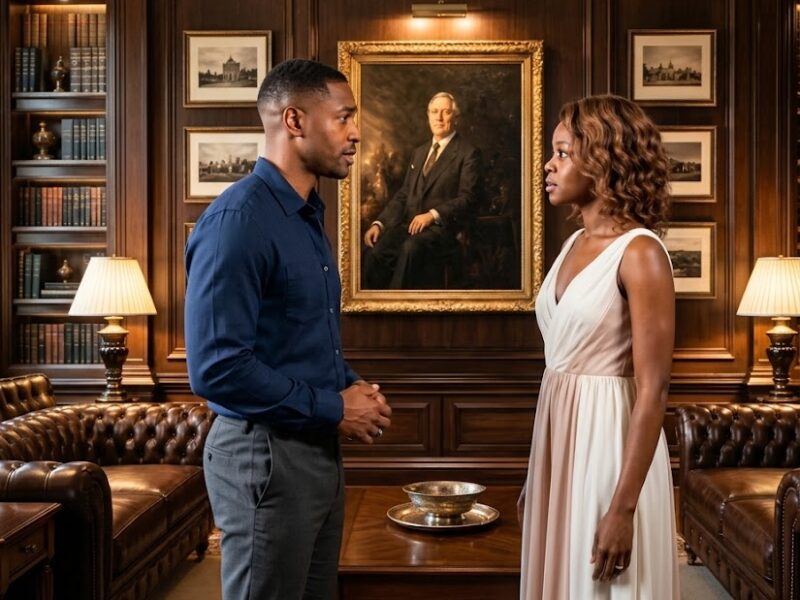
He Hired a Stranger to Fool His Family, Unaware She Was the True Heir
Part 1: The Gate of Rags and Iron
The iron gates of the Okonkwo estate towered over the humid outskirts of the city like a monument to indifference. Wrought in thick, black metal and tipped with defensive spikes, they stood ten feet high, keeping the dust of the red-earth road from touching the immaculately manicured lawns within. Behind those bars lay a world of white marble floors, a hundred silent rooms, and an ancient family whose wealth was matched only by the coldness of their blood.
Outside the gates stood Amara.
She was twenty-four years old, her skin dark and slicked with sweat from the afternoon heat. She wore a faded cotton buba, her hair wrapped tightly in a plain black scarf. Balanced carefully on her head was a wide wooden tray filled with freshly baked meat pies and small parcels of wrapping leaves containing local rice. For three years, this tray had been her only weapon against the predatory hunger of the slums.
“Beggars at my gate, take your filthy food and crawl back to your gutter!”
The voice cracked through the quiet air like a gunshot. Beatrice Okonkwo stood just inside the bars, her expensive silk wrapper rustling softly as she glared down her nose at the girl. Her neck was heavy with polished coral beads, and her face was twisted into an expression of profound disgust, as if the mere sight of Amara’s tray was an insult to the family name.
Amara did not lower her tray. She stood perfectly straight, her dusty sandals anchored firmly in the earth. “It isn’t filthy, madam,” she said, her voice dropping into a steady, dangerous calm that made the guards at the gate turn their heads. “It’s honest, which is more than some in that house can say.”
Beatrice’s face turned crimson. She stepped closer to the bars, her fingers locking around the cold iron. “How dare you speak to me? Do you know who I am? You are nothing but a common street seller!”
With a cruel, sudden lurch, Beatrice reached through the bars and struck out. Her hand caught the edge of the wooden tray, sending it tilting violently. The fresh meat pies and rice packages tumbled into the dirt, scattering across the muddy shoulder of the road.
Amara stumbled back, the heavy wooden tray clattering against her shin. A sharp, burning sting flared across her cheek where Beatrice’s fingers had clipped her skin. She looked down at the ruined food—her entire week’s profit buried in the mud—and then she looked back up at the wealthy woman behind the iron bars.
“You can strike my face,” Amara whispered, her brown eyes flashing with a cold, unbreakable fire. “You can’t strike my name. One day this gate will open for me. Not to beg… to belong.”
“Move along!” the head security guard barked, stepping out from the small concrete watchpost and raising a wooden baton. “The Okonkwos don’t want your kind here. Get out before I lock you up.”
Amara gathered her empty wooden tray, her jaw rigid as she looked at the guard and then back at Beatrice. “Kindness costs nothing,” she said, her voice carrying an absolute, ringing clarity across the lawn. “Try it sometime.”
From the shadow of the grand marble portico, a tall, elderly woman with a silver walking stick watched the entire scene unfold. Her name was Madame Ada, the matriarch of the family, her frail body leaning heavily against the stone pillar as her clouded eyes locked onto Amara’s face.
Madame Ada’s breath caught sharply in her chest. Her silver stick trembled against the marble. “That face…” she whispered, her voice a fragile rustle of dry leaves. “After twenty years… it can’t be.”
Beatrice turned around, her silk wrapper rustling as she rushed back up the steps to the old woman’s side, her voice instantly dropping into a defensive, honeyed sweetness. “Mother, please forgive the scene. Just a beggar who didn’t know her place. I’ve told the guards to handle her.”
Madame Ada slowly turned her head, her sharp eyes fixing onto her daughter-in-law with a look that made Beatrice’s smile falter. “Her place,” the old woman murmured, her voice dripping with an ancient, terrifying authority. “Yes. We shall see whose place is whose… if ever.”
She looked back toward the road, but Amara was already walking away, her small frame disappearing into the rising dust of the red-dirt road.
“Seven days,” Madame Ada whispered to herself, her fingers tightening around the silver handle of her stick as a deep, suffocating pain flared behind her ribs. “I don’t have much more than that. Long enough to test them all… with her.”
An hour later, Amara was washing her empty wooden tray at a communal tap in the heart of the Ajegunle slums when a man in a sharp black suit stepped into the narrow alleyway. His name tag read Adisa, his face a perfectly still mask of professional discretion as he stopped beside her.
“My employer watched you at the gate this morning,” Adisa said, his deep voice low. “She wishes to offer you work. Well-paid… and entirely discreet.”
Amara wiped her hands on a dry cloth, her eyes narrowing into slits of ice. “The woman whose family slapped me? I sell food, mister, not my dignity.”
Adisa reached into his inner pocket and pulled out a thick, white paper envelope. He slid it open just enough for her to see the crisp, green bank notes inside. “There is enough here for your mother’s surgery and medicine for an entire year.”
Amara’s breath froze in her throat. She looked at the money, and then up at the dark sky. God forgive me for even looking, she thought, her heart giving a frantic, painful thud against her ribs.
“Seven days,” Adisa said, stepping closer. “For seven days, you will enter that house and pretend to be Madame Ada’s long-lost granddaughter, Nneka. You will live in the house as royalty. You will say nothing of this arrangement to anyone.”
Amara backed toward the brick wall of the tap. “Pretend to be someone’s dead grandchild? That’s madness. Why me?”
“Because you have her face,” Adisa said, his voice completely flat. “And because the old woman trusts no one under her own roof.”
Amara stood in the dimming light of the alley, her mind spinning into a vortex of fear and desperation. She had spent her entire life with nothing, never knowing her own family, and now they were asking her to fake someone else’s. What does that make me? she thought.
But as she hesitated, her phone began to vibrate violently in her pocket. It was the general hospital charity ward. Her mother’s condition had worsened; the internal bleeding had returned, and the surgeons had given her weeks, not months, without the operation they could never afford.
“Seven days buys her years,” Adisa whispered, watching her face.
Amara looked at the envelope of cash, a hot tear of pure fury tracking down her cheek. “You’d use a dying mother to buy a lie.”
“I’d use the truth,” Adisa said softly. “The choice is yours, Amara.”
From the shadow of the alleyway, an old woman with a cane stepped out. It was Mama Grace, Amara’s foster mother, the woman who had raised her on a floor poorer than the Okonkwos’ servants’ quarters. She reached out, her trembling hand resting on Amara’s shoulder.
“Take it, child,” Mama Grace whispered, her eyes filled with an old, heavy sorrow. “Not for me… for the mother who raised you, and perhaps… for the one who lost you.”
Amara turned, her heart stopping as she looked at her mother’s pale face. “Mama…”
“Some promises we keep to protect the ones we love,” Mama Grace said, her voice dropping into a tight, cracking register that sent a shiver down Amara’s spine. “Forgive me, child, for the truth I’ve buried.”
Amara looked down at her own hands, realization hitting her like a physical blow. She had no choice. She took the thick white envelope from Adisa’s hand, her jaw set into iron.
Seven days of lies to buy her one honest future, she thought, her breath coming in ragged gasps. If that’s a sin… let it fall on me alone.
She turned back to the road that led to the grand estate, knowing that once she walked through those iron gates, her old life would be gone forever.
Part 2: The House of One Hundred Knives
The second morning began with the sound of a heavy brass lock sliding open.
Amara stood at the entrance of the grand dining hall, her simple cotton buba gone, replaced by a lavish lace wrapper of gold and cream that felt like an iron weight against her skin. Her dark hair had been braided into an intricate crown, and around her neck hung a heavy silver locket that Adisa had given her in the car.
“Seven days as Nneka, then back to Amara,” she whispered to herself as she stepped over the threshold onto the polished marble floor. “How lost can a person get in seven days?”
The dining room was massive, lined with dark walnut paneling and a table long enough to seat thirty people. Around it sat the remaining members of the Okonkwo bloodline—Emeka, the eldest son, whose sharp features were twisted into a permanent corporate scowl, and his sister, Ifeoma, whose fingers were covered in diamonds that clicked restlessly against her crystal glass.
Madame Ada sat at the head of the table, her silver walking stick resting against her chair, her sharp eyes tracking Amara’s every step.
“My granddaughter, home at last,” the old woman announced, her deep voice commanding the silent room. “Nneka, welcome to the house that is yours by blood.”
Amara felt her throat go dry as she took her seat across from Emeka. “Thank you, grandmother,” she said, her voice steady despite the panic roaring in her ears. “It’s… overwhelming.”
Madame Ada leaned closer, her voice dropping into a low, conspiratorial whisper that reached only Amara’s ears. “Smile, child. Watch everyone. Trust no one but me. Your test begins now.”
At the far end of the room, a silent servant in a crisp white uniform stood pouring water. His name tag read Chijioke, his face entirely expressionless, but his eyes were wide and fixed onto Amara’s locket with a terrifying intensity. He was the only person in the house who had been present twenty years ago, on the very night the real Nneka had vanished during a violent tropical storm.
“So the prodigal returns,” Emeka sneered from across the table, his gold watch catching the light as he slammed his folder shut. “How convenient. Mother finds an heir just as she is dying… and right before the corporate restructuring vote.”
“Convenient is dangerous, Emeka,” Ifeoma whispered from his side, her eyes narrowing into narrow slits as she stared at Amara’s lace dress. “I will find out what this ‘Nneka’ is hiding.”
After the awkward breakfast, Madame Ada led Amara into her private study on the third floor. The room was filled with old leather books, dusty legal ledgers, and a massive iron safe built into the stone wall. The old woman sank onto the sofa, her breathing shallow and rattling.
“Seven days, Amara,” Ada said, her voice dropping the royal mask completely. “Each night, you will sit in this room and tell me who lied, who schemed, and who was kind. On the seventh day, I sign my true will.”
Amara looked at her, her heart hammering. “And if I fail your test? If they see through me?”
“Then we both lose more than money, child,” Ada said grimly. “Marble floors, a hundred rooms… and every single one of them hiding a knife.”
“Then do not waste your test on me, madam,” Amara said, her voice turning sharp as iron. She stood up, looking down at the old woman. “I am not your granddaughter. I am a fraud you are paying to play a part. Give your fortune to someone real.”
Madame Ada stared at her for a long, suffocating moment, before a small, weary smile touched her dry lips. “In one single day, you have shown me more truth than my own blood has in twenty years. Sit down, Amara. Let an old woman decide what is real.”
She reached out, her thin, calloused hand taking Amara’s fingers. “I lost a granddaughter in a storm twenty years ago… Nneka. They told me she drowned in the river behind the estate. I never believed it. Her body was never found.”
“What was she like?” Amara asked softly.
“Kind,” Ada whispered, her eyes shining with an old tear. “Fearless. She would have fed a beggar at the gate… exactly like you did yesterday morning.”
Amara froze, a strange, chilling sensation washing over her skin. She looked down at the silver locket around her neck, and then back at the old woman’s face. She lost a granddaughter my age in a storm, she thought, her mind spinning into a dangerous territory. And Mama Grace never tells me where I came from… it’s a coincidence. It has to be.
“If you are who my heart screams you are, child,” Ada murmured, her voice dropping into a desperate whisper as she clutched her chest, “then I did not hire a stranger. God returned my blood. But I must be sure… and I must survive to prove it.”
By evening, the atmosphere inside the house had shifted from cold suspicion to silent warfare. Amara was walking down the dark hallway toward her room when a small slip of folded paper was slid beneath her door from the outside.
She rushed to open it, but the hallway was completely empty, the white curtains billowing in the night breeze. She unfolded the paper under the light of her bedside lamp. Written in crude, block letters was a single line:
Not everyone here wants the old woman to live. Watch her medicine, Nneka.
Part 3: The Grave in the Rain
The third morning arrived with a gray, suffocating mist that rolled in from the river, blanketing the estate grounds in a cold shroud.
Amara sat at the grand dining table for lunch, her jaw tight as she watched Emeka slice through his meat with a surgical precision. Beside him, Ifeoma was filling a small crystal glass with wine, her eyes tracking Amara’s every movement like a hawk watching its prey.
“A toast to Nneka,” Emeka said, raising his glass with a slow, mocking smile. “Risen from the dead. Tell us, dear… where have you been hiding for twenty years?”
Amara looked at him, her brown eyes completely calm as she leaned back against her leather chair. “Surviving, uncle. The same thing that teaches you who your real family is.”
Emeka’s smile faltered, his eyes narrowing. “Nneka, surely you remember the old family estate in the east? The massive mango tree you fell from as a child? You cried for three days.”
Amara reached for her water glass, her hand steady. “I remember climbing, uncle,” she said smoothly, remembering the briefing notes Adisa had forced her to memorize in the car. “Falling is what the people below wanted me to do. I did not.”
Across the table, young Toby—Ifeoma’s eighteen-year-old son—let out a genuine laugh. Toby was a quiet boy with soft eyes, the only person at the table who didn’t look at Amara with corporate calculation. “Ignore them, Nneka,” he smiled. “This house eats its own. You seem… different. Real.”
“You barely know me, Toby,” Amara said softly.
“I know kindness when I see it,” Toby said, looking down at his plate. “It is rare enough here to notice. Nobody ever talks to me at this table… will you? Everyone else only talks about money.”
Amara smiled, a real warmth finally touching her face. “Then you and I will talk about everything but money, Toby. Deal?”
“Deal,” Toby laughed. “Stars, football, and who has the loudest laugh in the compound.”
She was collecting only currency that mattered in that house, Amara thought, and she never knew she was spending it on allies.
But the warmth died the moment lunch dismissed. Amara walked into the grand kitchen to fetch some warm water for Madame Ada’s afternoon pills when she saw Chijioke, the silent servant, standing by the counter. He was holding a small brown medicine bottle, his hands shaking violently as he looked toward the doorway.
The moment he saw Amara, he went entirely rigid. He set the bottle down with a sharp clink and quickly bowed his head, backing away into the shadows of the pantry.
Amara walked over to the counter, her heart giving a frantic thud as she picked up the bottle. It was a new bottle of digitalis—the old woman’s heart medicine. But the security seal had been broken, and around the white rim of the plastic cap was a faint residue of fine, white powder that didn’t match the amber color of the liquid within.
Watch her medicine, the warning note had said.
“Do not take that one tonight,” a low voice whispered from the doorway.
Amara spun around, her breath catching in her throat. Toby was standing there, his face pale, his eyes wide with an intense, raw terror.
“Toby…” Amara whispered, holding the bottle out. “Which of these strangers is warning me? Did you write that note?”
“I can’t say,” Toby breathed, looking back toward the grand hallway. “Just… be careful, Nneka. Mother and Uncle Emeka… they are desperate. If you inherit, twenty years of their work evaporates. They will make this problem go away before the seventh day.”
Before she could answer, Toby vanished down the hall, leaving her alone with the poisoned bottle.
Amara rushed up the stairs to Madame Ada’s private study, slamming the heavy wooden door behind her. She walked straight to the sofa where the old woman sat, throwing the chemical bottle onto the small table between them.
“Someone truly means you harm, grandmother,” Amara said, her voice shaking with a deep, furious anger. “This is no longer a lie I can walk away from in seven days. They are tampering with your pills.”
Madame Ada looked at the bottle, and then up at Amara’s face, her old features completely unreadable. “I know,” she said quietly. “This bottle is new. It was not here this morning. So… one of my children has grown impatient. You may have just bought me a day, child.”
“You could have let me take it,” Ada muttered, her clouded eyes searching Amara’s face with an intense clarity. “My death… and you keep the money from Adisa and vanish. Why warn me?”
“Because a life is worth more than any envelope of money!” Amara cried out, her eyes filling with tears. “My mother taught me that on a kitchen floor poorer than your servants’ quarters! I came here to fake being family, but I will not be part of a murder.”
Madame Ada reached out, her thin fingers locking around Amara’s wrist with a sudden, powerful force. “Sit down, Amara. The past is locked for a reason… but tonight, the rain will drag a twenty-year-old secret out of the grave.”
She walked over to the massive iron safe, her walking stick clicking against the marble, and pulled out an old, dusty leather folder with yellowed pages. She laid it on the desk, pointing to a name that had been systematically scratched out of every single legal deed and corporate contract from the early 1990s.
“The Okonkwo fortune started with two partners,” Ada said, her voice turning cold as stone. “Chief Okonkwo… and a man whose name someone erased from history. Osas.”
Amara’s breath froze in her throat. Her heart stopped behind her ribs. “Osas…” she whispered, her hands trembling as she reached for the paper. “My mother… Mama Grace… she once whispered that name in her fever. Osas. That was my grandfather’s name.”
Madame Ada’s stick slipped from her hand, clattering against the marble floor as she stared at the girl in absolute, blinding shock. “What did you say?”
“What is my family doing in this house’s history, madam?” Amara wept, her face pale.
“Your grandfather… Chief Okonkwo ruined him,” Ada whispered, her voice shaking with an ancient, devastating guilt. “He took everything. He framed him for fraud… Osas died in prison, and his family scattered into the slums of Ajegunle. My eldest son, Emeka, handled all the dirty paperwork that night during the tropical storm.”
She stepped closer, her hand reaching out to touch the silver locket around Amara’s neck. “There were old rumors… rumors of a little one, a baby girl sent far away the same stormy night my granddaughter Nneka was supposed to have drowned in the river. Two lost young ones… one night. Nobody connected them.”
Amara looked down at the silver locket around her throat—the locket Mama Grace had given her before she left for the estate. Her fingers found a small, hidden catch at the base of the silver frame. She pressed it.
The locket clicked open.
Inside was a tiny, faded photograph of a baby girl sleeping in a white silk blanket, and engraved into the inner metal lining was a single name:
Nneka Okonkwo.
Part 4: The Song in the Bones
The silver locket stayed open in Amara’s palm, its polished surface reflecting the harsh blue light of the lightning that had begun to flash outside the high windows.
“The baby in this woman’s arms…” Amara whispered, her voice a hollow, breaking sound that seemed to tear through the vast silence of the study. “And the name engraved inside… Nneka Okonkwo. It is me. It has always been me.”
Madame Ada sank back onto the sofa, her hands covering her face as a loud sob broke from her chest. “Twenty years… twenty years I mourned an empty grave. I brought flowers to a lie… while a poor woman kept you alive in the slums with the love I could not give.”
She stood up, her thin frame shaking as she pulled Amara into her arms, burying her face against the girl’s shoulder. “God is cruel and kind in the same breath, child. You hired a stranger to play your granddaughter… but this locket says the stranger is her.”
“I knew it,” Ada wept, her fingers locking around Amara’s hair. “I knew the moment I saw you feed that beggar at the gate. My blood always did that.”
Amara pulled back slowly, her brown eyes burning with a deep, cold fury. “But how, grandmother? Who took me? Who paid Mama Grace to take a baby girl and let this entire family believe I had drowned in the river?”
“Only one man handled the estate papers that night,” Ada said, her voice dropping into a dangerous, dark whisper. “The one I trusted with everything after my husband died. Emeka.”
“If he learns you are truly Nneka,” Ada warned, her eyes wide with real terror, “he will silence us both. He has done terrible things before to protect this fortune.”
“Then I will not run,” Amara said, her jaw setting into iron as she wiped her tears away. “We tell no one until the seventh day. At the official will reading before the lawyers and the press, we lay all the proof out. For now, I stay the fraud for three more days. It is safer to be a lie than a threat.”
“Hold on, old heart,” Ada whispered, pressing her hand against her ribs. “Three more days. Let me live long enough to give my granddaughter back her name in front of them all.”
By the next morning, the household had assembled for a formal family luncheon in honor of the “returned heir.” The air inside the dining room was toxic with an unspoken hostility, the silver cutlery clinking sharply against the porcelain plates.
Emeka sat at the center of the table, his eyes locked onto Amara with a cold, predatory focus. He signaled the waiter to clear the soup, before leaning forward, his hands interlaced over his folder.
“If you truly are Nneka,” Emeka said, his deep voice carrying an authoritative weight that froze the room, “sing us the old cradle song. The song only our real Nneka knew as a child. Grandmother sang it to her during every tropical storm. Prove your blood, girl. Sing for us… unless you have forgotten.”
Ifeoma let out a sharp, mocking laugh from the side. “Yes, sing for us, dear. A real granddaughter never forgets her grandmother’s voice.”
Amara sat perfectly still, her heart hammering violently against her ribs. She looked at Madame Ada, whose face was a tense, frozen mask of anxiety. I do not know a family song, Amara thought, her throat turning dry as sand. Mama Grace never sang to me…
But as the rain began to batter against the high zinc sheets of the roof outside, a sudden, strange rhythm began to vibrate deep within her bones. An old, forgotten memory—a memory from a night filled with the smell of wet earth, the sound of howling wind, and a gentle voice humming against her ear before the darkness took her—awoke in her mind.
She closed her eyes. And she began to sing.
Her voice was low, clear, and hauntingly beautiful, the melody a sweet, melancholy river that flowed through the silent room.
Not a single person breathed. Emeka’s fork slipped from his fingers, clattering loudly against his plate. Ifeoma’s face drained completely of color, her hand freezing over her wine glass.
It was the exact cradle song. Note for note, inflection for inflection.
“Impossible,” Emeka whispered, his face turning an ugly, gray shadow of rage as he stared across the table. “The child was lost… I made sure of it.”
“That is the song,” Madame Ada said, her voice rising in a triumphant, ringing declaration as she stood up from her chair. “She heard it in my arms before the storm twenty years ago! No one alive could teach her that tune!”
Toby smiled warmly from the corner, clinking his glass against his plate. “You didn’t just pass his trap, Nneka. You broke this whole room’s heart.”
Leonard, the old family lawyer who had kept a cold distance since her arrival, slowly raised his eyes from his folder. He looked at the silver locket around her neck, and then up at her face, a deep, silent reverence in his eyes. Twenty years I have kept a case file no one would open, Leonard thought, his jaw tightening. Perhaps the truth just walked back through the gate.
But as the luncheon dismissed, Emeka walked into his private study, slamming the heavy wooden door shut. He turned to his youngest son, his face dark with a murderous, unhinged fury.
“She is a threat I underestimated,” Emeka hissed, his fingers digging into the edge of his desk. “She has to be gone before the seventh day. Mother’s failing heart… how convenient it has been getting worse this past month. Careful, Chima. Curiosity is the one thing we cannot inherit. Do your part. Dig up the girl’s real name from the slums. Leave the rest to me.”
Part 5: The Silent Servant’s Witness
The fourth night arrived with a heavy, suffocating darkness that seemed to hold the estate captive. Amara stood in the grand hallway on the second floor, her fingers tracing the carved wooden paneling as she walked toward the family library.
A shadow moved behind the pillar.
She stopped, her hand instinctively flying to the silver locket around her neck. “Who’s there?”
Chijioke, the silent house servant, stepped into the dim light of the hanging bronze lantern. He didn’t carry a water tray tonight; instead, he held an old, yellowed ledger and a small, rusted iron key. His face was tense, his chest heaving with an intense emotion he could not speak.
He sank onto his knees before Amara, placing the ledger at her feet.
“Chijioke…” Amara whispered, kneeling beside him on the cold marble floor. “You wrote the warning note? You are protecting grandmother?”
The silent servant nodded vigorously. He opened the ledger, his finger pointing to a date marked exactly twenty years ago during the great tropical storm. Beneath the corporate registry line was a handwritten custody transfer slip signed by Emeka Okonkwo, authorizing a private payment of fifty thousand naira to a woman named Grace in Ajegunle.
Beside the payment line was a small, ink print of a baby’s footprint—the exact size of the locket engraving.
“You saw him take me that night,” Amara breathed, tears blurring her vision as she looked into the servant’s wide eyes. “He silenced your voice so you could never say it… but you kept the proof all these silent years. You were waiting for me.”
Chijioke let out a low, choking sound from his throat—a desperate attempt at a word—before nodding fiercely. He pressed the iron key into her hand, pointing toward the massive mahogany safe hidden behind the tapestry in Emeka’s study.
“The original corporate accounts,” Amara realized, her jaw setting into iron. “The files that clear my grandfather Osas’s name from the fraud charges.”
“Whatever you are carrying, Nneka,” a soft voice called out from the darkness of the stairs, “you do not have to carry it alone.”
Toby walked down the steps, his hands tucked into his pockets, his blue eyes filled with a quiet, fierce determination. “I heard my father on the phone with the pharmacist from the city clinic. They are bringing a different chemical compound to the house tonight to mix into grandmother’s evening tea during the will-reading rehearsal. I cannot be part of this murder, Nneka. My father… he runs this family like a chessboard.”
“You don’t trust him?” Amara asked, standing up.
“My father died suddenly the week he asked to see the old financial accounts fifteen years ago,” Toby said, his voice dropping into a tight, bitter register. “It always comes back to Uncle Emeka. You are the ghost that proves it all, Nneka. Let’s take him down together. Not for the fortune… for my father. For your grandfather. For you.”
Amara looked at the young man, her heart swelling with gratitude. “Do not be kind to me, Toby. When the truth comes out… it will hurt you most of all. Your own blood—”
“My blood has been counting my money since I was born,” Toby said flatly. “You are the first real thing that has ever walked through that gate.”
By midnight, the house was silent. Amara slipped into the master study, using Chijioke’s iron key to unlock the hidden safe compartment. Her fingers found the original 1994 partnership deeds, the numbers clearly showing that Emeka had forged her grandfather Osas’s signature on the debt transfers to seize his entire share of the logistics empire.
She packed the documents into her bag, her breath coming in short gasps as she slipped back out into the corridor.
But as she reached the grand staircase, a sharp, blinding light flared from the landing above. Ifeoma stood there, her silk robe rustling, a smug, triumphant grin on her face as she held up a folder of printouts.
“Amara,” Ifeoma sneered, her voice echoing through the empty atrium like a whip. “A street food seller from the Ajegunle slums. A sick mother in a charity ward… and not one single drop of Okonkwo blood in your veins. Did I miss anything, darling?”
Amara stopped, her face pale, but her eyes stayed level. “You missed the part where you are helping a murderer, aunt. But go on.”
Ifeoma walked down the steps, her diamonds clicking. “Here is my price, Amara. When the old woman signs her will on the seventh day, you make sure it favors me, not Emeka. Do that… or your mother’s little charity ward loses its anonymous donor by morning. Her surgery will be canceled.”
“You would let a dying woman suffer for a bigger slice of gold?” Amara whispered, disgust thick in her throat. “What kind of family is this?”
“A rich one, darling,” Ifeoma smiled coldly, turning her back on her. “Sentiment is a poor person’s luxury. The fraud dances to my tune now. Delicious.”
Amara stood in the dark hall, her hand locking around the leather strap of her bag containing the corporate deeds. They think my mother is my weakness, she thought, her face turning into stone as she looked toward the old woman’s room. She is my reason. And a woman with a reason… is far more dangerous than a woman with a secret.
Part 6: The Poisoned Toast
The sixth morning arrived with the heavy, ominous rumble of thunder over the river.
The entire family had assembled in the grand library for the formal rehearsal of the will reading. A polished mahogany tray sat on the central table, holding twelve crystal glasses filled with a deep, dark red wine for the traditional family toast.
Emeka stood near the table, his fingers casually brushing against the silver rim of Madame Ada’s designated glass. A small, amber bottle lay hidden inside his palm, its contents already emptied into the dark liquid.
“Family,” Emeka announced, his deep voice filling the massive room as Madame Ada took her seat at the head of the table. “We gather today to honor mother’s impending wishes. Before the lawyers arrive tomorrow for the final signature, let us toast to her long life… and put to rest the matter of the impostor among us.”
He reached for the tray, lifting his glass. “To mother.”
“Before any toast, Emeka,” Madame Ada’s voice cut through the air like an iron blade, “the impostor will speak. I command it. Nneka… stand.”
Amara stood up from her chair, her gold lace dress rustling smoothly against the leather. She didn’t look like a street seller from Ajegunle; she looked like a queen who had just entered her own courtroom. She walked to the center of the room, her brown eyes locking onto Emeka’s face.
“I came into this house wearing a lie,” Amara said, her voice ringing clear and steady across the room. “My name is Amara. I sold food in the streets of Ajegunle to pay for my mother’s medicine. But six days ago… I did not know that the deepest lie in this room was never mine. It was his.”
She pointed her finger directly at Emeka.
“What insolence!” Ifeoma screamed, standing up. “Throw this slum girl out tonight!”
“Let her speak!” Toby shouted, stepping to Amara’s side, followed closely by Leonard, the old family lawyer.
“Let me tell you a true story about a storm,” Amara said, her voice dropping into a dangerous, lethal calm. “Twenty years ago, a little girl—the real Nneka—did not drown in the river. She was taken from her bed, sent away in the rain to a poor woman named Grace to live nameless and poor. And the man who paid for that crime… stands holding that toast.”
“Slander from a slum actress!” Emeka roared, his face turning an ugly, purplish crimson as he glared at the board. “Mother, must we endure this madness?”
“Then let others speak,” Amara said smoothly, turning toward the grand double doors of the library. “I brought witnesses.”
The doors swung open, and Adisa stepped into the room, leading an old, gray-haired man in a faded uniform jacket. Beside them walked Chijioke, the silent servant, carrying the yellowed ledger of corporate accounts.
“I am Detective Okon, retired from the state fraud division,” the old man said, his voice deep and unyielding. “Twenty years ago, I was assigned the case against Chief Osas—this girl’s grandfather. The ledgers were altered, the signatures forged. I kept the original file in my private archive because I knew the charges were untrue. Emeka Okonkwo wrongly condemned an innocent man to seize his entire logistics share.”
“God forgive me,” Ifeoma’s son Chima suddenly gasped from the back row, his face breaking into a sweat of pure guilt. He stepped forward, looking at Madame Ada. “I schemed with my father for money… but yesterday, I heard Uncle Emeka on the phone with the pharmacist. He planned to slip digitalis into your cup at this very toast, mother. I will not be part of a murder. It is true… all of it.”
The room fractured into a chaotic storm of shouting directors and weeping servants. Ifeoma sank back onto her chair, her hand covering her mouth as she realized her own son had just broken their alliance.
“Lies!” Emeka screamed, his voice unhinged as he grabbed the crystal glass from the tray. “A mute servant’s ledger! A beggar’s old archive file! Where is your proof, girl? Real proof that would stand in a federal courtroom?”
Amara reached into her bag, pulling out a thick, water-stained blue envelope she had retrieved from beneath Mama Grace’s pillow at the charity hospital that morning. She held it high under the light of the chandelier.
“You want proof, uncle?” Amara said, her voice dropping into a cold, lethal whisper. “I have your handwriting. Twenty years ago, you gave my mother Grace this envelope along with the child. Your handwriting, your signature, your explicit instructions to send the Okonkwo heir far away and ensure she never used her name.”
Madame Ada stood up, her hand trembling violently as she took the old blue envelope. Her sharp eyes scanned the elegant, sweeping script of her eldest son from 2004.
“That is my son’s hand,” Ada whispered, a single tear of pure, devastating grief cutting through her wrinkles. “And this locket… it carries my grandchild’s mark. This is Nneka. My Nneka… alive and home.”
She looked at Emeka, her voice turning into iron. “You took my husband’s partner… you took Toby’s father the same way, did you not? The sudden death fifteen years ago? It was always you, Emeka. Everything built on graves.”
Emeka backed toward the window, the crystal glass shaking in his hand, his mask completely shattered into a thousand pieces as the tactical police officers Adisa had stationed at the gate stepped into the room.
Part 7: The Inheritance of Grace
The iron gates of the Okonkwo estate swung open on the morning after the seventh day, but this time, they didn’t close against the crowd.
A massive wooden table had been set up along the red-dirt road outside the bars, loaded with hundreds of loaves of fresh bread, trays of steaming food, and cups of clean water. The poor of the Ajegunle slums stood in a long, orderly line, their faces bright with a wonder-filled joy as they were welcomed onto the grounds.
Amara stood behind the table, her gold lace dress gone, replaced by a simple, clean cotton wrapper. Her wrists no longer carried the marks of security guards; instead, she was sliding trays of food toward the hungry with her own hands.
Beside her stood Toby, his sleeves rolled up as he helped Chijioke pour water for the children.
“Seven days ago, I was slapped and thrown from this gate,” Amara said, a quiet smile touching her lips as she looked out at the busy road. “Now, my grandmother has written my true name over a multi-billion-naira fortune. But the money was never the point, Toby. The truth was.”
“The officers have finalized the processing, Miss Nneka,” Detective Okon said, stepping out from the watchpost. He wore a neat, pressed suit today, his silver hair catching the morning sun. “Emeka’s signed confession and the 2004 archive files are enough to reopen your grandfather Osas’s case and the investigation into Toby’s father’s death. He faces decades in prison.”
“Thank you, Detective,” Amara said softly. “Twenty years you carried that guilt… today, you are no longer a beggar at the gate. You are the man who gave this family back its soul.”
“Kindness always comes back around, Miss Nneka,” the old detective smiled, bowing his head. “Always. Your grandmother would be proud.”
Madame Ada sat in her wheelchair near the portico, a thick woolen blanket over her knees, her eyes fixed onto Amara’s profile with an absolute, profound peace. She had survived the seventh day; she had lived long enough to sign her true will, leaving the entire logistics conglomerate to the granddaughter who had guarded her life at midnight.
“You turned a fortune built on greed… into one built on grace, child,” Ada whispered as Amara walked up the steps to her side. “You could have destroyed this entire family with revenge, yet you chose mercy for Emeka’s children.”
“Hate would make me his daughter, grandmother,” Amara said gently, kneeling beside the wheelchair and taking the old woman’s hand. “Mercy is the only fortune that stays clean. I promised Mama Grace before she passed away yesterday… I will be the kindness this family forgot.”
Toby walked up the steps, a soft, nervous smile on his face as he looked down at her. “So… no more disguises, Nneka. No more fake names. No more secrets. Just you.”
Amara looked up into his eyes, her heart giving a warm, steady thud. “I came into your world to lie, Toby. I was terrified of losing the one true thing I found in it.”
“You won’t lose it,” Toby said softly, his hand slipping into hers. “Rich or poor, Amara or Nneka… it was always just you I wanted. We rebuild this family together. The right way.”
“Together,” Amara smiled. “And we keep the gate open for the hungry, not shut against them.”
The sun rose higher over the estate, casting a golden, brilliant light across the white marble of the portico and the red earth of the road below. A young girl from the slums took a warm loaf of bread from the table, waving her hand with a happy shout: “Thank you, Sister Amara!”
Amara waved back, her silver locket catching the full glare of the morning light. She had been a daughter for seven days, but she would be a light for a lifetime. The Okonkwo gate, once famous for keeping the world out, had finally become famous for letting them in.