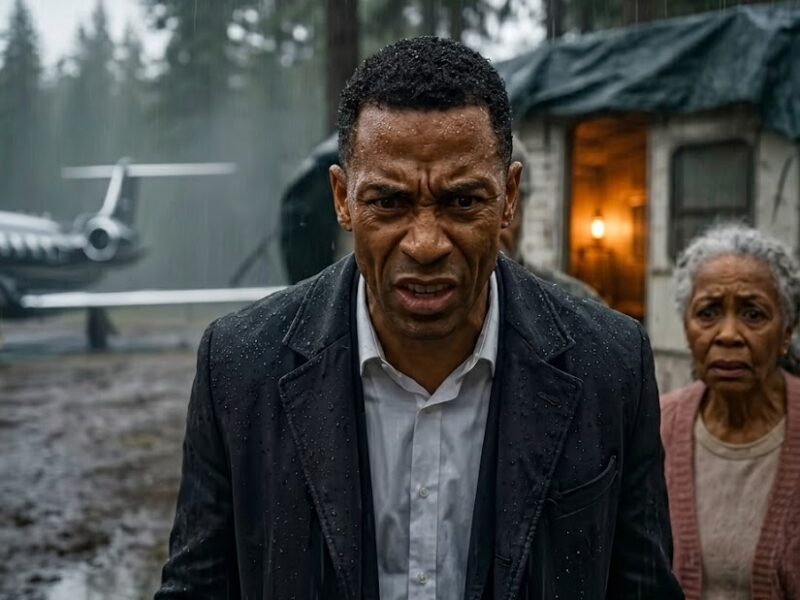
He Returned Home on His Private Jet-And Found His Parents Living Deep in the Woods
Part 1: The Hollow Ground
Landon Pierce stepped off his private jet, the crisp Montana air biting at his face. At forty-one, he was a success story—a man who had just sold a logistics empire for more money than he’d ever dreamed of. He hadn’t told his parents he was coming. He wanted to see the look on their faces when he surprised them at the front door of the house he had paid off years ago.
He rented an SUV and drove toward his hometown, his mind drifting to the quiet life his parents, Harold and Diane, lived near Missoula. They were good people—the kind who brought casseroles to neighbors and never asked for anything in return. He had sent money every month. He had funded their retirement. He had convinced himself that distance didn’t matter as long as the accounts were balanced.
But as he pulled onto the road lined with cottonwood trees, his heart hammered against his ribs. The house was gone.
Landon hit the brakes so hard the SUV skidded to a halt. There was no house. Just an empty lot, scarred by gravel and overgrown weeds. He stepped out, the silence of the vacant property ringing in his ears. It was where his father had taught him to ride a bike. It was where his mother had sat on the porch every evening, sipping iced tea. It was simply… erased.
Mrs. Callahan, a neighbor from down the fence, approached slowly, her eyes wide with a mixture of shock and pity. “Landon?” she whispered.
“Mrs. Callahan, what happened to my parents’ house?” he demanded, his voice tight.
She glanced toward the road, lowering her voice as if the air itself had ears. “They haven’t lived here for a long time, Landon. I thought Mason told you.”
Landon’s brother. Mason. The one who stayed behind. The one who handled everything. “What did he tell me?”
She hesitated, her face contorting in discomfort. “You should talk to Sheriff Collins.”
The hour spent at the sheriff’s office felt like a lifetime. Collins didn’t have many answers, but he had the ones that mattered. Harold and Diane were living in a weathered camper, hidden deep in the woods behind an abandoned logging road. Nobody knew exactly why. When offered help, Diane would politely decline, and Harold would stare at the ground, saying nothing.
Landon drove toward the location, his stomach churning. The paved road turned into gravel, then into two dirt tracks cut through dense, unforgiving pine. Finally, he saw it. A faded, silver-skinned camper, sagging under the weight of blue tarps. Piles of firewood were stacked haphazardly nearby. A small, struggling vegetable garden tried to push through the dirt beside the trailer.
His seventy-four-year-old father was there, hunched over a chopping block, his hands swollen with arthritis. His mother stepped out of the camper, holding a battered pot. She dropped it when she saw him.
“Landon?” she gasped, her voice cracking as tears filled her eyes.
He rushed forward, wrapping her in his arms. She felt tiny—fragile, like a bird that had been caught in a storm. “Mom, what happened?” he pleaded. “Why are you here?”
Diane didn’t answer. She looked past him, toward the dark tree line, her face pale with a terror he had never seen before. She grabbed his arm, her fingers digging into his skin, and whispered, “Please don’t call Mason. Not yet.”
Landon stared at her, frozen. The woods suddenly felt claustrophobic, and for the first time in his life, he realized that he had no idea what kind of monster he had left his parents with.
Part 2: The Secrets of the Camper
The camper was painfully clean, a silent testimony to a dignity they were fighting to maintain while living in the dirt. Landon sat at the narrow folding table, the mug in his hand—an heirloom he remembered from childhood—feeling like an anchor in a rising tide.
“Dad,” Landon said, his voice low, looking at his father. “How long have you been out here?”
Harold looked away, his breath coming in a shallow, wheezing rhythm. “Too long, son.”
“Mom said not to call Mason,” Landon pressed, his confusion hardening into a cold, sharp dread. “Why? He’s my brother. He’s the one who was supposed to be looking out for you.”
Diane exchanged a panicked look with Harold. “Mason is… dealing with things,” she murmured, clutching her own hands so tightly her knuckles turned white. “He’s trying to keep us safe.”
“Safe from what?” Landon countered. “I sent the money! I paid off the mortgage! Why is the house gone?”
Harold lowered his ax, his shoulders slumped in a way that looked permanent. “The money didn’t always make it to us, Landon.”
The air in the camper seemed to vanish. Landon felt his pulse roar in his ears. “What do you mean it didn’t make it? I sent it directly to the accounts he managed.”
“Your brother helped us,” Diane insisted, her voice trembling. “He had some trouble with his business, and he needed to borrow a little. It was just temporary.”
Landon stood up, the chair scraping violently against the floor. “Borrowing money isn’t why you’re living under a blue tarp in the middle of a forest! Someone has been bleeding you dry, and he has a name.”
He pulled out his phone, but before he could tap Mason’s contact, Diane reached out and pinned his wrist to the table. The strength in her grip was startling. “Don’t,” she begged, tears spilling over. “If you call him now, he’ll know you’re here. And then everything—everything—will be lost.”
Landon stared at her. “What could possibly be left to lose, Mom?”
She couldn’t answer. She just looked toward the door, watching the shadows of the pines stretch across the ground.
That night, Landon couldn’t sleep. The mattress was thin, and the wind moaned against the rusted metal of the camper. Around midnight, he stepped outside, needing to breathe. The forest was an ink-black void, but as he paced near the vegetable garden, he saw it: a set of headlights cutting through the distant trees.
The vehicle stopped on the old logging road, about three hundred yards away. It sat there, idling, for several minutes. A sentinel. A watcher. Then, slowly, it reversed and disappeared back into the darkness.
Landon stood in the cold, his hands balled into fists. He wasn’t just dealing with a brother in financial trouble. He was dealing with something that felt like a predator.
He waited until dawn, his mind racing. When the sun finally touched the tops of the trees, he decided he wouldn’t ask his parents for the truth anymore. He knew they were too terrified to give it. He needed to find the people who knew what happened before they went into the woods.
He drove back into town, his eyes scanning the rearview mirror. He stopped at a diner, the kind of place where every customer is a character and every secret is local property.
As he sat at the counter, an elderly man leaned over. “You’re Harold’s boy, aren’t you?”
“Yes,” Landon replied.
“You should have come home years ago,” the man whispered, looking over his shoulder. “Your brother… he told everyone you were the one who stopped helping. He told everyone the money dried up because you got greedy in California.”
Landon felt a wave of nausea. “He said what?”
Before the man could answer, the door swung open. A man walked in—Mason. He was older, his face etched with a hardness that shocked Landon. Mason stopped dead when he saw him. The recognition was instantaneous, but the reaction wasn’t a hug or a greeting. It was a look of pure, calculated panic.
“Landon,” Mason said, his voice flat. “What are you doing here?”
“I could ask you the same, Mason,” Landon said, standing up. “Especially about the house.”
Mason didn’t look at his brother. He looked at the exit. “We need to talk,” he said, his voice a dangerous, low warning. “But not here.”
Part 3: The Paper Trail of Deception
Mason’s truck was parked around the back of the diner. It was a heavy-duty model, mud-caked, with a trailer hitch that looked like it had dragged half the county’s property value behind it.
“Get in,” Mason said.
Landon didn’t budge. “I’m not going anywhere with you until you explain why Mom and Dad are living in a trailer.”
Mason leaned against the truck door, his jaw working. “You think you’re the hero, don’t you? You fly in on your jet, throwing your weight around, thinking you can fix ten years of damage with a checkbook.”
“I sent money for ten years, Mason! Where did it go?”
Mason looked toward the hills. “Business is hard, Landon. Things went wrong. I had to pivot. I had to protect the family assets from the banks.”
“By liquidating them?” Landon stepped closer, his voice low. “You stole from them.”
Mason let out a sharp, jagged laugh. “I invested for them. It didn’t pan out. I’m the one who stayed. I’m the one who had to watch them age while you were playing CEO in California. You don’t get to judge my methods.”
“I judge the result, Mason! They’re living like refugees in their own home state!”
Mason’s face hardened. “Go back to the camper, Landon. Stay away from the bank, stay away from the records office, and for God’s sake, stay away from the timber companies. If you go digging, you’re not going to like what you find—and it won’t just be about me.”
Before Landon could grab him, Mason jumped into the truck and roared away, kicking up a cloud of dust that choked the morning air.
Landon stood there, his lungs burning. He knew one thing for certain: Mason was terrified of something. And it wasn’t just Landon’s return.
He spent the afternoon at the county records office. He had to be subtle, but he was a businessman; he knew how to read a filing. He followed the trail of the “Rock Ridge Holdings” company Mason had mentioned in passing during a frantic phone call years ago.
The trail was a maze of LLCs, shell corporations, and deed transfers. But as the clock ticked toward five, he found it. The family land—not just the lot where the house stood, but the sprawling acres of pine forest behind it—was being mortgaged into oblivion.
He sat back in his chair, the glow of the computer screen hitting his exhausted face. Mason wasn’t just failing at business; he was using his parents as human collateral. And there was a signature on the latest filing that made his blood run cold: his mother’s.
But it didn’t look right. The penmanship was cramped, jagged. It didn’t match the elegant script he’d seen on birthday cards for years.
He realized then that he wasn’t looking at a bad business decision. He was looking at a crime.
As he packed his bag, a woman stood by the door, watching him. She was in her early sixties, wearing a sharp blazer and eyes that missed nothing.
“You’re Harold’s son,” she said, her voice calm.
“Yes,” Landon answered. “Who are you?”
“My name is Karen Brooks. I’m an attorney. And I think you and I need to have a very long conversation about elder rights.”
She didn’t wait for an invite. She walked toward the exit, signaling for him to follow. “Your mother came to me a year ago, Landon. She was too scared to file anything, but she wanted to know what would happen if she reported forgery.”
Landon’s legs felt weak. “Forgery?”
“Your brother isn’t just borrowing money,” Karen said, as they stepped out into the parking lot. “He’s been systematically erasing your parents’ legal existence to pay off debts that have nothing to do with them.”
“If it’s forgery, we go to the police,” Landon said.
Karen shook her head. “In this county? Your brother has been funding the sheriff’s campaigns for years. He’s the local power broker. You don’t go to the police. You go to court, and you move faster than he can cover his tracks.”
“He said there’s a deadline,” Landon realized. “Friday.”
“Friday,” Karen agreed. “That’s when the timber rights transfer goes through. If he gets that signature, the land is stripped of its value. It becomes worthless, and your parents become homeless for good.”
Landon looked toward the darkening mountains. He had come home to surprise his parents. Now, he was in a war for their very survival.
Part 4: The Witness
The night was freezing, but Landon barely felt it. He was back at the camper, the blue tarps flapping like ghost wings in the wind. Inside, his parents were asleep on the narrow cots, their breaths shallow and heavy.
He had to get them out. He had to take them to Missoula, to a hotel, to anywhere else. But when he touched his father’s shoulder, Harold woke with a start, his eyes darting to the door in a panic.
“Is he here?” Harold whispered.
“No, Dad,” Landon said. “It’s just me. We’re leaving. Pack a bag.”
“We can’t,” Diane murmured from the shadows of the curtain. “If we leave, he’ll know we’re talking to you. He told us… he told us if we ran, he’d make sure Ava never saw us again.”
Landon froze. “He’s using his own daughter as a threat?”
“He’s not himself,” Diane said, her voice a hollow shell. “The debt… it changed him. He thinks he’s playing a game he can win, but the people he owes… they aren’t people like us, Landon.”
Landon felt a chill that had nothing to do with the Montana winter. He realized then that Mason was drowning, and he was pulling the entire family under with him.
The next morning, the sun rose on a world of white. A light snow had fallen, muffling the sound of the forest. Landon went to meet Karen at a neutral spot—a gas station twenty miles from town.
She was waiting in her car, a thick folder on her lap. “I found a witness,” she said, her voice low. “But he’s hard to reach.”
“Who?”
“A former partner of Mason’s. He was pushed out of the construction company three years ago. He knows about the ‘property tours’ Mason was doing—taking realtors onto your parents’ land while they were still living in the house.”
“He was selling the land while they were still in the living room?” Landon asked, his voice shaking with fury.
“He was prepping the buyers. He was showing them the timber yield, the development potential. He was treating your parents’ lives like a closing stock.”
Landon took the folder. “What do we do?”
“We need a statement. We need to go to the judge, show the forgery, show the medical records from your father’s heart surgery—the records that prove he couldn’t have signed those documents when the bank claims he did—and pray the judge isn’t in your brother’s pocket.”
They didn’t have time to wait for the partner. They had to move. They drove to the courthouse, a small, brick building that felt like the center of the world. As they climbed the steps, Landon saw a silver sedan pull into the lot.
It wasn’t Mason. It was a young girl—Ava. She was carrying a bag of groceries, her face set in a mask of adult-like stoicism.
Landon intercepted her before she could start the long trek back to the woods. “Ava, what are you doing here?”
She looked up at him, her eyes old before their time. “Dad sent me. He said to give these to Grandma and Grandpa. He said… he said if I didn’t, he’d lose the truck.”
Landon took the bag. “Ava, I’m taking them away. You don’t have to do this anymore.”
She looked at the courthouse, then back at Landon. “He’s inside, isn’t he? Talking to the judge?”
“He’s trying to,” Landon said. “Ava, do you know what he’s doing?”
She looked at her shoes, kicking at a patch of slush. “He’s trying to stop the bad things. At least, that’s what he tells me.”
“And you don’t believe him?”
She looked him in the eye, and the raw honesty there broke his heart. “I think he just wants to be the one who decides when everything falls down.”
Landon hugged her, then watched as she rode her bike away—the only child in the world who seemed to know that her father was building a house of cards.
He turned to Karen. “Let’s go in.”
Part 5: The Confrontation
The courtroom was quiet, smelling of floor wax and old secrets. The judge, a man named Miller who looked like he’d seen every small-town disaster in the book, peered over his glasses as Landon and Karen took their seats.
Across the aisle sat Mason. He looked awful. His eyes were bloodshot, his movements jerky. He was staring at his hands, which were clasped tightly in his lap.
“Mr. Pierce,” the judge said, addressing Landon. “You are requesting an emergency stay on the timber rights transfer?”
“Yes, Your Honor,” Landon said, his voice ringing through the room. “The documents were signed under duress, and we have evidence that the signatures were obtained while my father was incapacitated by post-surgical medication.”
Mason stood up. “That’s a lie! My father was lucid. He knew exactly what he was doing!”
“Was he?” Karen asked, standing up and sliding a medical record toward the judge. “Because on the date of this signature, Harold Pierce was in the ICU, heavily sedated, as documented by the attending physician.”
The room went deathly silent. Mason’s face turned the color of ash.
“Mason,” the judge said, his voice dropping to a dangerous register. “Did you, or did you not, present these documents to your father while he was in the hospital?”
Mason looked at his brother, then at his parents sitting in the back row. For a second, the mask of the successful businessman crumbled, revealing a desperate, broken man.
“I had to,” Mason whispered. “The bank was going to foreclose on the equipment. They were going to take the trucks. If they took the trucks, I lost the contracts. If I lost the contracts, I lost the house. I was trying to save the house!”
“You didn’t save it,” Landon said, standing up to face him. “You devoured it. And then you tried to feed my parents to the timber company.”
“I was going to pay it back!” Mason yelled, his voice cracking. “I had a deal! A commercial developer in Billings—he was going to buy the rights, and I was going to buy the land back, and Mom and Dad would have a new house!”
“With their own money?” Landon asked.
Mason slumped back into his chair. “I didn’t have another way.”
The judge stared at him for a long, agonizing minute. “Mr. Pierce, we are not here to discuss your failed business ventures. We are here to determine the validity of a property transfer. If you have been coercing elderly parents into signing away their remaining assets, we are not talking about debt anymore. We are talking about criminal elder abuse.”
Mason didn’t respond. He just stared at the floor.
Landon looked at his mother. She was crying—not for the house, not for the money, but for her son. That was the most painful part of all. Even now, facing the truth of his betrayal, she was grieving for him.
“Your Honor,” Karen said, “I move to have the transfer nullified and an audit of the family accounts initiated.”
“Granted,” the judge said. “And Mr. Pierce? You are not to contact your parents or your brother until the forensic audit is complete. If I find any evidence of further coercion, you won’t be in this courtroom. You’ll be in a holding cell.”
Mason didn’t look up as they left. As they walked out into the cold afternoon air, Landon felt a weight shift—but it wasn’t gone. The truth had been spoken, but the family was still shattered.
“We won,” Karen said, standing by the SUV.
“Did we?” Landon looked back at the courthouse. “My brother is a criminal, my parents are homeless, and my niece is out there riding a bike through the woods like she’s a scout in a war zone. This isn’t a win, Karen. It’s just the end of the beginning.”
Part 6: The Unraveling
The weeks following the court hearing were a blur of meetings with bank investigators, accountants, and state officials. The deeper they dug, the worse it got. It wasn’t just the timber rights; Mason had been using the family home as a revolving door for loans for nearly a decade. He’d taken out second, third, and fourth mortgages, always keeping the payments just afloat until the entire structure collapsed.
Landon spent his days in the bank office, looking at ledgers that proved he had been paying for Mason’s lifestyle under the guise of “retirement support.” It was a betrayal so profound it felt like a physical blow. He had trusted Mason with their parents’ lives, and Mason had treated them like a line of credit.
He eventually moved his parents into a temporary apartment in Missoula. It was safe, it was clean, and for the first time in years, there were no blue tarps. But Harold and Diane were shells of themselves. They sat on the balcony, watching the mountains, rarely speaking. The trauma of the woods—the fear of Mason, the shame of the poverty—had left deep, invisible scars.
Then, there was the matter of Ava.
One evening, there was a knock at the door. Landon opened it to find Ava standing there, holding a backpack. She looked like she had been crying for days.
“He’s gone,” she said, her voice hollow.
“Who? Your dad?” Landon asked, feeling a sharp pang of alarm.
“He left,” she said. “He left a note. He said he couldn’t face Grandpa and Grandma anymore. He said he was going out west to find work.”
Landon let her in, his heart hammering. He called the sheriff’s office, but they were unconcerned. “A man leaving the state isn’t a crime, Landon, especially if there’s no active warrant. He’s just a guy who ran out of money and options.”
Landon sat on the edge of the sofa, watching his niece. She was so small. “Ava, stay here. We’ll figure this out.”
“He’s not coming back, is he?” she asked.
Landon didn’t have an answer. He looked at his parents, who were standing in the doorway, their faces etched with the same silent, devastating realization. Mason had taken the house, he had taken the savings, and now he had taken their ability to forgive him.
He was a runaway, leaving behind a wake of destruction that reached from the pine forests of Montana to the heart of their family.
“I need to go,” Landon said, standing up.
“Where?” his mother asked.
“I’m going to find him.”
“Landon, no,” Harold said. “Let him go. He’s done enough.”
“He’s my brother, Dad. And he’s her father,” Landon said, nodding toward Ava. “I’m not letting him disappear with the lie that he was the victim.”
Landon packed a bag, fueled by a rage that was finally, truly focused. He wasn’t looking for a businessman. He was looking for a man who had forgotten how to be a son.
He headed toward the coast, following the paper trail of the credit card hits and ATM withdrawals Mason had left behind. It was a trail of breadcrumbs leading into the dark.
Part 7: The Last Truth
Landon found him in a small, coastal town in Oregon, working in a commercial fishing yard. Mason was covered in grease and salt, looking like a man who had finally reached the absolute bottom of the barrel.
Landon didn’t shout. He didn’t punch him. He just pulled the SUV up to the dock and watched him.
Mason saw him, hesitated, then slowly wiped his hands on a rag and walked over. “You shouldn’t have come.”
“Ava is scared, Mason. Mom and Dad are broken. You didn’t leave a life; you left a crime scene.”
Mason looked at the ocean, his face unreadable. “I thought if I just got a fresh start—a real one, no banks, no timber deals—I could earn enough to make it right.”
“You can’t earn back twenty years of their lives,” Landon said. “And you can’t pay back the trust you burned.”
“So what now?” Mason asked. “Do you call the police? Do you send me back to Montana for them to lock me up?”
Landon looked at his brother. He saw the fatigue, the desperation, and the complete, crushing realization of his own failure. Mason wasn’t a villain in a movie. He was a man who had lived in a delusion until the walls collapsed on him.
“I talked to the bank,” Landon said. “The debt you owe… I’ve negotiated a settlement. But it’s not for you. It’s for the family. It’s a lien against your future earnings. Every cent you make for the next decade goes toward paying back what you stole from Mom and Dad.”
Mason stared at him, stunned. “Why?”
“Because you’re going to face it,” Landon said. “You’re going to work, you’re going to pay, and you’re going to be a father to your daughter. You don’t get to run away. That’s the only way you fix this.”
Mason’s eyes filled with tears. “They won’t want to see me.”
“They won’t,” Landon agreed. “Not for a long time. But you’re going to try. And you’re going to send money to Ava every month until she’s grown. No excuses. No ‘temporary’ business pivots. You work, you pay, and you survive.”
Mason nodded slowly. It was a sentence, not a prison sentence, but one that would last a lifetime.
Landon turned to leave, but he stopped, looking back at the dock. “One more thing. If you ever, ever step foot on their land or try to contact Mom or Dad without my permission, I won’t just call the police. I will make sure you spend the rest of your life in a cell.”
He drove back to Montana, the miles stretching out like a long, slow exhale.
When he arrived home, he saw them on the porch. The new house was small, clean, and filled with the smell of baking bread. Ava was there, sitting at the kitchen table, doing her homework. Harold and Diane were sitting together, their hands finally, truly, at rest.
Landon sat down at the table. He felt older. He felt like he had been gone for a hundred years.
“Is he…?” his mother asked.
“He’s working,” Landon said. “He’s paying for the damage. And he’s paying for Ava’s future.”
His parents didn’t cheer. They didn’t smile. They just looked at each other—a long, silent communication that spoke of a decade of horror and the quiet, stubborn reality of moving forward.
“The house,” Harold said, looking around the room. “It’s good, Landon. It’s quiet.”
“It’s yours, Dad,” Landon said. “And it’s not going anywhere.”
He looked out the window at the mountains. The woods were still there, the dark, towering pines where they had spent those years in fear. But the woods weren’t a place of hiding anymore. They were just trees.
The family had been built twice: once with the false hope of money, and once with the cold, hard weight of the truth. And as he sat there, watching his niece finish her math problems, he knew that the second foundation would hold. It had to. There were no secrets left in the house, no shadows hiding in the corners, and for the first time, he realized that the best surprise of all was just being there when it mattered.









