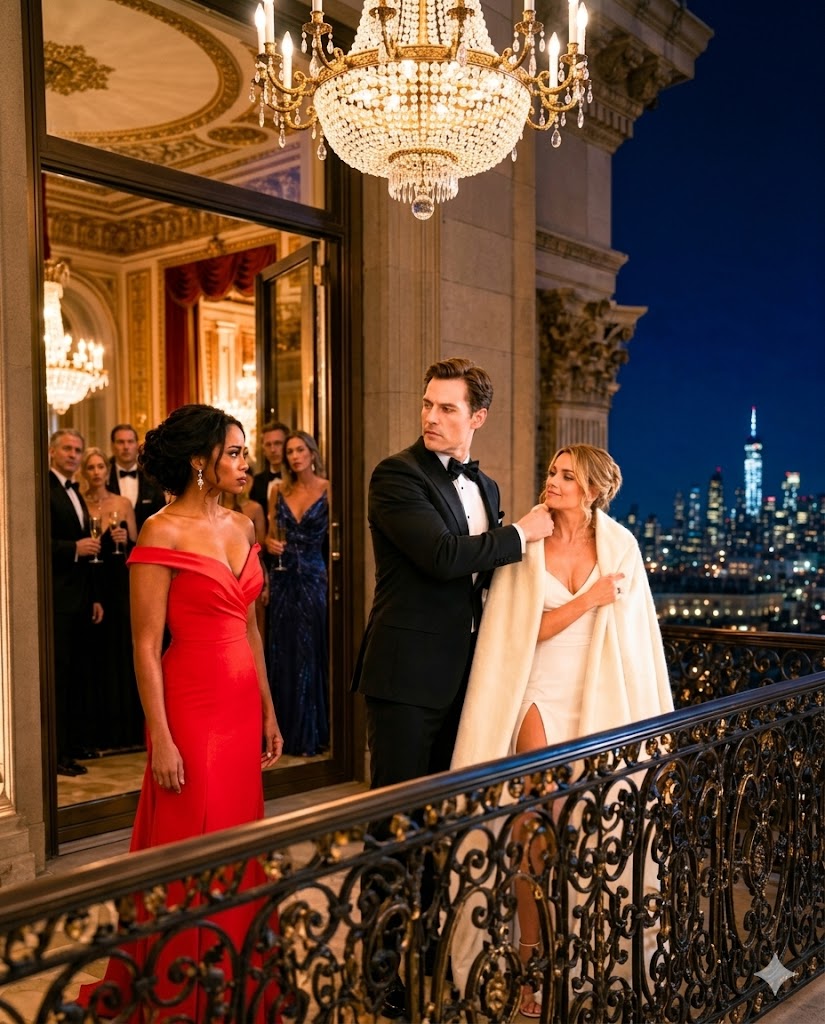
Her Billionaire Husband Gave His Mistress Her Coat—Then She Walked Out and Took Her Name Back
Part 1: The Weight of Cashmere
The night Naomi Brooks learned she had become a guest in her own marriage, the city of Manhattan was dressed in shimmering gold. Snow had not yet fallen, but the air carried that sharp, biting December promise, the kind that forced pedestrians to pull their coats tight and quicken their pace beneath the towering glass monoliths of Midtown. Inside the Grand Ellington Hotel, crystal chandeliers poured warm, liquid light over marble floors that had seen the rise and fall of a thousand fortunes. Champagne glasses chimed with a delicate, fragile sound, and five hundred of New York’s most admired names smiled for the cameras, their faces polished for public consumption as if every heart in the room had been buffed to a high shine.
Naomi stood near the charity auction wall, her hands tucked deep into the pockets of a cream cashmere coat. It was the same garment William Harrington had bought her eight years ago, back when his world was small and intimate. Before the private jets, before the glossy magazine covers, and before the world started calling him a billionaire with the casual ease of discussing the morning weather, William had been a young man with tired eyes, a single rented office, and a dream that felt far too large for his bank account.
He had wrapped that coat around her shoulders outside a greasy Brooklyn diner, his hands lingering on her collar for a second too long. “One day, I’ll give you the world,” he had promised, his eyes burning with a sincerity she hadn’t yet learned to doubt. “But tonight, let me at least keep you warm.”
She had believed him for years. She had anchored her entire identity in his ascent, believing that his wins were theirs. But as she watched him across the ballroom, tall and immaculate in a black Tom Ford tuxedo, her perception fractured. He was standing beside Camille Mercer, his company’s image consultant—a woman who possessed the uncanny ability to tilt her face exactly toward a flashbulb and hold a married man’s sleeve for just long enough to turn a gesture into a public statement.
Naomi did not move. She had spent too many years learning the silent, brutal language of rooms like this. She knew the power of a raised brow, the stinging cruelty of a swallowed insult, and the way a polite laugh could serve as a weapon.
She saw Camille shiver—a performance of delicacy near the balcony doors—with one hand pressed against her bare arm. Her silver gown glittered like frost.
“William,” Camille said, her voice light, pitched precisely to carry over the ambient chatter. “I’m so sorry, but it’s absolutely freezing. I should have brought a wrap.”
Naomi looked at her husband, expecting the smallest glance—a quiet, habitual check a man gives the woman he loves before making any choice that touches them both. The glance never came. William stepped toward Naomi with the distracted, lazy confidence of a man taking what he assumed would always be available.
“Naomi, let Camille use your coat for a minute,” he said, his hand already reaching for her shoulders.
The cold hit her skin before his words even registered. Around them, the conversation softened, turning into a murmur. Camille lowered her eyes with a practiced, winning smile, and William draped Naomi’s coat over the other woman as if he were displaying a trophy.
“There,” he murmured, his back to Naomi. “Better.”
Naomi’s hands remained at her sides. No scene, no trembling accusation, no broken voice for strangers to collect and whisper about over brunch. She only looked at the coat, at the woman wearing it, and then at the man who had long ago forgotten the night he gave it meaning.
William finally noticed her stillness. “Naomi, don’t make this uncomfortable,” he muttered, not turning around.
Something inside her became very still—not dead, not weak, but still in the way a lake becomes before it reflects the sky perfectly. She picked up her small black clutch, turned away from the chandelier light, and walked toward the entrance. Behind her, someone whispered her name, but the sound was already fading.
Outside, the doorman reached for an umbrella, but Naomi shook her head. Rain began to fall in thin, silver lines, cold enough to bite through her silk evening dress. Her driver waited at the curb, but she passed the car without a word. Three miles stood between the Grand Ellington and the Harrington penthouse. She began to walk, but she felt a shadow looming—someone was following her from the ballroom.
Part 2: The Three-Mile Walk
The rain turned from a drizzle into a persistent, icy soaking, but Naomi didn’t increase her pace. She walked past the glowing storefronts, the frantic yellow cabs, and the strangers hurrying home to people who might still choose them first. With every step, the humiliation began to shed, replaced by a cold, sharpening clarity. She realized the coat had never been the real wound; the real wound was the realization that the man who had promised to keep her warm was now perfectly comfortable leaving her to freeze.
By the time she reached Fifth Avenue, her hair was damp, her feet ached, and her wedding ring felt as heavy as a lead weight. She reached the penthouse at 2:00 a.m. The grand Harrington residence glowed with perfect, sterile discipline. White orchids sat on the entry table, and the polished oak floors reflected the cold city lights, framing a life that had once felt like proof that love could survive ambition.
Naomi stood just inside the door, rainwater darkening the hem of her black dress. For the first time, she saw the apartment not as a home, but as a showroom—a curated space where her life had been arranged to make William Harrington look complete. A silver-framed portrait hung above the console. In the photo, they were laughing in a Napa vineyard, her hand resting on his chest, his arm around her waist like a permanent promise.
She walked to the cedar closet and opened it. The empty space where her cream coat should have been seemed brighter than everything else in the dark room. On the lower shelf, partially obscured by William’s leather travel bag, she found a pale silk scarf she had never seen before. She picked it up gently. The fragrance hit her at once—expensive, floral, and deeply familiar. It was Camille’s scent.
Naomi didn’t cry. She simply closed her eyes, confirmation settling over her like a shroud. Somewhere in the vast apartment, the expensive grandfather clock William had bought at an auction began to strike midnight. Each note felt like a question she had been avoiding for years: How many times had she mistaken distance for pressure? How many times had she made herself smaller so his world could feel larger?
She folded the scarf once, placed it on William’s pillow, and looked at her reflection in the dark window. The woman staring back was wet and tired, but she was no longer confused. She knew that a marriage rarely breaks in one grand moment; it breaks in quiet, corrosive inches.
William arrived at 2:00 a.m. He heard the faint sound of his shoes crossing the marble, steady and unhurried. He was surprised to find her sitting in the dark living room, wrapped in a plain gray robe, her hands resting around a cup of tea that had gone cold hours ago.
He paused when he saw her silhouette. He still looked perfect—tuxedo crisp, hair slightly loosened, the scent of champagne and winter air trailing behind him. He noticed the scarf on the coffee table. His jaw tightened, but he dismissed it. “You waited up,” he said, walking toward the bar.
“No,” Naomi said, her voice cutting through the silence. “I stopped waiting tonight.”
William removed his cufflinks, placing them beside a silver tray with a clinical precision. “If this is about Camille, you are making something small into something ugly.”
Naomi stood up. The robe fell loosely around her. “You could let her be humiliated, but you couldn’t let me be warm?”
“People were watching!” he snapped. “I had to protect the brand.”
“You protected everything but the woman you married,” she said.
William’s eyes flashed with a sudden, sharp panic, but he reached for his phone, his thumb hovering over the screen to check the latest social media blowback. Naomi knew then that the man she had altered suits for was gone. She walked past him toward the hallway, her heart finally untethered. He called her name, but she didn’t look back. The bedroom door stood open, and for the first time in years, the house felt like it belonged to nobody.
Part 3: The Erasure
Naomi didn’t pack everything. That would have looked like a retreat, and she was finished with the language of surrender. She chose carefully: her sketchbooks, her grandmother’s heavy steel sewing shears, two framed photographs from a time before the world knew William’s name, her passport, and a small velvet box holding the first button William had ever lost from the navy suit she had hand-stitched for his big break.
At 8:30 a.m., she walked into a law office on Madison Avenue. Evelyn Grant, a silver-haired attorney with eyes as sharp as cut glass, listened to Naomi’s story without interruption. When Naomi finished detailing the years of unpaid design work, the gaslighting, and the systematic erasure of her creative identity, Evelyn didn’t offer pity.
“Let us talk about protection,” Evelyn said, opening a legal pad.
By noon, Naomi was standing in the archives at Harrington Lux. She was escorted by a nervous junior assistant who kept apologizing for the state of the files. Naomi moved through the concept boards and launch materials, her eyes tracing the evolution of the brand. In the early days, her name was everywhere—casual, affectionate, and foundational. Naomi thinks the lining should be message-stitched. Naomi suggested the silhouette. Naomi found the weaver.
Then, year by year, the name vanished. It became “the team,” then “creative direction,” and finally, “William’s vision.” The erasure was so surgical, so elegant, it was almost invisible. Naomi printed everything. She placed every page into a leather folder, feeling the paper under her fingertips like evidence.
When she returned to the penthouse, William was waiting in the living room, still wearing yesterday’s shirt. “Where were you?” he asked, his voice caught between wounded pride and desperate worry.
“Learning the difference between what I gave and what you took,” Naomi said, setting the folder on the table.
She removed her wedding ring. It hit the wood with a finality that made the air feel thin. She laid the cream coat, cleaned and pressed, across the back of the chair. Beside it, she placed a single sheet of stationery.
I did not leave because of the coat, the note read. I left because you forgot who I was before I wore your name.
William looked at the note, his face pale. He opened his mouth to speak, but Naomi held up a hand. She didn’t want the argument. She wanted the exit. She turned toward the elevator, not toward the man, but toward the life she had once known before she became his backdrop.
When the elevator doors closed, the penthouse remained perfect, polished, and suddenly, terrifyingly empty. William stood alone, surrounded by the silence of a showroom that no longer had a soul.
Part 4: The Brooklyn Studio
Naomi’s first winter alone began in a third-floor walk-up in Brooklyn, tucked above a bakery that perfumed the hallway with cinnamon, butter, and yeast every morning. The apartment was cramped, the radiator hissed like a restless neighbor, and the windows rattled in the wind, but it had a height to the ceilings that felt like possibility. For the first time, the silence was something she owned.
On the fourth morning, she walked to her old studio on Atlantic Avenue. The sign still read Naomi Brooks Design, a faded monument to a woman she had almost forgotten. The lock resisted her key, then gave way. Inside, the studio smelled of cedar and time. Rolls of fabric leaned in the corner like old friends.
She ran her hand across the cutting table, leaving a clear track in the dust. She opened the windows, letting the brisk Brooklyn air wash away the stale scent of the past. She picked up her shears. The sharp, metallic snip of steel touching air felt like a heartbeat.
The idea came to her at the subway station, watching a woman sitting on the stairs, shivering beneath two thin sweaters. The city passed her by with a practiced, callous blindness. Naomi stopped. She bought the woman—Mrs. Alberta James—soup and a thick, navy blanket. But as she walked home, she felt a burning in her chest—not of anger, but of a new, sharp compassion.
That night, she sketched until the sun rose. She didn’t sketch for ballrooms or limousines. She sketched coats with deep pockets, strong seams, soft linings, and hidden messages stitched near the heart. By the end of the week, she had finished the first one. She stitched in cream thread: You are still worthy of warmth.
When she gave it to Mrs. Alberta James, the woman touched the lining with trembling fingertips. “Sometimes a coat is not clothing,” she whispered, buttoning it tight. “Sometimes it is dignity.”
Naomi stood under the gray Brooklyn sky, realizing that warmth wasn’t something you waited for a husband to provide. It was something you built, multiplied, and handed to a stranger. As the weeks passed, her studio began to hum with a different kind of energy. Women from the neighborhood—mothers, daughters, survivors—stopped by to help, to learn, to sew, and to share their own stories of starting over.
Naomi paid them fairly, treating their work not as labor, but as a collaboration. And when the money ran thin, she sold two pieces of jewelry she no longer needed, feeling the weight of the gold disappear as she felt the strength of the fabric rise.
Part 5: The Rising Tide
By the following winter, Brooks and Grace had become more than just a studio; it was a sanctuary. The name Naomi Brooks began to appear in local papers, then in business journals, and eventually, on a morning news segment. When the host held up one of her navy coats and asked how something so practical could feel so personal, Naomi didn’t talk about profit margins.
“Warmth should never be treated as a luxury,” she told the camera, her voice steady and calm. “It’s a fundamental need. And dignity? Dignity is stitched into the places where the world isn’t looking.”
Her company grew not because she chased the spotlight, but because purpose has a quiet, gravitational way of attracting its own audience. She hired women who had been overlooked by every other major fashion house, women who had been told that their resilience made them “unemployable.” She taught them everything—pattern cutting, finance, management—turning the studio into a place where they could learn to govern their own lives.
Across the river, Harrington Lux Group began to suffer. Their new winter collection lacked the touch of the person who had once understood the language of comfort. Critics wrote that the brand had lost its soul, that it was all polish and no heart. William read the reviews, his office feeling more like a tomb with every passing day.
Camille Mercer pushed harder, demanding a new campaign that would reassert Harrington’s dominance. She wanted to frame Naomi as a bitter, opportunistic ex-wife. But William had become a different man. He spent his evenings reading the archive threads he had discovered, seeing Naomi’s notes in the margins—Add a warmer lining. Beauty that does not protect is only decoration.
One afternoon, a fashion journalist published a feature that quietly compared the Harrington designs to the early Brooks and Grace collections. The article didn’t accuse; it simply asked: Who actually built the soul of Harrington Lux?
By morning, the questions had reached every investor, every stylist, and every boardroom in New York. Camille demanded a statement, but William finally looked at her with clarity. He saw not a partner, but a mirror reflecting his own lack of depth. “No statement against Naomi,” he said, his voice cold. “She is finally getting credit for surviving me.”
Part 6: The Winter Gala
The invitation arrived on heavy, navy-embossed cardstock. It wasn’t just an invitation; it was a reclamation. Naomi had been asked to keynote the New York Winter Humanity Gala. She didn’t arrive as a wife or a decorative accessory; she arrived as the leader of a movement.
She wore a white wool coat of her own design, the pearl buttons gleaming in the light of the Metropolitan Hall. She walked in with her team—the women from Brooklyn, Queens, and Harlem—each of them carrying themselves with a new, quiet dignity.
William was there, standing near a marble column in a tuxedo that fit perfectly but failed to protect him from the reality of his own choices. Camille stood nearby, her face sharpened for survival, but she was a shadow in the wake of the light Naomi now carried.
When Naomi stepped to the podium, the ballroom became a breathless void. She didn’t start with a joke or a corporate platitude. She started with the truth.
“Last winter,” she said, her voice resonant, “I learned that a person can be surrounded by luxury and still feel cold. I learned that your silence is consent, and your love should never be something that can be borrowed without asking.”
She looked at William. He didn’t look away. For the first time, he saw the woman he had tried to erase, and he realized he hadn’t succeeded. He had only forced her to become something much stronger.
“Brooks and Grace was built for every woman who has ever had to walk home alone and convince herself that the next step would not break her,” she continued. “We are here to say that you are seen, you are protected, and you are worthy.”
When she finished, the room stood up. It wasn’t the polite, performative applause of the elite; it was the raw, genuine sound of people who had been touched by something real. Naomi’s team stood with her, a row of women who had refused to let their lives be reduced to backdrops.
Naomi didn’t look for William’s approval. She looked for the women in the front row, Mrs. Alberta James, her team, and the young designers who were ready to claim their own futures. She realized then that she hadn’t just survived the cold—she had become the fire that no ballroom could contain.
Part 7: The Unbroken Dawn
The gala had ended, and the city lights glittered through the hall windows, but the mood inside remained irrevocably altered. Naomi moved through the crowd, not as a guest, but as a force. She was thanked by shelter directors and young designers alike, but her focus remained on the women she had worked alongside for the past year.
Near the exit, she found William waiting in the shadow of the winter garden. He didn’t approach her with the arrogance of the billionaire she had married. He waited, his posture humble, his face etched with the specific exhaustion of a man who has finally stopped running from himself.
“I have something for you,” he said, handing her a folder. It contained a public correction—a full attribution of her work and the royalties she had been denied. “I don’t expect forgiveness,” he added quietly. “I only want the record to be true.”
“Forgiveness isn’t for you, William,” Naomi said, taking the folder. “It’s for me. But you don’t get to buy your way out of the silence you helped create.”
She left him in the garden and walked out into the cool, clear night. She stood on the steps of the hall, looking at the city that had once felt like an adversary. Now, it was just a landscape of lives, and she felt like a part of it—not as a wife, not as a background player, but as a person who had learned how to make her own warmth.
A year later, she walked back to her studio on Atlantic Avenue. She didn’t look at her phone for messages from him. She didn’t look at the skyscrapers for approval. She just felt the fabric of her own coat against her skin, the warmth she had built with her own hands.
As she unlocked the door, the smell of fresh bread from the bakery below drifted up. The studio was waiting, filled with fabric, light, and the work that still needed to be done. She knew that the path ahead was long, but she finally understood that the most important shelter she had ever built wasn’t the coat she gave to others—it was the strength she had found in the silence of her own worth.
She turned on the studio lights, looked at the empty cutting table, and began to work. There were more lives to protect, more dignity to stitch into the fabric of the city, and a lifetime of mornings waiting to be claimed. She was Naomi Brooks, and for the first time, that was more than enough.









