I Faked A Fall To Escape My Millionaire Husband—But The Doctor Recognized His Darkest Secret!
Part 1: The Fall That Saved My Life
“Touch that phone again, Ellie, and I’ll make sure nobody believes a word you say.”
That was what my husband told me at 7:14 that morning, standing in our white marble kitchen with one hand wrapped around his coffee mug and the other still red from striking my face.
Preston Davenport looked like the kind of man every woman in our small Connecticut town should want. He was a highly successful real estate developer, a prominent church donor, and a Thanksgiving sponsor at the local food pantry. He was the golden boy who smiled at little kids after Sunday service and shook hands with the mayor outside the diner like he was born to be loved by the world. But inside our house, behind the imposing iron gates and the perfect white porch columns, he was a monster in a tailored suit. And that morning, looking at the cold calculation in his eyes, I finally understood something fundamental. If I stayed quiet, I would die quietly.
He had slapped me because his shirt collar had a tiny wrinkle. Not a stain. Not a tear. A minor wrinkle. I stood near the kitchen island, my left cheek burning, the heavy smell of bacon grease and fresh coffee hanging in the morning air, and I watched him adjust his gold cufflinks like absolutely nothing had happened.
“You embarrass me,” he said coldly, his voice smooth as oil. “A man in my position cannot walk into a high-level bank meeting looking like his wife was raised in a barn. Fix yourself before the staff arrives.”
My fingers tightened around the linen dish towel until my knuckles turned stark white. I looked down at the floor, forcing my breathing into a slow, mechanical rhythm. I couldn’t run out the front door. There were high-definition security cameras in the hallway, cameras in the living room, cameras watching the gravel driveway, the wide porch, the front gate, the lush backyard, and even the interior entrance to the multi-car garage. Preston had wired our entire life to ensure total surveillance. But there were no cameras in the bathrooms. That was the only place in the vast mansion where I still belonged entirely to myself.
Preston inspected my smartphone every single night, checking call logs and hidden trash files. He completely controlled the bank accounts, giving me a tracked allowance that required receipts. He kept my car keys locked inside a biometric safe in his private home office. He had already spent two years telling the neighbors I was “fragile” and “deeply emotional” so if I ever screamed for help, they would simply think I was having another psychological breakdown. He had built a prison so beautiful that tourists stopped to take pictures of it from the street. And I was the prisoner dying inside it.
For five long years, I had tried to survive by making myself smaller, quieter, softer. I had become the kind of wife who knew exactly when to smile for his business associates, when to pour more coffee, and when to disappear upstairs before his sudden temper sharpened into physical violence. But that morning, while his black Mercedes rolled smoothly down our driveway, waving at the private security guard like a king leaving his castle, I stopped being his wife.
I became a woman planning her escape.
Not by running blindly into the woods. Running would get me caught by his security team before I reached the main highway. Not by begging him for a divorce. Begging only fed his twisted need for control. I needed public witnesses. I needed medical records. I needed a crowded place where Preston’s money and local influence could not silence every single room.
So I chose the hospital. And to guarantee I got there, I chose pain.
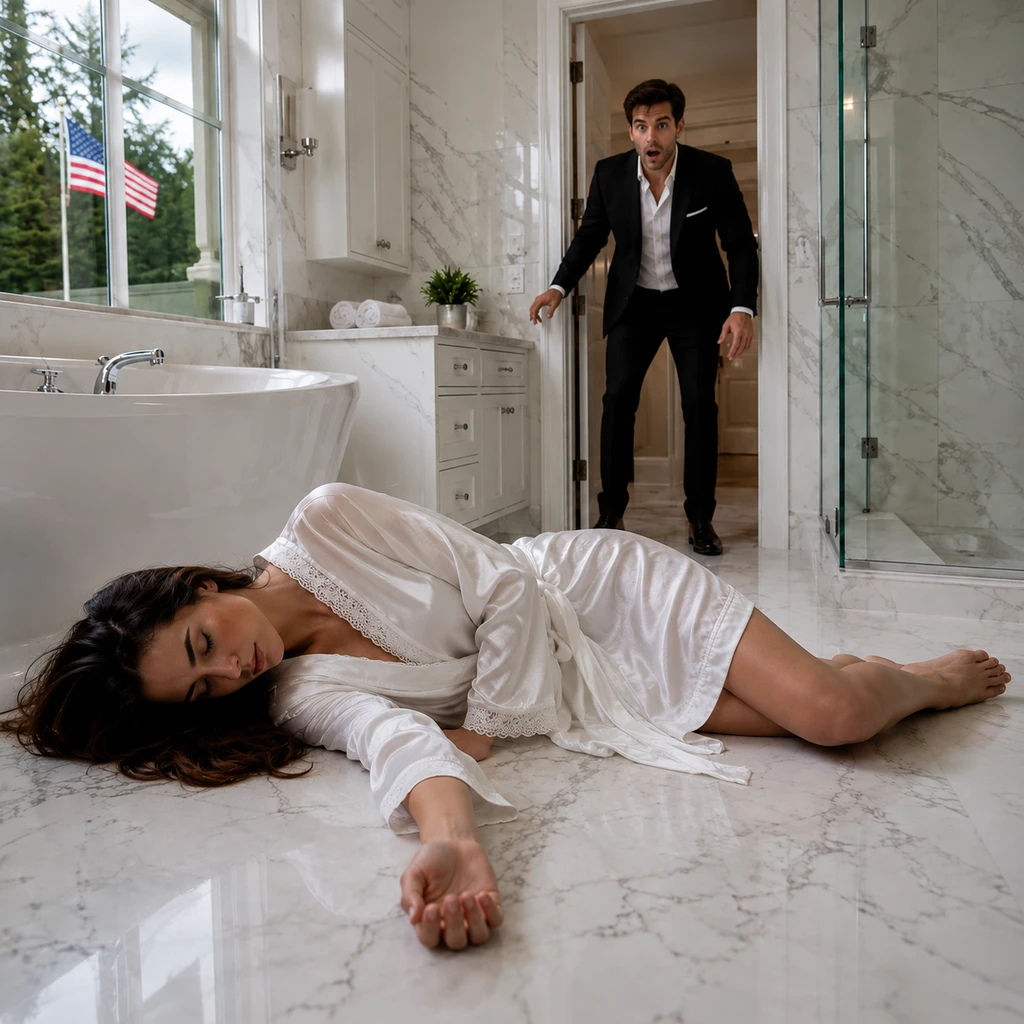
By late afternoon, the autumn sky had turned a dark, bruised violet. I stood inside the massive master bathroom, staring down at the polished white marble floor that had terrified me for years. My breath hitched as I unscrewed a large bottle of lemon-scented liquid floor cleaner. I poured it directly near the porcelain double sink, spreading it until the white tile shone wet, slick, and treacherous beneath the recessed lights. The smell was incredibly sharp, chemical, and almost cheerful—like a clean home, like a beautifully maintained lie.
My hands shook violently as I capped the bottle and hid it behind the laundry hamper.
“This is crazy,” I whispered to the empty room, my voice bouncing off the high glass mirrors.
Then I leaned forward and looked at myself in the vanity mirror. One cheek was still visibly swollen, a dark yellow-green bruise beginning to form along my jawline. One broken woman, still standing.
“No,” I said softly, my eyes locking onto my own reflection. “This is survival.”
At 6:03 p.m., the low, expensive rumble of Preston’s car rolled into the attached garage below. I heard the heavy engine die. His footsteps entered the lower hallway, loud and demanding. I heard his sharp voice bark an insult at Maria, our live-in housekeeper, because the fresh flowers in the grand foyer leaned an inch too far left. Then he began to walk upstairs. Each heavy step on the hardwood riser sounded like a dynamic countdown to an explosion.
I stood right at the bathroom doorway in my satin nightgown, my heart pounding so hard I could feel the pulse vibrating in my teeth.
“Preston?” I called out, my voice deliberately high, mimicking the fragile tone he expected from me.
“What now, Ellie?” he barked from the bedroom, his leather briefcase hitting the bed with a heavy thud. “I’m on a deadline for the city council report.”
I took a deep, final breath, stepped out onto the slick, wet marble tile where the cleaner lay, and threw my weight forward.
My bare foot flew out from under me instantly. For one terrible, weightless second, I was completely airborne, staring up at the high ceiling. Then my left hip and lower back slammed against the solid marble floor with a sickening, hollow crack that echoed through the entire bathroom suite.
Pain exploded through my entire body. Real pain. White-hot, blinding, paralyzing pain that stolen the air straight out of my lungs. It wasn’t simulated; the force of the impact made my vision turn entirely black at the edges. I screamed as loudly as I could, the raw sound tearing my throat until it went raspy and bloody. Then I forced my limbs to go completely limp. I closed my eyes, dropped my head back into the cold liquid, and let my arms slide across the slick tile.
The greatest performance of my miserable life began right there on that cold bathroom floor.
Preston burst through the double doors three seconds later, his leather shoes skidding slightly on the wet edge.
“Ellie?”
His voice didn’t carry a single drop of loving concern. It was a sharp note of angry panic—the specific kind of panic a public man feels when his darkest secret starts bleeding onto his expensive imported floor. He dropped to his knees, his hands grabbing my shoulders, shaking me roughly. He slapped my unbruised right cheek lightly, then harder, trying to force a reaction.
“Ellie, wake up! Don’t you dare do this to me tonight! The mayor is coming to dinner tomorrow!”
Don’t you dare do this to me. Not “please be okay.” Not “hold on for me.” Even when he believed I was completely unconscious, his first and only concern was the preservation of his own structure.
He checked the pulse at my throat with cold, trembling fingers. Good, I thought behind my frozen eyelids. Tremble, Preston. For once in your miserable life, let your hands shake in the dark.
He sprinted to the door, yelling at the top of his lungs for Manny, our private driver. Within five minutes, I felt myself being hoisted into the air, carried downstairs like a heavy sack of laundry, my limp left head bumping hard against the mahogany doorframe while Preston cursed continuously under his breath.
“Careful with the drywall, Manny!” he snapped as they rounded the staircase. “Don’t scratch the painting.”
Not careful with my fractured body. Careful with the wall.
The drive to the county hospital felt like an endless eternity of acceleration and braking. I kept my eyes clamped shut, holding my body completely still while Preston muttered an angry stream of complaints in the front seat about the evening traffic, the red lights, and how incredibly inconvenient this medical emergency was for his corporate timeline. But the exact second the Mercedes pulled into the bright, flashing lights of the emergency room entrance, his voice transformed completely.
“Help!” he shouted, throwing his car door open, his voice echoing off the concrete walls. “Please, someone help my wife! She’s hurt!”
He sounded utterly broken, devoted, and terrified. He sounded like a grieving saint. If I had not spent five years bleeding behind his iron gates, I might have believed the performance myself.
Nurses rushed toward the vehicle with a mechanical gurney. Preston grabbed my limp hand for the gathering audience of strangers in the waiting room.
“She slipped in the master bathroom,” he said loudly to the triage nurse, his face twisting into a mask of pure, frantic devotion. “Cost is absolutely not an issue here. Please do whatever you have to do to save her.”
There it was. Cost is not an issue. Even in the middle of a simulated tragedy, he needed the room to know he was the wealthiest man in the county.
They wheeled my frame through the bright double corridors, the air thick with the smell of disinfectant, institutional fear, and old coffee. A stern-faced nurse pulled a heavy privacy curtain around my metal bed bay, her eyes checking my vital monitors.
“Sir, you need to wait outside in the reception hall,” she said firmly to Preston, her arm blocking the gap in the fabric.
“I’m her husband,” Preston argued, his voice dropping into that low, threatening register he used when a contractor defied him. “I go where she goes.”
“And we are her medical team,” she replied, her voice remaining an unyielding wall. “Step back behind the line, sir.”
For the first time in five long years, someone told Preston Davenport no.
When his heavy leather footsteps finally faded down the linoleum corridor, I let out the smallest, shallowest breath through my nose. I had successfully made it outside the iron cage. I had an official medical file started. But freedom wasn’t the real shock of the evening. The true, life-altering shock arrived exactly ten minutes later, when a senior doctor stepped into the curtained bay, looked through the gap at Preston sitting in the hallway, and turned my husband’s face the color of cold ash.
“Good evening, Mr. Davenport,” the doctor said, his voice dropping into a flat, freezing cadence. “It’s been a very long time.”
Preston stumbled backward against a plastic chair, his mouth opening silently. No words came out of his throat. The doctor’s silver name tag read: Dr. Miles. And from the way Preston’s entire frame began to shake under the fluorescent lights, I knew this man was not just a random physician.
He was a ghost from Preston’s past. A ghost who had finally found his address.
Part 2: The Doctor Who Knew His Secret
“Your wife is safe with me tonight,” Dr. Miles told Preston, his voice dropping into a low, terrifyingly quiet register that vibrated through the fabric of the privacy curtain. “Unlike Rebecca.”
The name hit the room like a high-caliber gunshot.
Rebecca.
Preston’s first wife. The woman whose portrait still hung in the historical society downtown. The woman every old ledger in our small town claimed had slipped in the master bathroom and tragically died of a skull fracture before the local ambulance could arrive at the estate. I kept my eyes locked shut, my breathing shallow as I continued to simulate unconsciousness, but the blood inside my veins turned completely to ice.
Preston whispered, his voice thin and desperate, “Doctor, don’t do this here. Not in public.”
Dr. Miles took a single, deliberate step closer into his space, his leather shoes clicking against the linoleum floor. “My sister didn’t get a second chance on that marble, Preston,” he said, his words cutting through the air like a cold blade. “This woman will.”
Preston fled the room like a common coward, the heavy fabric of the curtain rustling violently as he pushed his way toward the exit doors of the ER wing.
The second the corridor outside went quiet, Dr. Miles turned around, stepping up to the side of my gurney. He placed a warm, incredibly gentle hand flat against my shoulder.
“Mrs. Davenport,” he whispered, his voice entirely devoid of the cold stone he had used with my husband. “You can open your eyes now. He’s gone from the floor.”
I opened my eyes, my vision blurry with tears of genuine pain from the fall. I looked up at his face. He had deep, tired gray eyes, the lines around his mouth heavy with a long-term sorrow he had been carrying for years. He didn’t run a diagnostic scan; he simply looked down at the physical patterns on my skin. He saw the targeted purple bruises on my forearms where Preston had gripped me last week. He saw the old, yellowing marks along my ribs, and the raw fear I was trying desperately to hide behind my teeth.
“A real bathroom floor accident doesn’t leave distinct finger pressure marks around a wrist, Ellie,” he said quietly, his hand steady against my blanket.
That was the exact moment I broke completely. Not loudly. Not with a dramatic outburst that would draw the nurses into the bay. Just one jagged breath, one heavy tear tracing down into the lemon cleaner on my neck, one desperate whisper.
“Please… please don’t send me back to that house.”
Dr. Miles looked down at me like he had spent five long years waiting in the dark to hear those exact words come out of someone’s throat.
“I couldn’t save my sister Rebecca,” he said, his jaw tightening until the muscle stood out against his cheek. “The department ruled it an accidental misstep because Preston owned the city council. But I swear to you, Ellie, I am going to help you bury his empire this time.”
And that was the exact moment I stopped being Preston’s victim. I became a woman with an ally who possessed a ledger of his history.
“Listen to me very carefully, Ellie,” Dr. Miles said, leaning down until his voice was nothing but a breath against my ear. “The force of your fall caused a minor hip contusion, but we are going to document it as a suspected internal hemorrhage. That gives me the legal authority to admit you to the restricted observation wing on the third floor for the next forty-eight hours. Preston cannot enter that wing without an escort from our security desk. It buys us exactly two days to build the case file before his attorneys realize what we are doing.”
“He has the security cameras at the house, Doctor,” I whispered, my fingers clawing at the cotton sheet. “He will delete the timestamps for the morning. He will say I was unhinged.”
“He can’t delete the physical evidence currently stamped into your bone density, Ellie,” Dr. Miles countered, straight up his spine as a nurse stepped into the bay carrying an IV bag. “Nurse Collins, run a full toxicology screen and prepare a deep tissue trauma log. Mark the file under restricted medical privacy protocol code nine. No internal updates to the spouse until I personally sign the voucher.”
“Understood, Doctor,” she said, her eyes shifting to my face with a look of quiet, professional understanding.
As they wheeled my bed out of the chaotic emergency room toward the secure elevators, I looked through the glass panels of the corridor. Preston was standing near the vending machines in the waiting room, his black Mercedes keys clutched tightly in his fist, his phone pressed to his ear as he talked rapidly to his primary corporate attorney. He was already spinning the narrative for the town. He looked like a man trying to manage a financial liability, completely unaware that the ledger had already been taken out of his hands.
The elevator doors glided shut with a heavy, pressurized hiss, the numbers on the display lighting up as we rose toward the third floor. I looked up at the smooth metal ceiling of the car, the physical pain in my hip a sharp, constant reminder that I was finally breathing independent air. I had spent five years living inside a beautifully engineered tomb, but tonight, the cold marble of his bathroom had cracked the floor wide open, and the ghosts were finally stepping out into the light.
Part 3: The Observation Lock
The third-floor observation wing of St. Jude’s Medical Center was defined by its functional silence. The walls were a pale, generic gray, the floors covered in heavy rubber runners that absorbed the sound of the medical staff’s movements. It was a restricted zone, accessible only through a heavy set of security doors that required an electronic key-card swipe at the desk.
They rolled my bed into Room 312, a private corner suite with a single high window that looked out over the wet asphalt of the rear parking lot. The room smelled faintly of clean laundry and ozone, a welcome relief from the suffocating chemical sweetness of the lemon cleaner that still lingered in my hair.
Nurse Collins worked quickly, attaching the pulse oximeter to my finger and hanging the saline drip from the stainless-steel pole. She didn’t ask me to explain the marks on my ribs; she handled my skin with a cold, professional reverence that felt like the first real dignity I had been granted since 2021.
“Dr. Miles has placed a continuous medical holds block on your chart, Mrs. Davenport,” she said softly, adjusting the blanket around my feet. “That means if your husband calls the front desk or attempts to access this corridor through the lobby elevator, the automated system will route his inquiry straight to our head of security. You need to rest. Your body has been running on pure adrenaline for forty-eight hours.”
“Thank you,” I whispered, my throat feeling dry as sandpaper.
When she stepped out of the room, the heavy wooden door clicked shut with a solid, definitive sound that made my chest expand. I lay there in the dark, watching the red digital numbers of the heart monitor trace a steady, slow rhythm against the wall. For the first time in five years, Preston didn’t know exactly what I was doing. He couldn’t open the door to demand why my posture was wrong; he couldn’t check my screen to audit my thoughts.
But peace is a fragile commodity when you are married to a man who owns half the real estate in the county.
Around 2:00 a.m., the low, muffled sound of a heated argument drifted through the thick glass panel of my door. I sat up instantly, my left hip screaming with a sharp, hot flash of pain from the deep contusion. I pressed my palm flat against the mattress, straining my ears to catch the syllables over the steady hum of the air conditioning unit.
“I don’t care about your internal hospital codes, character!” Preston’s voice boomed from the security desk down the hall, his tone carrying that sharp, arrogant resonance that usually made our household staff drop their eyes instantly. “I am Preston Davenport. My development company personally funded the construction of this entire emergency wing back in 2024. I demand to speak with the chief administrator immediately! My attorneys are already drafting an injunction for unlawful medical separation.”
“Mr. Davenport, you need to lower your volume right now,” a heavy, unyielding voice replied—it was the night security supervisor, an old ex-state trooper named Vance. “Dr. Miles has noted a critical internal instability in the patient’s vitals. No visitors are permitted on this floor until the laboratory screens are finalized at dawn. If you take another step toward that security gate, sir, I will have our on-duty officers escort you out of the building in handcuffs.”
A long, heavy silence followed his words. I held my breath, my fingers clawing into the white hospital sheet until my nails hurt. I knew exactly what Preston’s face looked like right now—his jaw locked tight, his chest expanding beneath his tailored coat, his gray eyes turning into slots of cold calculation as he measured the political cost of a public arrest in a hospital lobby. He was a master of strategy; he wouldn’t risk a scene that the local papers could print before his bank expansion meeting on Monday.
“This is an administrative mistake, Officer,” Preston said, his voice dropping into a low, terrifyingly calm register that made the hair on my arms stand up. “A very expensive mistake for this facility’s future funding. I will be back at eight o’clock with our family physician and a court order. Tell Miles that he’s playing with a fire he can’t afford to clear.”
His heavy leather footsteps finally retreated down the service corridor, the distant chime of the elevator doors signaling his departure from the floor.
I sank back down onto the pillows, my chest heaving as a cold drop of sweat traced down my neck. He was coming back. He was coming back with his lawyers, his private doctors, and the immense weight of his local political influence. He would buy a signature from a corrupt judge before breakfast, and by noon, they would wheel my bed straight back to his black Mercedes.
The door to Room 312 glided open silently, a tall silhouette stepping into the shadows of the room. It was Dr. Miles, still wearing his stained white lab coat, a thick blue manila folder clutched firmly against his chest. He locked the door behind his back, walked over to the side of my bed, and turned on the small, low-intensity reading lamp over the desk.
“He’s already moving his pieces, Ellie,” Dr. Miles said quietly, setting the folder down flat on the blanket over my legs. “My contact at the courthouse just texted me. Preston’s personal attorney has already woken up Judge Evans to request an emergency medical guardianship transfer based on your history of ’emotional fragility.’ If that order is signed at eight, I cannot legally block his access to your room.”
“Then it’s over,” I whispered, a wave of familiar, suffocating panic crashing through my throat. “He will take me back to the house. He will lock me in the study, and nobody will ever see me again, Miles.”
“No, it’s not over,” Dr. Miles said, his eyes drilling into mine with a fierce, burning light that stopped my panic cleanly. He flipped the blue folder open, revealing a series of old, yellowed autopsy reports, police scene photographs, and handwritten laboratory sheets from 2021.
“This is the original file on my sister Rebecca’s death,” he said, his voice dropping into a raspy, emotional whisper. “Preston’s money managed to bury the primary investigation five years ago. But they forgot to check the auxiliary pathology logs. Look at the chemical screen from her intake sheet, Ellie. She had massive traces of a highly specific sedative in her bloodstream on the night she ‘slipped’ on that marble floor. The exact same sedative Preston has been filling prescriptions for under his corporate health account for five years.”
He reached into his pocket and pulled out a small, encrypted thumb drive, setting it flat next to the old sheets.
“Your toxicology report from tonight just cleared the lab ten minutes ago, Ellie,” Dr. Miles said, his gray eyes locking onto mine with the absolute precision of a executioner dropping the blade. “The exact same sedative is currently sitting inside your bloodstream right now. He wasn’t just striking your face, Ellie. He’s been dosing your morning coffee for months to make sure you looked unstable to the neighbors.”
Part 4: The Architecture of Evidence
The red digital lines of the heart monitor seemed to freeze on the wall as Dr. Miles’s words hung in the sterile air of Room 312. I looked down at the old yellowed pathology logs of his sister Rebecca, then at the fresh, white laboratory printout bearing my own name. The chemical markers were identical—a matching sequence of numbers that described a slow, systematic poisoning designed to mimic a long-term psychological breakdown.
“He… he was giving this to me every morning?” I whispered, my voice shaking as the true architecture of his prison finally became visible to my intellect.
“Every single morning, Ellie,” Dr. Miles said, his fingers tracing the chemical sequence on the sheet. “It’s a low-dose cognitive depressant. In small quantities, it causes mild vertigo, slurred speech, and severe memory lag. It’s the exact medical justification he required to tell the country club members that his poor wife was losing her grip on reality. If you had actually fallen down those stairs next month out of pure dizziness, the coroner would have found a history of ‘unstable behavior’ and a system packed with sedatives. It was the perfect, unchallengeable accidental death plot. He used it five years ago, and he was executing the exact same blueprint on you this week.”
I looked at the small black thumb drive resting on the white cotton blanket. “Can we take this straight to the state police, Miles? Can we have him arrested before eight o’clock?”
“The local state police precinct is managed by Captain Vance—Preston’s first cousin,” Dr. Miles said, his face setting into a cold, grim mask. “If I drive down there with this file right now, the evidence will vanish into an administrative paper shredder before the sun hits the roof. We cannot go through the local grid, Ellie. We have to go over their heads. We have to route this data straight to the Federal Prosecutor’s office in New Haven. But to do that, we need a complete narrative chain of custody. We need the physical prescription bottles from inside your house layout.”
“The safe,” I said, a sudden memory flashing through my mind with the sharp clarity of a lightning strike. “He keeps the private medication logs inside the biometric safe in his home office. The safe requires his thumbprint, but he keeps a backup manual key hidden inside the hollow base of the antique bronze clock on his desk. I saw him move it once when he thought I was asleep on the sofa.”
Before Miles could answer, the small internal intercom at the nurse’s station outside began to emit a sharp, rhythmic series of chimes. Nurse Collins’s voice came through the panel speaker near my bed, her tone tight with immediate alarm.
“Dr. Miles, you need to check the security monitor for the main lobby parking lot right now,” she said rapidly. “Preston Davenport’s private security vehicle has just returned. He’s not alone this time. He has two corporate attorneys and a local uniform officer from the township department with him. They’re walking through the front double doors right now, and they’re carrying a signed executive order.”
Darius—Miles stood up from the bed frame instantly, his face turning into ice as he clutched the blue manila folder tightly against his chest. He looked down at me, his gray eyes locking onto mine with an unyielding, protective force.
“He bought the judge,” Miles muttered, his jaw tightening until the muscle stood out against his cheek. “Evans signed the medical emergency guardianship transfer before the dawn shift. They’re coming to lift the hospital hold by force.”
“If he takes me back to that mansion, Miles…” I stammered, a cold, paralyzing panic crawling up my throat as I tried to swing my bruised legs off the gurney frame, the pain in my contused hip making my vision blur. “If I go back inside those iron gates—”
“You aren’t going back there, Ellie,” Dr. Miles said, his voice dropping into a low, commanding register that completely stopped my panic. He reached into his lab coat pocket, pulled out his own master electronic security key-card, and slid it into the pocket of my nightgown.
“Listen to me very carefully,” he whispered, leaning down over my mattress rail. “Nurse Collins is going to wheel your gurney down the rear service elevator right now, moving toward the basement laundry loading bay. My personal vehicle is parked near the loading dock door—a gray sedan with the engine already idling. You take the keys from the glove box, and you drive straight out of this county. Don’t go to a hotel, and don’t go to a friend’s house. Drive straight to the federal building in New Haven. I will stay here on the third floor to block the corridor access lines, giving you exactly a twenty-minute window before his lawyers realize the suite is empty.”
“Miles, no,” I choked out, grabbing his sleeve. “If you block a local police officer with a signed judicial order, they will ruin your medical license. They will lock you down.”
“They already locked my sister Rebecca inside a concrete vault five years ago, Ellie,” Dr. Miles said, his voice rich with a raw, emotional quiet as he gently released my fingers from his coat. “Losing my license is couch change compared to the price of finally making him pay for her blood. Now go through the elevator before the gate doors clear.”
The door to Room 312 burst open, and Nurse Collins stepped inside, her face completely pale as she grabbed the handles of my rolling gurney, unhooking the saline drip from the stainless-steel pole with a sharp click.
“They’re inside the main elevator bank on two right now, Doctor,” she reported, her boots already moving the heavy metal bed frame toward the back corridor exit. “We have exactly ninety seconds before the front desk line is compromised.”
Part 5: The Laundromat Escape
The concrete corridor of the hospital basement layout was freezing cold, smelling of stale detergent, damp steam, and industrial motor oil. The heavy rubber tires of my rolling gurney clicked loudly against the floor drains as Nurse Collins sprinted down the narrow passageway, her face covered in sweat under the dim flourescent bulbs.
“The gray sedan is directly through those metal double doors, Ellie,” she gasped, her hands pushing the gurney frame hard against the rubber bumpers of the exit threshold. “The keys are inside the unlatched glove compartment, just like Dr. Miles said. You have to move now. The security alarm on the service lift just chimed on the third floor.”
I scrambled off the metal mattress, my left hip sending a white-hot flash of agony straight up my spine as my bare feet struck the cold concrete floor. I clutched the oversized cashmere coat Vincent—Preston had bought me around my shoulders, my nightgown stained with the gray residue of the lemon cleaner, and threw the heavy metal exit doors open, stepping out into the lashing autumn rain.
The storm was completely blinding, the wind ripping through the asphalt loading bay like a physical wall. I spotted the gray sedan idling quietly in the shadow of a massive commercial trash compactor, its exhaust pipe releasing small white plumes of condensation into the chilly night air. I sprinted across the wet gravel, threw the driver’s side door open, and lunged into the interior cabin, slamming the door shut to block out the roar of the rain.
My fingers tore open the glove compartment box. There they lay—the mechanical keys attached to a small leather fob. I jammed the key into the ignition cylinder, threw the transmission into drive, and accelerated hard out of the loading dock layout, the tires screaming against the wet asphalt as I cleared the hospital perimeter gates just as the red strobes of a local police cruiser entered the front driveway.
The drive down the dark Connecticut turnpike was an exercise in slow-motion claustrophobia. The rain rolled down the windshield glass in heavy, silver sheets, blurring the reflections of headlights and neon signs into a chaotic mesh of gray and red. Every single time a pair of bright high beams appeared in my rear-view mirror, my stomach tightened into a hard, cold knot of pure panic, my eyes darting to the dashboard clock. It was 3:14 a.m.
I was thirty miles away from the federal building in New Haven, completely alone inside a stranger’s vehicle, running on pure adrenaline and a system packed with low-dose sedatives.
Then, the central console screen of the sedan began to flash, an unlisted corporate phone number overriding the Bluetooth network array.
I hesitated for three terrifying seconds, my hands shaking against the plastic steering wheel, before my thumb automatically pressed the Accept button on the console frame. I needed to hear where the danger was moving.
“Ellie,” Preston’s voice boomed through the car speakers. It wasn’t his loud, performative church-donor voice, and it wasn’t the angry panic of the bathroom floor. It was a low, terrifyingly smooth cadence—the voice of a master developer who had just finalized the extraction coordinates for a liability.
“You have made an exceptionally expensive administrative mistake tonight, sweetheart,” he said softly, the sound of his breath steady over the line. “Dr. Miles is currently sitting in a holding cell downstairs at our cousin’s precinct, charged with high-level medical fraud and structural endangerment of a patient. The state police have already logged the license plate tracking numbers for the vehicle you are driving. They have flagged it as a stolen asset.”
I felt the air leave my lungs, my chest physically hurting against the wheel. “He knows what you did to Rebecca, Preston,” I choked out, the hot tears finally spilling down my cheeks into the dark. “He has the pathology logs from 2021. He has the toxicology screens from tonight. It’s all inside a federal file.”
Preston let out a short, hollow laugh that sent a chill straight down my spine. “A federal file requires a living witness to carry the text into a grand jury room, Ellie baby. And right now, the local state troopers are preparing a rolling spike strip block on the New Haven bypass, under the legal assumption that a mentally unstable, heavily drugged woman has fled medical custody inside a stolen vehicle. If you crash that car into a concrete bridge at eighty miles an hour in this storm, the coroner will simply find a history of emotional fragility and a system full of sedatives. It will be an absolute tragedy for our town, Ellie. Just like Rebecca.”
“No,” I whispered, my thumb lunging forward to slam the console panel, disconnecting the call, cutting his smooth voice completely out of the air.
I looked up at the wet highway ahead. Two miles away, through the shifting sheets of gray rain, the bright red and blue strobes of three state police cruisers were already flashing in a synchronized line across the New Haven entrance lanes, blocking the entire bypass with a wall of white steel.
Part 6: The Boundary Turn
The red and blue strobes of the state police cruisers sliced through the dark sheets of rain like digital neon blades, turning the wet asphalt of the New Haven turnpike into a stark, shadowless white arena. The high beams of the three vehicles were pointed directly toward my oncoming car, their white glare blinding my gray eyes through the rain-streaked windshield pane.
I slammed my bare foot hard against the brake pedal, the gray sedan’s anti-lock brakes groaning and fighting for traction as the car fishtailed wildly across the slick lane markings, stopping exactly forty yards short of the metal spike strips the troopers had deployed across the concrete.
“Driver! Step out of the vehicle with your hands flat above your head!” a voice boomed through a high-volume megaphone from behind the flashing strobes—it was Officer Miller, Preston’s first cousin from the local township precinct. “You are currently operating a stolen asset under a state medical emergency intervention warrant! Do not make an asset movement!”
I sat inside the dark cabin, my hands completely frozen around the steering wheel, my heart hammering against my ribs like a trapped bird. The red digital numbers on the dashboard read 3:42 a.m. I looked to the right side of the highway layout. There sat a narrow, unpaved service road that sliced cleanly through a dense forest of old pine trees—the old logging bypass that led toward the eastern shoreline docks, completely outside the town line jurisdiction.
I didn’t think about the legal liabilities or the deep deep tissue contusion in my hip. I slammed the transmission into reverse, backed the sedan out of the spin in a cloud of smoking rubber, threw the wheel hard to the right, and accelerated violently down into the dirt track of the pine woods, plunging the car into an absolute, pitch-black tunnel of trees.
Behind me, the high shriek of three local police sirens shattered the quiet of the forest as the cruisers turned their frames to give chase, their red strobes bouncing off the wet pine needles like blood through an eye.
The dirt track was a mechanical nightmare, packed with deep potholes and slippery mud that dragged hard at the sedan’s lower oil pan. The car groaned under the force of the impact, the steering wheel violently twisting against my palms as I kept my foot pinned flat to the floorboard. I was driving blind, relying solely on the faint yellow glare of the low beams cutting through the gray mist of the trees, my mind screaming a single verse over and over: Don’t look behind your back. Just run the line.
After three miles of chaotic weaving through the pine woods, the trees suddenly broke apart, revealing the wide, industrial expanse of the municipal shipping docks. The concrete wharf was completely deserted at this hour, smelling of salt water, diesel exhaust, and wet timber. I pulled the sedan into the deep shadow of a massive commercial shipping crane, threw the engine into park, and killed the headlights, plunging myself back into the darkness.
From the road entrance of the wharf, the headlights of Preston’s private black Mercedes S-Class tore through the brush, its massive chrome grill filling the space like a silver predator as it pulled to a manual stop exactly thirty yards from my vehicle.
The driver’s side door threw open, and Preston Davenport stepped out into the pouring rain. He didn’t have his tailored suit jacket on today, and he wasn’t checking his smartphone for bank metrics. He stood flat-footed in the storm, a black cashmere wool coat draped casually over his shoulders, his white hair plastered to his forehead as he walked slowly toward the gray sedan, his long fingers sliding into his pocket to pull out a sleek silver key fob.
“The server on Dr. Miles’s laptop was completely wiped ten minutes ago by our corporate security unit, Ellie,” Preston called out over the roar of the lashing waves against the concrete docks, his voice smooth, calm, and absolute. “The pathology records from 2021 are entirely gone from the network ledger. There is no federal file left to carried into New Haven. You are completely alone out here with your husband.”
I pushed the sedan door open, stepping out onto the wet concrete of the wharf, my body wrapped inside his oversized coat, the rain driving into my swollen face. I clutched the small black thumb drive tightly inside my palm, the metal edges biting into my skin until it bled.
“I still have the toxicology report from tonight inside my hand, Preston,” I shouted back through the wind, my voice breaking with a raw, unbridled force. “I still have my own voice, and I am going to stand in front of a grand jury and say your full name aloud until the whole state hears the text!”
Preston smiled slightly then—that slow, patronizing smirk he always used before delivering a physical blow. He took another slow step closer, his leather shoes quiet against the concrete.
“Who is going to believe the text of an emotional, heavily sedated woman who just fled a medical emergency facility inside a stolen car, Ellie baby?” he whispered, his gray eyes turning into slots of cold calculation. “The town council already knows your history. By tomorrow noon, you will be checked into a private containment suite upstate, and nobody will ever see your face on Newbury Street again. Give me the drive.”
He reached out his hand, his fingers two inches from my coat sleeve. But before his hand could make contact with the fabric, a sudden, explosive roar of twin-turbine helicopter engines shattered the silence of the docks, a massive five-million-candlepower searchlight crashing down from the dark sky above, turning the entire concrete wharf into a stark, shadowless white arena.
Part 7: The Final Ledger
The blinding white light of the federal searchlight crashed down from the hovering chopper, pinning Preston Davenport directly in its center frame like a specimen caught beneath a laboratory microscope. The immense downdraft of the rotor blades tore his expensive black cashmere coat straight off his shoulders, sending it flying across the wet concrete into the black water of the harbor.
From the main road entrance of the shipping docks, five black armored SUVs with federal transport markings stormed the driveway, their heavy bull-bars smashing through the local precinct’s wooden barriers with a thunderous crunch of splintering timber. A dozen men wearing matte-black ballistic body armor and federal tactical helmets cleared the vehicles before the wheels had even stopped spinning, their short-barreled assault rifles raised, the red laser lines clicking alive across the white stone of the wharf.
Within three seconds, a single bright red laser dot centered itself precisely on the gold link of Preston’s right cufflink.
“Federal Bureau of Investigation!” a voice boomed through an electronic megaphone from behind the high-intensity strobes—a deep, unyielding baritone that made Preston’s cousin, Officer Miller, instantly drop his local service weapon onto the gravel and drop to his knees with his hands flat above his head. “Mr. Davenport! Step away from the witness! Drop to your knees and lock your fingers behind your neck!”
Preston completely froze, his face turning an administrative shade of gray that looked ancient under the white searchlight glare. The corporate swagger, the political connections, and the real estate millions he had used to rule the county for decades were completely useless against the industrial weight of a federal grand jury warrant.
A tall, sharp-eyed woman in a dark federal blazer stepped out from the lead vehicle—it was Prosecutor Vance from the New Haven district court. She didn’t look at Preston’s lawyers; she walked straight to my side, her boots quiet against the concrete, and threw a heavy, dry wool blanket around my trembling shoulders.
“Ellie Vale,” she said, her voice a solid, unyielding wall of comfort as her fingers took the small black thumb drive from my bloody palm. “Dr. Miles managed to route a secondary encrypted mirror of his sister Rebecca’s pathology files directly to our central server terminal two hours before his local arrest was executed. We have the full medication logs, the wire transfers to Captain Vance’s accounts, and the corporate prescriptions spanning five years. The ledger is officially closed.”
I turned my face slowly to look at Preston. He was kneeling flat in the red clay puddles of the concrete wharf, his white hair plastered to his forehead by the storm, his hands locked behind his head as two federal operators slammed the heavy steel handcuffs around his wrists with a sharp, definitive click. He looked small, old, and entirely stripped of the tailored suit of code that had hidden his cruelty from the town. He looked like the monster he had always been when the iron gates were locked.
“Ellie…” he choked out as they hoisted his frame toward the rear compartment of the transport van, his gray eyes locking onto mine with a final, desperate plea for a private negotiation. “Please… we can handle this inside the house layout. I can give you the Florence firm… I can buy out the contracts…”
I didn’t answer his voice with a single word of noise. I simply stood flat-footed in the rain, my hand resting steady under the blanket, and watched his black Mercedes keys clatter onto the wet concrete of the dock as the federal doors slammed shut behind his face, locking his ghost inside the steel cabin forever.









