I GAVE MY HUSBAND TWENTY YEARS AND HE CHOSE THE WOMAN WHO GAVE HIM TWENTY MINUTES
Part 1: The First Honest Breath
The day Ifeoma Dike stopped crying was not the day she found the messages. It was not the day she packed his shirts into black nylon bags and left them outside the gate like refuse—a public confession of a private collapse. It was not even the day the divorce papers arrived: thin, bureaucratic, indifferent, smelling faintly of the court clerk’s stale tobacco.
No, the day she stopped crying was a Thursday morning in November, six months after Chukwudi had left, when she woke before the sun. She walked to her kitchen, the tiles cold beneath her bare feet, and made herself a cup of tea with the unhurried, deliberate movement of a woman who had finally understood, with the clarity of a blade, that no one was coming to save her.
She stood at the window, the steam rising from her cup, and watched the street below slowly open its eyes to mourn the night. She felt not happiness—not yet—but something adjacent to peace. It was the first honest breath she had drawn in twenty years.
She did not know then that the phone would ring before the month was out. She did not know that Chukwudi’s voice, desperate and stripped of the arrogance she had spent two decades navigating like furniture in a dark room, would force her to look at everything—their marriage, their ruin, her own calloused hands—from a distance she had not yet mastered.
But we are getting ahead of ourselves. Let us go back, not to the beginning—the beginning is a long road and a tired one—but to the middle, where all the real damage was done.
They had met at a funeral. It is not the dark omen it sounds like; funerals in the east are crowded, noisy affairs that smell of pepper soup and generator fumes, and people fall in love at them with a regularity that borders on the absurd. She was twenty-three, wearing her mother’s borrowed iro and blouse, trying to look older. He was twenty-eight, standing at the perimeter of the crowd with a glass of orange Fanta he hadn’t touched, watching the dancing with the expression of a man trying very hard not to be moved.
Ifeoma had thought, This one is afraid of his own feelings. She had been right. She had not understood at twenty-three that afraid men do not become brave simply because someone loves them enough. They only become better at hiding.
They married two years later. Their families were satisfied. His people said she was humble and hardworking. Her people said he had prospects and a government salary. Nobody asked either of them if they were happy. Happiness was for children and fools. Stability was the thing. Stability, and a man who came home.
Chukwudi came home. They built. That is the word Ifeoma always uses when she tells this story to herself in the quiet of her own mind. Built. Not a fairy-tale word, but a labor word—a word that carries mortar, cement, and broken nails. They built three children: Chinua, her firstborn, serious and watchful; and the twins, Adana and Adai, who arrived like an argument no one had asked for.
She built a home around him like one builds a wall around something fragile: carefully, with both hands, with her back to the wind. She gave up her banking job when the twins came because the logistics were impossible and because Chukwudi said, very reasonably, that one of them needed to be present. He was the one with the salary. The logic was airtight. She did not argue. She did not argue about many things.
She did not argue about her mother, who came every Christmas and rearranged her kitchen without asking. She did not argue about the money he sent to his brother’s business without telling her—the business that collapsed anyway. She did not argue about the weeks when he came home late, smelling not of another woman, but of whiskey and bad decisions. She held her tongue because the children were asleep, and there was always tomorrow. That was the lie she had told herself so consistently it had become the architecture of her life.
Then came the Tuesday evening that shattered the structure. She hadn’t gone looking; she was simply passing through the kitchen to get a glass of water while he was in the shower. His phone, left on the counter, lit up. She read three messages.
She did not gasp. She did not drop the glass. She read the words, put the phone down, took her water, and went back to bed. She lay on her side of the mattress, listening to the shower run, and realized that the ground beneath her hadn’t disappeared—it had simply been a mirage all along. And then, her phone began to vibrate with an incoming call from a number she didn’t recognize.
Part 2: The Logic of Ruin
The phone vibrated against the bedside table, a persistent, jagged sound that seemed to mock the silence of the room. Ifeoma stared at the screen. The name displayed was simply “Blessing.”
She did not answer. She let the phone fall into the gap between the bed and the wall.
What Ifeoma did not know then, what she would not fully understand for another four years, was that Chukwudi’s restlessness had finally found a name. Blessing Okoli, twenty-six years old, assistant manager at the filling station three streets from his office. She was loud in the way of a woman who had been told all her life she wasn’t loud enough. She wore false lashes on weekdays and laughed at everything Chukwudi said.
And he, a man who had not been laughed at in twenty years—at least not in a way that felt like applause—mistook her laughter for understanding. He mistook the thrill of being new to someone for the thrill of being known.
This is the lie that ruins men and the lie that destroys marriages: that the beginning of a thing is the best of it, that the fizz is the drink.
Ifeoma did not confront him that night. This was not cowardice; it was calculation. She had spent twenty years managing a household, three children, a mother-in-law, and a man’s ego. She understood timing. She knew that what you do with information is as important as the information itself.
She watched him over the next few weeks. She watched him check his phone with a new, frantic energy. She watched him dress with a vanity he had abandoned years ago. And all the while, she began, very quietly, to prepare.
Here is what nobody tells you about a woman who has been holding a household together for two decades: she is extraordinary at logistics. Ifeoma found a lawyer before Chukwudi even suspected she knew. She opened her own account, something she had not had since she left the bank, and began to move money into it with the patience of someone filling a bucket drop by drop. She called her sister in Port Harcourt—a conversation she had been avoiding for fifteen years—and started sleeping differently. Not better, not yet, but on her stomach, arms spread, taking up space in a bed she had learned to occupy as though she were a guest.
It was Chinua who finally broke the silence. He was nineteen, perceptive in the way that first children are when they grow up as witnesses to a marriage’s slow negotiation. He came to her in the kitchen one evening while she was frying plantains.
“Mama,” he said, his voice barely a whisper. “I have seen the messages too.”
Ifeoma turned the heat down. She did not turn around. “How long?”
“A year. Maybe more.”
She turned the heat all the way off. She turned around and looked at her son—her serious, watchful son who had learned silence from her.
“Why didn’t you tell me?” she asked.
“Because,” he said, and the words hit her harder than any infidelity, “you looked like you were already carrying too much.”
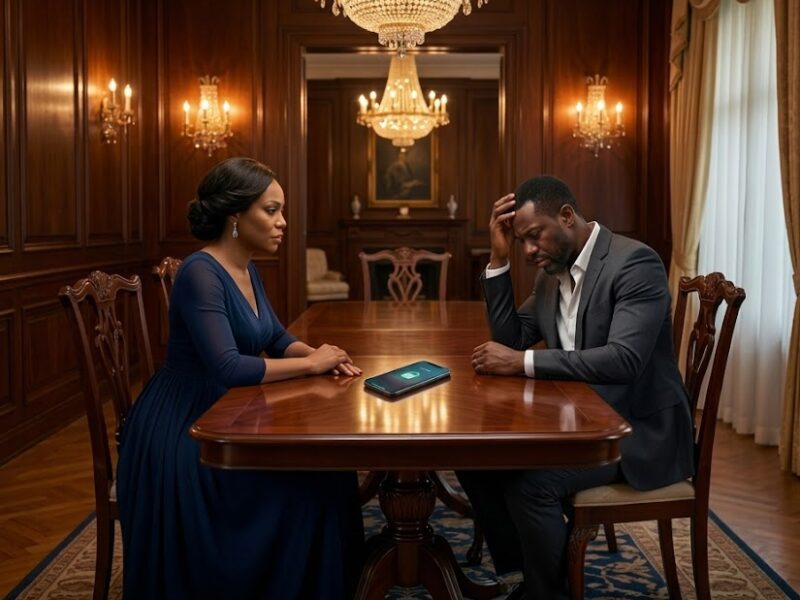
She wept that night. It was a long, ugly, thorough weeping—the kind she had been postponing for months. And when she was done, she washed her face, walked into the dining room where Chukwudi sat reading, and placed her phone on the table between them, the conversation open.
He looked at the screen, then at her. He didn’t offer an excuse. He leaned back, looked at the ceiling, and said, “I have not been happy for a long time.”
As though happiness were a utility he was owed. As though twenty years of shared life—hospital nights, school fees, funerals attended, in-laws managed—were simply a failed provision of his happiness, and she was the provider who had defaulted.
“Get out,” she said.
He didn’t leave immediately. Men like Chukwudi never do. They require several more conversations, several more accusations, the slow, bureaucratic collapse of a life jointly constructed before they will admit the thing they came to ask. But he did eventually pack.
And it was then, while sifting through the wreckage, that Ifeoma’s lawyer found the second betrayal. Buried inside the financial disclosure documents was a three-bedroom flat in Asaba, registered in the name of his cousin, Emmanuel Dike, purchased eight years ago with money from a joint account she had believed was empty.
He hadn’t bought it for Blessing. That was the part that disturbed her most. The hiding wasn’t new. The hiding was simply who he was.
Part 3: The False Wall
The discovery of the flat in Asaba shifted the gravity of the divorce. When Ifeoma’s lawyer presented the evidence, the conversations moved from the emotional to the transactional. Chukwudi, panicked by the prospect of the asset being exposed in court, tried to break protocol. He called her directly, his voice tight with a mixture of fear and entitlement.
“Let us be reasonable, Ifeoma,” he urged.
“We will be reasonable in court,” she replied, her voice as steady as a metronome.
The flat was factored into the settlement. But the most important thing that happened that day was not the legal victory. It was the feeling she had walking out of her lawyer’s office into the December afternoon. She felt as if she had been living in a house with a false wall, and she had finally put her hand through it. What she found on the other side was not another man’s secret, but her own lost years, standing there in the light, waiting to be picked back up.
She picked them up.
Blessing moved into Chukwudi’s life with the confidence of a woman who had never seen a man age. She called him “Chucks.” She took photographs of the food she cooked for him and posted them on social media. She laughed at his jokes, and for a few months, he sat up straighter in restaurants than he had in years.
But for three months, it was intoxicating. By the fourth month, the first request came—not large, just something for her younger brother’s school fees. Chukwudi, still in the first glow, paid without hesitation. By the fifth month, there was a second request, and then a third. They came with a different texture. They weren’t requests anymore; they were expectations. The way you expect a door to open that you have already opened before.
He paid. He was still paying the settlement costs from the divorce. He was still servicing the credit he had taken to maintain the appearance of a life he no longer had. He was paying the twins’ school fees. His life was becoming smaller—the rooms, the bank balance, the very air he breathed.
And Blessing, who had never seen him tired, who had only ever seen him performing the version of himself that wanted to be seen, was starting to notice the cracks. She was starting to see the man who came home at night not “fizzing,” but depleted. She was starting to see what twenty-six-year-old eyes see in a tired, fifty-year-old man: a problem she hadn’t budgeted for.
By month six, she was complaining to her friends. By month seven, she was spending more evenings with her cousin in Enugu. By month eight, though Chukwudi did not know it yet, Blessing Okoli was falling quietly out of love with the man she had destroyed a twenty-year marriage for.
Ifeoma did not watch this collapse with satisfaction. People often assumed she did, but they were wrong. Satisfaction would require her to still be oriented toward Chukwudi, still measuring herself against his choices. She had stopped doing that.
Instead, while Chukwudi’s second life was dissolving, Ifeoma was building. She took a six-month certificate course in financial planning at a Lagos business school. She sat in a room full of people twenty years younger than her, and she was the best student in the room. Not because she was the smartest, but because she was the most awake.
She had spent twenty years making someone else’s money work; she knew exactly how compound interest behaved and how a budget unraveled if you looked away from it. Before the course was finished, she was offered a junior consulting role. The salary wasn’t impressive, but it didn’t matter. It was hers.
Chinua helped her move into a smaller place, a flat with a balcony she hadn’t known she wanted until she sat on it every morning with her tea and felt the particular luxury of a space that no one else would rearrange. She planted a small pot of uziza on the balcony. It took. She took that as an omen.
The twins were adjusting, but the silence in the house was beginning to feel heavy in a new way. One evening, as the sun dipped low, painting the sky in bruises of purple and orange, Ifeoma heard a knock at her door. It wasn’t the twins. It was Chinua, looking troubled.
“Mama,” he said, stepping inside. “I heard something about Papa. About the bank.”
Ifeoma felt a chill. “What about the bank?”
“They’re calling in a debt. An old one. A big one.”
Ifeoma felt the ground shift again. She hadn’t realized that the past had tentacles that could reach into her new, carefully ordered life.
Part 4: The Debt of Truth
The debt involved Chukwudi’s brother, Aken—the one whose business had collapsed years ago. The loan had been guaranteed by Chukwudi, personally guaranteed with his signature on documents that named him as a secondary obligator. The bank had let it lie dormant through years of legal maneuvering, but now that Chukwudi’s life had been dismantled and his assets liquidated, the bank had finally woken the debt.
The amount, with eleven years of interest, was astronomical.
Ifeoma sat at her desk, her tea going cold beside her. She felt a strange detachment. This was a man she had once shared a bed with, a man who had fathered her children, yet the news felt like a report on a stranger’s financial misfortune.
Then, the phone rang. It was him.
She stared at the screen for two full rings. She answered not because she felt obligated, but because she had always preferred to face difficult things head-on.
“Ifeoma,” his voice was thin, stripped of the arrogance she had spent twenty years navigating. “I need to ask you something. Please, just hear me out.”
She leaned back, her chair creaking in the quiet office. “I am listening.”
He explained the situation. He wasn’t asking her to pay the debt—he knew that was impossible—but he needed a written statement from her. He needed her to confirm that the guarantee had been made without her knowledge, outside of any shared financial decision-making.
“My lawyer says it might be the only thing that could save me from total ruin,” he said, his voice cracking. “I know I have no right to ask.”
Ifeoma was silent. She looked out the window at the bustling street below, where life moved on with an indifference that was both cruel and comforting. She thought about twenty years. She thought about the thousands of Tuesday evenings, unremarkable and now permanently gone, when they had been two people in the same house. She thought about the flat in Asaba. She thought about the morning she made herself tea and felt the first honest breath.
“Why should I help you, Chukwudi?” she asked, her voice calm.
“Because it’s the truth,” he whispered. “You didn’t know. You never knew.”
“Truth is a luxury, Chukwudi. One you didn’t afford me for twenty years.”
“I know,” he said. “I know.”
She hung up without promising him anything. She spent the night awake, pacing the balcony, watching the uziza leaves sway in the wind. She wasn’t thinking about revenge—revenge was for people who still needed something from the other person. She didn’t need anything from him.
But she was a woman who believed in accuracy. Withholding the truth, even to a man who had hurt her, felt like a distortion of her own character.
The next morning, she made her decision. She contacted her lawyer and authorized the statement. It wasn’t a gift to him; it was a testament to herself.
Later that week, she received a call from the twins’ school. There had been an incident. Adana and Adai had been involved in a fight. As she drove to the school, her heart heavy, she wondered if the chaos of the past was finally catching up to them, pulling them back into the orbit of their father’s failed life.
Part 5: The Geography of Children
The school corridor smelled of floor wax and adolescent anxiety. Ifeoma walked with her head held high, though her pulse was hammering against her ribs. She was greeted by the principal, a stern woman who looked at Ifeoma with a mixture of pity and professional detachment.
“Mrs. Dike,” the principal began, gesturing to the two girls sitting on a bench outside her office. “They were involved in an altercation with another student. Something about… rumors regarding their father.”
Ifeoma looked at her daughters. Adana had her arms crossed, her jaw set in a line so like her father’s that it made Ifeoma’s breath hitch. Adai was staring at the floor, her eyes red.
“He doesn’t have a house anymore,” Adana spat out before Ifeoma could speak. “That’s what they said. They said he’s a beggar.”
The silence in the corridor felt like a vacuum. Ifeoma went to them, kneeling so she was at eye level. She didn’t shush them. She didn’t tell them it wasn’t true.
“Your father is going through a very difficult time,” Ifeoma said, her voice steady. “And the world can be cruel when it sees someone failing. But that does not define you.”
“Are you going to pay for him?” Adai asked, her voice small.
“I am going to do what is fair, and I am going to do what is true,” Ifeoma replied. “That is all anyone can do.”
As they drove home, the silence in the car was different. It wasn’t the heavy, suffocating silence of the marriage; it was a thoughtful one. She realized that she hadn’t just been building a life for herself; she had been creating a new geography for her children, one where truth was the compass.
That evening, Chinua arrived. He had heard about the school incident. He was quiet, his brow furrowed as he watched his mother prepare dinner.
“You’re giving him the statement, aren’t you?” he asked, not as a question, but as an observation.
Ifeoma looked at her son—the boy who had carried her secret for a year. “Yes.”
“Why, Mama? He doesn’t deserve it.”
“Deserving is not the point, Chinua. The point is what I can live with. If I withhold the truth to hurt him, then I am no better than the people who keep secrets to protect themselves. I refuse to play that game.”
Chinua looked at her for a long time. “You are strange, Mama.”
She smiled, a genuine, tired, but peaceful smile. “Yes, I suppose I am.”
The next few weeks were a blur of meetings, legal filings, and the mundane business of living. The statement was submitted. The bank accepted the evidence. Chukwudi was spared the worst of the legal repercussions, though his financial situation remained precarious. He didn’t thank her. He didn’t call. He seemed to have finally understood her boundary.
She was finally, completely, “done.”
However, just as she felt she had reached the shore of her new life, she received an unexpected envelope in the mail. It was a letter from her mother, who had been silent since the divorce. Her hands trembled as she opened it. Inside, there was a check—a significant sum—and a short note.
I know you never asked for help. But you are my daughter. And I saw what you built.
Ifeoma sat on her balcony, the letter in her lap, and felt a tear track down her cheek. It wasn’t sadness. It was the sudden, overwhelming realization that she was not alone.
Part 6: The Weight of Unfinished Business
The money from her mother was a bridge. It allowed her to pay off the last of the settlement debts and finally close that chapter of her life. She invested the remainder in her consulting business. Her work grew. She found herself advising other women—women who, like her, had spent years building walls around fragile things, only to realize the foundation was made of sand.
She became known for her no-nonsense approach. “Financial independence,” she would tell her clients, “is not just about the money. It is about the ability to see the world as it is, not as you hope it to be.”
Her life, once defined by the constraints of someone else’s ego, was now hers. She spent her mornings on the balcony with her tea, watching the uziza plant grow. She spent her days working, her evenings with her children. They were growing up, moving toward their own lives, and she found that the thought of an empty nest didn’t frighten her. It excited her.
But the past is never truly buried; it only waits for a quiet moment to resurface.
Six months after the incident at the school, Chukwudi came to her house. It was a Saturday. She was in the kitchen, and when she saw him standing at her gate through the window, her heart didn’t race. She felt a strange, cold curiosity.
She walked to the gate, leaving it locked, and looked at him through the bars. He looked older. The gray in his hair had spread, and the swagger he had once worn like a suit of armor was gone.
“Ifeoma,” he said, his voice raspy. “I didn’t come to ask for anything. I just… I wanted to say I’m sorry.”
“Sorry for what, Chukwudi?” she asked, her voice devoid of heat. “Sorry for the affair? Or sorry for the debt? Or sorry for the twenty years you spent pretending to be someone you weren’t?”
He looked down at his shoes. “All of it. I thought I was looking for happiness. I thought I was looking for someone who would make me feel like I mattered. I didn’t realize I was just running away from myself.”
“You weren’t running from yourself,” she said, her voice sharp. “You were running from the reality of being a husband and a father. You wanted the reward without the work.”
He looked up, his eyes searching hers. “I have nothing left, Ifeoma. Blessing is gone. The flat in Asaba is gone. I am living in a room that feels like a coffin.”
“That is the consequence of your choices, Chukwudi,” she said, and her voice didn’t waver. “I am not responsible for your life anymore. I gave you the truth because it was accurate. Do not come here expecting me to provide you with comfort. That account is closed.”
She turned and walked away. She didn’t look back to see if he was still standing there. She didn’t need to. She went back into her house, sat on her balcony, and felt a profound sense of closure.
That night, she realized that the most important thing she had done wasn’t surviving the divorce. It was letting go of the need to be vindicated. She didn’t need him to suffer, and she didn’t need him to apologize. She simply needed him to be irrelevant to her happiness.
As she sat there, she heard a sound from the living room—the twins were laughing at something on the television. Chinua was in the kitchen, making tea. It was a normal, mundane, beautiful evening.
She realized that she hadn’t just survived. She had transformed.
Part 7: The Architecture of the Future
Years later, if you were to visit Ifeoma Dike, you would find a woman who moves with the unhurried grace of someone who knows exactly where she is going. Her consulting firm is thriving. Her children are adults, living their own lives, but they remain anchored to her, not by duty, but by the quiet, steady strength she emanates.
The balcony is still there. The uziza plant has grown into a small bush, its leaves vibrant and green. She still sits there every morning with her tea, watching the city wake up.
People often ask her how she did it. How she survived the betrayal, the ruin, the long, slow erosion of her identity. She usually gives them a simple answer: “I stopped looking for someone else to build my house.”
She has come to understand that the twenty years she spent with Chukwudi were not wasted. They were an apprenticeship. They taught her the value of resilience, the complexity of human nature, and the importance of accuracy.
She is not a bitter woman. She doesn’t hold onto grudges. She sees the world with a clarity that is both terrifying and liberating. She knows that life does not run on “deserving.” She knows that justice is not a guaranteed outcome. She knows that people will hurt you, not always because they are evil, but because they are small.
But she also knows that you have the power to define your own existence. You have the power to build your own rooms, to choose your own furniture, to decide who enters and who remains.
As she sits on her balcony, looking out over the city, she thinks about the future. She thinks about the next thing—the next client, the next challenge, the next leaf on the uziza plant. She thinks about the legacy she is leaving for her children: a record of a life that was lived with integrity, even when the truth was inconvenient.
She is forty-eight now, and she feels more alive than she ever did at twenty-three. She has learned that the building is never done. Every day is a brick, every decision a beam, every honest breath a coat of paint.
She doesn’t look at the past with nostalgia or regret. She looks at it as a map—a map of a country she has finally crossed, a land where she was once lost, but where she has finally, definitively, found her way home.
She picks up her cup, the steam rising into the morning air. She takes a sip, and the taste is sharp, warm, and perfectly balanced. It is the taste of a life that is entirely her own. She watches a neighbor walking to work, a child running to school, a city beginning the slow, frantic dance of survival.
She is at peace. She is accurate. She is awake.
And for the first time, in all the years she has lived, she knows that no matter what comes next, she will be standing. Not because someone else is holding her up, but because she has built herself into something that cannot be broken.
The balcony door slides shut, and she turns back to the work on her desk. The future is waiting, and for the first time, it belongs to her.