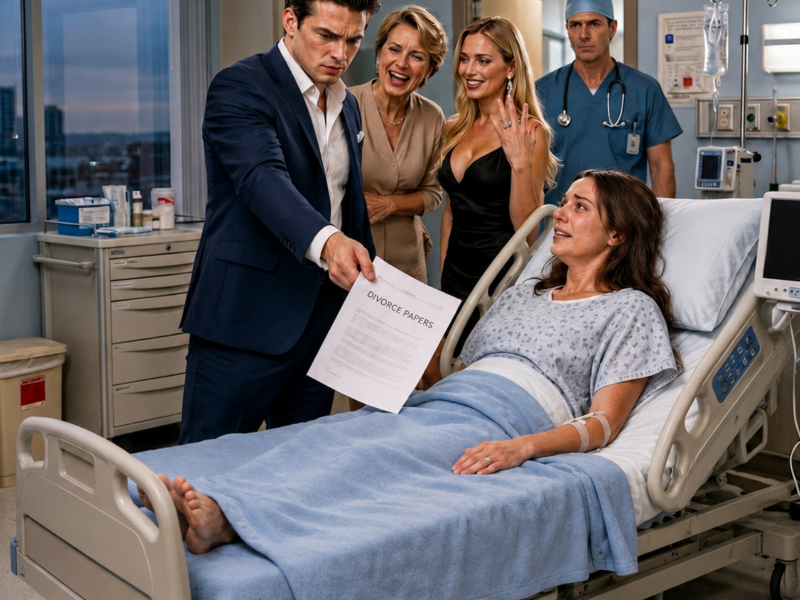
I Gave My Kidney To Save His Mother. He Dropped Divorce Papers On My Surgical Wound. Then…
Part 1: The Transaction
The anesthesia was a thick, suffocating fog, but the cold reality cutting through it was sharp as a scalpel. I was Breen Hale, thirty-one years old, and I had just emerged from seven hours of surgery. My left side felt hollow, an ache that radiated deep into my bones, a permanent reminder of the sacrifice I had made. I had given up a piece of myself, willingly, to save my mother-in-law.
Conrad Bennett, my husband, stood at the foot of my hospital bed. He wasn’t crying. He wasn’t offering comfort. He was wearing an impeccably tailored suit, his face set in a practiced, predatory smile. Beside him stood Sable, his executive assistant, the woman who had been lurking at the edges of our marriage for two years. She was wearing a diamond ring on her finger—the same finger where mine should have been.
Conrad didn’t ask how I was feeling. He didn’t ask if I was in pain. He reached into his jacket, pulled out a thick, heavy envelope, and dropped it directly onto my surgical site. The impact was electric, white-hot agony that stole the breath from my lungs.
“Sign it,” Conrad said, his voice as smooth and cold as polished marble. “We’re done, Breen.”
His mother, Georgiana, sat in a wheelchair near the door, wrapped in a cashmere throw, looking remarkably healthy for a woman who was supposed to be a renal failure patient. She actually laughed—a dry, brittle sound that echoed off the sterile tiles.
I was too weak to sit up, too shattered to process the betrayal. I looked at the envelope, then at the trio standing there like vultures in a boardroom. In that moment, the fog lifted, revealing the horrifying truth: the last three years hadn’t been a marriage. It had been a long-con transaction. I was never a wife; I was a donor. And I had no idea that just outside that door, a surgeon was about to walk in and dismantle the life they thought they had built.
Part 2: The Blueprint of a Lie
Before I was a donor, I was just Breen from Ohio, a woman who knew the weight of loneliness. I grew up in a place where people left their doors unlocked, but I learned early that doors don’t keep grief out. My father died when I was nineteen, and my mother followed two years later, simply letting go of a world that felt too heavy without him.
I moved to Chicago with nothing but two suitcases and a biology degree. I found work as a medical records coordinator. I was detail-oriented, reliable—the kind of person who fades into the background. I was building a quiet, safe life.
Then came the gala. Conrad Bennett was everything I was not: polished, affluent, and dangerously charismatic. He found me hiding by the windows and asked if I was hiding, too. It was a calculated trap, and I walked right into it. He spent months studying me, cataloging my favorite tea, the anniversary of my mother’s passing, the small, intimate details that made me feel “seen.”
I fell in love with a ghost. We married eleven months later. Georgiana never liked me; she looked at me like a placeholder. When her kidneys began to fail, Conrad came to me with tears in his eyes, framing a question as a selfless act of love. “You’re family, Breen. Would you consider being tested?”
I didn’t hesitate. I was the match. I was the fool. And as I lay in this converted storage room—a punishment for my utility—I realized I had been selected, not chosen. The door handle turned, and I braced myself. The game had changed, but I didn’t know how yet.
Part 3: The Anomaly
Dr. Whitmore walked in, his surgical scrubs a stark contrast to the opulence of the people who had just walked out. He looked to be in his fifties, with silver at his temples and the quiet, steady eyes of a man who held life in his hands every day. He didn’t stand; he pulled a chair up to my bedside.
“Ms. Hale,” he said, his voice dropping to a low, serious register. “I performed your procedure this morning. I need to tell you something before the Bennett family leaves this building.”
My heart hammered against my ribs. “What is it?”
“During the final pre-operative cross-match, we flagged an anomaly,” he said. “We ran the tests three times to be absolutely certain.”
He took a breath, and the air in the room felt heavy. “The kidney was transplanted successfully, but not into Georgiana Bennett. It was transplanted into a fourteen-year-old girl named Cassidy Ran. She’s been on the registry for three years. She was critical. Her body is accepting the organ without complication.”
I stared at him, my mind struggling to bridge the gap between his words and reality. “Then where is Georgiana’s?”
“She wasn’t transplanted,” Whitmore said, his face hardening. “When our system flagged the discrepancy in the compatibility reports—reports that appear to have been falsified—my team made an executive decision to redirect the organ to the next verified match. That was Cassidy.”
The word falsified hit me like a physical blow. They hadn’t just used me; they had committed a crime. And because they were greedy enough to forge the documents, they had lost the very thing they were trying to buy. My kidney hadn’t saved their socialite mother; it had saved a child.
Part 4: The Attorney’s Gambit
I had one phone call left in me before the adrenaline faded. I called Adrienne Marsh. She was my college roommate, and for the last four years, she had been a shark in the Illinois civil courts. She didn’t ask questions; she just listened to the raw, jagged facts. When I finished, she didn’t offer pity.
“Do not sign anything,” she commanded. “I’m on my way.”
Forty minutes later, she stormed into the hospital room like a force of nature. She took one look at the divorce papers on my chest and the check on my tray, and her expression turned to ice.
“Let me get this straight,” she said, her voice sharp enough to cut glass. “He scouted you for your biology, courted you for your compatibility, forged medical documents, and tried to pay you off while you were under the influence of post-operative medication?”
“Yes,” I whispered.
“The federal investigation into the fraud is already triggered by Dr. Whitmore,” Adrienne said, her eyes glinting with a dangerous excitement. “Conrad is done. He doesn’t control this narrative anymore. Now, we move to the civil side. The Bennett pharmaceutical empire is worth four hundred million dollars. You have three years of marriage on record. You are entitled to a seat at the table, Breen.”
“I don’t want his money,” I said, the truth of it surprising me.
“Then what do you want?” she asked.
I thought of the diamond ring on Sable’s hand and the cold, empty look in Conrad’s eyes. “I want them to pay. Publicly.”
Part 5: The Confrontation
We found them in the second-floor waiting area. Conrad was standing there, his composure finally beginning to fray. Sable was at his side, and Georgiana was near the window, clutching her purse.
Adrienne marched up to them, a stormfront in a tailored blazer. “Mr. Bennett,” she began, the sound carrying across the quiet room. She handed him a document—a notice of intent to file for fraud-based annulment and civil damages. “You will also note the federal matter. The Organ Oversight Board is currently reviewing your falsified documentation.”
Conrad’s jaw tightened. The polished mask he wore began to crack. “This is premature,” he stammered, his voice stripped of its warmth. “The settlement offer was generous.”
“Your client attempted to coerce a woman in post-operative recovery,” Adrienne countered, loud enough that a nurse nearby looked up. “That is not a settlement; that is a felony.”
Georgiana spoke up, her voice trembling with indignation. “You signed the consent forms! The donation was voluntary!”
“Consent obtained through fraud is not consent,” Adrienne shot back. “And a marriage entered under false pretenses specifically to harvest an organ is not a marriage—it’s a crime.”
I looked at Conrad. For the first time, he wasn’t looking at me like a business asset. He looked at me with raw, undisguised panic. The boardrooms and the press releases couldn’t save him from this. The hospital security guards were already moving toward us, and the legal compliance director was striding down the hall.
Part 6: The Unraveling
The fallout was swift and absolute. Within 72 hours, the federal investigation had confirmed that the documents submitted by the Bennett family were not just altered; they were a complete fabrication created by a private medical consultant who was now in handcuffs. Georgiana had never been a match. The entire orchestration had been a gamble that relied on me being too passive to fight back.
I spent the next several months in a blur of depositions and legal victories. Adrienne was relentless. She uncovered emails dating back four years, documenting their search for a “compatible donor with low social overhead.” They had tracked my movements, my blood type, and my vulnerabilities long before I ever met Conrad at that gala.
Cassidy Ran, the fourteen-year-old who had received my kidney, was recovering beautifully. Her mother sent me a letter—a simple, handwritten note that I kept folded in my wallet. She was going back to school. She was dreaming of being a marine biologist. Knowing that my sacrifice had been hijacked by monsters, only to be reclaimed by fate to save a child, gave me a strange, hollow sense of peace.
Conrad and Georgiana didn’t just lose money; they lost everything. Their reputation, their company, their social standing. The court cases were televised, and I sat through every single one, watching the man I had loved reveal himself to be nothing more than a hollow shell of greed. When the judge finally delivered the verdict, I didn’t feel triumph. I felt an overwhelming sense of finality.
Part 7: A New Beginning
I left Chicago eight months later. I didn’t move because I was running; I moved because I was finally ready to stop. I chose a small, quiet coastal town in North Carolina. It reminded me of Ohio, but the air here tasted like salt and new starts.
I took a position consulting for a nonprofit dedicated to protecting living donors. I spent my days lobbying for legal reforms that would prevent what happened to me from ever happening to anyone else. It was grueling work, but it was honest.
I am not “fixed,” and I don’t pretend to be. There are days when the silence of the house feels too heavy, and there are nights when I touch my side and feel the absence of what was taken. But I also have days where I walk along the beach and watch the tide come in, and I know that I am the one in control of my story now.
Cassidy Ran is going to college this fall. She sent me a picture of her in her scuba gear, grinning at the camera, completely unaware of the woman whose body made her future possible. And that is exactly how it should be.
I gave something away, yes. But in the process, I found that the version of myself Conrad had tried to destroy—the “fool,” the “donor”—was actually the strongest woman I had ever known. I am not the woman who walked into that hospital room three years ago. I am someone else entirely. And for the first time in my life, I am exactly who I was meant to be.