I Had to Share One Hotel Room With My Boss… And She Saw My Hidden Talent
Part 1
I was twenty-eight years old, functioning as a copywriter whose desk was situated dangerously close to the office printer. I possessed a deeply ingrained, miserable habit of apologizing before I even dared to share an idea with the team.
“This may be nothing,” I would inevitably say, shrinking back in my rolling chair. “Maybe this is far too simple. You can totally ignore this if you want.”
I thought it was harmless, a way to soften the blow of rejection. But Lauren Donovan—or rather, Lauren Hayes, as she was known before the complexities of her personal life fully bled into her professional one—hated that weakness with a quiet, smoldering intensity. I knew it because of what happened one Tuesday morning in the main conference room overlooking the slate-gray river.
I was halfway through pitching a campaign hook, already preparing my retreat, when she sharply raised a hand. The room went absolutely still.
“Connor,” she said, her voice devoid of any warmth but perfectly measured. “Never invite people to dismiss you before they’ve even had the chance to hear you.”
My face flushed instantly, burning hot enough that I could feel the heat radiating to my ears. I nodded quickly, like she had just handed me a binding legal document.
“Yes,” I stammered. “Sorry.”
Her sharp, unblinking eyes stayed locked on mine. “And don’t apologize for understanding the assignment, either.”
That was Lauren. She was sharp enough to cut glass, though the blade didn’t always land in the direction you expected. In her early forties, she was a commanding presence, always draped in clean lines, dark tailored blazers, and low heels. There was no wasted movement in her walk or her speech. As the managing director, she was the exact person high-paying clients asked for when they wanted the agency’s absolute best thinking. Conversely, she was the person junior employees actively avoided in the breakroom kitchen when they just wanted to complain about their workloads.
She knew when an advertising campaign had absolutely no spine. She knew when a glossy presentation deck was merely hiding a weak, meandering strategy under pretty slides and buzzwords. She knew exactly when someone in a pitch was pretending to be prepared. And for some reason—a reason I still don’t fully understand to this day—she picked me, the nervous copywriter by the printer, to accompany her to Milwaukee for an intensive overnight pitch.
The client was a massive national restaurant group desperately trying to rebuild its public image after years of looking like every generic airport bar in America. I had written the vast majority of the campaign language, but I had safely assumed one of the senior account directors would be the one to fly out and present it.
Instead, Lauren walked by my desk at 6:10 PM on a brisk Thursday evening, dropped a file folder on my blotter, and said, “Pack a bag. The train leaves at 7:30 tomorrow morning.”
I looked up from my glowing laptop screen, blinking in sheer disbelief. “Me? No, Connor, the person you actually want is behind me,” I muttered, starting to turn around before I realized she wasn’t joking.
The trip was tense from the very first second, mostly because I spent the entire time trying to act like a seasoned professional who traveled with managing directors on a whim. I did not. On the morning train, I opened my laptop, closed it, opened it again, and aggressively pretended to review notes I already knew by heart.
Lauren sat quietly beside the window, a printed copy of the deck in her lap, marking pages with a thick black pen. At one point, she didn’t even look over. “You can breathe at a normal rate, Connor. It won’t hurt the presentation.”
“I’m breathing normally,” I lied, my voice tight.
“You’re breathing like someone attempting to diffuse a bomb.”
I let out a single, high-pitched laugh that was entirely too loud for the quiet train car, then promptly shut my mouth and stared at the passing scenery. The meeting preparation later that afternoon ran incredibly late. The client suddenly wanted massive, sweeping changes. Then, to make matters worse, our lead designer called in with a debilitating migraine. By the time we finally reached our hotel that evening, I felt like my brain had been completely squeezed dry.
The lobby was an exercise in corporate design—soft, ambient lighting, fake tropical plants, and tired business travelers desperately pretending they weren’t exhausted. Lauren stepped up to the front desk to give her name. The clerk typed efficiently, smiled politely, stopped smiling, and typed again.
“I’m so sorry,” the clerk said, his brow furrowing.
Lauren didn’t even shift her weight. “For what?”
“There seems to be an issue with the reservation. We have one room under Hayes, but not two.”
I felt my stomach drop straight to my shoes.
Part 2
Lauren blinked once, processing the operational failure, then simply said, “Add the second room.”
“I would if I could, ma’am, but we are entirely fully booked,” the clerk replied, sweating under his collar. “There is a massive medical conference in town.”
I waited for the temperature in the lobby to drop ten degrees. I fully expected Lauren to ask for a manager, demand an impossible solution, or perhaps turn that poor, terrified desk clerk into literal dust with one of her razor-sharp sentences.
Instead, she remained completely pragmatic. “What kind of room do you have available?”
“Two queen beds. Clean.”
“Yes, ma’am. Then we’ll take it.”
My head snapped toward her so fast my neck twitched. She took the plastic key cards from the desk like this was no different from choosing a font size for a header. She turned to me, unbothered. “Connor, we have eight hours of heavy work left and a nine a.m. pitch. I trust we can both survive a room with two beds.”
“Right,” I managed to squeak out. “Yes, completely. Of course.”
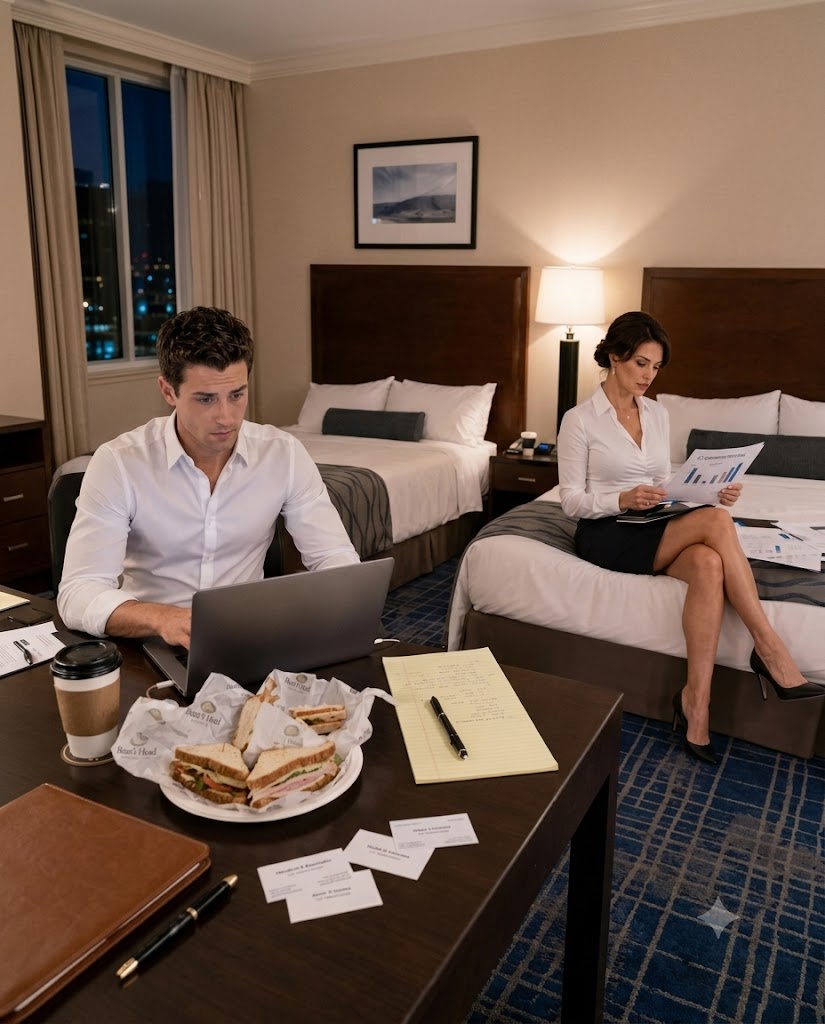
The elevator ride up to the floor felt roughly six years long. The room itself was utterly ordinary. Two beds, one narrow desk, a small armchair by the window, beige walls, a generic coffee machine, and the blurred city lights shining beyond the glass. Lauren rolled her sleek black suitcase to the far bed, placing her heavy leather laptop bag squarely on top of it.
“Ground rules,” she announced, shrugging off her blazer. “You take the desk first. I will review the financial slides sitting on the bed. No strange behavior, no dramatic discomfort, and absolutely no calling the office tomorrow and creating juicy gossip for people with too much free time.”
“I would never,” I said quickly.
She paused, looking right at me. “I mean, I definitely won’t.”
“Good.”
For the first hour, we worked like two people desperately trying to pretend the situation was not profoundly weird. I sat at the small desk, furiously adjusting headlines and tweaking sub-copy. She sat cross-legged on the far bed, her crisp white blouse unbuttoned at the collar, her sleeves pushed up to her elbows, critically reading through the strategy section.
That alone felt deeply strange. At the downtown office, Lauren Hayes never looked tired. She never sat cross-legged on a bed. She certainly never rubbed her eyes with the heel of her hand and muttered under her breath.
“This slide is lying to me,” she suddenly declared, breaking the silence.
I looked over my shoulder, my fingers hovering over the keyboard. “Which slide?”
“Slide nineteen. It says heritage-driven freshness. That means absolutely nothing.”
“I didn’t write that one.”
“I know. That’s why I said it out loud.”
A tiny, fleeting smile pulled at the corner of her mouth. It disappeared almost as fast as it arrived, but I caught it.
Around nine o’clock, she took charge and ordered sandwiches from a local deli down the street. There was no collaborative discussion about menus. “Turkey for me, grilled chicken for her, chips, two coffees,” she had dictated.
“How did you know what I wanted?” I asked when the brown paper bag arrived.
“You always get turkey from the deli downstairs from our building.”
“You noticed that?”
“I notice many things, Connor. It is, unfortunately, part of the job.”
We ate our dinner with the printed deck spread out between us. At one point, she pulled up old, rejected campaigns from the agency archive, the kind of embarrassing work everyone preferred to pretend never existed. One of them featured a disastrous slogan for a regional bank that boldly stated: Money, but friendlier.
I nearly choked on my lukewarm coffee. Lauren stared at the bright screen, her expression unreadable. “A room full of highly paid adults approved that.”
“Maybe they were under severe pressure,” I offered, defending the anonymous team.
“Pressure does not excuse Money, but friendlier.”
Then, she let out a sound. It was not a polite, calculated office laugh. It was a real one—quick, low, surprised right out of her. I looked at her before I could stop myself, my eyes wide.
“What?” she asked, catching me staring.
“Nothing. I just… I don’t think I’ve ever heard you laugh before.”
“That can’t be true.”
“At work? Not really.”
She looked back at the glowing screen, but something subtle shifted in her face. It wasn’t hurt, exactly; it looked more like she had just heard a painfully accurate description of herself from outside a locked door.
“Well,” she said, her voice growing noticeably quieter. “There are not a lot of hilarious budget meetings.”
The evening settled into an easier rhythm after that. We worked. We made the client language sharper, more human. She aggressively questioned every soft, evasive phrase I had written. I defended exactly two lines, and for the first time since I had met her, she actually let me win the argument.
Part 3
Around 11:30 PM, her cell phone began to vibrate against the nightstand. She looked at the illuminated screen, her expression hardening, and didn’t answer it right away. I tried my absolute hardest not to look, but I couldn’t help but see the caller ID flashing: Martin.
Her posture instantly changed. That is the only way I can explain it. There was nothing overtly dramatic, just a tiny, imperceptible tightening of her shoulders, like a heavy window slowly slamming shut against a storm.
She stepped toward the dark, tiled bathroom and finally answered, “Hi.”
I couldn’t hear his end of the exchange clearly. A man’s voice thinned through the speaker, carrying an edge of demand.
Lauren sighed, her tone sharpening. “No, Martin, I’m working.” Then, after a heavy pause, she added, “Because that is still what pays for the things you keep asking me to handle.”
I stared incredibly hard at the marketing deck on my screen, pretending to be deaf.
“No, Martin,” her voice remained perfectly controlled, though it was not cold—just profoundly, bone-weary tired. “I’m not doing this tonight. I understand. I always understand. That’s the problem.”
She ended the call abruptly and stood in the dim light of the bathroom for a long moment, staring down at the piece of glass in her hand like it was an artifact from a different life. I aggressively pretended to fix a misplaced comma.
When she finally emerged, she sat on the edge of her bed, but didn’t reach for her open laptop.
“Everything okay?” I asked, before my brain could stop the words. I cringed instantly. “Sorry, you don’t have to answer that.”
Lauren looked at me, and for the first time, she didn’t seem annoyed by my nervous apology. She looked far too tired to keep her corporate wall fully elevated. “My ex-husband believes urgency is the exact same thing as importance.”
I nodded slowly, letting the silence wrap around us. “That sounds exhausting.”
“It is predictable,” she said, looking past me toward the dark window. The distant city lights reflected faintly over her tired face. “People get used to you being capable. After a while, they stop asking what it costs you to be that way. They just keep handing you more.”
I didn’t know what to say. At the agency, Lauren Hayes was the person who handed more to everyone else. More revisions, more probing questions, more impossible standards. But sitting in that beige hotel room, with one untouched sandwich wrapper on the desk and her designer shoes lined up perfectly by the door, she didn’t look like an ice queen. She looked like someone who had been useful for so long that the world entirely forgot she was also flesh and blood.
That was the first time I genuinely wondered if all that bristling distance wasn’t arrogance at all. Maybe it was armor. Maybe everyone, including myself, had been far too scared of her sharp edges to ever notice what they were actually protecting.
I slept very badly. It wasn’t because anything dramatic happened—nothing happened at all. Lauren took the queen bed closest to the window, and I took the one near the bathroom. Between us sat a small nightstand holding a lamp. Neither of us wanted to be the first to turn it off. We said good night like two terrified co-workers trapped in a very boring HR compliance training video.
Still, every single time I woke up in the dead of the night, I was jarringly reminded of where I was. At 6:15 AM, I snapped awake to the sharp, metallic sound of a zipper.
Lauren was already fully dressed. Her hair was immaculate, her makeup perfectly applied, and her dark blazer hung neatly on the back of the chair. She looked exactly like the formidable woman from the Chicago office again, except for one detail: she was standing barefoot by her suitcase, quietly eating a granola bar over the plastic trash can.
“Morning,” she said, without looking up from her wrapper.
“Morning,” my voice croaked, sounding like a gravel road.
I sat up entirely too fast and immediately bashed my kneecap against the sharp wooden edge of the bed frame.
She glanced over, her mouth twitching. “Strong start.”
“I’m fine.”
“I wasn’t worried.”
That almost made me smile through the pain. By 7:00 AM, the mundane hotel room had been effectively converted into a high-stakes command center. Empty coffee cups littered the desk, laptop chargers were hopelessly tangled together across the floor, and printed strategy notes were scattered across both beds.
I was desperately trying to export the final, updated deck while Lauren stood by the window, on the phone with the client’s administrative assistant to confirm our arrival time.
Then, my laptop froze. It didn’t just slow down or hesitate; it locked up completely, the spinning wheel of death mocking my rising blood pressure. I clicked the trackpad once. Nothing. I clicked it again, like that had ever helped anyone in the history of computing.
Lauren ended her call and turned around. “What happened?”
“It’s just… thinking. The file may be stuck.”
Her expression did not change, but I could physically feel the air in the entire room tighten. I was forced to hard-quit the program and anxiously reopen it. The presentation file popped up, loaded halfway, and then presented me with a terrifying gray error box.
The presentation file is corrupted. Lauren walked over, her heels clicking softly. “Comment fast. Is there a backup in the shared server folder?”
“Yes. Opening it now.”
I pulled up the backup. It was from yesterday afternoon—before all the extensive changes we had brilliantly hammered out in the hotel room. The sharper headlines were gone. The revised, punchy flow was completely missing. The client-specific examples had vanished into the ether.
Before either of us could formulate a response, Lauren’s cell phone buzzed again. She looked down at the screen, her eyes darkening.
“Our senior designer is out,” she said flatly.
“With what?” I asked, dread pooling in my stomach.
“Food poisoning, of course. And the clients just moved their arrival time up. They are arriving at 8:30 instead of 9:00.”
Part 4
My body went instantly cold in that very specific, sickening office way where a problem is fundamentally professional, but still feels like it is landing a physical blow directly to your chest. I stared at the clock on the nightstand: 7:42 AM.
“I can rebuild the language,” I said quickly, already furiously opening the outdated file, my fingers flying. “Maybe not all of it, but—”
“You can rebuild the argument, Connor,” Lauren interrupted, her voice cutting through my panic.
I stopped, looking up at her in confusion. “What?”
“The language matters, yes, but the argument matters infinitely more. We know the story. We know exactly what they need to believe by the end of the deck.”
She pulled the wooden desk chair right beside me and sat down, rolling up her sleeves. For the next thirty minutes, she moved with the cold precision of a skilled surgeon. There was no panic, no dramatic speeches, no throwing of hands. She clinically told me which slides to save, which ones to ruthlessly cut, and which visual pieces to rebuild entirely as vocal talking points instead of fancy graphics.
By 8:20 AM, we were standing in the glass-walled conference room at the client’s corporate office. The deck was still technically missing two major sections, but the framework was intact. The room was intimidating—a long walnut table, entirely too much glass, and a sprawling, panoramic view of downtown Milwaukee that neither of us had the peace of mind to appreciate.
Their executive team started walking in while I was still frantically arranging printed notes in front of my designated chair. Lauren stood at the head of the table, composed and untouchable as ever. I fully expected her to take over the entire presentation. It was the only logical move. She was the veteran managing director, the feared Lauren Hayes. I was just the junior copywriter who still habitually prefaced ideas with Maybe this is too simple.
Instead, right before the client’s CEO sat down, she leaned over the table toward me. “You’re leading the voice section.”
I stared at her, my eyes wide. “Lauren, the slides aren’t—”
“You wrote it?”
“Yes, but—”
“Then speak like you understand it.”
My mouth went completely dry. I wanted to argue, to say No, Connor, to hide in the hallway vending machines, but she had already turned away to greet the incoming clients with a warm, disarming smile.
The meeting began with Lauren doing what Lauren did best. She masterfully set the frame. She made the restaurant group’s public image problem sound clear, urgent, and imminently solvable. She did not mention the corrupted file. She did not apologize for the thinner visuals. She wielded every simple slide like it was an intentional choice.
Then, she smoothly pivoted. “Connor is going to walk you through how this brand should actually sound when it speaks to the public.”
Every face at the table turned to look at me for one agonizing second. I nearly stepped outside of my own body. I saw the room the way I always saw rooms filled with power—older people, better titles, expensive watches, clean leather notebooks, all silently waiting for me to prove that I didn’t actually belong there.
My default, cowardly instinct was to soften myself before anyone else could do it. This may not be perfect, I wanted to say. This is just a rough thought you can ignore. But Lauren was standing beside the projection screen, casually watching me with a look that suggested she already knew I would not fail. So, I swallowed hard and started talking.
It wasn’t perfect. My very first sentence came out entirely too fast, tripping over itself. I had to physically stop, take a deep, stabilizing breath, and begin again. But then, I found the thread. I found my footing.
I told them their brand had been speaking like a terrified company trying desperately to be liked by everyone at once. I told them people did not need another casual restaurant chain pretending to be their over-enthusiastic best friend. They needed clarity. They needed warmth without fake excitement. They needed confidence without corporate gloss.
The CEO leaned forward, his elbows on the walnut. Their marketing director actively scribbled something down in a notebook. I kept going.
At one point, a sharp man from their corporate finance department aggressively challenged a line I had written for the campaign hook: Good food, no performance.
“That sounds almost too plain,” the finance guy scoffed. “A bit amateurish.”
My chest instantly tightened. The old me was ready to immediately back away from the line, to apologize and offer an alternative. But before I could open my mouth, Lauren spoke.
“Plain is not the same as weak,” she said, her tone perfectly level. “That line works because Connor understood something this entire industry consistently misses. Customers are tired of being shouted at.”
She looked at me, giving me the floor. I picked it up, riding the wave of her absolute conviction. By the time I wrapped up, the atmosphere in the room had fundamentally changed. You could physically feel it. The clients were asking better, deeper questions. They were testing the validity of the idea, not looking for ways to dismiss it.
When the CEO finally closed his heavy notebook and said, “This is the first version of a campaign that actually sounds like us,” I had to stare down at my printed papers so I wouldn’t grin like an absolute idiot.
Part 5
Afterward, riding down in the glass elevator, Lauren said absolutely nothing. I managed to last about eight floors before my anxiety cracked my resolve.
“Was that… okay?” I asked, breaking the silence.
She turned her head slowly, her expression neutral.
I hastily tried to correct myself. “No, sorry. I mean, Connor, shut up, you’re doing it again.”
The elevator doors chimed and slid open. Lauren stepped out into the lobby. “It was more than okay, Connor.”
That was all she said, but the simple acknowledgment landed harder and meant more than a glowing paragraph of formal praise from anyone else at the agency.
Our return train back to Chicago was delayed for almost two hours. The central station was crowded, brightly lit, and full of irritable commuters aggressively pretending not to be annoyed by the infrastructure failure. Lauren checked the electronic departure board once, then pointed elegantly toward a small, quiet cafe situated near the far end of the concourse.
“We wait there,” she directed.
She bought two coffees before I could even fumble for my wallet. We sat down at a tiny, rickety table with notoriously uneven legs. For a long while, neither of us talked about the triumphant client meeting. I watched weary commuters drag heavy bags across the polished floor. Lauren methodically answered three urgent emails, then resolutely closed her laptop like she was physically forcing herself to unplug.
At the adjacent table, an elderly man was visibly struggling with his smartphone. He kept jabbing his trembling finger against the dark screen, looking around the bustling station with an expression of deep, humiliating frustration—the look of a man who absolutely hated needing assistance from strangers.
Dozens of busy people kept walking past him without a second glance. Lauren noticed him before I did.
She stood up seamlessly, walked over to his table, and said, “Are you trying to find your digital train ticket?”
The man looked embarrassed, his cheeks pinkening. “My daughter sent it to me yesterday, but now it’s completely vanished. I’m sorry to bother you.”
“It’s not gone. It’s just hiding.”
She took his phone only after he gratefully offered it. Within seconds, she navigated the inbox, located the buried email, enlarged the barcode to maximum brightness, and systematically showed him how to save the pass directly to his digital wallet. Her voice was incredibly calm, clear, and infinitely patient—a tone I had never once heard her use inside the aggressive, posturing walls of a corporate conference room.
“There,” she smiled, handing it back. “Now it can’t run away from you.”
The old man laughed warmly. “You’re an absolute lifesaver, young lady.”
“Just organized,” she said smoothly, walking back to our wobbly table as if she hadn’t just rescued a stranger’s day.
I stared at her, my eyebrows raised. “What?”
“What, Connor?” she asked, taking a sip of her dark coffee.
“You didn’t make him feel stupid for not knowing how to use a phone.”
Her face shifted slightly, the corporate armor slipping. “Why on earth would I do that?”
“A lot of people in our world do. Especially when they’re in a rush.”
She stared into the dark liquid of her paper cup for a long second. “My father hated asking for help near the end of his life,” she said, her voice dropping into a register meant only for me. “Not because he was proud, though he was. But because people became aggressively loud when he didn’t understand something… as if volume was a synonym for kindness.”
I didn’t know that about her. Nobody at the Chicago office knew personal, vulnerable things like that about Lauren Hayes. She kept her eyes fixed on the cup.
“Efficiency became a very useful tool for me,” she continued softly. “Professionally, it made people stop testing every single administrative decision. It made the conference rooms move much faster. And personally…”
A wry, sad smile lifted her mouth, but it did not reach her eyes. “Personally, it made people assume I didn’t need much of anything at all.”
The ambient white noise of the busy train station filled the quiet space between us. I thought about the tense, late-night phone call in the hotel room, the way she had confessed that people just kept handing her more burdens. I thought about that Milwaukee meeting room, and how she had handed something to me, too—but completely differently. She hadn’t handed me a burden; she had handed me a chance.
“I don’t think I’ve ever had someone do that before,” I said quietly, looking down at my hands. “Help an old man with a ticket… no, I mean, trust me. Before I was entirely sure I even deserved it.”
Lauren looked at me, holding my gaze with an intensity that didn’t soften, but rather validated. “Confidence is not a personality trait, Connor,” she said, her voice carrying the weight of a decree. “It is often just evidence. Someone lets you stand where it actually matters, and you survive it. Then, and only then, your brain has the necessary proof.”
I sat heavily with those words. Outside the frosted cafe window, our delayed train finally appeared on the departures board. It was late, but it was coming.
For the first time in my professional life, I didn’t feel like an imposter desperately sneaking into a boardroom where everyone else belonged more than I did. I had stood right there in front of the critical clients with Lauren Hayes beside me, and I had not disappeared. And the strangest, most comforting part was that she didn’t seem surprised by it at all.
Part 6
Back at the agency, I fully expected everything to magically return to the status quo. That was what made logical sense in the rigid hierarchy of corporate advertising. The trip had been an anomaly, made weird and intimate by the shared hotel room, the corrupted presentation deck, the cancelled flights, and far too many cups of bad station coffee.
Once we were securely back in the glass-and-steel offices of West, Bridge, and Cole, Lauren would inevitably revert to the unapproachable Ms. Hayes. I would inevitably sink back into being ‘Connor from Copy’, and whatever intangible shift had occurred between us would quietly file itself away as a fond, unspoken memory.
At least, that was what I told myself all weekend.
Come Monday morning, I walked into the weekly strategy meeting with my leather notebook, took my usual strategic seat near the far, dark end of the walnut table, and actively tried to make myself small enough not to bother anyone.
Lauren entered the room last. The entire space instantly straightened without anyone even meaning to do it. That was simply the gravitational pull of what happened when she walked through a door. People reflexively closed their open laptops. Someone stopped whispering mid-sentence. Mark from Accounts actually sat up straight, looking guilty, like a schoolteacher had just caught him chewing gum in the back row.
Lauren placed her thick folder at the head of the table and scanned the room. “Before we dive into the retail docket, Connor will walk us through the voice direction that successfully landed the Granger Foods account in Milwaukee.”
I froze, my pen slipping from my fingers. Across the walnut, two senior copywriters turned their heads and looked at me like I had just stolen something valuable off their desks. I glanced desperately at Lauren, waiting for her to clarify, looking for some sort of executive escape route.
She only opened her notebook and looked at me expectantly. So, I talked.
At first, I sounded stiff and overly rehearsed. I could hear myself doing it, utilizing safer, corporate-approved words instead of the raw copy I wanted, desperately trying to sound impressive instead of clear.
Then, Lauren mercifully interrupted me. “Not the polished version, Connor. Give us the useful version.”
A few people shifted uncomfortably in their ergonomic chairs. I looked down at my scribbled notes, and then, taking a leap of faith, I closed the notebook entirely.
“The client is tired of sounding like they’re begging to be liked by suburban focus groups,” I said, my voice dropping the fake pitch cadence. “So, we stopped writing like empty hype is a legitimate strategy.”
Lauren’s black pen made a single, decisive stroke across her crisp paper. That was all she did, but somehow, it gave me all the oxygen and room I needed.
Things changed in ways nobody officially announced over the following weeks. Lauren started actively asking for my opinion in high-level meetings before the room had already collectively decided what it thought. She did not praise me in a big, theatrical way—she never leaned back and said, “Great job, Connor,” like a cheesy manager in an instructional video. She simply carved out a vacancy in the conversation and expected me to step up and fill it.
“What does Copy think?” she would say. Not, Does anyone from Copy have a quick thought? Not, Connor, can you maybe add some generic color to this? Just… Connor. The first few times she did it, the room looked profoundly surprised. Then, they looked visibly annoyed. Then, slowly, painfully, the veterans started looking at me before they finished formulating their own opinions.
That was almost harder than being blissfully ignored. When no one expects anything from you, hiding behind a desk is easy. When someone wielding absolute power acts like your voice unequivocally belongs in the room, you are forced to make a choice: you either step aggressively into the intimidating light, or you reveal to yourself that you were far more comfortable being overlooked than you ever wanted to admit.
Lauren absolutely did not let me hide.
One Thursday night, the eighth floor was nearly deserted, save for the hum of the fluorescent lights from the editing bays and the night janitorial crew lazily moving vacuum cleaners down the distant hall. I was still at my desk, aggressively striking out taglines for an obstinate healthcare client who kept demanding ‘human warmth and empathy’ and then rejecting every single human sentence we pitched them.
Lauren passed right behind my chair, her heavy wool coat draped over one arm. “Why are you still here, Connor?”
I looked up, trying to stretch my cramped shoulders, attempting to make my messy desk look less like it was managed by a committee trapped in an elevator.
She leaned over the back of my chair, looking directly down at the glowing monitor. For a second, I was hyper-aware of how close she was. There was nothing dramatic about it—it was simply the clean scent of her expensive coffee, the crisp edge of her tailored sleeve near my shoulder, and the stark realization that outside the sterile conference rooms, she was just a person who also stayed far too late at the office.
“This line,” she said, her manicured finger pointing to a deleted block of text. “Bring it back. Keep it. That one.”
“I don’t know,” I muttered. “I thought it was too quiet.”
“It’s honest. And quiet and weak are categorically not the same thing.”
I eagerly hit save on the document before I could talk myself out of it. She started to walk away, then hesitated, her heels clicking to a halt. “Have you eaten real food today?”
“Technically, I had three stale pretzels from the vending machine at 4:00 PM.”
“That is definitively not dinner.”
“I didn’t say it was a particularly proud moment in my adult life.”
“Come on.”
Ten minutes later, we were sitting in the small, under-utilized kitchenette near the west windows, quietly eating takeout noodles from cardboard cartons while the Chicago skyline blinked a dizzying array of lights across the dark river. She stood as she ate, because she maintained that sitting for more than an hour made her mentally useless. I sat on the high marble counter, desperately trying not to act amazed that this surreal moment was actually happening.
She casually asked about my mother’s health. I almost answered too quickly, because I had not expected her to even remember the medical leave I had taken.
“She’s doing better,” I said, swirling my chopsticks. “Physical therapy is kicking her ass, which probably means it’s working. She hates it.”
Lauren nodded knowingly. “And you’re still driving out to Naperville to see her on Sundays?”
“Most Sundays, yes.”
“Good.”
That single, simple word did something strange to my chest. It wasn’t an emotional explosion; it was because it was so deeply exact. She had remembered a domestic detail I had only offhandedly mentioned once, months ago, during a brutally late edit review when I was sleep-deprived enough to drop my guard.
A few weeks later, I found out by pure happenstance that she had remembered and acted upon far more than just casual conversation.
My mother had been recovering from a highly invasive hip surgery the previous winter—right before the Milwaukee trip. Before any of our breakthroughs, I had been barely functioning, surviving on three hours of sleep, taking frantic calls from surgeons, missing critical campaign deadlines by hours instead of days, and pretending everything was fine because I was utterly terrified of being labeled unreliable by management.
HR had quietly approved an emergency extension of my leave. There was no big meeting, no awkward sympathy, just a sterile, automated email saying my workload had been temporarily adjusted. Then, on two separate bleak Fridays, high-quality groceries unexpectedly arrived at my mother’s apartment—gourmet soup, fresh fruit, artisan bread, tea, and the exact brand of low-sodium crackers she uniquely preferred.
My mother had assumed I ordered them. I had naturally assumed my sister had arranged it. Neither of us had.
I discovered the truth entirely by accident. I was standing in the back of the print room waiting for a thick deck to bind when I overheard Mark from Accounts talking to Jenna from Finance near the copier.
“I still don’t get why Hayes protected him,” Mark was saying, his voice carrying a bitter edge. “The board explicitly wanted him gone last year. Too distracted, too slow, whatever. She acted like he was some rare, undiscovered creative talent.”
My hand froze on the warm plastic lid of the copier.
“Jenna said…” Mark continued.
“Said what?” Jenna asked.
“Said that cutting a copywriter going through family strain would be ‘lazy management’. Those were her exact words. Can you believe it?”
I stood completely frozen behind the partition, not breathing right.
Mark let out a derisive, quiet snort. “Must be nice having Saint Lauren Hayes personally decide you’re worth saving from the chopping block.”
I quietly backed out of the print room before they could turn around and see the blood draining from my face. For the remainder of the afternoon, I couldn’t focus. Every meeting felt like it was occurring underwater. Every sentence on my screen looked like it belonged to a total stranger.
The board had actively wanted me fired. Lauren had known about it. Lauren had unilaterally defended my desk, and she had never once held it over my head, never used it to extract groveling gratitude.
Part 7
That evening, driven by a storm of conflicting feelings, I found her in Conference Room 3. She was alone, surrounded by towering stacks of investor reports and financial notes. The agency was under intense pressure that month; a massive retail client was actively threatening to jump ship to a rival firm, and everyone above a certain title looked like they were sleeping with one eye permanently pried open.
I stood silently in the doorway. She didn’t look up from her paperwork. “If that is the revised Harper deck, put it on the side table, Connor.”
“It’s not.”
Her black pen paused over the paper. She finally looked up, and I could tell by the guarded set of her face that she already knew what kind of ‘something’ I was carrying.
“I heard something in the print room today,” I said, the words heavy. “About last year. About the board wanting me out.”
The empty conference room went very, very quiet. She slowly set her pen down and deliberately closed the leather folder in front of her. “That was not meant to reach you through the office grapevine.”
“So, it’s true.”
“Yes.”
I tried to let out a short, dismissive laugh, but it came out sounding like a choked gasp. “Wow. I mean, it makes sense, right? I was missing deadlines. I was distracted. I probably looked like a terrible bet for the agency.”
“You looked like a person under severe, unyielding strain,” she corrected.
“That’s a very generous word.”
“That is an accurate word.”
I looked down at the polished mahogany table, because looking directly into her piercing eyes felt infinitely harder. “Why didn’t you tell me? Why keep that from me?”
“Because professional support should never be weaponized into a psychological debt,” she said, her voice rising—calm, but firm as iron. “The moment someone feels they have to perform groveling gratitude to justify their employment, the support loses its value. You were talented. You were also tired, terrified, and apologizing for taking up basic oxygen.”
She leaned forward, resting her folded hands on the table. “Terminating your contract at that juncture would have been easy. It also would have been fundamentally wrong.”
My throat tightened, hot and painful. “You sent the groceries to my mother, too, didn’t you? The soup, the tea…”
Lauren leaned back slightly, her expression unyielding. “Your mother needed basic care. And you were far too proud to ask the agency for help.”
“I wasn’t proud.”
“No, you were deeply ashamed. There is a vast difference.”
That landed far too close to the bone. I pulled out a chair and sat down directly across from her without even asking for permission. For once, she didn’t reprimand me by stating the conference room was not an employee lounge.
“All this time,” I whispered, “I thought I was one bad week away from being permanently found out as a fraud.”
“You were one supported year away from becoming exceptionally better at your craft.”
I looked up. She held my gaze, steady and unflinching, refusing to soften the blow too much. That was the beautiful, terrifying essence of Lauren. Even her radical kindness was delivered with a perfectly straight back.
“Confidence grows in supported people,” she said quietly. “Not coddled people. Supported. There is a canyon of a difference between the two. I gave you the physical room to breathe, Connor. You still had to sit at the desk and do the hard work.”
I nodded slowly, unable to speak right away, because suddenly I could view the entirety of the past year through a completely new lens. The sudden leave, the surprise deliveries, the meetings where she would effortlessly cut off senior suits who tried to talk over me. The quiet ways she ensured I got byline credit on major campaigns and publicly corrected anyone who treated my drafts like they had magically appeared out of nowhere.
She had been engineering my salvation for far longer than I had ever comprehended. She did it without fanfare, without looking for a pat on the back, without the superficial warmth people usually expect from a savior.
And maybe that was precisely why it meant everything. She had witnessed the absolute weakest, most pathetic version of my life, and she had resolutely refused to treat it as the final version of who I was.
When I finally stood up to leave the conference room that night, the eighth floor was cast in deep shadows. My reflection moved beside me through the expansive glass walls—tie slightly loose, laptop tucked securely under one arm. I was still the same person, yet not the same person at all. I had spent my entire adult life falsely believing that ironclad confidence would arrive only when I finally became an impressive enough figure.
Lauren had done something far stranger, and far more profound. She had treated me like I mattered long before I had any tangible proof that I did. And now, piece by agonizing piece, I was finally starting to believe her.
Part 8
The biggest, most lucrative contract West, Bridge, and Cole had ever secured in its history started with a single sentence I almost permanently deleted.
It was a massive, high-stakes pitch for a national homegoods chain that was looking for a complete corporate rebrand. We weren’t just talking about a visual refresh, a new pastel color palette, and a softer, rounded logo; this required a full, top-to-bottom brand repositioning. The kind of account that could radically alter the agency’s revenue for the next five years, and finally make everyone on the partner’s floor start speaking in much calmer, relaxed voices for once.
I had written one particular line in the preliminary draft that felt dangerously, embarrassingly simple: Make room for real life. I stared at the four words on my screen for twenty straight minutes, my cursor blinking rhythmically, preparing to do what I had done a thousand times before. I hovered my finger over the delete key.
Lauren was casually walking past my desk, carrying a stack of billing files, when she suddenly stopped in her tracks. “Don’t.”
I looked up, startled. “You don’t even know what I’m about to delete.”
“I know the panicked trajectory of your posture, Connor.”
“It’s disturbing how well you read me.”
“It’s useful. Show me the screen.”
I turned the laptop slightly toward her. She read the four-word sentence once, her eyes scanning the simple syntax. “Keep it.”
“It might be too plain,” I argued, my old anxieties surfacing. “They’re paying millions, they want fireworks.”
She gave me that look—the unblinking, commanding look that usually signaled the end of a debate.
I sighed in defeat. “I know. Quiet and weak are not the same thing.”
“Good,” she said, a ghost of a smirk touching her lips. “Endlessly repeating my own managerial maxims back to me is not technically professional growth, but in this isolated case, I will happily allow it.”
That short line became the thematic spine of the entire creative pitch. Two weeks later, we were standing in the largest, most prestigious conference room at the agency—the one featuring the massive walnut table and the complex projection screens that never worked correctly until someone from the IT department came in and dramatically sighed at them.
The client team had flown in from three different regional hubs. The partners were impeccably polished, highly cynical, and profoundly nervous. I was not entirely calm—far from it. But I was no longer trying to physically shrink down and disappear inside my navy blazer.
Lauren stood at the front of the room, in command as ever. But knowing her as intimately as I now did, I could finally pick up on the tiny, human tells. The way she briefly flexed her manicured fingers once before launching into her opening remarks. The way she glanced toward the window when she needed half a second to recalibrate. The way her gravelly voice dropped an octave and became even softer when the room mattered most.
She flawlessly opened with the high-level strategy. Mark elegantly handled the complex financial metrics. Jenna confidently walked them through the multi-platform media planning.
Then, seamlessly, Lauren turned. “Connor will take you through the brand voice.”
There was no warning given. There was no apologetic preamble explaining to the executives why a relatively junior copywriter was suddenly speaking during the single most important pitch of the year. There was only my name, firmly placed in the center of the room like it had lived there for a decade.
So, I stood up.
I didn’t use a laser pointer. I talked about homes that were messy without being absolute failures. Kitchens cluttered with opened mail piled on the counters. Sofas that proudly held sleeping dogs and heaps of unfolded laundry. Families that did not need a sterile brand to shame them into chasing an impossible, glossy perfection.
The client’s old messaging had made every living room look ready for a high-end magazine. I told them we wanted to make it feel ready for actual human beings.
When I confidently delivered the line, “Make room for real life,” the cavernous room went utterly still in the best possible way. The female CEO stopped taking notes, looked up at the big screen, and slowly turned her gaze to Lauren.
“That’s it,” she said quietly, breaking the trance. “That is exactly what we’ve been trying to articulate to our shareholders for five years.”
We officially won the account three days later.
The agency reacted like someone had finally thrown open a massive window after a long, stifling winter. People openly laughed louder in the hallways. Someone smuggled champagne into the eighth-floor kitchen at 4:00 PM, and Lauren pretended not to notice until she eventually accepted half a glass from Jenna with a polite nod.
That evening, the entire agency staff gathered near the sweeping main floor staircase. Lauren stood exactly one step above everyone else. Not because she craved dramatic attention, but because the acoustics of the atrium meant it was the only way the employees crammed in the back could physically hear her speak.
“I know everyone here wants me to stand up and say this massive win proves we are inherently smarter than the other Madison Avenue firms,” she said, projecting clearly.
A few people chuckled appreciatively.
“We are not always smarter,” she stated, her eyes scanning the crowd. “But we were significantly clearer. We listened better. We actually trusted the creative work long before it looked superficially impressive to an auditor.”
Her sharp eyes moved across the sea of employees, and they landed on me for only a fraction of a second, but it was enough to anchor me. “True leadership,” she concluded, “is not the art of making yourself permanently necessary to the machinery. It is the art of making other people believe they matter enough to do their very best work.”
No one made a joke after that. For the first time, the broader office caught a fleeting glimpse of the profound, complete Lauren I had been seeing in private fragments. She wasn’t necessarily warmer, exactly; rather, she appeared more whole. She was still formidable, still precise, but human in a way that no one in the industry could easily dismiss or overlook.
Part 9
Three months after the homegoods triumph, London unexpectedly called.
It was an overture from an elite, boutique creative agency that was fast growing, offering a highly coveted Creative Director role. It meant a much bigger title, vastly larger international clients, and a significant increase in professional risk. It was the precise echelon of career opportunity I used to unthinkingly assume belonged exclusively to men who aggressively spoke first in every meeting and never for a single second checked to see if their ideas were ‘allowed’ to take up space in the industry.
I sat with the official offer email open on my desktop for two solid days, paralyzed by indecision. Then, taking a deep breath, I walked straight into Lauren’s corner office, tapped on the open glass door, and said, “I need your professional advice.”
She didn’t look up immediately from a vendor contract she was reviewing. “You got the London offer.”
I blinked, my jaw dropping. “How on earth could you possibly know that?”
“They quietly called me for a formal reference check yesterday morning.”
“And you didn’t think to give me a heads-up?”
“It was your news to process, Connor. Not mine to preemptively manage.”
I walked in and sat heavily in the leather client chair, my hands feeling intensely restless. “I don’t know if I should accept it. It’s a huge leap.”
“You should take it,” she said immediately.
I hated how fast and unbothered she was by the prospect of losing me. “You haven’t even asked me about the financial details or the relocation package.”
“I know the details,” she said, finally looking up with a wry expression. “I asked their managing partner much better, more probing questions during the reference call than you probably did.”
That made me let out a nervous laugh, but the humor faded quickly. “What if I get over there and I’m simply not ready for it? What if I fail?”
Lauren leaned back in her high-backed chair, steepling her fingers. “You are categorically not ready for every operational part of that job. No sane executive ever is. But you are profoundly ready for the creative stretch.”
I looked slowly around her immaculate office—the perfectly aligned books on the shelves, the framed campaign awards on the wall, the expansive view of Chicago sprawling behind her, looking gray and brilliantly bright at the exact same time.
“It feels wrong leaving you now,” I admitted, my voice dropping. “After everything. After you went out on a limb and backed me when no one else would.”
Her calm face changed just a little, a flicker of disappointment crossing her features. “Connor,” she said, her tone carrying an edge of warning. “I am your manager. I am emphatically not your owner.”
I looked down at my lap, chastised.
“If my professional support only taught you to stay safely anchored where I can continually see the positive result,” she continued, her voice softening but remaining firm, “then I have utterly failed as a director.”
“You didn’t fail.”
“Then don’t make me act like you did by shrinking back.”
That was Lauren, distilled to her core. Even her difficult, loving goodbyes came hand-in-hand with an uncompromising standard.
On my final Friday at the agency, she didn’t orchestrate a superficial cake-cutting ceremony or make an embarrassing speech about my tenure. She would have universally hated that, and honestly, so would I. Instead, she efficiently corrected Mark from Accounts when he tried to deceptively take credit for my client transition plan, swiftly approved my final corporate expense report in six uninterrupted minutes, and casually left a small, unadorned black notebook sitting on the center of my cleared desk.
Inside the front cover, written in her unmistakable, sharp handwriting, was a single, commanding line:
Confidence grows in supported people. Now go support someone else. I carefully packed that black notebook into my carry-on bag and carried it all the way across the Atlantic to London.
Part 10
The years in the UK passed significantly faster than I ever anticipated.
I adapted to the frantic pace of the London advertising scene. Over time, I evolved from the anxious copywriter by the printer into the person standing confidently at the front of the creative rooms. I learned the hard way how to ruthlessly question weak, lazy work without making young, vulnerable creatives feel small or entirely worthless in the process. I learned how to give credit loudly in public, and deliver necessary, piercing corrections quietly in private.
I did not always get it right. There were difficult weeks where I heard my own rising impatience echoing the ghosts of managers past, and I had to physically pull my critiques back before they became someone else’s unmanageable burden. But Lauren’s steadfast voice never left the back of my mind.
One bleak, rainy Thursday afternoon, a painfully junior writer named Miles timidly entered my corner office. He was holding a campaign pitch printed on two crooked, poorly stapled pages. He stood awkwardly by the closed door like he was actively preparing to apologize for the sheer audacity of existing in my presence.
“This… this may be nothing,” he mumbled, looking at the carpet.
I felt the profound weight of the past immediately move through the quiet room. Miles looked to be about twenty-six years old—nervous, clearly talented, and already desperately trying to make himself much easier for the world to reject.
I pointed to the leather chair opposite my desk. “Sit down.”
He jumped slightly, then sat. I took the crooked pages from his trembling hand and read through the messy pitch. It was rough, entirely too scattered in places, clearly terrified of its own premise, but beating underneath the flawed text was something undeniably alive.
Miles started talking far too fast, preemptively building his own defense. “You can absolutely ignore it. I know it’s probably not senior enough for this tier of client, and I’m probably missing the core demographic entirely, so—”
“Miles,” I interrupted.
He stopped his nervous rambling, his eyes going wide.
I leaned forward, placing my elbows on the mahogany. “Never invite people to dismiss you before they have even had the chance to hear you out.”
His face went perfectly still, processing the unexpected instruction.
For a surreal fraction of a second, I was magically transported back to Chicago—sitting in a glass conference room over the river, with Lauren Hayes looking at me like I was actively wasting something precious every single time I tried to make my existence smaller.
I tapped the junior writer’s crooked pages with my pen. “This core hook works beautifully,” I said, offering a reassuring nod. “We build the real campaign from here.”
He looked down at his paper, and then looked back up at me like he was desperately trying to determine whether he had hallucinated the interaction.
In that quiet, rainy moment, I finally understood the true, enduring gift Lauren had bestowed upon me. It wasn’t a plum job, or an impossible chance at an overseas career, or even a veneer of professional confidence.
It was a highly specific, empathetic way to truly see people long before they were ever capable of seeing the best in themselves.