“I Never Loved You” The Billionaire Said—And Meant It. She Left That Night, And He Lost Her.
Part 1: The Sealed Promise
The priest finished the prayer, and I didn’t hear half of it. The wind in Providence has its own way of slipping through the collar of a black coat, and that morning, it made a point of reminding me that I was still alive, standing before an open rectangle in the ground. My father used to say that a gardener doesn’t cry for the flower he planted himself. In my childhood, I thought that was poetic. As an adult, standing before his casket, I thought it was unfair.
Bri was by my side, holding my elbow with both hands. She was my best friend, a colleague at the same public school, and the official witness to all the small tragedies of my life. That day, she was working overtime on a big one. There were few of us around the grave. Three colleagues from the landscaping company where my father worked recently, a downstairs neighbor, the owner of the corner bakery in a worn-out suit, and Mr. Whitmore, the lawyer, standing a few paces away with a leather briefcase under his arm.
We had cried all there was to cry at the hospital. Sleepless nights, his cold hand in mine, the morphine pushing my father’s consciousness to the other side of the room. When he closed his eyes, I had already emptied the part of my soul that still knew how to weep. What remained was a harsh silence, and silence was what I brought to the cemetery.
“Maddie,” Bri whispered. “We can go.”
I nodded, but I didn’t move. I was only able to leave after the priest touched my shoulder and Mr. Whitmore took the first step toward the black car waiting at the exit. My feet obeyed Bri before they obeyed me. In the car, Bri spoke for both of us. She talked about the wet asphalt, the strange weather, the cake recipe her mother was going to send me. She knew that if she left me in silence, I would collapse. I had never been so grateful for a woman who talked too much.
Mr. Whitmore’s office was in an old building downtown with a wrought-iron gate elevator. We went up three floors without exchanging a word. He led us into a small room with dark green carpet and the smell of old paper. He pointed me to a leather chair that must have been as old as my father.
“Sit down, Meline,” he said, his voice worn. “Your father left few things, but they were well organized. The Federal Hill apartment, a box of garden tools, and the cottage in Narragansett that came from your mother’s family. The one he kept closed for eighteen years because he had neither the heart to sell it nor to go back. It’s all in your name, awaiting probate. But before that, he asked me to hand this directly to you.”
He pulled two envelopes from the briefcase. One was white, sealed, with my nickname written in the shaky handwriting of his final months: Maddie. The other was thicker with no name, featuring a sentence in the firmer script of an earlier time: Open only if the first one worked out.
“Your father asked that you open the first one now,” Mr. Whitmore said. “The second you keep. He was emphatic about that.”
I held the envelope with both hands. Bri went silent. I broke the seal and pulled out a sheet folded in three. My father’s handwriting occupied less than six lines. It wasn’t a letter. It was an order.
Maddie, marry Brandon Ashworth for 2 years. Don’t ask me why. One day you’ll understand. I love you, Dad.
I tucked the second envelope into my purse. The lawyer nodded. I read it twice. On the third time, Bri leaned in and read it too. I heard her catch her breath. “Maddie, who is Brandon Ashworth?”
I asked the lawyer. Mr. Whitmore cleared his throat. “Your father left only a name, a phone number, and an address in Newport. He asked me that if you agreed, I should make the call. He said, ‘My daughter doesn’t disobey a serious request, and this is the most serious one I’ve ever made of her.'”
I closed my eyes. Inside my mind, a storm was brewing. “Call him,” I said. “Now. I want to hear this man’s voice before I decide anything.”
The lawyer dialed the push-button phone on the desk and put it on speaker. Three rings, a click, and a voice.
“Ashworth.”
One word. spoken by a man who didn’t care to hide his power. Deep, devoid of affection, crisp.
“Mr. Ashworth, this is Paul Whitmore, Aaron Vance’s attorney. I have his daughter beside me. Aaron was buried earlier today. Meline has opened the envelope.”
There was a pause. Heavy. “I’ll send a car the morning after tomorrow,” he said.
I leaned toward the phone. “It’s me speaking now. Meline. I wanted to hear your voice first.”
Another pause. Shorter. “Have you heard it?”
“I have.”
“The car will come to the address Whitmore has. Bring only the essentials. We’ll handle the rest in Newport.”
He hung up.
“He sounds like a piece of ironed ice,” Bri whispered.
I didn’t answer. I already knew I was going to get into that car. That evening, back at the apartment, I opened a shoebox on my father’s desk. Inside were bills. Thousands and thousands of dollars for experimental treatments in Boston. Almost all were stamped PAID by a fund I didn’t recognize. Only one was open—the final bill, with my signature beside a co-signature I’d done months ago without reading.
The debt was large enough to swallow my life. My father hadn’t just left me an order; he had left me a trap, and Brandon Ashworth was the only way out.
Part 2: The Marble Mansion
Two days later, the black sedan arrived. The driver was a man in a gray suit who looked like he was carved from the same stone as the voice on the phone. Bri stood at the window, clutching a mug, watching me leave the only home I’d ever known. I didn’t look back.
The road to Newport felt like a descent into another world. As we pulled through black iron gates, a mansion appeared. Greystone, narrow windows, two long wings. It looked like a living being of stone that had stood before the sea for a century, burying the families who lived inside while remaining perfectly whole.
I stepped onto the gravel and felt the Atlantic wind. A woman in her late sixties with white hair pulled into a tight bun met me at the top of the stairs.
“Mrs. Ashworth,” she said, her voice matching the temperature of the wind. “I am Perpetua Danforth, the housekeeper. Your room is ready. Mr. Ashworth returns from Boston in the late afternoon and has requested that you dine together later.”
“You can call me Meline,” I said.
“Mrs. Ashworth is the form of address in this house,” she replied. “Follow me.”
The house was a museum of wealth. Marble floors, massive chandeliers, and a silence so thick it felt intentional. Perpetua led me to the East Wing. My suite was beautiful—a canopy bed, dark wood furniture, and white peonies on a round table. It was too much for a public school teacher from Federal Hill.
I walked to the window and pulled back the heavy curtain. My breath hitched. Below was a rose garden designed in the shape of an ‘S’. One wing had copper-colored petals, the other white. In the back, a row of pale pink roses wrapped around an old branch.
I knew this design. I had seen it on our kitchen table in Providence. My father had spent Saturdays drawing it with a ruler and pencil, explaining that a good English garden starts with broken symmetry. This was his garden. He had been here.
I went down to dinner in a black jersey dress. Perpetua led me to a dining room dominated by a massive portrait of a man with dark hair and a white rose in his lapel. “Mr. Ashworth’s father,” she noted.
Then the door opened.
Brandon Ashworth was a head and a half taller than me. Broad shoulders, custom-made dark gray suit, and eyes like wet stone. He didn’t smile. He sat at the head of the table, six feet of distance between us.
“Meline,” he said.
“Brandon.”
He raised an eyebrow. “Most people start by calling me Mr. Ashworth.”
“I’m not most people. Your housekeeper already tried.”
“Perpetua takes the name seriously,” he said, unfolding his napkin. “She doesn’t hate you. She just doesn’t trust you. Those are different things in this house.”
He offered his condolences for my father, but his voice remained flat. Finally, he reached to the side of his chair and pulled a leather folder from a briefcase. He slid it across the table. It glided over the varnish without a sound.
“I have a contract,” he said. “You read it during dinner and sign after dessert. Or you don’t sign, and Theo Marchetti, my attorney, will settle the terms of your compensation for the travel.”
I read it while the food grew cold. Separate rooms. Minimal public appearances. No physical contact without express consent. A two-year term. And a compensation clause in an amount that made me dizzy.
I pushed the folder back toward him. Brandon looked up. “Are you refusing?”
“Not yet. But first, I need to know why. Why did my father send me to you?”
Brandon remained silent. His jaw moved inward. He looked at the painting of his father for a second, then back at me. “Because I owed him,” he said. “The only thing I had to offer a daughter of his was security.”
“Security from what?”
“This isn’t the night to ask that question.”
“Then this is the night I don’t sign.”
He looked at me, calculating. For a moment, his voice dropped a tone, almost soft. “You will have all your answers, Meline. But one at a time. Today the answer is just this: I owed your father. I am offering a home, a name, and protection. If that isn’t enough, I accept it.”
I thought of the shoe box, the hospital bills, and the signature I’d given my father. If I left, I lost everything. “Lend me a pen,” I said.
He handed me a silver pen. I signed Meline Vance on the top line and handed it back.
That night, I looked out my window. The garden was dark, but a low spotlight illuminated a single rose bush in the center. A man stood there in a long coat, his back turned. Brandon. He wasn’t doing anything—just standing before the rose bush in the middle of the night.
“Dad,” I whispered to the glass. “What did you do here before me?”
Part 3: Names of Roses and Poisonous Women
Life at the Ashworth mansion fell into a cold, predictable rhythm. I taught literature three mornings a week at a local school, and Brandon was away on constant business trips. We were like two planets orbiting the same sun but never colliding.
One afternoon, I got lost in the West Wing and found the library. It was a cathedral of mahogany and leather. I found myself drawn to the botany section. I pulled out a volume: English Gardens of the 19th Century. Inside was a dedication in firm black ink.
“That was my father’s.”
I jumped. Brandon was standing behind me, suit without a tie, collar open. He took the book from my hands and ran his thumb along the worn cover.
“Did your father like botany?” I asked.
“He said it was the only subject that didn’t lie,” Brandon replied, replacing the book. “Lunch is served on the winter porch. Perpetua has been looking for you.”
After lunch, I went to the rose garden. I touched a copper petal, and it fell.
“Grace, darling,” a voice said.
Brandon was on the gravel path in a simple white shirt. “The rose you just touched. Grace, Darling. It gave only one petal because you arrived before the time.”
He pointed to a taller copper flower. “Souvenir de la Malmaison. It was the first one he planted here.”
“Who did you learn that from?” I asked.
Brandon’s gray eyes flickered to my mouth and then back to my eyes. “From a good man,” he said, and he left before I could ask more.
A few days later, Perpetua delivered a box to my room. Inside was a dark green velvet dress with a note: Ashworth Hotel, Boston, 8:00 p.m.
The gala was an exercise in high-society warfare. Brandon gave me his arm at the entrance and led me through the crowd. We stopped before a woman in a red dress.
“Celeste,” Brandon said with dry obligation. “My second cousin.”
“Ah, the mystery wife,” Celeste said, her smile like burgundy wine. She leaned in and whispered so others could hear, “Vera Wang doesn’t dress just any woman, dear. On you, the dress is small in the wrong places.”
I didn’t blink. “Vera Wang dresses women, Celeste. Expensive clothes don’t fix posture.”
Celeste’s mouth became a thin line. Brandon’s mouth turned up in a ghost of a smile. He leaned in and whispered something in Celeste’s ear that made her turn pale. She vanished from the ballroom before the next round of drinks.
Later, an elderly woman named Mrs. Hensley approached me. She was sweet, with white hair and a navy dress. “A young woman needs to learn to bite early,” she said warmly. “I’m sorry about your father. My husband was also a gardener. You recognize a gardener’s daughter from a mile away.”
She squeezed my hand. Her thumb spun a thin ring on her pinky in a repetitive gesture. “If you ever need tea, I have a house in Newport. Perpetua knows where.”
On the drive back, Brandon sat in silence for twenty minutes. Then he spoke without looking at me. “Did your father teach you the names of the roses?”
“He did.”
“He was the best man I ever knew,” Brandon said.
The air in the car changed. That wasn’t in the contract. That wasn’t a business statement. That was a sentence from a man who had loved my father.
“Brandon?” I whispered.
He didn’t open his eyes. But for the first time, I felt like the mansion wasn’t just a house. It was an address my father had sent me to for a reason I was only beginning to grasp.
Part 4: The Cabin in the Storm
Six months had passed. The winter was fading into a wet, gray spring. Brandon began appearing in the library in the late afternoons. He would pick a book, sit in the armchair across from mine, and read in silence. Eventually, I started bringing two cups of tea. He drank his without a word.
One morning, Brandon passed me the newspaper. “An old investor in Watch Hill insisted you come to a meeting today. The trip is short.”
We left after lunch. It was the first time I had sat in the front seat while he drove. He wore a gray cotton shirt, sleeves rolled up, revealing a thin scar on his forearm I’d never noticed.
Halfway there, the sky opened up. A wall of water hit the windshield. The coastal road vanished.
“The investor’s house is still an hour away,” Brandon said, his hands tight on the wheel. “There’s a family cabin ten minutes up the road. We’ll wait there.”
The cabin was small—two rooms, a central fireplace, and a bed covered in a patchwork quilt. It smelled of old wood and salt. Brandon lit the fireplace. The light caught the scar on his right eyebrow.
“How did you meet my father?” I asked, sitting on the rug.
Brandon settled on the rug too. “He worked here for two years when I was a teenager. He taught me the names of the roses because I followed him around. I was an annoying kid.”
“My father loved annoying kids.”
Brandon smiled—a real one this time. “He taught me something important without ever asking for anything in return. I owe him a debt that money cannot hold. That is why you are here.”
“So you married me because of a debt?”
He turned his face to me. The wet-stone eyes had thawed. “At first. Now it’s not just that anymore.”
The rain became a muffled roar. The cabin felt like the only quiet point in the universe. Brandon found a loaf of bread, some cheese, and a bottle of wine. We ate in a silence that felt heavy with things unsaid.
I laughed at the hardness of the bread, and Brandon laughed with me. It was a low, husky sound he’d kept inside for years.
“Why are you looking at me like that?” I whispered.
“Because it’s the first time I’m truly seeing you.”
He moved toward me, his thumb touching my chin. He leaned his forehead against mine. The rest of the world vanished. His mouth met mine—carefully at first, then with a desperate heat. He lifted me from the floor and carried me to the bedroom.
“Don’t ask me to stop,” he rasped against my ear.
“Never.”
That night wasn’t part of a contract. It was the first time someone had touched me with the fear of losing me. Lying against his chest afterward, I felt a circle being traced on my skin by his thumb.
“Meline,” he whispered. “If I ever tell you to leave, don’t go.”
“Why?”
“Because I need you to remember.”
I woke to gray morning light. The bed was empty on his side. Brandon was already dressed, staring out the window at the road.
“The rain has passed,” he said, his voice back to the stone-cold CEO. “We can go back.”
In the car, we didn’t speak. When we reached the mansion, he stopped the car but didn’t kill the engine.
“The contract still stands,” he said, looking straight ahead.
I gripped my seatbelt. My heart was breaking, but I wouldn’t let him see. “Fine. If it stands, it stands for me, too.”
I walked into the house alone. I spent the next three weeks in a frozen state. I had lunch alone. I went to events alone. I smiled for the cameras. But at night, I stared at the rose garden, trying to understand why a man would hold me like I was his soul and then treat me like a legal liability the next morning.
Part 5: I Never Loved You
The night of the Ashworth Group’s 50th-anniversary ball arrived. 300 guests were invited to the mansion. I chose my own dress—a black silk gown with an open back. It was a choice, not a mourning.
When I descended the main staircase, Brandon was waiting at the foot. He lost his color for a second when he saw me. He offered his arm and led me into the ballroom.
Mrs. Hensley appeared in her navy dress. She hugged me and touched her lips to my cheek. “My old friend would be proud,” she said. Her thumb spun the ring on her pinky in that short, repeated circle.
Suddenly, Brandon was there. His expression was more closed than I’d ever seen. He looked at Mrs. Hensley’s hand on my shoulder, specifically at the pinky ring, and something in him broke.
“Excuse us,” he said. “I need my wife.”
He led me to the center of the ballroom. The band lowered their volume. A microphone appeared. Brandon looked at me, and for half a second, I saw him asking for forgiveness.
“Good evening,” he said. “Before the toast, I’d like to thank one person. My wife. She has fulfilled a difficult contract for six months. Meline…”
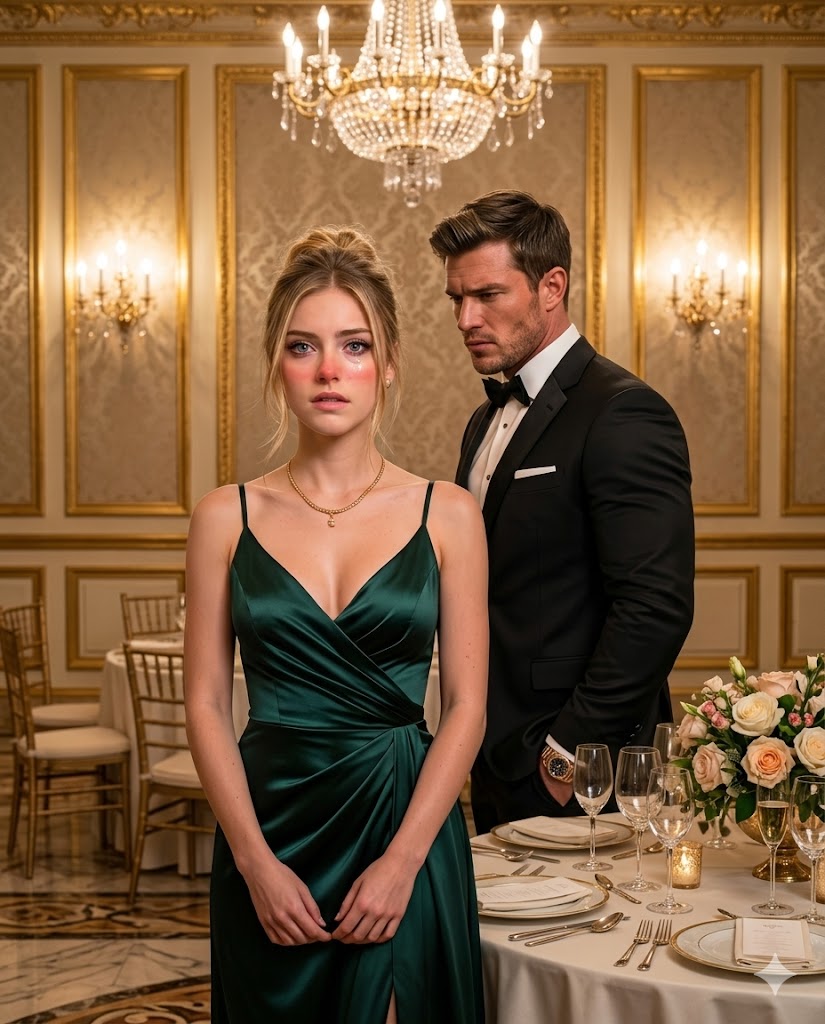
He looked me in the eyes. “I never loved you. This was always a contract. And it expired today.”
The ballroom became a vacuum. I felt 300 pairs of eyes on me. I didn’t cry. I took off my wedding ring, walked to a crystal table, and placed it next to an arrangement of white roses. The click of metal against glass echoed. I turned my back and left.
I drove to my father’s cottage in Narragansett. I sat on the wicker sofa in my black dress and cried until I fell asleep.
Two days later, I heard footsteps on the sand. Brandon was crossing the fence, still in his wrinkled tuxedo. He looked like he hadn’t slept since the ball.
“I need an hour if you’re willing to listen,” he said.
I let him in. He stood in the middle of the room, his hands hanging at his sides.
“My father died when I was twelve,” he began. “I was left with his second wife, Violet Ashcroft. She was a monster. She locked me in the attic. She burned my arm with an iron. At fourteen, your father was hired as the gardener. He saw the scar. He gathered evidence and handed it to a prosecutor. Violet was arrested.”
I looked at my hands. “The hospital bills…”
“That was me,” he said. “Your father told me that if I wanted to pay him back, I should pay his daughter back one day. I kept the contract and slept in a separate room because three weeks after our wedding, I got a message: Whoever has his heart will pay. Violet escaped prison three years ago.”
My heart stopped.
“At the cabin, I failed,” Brandon said, closing his eyes. “I fell in love with you. I lied the next morning to protect you. But at the ball, I saw Mrs. Hensley spinning her pinky ring. Violet used to do that when she gave me orders. I recognized her in three seconds. I realized the only way to save your life was to distance you from me so publicly that she believed I didn’t care about you.”
He knelt before the sofa. “I used the worst sentence of my life against you. If you want to kick me out, the door is on your side.”
I stood up. “Now it’s my turn. I won’t be saved, Brandon. My father sent me to you because he knew she would come back, and he didn’t want you to face it alone. But he also taught me to think.”
“Your plan is weak,” I continued. “If you keep me away, she just waits for the next person you love. We’re going to trap her. We’ll set a public lunch. She’ll come to ‘comfort’ me. I’ll meet her in the library, alone, while you and the police record everything.”
Brandon looked at me from the floor. “Why would you do that?”
“Because you covered my father’s roses,” I whispered, touching his face. “And because I’m not letting you face a villain alone.”
Part 6: The Trap is Set
I returned to the mansion six days later. We played our parts. The press saw a “hurt wife” and a “husband back to business.” We talked by phone twice a day in code. Brandon’s investigator, Orson Lazar, found the gap in Mrs. Hensley’s history. It matched the years since Violet’s escape.
The public lunch was set for 1:00 p.m. Perpetua had called society photographers. Celeste uninvitedly showed up in a loud blue dress, smelling blood.
“I heard you reconciled,” Celeste sneered.
“That was very kind of you to notice,” I said, showing her my ring.
Mrs. Hensley arrived at 4:00 sharp with white roses and pralines. She hugged me with the tenderness of a mother. “My dear, that poor man needs a psychiatrist, and you need a friend.”
I led her to the library. Perpetua had set the tea. I sat in the armchair with the microphone taped underneath.
“You must be exhausted,” I began. “Do you love my husband?”
“In the way one loves a son who was a childhood friend,” she smiled. “I saw him grow up. His mother died when he was eight.”
“Were you at the funeral?”
“I was in the front row.”
I nodded. “Do you know the name of the first rose bush my father planted here?”
She blinked. Her ring spun. “A white one, I think.”
“Copper-colored,” I replied. “Souvenir de la Malmaison. It was the first.”
Mrs. Hensley’s smile stayed firm, but her tone dropped. “Dear, Brandon is a dangerous man. I have a lawyer who handles these cases. You could leave with alimony for life. Think about it.”
I drank my tea. “You’re very well-informed about a prenuptial agreement that never left this house. And about a mother who died when Brandon was eight—on an afternoon when she had been in an induced coma for two days.”
Her ring spun faster. “Photos and documents can be misfiled, dear.”
“When did you learn Brandon’s childhood nickname?” I asked.
“Which nickname?”
“Bram. He said only two people called him that. His mother, and his stepmother during the punishments.”
Her hand stopped on the ring. The second I needed.
“I didn’t know his stepmother,” she said, her voice dropping.
“Funny. I have five photos of you with her. You’re standing right next to her, smiling.”
Mrs. Hensley lowered her cup. Her thumb spun the ring three times out of control. “Have you ever been in this house before?”
“I’m not confused,” I said. “And I’m recording.”
The side door opened. Brandon entered first. Behind him, Theo with the recorder and Orson with two police officers.
Mrs. Hensley stood up, her cup tipping over.
“Violet,” Brandon said, his voice lower than I’d ever heard. “Sit down.”
The sweetness left her face like a mask falling. Underneath was a face that was hard, tight in the jaw. “Brat,” she spat at Brandon. “You’ve hunted me for years.”
“Twenty,” he replied.
A policeman took her arm. She looked at me, the gardener’s daughter. “He taught you well,” she whispered.
They led her out through the garden. My father’s roses watched her depart for the last time.
Part 7: The Garden My Father Planted
When the car left, I sat on the stone bench in the garden. Brandon sat beside me.
“It’s over,” I said.
“It’s over,” he replied. He rested his hand on mine.
The next morning, he was waiting for me at the start of the gravel path. No jacket, gray eyes full of the rest of a man who had finally slept. He offered his arm. We walked to the back of the bed, to a small rose bush I’d never noticed. It had closed white buds and a thin stem.
“And this one?” I asked.
” Souvenir d’un Ami,” Brandon said. “Memory of a friend. Your father planted it on the last day he worked here. He pointed to this corner and told me, ‘When you miss me, come here. You don’t need to speak. She remembers for you.'”
My throat tightened. “I came here many times,” Brandon whispered. “In the last few months, I started coming here with you on my mind. Every night, I thought I was going to lose you.”
I cried then—fully, without holding back. Brandon hugged me and let my tears wet his shirt. When I finished, he pulled my wedding ring from his pocket.
“I loved you since the night you answered Celeste,” he said. “No microphone. No hundred faces. I loved you before the cabin. I loved you at the cabin. I loved you every dawn that I stopped in the middle of the hallway because I couldn’t go into your room. I love you now.”
I extended my left hand. “I’ll let you.”
He slid the ring back onto my finger. The pressure was the same as it had been at the cabin. I closed my hand over his and squeezed back for the first time in six months.
We stayed under the Souvenir d’un Ami with the sea crashing in the distance. Then we went up to the house. Perpetua was waiting to serve breakfast. For the first time since I buried my father, life didn’t need to hurry.
But as we reached the porch, Perpetua handed me a small, yellowed envelope. “I found this in the garden tool box this morning, Mrs. Ashworth. It was hidden in a false bottom.”
I recognized the handwriting. It was the firmer script from the second envelope the lawyer gave me.
Open only if the first one worked out.
I pulled out a small key and a single line of text: The basement floor under the third copper rose. Dig.
Brandon and I looked at each other. The war with Violet was over, but my father had one last secret to share. We walked to the garden bed, to the third rose, and began to move the earth.
Beneath the soil was a small metal box. Inside was a photograph of my mother, Brandon’s father, and mine—all three of them standing on this very porch thirty years ago. And a letter.
Brandon, your father was my brother. Meline, you were born to take back what was stolen. You didn’t marry a stranger, Maddie. You married family. Now, build a real home.
My knees went weak. Brandon caught me. We weren’t just a contract. We were a legacy.
“I guess the contract really did expire,” Brandon whispered, kissing my forehead.
“No,” I smiled, looking at the house. “A new one just began.”
The end.









