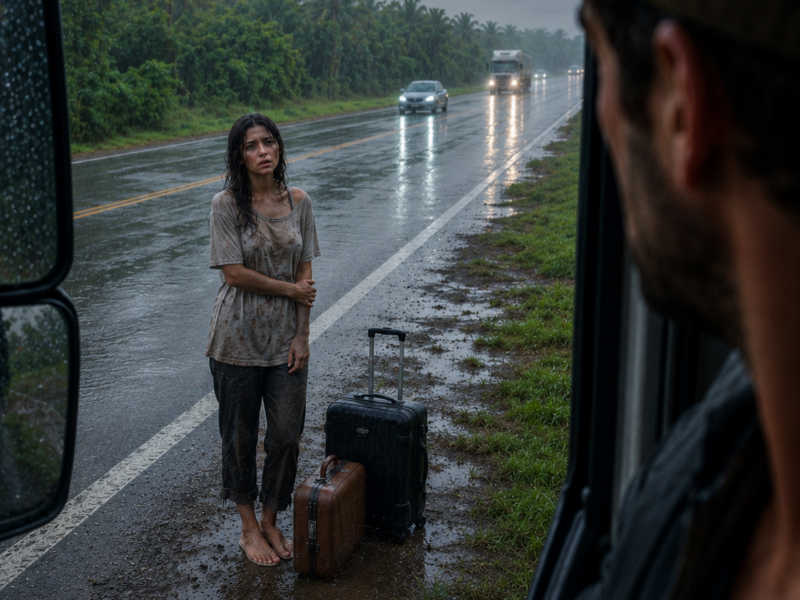
I Picked Up A Stranger On The Side Of The Road… I Had No Idea It Would Change My Life Forever.
Part 1: The Erased Highway
The first thing she said after climbing into my truck was, “Please don’t ask questions until I stop shaking.”
That was not the kind of sentence a man forgets. It was a raw, jagged declaration that immediately altered the temperature inside the cab. I had been coming back from a long, brutal run through the flat, dark heart of Missouri. I was hauling an empty flatbed trailer, fighting a persistent, driving rainstorm that had been hammering the windshield for three hundred miles, and nursing an even worse mood. My name is Mark. I was thirty-eight years old then, and I had built a clean, quiet profession out of being entirely hard to reach. Long-haul trucking suited me down to the asphalt because nobody ever expected much from a man who was always somewhere between exits.
I had a small, mostly dark house just outside Tulsa, a mortgage I managed to pay on time every single month, and rooms I barely used. That particular night, the October rain was coming down so hard the interstate looked like it was being completely erased by a pressure washer.
Then my headlights caught her.
She was walking along the gravel shoulder of the highway, both arms wrapped tightly around herself like a makeshift straightjacket, her head down against the gale, moving with the heavy, halting rhythm of a person whose every step cost them a physical price. I drove right past her at first. I will admit that openly. I watched her shivering form disappear into my massive side mirror, and for about five agonizing seconds, I told myself all the convenient, cowardly things men tell themselves when they are exhausted and don’t want any trouble.
Not my business, I thought. Could be a setup. Could be somebody else’s mess. Just keep the wheels turning.
Then she slipped. Her foot gave out on the wet gravel, and she caught herself hard against the cold steel guardrail, her body collapsing slightly before she forced herself back up.
“Damn it,” I muttered into the empty cab.
I eased the heavy truck onto the shoulder, air brakes hissing loudly over the roar of the storm. When I put the rig in reverse and backed up with my flashers casting a rhythmic amber glow over the ditches, she didn’t run toward the truck. She just stood there, soaked completely through to the bone, watching the massive chrome grille of the cab like she had to manually decide whether a strange trucker was safer than the freezing rain.
I rolled the heavy passenger window down, the wet wind instantly spraying across my face. “You need help?” I yelled over the engine’s idle.
She blinked water off her eyelashes, her pale face illuminated by the dashboard lights. She was an attractive woman, even half-frozen, soaked, and clearly terrified. It wasn’t a polished, high-maintenance kind of beauty; it was a real, grown-woman way. She looked tired, careful, and desperately holding the remaining pieces of her composure together.
“My car broke down,” she called back, her voice competing with the downpour. “A few miles back. My phone is completely dead.”
“Get in before you turn into a medical bill,” I shouted.
She hesitated, her hand lingering on the grab handle. I reached across the console and unlocked the heavy door. “Lady, I’m not selling magazines. It’s pouring. Get inside.”
That managed to elicit the absolute smallest reaction from her mouth. It wasn’t quite a smile, but it was a crack in the ice. She climbed up into the high passenger seat and shut the heavy door with both hands, leaning her weight against it as if she were barring it from the outside world.
The interior of the cab filled instantly with the smell of wet pavement, cold air, and soaked fabric. She started trembling so violently that I could hear her teeth clicking together over the low rumble of the diesel engine. I reached behind my seat into the sleeper berth and grabbed the only spare shirt I had—an old, heavy red flannel I kept in my tool box for roadside breakdowns.
“Here,” I said, tossing it into her lap. “You need to get out of that wet stuff before hypothermia sets in.”
She stared at the flannel shirt as if it were an unidentified object, then turned her wide eyes directly onto me. I immediately turned my head toward the windshield, raising my right hand in a clear gesture of privacy.
“I’m facing forward,” I told her. “You can pull the sleeper curtain shut. I don’t have anything else back there, but that’s what the shirt is for.”
She took the heavy fabric from me, her fingers pale and wrinkly from the water. “You do this often?” she asked, her voice shaking. “Pick up strange women on the highway and hand them clothes?”
“Only on Tuesdays,” I replied without looking back. “Today is Friday.”
“Then you’re getting premium service,” she murmured.
A weak, involuntary laugh escaped her lips—quick, surprised, and fragile. I heard the rings of the heavy sleeper curtain slide across the metal track as she pulled it halfway shut and moved behind it. I kept my eyes fixed entirely on the dark highway ahead, my hands gripping the steering wheel as if the truck were still traveling at seventy miles an hour, even though we were parked solid on the shoulder.
I heard the heavy, wet thud of her soaked jacket and shirt hit the rubber floor mat. I heard her breathing, unsteady, ragged, and clearly embarrassed by the sheer vulnerability of the situation. A minute later, the curtain clicked open again, and she slid back into the passenger seat wearing my oversized shirt. It swallowed her entirely, the sleeves hanging past her knuckles, and she had pulled the front tight around herself like it was the last defensive wall she possessed in the world.
“Better?” I asked, finally turning my head.
“No,” she whispered.
I reached down and turned the truck’s heater dials to the absolute maximum, the vents roaring with hot air. She rubbed her hands together frantically, her frame still vibrating with deep tremors. Then she looked across the cab at me in a way that made the entire space go completely silent.
“I need one more thing,” she said, her voice dropping into a register that made my chest tighten. “I am so cold, Mark.”
I knew exactly what she meant before she even moved. She didn’t lean across the console like a flirt or someone playing a game. She leaned inward like a human being who had completely run out of options and hated the very fact that she had to ask a stranger for help. I sat there like an absolute idiot for half a second, the trucker who prided himself on being completely untouchable. Then I opened my right arm just enough.
She pressed her entire body against my side, burying her cold face near my shoulder, tucking both of her freezing hands between our shirts. She felt like a literal block of ice. I kept my left hand firmly on the steering wheel and placed my right arm lightly around her back—not holding her tightly in place, not forcing anything, just giving her a steady, unyielding source of heat.
“Is this okay?” she whispered against my jacket.
“Yeah,” I muttered, my voice rough. “You’re stiff as a board.”
“I’m driving an eighty-thousand-pound machine,” she said, her voice muffled. “We’re currently parked.”
“Then I am emotionally committed to basic safety,” I replied.
She gave another small laugh against my shoulder, but it came out shaky, ending in a quiet catch of her breath. I felt her breathing slowly begin to level out against my ribs. If I had known in that exact, awkward minute where this stranger’s path was headed, I might have opened the driver’s door and walked straight into the highway traffic just to avoid the massive amount of legal and emotional paperwork my heart was about to create. Instead, I just sat there in the dark and let a complete stranger warm herself against my side. For the first time in ten long years, I remembered exactly what it felt like when another human being’s comfort mattered infinitely more than my own convenience.
After a few minutes, she pulled back slowly, her color returning. “Thank you,” she said, smoothing down the flannel. “What’s your name?”
“Chloe,” she said, answering her own question before I could ask.
“Mark,” I replied, putting the truck into gear.
She nodded once, looking down at the heavy fabric. “I’m sorry about the shirt.”
“It’s had worse nights,” I said, releasing the air brakes.
She looked out toward the dark windshield as the wipers cleared the deluge. “Can you take me to a motel? The next town?”
“The closest one is thirty miles out, maybe more,” I said, checking my mirrors as I pulled the massive rig back onto the slick asphalt. “The roads are bad, and the county sheriff is already flashing lights at the next exit. I can pay you back for the fuel, Mark. I have money in my bag.”
“I didn’t ask,” I said flatly.
That made her look at me again—sharper this time, her analytical eyes tracking my profile in the green glow of the gauges. “People usually ask, Mark. Especially out here.”
“I’m not people,” I said, keeping my eyes on the road. “I’m a trucker. Lower your expectations.”
Her mouth moved slightly, the closest she had come to a genuine smile since she climbed into the cab. I shifted gears, the transmission whining softly under the floor. “Where’s your car?”
“Back near mile marker 214,” she said. “The engine just died. I waited over an hour in the dark. No one stopped.”
“Hazards on?”
“They were,” she whispered. “But the battery probably gave up right before you showed up.”
“You alone out here, Chloe?”
She looked down at her hands, her fingers locking together tightly. “Yes.”
There was a long, heavy pause in the cab—long enough to tell me that single word carried a massive, ugly history behind it. I didn’t push her for details; I knew better than to dig into a fresh wound on a rainy night. We drove slowly through the downpour, the headlights cutting weak yellow holes into the Missouri fog.
After several miles of silence, she spoke again, her voice tight. “I left Kansas City early this morning.”
“That’s a hell of a long way to travel in a car that didn’t want to cooperate,” I noted.
“It cooperated just long enough,” she said, staring at the rain.
“With what?”
“With getting me away,” she whispered.
I kept my eyes locked straight forward on the white lines of the highway. “From who, Chloe?”
She didn’t answer right away. The wipers made three loud, rhythmic sweeps across the glass before she finally spoke the name. “A man named David,” she said. “We lived together. We weren’t married. He liked knowing exactly where I was, who I talked to, what I spent, what I wore. It got a lot worse after I finally told him I was done.”
I tightened my grip around the steering wheel until my knuckles turned white. “He hurt you?”
She looked out the passenger side window, watching the dark, empty trees blur past. “Not the way you’re probably thinking, Mark. He was very careful. He didn’t have to swing at me to make the entire room feel incredibly small.”
I understood that sentence more than I ever wanted to admit to a stranger. “You have any family nearby?”
“Not close,” she said. “I have a friend in Tulsa. Aaron. Or at least, I thought I did. I was trying to make it to her place.”
“What’s her name?”
“Aaron,” she repeated. “I called her yesterday from a gas station payphone. I told her I was coming. Then my phone died today.”
I nodded slowly, signaling my turn off the interstate. “You can make your calls from my house.”
Her head snapped toward me, her eyes narrowing with sudden caution. “Your house?”
“It’s about twenty miles closer than any decent motel,” I said, keeping my voice entirely professional and flat. “You’ll have dry clothes, a phone charger, a couch, and solid door locks. In the morning, I’ll drive back out and take a look at your car.”
“No,” she said quickly, her posture stiffening. “I can’t do that. I can’t go to your house.”
“You can,” I said. “It’s a practical choice.”
“You don’t know me, Mark,” she said, her voice rising slightly. “You don’t know what kind of trouble comes with me.”
That line sat between us in the small cab like a physical object. I glanced over at her briefly. “Does the trouble have a name and drive a pickup truck?”
She shut her eyes tightly for a second, her shoulders dropping. “I don’t want to bring any trouble to your front door, Mark.”
“My door has been completely bored for years, Chloe,” I said.
That was the very first time she said my name, and it sounded far too careful, far too heavy for a woman sitting in my oversized flannel shirt. I kept my voice perfectly even as I pulled the truck onto the dark, gravel road leading to my property. “You can sleep on the living room couch. I’ll sleep in my own room. In the morning, you make your phone calls, I take a look at the car’s alternator, and we figure out the next step together. That’s all this is.”
She studied my profile through the dark, searching my face for the hidden trick, the catch that every man before me had probably utilized. “What do you want for doing all this?”
“Nothing,” I said.
“Nobody wants nothing, Mark.”
“I want to get home without reading about your frozen body in tomorrow’s local newspaper,” I said, pulling the truck into the dark driveway. “That’s about the extent of my agenda.”
She looked away from me, watching the headlights reflect off the dark windows of my house. She gave a single, quiet nod. But as I killed the engine, the sudden silence inside the cab felt heavy with an unspoken threat—because down the highway, forty miles back, a pair of headlights had just pulled up behind a dead sedan near mile marker 214.
Part 2: The Living Room Wall
My house was completely dark and freezing when we finally unlocked the front door. It always looked exactly like a place where somebody lived exclusively on paper—mail stacked in a neat, clinical tower on the kitchen counter, the air smelling of stale pine and emptiness, clean enough only because I was never home long enough to actually make a mess. It was quiet enough to remind me precisely why I stayed gone for three weeks out of every month.
I opened a dresser drawer in the hallway, pulled out a clean towel and a pair of gray sweatpants, and pointed down the dark corridor. “Bathrooms are right through that door. The guest room is currently more of a tool storage unit than a bedroom, but the living room couch is decent.”
She stood in the center of the kitchen, holding the oversized sweatpants against her waist. Her hair was still damp, sticking to the collar of my flannel shirt. “You’re really not going to ask for any proof, Mark?”
I paused, leaning my weight against the laminate counter. “Proof of what, Chloe?”
“That I’m not lying to you,” she said, her eyes intensely focused on mine. “That I didn’t just make up a story about a man named David to get a free ride into Oklahoma.”
“Are you lying to me?” I asked.
“No,” she said flatly.
“Then we’re current,” I said, turning away to turn on the stove.
Her face changed in that moment. It wasn’t a dramatic, theatrical expression; it was simply the specific way a human being looks when they have been braced for a violent physical impact for days, and the impact suddenly doesn’t arrive. She turned without another word and disappeared into the bathroom, the door clicking firmly shut behind her.
I put a kettle of water on the burner and began rummaging through the pantry, eventually pulling out a can of chicken soup that had probably been waiting for a better life since the previous winter. When she finally stepped out of the bathroom ten minutes later in the dry clothes, she looked noticeably smaller somehow, but her hands had stopped their violent shaking. She sat down at the small kitchen table, wrapped both of her sleeves around the hot ceramic mug of tea I handed her, and just stared blankly down into the dark liquid.
“The soup isn’t fancy,” I said, setting the bowl down. “But it’s technically classified as food according to the label on the tin.”
She tried to answer me, her lips moving, but her mouth started to shake uncontrollably. Then, without a single sound, she started crying. It wasn’t a loud, performative wail designed to elicit sympathy; she just put one pale hand completely over her face and broke down right there at my table, her shoulders heaving as the tears slipped through her fingers.
I stood there in the center of my own kitchen, feeling exactly as uncomfortable as any man would when a woman starts weeping in front of his stove, possessing precisely zero emotional tools in my inventory sharper than a half-inch socket wrench.
“Hey,” I said quietly, stepping a inch closer. “You’re safe here, Chloe. The doors are locked.”
That statement only seemed to make the tears come faster. “I am so sorry,” she whispered into her hand, her voice thick. “I am so incredibly sorry, Mark. I’m just… I am so exhausted.”
“I know,” I said.
She lowered her hand, her red-rimmed eyes locking onto mine with a sudden, fierce intensity. “No, you don’t. You don’t know.”
“You’re right,” I said evenly, pulling out the wooden chair across from her. “I don’t. I don’t know a thing about it.”
She wiped her cheek with the back of the flannel sleeve, taking a ragged breath. “Thank you for not making me explain every single detail of my life while I was still wet and terrified on the side of that road. That bar is usually on the floor for most men, Mark. You’d be amazed how many of them still manage to trip over it.”
“I’m not one of them,” I said, sitting down across from her. “I don’t collect stories.”
She watched me for a long, silent second, analyzing the lines around my eyes, searching for the threat. “No,” she said softly, her shoulders finally dropping an inch. “I don’t think you are.”
That should have been the exact moment I stood up, walked away, and reminded both of us that she was merely a temporary passenger who would be leaving my house first thing in the morning. Instead, I just sat there at the table with her until she finished every drop of the lukewarm soup.
When she was done, I cleared the bowl, brought a heavy wool blanket out of the hall closet, and set it on the couch alongside my phone charger and the landline receiver. “My room is at the very end of the hall,” I told her, pointing down the dark corridor. “The door stays completely open tonight, unless you want it closed.”
She stood beside the couch, her fingers gripping the edge of the wool blanket. “Why would I want it closed, Mark?”
“So you don’t have to spend the night wondering if I’m standing in the dark, listening to you breathe,” I said bluntly.
She swallowed hard, her jaw tightening briefly. “Leave it open.”
“All right,” I said. “Goodnight, Chloe.”
I slept terribly that night. It wasn’t because I didn’t trust her in my house; it was because I realized, with a cold knot in my stomach, that I did trust her, and that specific realization bothered me more than any stranger should have.
In the morning, the smell of fresh coffee dragged me out of bed before my alarm went off. I walked into the kitchen and found her standing by the counter, using my old drip machine like she had been living in my house for months instead of nine hours.
“I hope this is okay,” she said, handing me a heavy black mug before I could even say hello. “I saw the coffee grounds in the cabinet.”
“If you found the coffee in this kitchen, you’ve already performed better than me most mornings,” I said, taking a slow sip.
“You take it completely black,” she noted, watching me.
“Do I look like a man who owns hazelnut creamer, Chloe?”
“You look like a man who thinks cinnamon is a personal insult,” she replied.
“It is sneaky,” I muttered.
She laughed properly that time—a clear, beautiful sound that echoed off the empty kitchen walls. Half an hour later, I drove my pickup truck back out to the interstate and found her sedan exactly where she had left it near mile marker 214. The hazards were completely dead, the battery completely flat, and the alternator looked like it had given up its ghost three states back.
I managed to get it towed back to my property with some help from an old mechanic named Gus, who ran a small, rusted garage near the county line and owed me a massive favor from a winter breakdown three years ago. Gus unhooked the chain, looked at Chloe’s sedan sitting in my gravel driveway, and then turned his sharp, grease-stained eyes directly onto me.
“This belong to you, Mark?” Gus asked, spitting a stream of tobacco into the grass.
“No,” I said.
“The woman’s shoes on the passenger floorboards usually give it away, Mark,” Gus grinned, leaning against his tow truck. “You finally making friends out here? I liked you a hell of a lot better when you charged too much for freight and kept your mouth shut.”
Chloe stepped out onto the front porch, wearing an oversized gray sweatshirt she had found in my dryer, her arms crossed tightly over her chest as she listened to us talk. Gus immediately tipped his stained baseball cap toward her, his grin widening.
“Morning, ma’am,” Gus called out. “Don’t believe a single word this man tells you. He once drove six hundred miles through a Tennessee blizzard with a single ham sandwich on his dashboard because he refused to stop the wheels from turning.”
“It was wrapped in foil, Gus,” I muttered. “And it had moved completely into the passenger seat by the time I hit Memphis.”
Chloe looked across the gravel at me, her eyes dancing with amusement. “You’re really not helping your mysterious long-haul image, Mark.”
“I didn’t order one,” I said, grabbing my toolbox from the truck bed.
Gus laughed, climbed back into his rig, and roared down the gravel road, leaving us alone in the quiet morning air. I spent the next four hours checking the sedan’s belts, the electrical lines, and three other components that had absolutely no business giving up at the exact same time. Chloe came out twice, standing near the open hood, offering a wrench before I could even ask for it.
“You know cars?” I asked, wiping grease off my knuckles.
“I know exactly when they stop moving,” she said. “Advanced level strategy.”
“I can hold the flashlight for you,” she offered on her second trip out.
“It’s full daylight, Chloe,” I pointed out.
“I can hold it emotionally, Mark,” she said, her voice soft.
I glanced up from the engine block and found her smiling down at me. That specific smile hit my chest harder than any physical wreck I had ever witnessed on the interstate. It wasn’t coy or performative; it was just a tired, grateful woman trying her absolute best to feel normal after a lifetime of walking on eggshells.
“Go back inside,” I told her, looking back down at the wires. “Eat something.”
“Are you always this aggressively bossy, Mark?”
“Only when I’m right,” I said.
When I finally walked back into the house around six o’clock that evening, the smell of a real, homemade dinner stopped me dead in the doorway. There was hot food bubbling on the stove, the dishes were completely washed and stacked, and the counters were entirely cleared. It wasn’t perfect or staged like a magazine; it just looked… lived in.
Chloe turned around from the sink, a dish towel in her hands. “I didn’t mean to snoop through your cabinets, Mark, but your pantry was an absolute crime scene.”
“My pantry is perfectly organized by expiration year, Chloe,” I said, hanging up my keys.
“That’s not organization,” she said, her eyes warm. “That’s a historical excavation. I made chicken and rice. Nothing fancy.”
I stood there in the kitchen hallway longer than I should have, my boots heavy on the linoleum.
“What?” she asked, her smile fading slightly. “Is something wrong?”
“Nothing,” I muttered.
“No,” she said, stepping closer. “That face isn’t nothing, Mark. Tell me.”
“I’m just not used to coming home to the sound of food on the stove,” I said, and the exact second the sentence escaped my lips, I hated myself for letting my guard down that far.
Her expression softened instantly, and I braced myself for the pity I knew was coming. But she didn’t give it to me. She just pulled out a chair and pointed to the plate. “Well,” she said quietly. “You’re fixing my car. The least I can do is provide a down payment in chicken.”
I sat down at the table, the warmth of the food rising between us. My ex-wife had taught me years ago that a house could look completely full on the outside and still be entirely empty on the inside. She had also taught me that some people treat a man’s daily labor like a utility bill—completely expected, mildly annoying, and only ever noticed when the service stops working. After the divorce, I had simply stopped inviting people inside my walls. A truck cab was the perfect home for a man who wanted heavy steel boundaries but was too proud to admit he was hiding.
Chloe didn’t know a single piece of that history. She just passed me the salt shaker and asked if the rice was too soft for my liking.
“It’s good,” I said after a bite.
“You hesitated,” she noted, her eyes narrowing playfully.
“I was chewing, Chloe.”
“You inspected it like a mechanic,” she said. “Very romantic.”
I looked up from my plate, my fork halting. She looked down fast, her cheeks turning a sudden, faint shade of pink, but she wasn’t fast enough to hide the flash of panic in her eyes. The word romantic hung there in the quiet kitchen air—ridiculous, sudden, and not remote-control ridiculous at all.
And outside, past the tree line, a dark pickup truck slowly rolled past the entrance of my gravel road, its headlights turned entirely off.
Part 3: The Wall and the Window
The next two days fell into a strange, rhythmic little routine that neither of us acknowledged out loud. I spent my afternoons in the gravel driveway, cursing at her car’s rusted alternator, while she cleaned the kitchen, cooked real meals, and called her friend Aaron twice from my landline. Both times, there was absolutely no answer on the other end, and the voice messages Chloe left became progressively shorter, tighter, and more controlled.
She never asked for a single thing more than I offered. She never wandered down the hall toward my bedroom, and she never touched my personal papers on the desk without asking for permission first—except to systematically rescue my kitchen from what she called “bachelor-grade structural neglect.”
On the third morning, the heavy black dispatch phone on my counter rang loudly. I picked it up, listened to the terminal manager’s voice for thirty seconds, and checked my logbook.
“Yeah, I can take that run,” I said. “It leaves tomorrow before dawn.”
Chloe looked up from her coffee cup across the table, her hands freezing around the ceramic. The dispatcher kept talking into my ear, detail-oriented.
“Short haul,” I told her after I hung up the receiver. “Two nights maximum. Oklahoma City to Amarillo, then straight back. It’s a clean route.”
“You’re leaving tomorrow morning,” she said, her voice dropping into that quiet, careful register.
“Two nights,” I repeated, pouring myself a fresh cup. “Maybe three if the loading docks in Texas get stupid. You stay here. The doors lock from the inside, you have my mobile number, Gus’s garage number, and the house phone. You’ll be fine.”
“No, Mark,” she said, setting her mug down with a firm clack. “I can’t do that. I can’t just stay alone in your house while you’re out working. I am not your responsibility.”
“I don’t recall saying you were,” I said, leaning back against the counter.
“You’re acting like it,” she countered, her eyes flashing with a sudden, defensive heat.
“Then let me phrase it in a way that insults your independence less, Chloe,” I said evenly. “I don’t particularly want a half-fixed car sitting on my property, and I don’t want a half-safe woman sitting in a cheap motel off Route 66 while I’m hauling freight. It distracts me from my mirrors.”
She looked across the space at me, her gaze entirely quiet for a long moment. “A half-safe woman?” she asked softly.
“Don’t make me regret my choice of grammar,” I muttered, looking away.
A real smile broke through her serious expression, but her eyes remained deeply worried. “What if he tracks me here, Mark? What if David finds this place while you’re somewhere in Texas?”
“He won’t,” I said.
“You don’t know that for a fact,” she whispered.
“No,” I said, looking back at her. “I don’t. I don’t know it at all.”
That raw piece of honesty landed much heavier in the quiet room than any fake, manufactured confidence would have. I reached down, sliding Gus’s greasy business card across the laminate table toward her fingers. “If anything out there feels wrong—if a car slows down near the mailbox, if the dog down the road starts barking past midnight—you call Gus. Then you take your keys, you get in my pickup, and you leave. You don’t wait around to see who it is. Not because you are weak, Chloe. Because smart people don’t stick around to prove a point to a monster.”
She picked up the small card, her fingers tracing the printed ink. “You really trust me alone in your house with your truck keys, Mark?”
“No,” I said flatly.
Her face fell slightly, a quick shadow of disappointment crossing her features.
“I trust my read of you,” I added, before she could shut down. “That’s a different machine entirely.”
She studied my face, her analytical eyes searching for the trap. “And what exactly does your read say about me, Mark?”
“It says you’ll leave this place three times cleaner than I deserve, you’ll use exactly two towels, and you’ll leave a note apologizing for the coffee consumption,” I said.
She let out a quiet laugh under her breath, her shoulders easing. “That is annoyingly, terrifyingly accurate.”
The next morning, I left the property long before the sun even cleared the horizon. Chloe stood on the front porch in the freezing pre-dawn air, wearing a pair of old jeans and one of my heavy canvas winter jackets. She had meticulously washed my red flannel shirt, and it was currently folded neatly over her arm.
“You want this back before you hit the road?” she asked, holding it out.
“Keep it,” I said, climbing up into the cab. “Until you have a dry emergency wardrobe of your own. Consider it a loan.”
“I can’t keep systematically stealing your clothes, Mark,” she called up over the engine’s rumble.
“That shirt was incredibly lonely in the toolbox anyway, Chloe,” I said.
She held the heavy fabric against her chest, stepping back toward the door. “Drive safe, Mark.”
“I usually do,” I said, releasing the brakes.
“That’s not the exact same thing as a promise,” she called out.
I looked down at her from the high window, and for a terrifying second, it felt entirely too much like leaving someone who actually belonged to me. “I’ll drive safe, Chloe. I promise.”
Her shoulders visibly relaxed in the yellow glow of the porch light. “Good.”
Out on the open road, I forced myself to act like the seasoned professional I was. I methodically checked my side mirrors every ten seconds, monitored my fuel levels, logged my hours precisely, and tracked the approaching weather front moving out of New Mexico. But every single time the mobile phone on my dashboard buzzed, my hand moved faster than it ever had in ten years of driving.
Around noon, a text message came through. It was a picture of a steaming pot of soup on my stove. Below it, she had written: I found actual, real spices hiding behind three identical cans of expired baked beans from 2018. Do you want me to report this illegal discovery to the local authorities, or should I destroy the evidence?
I typed back with one thumb: Destroy the evidence immediately. No witnesses.
Her response arrived three minutes later: Too late. I already used them in the rice. You’re an accomplice now.
That night, parked in a bleak, concrete truck stop outside Amarillo, I sat back in my sleeper berth and stared at that glowing text screen for far longer than any sane man should have. A woman was currently walking through my quiet house. Food was cooking on my stove. My oversized shirt was wrapped around her shoulders, and my emergency number was programmed into her phone. By all accounts of my past life, I should have felt entirely cornered, entirely trapped by the sudden weight of it.
Instead, all I wanted to do was turn the truck around and drive fast toward Oklahoma. That realization made me almost angry at my own vulnerability.
The next afternoon, I finished my delivery three hours ahead of schedule. I completely skipped my usual slow diner stop off the highway, bypassed the fuel lane check, and took the absolute cleanest, fastest route back toward the state line. I told myself it was simply because I had valuable tools laid out in the driveway and a mechanical job to finish before the weekend rain came back. Truckers lie to themselves just like everyone else; we’re just significantly better at doing it with a completely straight face.
When I finally pulled the massive rig into my driveway that evening, the kitchen light was already burning bright. Before I could even kill the loud diesel engine, the front door swung open.
Chloe stepped out onto the porch, a soft smile breaking across her face—the kind of smile that looked like she had been actively trying to hold it back all day and had finally failed.
“You’re early,” she called down as I climbed out of the cab.
“Disappointed?” I asked, grabbing my bag.
“I didn’t say that,” she said, walking down the wooden steps toward the gravel. “But you look exactly like a man who is about to file a formal corporate complaint with dispatch.”
“I made far too much dinner,” she added as I reached the bottom step.
“Convenient,” I muttered, stopping a few feet away from her.
“Don’t flatter yourself, trucker,” she said, her voice dropping into a softer, quieter frequency. “I only ever cook when I’m incredibly nervous.”
“You were nervous?” I asked, looking down at her.
She stopped just two feet away from me, the smell of clean laundry and warm spices drifting off her clothes. “I didn’t know if you’d come back to the house feeling the exact same way you left, Mark.”
I didn’t have a smart, safe answer ready for that sentence. I set my heavy duffel bag down on the wet gravel between us. “I didn’t know either, Chloe.”
She nodded slowly, her eyes locking onto mine, and for three long seconds, neither of us moved a single inch. Then, she stepped forward across the gravel and wrapped her arms completely around my neck.
It wasn’t like the first night on the highway shoulder. It wasn’t a desperate, freezing act of physical survival. It wasn’t because she was running out of breath or needed immediate heat to keep her heart beating. This hug was a definitive, deliberate choice.
I put my massive, grease-stained arms all the way around her waist, pulling her against my chest, and for the first time in my entire adult life, I allowed myself to fully feel the weight of another human being holding onto me.
“I’m really glad you’re back, Mark,” she whispered against my collarbone.
“Yeah,” I said, my voice thick. “Me too, Chloe.”
She pulled back first, her cheeks flushed a beautiful, bright shade of pink in the twilight. “The dinner is going to get cold if we stand out here in the gravel.”
“Can’t have that,” I said, picking up my bag. “Your spices worked entirely too hard today.”
That weekend, we fixed her car’s alternator—and we made a complete, beautiful mess of every single steel boundary I thought I still possessed.
Part 4: The Altitude of the Engine
We spent the entirety of Saturday afternoon inside the small garage. I was hunched over the open hood of her sedan, wrestling with a stubborn bolt on the new alternator, while she sat comfortably on an overturned plastic bucket beside the bumper, handing me tools after repeatedly pretending she had absolutely no idea which one was which.
“This one?” she asked, holding up a heavy steel wrench with a straight face.
“That’s a half-inch box wrench, Chloe,” I said, looking over the radiator. “You knew that three hours ago.”
“I forgot,” she smiled, her eyes crinkling. “You were holding it like it was a dangerous animal that might bite you if you used the wrong torque.”
“Tools have highly specific attitudes, Chloe,” I muttered, turning back to the engine block. “They only ever bite if you insult their manufacturing.”
She crouched down lower beside the open fender, resting her chin on her hands. “Do you always talk this much when you’re working on a vehicle, Mark?”
“No,” I said flatly.
“So… that means I’m special?” she asked, her voice light, but carrying a sharp undercurrent of genuine curiosity.
I looked over the edge of the metal hood, my hands freezing on the socket line. She tried her absolute best to look entirely innocent, but she failed completely.
“You are incredibly distracting, Chloe,” I said, my voice dropping.
“That wasn’t a no,” she whispered.
“No,” I said, looking her dead in her eyes. “It wasn’t.”
Her smile faded slightly in that moment—not out of sudden sadness, but out of a deep, mutual awareness of the space between us. The entire air inside the small garage changed density, turning thick and heavy with an unspoken momentum. I forced myself to look back down at the dark engine parts because I realized, with a jolt of survival instinct, that I was still entirely capable of cowardice when it came to a woman’s gaze.
That evening, after we had finished the meal, we took our coffee mugs out to the back steps of the house. The night was crisp, the wind rustling through the empty oak trees at the edge of the property. She sat on the step below me, her back resting against my knee, and she finally told me more about the man named David.
“He never started with physical rules or screaming,” Chloe said, staring out at the dark field. “He started with an overwhelming amount of intense concern. He wanted to know if I arrived safe, who I sat next to at lunch, what my coworkers said to me. Then, over the years, the concern turned into mandatory questions. The questions turned into daily reports. And the reports eventually turned into a system of absolute punishment.”
“What kind of punishment?” I asked, my hand resting on her shoulder.
“Silence,” she whispered, her voice tightening. “He would completely freeze me out of the house for three days if I spent money without his direct permission. He would move the house keys, block the driveway with his truck, or take my wallet ‘for safekeeping’ so I couldn’t leave the front door. I stayed far too long, Mark. I know that now.”
“Most people do,” I said quietly. “When the machine changes its speed that slowly, you don’t notice the temperature rising until the engine is already on fire.”
She turned her head to look up at me over her shoulder. “You sound like you know that specific repair bill, Mark.”
“I was married once,” I said, staring at the dark horizon.
She waited in silence, her posture entirely receptive. She didn’t dig into my history, she didn’t pry for names, and she didn’t demand an accounting of my scars. I rubbed my thumb along the rough ceramic edge of my coffee mug, letting the memory surface without fighting it for once.
“She didn’t try to control my movements,” I said. “She just used my labor to fund a life she didn’t want to share with me. I worked eighty hours a week to pay off her credit card debts. Every time I came home, she had a new promise, a new excuse, a new standard I had failed to meet. I worked harder, she respected me less. Eventually, I realized the only thing keeping that marriage alive was my own stubborn refusal to admit that the engine had been dead for five years.”
Chloe didn’t offer me a single ounce of cheap, patronizing pity. I liked her immensely for that.
“That’s an incredibly hard thing to admit out loud, Mark,” she said softly.
“It gets a lot easier after you’ve already paid the final bill,” I said.
“Some bills cost a hell of a lot more than just money,” she noted, her head dropping back against my knee.
“Yeah,” I muttered. “They do.”
We sat in the dark silence for ten minutes, the wind cooling our coffee. Then, she slowly reached her right hand backward up the wooden step and touched my hand. It wasn’t a desperate grab; she just rested two soft fingers lightly against my scarred knuckles.
“I don’t want to use you, Mark,” she whispered into the night.
I looked down at her small fingers, then down at the profile of her face. “I know, Chloe.”
“Do you?” she asked, turning her head slightly. “Do you really know that?”
“I’m trying my absolute best to believe it,” I said honestly.
She didn’t move her fingers away from my hand. I turned my palm completely over, sliding my fingers between hers, and held her hand tight against the wood.
The first real kiss happened much later that night inside the kitchen, and it happened for the most ridiculous, un-romantic reason possible: we both reached for the exact same dish towel at the exact same second after drying the plates. Our hands collided against the fabric, our eyes locked, and I said her name aloud like a final, desperate warning label.
“Chloe.”
She didn’t take a single step backward into the safety of the hall. “Is this a terrible idea, Mark?” she whispered, her breath warm against my chest.
“Probably,” I muttered. “An absolute disaster for my insurance.”
“Do you want me to stop you?” she asked, her eyes dark and wide.
“No,” I said.
“Good,” she whispered.
She kissed me first. It was a soft, incredibly careful movement, as if she were testing the physical structural integrity of the ground beneath her feet before she committed her full weight to it. I answered her the exact same way—careful, steady, and controlled—because I had absolutely no intention of being another aggressive man who took more than she was willing to offer. When we finally separated, her breathing was completely ragged, and she looked slightly shaken by the intensity of it.
I took a deliberate step back, clearing my throat. “You okay, Chloe?”
“Yes,” she breathed, a small, embarrassed laugh escaping her lips as she wiped her mouth with the back of her hand. “I’m fine. I’m just… I forgot exactly what it felt like to actually want something from a man and not feel a wave of immediate terror right behind it.”
I understood that sentence so deeply it made me entirely uncomfortable in my own boots. “We go slow,” I told her, hanging the towel up. “We move at a safe speed limit.”
She nodded quickly, her eyes warm. “Slow is good, Mark. I like slow.”
For the next two days, our life felt almost entirely normal—better than normal, if I was being completely honest with myself. We ate breakfast late, finished the structural alignment on her car, and took it for a test drive around the county block. She kept talking about how she needed to look for local work, call Aaron again from a different payphone, and formulate a real, long-term survival plan.
And I kept nodding my head, saying all the practical, logical adult things a man is supposed to say—all while quietly, desperately hoping that her long-term plan had a passenger seat reserved specifically for me, and entirely hating myself for allowing that hope to take root in my empty house.
On Sunday afternoon, the replacement phone charger I had picked up from the truck stop finally finished cycling her dead mobile battery back to life. The exact second the screen flared to life, a massive pile of text messages and voicemails descended upon the device. Most of them were from her friend Aaron—some worried, some frantic, but the final one made Chloe go completely, totally rigid in her chair.
“What is it?” I asked, dropping my socket wrench onto the table.
She read the text screen twice, the remaining color completely draining from her lips. “Aaron says… she says David came by her apartment yesterday afternoon.”
I walked over to her side, my jaw clenching. “Did she tell him anything?”
“She says she didn’t tell him a single word,” Chloe whispered, her hand trembling against the glass screen. “Then she says she’s so sorry. Then the messages completely stop.”
I looked down at the timestamp on the screen. “You told Aaron my name when you called her from the highway gas station, Chloe?”
“No,” she cried, her eyes wide with panic. “I swear I didn’t, Mark! I just told her that a long-haul trucker had helped me out and that I was safe somewhere just outside of Tulsa. I didn’t give her an address!”
“Did you mention the specific county line?” I asked quietly.
She closed her eyes tightly, a tear escaping her lid. “I might have mentioned the exit number… I was so tired, Mark. I don’t remember exactly what I said. This is all my fault. I brought him straight to your house.”
“Hey,” I said, grabbing her shoulders firmly. “Look at me. That is not your fault. Do you hear me?”
“It feels like it is,” she sobbed.
But the argument didn’t matter. Because the very next afternoon, at exactly two o’clock, the heavy sound of large tires crunching across gravel echoed through the quiet yard. I was standing inside the open garage, Chloe right beside me wiping grease off her hands because she had completely stopped pretending she hated helping me work.
The sound of the engine outside made her turn her head toward the driveway. The grease towel slipped from her fingers, landing in the dirt.
“Mark,” she whispered, her entire frame going rigid. “It’s him.”
Part 5: The Driveway Line
I looked past her shoulder, through the wide framing of the garage door. A heavy, dark-colored pickup truck with tinted windows had just rolled into my driveway, its engine idling with a low, aggressive rumble that shook the windowpanes.
The driver’s side door swung open, and a man stepped out onto the gravel. He was in his early forties, wearing a crisp, perfectly ironed western shirt and designer jeans, his face completely controlled and calm. He possessed the highly specific look of a man who spent his entire life saying “calm down” to people he had just spent twenty minutes intentionally provoking into a fury.
“Go inside the house, Chloe,” I said, my voice dropping into a flat, deadly frequency as I reached for a heavy steel tire iron resting on the workbench. “Right now. Lock the door.”
She looked at the tire iron in my hand, then looked out at the man standing on our gravel, her jaw setting into a hard, rigid line. “No,” she said, her voice shaking but resolute. “I am absolutely not going to hide inside your kitchen like a scared child while he stands on your property talking about me, Mark. I’m done hiding.”
“Fair enough,” I muttered, setting the iron back down on the wood. “But you stay directly behind my left shoulder. Do not step around me.”
“Okay,” she whispered.
I stepped out of the shadow of the garage first, my heavy work boots crunching solidly against the stone. Chloe came right behind me, her hand lightly resting against the back of my canvas jacket, but I made absolutely certain that my entire thirty-eight-pound frame stood directly between her and the dark pickup truck.
David stopped near the chrome front bumper of his vehicle, his hands tucked casually into his front pockets. He looked around my property with a slow, patronizing scan, eventually letting his eyes land on Chloe with a broad, theatrical smile—as if they were simply meeting up at a friendly neighborhood barbecue.
“Well, Chloe,” David called out, his voice smooth and entirely reasonable. “Don’t you think you’ve made this little dramatic production entirely long enough? Everyone back home is worried sick about you.”
Chloe said absolutely nothing from behind my shoulder, her fingers tightening against the fabric of my coat.
I took two steps forward, stopping right at the edge of the grass line. “You’re standing on private property,” I said, keeping my voice completely level and flat. “Turn the engine off and state your business, or remove your vehicle from my road.”
David looked at me for the first time, his eyes tracking my work shirt and my mud-stained boots with a slow, dismissive sneer—as if I were a piece of cheap lawn furniture that had broken down in the yard. “And who exactly are you supposed to be, buddy?”
“The man telling you exactly where you are currently standing,” I said.
His eyes narrowed slightly, the smooth corporate facade cracking for a microscopic fraction of a second. “I’m not here to have an argument with the local labor, friend. I’m here to talk directly to my girlfriend. Chloe, get your things. We’re driving back to Kansas City tonight.”
“I am not your girlfriend, David,” Chloe called out from behind my back, her voice clear and steady despite the tremble in her frame. “I told you that three days ago before I left the keys on the counter. I am completely done with you.”
David let out a soft, patronizing laugh, turning his head toward the road as if she were a child throwing a tantrum in a grocery store. “See, this is exactly what she does,” he said, directing his words entirely to me as if we were roommates sharing an inside joke. “She gets a little bit emotional over a minor disagreement, she runs off into the woods, and then she lets a complete stranger play the big highway hero for a weekend. She’s a lot of maintenance, friend. Trust me on that.”
I took one massive step forward across the gravel—not fast, not aggressive, just a steady shifting of eighty thousand pounds of momentum into his direct line of sight. “You don’t take another step closer to this house,” I said, my voice dropping an octave.
David laughed again, but his hands slowly came out of his pockets, his fingers hovering near his belt. “Or what, trucker? What exactly are you going to do about it?”
“Or we stop pretending this is a polite civil conversation,” I said, my eyes locking onto his.
Chloe reached out, her small hand firmly grasping my forearm—not because she was trying to pull me back from a physical altercation, but because she needed to anchor her own trembling weight against something solid. David’s eyes dropped down to her fingers on my arm, and the artificial sweetness completely vanished from his face, his jaw clenching until the bone showed white against his skin.
“You don’t know a single thing about this woman,” David hissed, stepping around the front of his bumper, his finger pointing directly at my face. “You only know whatever pathetic, sad little victim story she gave you while she was wearing your shirt in the cab of that truck. She’s using you, friend. Just like she uses everyone else when the bills come due.”
I felt Chloe flinch violently behind my back, her breath catching in her throat as his words hit their target. My jaw tightened until my teeth ached, but I kept my voice entirely calm, entirely professional. “This is your last legal warning. Get back inside your truck, back out of my driveway, and do not return to this county.”
David ignored me entirely, shifting his furious gaze directly to the woman hiding behind my left shoulder. “Tell him the truth, Chloe! Go on, tell your big hero how you always need a man to rescue you the exact second the rent comes due, or the car engine breaks down, or life gets just a little too hard for you to manage on your own! Tell him how you cry on cue!”
“Stop it, David,” she whispered, her head bowing.
“Did she cry for you yet, trucker?” David sneered, a triumphant smirk returning to his lips as he saw her shoulders drop. “She does that real well. Big eyes, sad, trembling voice. Let me guess—you’re currently fixing her car for free out in the garage, aren’t you? You think you’re special because you’re sacrificing your weekend for a poor, broken girl?”
The specific words landed exactly where he had aimed them, slicing deep into the oldest, ugliest scar tissue in my chest. I hated with every fiber of my being how incredibly good he was at finding the exact fracture line in a person’s confidence. In that split second, my ex-wife’s bitter, mocking voice came roaring back into my head in perfect, crystal-clear pieces: You just love feeling needed, Mark. That’s your pathetic little problem. You don’t even know when a woman is using you because you genuinely think sacrifice makes you noble.
David saw the brief, microscopic flash of doubt cross my features, and his smirk widened into a look of absolute, sickening victory. “There it is,” he said softly, pointing a finger at my face. “You’re not a completely stupid man, are you? You just figured it out. You realize exactly what kind of game she’s playing with your garage tools.”
Chloe stepped completely around my left side, her pale face flushed with an intense, brilliant maternal rage as she faced him fully for the first time. “You don’t get to do that to him, David! You don’t get to rewrite my life anymore!”
I reached my right hand out horizontally—not grabbing her arm, not forcing her back behind me, just keeping my palm open and ready to support her if her knees gave out.
David looked immensely pleased by the chaos he had created in just three minutes. “Do what, Chloe? Tell the truth to your new boyfriend?”
“You don’t know a single thing about the truth, David,” she said, her voice shaking violently, but her small frame stayed completely upright against the cold wind. “You only know how to apply pressure. You only know how to make people doubt their own sanity until they have nothing left but your approval. That is not the truth. That is just an illness.”
David’s face turned an ugly, dark shade of purple, his controlled executive persona vanishing completely as he took a threatening step forward onto my grass. “Get in the truck, Chloe. Right now. I’m not asking you again.”
I stepped right back in front of her, my massive frame cutting off his path entirely. “No,” I said.
I pulled my heavy mobile phone out of my canvas jacket pocket, my thumb hovering over the screen. “You have exactly ten seconds to put your vehicle in reverse and leave this property before I call the county sheriff’s department and report an aggressive, armed trespasser refusing to leave a residential estate. The sheriff owes me three favors, David. Let’s see how fast his lights get down this road.”
David scoffed, looking at the phone, then looking at the wide, empty fields surrounding my property. “You honestly think a local badge scares me, trucker?”
“No,” I said, keeping my eyes locked onto his. “I think the absolute legal and financial consequences of a felony stalking charge will annoy your corporate ego immensely. And that’s entirely close enough for my purposes.”
For three long, agonizing seconds, I thought he might actually push past me and test the structural integrity of my knuckles. Then, he looked past my shoulder at Chloe’s cold, unyielding glare, and the smirk completely died on his lips, turning into a flat, venomous line.
“This isn’t over, Chloe,” David hissed, stepping backward toward his truck door. “Not by a long shot.”
“It is completely over here,” I answered as he slammed his door shut.
He threw the heavy pickup into reverse, the tires throwing gravel across my grass as he backed out of the driveway at a high speed, roaring down the empty county road until the sound of his engine vanished into the distance.
The entire driveway went completely, deathly quiet. Chloe stood right beside me on the stone, her chest heaving as she breathed like a person who had been holding herself together with nothing but rusty wire for three full days.
“Are you okay, Mark?” she whispered, turning her pale face up to look at me.
I looked down at her, then looked toward the empty garage where her half-fixed car sat in the shadows. “Are you?” I asked, my voice cold.
That was entirely the wrong question to ask her in that moment. Because I wasn’t okay—not in the way I should have been. David had driven away into the night, but he had left something heavy and toxic behind on my gravel. He had dropped a seed of doubt. Not doubt about what she had suffered, but doubt about my own pathetic motivations.
I turned around without another word, walked back into the dark shadow of the garage, and began methodically putting my tools away in their metal drawers with sharp, heavy slams. Chloe followed me inside, her shoes clicking softly on the concrete floor.
“Mark,” she said quietly, standing near the workbench. “We need to talk about this. We need to clean this up.”
“The tools can wait until morning, Chloe,” I said, my back turned to her as I slammed a drawer shut.
“I said we need to clean this up, Mark!” she repeated, her voice rising with a desperate edge.
I spun around to face her, and the exact second I opened my mouth, I heard the sound of my own voice—cold, flat, distant, and terrifyingly familiar to the man I used to be before the highway saved me. “There’s nothing left to clean up, Chloe. Your car works. The road is clear.”
She stopped moving entirely, her eyes widening as if I had just struck her across the face with a wrench. “Okay,” she whispered softly, her shoulders dropping into a hollow line. “I hear you.”
I wanted to turn around instantly, take her by the shoulders, and fix the damage I had just caused with my tongue—but old, defensive habits are incredibly fast machines. They don’t ever ask your heart for permission before they slam the emergency brakes down.
Part 6: The Exit Engine
That evening, the heavy black dispatch phone on my kitchen counter rang again. I picked up the receiver before the terminal manager could even finish explaining the logistics of the freight route.
“Yeah, I’ll take the run,” I said, my voice empty. “I can hook up the trailer tonight and leave before midnight.”
Chloe was standing in the kitchen doorway, her small hands tucked into the pockets of my oversized gray sweatshirt, watching me toss my logbooks into my canvas duffel bag. “You’re leaving tonight, Mark?”
“Early morning run,” I said, not looking up from my bag as I zipped the heavy track shut. “The terminal needs a driver who doesn’t waste time between exits.”
“You just got back to this house yesterday,” she said, her voice dropping into a razor-thin whisper.
“The work doesn’t care about my calendar, Chloe,” I said, slinging the bag over my shoulder. “It’s a standard freight run, not a sudden disappearance.”
“It feels exactly like one,” she whispered against the doorframe.
I looked up at her then, and the exact second my eyes landed on the raw, unedited hurt written across her features, I hated myself entirely. But the feeling of being cornered by my own emotions made me defensive, and being defensive always makes a man incredibly unfair to the people who trust him.
“You’ve got your car fully operational out in the garage now, Chloe,” I said, and the millisecond that sentence escaped my teeth, I wished I could reach out into the air and swallow it whole.
Her eyes completely changed in that moment. The warmth vanished, replaced by a sudden, icy understanding. The defensive wall I had just built was met by one of her own, locking into place with a definitive click.
“Right,” she nodded once, her voice turning perfectly flat. “Of course. The car is road-ready.”
“That’s not what I meant by that sentence, Chloe,” I muttered, my boots shifting on the linoleum.
“Yes, it is, Mark,” she said softly, stepping back into the hallway. “It’s exactly what you meant. And it’s completely okay.”
“No, Chloe, wait—”
“It’s fine, Mark,” she said, a tired, cynical little laugh escaping her lips as she walked toward the guest room. “You don’t have to do the awkward performance. I heard you the first time.”
“Don’t do that,” I snapped, following her down the corridor. “Do what, Mark? Act like I’m being kicked out of a clean house?”
“I didn’t kick you out,” I said, my hands clenching into fists.
She stopped at the edge of the couch, turning to face me with a calm that was far more terrifying than any screaming match. “You didn’t have to use the words, Mark. You just opened the door and pointed at the exit with your calendar.”
I stood there in the center of my own hallway, holding my canvas duffel bag in my right hand, entirely too proud to admit to a woman that I was utterly terrified of needing her, and far too stupid to just drop the bag on the floor and hold her in place.
She walked into the guest room and came out three minutes later with her few belongings neatly packed into her small travel duffel. Resting right on top of her clothes was my red flannel shirt, washed, pressed, and folded into a tight square.
“That’s your shirt,” I said, pointing at the red fabric. “Take it with you.”
She looked down at the flannel, a sad smile touching her lips. “No, Mark. It was never my shirt. It was just a temporary loan on a rainy night.”
I felt that specific line hit my chest like a physical blow from a tire iron. “Where are you going to go, Chloe? Aaron isn’t answering her phone.”
“I don’t know yet,” she said, lifting her bag. “I’ll find a motel near the interstate. I’ll figure it out.”
“That is not a real survival plan, Chloe,” I said, my voice rising with frustration.
“Neither is running a seventy-foot freight rig into Texas every single time your feelings become mildly inconvenient, Mark,” she said, walking past me toward the front door.
A broken, involuntary laugh escaped my throat despite the absolute misery of the moment. “That’s a bit dramatic, don’t you think?”
“It’s completely accurate,” she said, her hand resting on the brass doorknob.
She stopped, her back turned to me, her head bowing against the wood. She didn’t turn around to face me. “I’m not going to be the reason your clean, predictable life gets messy, Mark. You worked entirely too hard to build your walls.”
“My life was a complete disaster before you ever climbed into my cab, Chloe,” I said, my voice rough. “It was just quiet. That’s all.”
“Then don’t let me make it any louder,” she whispered.
She opened the front door and stepped out into the cool evening air. I stood inside the threshold like a complete coward in heavy work boots, watching her cross the gravel yard toward her repaired sedan—the vehicle I had fixed with my own two hands, which suddenly felt like a massive exit ramp I had personally constructed to ensure she could leave me behind. It was a fair piece of poetic justice. Immensely painful, but completely fair.
She tossed her travel bag into the passenger seat, climbed behind the wheel, and turned the key in the ignition. The engine turned over instantly, humming with a clean, perfect idle. A flawless mechanical repair. Absolute terrible timing.
She shifted the car into reverse, her backup lights illuminating the gravel behind her bumper. And in that precise, suspended second, something deep inside my soul simply grew tired. I grew completely, utterly exhausted by my own defensive nonsense, my own historical baggage, and the empty rooms waiting for me inside that house.
I tossed my canvas duffel bag onto the porch floor, ran down the wooden steps across the gravel yard, and climbed straight into my pickup truck. Before she could back her sedan out into the main exit road, I roared forward and pulled my truck horizontally across the entire width of the driveway, completely blocking her path.
Her brake lights flared bright red in the dark. A second later, her car door flew open, and she stepped out onto the gravel, her face flushed with fury.
“Are you completely serious right now, Mark?” she shouted over the idling engines. “What on earth are you doing?”
“Unfortunately for my pride, yes,” I called back, stepping out of my truck cabin. “I am completely serious.”
“You blocked me in!” she yelled, gesturing at the trucks.
“I did,” I said, walking toward her bumper. “I locked the exit down completely.”
“That is not a particularly great look after the kind of afternoon I’ve just had, trucker!”
“You’re entirely right,” I said, stopping five feet away from her in the dark. “It’s a terrible look. Zero stars on the app.”
She stared at me, completely caught off guard by my immediate compliance, her anger faltering for a split second. I stood by the steel tailgate of my truck, my hands hanging loosely at my sides, letting the wind blow between us.
“I am not stopping you from leaving this property if you genuinely want to go, Chloe,” I said, my voice steady and clear. “I am stopping myself from letting you walk away simply because I was too much of a coward to ask you one straight, honest question before the wheels started turning.”
Her rigid posture softened slightly, her arms crossing over her chest as she maintained her distance on the gravel. “Then ask it, Mark. Go on.”
I looked down at the wet stone between my boots for a single second, took a deep, stabilizing breath, and looked her directly in her wide eyes. “Do you actually want me, Chloe? Not the safety of this house, not the protection of my truck cab, not a free alternator repair, and not a temporary hideout from David for a week. Do you want me?”
Part 7: The Passenger Horizon
She didn’t answer my question right away. The silence that settled over the gravel driveway was absolute, broken only by the low, mechanical ticking of her car’s cooling engine.
I forced myself to keep standing there, to keep her gaze, because I knew with absolute certainty that David had known exactly where to strike my foundation. “I have been used by a woman before, Chloe,” I said, my voice rough against the wind. “I paid a massive price for it in ways that had nothing to do with bank accounts. And when David stood out here on my gravel and said those things about your history, a part of my brain believed him—because a part of me has been waiting in the dark for ten years for absolute proof that I was a complete idiot for ever letting another human being inside my door again.”
Her eyes filled instantly with fresh tears, but she clenched her jaw, refusing to let a single drop fall in front of my truck.
“And that doubt is entirely on me, Chloe,” I said, taking a step closer to her bumper. “It’s not on you. It never was. I should have had the courage to ask you for the truth face-to-face instead of freezing you out like a coward because I was scared of getting hurt again.”
She kept her arms crossed tightly over the gray sweatshirt. “You hurt me, Mark. You made me feel like I was just a piece of dirty highway baggage you regretted dragging into your clean, predictable little empty life.”
“My life wasn’t clean, Chloe,” I said softly. “It was just entirely empty. There’s a massive structural difference between those two machines.”
“That still doesn’t make the way you treated me in the garage okay,” she whispered.
“No,” I said. “It doesn’t. It was an unfair repair job.”
She looked over at her running sedan, then looked back up at my face through the dark. “I was packing my bag because I genuinely believed that staying in this house would end up costing you far too much of your peace, Mark.”
“Oh, it’s absolutely going to cost me something substantial,” I said.
Her face tightened visually, her shoulders bracing for the blow. I took one final, massive step forward across the gravel, stopping just twelve inches away from her frame, and I didn’t let my eyes leave hers.
“It’s going to cost me the comfortable, convenient lie that I don’t need another human being to make this life make sense,” I said, my voice dropping into a quiet frequency. “And I can finally afford to pay that specific bill, Chloe.”
She looked down at her shoes, her lower lip trembling. When she finally spoke, her voice was rough, cracked with a deep, beautiful vulnerability. “You were the very first place I stopped running, Mark. The exact first exit where I didn’t feel the need to check my mirrors every five seconds.”
I stayed completely quiet, letting her speak.
She wiped under her left eye with the heel of her hand, visibly annoyed by the single tear that had escaped her control. “I don’t have a single clue what love is supposed to look like when it isn’t mixed with a constant, suffocating fear, Mark. I’m still learning the manual. But I know this much for a fact: when you were out on the road in Amarillo, I didn’t feel a wave of relief that the house was empty again. I missed you. I missed the sound of your boots on the floor. When you pulled into the driveway early, I felt like the entire house finally made sense. And when David was standing out here sneering at us… I wasn’t hoping you’d jump out and save me like a child. I was just hoping you’d believe me.”
Those specific words hit my chest exactly where they needed to, shattering the last remaining stones of my old defensive wall into absolute dust.
“I do believe you, Chloe,” I said, reaching down to gently take her hands out of her pockets. “I believe every single word.”
“Do you?” she whispered, her eyes searching my face for the catch.
“Yes,” I said.
She squeezed my fingers tightly, the wind catching her damp hair. “And what exactly do you want from me now, Mark?”
I looked at her running car, I looked at my dark house, I looked at the long gravel driveway, and I looked at the massive chrome semi-truck parked near the edge of the property line. The safest, most logical corporate answer would have been to let her drive away, to wish her a good life, and to tell myself that I had done the decent, honorable thing by fixing her alternator. But I was completely, entirely sick of safe answers.
“I want you to stay,” I said clearly. “But I don’t want you staying entirely alone in this empty house while I’m running freight through Texas, spending every night wondering if David’s dark pickup truck is going to roll back into my driveway.”
She frowned slightly, her head tilting in confusion. “What exactly are you saying to me, Mark?”
“I’m saying there is a perfectly good, highly functional passenger seat sitting inside the cab of that semi-truck,” I said, pointing toward the rig.
Her mouth parted slightly, a quick gasp escaping her lips.
“I leave in exactly five hours,” I continued, the blueprint locking into place in my mind. “Come with me on the run. Two nights, maybe three. There’s absolutely no pressure, no big performance, and no expectations. You see exactly what my life is on the asphalt. I’m entirely done pretending that my home is just a concrete building I barely use. Let’s see the road together.”
She turned her head, looking over at the massive silver truck sitting under the moonlit sky. “You really want me in that cab beside you, Mark? For three days straight?”
“I want you exactly where I can look over every ten miles and know with absolute mathematical certainty that you are safe, Chloe,” I said, my voice thick with emotion. “I want you to decide if this is a road you actually want to travel when the scenery isn’t romantic, the coffee tastes like rust, and I get deeply irritated at the corporate loading docks. Consider it an honest marketing pitch.”
A real, brilliant smile finally broke completely through the hurt on her face, her eyes shining in the dark. “That is a profoundly terrible sales pitch, trucker.”
“I am widely known across forty-eight states for my entirely honest marketing, Chloe,” I smiled back.
She looked over at her sedan one final time, her fingers still locked in mine. “What about my car?”
“We pull it into the garage, lock the heavy steel door, and leave it right there,” I said. “It’ll be waiting for us when we get back. And if you decide after three days that you want to take it and leave… I will personally move my pickup, I will unlock the gate, and I will let you go. I won’t follow you, I won’t punish you, and I won’t freeze you out. I’ll absolutely hate every mile of it, Chloe, but I will respect your choice.”
She studied my face for five long, silent seconds, searching the lines of my mouth, ensuring the foundation was real. Then, she walked calmly over to her sedan, turned the ignition off, took the keys out of the cylinder, and grabbed her small duffel bag from the passenger seat.
“Does that massive truck have a decent heating system, Mark?” she asked, walking back toward my bumper.
“Significantly better than the one inside this house,” I said.
“And what about the snacks?”
“Define your structural parameters for snacks, Chloe.”
“Oh, Mark,” she laughed, shaking her head. “We are going to have to severely address your corporate inventory.”
“So… that means that’s a yes?” I asked, my heart hammering.
She walked straight up to me, reached out, and handed me the folded square of my red flannel shirt. “No,” she said.
My chest tightened into a sudden, painful knot before she could finish the thought.
Then she smiled—the most beautiful thing I had ever seen in thirty-eight years of life. “That means you need to immediately move your pickup truck out of the way, Mark, so I can park my vehicle in the garage properly.”
“Genius,” I laughed, and the sound came out of my throat with a hell of a lot more raw relief than masculine dignity.
We loaded her sedan into the dry security of the garage, locked the heavy bolt down, packed her small travel duffel into the storage compartment of the semi-truck, and systematically shut the main house down for the open road. Chloe climbed up into the high passenger seat like she was stepping onto a solid bridge she had chosen to cross with her own two feet.
As I climbed behind the wheel and started the massive diesel engine, she ran her small hand gently over the vinyl dashboard. “So… this is the famous long-haul office I’ve heard so much about.”
“Office, dining room, master bedroom, and occasional legal argument chamber,” I said, releasing the air brakes with a loud hiss. “Welcome to the firm.”
“Sounds incredibly cozy,” she murmured, buckling her seatbelt tightly. “Show me what the cup holders can do.”
“They are highly demanding consumers, Chloe,” I said, putting the rig into gear.
She buckled in fully, then turned her head to look across the console at me as we began to roll down the gravel road. “I’m still a little bit scared, Mark. If I’m being entirely honest.”
“Me too, Chloe,” I said, looking over at her. “Me too.”
“You don’t look it at all,” she whispered.
“I’ve had ten years of professional over-the-road practice at hiding the gauges,” I told her, turning the headlights onto the dark highway entrance.
She reached across the wide console between our seats and took my right hand, her fingers warm and solid against mine. “Don’t you ever shut me out behind that defensive wall again without at least giving me the manual opportunity to be honest with you, Mark. Promise me.”
“I won’t,” I said, squeezing her hand. “I promise.”
“And don’t you ever ask me to stay in your life if you’re going to treat my presence like a mechanical problem you regret picking up on the highway,” she added.
“I won’t ever do that, Chloe,” I said, my voice steady. “Never.”
She gave a single, definitive nod, her eyes turning back toward the open windshield. “Then shift the gears, trucker. Let’s see the road.”
I pulled the massive eighty-thousand-pound machine completely out onto the dark asphalt of the interstate. We had barely cleared the two-mile marker leading toward the highway entrance when a sudden pair of bright headlights appeared from the right lane.
David’s dark pickup truck rolled sharply into the intersection, coming to an aggressive, sliding stop directly across the narrow entrance ramp, completely blocking our path forward.
Chloe went completely, totally still beside me, her fingers gripping the edge of the vinyl seat until her knuckles turned white.
“You have got to be absolutely kidding me,” I muttered into the dark cab.
David slammed his door shut, walked around the front of his chrome bumper, and held up both of his hands in an expansive, theatrical gesture—as if he were the only reasonable, civil adult left in the state of Oklahoma.
“I just want to have an honest talk, Chloe!” he shouted up toward the high windows, his voice carrying over the engine’s idle. “Get out of the truck!”
Chloe’s fingers dug deeper into the seat cushion, her eyes wide with a sudden flash of the old survival terror. I looked down at her from the high window, then looked down at the man standing in the dirt below our chrome wheels.
The vertical height difference did something incredible to the molecular structure of the moment. She wasn’t standing below him on the gravel anymore. She wasn’t trapped inside his kitchen doorway, or sitting in his car, or living under the suffocating weight of his private household rules. She was sitting twenty feet above his head, secured behind heavy safety glass, occupying the command seat of an eighty-thousand-pound machine entirely by her own free will.
“Move your vehicle, David,” I called down through the open half-inch of my window, my voice carrying the absolute, unyielding weight of the engine block.
“Chloe, look at me!” David shouted, completely ignoring my warning as he stepped closer to the passenger side wheel. “You don’t even know this man! You’re making a massive, catastrophic mistake with your life! Get down from there right now!”
Chloe leaned her body slightly forward toward the glass, looking straight down through the window at his furious, upturned face. Her breathing was fast, but her jaw remained completely set, her voice steady and clear as it echoed through the cab speaker system.
“I know exactly who he is, David,” she called out into the night. “And I know more than enough about who you are. Move your truck. We are leaving.”
David pointed a finger aggressively up at her face. “You come back to Kansas City with me tonight, or I swear to God, Chloe—”
I didn’t let him finish the threat. I slowly released the heavy air brakes, the system letting out a massive, deafening roar of pressure that echoed off his pickup’s hood, and I shifted the massive transmission into low gear.
The giant truck eased forward—slow, perfectly controlled, completely unbothered by his presence, moving with the immovable direction of pure mass. David’s eyes widened into dinner plates as twelve feet of steel grille began creeping steadily toward his personal truck’s side paneling.
“Hey! Stop the wheels!” he shrieked, scrambling backward out of the gravel ditch.
I didn’t speed up, and I didn’t yell a single threat out the window. I just kept the wheels turning at a steady, unyielding crawl, giving his executive ego every single opportunity to make the logical, survival choice before the chrome bumper met his fiberglass door.
“Mark,” Chloe whispered beside me, her eyes tracking his movements.
“He’s going to move the machine, Chloe,” I said, my foot steady on the pedal. “Watch.”
David slammed his fist down hard onto the hood of his own pickup, looked up at my face through the dark glass, and finally realized that the time for his psychological games had officially ended. He turned on his heel, scrambled frantically back into his driver’s seat, threw the vehicle into drive, and pulled it entirely clear of the asphalt ramp, his tires throwing dirt into the air.
As the massive semi-truck rolled smoothly past his open window, Chloe didn’t shrink back into the shadows of the sleeper curtain. She didn’t hide her face behind her hands, and she didn’t look away from him. She looked straight down through the passenger glass, calm, quiet, and entirely free, and she slowly lifted her right hand toward the window.
It wasn’t a friendly wave goodbye, and it wasn’t an angry gesture of malicious triumph. It was simply a slow, definitive period placed firmly at the absolute end of a very long, very dark sentence.
Then, we turned the wheels onto the open highway, and the city disappeared into the dark behind us.
For the first thirty miles of the run, neither of us spoke a single word. The autumn rain had stopped completely, and the black pavement shone like polished glass under the glare of our high beams. Chloe sat with both of her hands resting easily in her lap, staring forward at the open horizon line stretching out into Kansas.
“You doing okay over there, passenger?” I asked quietly, checking my left mirror.
She let out a long, slow breath, her shoulders dropping into a beautiful, restful alignment against the seat. “I think so, Mark. I really think I am.”
“You think?” I smiled.
“I didn’t run away from him this time,” she whispered, looking over at me. “I didn’t try to explain my choices to his ego, I didn’t yell, and I didn’t ask his permission to breathe. It feels… strange.”
“Good strange or bad strange, Chloe?”
She leaned her head back against the cushion, a real, beautiful smile lifting the corners of her mouth as she reached across the console to lock her fingers back into mine.
“Passenger-seat strange, Mark,” she whispered into the dark cab. “I can work with that manual.”
“Yeah,” I muttered, squeezing her hand tight as I shifted into top gear, roaring toward the state line. “I think I can work with that engine too.”