INFERTILE MAFIA BOSS DIDN’T KNOW HE HAD SONS, UNTIL THEY APPROACHED HIM IN AN LUXURIOUS VILLA
Part 1: The Fortress and the Ghost
The Amalfi Coast shimmered under a relentless Italian sun, turning the Tyrrhenian Sea into a blinding sheet of molten silver. Perched three hundred feet above the sapphire water, Villa Saraphina rose like a fortress carved from the earth itself. Its pale stone walls, draped in cascading bougainvillea, were a monument to the Montero dynasty. To the world, it was an architectural masterpiece. To the men who controlled the southern European underworld, it was the throne room.
Today, the air inside the villa was thick with the scent of ozone and impending violence. The annual commission gathering—the blood-soaked summit of the five ruling families of the Cosa Nostra—had begun. Helicopters circled lazily above, and armed guards disguised in tailored suits patrolled the gardens, their hands never far from the submachine guns concealed beneath their jackets.
Luca Montero stood on the grand western terrace, a glass of 1997 Mita held loosely in his right hand. At thirty-eight, he was the undisputed king of the underworld, his shipping corridors moving billions through legitimate ports and shadow channels alike. He was a man of sharp angles and predatory stillness, his dark hair threaded with silver at the temples. But it was his eyes that commanded the room: clear, piercing amber that registered everything and forgave nothing.
“The Naples delegation is nervous, Luca,” Enzo Ferretti murmured from his right. Enzo, a former intelligence officer and Luca’s consigliere, was a man whose mind operated like a supercomputer. “Ferraro keeps looking at his watch. He’s waiting for something.”
Luca didn’t turn. “Ferraro is waiting for a crack in the foundation, Enzo. He’s waiting to see if I’m as strong as they say.”
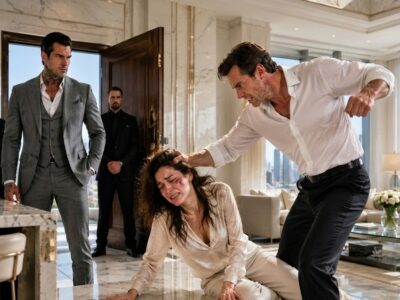
To Luca’s left, Marco Montero leaned against the stone balustrade, a glass of prosecco in hand and a politician’s easy smile on his lips. Marco was the underboss, handsome and polished. He had spent the last five years quietly building alliances, positioning himself for the day Luca’s “sterility” would finally cost him the throne.
The silence on the terrace was interrupted by a sharp, buzzing vibration against Enzo’s jaw. He touched his earpiece, his sharp features tightening. He listened, then slowly turned to Luca. His face had gone uncharacteristically pale.
“What is it?” Luca asked, his voice a low, dangerous baritone.
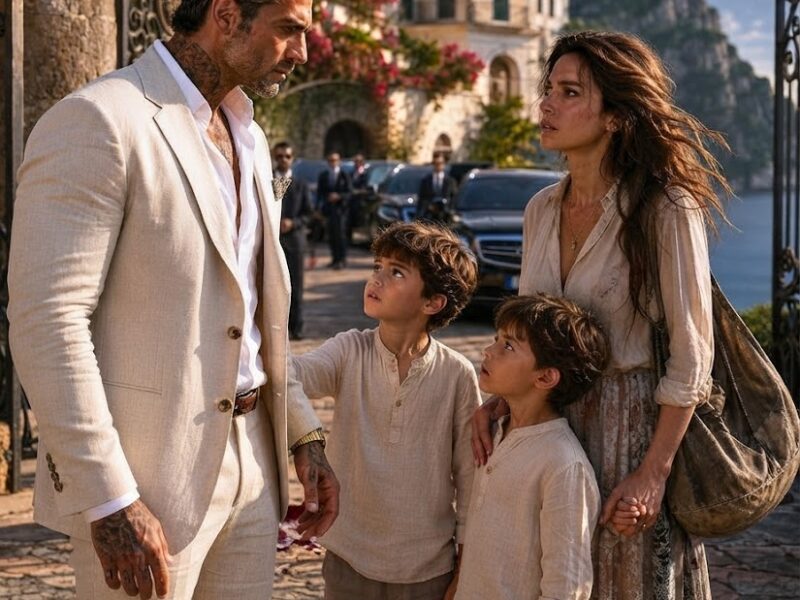
“There is a disturbance at the outer gate,” Enzo said, his voice barely audible. “A woman. Two young boys. They arrived on foot, no vehicle, no security clearance. They are refusing to leave.”
Luca’s amber eyes narrowed. “A Trojan horse? During the summit?”
“Wait,” Enzo said, holding up a hand. He pulled an encrypted tablet from his jacket and tapped the screen, pulling up the security feed from the front gate. He froze. After a long moment, he wordlessly turned the tablet toward Luca.
Luca’s glass slipped from his fingers, shattering against the terracotta floor. The spray of red wine looked like blood on the sun-bleached stone. On the screen stood a woman with wild chestnut hair and green eyes, gripping the hands of two six-year-old boys. The boys stood perfectly still, their faces turned toward the camera.
They had his eyes. The unmistakable, piercing amber eyes of the Montero line.
The woman was Sarah Malone. The forensic accountant who had vanished seven years ago with a secret that would ignite a war.
Part 2: The Archive of Lies
Seven years ago, Sarah Malone had been nobody—at least, in the way powerful men measured value. She was a forensic accountant from South Boston, the daughter of a diesel-stained dock worker and a woman who had mastered the art of stretching a paycheck until it screamed. She understood debt before she understood algebra. She read balance sheets the way others read scripture, seeing the places where the numbers lied.
She had come to the Montero organization to audit his accounts, expecting a transient, high-paying job. She had found a man who was as cold and precise as the numbers themselves. Luca, freshly ascended to his father’s throne, had looked at her like a variable to be solved. But they had grown closer, late-night arguments about risk assessment turning into stolen moments of absolute, devastating honesty.
The affair was their secret. Four months of reckless, life-altering intimacy inside a Lincoln Park safe house.
Then, on a Tuesday in May, Sarah had seen two lines on a pregnancy test.
She had planned to tell him on Friday. But on Wednesday, Marco Montero had arrived at her door. He was smiling, as always, but his men had held the weight of death in their eyes. He showed her photos—her mother at a grocery store, her sister at a crosswalk—and he told her that if she stayed, they would die. If she left, they would live.
She left that night, vanishing into the gray anonymity of a life in Maine. She became Sarah Mercer. She raised her twins, Matteo and Nico, in a small cottage that smelled of salt air and wood smoke, teaching them to be invisible, to be quiet, to be safe. She watched them grow, seeing more of Luca in them every single day—the way Matteo tilted his chin when he was suspicious, the way Nico hummed Vivaldi in his sleep.
For seven years, she kept them hidden behind a wall of silence. But the wall hadn’t just stood still; it had been dismantled, piece by piece.
Three weeks ago, she saw the man at the school fence. Then, the black sedan parked outside her cottage in the dead of night. Then the call from her sister in Boston, sobbing about men in suits asking questions about “Sarah Mercer.”
Marco had found her.
Through a desperate, tangled web of contacts, she learned the truth: the commission was gathering at Villa Saraphina, and Marco was preparing to seize the throne. He would use the claim that Luca was sterile—a diagnosis she now knew was a lie—to call for a leadership vote. And he would eliminate the only threat to his power: the boys with the Montero eyes.
Running was no longer an option. She wasn’t just a woman anymore; she was a mother with nothing left to lose. She took her boys, destroyed every trace of her life in Maine, and traveled four thousand miles to the iron gates of the devil himself.
As she stood there, with Matteo and Nico holding her hands, she looked up at the camera. She knew he was watching. She knew the war was beginning. And she was ready to burn the whole empire to the ground to keep her sons alive.
Part 3: The Reckoning
Luca’s order to open the gates hung in the air like a death sentence. Enzo protested, his voice sharp with the logic of security, but Luca ignored him. He was a man who had spent millions searching for a ghost, and the ghost was now walking toward him with his own bloodline in her hands.
The grand marble foyer of the villa was silent as Sarah and the boys were led to the private study. Luca stood behind his grandfather’s desk, his hands white-knuckled against the polished wood. When the door opened, the air in the room felt ionized, charged with seven years of grief and fury.
Sarah walked in, her head held high. She was thinner, the edges of her face sharpened by years of fear, but her green eyes were burning with a cold, terrifying light. Matteo stood in front, his small shoulders square, his eyes—that perfect, unmistakable amber—locking onto Luca’s. Nico clung to Sarah’s side, his gaze moving around the room with a patience that made Luca’s breath hitch.
“I didn’t come here for you, Luca,” Sarah said, her voice steady and rhythmic. “I came here because your cousin is a monster, and he has spent seven years hunting my children.”
She didn’t cry. She placed a thumb drive on the mahogany desk. “This is why he told you that you were sterile. This is the wire transfer he made to the fertility specialist to rig your results. This is the proof of the sabotage of your marriage.”
Luca looked at the drive, then back at his sons. The room seemed to expand and contract. He looked at Matteo, who tilted his head, copying Luca’s exact stance, and he felt his heart rupture.
“Are you the man who is going to stop the bad people?” Matteo asked, his voice small but piercing.
Luca dropped to one knee, ignoring the protocol, the guards, and the history. He brought his eyes to the boy’s level. “I am.”
Matteo leaned in, looking at Luca’s eyes. “You have the same eyes as us.”
“I know,” Luca whispered, his voice cracking. “I know.”
Enzo stepped forward, his face a mask of stone. He had heard the truth. The betrayal wasn’t just an insult; it was an act of war. “Luca,” he said quietly, “we have to move. The commission is in the dining room. They’re waiting for the speech.”
Luca rose. The devastation in his eyes had hardened into a cold, diamond-sharp purpose. “Move them to the secure wing. If anyone touches this door, they die. Understood?”
Enzo nodded. “Understood.”
Luca turned to the door. He checked the weight of the Beretta at his side. He didn’t need a strategy anymore. He had the truth. And the truth was a weapon that would cut through the commission like a scythe. He walked toward the dining room, his footsteps echoing on the marble, each one a promise of the fire that was coming for his cousin.
Part 4: The Dinner of Death
The dining room was a theater of shadows. Twenty feet of reclaimed oak, set with porcelain and silver, held the five most dangerous men in Europe. They were wolves in bespoke wool, waiting for the feast.
Marco sat at the table, his smile now a permanent fixture of his face. He felt the tension in the room, but he interpreted it as fear—the fear of a man who was about to be displaced. He rose to give his speech, a masterpiece of fabricated sorrow. He spoke of the Montero legacy, the “tragedy” of Luca’s condition, and the necessity of passing the torch.
He spoke for ten minutes, weaving a tapestry of lies so beautiful that even Don Ferraro looked moved. When he sat down, the silence was total.
“Thank you, Marco,” Luca’s voice came from the threshold, low and smooth.
Every head turned. Luca walked into the room, his movements fluid and relaxed. He was not carrying a weapon in his hand, but the men around the table could feel the change in the air. The temperature seemed to drop ten degrees.
“You have always been so concerned with the future of the family,” Luca said, moving to the head of the table. “It’s touching, really.”
Luca signaled to Enzo, who tapped his phone. A screen on the wall flickered to life.
The financial records spilled across the room. The wire transfers, the bank statements, the emails between Marco and Dr. Rinaldi. Every lie, every bribe, every sabotaged IVF session was laid bare for the commission to see.
Marco’s face collapsed. The polished mask shattered, leaving behind the raw, ugly features of a man who realized he was drowning.
“What is this?” Don Kazal asked, his voice a low growl.
“This,” Luca said, stepping closer to Marco, “is why my cousin isn’t fit to be a dog, let alone a boss.”
Enzo opened the side door. Sarah walked in, the twins flanking her. The room went dead silent. The boys stood in the candlelight, and as they looked up, the amber eyes reflected the flames, a haunting, undeniable mirror of the man standing at the head of the table.
“Meet my sons,” Luca said. “The ones Marco tried to kill for seven years.”
The room erupted into chaos. Don Ferraro stood up, his face twisted in disgust as he stared at Marco. The neutrality of the other bosses vanished; they were not going to back a man who had committed such a clumsy, pathetic betrayal.
Luca leaned down to Marco’s ear, his voice a cold whisper. “I’m not going to kill you here, Marco. That would be too quick.”
Marco began to shake, his skin turning a sickly gray. He was escorted out of the room, not by his own men, but by guards who wouldn’t even meet his gaze. The war was over before the main course was served.
Part 5: The Reconstruction
The dawn broke over the Amalfi Coast, painting the villa in hues of gold and honey. The political landscape of the underworld had been scorched earth. By sunrise, the Montero name was erased from the registry for Marco, his assets seized, his influence burned away by a series of precise, surgical strikes.
The villa was quiet, but the quiet felt different now. It wasn’t the silence of a fortress under siege; it was the silence of a home coming back to life. In the secure wing, Sarah sat on the edge of a bed, watching her sons sleep. Matteo, one arm thrown over his head in a careless sprawl; Nico, curled on his side, his hand resting on his brother’s arm.
She felt a presence at the door. Luca stood there, his shirt sleeves rolled up, the Beretta gone. He looked older, tired in a way that had nothing to do with the night’s events and everything to do with the two boys on the bed.
He didn’t enter. He stood at the boundary, a king waiting for a permit to cross into his own heart.
“You don’t have to stay there,” Sarah said quietly.
“I wanted to be sure,” he replied.
She looked at him, really looked at him, for the first time since she had walked into the study. The anger was still there—the betrayal of seven years, the cost of the hiding, the fear—but beneath it, a desperate, aching pull remained.
“Trust isn’t built in a night, Luca,” she said. “It’s built in inches. School runs. Bedtime stories. Being there when they’re sick. You want to be a father? Then you earn it. Every single day. If you think you can just buy your way back into their lives, you’re wrong.”
Luca nodded once. “I understand.”
“Do you?” She looked at him with that fierce, brilliant intelligence. “Because you are a man who commands armies. This isn’t an army. It’s a life. It’s fragile. And if you break it, I won’t just leave. I will destroy you.”
“I know,” Luca said. “And I would deserve it.”
That afternoon, they moved to the garden. Luca sat on a stone bench under an olive tree, looking terrified. It was the most honest he had ever looked. Matteo walked up to him, his stride mirroring Luca’s own, and looked him in the eye.
“Are you our father?”
“Yes.”
“Why were you not there before?”
Luca looked at Sarah, then back at his son. “Because someone kept us apart. But I am here now. And I am not going anywhere.”
Nico sat down beside Luca and placed a small, steady hand on the man’s calloused palm. He didn’t speak. He just held on. Luca looked down at that hand, and the last wall inside him—the one built of marble and ego—crumbled into dust.
Part 6: The Tuscan Silence
Three months later, the world had shifted. The Montero name was synonymous with a new kind of power: quiet, untouchable, and firmly rooted in the landscape of Tuscany.
They lived in a sprawling stone estate surrounded by rolling hills of lavender and olive groves. It was secured, of course—Luca would never abandon his nature entirely—but the security was invisible. The armed men were there, but they wore flannel shirts and carried groceries instead of submachine guns.
Sarah had established her own firm in Rome, commuting twice a week. She was not a mafia wife. She was a partner. She was a mother. She was a woman who corrected Luca’s grammar and argued about financial policy over dinner.
The rebuilding was a slow, agonizing process. There were long nights on the terrace when the silence was thick with the ghosts of the years they had lost. They argued about the past, about the fear, about the impossible math of their existence.
But there were also moments of profound, simple grace.
One evening, Luca found himself helping Nico with a long-division worksheet at the kitchen table. He was a man who could calculate the logistics of a global shipping operation in his head, yet here he was, sweating over a fraction.
“You have to carry the one, Papa,” Nico said, his eyes bright and patient.
Luca laughed, a genuine, startled sound. “Right. Carry the one.”
He realized then that the boys weren’t just reflections of him; they were the future he hadn’t known he deserved. Matteo had his temper, sure—a fierce, stubborn fire that would occasionally erupt over a broken toy or a missed goal. Luca didn’t shout. He sat on the floor, waited for the storm to pass, and taught the boy how to breathe.
Enzo came by on Thursdays. Sarah would listen from the barn office, slipping handwritten notes under the door—insights into the organization’s architecture that made Enzo pause and rethink his entire strategy. Luca found himself laughing at the way his most lethal operative was being outmaneuvered by a woman with a spreadsheet.
“You’re being handled, Luca,” Enzo joked one afternoon.
“I know,” Luca replied. “It’s the most refreshing thing that’s ever happened to me.”
He was terrified, constantly. He knew that the moment you have something worth losing, the world becomes a dangerous place. But as he sat on the steps of the farmhouse on a warm October night, watching his sons chase a football through the sunflowers, he realized that for the first time in his life, he wasn’t looking at the horizon for enemies. He was looking at his life, and it was enough.
Part 7: The Empire of Dust
The Tuscan sun dropped behind the olive groves, bathing the estate in amber and rose. It was the end of another ordinary day—a day of school runs, of math problems, of scraped knees and laughter.
Luca sat on the stone steps, a glass of Chianti in his hand. Sarah stepped out of the farmhouse and sat beside him. Her shoulder brushed his, a spark of contact that still felt like a jolt of electricity even after all this time. She had a thick financial report tucked under her arm, but she wasn’t reading it. She was just watching the boys.
Matteo scored a goal against the wind and sprinted toward them, his face flushed with the kind of joy that made Luca’s heart ache. He dove into Luca’s lap, the careless, total trust of a child who knew he was safe. Nico followed, climbing up to sit by Sarah’s side, leaning his head against her arm with a contented sigh.
“They’re getting big,” Sarah said softly.
“They’re perfect,” Luca whispered.
He watched the light fade from the sky, the hills turning into silhouettes against the darkening blue. He thought about the Villa Saraphina, the marble, the fear, the gold-plated knives, and the men who had bowed to him in terror. He thought about the billions of euros, the shipping fleets, the power that had felt like an absolute shield.
He realized now that none of it was real.
Real was the weight of his son on his knee. Real was the smell of lavender and the sound of his children’s breathing. Real was the woman beside him who had saved his soul when he didn’t even know it was lost.
“I didn’t think I could be this,” Luca said, his voice quiet. “I didn’t think there was room for this in my life.”
Sarah looked at him, her green eyes capturing the last of the light. “You made room, Luca. You tore down the walls yourself.”
“I think I’m still learning how to be a person,” he admitted.
She squeezed his hand. “We all are.”
Matteo leaned back, looking up at his father. “Will you read to us tonight, Papa?”
Luca looked at his son, then at Sarah, then out toward the vast, dark expanse of his estate. He had built an empire, yes. He had commanded the world from a throne of stone. But this—this small, fragile, ordinary moment—was the only empire that would ever matter.
“I would like that,” Luca said, rising to his feet and pulling his sons toward the house.
He walked toward the door, his arm around his wife and his heart entirely, irrevocably in the hands of the people who called him home. The war was over. The past was a ghost. And for the first time in a life defined by battles, Luca Montero was finally, perfectly, at peace. He opened the door, the light from the kitchen spilling out into the dark, and they stepped inside, leaving the world behind them.