Korean Mafia Heir Told His Black Wife to Leave — She Took His Entire Empire With Her
Part 1: The Elevator Chimed
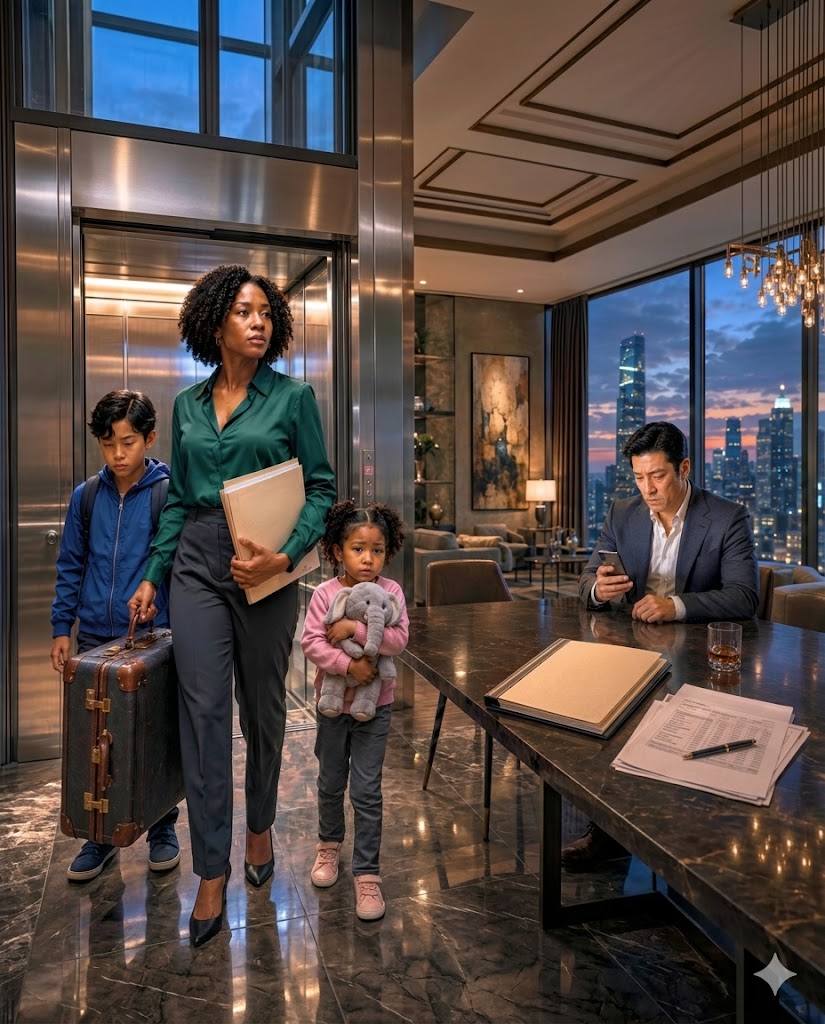
The elevator doors hadn’t opened yet. Thirty-four floors above the Chicago River, inside a steel box barely large enough for three people and one small suitcase, Amara Osei stood completely still. Kofi was on her left, eight years old, his backpack on, staring at the floor the way children stare at things they are trying not to cry about. Senna was on her right, five years old, one arm wrapped around a stuffed elephant named Pepper, the other hand folded inside her mother’s.
The suitcase between them held four days of clothes. Four days was all Amara had packed. Not because that was all she needed, but because that was all she was taking.
The reflection in the polished steel doors showed a woman with her shoulders back, her jaw set, and her eyes focused on something the doors couldn’t show. Something on the other side of this moment: past the lobby, past the parking garage, past whatever came next. She did not look like a woman who had just been asked to leave.
The elevator chimed. The doors opened. Amara did not look back.
What the onlooker—the man who would later realize his life was hollow—did not know, standing in that penthouse with his phone already in his hand, was whose name was actually on every document, every account, and every contract that made his life possible. He would find out, just not the way he expected.
Duhyun Kang had never once in his life walked into a room and wondered whether he belonged there. That was not arrogance exactly. It was something older than arrogance, something inherited. He was forty-three years old, Korean-American, the eldest son of Minjai Kang—a man whose name, depending on who you asked and how well they knew him, meant either “Real Estate Empire” or something that required a lower voice and a quick glance over the shoulder before answering.
Kang Continental had its offices on the 29th floor of the Harrington Exchange building in Chicago’s West Loop. The lobby carpet was gray as river fog. The windows faced the Chicago River directly, and on clear mornings, the light came through at an angle that made the whole room look like the inside of a very expensive promise.
There was a photograph near the entrance. Minjai, thirty years younger, shaking hands with a former mayor of Chicago. Both men smiling. Neither one explaining what the handshake was actually about. Duhyun had grown up understanding that some things were not explained. They were simply understood.
His father had built Kang Continental across three decades and two continents, starting with logistics contracts that no one asked too many questions about, and ending—or trying to end—with something cleaner. Something his son could inherit without needing a lawyer present every time someone said the family name. That was why Duhyun had been sent to study in the United States at seventeen. That was why he had stayed.
And that was why, in the spring of 2015, he had attended a corporate restructuring seminar at the L.E. Chicago Hotel and found himself sitting three chairs away from the most focused person in the room.
Her name was Amara Osei. She was thirty-seven years old, Ghanaian-American, a corporate financial attorney who had graduated first in her class from Northwestern Law in 2011 on a full scholarship that she had applied for herself—without anyone’s help—at the age of seventeen. The same age Duhyun had been put on a plane to America by a father who could afford to solve problems by writing checks.
Amara’s father, Emmanuel Osei, had solved problems differently. He had worked two jobs in Chicago for eleven years before opening a small accounting firm in Evanston. He had told Amara when she was nine years old and had just been passed over for a school award she had clearly deserved, something she would carry for the rest of her life: “The room will always underestimate you first. That is not an insult. That is your advantage. Use it.”
She had used it every single day since.
At the seminar, Duhyun had watched her dismantle a flawed financial model in front of forty people. Not loudly, not cruelly, but with the kind of precise, unhurried confidence that comes from someone who has been the smartest person in the room so many times that it no longer requires any effort. He had introduced himself afterward. She had shaken his hand and immediately asked him two questions about his company’s asset structure that no one had ever asked him before.
He was attracted to her intelligence before he was attracted to anything else. They were married in 2016, and from the beginning, there was something underneath the love—something Duhyun could not name, and therefore could not fix. He had grown up watching his father make every decision and his mother, Yuna, make none. Not because she was incapable, but because that was the architecture of their life, and no one had ever questioned the blueprint. Duhyun had not questioned it either. He had simply, without realizing it, without meaning to, tried to build the same structure in a different city with a woman who had never once in her life agreed to live inside someone else’s design.
Part 2: The Architecture of Silence
Yuna Kang came to Chicago twice a year. She always brought kimchi she had made herself, packed in glass jars wrapped in newspaper. She always sat in the center chair at the dining table. She always wore something understated and expensive. And she always, always greeted the apartment the way a building inspector greets a property they already have opinions about.
She was not a cruel woman. That was important to understand. She did not say unkind things. She did not raise her voice. She had, in nine years, never once said anything directly negative to Amara’s face. She simply had a way of being present that made certain things invisible.
On her most recent visit, three months before everything changed, Yuna had sat at that center chair while Amara served dinner—a meal Amara had prepared after a twelve-hour workday, after picking up both children from school, after fielding three calls from a client in crisis. Yuna had taken one bite, set down her chopsticks, and said to no one in particular, “The galbi is very tender.”
Then she had turned to Duhyun and asked about the Riverside Project. Not to Amara—to Duhyun. The Riverside Project: a $4.7 million commercial contract that Kang Continental had been on the verge of losing four weeks earlier, before Amara had spent six consecutive evenings restructuring the liability framework and personally called the client’s legal team to walk them through every clause until their concerns were resolved.
Yuna did not ask about that. She asked Duhyun how the project was going. Duhyun said it was going well. Amara refilled the water glasses and said nothing.
That was the thing about Yuna Kang that was so difficult to explain to anyone who hadn’t lived inside it. There was no single incident, no explosion, no moment so obvious it could be pointed to. There was only the accumulation. Years of dinners where Amara’s professional accomplishments went unacknowledged. Years of family gatherings where she was thanked for the food and asked about the children and never, not once, asked about her work.
And Duhyun’s silence through all of it—not out of agreement, but out of the deeply conditioned reflex of a man who had learned, very young, that keeping peace in his mother’s presence was simply what you did. He had never understood what that silence cost.
After dinner that evening, after the children were in bed and Yuna had retired to the guest room and Duhyun had fallen asleep quickly—the way he always did—Amara sat at the kitchen island with a glass of water and her laptop open. The apartment was quiet. The city moved thirty-four floors below. She looked at the reflection in the window for a long moment. The kitchen behind her, the hallway dark, the whole careful life she had helped build, visible in the glass like a photograph of something that was already changing.
Then she opened a new document. She stared at the blank page. She did not type anything yet. She simply sat with the weight of what she already knew. The way a structural engineer sits with the knowledge of a crack in a foundation—not panicking, not dramatic, just quietly calculating what comes next. She had seen this pattern before, not in her marriage, but in her clients: men who believed the structure around them was permanent, who never stopped to ask who had built it or what would happen if that person chose to stop.
She knew what happened. She knew exactly what came next.
Cassie Hall had done her research. That was the part people never talked about afterward—the part that got lost in the easier narrative of a man who made a foolish choice. The truth was more uncomfortable than that. Cassie was not a woman who stumbled into situations; she was a woman who studied them first.
She was thirty-one years old, a lifestyle influencer with 340,000 followers on Instagram and a personal brand built around the aesthetic of effortless luxury. The kind of luxury that required, in reality, a great deal of careful effort to maintain. She had attended the Kang Tower launch event in River North on a Tuesday evening in October, not because she had been invited, but because she had found the guest list, recognized the name Kang Continental, and spent forty-five minutes reading about the company before deciding the evening was worth her time.
She had worn a dress the color of champagne. She had positioned herself near the architectural renderings. And when Duhyun walked past with two associates, she had said something about the rooftop design that was specific enough to sound informed and vague enough to invite a conversation.
Duhyun had stopped. He was tired that evening in a way he couldn’t explain to anyone. Tired in the particular way of a man who has everything he was supposed to want and cannot understand why it feels like not quite enough.
Amara was at home. She had a client call at 9:00 p.m. She had told him to go, to represent the company, to enjoy the event. He had kissed her on the cheek and left. And standing in front of those architectural renderings with a woman who was looking at him like he was the most interesting thing in the room, he felt something he hadn’t felt in a long time. Not love, not even attraction exactly. Recognition.
“A man like you,” Cassie said that evening, tilting her glass slightly in his direction, “shouldn’t have to explain himself to anyone.” She paused. “Not even to his own wife.”
She said it lightly, almost as a joke—the kind of sentence that could be laughed off or leaned into, depending on what the listener needed it to be.
Duhyun did not laugh it off.
Three weeks later, he was coming home later than usual. Five weeks later, he was taking calls in the parking garage and sitting in his car for twenty minutes before coming inside, the blue light of his phone visible from the kitchen window where Amara sometimes stood while the children finished their homework.
She saw it. Of course, she saw it. She did not go to the window to confront him. She did not check his phone. She did not do any of the things that fear makes people do. She made Kofi’s lunch for the next day and thought about what she already knew.
The breaking point—the moment Amara would later identify as the one where everything became irreversible—did not happen at home. It happened at a function.
Part 3: The Gala of Glass
Kang Continental’s annual client appreciation dinner was held on the second Friday of November at Proximo, a private event space on the 22nd floor of a building in the Fulton Market District. The room had floor-to-ceiling windows and a view of the city that made people feel briefly like the world was manageable.
Amara wore a deep green dress. She had spent the prior week finalizing a 47-page legal framework for a commercial real estate acquisition—a document that, once executed, would generate $2.3 million in projected revenue for Kang Continental over the following eighteen months.
She was standing beside Duhyun when one of his longest-standing clients, a developer named Warren Briggs, approached them with his hand already extended. Briggs shook Duhyun’s hand. Then he looked at Amara. Then he looked back at Duhyun.
“Is she your assistant?” he asked.
He was not being cruel. He simply genuinely had not considered any other possibility. The silence that followed lasted perhaps two seconds. Duhyun smiled.
“This is my wife,” he said, and then almost immediately turned back to Briggs to ask about a project in the South Loop.
Not, This is my wife who wrote the contract you signed last quarter. Not, This is my wife who has kept this company legally protected for the past seven years. Just, This is my wife. And then away.
Amara smiled at Warren Briggs. She shook his hand. She said it was lovely to meet him. She held her glass of sparkling water and stood in that room for another ninety minutes, and spoke when spoken to, and laughed at the right moments, and gave nothing away. She was very good at that.
They got home at 11:23 p.m. Duhyun checked his phone in the elevator and was asleep by midnight. Amara changed out of her dress, checked on both children, stood in the doorway of Senna’s room for a moment, watching her daughter sleep with one arm thrown over Pepper the elephant, and then walked to the kitchen.
She sat at the island. She opened her laptop. The clock in the corner of the screen read 11:47 p.m. She opened a new document. She stared at the blank page. She did not type anything yet. She simply sat with the weight of what she already knew. The way a structural engineer sits with the knowledge of a crack in a foundation—not panicking, not dramatic, just quietly calculating what comes next.
She had seen this pattern before, not in her marriage, but in her clients: men who believed the structure around them was permanent, who never stopped to ask who had built it or what would happen if that person chose to stop. She had seen what happened. She knew exactly what came next.
Cassie Hall had done her research. That was the part people never talked about afterward—the part that got lost in the easier narrative of a man who made a foolish choice. The truth was more uncomfortable than that. Cassie was not a woman who stumbled into situations; she was a woman who studied them first. She was thirty-one years old, a lifestyle influencer with 340,000 followers on Instagram and a personal brand built around the aesthetic of effortless luxury. The kind of luxury that required, in reality, a great deal of careful effort to maintain.
She had attended the Kang Tower launch event in River North on a Tuesday evening in October, not because she had been invited, but because she had found the guest list, recognized the name Kang Continental, and spent forty-five minutes reading about the company before deciding the evening was worth her time.
She had worn a dress the color of champagne. She had positioned herself near the architectural renderings. And when Duhyun walked past with two associates, she had said something about the rooftop design that was specific enough to sound informed and vague enough to invite a conversation.
Duhyun had stopped. He was tired that evening in a way he couldn’t explain to anyone. Tired in the particular way of a man who has everything he was supposed to want and cannot understand why it feels like not quite enough.
Amara was at home. She had a client call at 9:00 p.m. She had told him to go, to represent the company, to enjoy the event. He had kissed her on the cheek and left. And standing in front of those architectural renderings with a woman who was looking at him like he was the most interesting thing in the room, he felt something he hadn’t felt in a long time. Not love, not even attraction, exactly. Recognition.
“A man like you,” Cassie said that evening, tilting her glass slightly in his direction, “shouldn’t have to explain himself to anyone.” She paused. “Not even to his own wife.”
She said it lightly, almost as a joke—the kind of sentence that could be laughed off or leaned into, depending on what the listener needed it to be.
Duhyun did not laugh it off.
Three weeks later, he was coming home later than usual. Five weeks later, he was taking calls in the parking garage and sitting in his car for twenty minutes before coming inside, the blue light of his phone visible from the kitchen window where Amara sometimes stood while the children finished their homework.
She saw it. Of course, she saw it. She did not go to the window to confront him. She did not check his phone. She did not do any of the things that fear makes people do. She made Kofi’s lunch for the next day and thought about what she already knew.
The breaking point—the moment Amara would later identify as the one where everything became irreversible—did not happen at home. It happened at that gala. And it wasn’t just about the assistant remark. It was about the seven years of structural erosion that had led to it.
Part 4: The Exit Framework
She worked until 1:30 in the morning. She closed the laptop, washed her glass, turned off the kitchen light, and went to bed. Two weeks later, Kofi came to her while she was folding laundry on a Sunday afternoon. He stood in the doorway of the bedroom with his soccer cleats still on and his jacket half-unzipped, and he looked at her with the particular expression of a child who has been trying to figure out how to ask something for a long time.
“Mom,” he said. “Is Dad okay?”
Amara set down the shirt she was folding. She looked at her son—eight years old, his father’s jawline, her father’s eyes—and she felt something move through her chest that she would not name out loud. Not then, not in front of him.
“Dad is going through something,” she said. “But you and Senna are okay. That doesn’t change.”
Kofi looked at her for another moment. Then he nodded. The way children nod when they don’t entirely believe you, but have decided to trust you anyway. He went back to the hallway.
Amara picked up the shirt again. Her hands were completely steady. What no one watching from the outside could have understood—what Duhyun himself did not understand—was that the woman folding laundry in that bedroom, the woman who had smiled at Warren Briggs and said nothing, the woman sitting alone at 11:47 p.m. with a blank document and a clear head, was not waiting for something to happen. She was already ninety-three days into making sure that when it did, she would not be the one left with nothing.
The filing was ready.
Clare Adame opened the door before Amara knocked. She had been waiting. That was the thing about Clare. She was always already there, already prepared, the way people are when they have known you long enough to understand your silences as well as your words. They had met during their first week at Northwestern Law. Two women in a lecture hall full of people who assumed they knew each other already simply because they were both Black, and had built over seventeen years the kind of friendship that does not require explanation.
Clare looked at Amara. Then at Kofi—backpack on, jaw set, his mother’s composure already beginning to take root in him, the way composure does when children learn it from someone they love. Then at Senna, still half-asleep against Amara’s shoulder, Pepper the elephant hanging from one hand.
“Come in,” Clare said. She did not ask what happened. She did not say she was sorry. She simply stepped back, opened the door wider, turned on the lamp in the guest room, and found an extra blanket without being asked. That was enough. That was everything.
After the children were settled—Kofi in the guest bed with his phone face down on the nightstand, Senna tucked against three pillows with Pepper beside her—Amara sat at Clare’s kitchen table. She opened her laptop. She was not crying. She had cried once, six weeks earlier, sitting in her car outside the Harrington Exchange after a meeting. She had walked out of it knowing everything she needed to know. She had sat in the parking garage on level 3 and cried for eleven minutes. Not the soft, cinematic kind, but the real kind—the kind that comes from somewhere structural. And then she had wiped her face, reapplied her lip balm, and driven home in time to help Senna with a puzzle. She had allowed herself those eleven minutes. She had not allowed herself anymore.
“The filing is ready,” Clare said, sitting across from her with two cups of tea.
“Send it Monday,” Amara said.
Clare nodded. She slid a folder across the table. Amara opened it. The prenuptial agreement had been Minjai’s idea. That was the irony that Duhyun would spend a long time sitting with. The fact that the document which would define everything had been requested by his own father to protect the Kang family assets. Minjai had insisted on it before the wedding. His attorney had drafted the initial terms, and Duhyun—in the particular confidence of a man who believed the marriage would last and the document was therefore a formality—had signed it after a twenty-minute review. He had not read page 14.
Page 14 contained the clause that Amara, who had been asked quietly by Duhyun’s attorney to review the draft for any “structural issues,” had suggested adding: a single paragraph, precisely worded, that designated all assets generated through Amara’s independent legal practice as her separate property, regardless of when they were acquired during the marriage. Duhyun’s attorney had read it, had nodded, had said it seemed reasonable. Duhyun had signed. He had been thinking that day about the honeymoon.
The second document in the folder was more recent. Amara set it on the table and looked at it for a moment, not with satisfaction, not with grief, just with the clear-eyed recognition of someone looking at the result of work they had done carefully and done well.
She held 23% equity in the Meridian Group, a boutique legal consulting firm she had co-founded three years into her marriage with two partners, structured entirely under her own name, financed entirely from her own earnings. Meridian had been the entity through which all of Kang Continental’s legal restructuring had been conducted for the past six years. The relationship between Meridian and Kang Continental was not informal. It was a contract—and the contract contained a clause, standard in the industry, unremarkable on its face, that tied the continuity of services to the active participation of the named lead counsel: Amara Osei.
When Amara submitted her formal withdrawal from the Meridian-Kang engagement on the same Monday that Clare filed the divorce papers, three of Kang Continental’s largest active contracts entered a review period. The projected revenue impact over the following quarter was $2.3 million.
Duhyun found out on a Tuesday morning at 9:14 a.m., when his CFO called him into a conference room, closed the door, and set a spreadsheet on the table between them with the kind of careful, practiced calm that people use when they are delivering information they would prefer not to be delivering. Duhyun looked at the spreadsheet. He looked at it for a long time.
Across town, in the offices of a client who had worked with Amara for four years, a meeting was already underway. The client had called Amara directly—not through Meridian, not through any intermediary—and asked if she would be open to continuing the relationship under a new arrangement. She had said she would consider it. She was already considering it.
Part 5: The Evisceration of the Empire
Cassie Hall had been living in the penthouse for eleven days when Duhyun came home from that Tuesday meeting. She was in the kitchen when he walked in. She looked at his face—the particular flatness of it, the way his jaw was set, and his eyes were focused on something she couldn’t see—and she set down her phone.
“What happened?”
He told her the number. 2.3 million.
Cassie was quiet for a moment. Not the sympathetic quiet of someone absorbing difficult news on behalf of someone they love. The calculating quiet of someone running numbers.
“I thought you said the company was stable,” she said.
“It is stable,” Duhyun said.
“2.3 million isn’t stable,” Cassie said. “That’s a problem.”
She said it without cruelty. Simply as a statement of fact—the way someone speaks when they are deciding something. Duhyun did not answer. He walked to the window. The city moved outside.
The phone call from Minjai came three days later. Duhyun was in his office when it rang. He looked at the screen—his father’s name, the Seoul area code—and felt something tighten in his chest that had nothing to do with the financial situation. He answered.
Minjai did not say hello. He spoke in Korean, the way he always did when the conversation was serious—the language of everything that mattered.
“I heard what you did,” he said. His voice was not loud. It never was. Minjai Kang had not needed to raise his voice in thirty years. Volume was for people who had not yet learned that the most dangerous thing a man can do is speak quietly and mean every word.
“I want you to understand something,” he continued. “The men in our family have always confused being feared with being respected.”
Duhyun did not say anything.
“Your grandfather confused them. I confused them. For most of my life, I believed that if people needed me, that was the same as them trusting me. It is not the same. It has never been the same.” He looked at his son directly through the camera of the video call. “I thought you had learned that. I thought because you chose differently than I did, because you built something cleaner, because you married someone with more integrity than anyone in this family deserved… I thought the pattern had stopped with you.”
A long pause. Outside, Chicago moved with its ordinary indifference.
“I was wrong,” Minjai said. “And that is my failure as much as yours. You cannot learn what you are never shown.”
Duhyun sat with that sentence for a long time. Not because it excused him—because it was true, and because the truth in that room, in that chair, under his father’s quiet gaze, had nowhere left to hide.
“What do I do now?” he asked.
“You do what men in this family have never been good at,” he said. “You live with what you chose, and you become, slowly, someone your children are not ashamed of.”
He drank his tea. The conversation was over.
The divorce was finalized on a Wednesday afternoon in March, seven months after the night Amara had walked out of the penthouse with two children and one small suitcase. The settlement reflected, with precise and unsentimental accuracy, the financial architecture Amara had spent ninety-three days constructing.
Duhyun retained his equity in Kang Continental, his personal accounts, and the penthouse—which he subsequently vacated because he found, once alone in it, that every room reminded him of decisions he could not unmake. He lost access to the Meridian consulting relationship permanently. He lost three contracts worth a combined $870,000 in renegotiation costs and penalties. He spent four months working with two new attorneys who charged significantly more than Amara ever had and understood the Kang Continental structure significantly less.
The custody arrangement gave both parents equal time. Kofi and Senna, when asked by the family mediator where they felt most comfortable, both said “their mother’s,” and were surprised. Victor Osei drove up from Atlanta for the signing. He arrived the evening before, took his sister to dinner at a quiet Italian place in Lincoln Park, and spent two hours listening—not advising, not strategizing, just listening, the way he always had, the way that had always been enough.
The next morning, he sat in the waiting area of Clare’s firm in his good jacket with his long legs stretched out and a coffee he had bought from the cart downstairs, and he waited. When Amara came out of the conference room after the signing, Victor stood up. He did not say, I told you so. He did not say, It’s over now. He did not say anything. He simply opened his arms.
His sister walked into them. They stood like that for a moment. Two children of Emmanuel Osei, who had worked two jobs in the city so that his children could stand in rooms like this one on their own terms, on their own. Then Victor stepped back, held her at arm’s length, and looked at her face.
“You good?” he said.
“Getting there,” Amara said.
He nodded once. “That was enough.”
Part 7: The Final Blueprint
Six months later, Osei Law and Advisory occupied a light-filled corner suite on the fourth floor of a converted warehouse building on North Carpenter Street in Fulton Market. Four employees, eleven active corporate clients, a small kitchen where someone always seemed to be making coffee, and a whiteboard near the entrance covered in the kind of organized complexity that looks like chaos to the uninformed and like clarity to anyone who knows what they’re looking at.
Two of the eleven clients had previously been Kang Continental accounts. They had called Amara directly—not through Meridian, not through any intermediary—just called because the relationships had always been with her. And when the situation changed, they followed the person rather than the entity. That was what seven years of doing the work correctly looked like.
On Saturday mornings, Amara walked along the lakefront. Not for fitness, exactly—not for any reason she could have fully articulated to someone who asked. She walked because for nine years she had not had the time or the space to walk alone with her own thoughts. And she was reclaiming it quietly, without announcement, the way she did everything that mattered.
The lake was the same lake it had always been. Gray sometimes, blue sometimes, enormous always. She walked until her mind settled into the particular clarity that only comes from moving without a destination. And then she turned around and walked back.
Kofi had joined a robotics team at his new school. He had called her on a Tuesday evening, his voice pitched three notes higher than usual, to tell her that their team had qualified for a regional competition. She had sat down on the kitchen floor—just sat down right there—and laughed with her whole chest.
Senna took piano lessons on Saturday afternoons. She came home each week with her fingers slightly cramped and her face carrying the specific satisfaction of a child who is learning that hard things become easier slowly if you keep showing up.
The email arrived on a Thursday morning in October. Amara was at her desk. Second coffee, briefs stacked in the order she would address them. The subject line read: Inquiry, Associate Position.
She almost moved it to the folder she kept for applications. Then she read the first paragraph. The sender was twenty-six years old. Her name was Nana Asante. She had graduated from DePaul Law eight months earlier, first in her class on a scholarship she had applied for herself. She had found Amara’s name while researching the Kang Continental restructuring filings—public documents available to anyone willing to look carefully enough—and had spent two weeks reading everything attached to Amara’s name before writing the email.
The last line read: “I want to learn from someone who builds things that last.”
Amara read it twice. Then she set down her coffee and looked out the window at Fulton Market below, at the city her father had worked two jobs to stay in, at the ordinary Tuesday morning moving at its ordinary pace—indifferent to the fact that something small and significant had just happened inside this room.
She thought about her father. She thought about what he had told her when she was nine years old: “The room will always underestimate you first. That is your advantage.” She thought about all the rooms she had walked into since then. All the times the room had underestimated her. All the times she had used it.
She thought about the rooms she was building now. Not for herself alone, but for the people who would come after her and need to see that it was possible.
Then she opened a reply.
“Nana, thank you for your email. I’d like to schedule a call.”
She sent it. She picked up her coffee. She went back to work.
Duhyun came to pick up the children on a Saturday afternoon in November. He pulled up in a car that was not the one he had driven when they were married. He was thinner than he had been. The room-filling confidence that had once been his default setting had been replaced by something more careful—not broken, but recalibrated. The specific humility of a man who has learned the hard way the difference between certainty and wisdom.
Amara opened the door. The children’s bags were already packed and waiting by the entrance, organized and labeled, because that was how Amara did things and had always been. Duhyun stood on the step. He looked at her. He had rehearsed something on the drive over. Several versions of it, actually—different openings, different words—all of them trying to carry the weight of seven months of understanding. He had arrived at “too late.”
“Thank you,” he said, “for never letting what I did become something they carry.”
Amara looked at him for a moment—not with warmth, not with coldness, either. With the steady, clear eyes of a woman who has processed everything he is only now beginning to understand, and who has decided that clarity is more useful than bitterness.
“Your kids, too,” she said. “That doesn’t change.”
She called their names. Kofi came down the stairs with his backpack and his robotics notebook tucked under one arm. Senna followed with Pepper the elephant and her piano sheet music in a folder she was holding very carefully with both hands—the way children hold things they have decided are important.
Duhyun knelt down. He held them both. Held them a little longer than the moment required. The way fathers hold their children when they are also holding an apology that has no other form.
Then he stood.
Amara had already stepped back inside. The door closed behind her softly, the way it always had. Senna was buckled into the backseat. She turned toward the window as the car pulled away from the curb. She saw her mother standing in the front room, visible through the glass, just standing there watching them go, one hand raised. Senna raised her hand back. She waved. Her mother waved.
The car moved into the street. The window passed the frame, and Amara stood alone in the quiet of the life she was building. Not the one she had planned, not the one she had imagined, but the one that was hers now—entirely and completely hers.
And she watched until the car turned the corner.
Then she turned back to the room. She had work to do.
Some people spend their whole lives building something and never stop to ask whose name is on the foundation. They assume it is theirs because they are standing on it. They do not ask who laid it, who maintained it, who came in quietly—without credit, without acknowledgement—and did the work that kept the whole structure from coming down.
Amara Osei knew whose name was on the foundation. It had always been hers. And when she finally let go, when she finally allowed the weight of someone else’s choices to land where it belonged, the truth did not require an announcement. It simply became impossible to ignore.
She wasn’t just a wife who had been wronged. She wasn’t a victim waiting to be rescued. She was the foundation. And foundations, it turns out, do not disappear when someone walks away from them. They remain exactly where they were built, waiting for someone with enough sense to recognize what they are standing on.
So, let me ask you something, and I want you to really sit with this before you answer: How many people in your life are quietly holding more than you realize? Not loudly, not with complaints, not asking for recognition—just showing up every day, doing the work that keeps everything standing, and never once demanding that you notice.
Amara didn’t plot against Duhyun out of hatred. She protected herself because she was a woman who understood that no one else was going to do it for her. And when she finally stopped, when she finally let the weight of his choices land on him instead of absorbing it herself, the truth became undeniable. She wasn’t just a wife. She was the reason the whole thing worked.
Think about the people in your life like that. The ones who never ask for credit. The ones whose absence you would feel immediately, completely, in ways you are not currently prepared for. Do they know you see them? Have you told them?
Drop a comment below and tell us what moment in this story hit you hardest. Was it the dinner where Yuna looked past her? The night Amara opened that laptop at 11:47 p.m.? The drawing Senna left behind? Or was it the door, the way it closed softly both times? Because some endings don’t announce themselves. They just happen quietly, and then they’re done.









