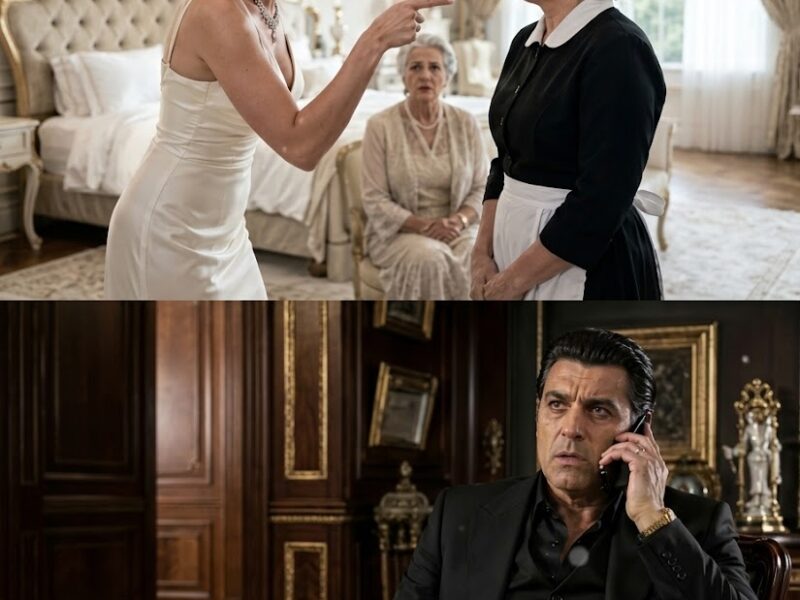
Mafia Boss’s Fiancée Forgot to Hang Up… What He Heard Her Tell the Maid Changed Everything
Part 1: The Weight of Silence
My name is Sophia, and I am telling you this from the very mansion where a single, forgotten phone call changed all our lives. I was not born into money, power, or protection. I was born in a small apartment above a bakery on a narrow street where people knew each other’s troubles before they knew each other’s names. My mother cleaned hotel rooms until her knees gave out, and my father drove a taxi at night, sleeping through the daylight hours. We weren’t wealthy, but we were never ashamed. We learned early that dignity was something poor people had to protect harder than money, because money could disappear in one bad month, but dignity only left when you handed it away.
By the time I was thirty-two, I had never been married. It wasn’t for lack of offers; it was because every offer came with a condition I could never accept. Years ago, I had been engaged to a kind man named Marco. We were supposed to marry before winter ended. Then, my younger sister and her husband died in a road accident, leaving behind their newborn son, Luca. Everyone told me to send the baby to distant relatives to protect my future, to think about my own life before it was too late. Even Marco’s family said a man should not begin his marriage by raising someone else’s child. Marco tried to stand by me at first, but the pressure became heavier than love. His mother stopped speaking to me; his brothers told him he was ruining his life. In the end, the engagement broke, and I let it break. Luca was not my burden; he was my promise. I became a mother before I became a wife, and after that, I stopped accepting any love that asked me to abandon him.
Before the Bellini mansion, I worked at a small care home near the old church district, a place where elderly people came after strokes, accidents, and illnesses took away the simple things most of us never thank God for: a clear voice, steady hands, easy hearing, quick words. Some of them were deaf. Some could hear but could not speak. Some could not write more than two letters before their fingers gave up. I made mistakes at first. I cried in the storage room because I felt useless. But slowly, I learned. I learned basic sign language from an old retired teacher who had lost her hearing as a child. I learned how to read lips. I learned that a person’s eyes can answer before their hands move. I learned that silence is not empty; it is full of meaning when someone has the patience to listen.
That skill became the reason the Bellini household found me. They did not need an ordinary maid. They needed someone who could understand a woman the whole house had stopped trying to understand: Donna Elena Bellini, the mother of the most feared mafia boss in the city. By the time Luca was eight, I had learned how to live with tired feet, unpaid bills, and a smile that only came out when he was watching. He was small for his age, with dark curls that never stayed combed and a habit of asking questions I could not always answer. Every morning, he would stand in the kitchen doorway and ask if my job was dangerous. I always told him no. That was the first lie I ever told my son for love. The mansion stood behind black iron gates on a hill above the city, with guards at every entrance and cameras hidden where flowers should have been. Everything looked perfect from the outside, but perfection in that house felt less like beauty and more like a warning. Little did I know, the biggest warning was about to come from the woman inside.
Part 2: The Trapped Queen
The housekeeper interviewed me in a cold, sterile office. She placed a wooden board in front of me with letters and simple symbols on it. “Can you work with this?” she asked. I told her yes. When she asked about my experience, I told her about the teacher who had taught me signs, about the old men who communicated with two fingers and stubborn eyes. She didn’t smile, but I saw her shoulders relax. “Then you may last longer than the others,” she said.
My first morning, she led me to a large bedroom at the end of the East Wing. Donna Elena sat near the window in a pale blue robe, her silver hair brushed neatly, her hands folded. She looked fragile at first, but when she raised her eyes to mine, I knew she was not weak. She was trapped. There is a difference. Weakness has no strength left; trapped strength is still strength, only locked behind something cruel. She watched the servants who avoided her eyes. She watched the guards who treated her like furniture. When I placed the writing board beside her hand, she looked at me for a long moment, then slowly tapped the wood twice.
“That means thank you,” the housekeeper said. But Donna Elena’s eyes stayed on me, testing me. I tapped the wood twice back to her, then pointed to myself and signed my name: Sophia. Her eyes changed. It was the first time I saw her look at someone in that house and believe there might still be a person behind the uniform.
From that day on, I began learning her language. Two taps meant yes. One slow tap meant no. A finger against the silver cross at her neck meant someone was lying. A closed fist meant pain. Most people in the mansion thought caring for Donna Elena meant feeding and dressing her, but I learned that real care meant listening to what no one else had the patience to hear.
Nico Bellini, the man the staff whispered about as if he were thunder, came to his mother every morning. He never entered with guards. He stopped at the door, knocked once, and waited for her eyes to find him. Then he would walk to her chair, bend down, and kiss her forehead. “Good morning, mama,” he would say. Sometimes she would tap twice; sometimes she would look at me, waiting for me to explain what she could not say. The first time I told him his mother was angry with him, the room went silent. I thought I had gone too far, but Nico looked at his mother and lowered his head like a guilty son, not a feared boss. “You are right, mama,” he said. “I should have come.” That was the moment I understood why Donna Elena still had power in that house. It wasn’t because of her name, but because Nico loved her enough to become small in front of her. But Nico was about to introduce someone into this fragile world who had no intention of loving anyone but herself.
Part 3: The Threat in Ivory
Bianca Rosetti arrived wearing white—not a wedding dress, but something close enough to make every servant understand what she wanted to become. She kissed Donna Elena’s cheek in front of Nico. She held the old woman’s hand. She told him his mother looked beautiful. Nico seemed relieved. He wanted peace. He wanted the two women he cared about to accept each other. But Donna Elena’s fingers tightened on the arm of her chair the moment Bianca touched her. I saw it. Bianca saw it.
In front of Nico, Bianca was gentle. She brought flowers. She asked about meals. She touched the blanket over Donna Elena’s knees and called her “Mama Elena” in a sweet voice that made the staff smile. But when Nico left, the sweetness disappeared. Bianca would stand too close to Donna Elena’s chair. She would move the writing board just out of reach. She would speak slowly, not because Donna Elena could hear her, but because she enjoyed saying cruel things to a woman who could not answer back.
“He will marry me,” she once whispered while fixing her lipstick. “You can stare all you want.”
I stepped forward to help Donna Elena, but Bianca turned and looked at me. “Leave it,” she said softly. “She is tired.”
I didn’t leave it. I placed the board back. Bianca smiled, but there was no kindness in it. That was when I understood she didn’t just dislike me; she feared what I could translate. She feared the fact that I could read the truth in Donna Elena’s eyes. The rule in the Bellini family was absolute: Nico would never marry a woman his mother refused to accept. For Bianca, that wasn’t a tradition; it was an obstacle.
She began visiting Donna Elena when Nico was busy. She brought expensive scarves and imported sweets that Donna Elena never touched. Then she started asking me questions. Does she understand everything? Can she write clearly? If she is tired, could she mistake one sign for another? I answered only what I had to.
One afternoon, Bianca stood beside me and said, “You are very loyal for someone who is paid to be here.” I folded a shawl and said nothing. She tilted her head. “Loyalty is beautiful, Sophia, but it does not pay school fees forever.”
My hand stopped. Bianca smiled. “Luca is eight, yes? Small curly hair, blue backpack.”
I turned to face her. “Do not say my son’s name.”
“Then do not make me,” she replied.
That night, I didn’t sleep. I sat beside Luca’s bed and listened to him breathe. I told myself she was only trying to frighten me, but the next morning, when I walked Luca to school, a black car was parked across the street. The driver didn’t look away. I squeezed Luca’s hand until he complained, my mind racing through a thousand scenarios of how I could keep him safe. I was being hunted by a woman who saw my son as a chess piece. I couldn’t go to Nico—not yet. The truth is only easy when the person threatening you has no access to what you love.
Part 4: The Silent Witness
Donna Elena knew something had changed. She watched me too closely. When I poured her tea, my hand shook. When Nico entered the room, I avoided his eyes. Donna Elena tapped once: No. I looked at her. She tapped again, slower: No. Then she touched the cross at her neck.
“Someone is lying,” I whispered. “Please, not now.”
Her eyes filled with anger—not at me, but for me. She reached for the board and wrote one shaky word: Luca.
My breath left me. “How do you know?” I whispered.
She stared at me, and in that stare was the truth I had forgotten: silent people see everything. The engagement dinner was two days away. The mansion was a machine of flowers, music, and polished glass. Bianca moved through it like she already owned the walls, choosing flowers and changing seating plans, even telling the cook what Nico preferred, though he had never said such a thing.
She inspected Donna Elena’s dress and rejected the first choice because “black makes her look too severe.” Donna Elena looked at me and tapped once: No. I knew she wanted the blue one.
“The blue one,” I said. “Donna Elena prefers the blue one.”
Bianca turned sharply. “Did she say that?”
I met her eyes. “Yes.”
Bianca stepped closer, her voice low. “Be careful, Sophia. You are starting to sound like you think you are family.”
I lowered my gaze. Survival, I realized, sometimes looks like surrender from the outside. But inside, something in me was hardening. That Thursday, one day before the dinner, Nico left for a meeting near the docks. Before he left, he visited his mother. Bianca stood beside him, her hand on his arm.
“Mama,” he said, kneeling. “The next evening is important. I will not marry without your blessing.”
Bianca’s fingers tightened. Donna Elena looked at Bianca, then looked away. Nico didn’t understand the look, but I did. It meant danger.
Bianca spoke quickly. “She is nervous, darling. It is a big night.”
Nico looked at me. “Sophia?”
My mouth went dry. Bianca’s gaze was a knife. I thought of the black car outside Luca’s school. I thought of my son. “She is tired,” I said softly.
Donna Elena’s eyes moved to me, and the disappointment in them hurt worse than anger. Nico stood, kissed her forehead, and left. I stayed behind, unable to breathe. Donna Elena did not look at me for a full minute, then tapped the board: No. “I am sorry,” I whispered. “I am so sorry.”
She wrote slowly: Boy, safe. I covered my mouth with my hand. “I don’t know,” I whispered.
She closed her eyes, and a tear slipped down her cheek. It was the first time I saw her look at me with pity. She was a woman who had already lost her voice and her hearing, and yet, she was still thinking of my child before herself.
Part 5: The Forgotten Line
Later that afternoon, Bianca returned to Donna Elena’s room alone. I was folding linen. Bianca had a phone in her hand, still on a call with Nico.
“She is resting, my love,” Bianca said, her voice dripping with sweetness. “Sophia is with her. Everything is calm.”
She laughed gently. “No, do not worry. The next evening will be perfect. Your mother will bless us. I can feel it.”
She lowered the phone and touched the screen. She thought the call had ended. It had not. Nico was still on the line. She turned toward me, and the smile vanished as if someone had blown out a candle. “Close the door,” she said.
I didn’t move.
“Close it, Sophia!”
I closed it, but I didn’t step away from Donna Elena. Bianca walked toward the old woman. “You are becoming a problem,” she whispered, leaning down. “A useless, silent problem.”
Donna Elena stared at her without blinking. Bianca turned to me. “The next evening, when Nico asks for her blessing, you will make her say yes.”
My throat tightened. “I cannot make her say anything.”
“Do not be stupid,” Bianca hissed. “You are her voice. If you say she accepts me, Nico will believe you.”
“That would be a lie.”
Bianca laughed once, cold and small. “You think this house runs on truth?” She leaned in until I could smell her perfume. “Listen carefully. The next evening, in front of everyone, you will tell Nico his mother blesses the marriage. You will guide her hand if you must. You will do exactly what I tell you.”
I shook my head. “No.”
Bianca’s eyes hardened. “Then your son will never come home from school.”
The room went silent. The clock seemed to stop. Donna Elena’s hand jerked against the blanket. I felt the floor shift under my feet. Bianca smiled because she had hit the right place.
“Blue backpack,” she said softly. “Dark curls. Always waits near the left gate because he likes the guard dog. Children are so easy to find when their mothers are predictable.”
I couldn’t speak. My mind was outside Luca’s school, searching for the one face I lived for.
“And if you try to expose me,” Bianca continued, “I will tell Nico you twisted his mother’s signs because you hate me. I will tell him the poor old woman was confused and you used her silence to control this house.”
“He will not believe you,” I whispered.
Bianca tilted her head. “Are you sure? You are a servant. I am his fiancée.”
Donna Elena reached for the board, but Bianca snatched it and held it against her chest. “No more little messages,” she said. “No more warnings.”
I stepped forward. “Give it back.”
Bianca looked almost amused. “Or what?”
My hands curled into fists. I thought of the black car. I thought of every woman who had been forced to swallow the truth because someone stronger knew where her child slept. I lowered my hands. I couldn’t risk Luca. Bianca saw the surrender and smiled. She placed the writing board on a high shelf where Donna Elena could see it but couldn’t reach it.
The next evening, she said, “You will save your son by giving me what I want.” She turned to the mirror, fixed her hair, and finally noticed the phone. For one second, she froze. The call was still connected.
“Nico?” she whispered.
No answer came. The call ended. She stared at the black screen, then slowly looked at me. “If he heard anything,” she said quietly, “you will say I was emotional. You will say you misunderstood.”
Donna Elena’s eyes burned with silent fury. I said nothing. Bianca stepped close. “Remember your son.” Then she left. I finally understood the terror of the trap. Nico had heard, but would he believe?
Part 6: The Sound of Proof
After Bianca left, I couldn’t move. The phone call had changed everything, but I didn’t know if it had saved us or doomed us. Donna Elena tapped the arm of her chair rapidly. I rushed to her.
“I know,” I whispered.
She pointed toward the shelf. I took down the writing board. Her hand shook so badly the letters broke apart. I held the board steady while she wrote: Nico heard. I looked at the door. “I think so.”
She closed her eyes, and for the first time, I saw hope frighten her more than fear. Hope is dangerous when you have survived too long without it. An hour passed. Then two. Bianca didn’t return. I finished Donna Elena’s tea, helped her wash, and pretended my hands were steady.
At 6:00 p.m., my phone buzzed. It was Luca’s school. I nearly dropped it.
“Miss Sophia,” the secretary said, “your son is safe. A driver from your employer is here to take him home.”
My blood went cold. “What driver?”
“A man named Carlo. He said Mr. Bellini sent him.”
I gripped the phone. “Do not release Luca to anyone.”
“Miss Sophia, Mr. Bellini is here himself.”
I stopped breathing. “What?”
“He is in the office with the principal.”
My knees almost gave out. “Put Luca on the phone.”
A moment later, my son’s voice came through. “Mama.”
“Luca, are you all right?”
“Yes. A tall man came. He bought me a sandwich. He said you were busy.”
Tears filled my eyes. “Stay with the principal. Do not go anywhere unless I call you.”
“Mama, are you crying?”
“No,” I lied. “I love you.”
When the call ended, Donna Elena was watching me. I turned to her, barely able to speak. “Nico was at Luca’s school.”
Donna Elena’s hand pressed against her heart. Nico didn’t come back to the mansion until after dark. By then, Luca was safe in a guarded apartment owned by the Bellini family, with a woman named Rosa who used to care for Donna Elena. Nico had arranged it without asking, without announcing it, without giving Bianca a chance. That was when I understood why his enemies feared him. His anger was not loud. It was precise.
At 9:00 p.m., a guard came to Donna Elena’s room. “Don Bellini wants to see Sophia in the library.”
The library smelled of old leather and cigar smoke. Nico stood by the window, his jacket removed, sleeves rolled up. On the desk lay a phone, a small recorder, and a photograph of Luca outside his school. That recording had captured Bianca’s voice clearly.
“My son is safe,” I said.
Nico turned. His face wasn’t the face of a man betrayed by a fiancée. It was the face of a son who had just learned his mother had been suffering while he walked past the door every day. “I heard enough,” he said.
“I should have told you,” I said.
“Yes,” he replied. Then his jaw tightened. “She knew where your child was.”
I looked down. “I was afraid.”
“You had reason.”
Nico didn’t ask about Bianca first. He asked, “How long has my mother been afraid of her?”
“Since the first day.”
Nico looked away. He turned back to me. “Tell me everything.”
And so, I did. I told him about the board, the cruel whispers, the black car, the way Bianca watched me. He listened without interrupting, his knuckles whitening as I reached the part about Bianca calling his mother “useless.”
“The car outside your son’s school belongs to a man who worked for Bianca’s cousin,” he said. “He was picked up twenty minutes ago.”
“Did you hurt him?”
Nico looked at me, his eyes meeting mine. “I made sure he understood children are not weapons.”
I didn’t ask again. I didn’t have to.
Part 7: The Blessing
The next evening, Friday, October 18th, the mansion was a stage. Florists arrived before sunrise. Caterers moved through the halls. Guards checked every guest name twice. Bianca moved through the chaos in a pale cream dress, her face calm, her hair pinned perfectly.
When she entered Donna Elena’s room, I was brushing the old woman’s hair. Bianca looked at me through the mirror. “How is Luca?” she asked softly.
“Safe,” I said.
Bianca’s smile flickered. “For now.”
“Safe,” I repeated, and this time, there was something in my voice I had never allowed her to hear before.
Bianca turned toward Donna Elena. “Tonight will be beautiful. All you have to do is sit there and let Sophia speak for you.”
Donna Elena slowly lifted her hand and tapped once. No. Bianca’s eyes flashed. “Still stubborn.”
I placed the brush down. “She needs rest before the dinner.”
“Do not forget your place,” Bianca hissed.
I met her gaze in the mirror. “I know my place.”
At noon, Nico came to his mother’s room. He looked as if he hadn’t slept. He knelt before her and took her hand. “Mama, I am sorry. I should have seen it. I should have listened better.”
Donna Elena stared at him, then tapped the board. “Not Sophia’s fault.”
Nico read the words and something in his face broke. “I know.”
“Boy, safe.”
Nico nodded. “Yes, Luca is safe.”
She closed her eyes in relief. Then she wrote one final word: Bianca.
“Tonight,” Nico promised.
The dinner hall glowed with candles. The Bellini family and Bianca’s relatives waited, measuring the marble, the silver, and the power. I stayed near Donna Elena. Bianca entered last, ivory silk flowing around her, looking beautiful enough to make people forget beauty can be a weapon.
Nico stood. The room went silent. “Before I marry, my mother gives her blessing. Without it, there is no marriage.”
Bianca smiled, though her glass trembled. Nico turned to his mother. “Mama. Do you bless my marriage to Bianca Rosetti?”
I placed the writing board in her lap. Her hand shook. Bianca stepped forward. “She is tired. Sophia can tell us what she means, can’t you, Sophia?”
Every face turned to me. Bianca’s voice softened. “Sophia knows Donna Elena better than anyone. Tell them.”
I looked at Donna Elena. Her eyes were steady, trusting. I looked at Nico. He gave a small nod, giving me the choice.
“Donna Elena will speak for herself,” I said.
Bianca snapped. “This is a lie! That maid wrote it!”
Nico lifted his hand. A guard placed a speaker on the table. Bianca’s own voice filled the room—the threats, the coercion, the mention of my son.
She stared at the speaker as if it were a living thing. Then, Nico played the rest. You are a servant. I am his fiancée, and she cannot speak. Nico stopped the recording. “My mother heard lies in you before I did,” he said.
Bianca tried to plead, tried to lie, but it was over. He removed the engagement ring himself, a finality that made the room understand there would be no forgiveness.
“Take her out,” he said.
She screamed as the guards dragged her away, pointing at me. “You ruined everything!”
“No,” I said, my voice cutting through the hall. “You did.”
Nico knelt before his mother, taking her hands. “Mama, forgive me.”
Donna Elena tapped twice. Yes. Months later, we sat in the garden. Nico had learned to listen, and I had learned that courage wasn’t standing alone—it was letting the right people stand beside you. We were family. The mansion was no longer a cage; it was a home that had finally learned how to be warm. Bianca was gone, and the truth had set us free, one tap at a time.