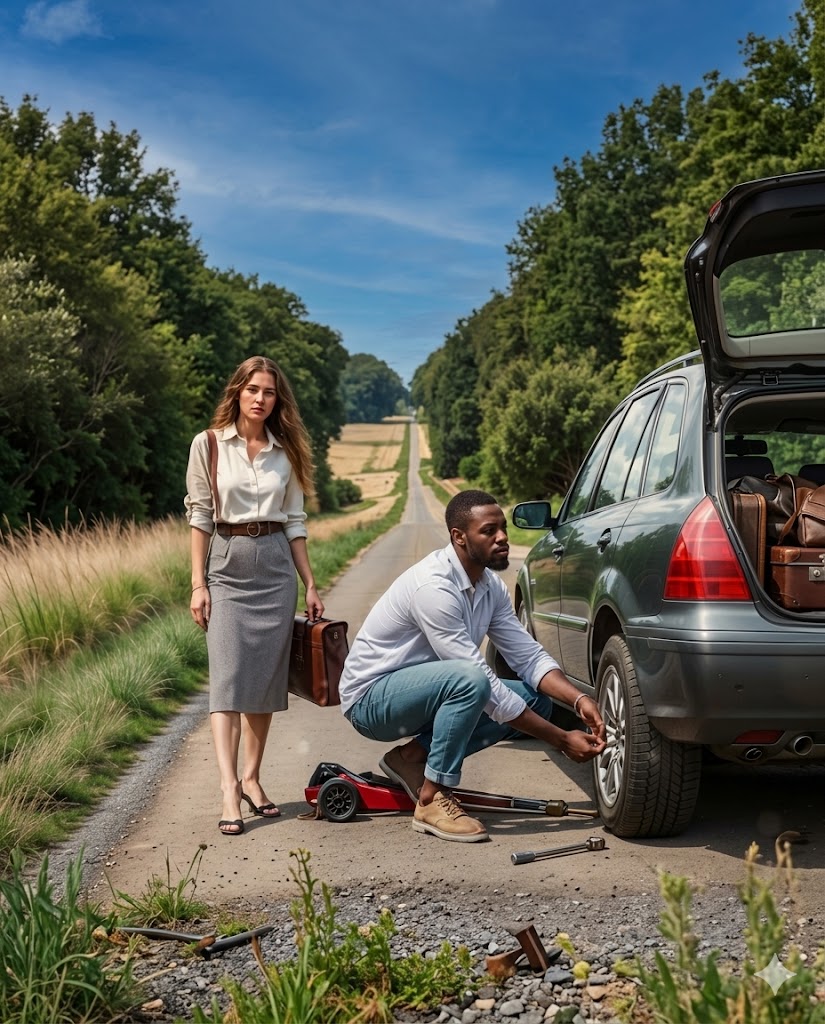
Man Helped a Desperate Woman Change Her Tire. The Next Day, a Black SUV Showed up at his House
Part 1: The Winding Road and the Shattered Rim
Marcus Turner adjusted his grip on the steering wheel of his weathered Ford pickup, the familiar vibration of the engine humming a comforting rhythm against his calloused palms. The sun was dipping below the horizon, casting long, bruised shadows across the narrow, winding asphalt of County Road 12. It was a quiet stretch of road that sliced cleanly through the thick pine woods on the outer edge of Brooksville, a small town where time didn’t just move slowly—it felt entirely heavy, anchored to the Earth by generational habits.
At thirty-five, Marcus had built a life out of the small, discarded fragments of other people’s problems. As a maintenance technician at the Brooksville Community Center, his days were defined by the steady, predictable mathematics of repair. A stripped screw, a dry-rotted pipe, a squeaking hinge on the gym door—these were equations Marcus understood perfectly. He didn’t look for applause or chase after the fast, sharp edges of big-city ambition. He simply believed that if a man left a room slightly more functional than he found it, his day had a purpose. He lived alone in the single-story frame house his parents had left him, a modest property shaded by massive, centuries-old oaks that dropped heavy acorns onto the tin roof during the autumn months.
As his truck rounded a particularly sharp bend where the pine trees crowded the gravel shoulder, Marcus saw the sharp flash of amber hazard lights piercing the deepening violet of the twilight. He automatically eased his foot off the gas pedal. A sleek, late-model silver sedan was pulled awkwardly onto the grass, its frame tilting hard to the rear passenger side. Standing beside the trunk was a woman, her posture tense, her silhouette a sharp outline against the dying glare of her own headlights.
Marcus pulled his truck to a stop twenty feet behind the sedan, leaving his high beams on to illuminate the dark shoulder. He didn’t hesitate; helping a stranded motorist on a dark county road wasn’t a choice for Marcus—it was an instinctive reflex. He stepped out of his truck into the cool evening air, the smell of damp pine needles filling his lungs.
As he walked forward, the woman turned sharply, her hands flying to her chest in a defensive movement. In the bright beams of his truck, Marcus saw her face clearly. She was in her late twenties, with blonde hair pulled back in a tight ponytail that had begun to fray at the edges. She wore a sharp, tailored business suit—a dark pencil skirt and a pale silk blouse—but the fabric was stained with gray highway dust and smudged with dark grease near the cuffs. Her eyes were wide, bloodshot, and frantic with a raw, vibrating anxiety that seemed far too heavy for a simple mechanical breakdown.
“Hey there,” Marcus called out, keeping his voice deliberately low, steady, and melodious, the exact tone he used when calming nervous children at the community center. “Need a hand? Saw the lights from the bend.”
The woman let out a jagged, shuddering breath, her shoulders dropping a fraction of an inch, though her fingers still clutched the fabric of her blouse. “Yes,” she whispered, her voice trembling so violently the words almost broke apart. “Yes, please. I… I have a flat tire. I looked for the tools, I found the jack, but I don’t… I’ve never done this. I can’t get the car up.”
Marcus looked down at the gravel. The sedan’s factory jack was scattered in pieces next to a small, heavy spare tire that looked completely inadequate for the vehicle’s weight. “Don’t you worry about it,” Marcus said with a reassuring nod, stepping into the space between the cars. “I’ve changed more of these than I can count. You step back into the light where it’s safe, and I’ll have you rolling in ten minutes.”
He rolled up the sleeves of his flannel shirt, exposing forearms lined with thick, strong veins earned through years of lifting heavy commercial machinery. He knelt in the dirt beside the rear tire, assessing the damage. The rubber wasn’t just flat; it was completely shredded, torn from the steel rim in long, jagged ribbons. The silver alloy of the wheel was deeply scratched and packed with dark mud, suggesting she had driven on the flat for miles before finally pulling over.
“You must have hit something real hard back there,” Marcus murmured, positioning his own heavy-duty hydraulic floor jack beneath the sedan’s reinforced frame. “This rubber is completely gone.”
Sarah Collins stood exactly where he had told her to, her arms wrapped tightly around her torso as if she were freezing, despite the mild evening air. Her eyes weren’t watching Marcus’s hands; they were constantly darting past the truck, searching the dark, empty road behind them, scanning the black wall of pine trees with a desperate, frantic intensity.
“I didn’t notice,” she said, her voice strained, almost breathless. “I was… I was just driving. It’s been a very long day. I didn’t realize until the steering wheel started pulling out of my hands.”
“It happens to the best of us,” Marcus said, pumping the jack handle. The hydraulic cylinder hissed, and the heavy silver sedan rose smoothly into the air. “The roads out here have a habit of hiding deep potholes in the shadows. If you’re not from around Brooksville, they’ll catch you off guard.”
“I’m not,” she said quickly, her words clipping together. “I just moved to the county a few months ago. I’m still… still trying to find my way around.”
Marcus didn’t press her. He used a heavy lug wrench from his own toolbox, loosening the nuts with smooth, powerful turns. The metal groaned under the force, but Marcus didn’t slow down. He could feel her anxiety radiating through the space between them, a thick, invisible current that made the hair on his arms stand up. He figured she was just shaken by being stranded alone in the dark woods, a natural reaction for someone unfamiliar with the isolation of rural roads.
Within minutes, Marcus had the ruined tire off the wheel hub and was lifting the compact spare into place. He spun the lug nuts on by hand, then tightened them in a star pattern with the wrench, ensuring the wheel seated perfectly flat against the brake rotor.
“There we go,” Marcus said, wiping his greasy hands on a clean red shop rag he pulled from his back pocket. “That’ll get you where you need to go. But remember, this spare is just a ‘donut.’ It’s not meant for the highway, and it’s definitely not meant for long distances. You need to get to the tire shop in town first thing in the morning.”
Sarah looked down at the securely mounted wheel, then up at Marcus. The sheer relief on her face was instantly replaced by a deep, evaluating look, as if she were trying to decode the core DNA of a man who would pull over on a dark road to help a total stranger for absolutely nothing.
“Thank you,” she said, her voice dropping into a softer, steadier register. “Thank you so much, Marcus. I don’t… you don’t know what you just did for me.”
She unzipped her leather handbag, her fingers digging frantically through the interior before pulling out a thick, folded wad of hundred-dollar bills. She extended it toward him, her hand shaking again. “Please. Take this. It’s all I have on me right now, but it’s yours. Please.”
Marcus looked at the money, then reached out and gently pushed her hand back toward her purse. “No ma’am. I appreciate the gesture, but I can’t take that. A man doesn’t charge for doing what’s right. You get home safe, get that tire replaced, and that’s all the pay I need.”
Sarah hesitated, her lips parting slightly in disbelief. “Are you sure? This is… it’s easy money, Marcus. Nobody would know.”
“I’d know,” Marcus said with a warm smile, stepping back toward his truck. “Drive safe now, Miss Sarah.”
He watched her climb into the silver sedan, her movements still hurried but possessing a new purpose. She started the engine, gave him one final, unreadable look through the glass—a mixture of deep gratitude and an underlying terror that he couldn’t quite interpret—and pulled onto the black asphalt, the small spare tire humming against the road.
Marcus drove home in the dark, the encounter lingering in his mind like a persistent echo. He couldn’t shake the memory of her eyes—the way she looked at the woods, as if the shadows themselves were hunting her. He shrugged it off as he pulled into his own gravel driveway, walked inside his dark house, and fell into a deep, dreamless sleep, completely satisfied with his small deed.
The next morning, Marcus woke up at his usual hour, 5:30 AM. He brewed a pot of black coffee, the rich aroma cutting through the cool, stale air of the old house. He poured a mug, stepped out onto his front porch, and froze.
Parked directly across the gravel road, completely idling in the gray morning mist, was a massive, jet-black SUV. The vehicle was entirely brand new, its paint polished to a mirror finish that looked alien against the dusty county landscape. Every single window was dark, covered in a heavy, impenetrable tint that made it completely impossible to see who—or what—was sitting inside. The engine emitted a low, deep, guttural growl that vibrated straight through the floorboards of Marcus’s porch and into the soles of his bare feet.
Part 2: The Shadow on the Curb
Marcus stood on the edge of his wooden porch, the hot ceramic mug warming his palm, but his chest felt completely cold. In Brooksville, people didn’t drive vehicles like that. The town was an ecosystem of scratched tailgates, mud-splattered fenders, and old sedans with mismatched hubcaps. This SUV was a predatory silhouette against the soft, rural gray of the morning. It had no license plates—only a temporary dealer placard from a city three hundred miles away.
He watched it for five minutes. The vehicle didn’t move. No doors opened. The exhaust pipe released small, white plumes of condensation into the chilly air, proving the engine was running, waiting, watching.
Marcus took a slow sip of his coffee, his eyes narrowing. His maintenance training had taught him to look at the world through the lens of cause and effect. A pipe didn’t leak without pressure; a door didn’t sag without a failed hinge. And a high-end, heavily tinted black SUV didn’t park outside a maintenance man’s house at dawn by accident. The memory of Sarah Collins—her frantic eyes, her grease-stained suit, her thick stack of hundred-dollar bills—flashed through his mind with the sudden, sharp clarity of a lightning strike.
“Don’t go borrowing trouble, Marcus,” he muttered to himself, forcing his eyes away from the road as he stepped back inside the house.
He went through the motions of his morning routine, but the rhythm was entirely broken. He burned his toast. He spilled a splash of milk on the counter. Every few seconds, his eyes would instinctively drift toward the front window, checking the line of the curb. The black vehicle remained there, an immovable block of shadow against the green grass.
At 6:30 AM, Marcus grabbed his tool belt, locked his front door, and walked down the steps toward his Ford pickup. He deliberately kept his head high, his shoulders squared, refusing to show the creeping anxiety that was tightening the muscles in his neck. As he backed his truck out of the driveway, his rear-view mirror locked onto the SUV. The moment his tires hit the main asphalt road, the black vehicle clicked into gear. It didn’t accelerate aggressively; it simply rolled forward, maintaining a precise, three-car-length distance behind him.
The drive into town felt like an exercise in slow-motion claustrophobia. Marcus turned left onto Oak Street; the SUV turned left. Marcus took the bypass around the old lumber yard; the SUV followed smoothly, its massive chrome grill filling Marcus’s rear window like a silver wall.
He pulled into the gravel lot of the Brooksville Community Center at exactly 6:55 AM. The center was an old brick building that used to be a primary school, its red facade covered in climbing ivy. Marcus stepped out of his truck, his work boots crunching loudly on the stones. He turned around, fully expecting to confront the driver.
Instead, the SUV didn’t enter the lot. It pulled over onto the shoulder of the main road, fifty yards away, its engine still idling, its dark windows staring at the brick building.
“Morning, Marcus,” Denise called out as he walked through the heavy double doors of the lobby. She was sixty-something, with oversized reading glasses on a silver chain and a permanent cloud of white hair. She was setting up the sign-in sheet for the senior citizen pottery class. “You look like you saw a ghost out there. Everything alright at the house?”
“Morning, Denise,” Marcus said, forcing his voice into its usual gentle pocket. He reached into his pocket and grabbed his ring of master keys. “Just a little stiff this morning. Think the weather’s changing. Is that leaky valve in the basement boiler still holding up?”
“Held through the night, thanks to you,” she said with a bright smile. “But the principal from the middle school called—they’ve got a jammed locker row in the west hall if you get a spare hour.”
“I’ll head over there before lunch,” Marcus nodded, walking down the long, linoleum-tiled corridor toward his basement workshop.
The baseline work of his day usually brought him a deep, meditative peace, but today the walls of the community center felt unusually thin. Every time a heavy delivery truck rumbled past on the street outside, Marcus found himself dropping his wrench, stepping to the small, ground-level basement windows, and peering up at the asphalt. He couldn’t see the shoulder from this angle, but he could feel the weight of that vehicle, sitting out there in the heat, waiting for the clock to run down.
By 12:15 PM, Marcus couldn’t take the isolation of the basement anymore. He needed to clear his head, to see if he was simply losing his mind to a string of bizarre coincidences. He left his tool belt on the workbench, walked up the stairs, and stepped out into the bright midday sun. He decided to walk the three blocks to Miller’s Grocery to buy a pre-made ham sandwich and a bottle of sweet tea.
The air was hot now, the morning mist completely burned away. Brooksville was alive with its usual midday chatter. Farmers in overalls were talking outside the feed store; old women were carrying plastic bags of groceries. Marcus walked at a steady pace, nodding to the people he knew, trying to lose himself in the familiar, comforting fabric of his hometown.
He bought his sandwich, stepped out of the grocery store, and stopped dead on the concrete sidewalk.
Across the street, parked directly in front of the town library, was the black SUV.
It was unmistakably the same vehicle. The dust from County Road 12 was still caked on the lower black molding of the doors. The engine was silent now, but the heavy, predatory presence of the machine was even louder in the middle of the crowded town. Marcus stood on the sidewalk, his sandwich clutched in his hand, his heart hammering a frantic, erratic beat against his ribs.
This wasn’t a neighbor visiting a friend. This wasn’t a traveler lost on the highway. This was surveillance. Someone was tracking his movements, documenting his day, checking his routine.
Marcus felt a sharp spark of anger burn through his fear. He was a good citizen. He paid his taxes, he helped his neighbors, and he had never broken a law in his entire life. He didn’t deserve to be hunted in his own town. He tossed the sandwich into a public trash can, squared his jaw, and marched directly across the street, his heavy work boots striking the asphalt with absolute authority.
He reached the driver’s side door of the SUV. He couldn’t see through the glass, but he could see his own reflection—pale, wide-eyed, and furious. He raised his fist and slammed it hard against the tinted window.
“Hey!” Marcus shouted, his voice echoing off the brick front of the library. “Who are you? Why are you following me?”
For three seconds, nothing happened. The street around him seemed to go completely dead, the ambient noise of the town dropping away into an absolute silence. Marcus raised his hand to hit the glass again, his knuckles white.
Suddenly, a low, metallic click resonated from the door frame. The heavy, pressurized seal of the SUV broke, and the electronic window began to slide down into the door panel, revealing the dark interior millimeter by millimeter.
Part 3: The Men in the Gray Wool
The window sank completely into the door, but the interior of the SUV remained incredibly dark, cooled by an air conditioning system that smelled faintly of expensive leather and dry, ozone-scented paper.
Sitting in the driver’s seat was a man who looked like he had been manufactured in a corporate laboratory rather than born. He was in his late forties, with silver-gray hair slicked back so tightly against his skull it looked like a metal cap. He wore a sharp, charcoal-gray wool suit that didn’t have a single wrinkle, despite the midday heat, and a pale blue silk tie pinned with a small, unpolished silver bar. His hands were resting casually on the leather-wrapped steering wheel, his fingers long, clean, and perfectly manicured.
He didn’t look angry that Marcus had slammed his fist against the glass. He didn’t look surprised. He simply turned his head, his eyes an icy, pale blue that possessed the absolute flat neutrality of a bird of prey.
“Mr. Turner,” the driver said. His voice was a smooth, low baritone that sounded like it belonged in a high-end television commercial. It carried an immense, heavy weight of absolute authority—the kind of tone that only came from a man who spent his life giving orders that thousands of people executed without question. “You have an exceptionally strong right arm. I would prefer if you didn’t test the structural integrity of our glass a second time.”
Marcus took a step back, his hand dropping to his side, his knuckles still throbbing from the impact. Hearing his own name come out of this stranger’s mouth in the middle of Brooksville felt like an ice-water bath.
“Who are you?” Marcus demanded, his voice shaking slightly, though he fought to keep his footing on the asphalt. “How do you know my name? You’ve been sitting outside my house since five in the morning. You’ve been following me all day. That’s stalking. I can call Sheriff Miller right now and have you locked down before the sun sets.”
The driver offered a small, razor-thin smile that didn’t involve his eyes at all. “You could call the Sheriff, Mr. Turner. But I assure you, Sheriff Miller is currently enjoying a fully funded weekend fishing trip in the Outer Banks, courtesy of a private corporate development grant. His deputy is currently dealing with a multi-car fender-bender on the interstate that our logistics team took the liberty of… coordinating thirty minutes ago. You are entirely safe, but you are also entirely alone with us.”
Before Marcus could process the terrifying implications of that statement, the rear passenger door of the SUV clicked open.
A second man stepped out onto the hot gravel of the library street. He was younger, perhaps early thirties, with a wide, muscular frame that filled the shoulders of an identical gray wool suit. His face was a hard block of unreadable stone, his jawline square and set, his eyes hidden behind a pair of matte-black tactical sunglasses. He didn’t say a word. He simply stood by the open rear door, his arms crossed over his chest, his posture indicating he was a human wall designed to prevent anyone from leaving or entering without permission.
“Please, step inside, Mr. Turner,” the driver said, gesturing toward the open rear seat with a polite, fluid wave of his hand. “The sun out there is quite punishing, and we have a significant amount of ground to cover. My name is James Bennett. I represent the Montgomery family interest.”
Marcus didn’t move. His boots felt like they had been welded to the concrete. “The Montgomery family? I don’t know any Montgomerys. I fix boilers and doors. You’ve got the wrong man.”
“We rarely have the wrong man, Marcus,” Bennett said softly, his voice dropping into a tone that was almost parental in its calm reassurance. “Eleven hours ago, on County Road 12, you spent exactly twelve minutes in the dirt changing a shredded Goodyear tire on a silver Mercedes sedan. The driver of that vehicle was a young woman who introduced herself to you as Sarah Collins.”
Marcus felt the air leave his lungs. “Yeah. I helped her. Her tire was flat. She was shaken up.”
“Her name is not Sarah Collins,” Bennett said, his blue eyes locking onto Marcus’s face with the precision of a laser sight. “Her name is Sarah Montgomery. She is the only daughter of Richard Montgomery, the chief executive officer of Montgomery Global Logistics and the primary stakeholder in a private energy portfolio worth roughly eleven billion dollars. And three days ago, Miss Montgomery was forcibly removed from her residence in Atlanta by individuals who wish to alter her father’s corporate voting behavior.”
Marcus’s mind spun into a chaotic, dizzying spiral. The grease-stained suit. The frantic eyes. The stack of hundred-dollar bills. She wasn’t an anxious commuter; she was a billionaire’s daughter running for her literal life through the backwoods of Georgia.
“She escaped her handlers forty-eight hours ago,” Bennett continued, his voice remaining terrifyingly level. “She managed to acquire a vehicle, but she ran over a spike strip our security teams deployed near the county line. She was entirely trapped, defenseless, and completely exposed on that road. If the individuals who are hunting her had found her first, she would be dead, or worse. But instead, you pulled over. You changed her tire. You gave her the exact ten-mile window of mobility she needed to reach a secure, encrypted communications outpost three towns over. You saved her life, Marcus. And the Montgomery family does not allow a debt of that magnitude to remain unpaid.”
The younger man in the sunglasses moved slightly, reaching into his suit jacket and pulling out a small, heavy silver briefcase. He extended it toward Marcus, flipping the two chrome latches with a sharp, synchronized snap.
The lid rose, revealing rows of perfectly banded, crisp, uncirculated hundred-dollar bills, packed so tightly inside the foam interior they looked like a solid brick of green and gold.
“Inside this case is exactly two hundred and fifty thousand dollars in non-sequential currency,” Bennett said, his voice practical, as if he were discussing the price of a hardware delivery. “It is a preliminary token of appreciation. In addition, Mr. Montgomery has already purchased the deed to the three hundred acres of timberland surrounding your home to ensure your permanent privacy, and a clearing account has been established at the State Bank in your name with an active balance that will allow you to never turn another wrench for the rest of your life. It is all yours, Marcus. Free and clear.”
Marcus stared into the silver briefcase. The sheer volume of the money was blinding, an astronomical sum that could rewrite every single line of his humble existence. He could fix the roof on his house; he could buy a brand new fleet of maintenance trucks; he could retire tomorrow and spend his mornings watching the sunrise without a care in the world.
But as he looked at the money, he looked past the green ink and saw the hard, Steely eyes of the two men in the gray suits. He saw the tinted windows of the SUV. He saw the terrifying precision with which they had cleared the town’s law enforcement just to have this conversation. This wasn’t a reward; it was an anchor. If he touched that silver case, he was no longer Marcus Turner, the independent maintenance man of Brooksville. He was a registered variable in a billionaire’s private corporate war.
“No,” Marcus said, his voice coming out clear, hard, and absolute. He took a full step back, his chest expanding. “I told her last night, and I’m telling you now. I don’t take pay for doing what’s right. Put your money back in the truck, Mr. Bennett, and leave my town.”
Bennett’s smile faded entirely, his features setting into a cold, geometric mask that looked as ancient and unyielding as granite.
“I admire your integrity, Mr. Turner,” Bennett said, his voice dropping into a low, menacing whisper that chilled Marcus to the bone. “But you do not seem to understand the reality of your current situation. You have already altered the trajectory of a multi-billion-dollar international conflict. The individuals who were hunting Miss Montgomery watched you change that tire through a long-range thermal imaging scope from the tree line. They know your face. They know your address. And they do not care about your moral principles.”
Part 4: The Circle of Trust
Marcus felt the heat of the afternoon sun burn against his skin, but his hands were entirely numb. The words hung in the air between him and the open door of the black SUV, heavy with the scent of ozone and leather. They know your face. They know your address.
“You’re lying,” Marcus said, though the conviction in his voice felt like dry sand slipping through his fingers. He looked at the younger man in the sunglasses, whose hand remained steady on the frame of the silver briefcase, completely unmoved by Marcus’s refusal. “You’re trying to scare me into taking your money so you own me. That’s how people like you work.”
“I have no need to own you, Mr. Turner,” Bennett said softly, his long fingers tapping a slow, rhythmic beat against the leather steering wheel. “If I wanted to own you, I would have bought your mortgage from the local credit union three hours ago and had you evicted by noon. I am giving you a survival strategy. The men who are currently tracking Miss Montgomery belong to a private intelligence firm called Vanguard Security Group. They are paid millions of dollars to eliminate liabilities, and right now, you are the largest liability in the state of Georgia. If you stay in this town, if you attempt to return to your little basement workshop, you will be dead before Tuesday.”
“Then I’ll go to the federal marshals,” Marcus snapped, his jaw tightening. “I’ll go outside the county.”
“Vanguard has three former regional directors sitting on the federal oversight board,” Bennett countered, his voice entirely flat, entirely devoid of emotion. “The moment your name hits an official government database, a notification will be routed to a terminal in London, and a sanitation team will be dispatched to your location within twenty minutes. Your only safety lies within the Montgomery perimeter. Take the case. Step into the vehicle. We have a secure transport waiting at an auxiliary airstrip twenty miles north.”
Marcus looked down at the gravel beneath his boots. The red bricks of the library looked older now, more fragile. He thought about his house, the massive oaks that his father had planted, the quiet mornings on the porch with his coffee. He thought about Denise sitting at the front desk of the community center, completely unaware that a storm of international corporate espionage was currently idling fifty yards from her sign-in sheets. If he got into that SUV, he was abandoning everything he was. He was admitting that a simple act of kindness was a mistake that had destroyed his life.
“No,” Marcus said again. He didn’t shout this time; his voice possessed the deep, resonant quiet of a man who had reached the bottom of his own soul and found something solid. “I’m not getting in the car. And I’m not taking your money. If these people are coming for me, let them see me standing on my own feet in my own town.”
He turned his back on the silver briefcase, turned his back on James Bennett’s cold blue eyes, and walked away.
His skin crawled with every step, his shoulder blades twitching as if he were expecting a high-velocity round to shatter his spine from the dark interior of the vehicle. But no sound came from behind him. The heavy door of the SUV didn’t slam; the tires didn’t screech. When Marcus reached the corner of Oak Street and looked back, the black vehicle was gone, leaving only a faint smell of exhaust lingering in the hot midday air.
He didn’t go back to the grocery store. He didn’t eat his sandwich. He walked back to his Ford pickup, his movements mechanical, his mind racing through every locking mechanism and reinforced bolt he had ever installed in his house. He needed to think. He needed to talk to the only people in the world who knew his heart well enough to tell him if he was being brave or completely suicidal.
By 6:00 PM, the small living room of Marcus’s frame house was packed with a heavy, anxious silence. The old window air conditioner hummed in the corner, its plastic vents vibrating against the woodwork.
Sitting on the worn plaid sofa was Derek, Marcus’s closest friend since the third grade. Derek was a massive man who worked as an independent logging contractor, his hands covered in thick scars from chainsaw chains, his face permanently tanned by the Georgia sun. Beside him sat Angela, Marcus’s older sister, a high school mathematics teacher from the next county who possessed a sharp tongue and a brain that operated with the speed of a calculation matrix. In the single armchair near the dead fireplace sat Aunt Clara, the matriarch of the family, her silver hair coiled neatly on top of her head, her old, wise eyes watching Marcus as he paced the faded hardwood floor.
Marcus had told them everything. He started from the flat tire on County Road 12, moved through the surveillance of the morning, and ended with the silver briefcase full of hundred-dollar bills outside the library.
“Man, you are a special kind of fool,” Derek said, shaking his head as he leaned forward, his heavy elbows resting on his knees. “Two hundred and fifty grand? Free and clear? Marcus, I’ve been cutting pine trees in the mud for fifteen years and my back feels like a bag of broken glass, and I haven’t seen fifty grand in one place in my entire life. You could have taken that money and disappeared to Costa Rica before these Vanguard characters even found your name.”
“And what happens when the money runs out, Derek?” Angela countered, her voice sharp as a razor blade as she turned on the sofa. “What happens when you’re living in a foreign country with a target on your back, wondering if the guy delivering your groceries is a corporate hitman? Marcus did the right thing. The moment you take their money, you’re on their payroll. You become a soldier in their war, whether you want to be or not.”
“He’s already a soldier, Angela,” Derek muttered, his face dark. “The man said they saw him through a thermal scope. You know what that means? It means they’ve got pictures of him. They’ve probably got his fingerprints off that lady’s tire rim. He’s in the middle of the field, and he’s wearing a bright orange vest.”
Marcus stopped pacing, standing in the center of the room beneath the single, unshaded light bulb. “I don’t care about the money. I don’t care about the Montgomerys. I just want to know how I protect this house. How do I protect Denise at the center? How do I make sure these people don’t turn Brooksville into a graveyard just to fix a corporate vote?”
Aunt Clara moved slightly in her chair, her old joints popping in the quiet room. She reached out her hand, her long, thin fingers trembling with age but her voice remaining completely steady, completely clear.
“You can’t build a wall high enough to keep out the world, Marcus,” she said softly, her eyes holding his with an immense, ancient weight. “Your father spent thirty years fixing things because he knew that everything breaks eventually if it’s left alone in the dark. You stopped on that road because you are your father’s son. You brought light into a dark place for that girl. Now, the dark is coming to see who turned on the lamp. You don’t run from that. You don’t hide behind a stack of stolen money. You stand in the doorway, and you see what needs to be mended.”
Before Marcus could answer her, before Derek could voice another objection, a sudden, heavy metallic knock echoed from the front door.
Every person in the room froze, their breath catching in their throats. Derek’s hand automatically drifted toward the heavy iron fire poker leaning against the hearth. Marcus stood perfectly still, his eyes locked onto the solid oak door panel as the brass knob began to slowly, deliberately turn from the outside.
Part 5: The Knock at the Door
The brass knob turned with a slow, agonizing creak, the old mechanisms grinding inside the lock. Marcus felt the blood rushing through his ears, a loud, pulsing roar that drowned out the hum of the air conditioner. Derek rose from the sofa in a single, fluid movement, his massive frame blocking the light as he gripped the iron fire poker with both hands, his knuckles white, his breath coming in short, dangerous gasps.
Marcus didn’t wait for the door to open. He stepped forward, his right hand reaching out to grab the deadbolt lever. He turned it hard to the left, the heavy iron bolt sliding out of the strike plate with a loud, definitive click. He threw the door open, ready to face whatever gray wool suit or tactical weapon was waiting in the shadows of his porch.
The porch light illuminated a figure that looked entirely out of place in a corporate war.
It was Sarah Montgomery.
She looked completely different from the woman Marcus had helped on County Road 12. She was no longer wearing the stained pencil skirt or the disheveled silk blouse. She wore a pair of faded blue jeans, a heavy canvas work jacket that looked three sizes too big for her narrow shoulders, and a simple black baseball cap pulled down low over her eyes. The frantic, vibrating panic that had defined her expression the night before had settled into a deep, hollow exhaustion. Her skin was incredibly pale, dark blue circles bruising the flesh beneath her eyes, her lips dry and cracked.
“Marcus,” she whispered, her voice barely a thread of sound in the cool night air. “I’m sorry. I didn’t know where else to go. They… they closed the outpost.”
Marcus didn’t ask questions. He didn’t look past her into the dark trees. He reached out, grabbed her slim arm, and pulled her quickly into the warmth of his living room, slamming the heavy oak door shut behind her and throwing the deadbolt back into place with a sharp snap.
“Derek, put the iron down,” Marcus ordered, his voice dropping into that safe, functional maintenance pocket. “Angela, get some water from the kitchen. Now.”
Sarah stood in the center of the small room, her eyes darting across the faces of Marcus’s family with a defensive, animalistic caution. She looked at Derek’s massive shoulders, at Aunt Clara’s silver hair, at the old plaid sofa. She swallowed hard, her chest heaving under the heavy canvas jacket.
“You shouldn’t have brought me inside, Marcus,” she said, her voice trembling as Angela handed her a glass of cold water. She took a slow, shaking sip, the glass clicking against her teeth. “James told me he approached you today. He told me you refused the protection facility. I… I had to come myself. I had to tell you the truth before they find me again.”
“James Bennett told me you were safe,” Marcus said, crossing his arms as he stood near the door. “He told me you reached a secure outpost three towns over.”
Sarah let out a short, bitter laugh that sounded like dry leaves scraping across concrete. “The outpost was compromised three hours ago. Vanguard intercepted our satellite array. Two of my father’s personal bodyguards… they didn’t make it out of the building, Marcus. James is currently trying to move my father to an undisclosed location in Virginia, but the corporate board meeting is scheduled for Tuesday morning at nine. If I am not found by then, if I cannot sign the proxy documentation in person, Vanguard’s shell company takes total control of the regional energy grids. They don’t just want to stop my father—they want to decapitate the infrastructure of the entire eastern seaboard.”
Derek let out a low whistle, lowering the fire poker until the iron tip rested against the hardwood floor. “Miss, with all due respect, you are talking about global logistics and energy grids, and we are talking about a town where the biggest news this week was a clogged culvert on Main Street. Why are you hiding in a frame house on the edge of the woods?”
“Because Marcus is the only person Vanguard hasn’t categorized yet,” Sarah said, turning her wide, dark eyes directly onto Marcus’s face. “They know his address, they know his name, but their algorithm views him as a non-combatant—a rural maintenance worker with zero tactical capability. They expect me to run toward the coast, or toward Atlanta, or toward a government building. They don’t expect me to double back to the exact spot where my tire went flat. This house is the only blind spot left on their map.”
“For how long?” Angela asked, her voice tight with mathematical precision as she stepped forward from the kitchen doorway. “If they have a thermal scope, if they have tracking arrays, how long until their algorithm realizes that a blind spot is a hiding place?”
“Thirty-six hours,” Sarah said flatly. “Until the board meeting opens in Atlanta. If I can stay alive, hidden, and offline for thirty-six hours, my father’s legal teams can execute an emergency injunction based on my physical survival. If they find me before then… the proxy transfers automatically to the Vanguard board due to ‘incapacity.'”
Marcus walked over to the front window, peeling back the edge of the faded fabric blind by a single millimeter. The gravel road outside was completely dark now, the gray mist of the morning replaced by a thick, suffocating blackness that seemed to press against the glass. The massive oaks in his yard were entirely still, their leaves hanging like dark hands in the air. He knew that out there, past the gravel, past the tree line, the world was moving with terrifying speed, thousands of electronic data points searching for the woman standing in his living room.
“You stay here,” Marcus said suddenly, turning back to face the room. His voice held no doubt, no hesitation. “Derek, I need your logging truck. The old one with the high wooden sideboards that you use for hauling cedar posts.”
“Marcus, what are you thinking?” Derek asked, his brow furrowing. “Vanguard’s going to be looking for a commercial truck.”
“They’re looking for a silver sedan, or a luxury SUV, or a government transport,” Marcus said, his eyes flashing with the sudden, sharp inspiration of an engineer solving a structural bottleneck. “They aren’t looking for a beat-up 1998 International harvester hauling fence posts down the backroads. We don’t hide her in the house for thirty-six hours. We move her through the field where their satellite can’t track a stationary target. We keep her shifting between the old lumber barns and the state parks until the clock runs down.”
Aunt Clara stood up from her armchair, her old hands smoothing the fabric of her apron. She walked over to Sarah, her movements slow, and placed a warm, wrinkled palm against the young woman’s pale cheek.
“The boy is right,” Aunt Clara said softly, looking back at Marcus with a proud, fierce light in her eyes. “You don’t fight the dark with weapons, child. You fight it by moving the light before they can throw a blanket over it. Go get your truck, Derek. Angela, go down to the community center and open the rear maintenance doors—the ones that lead into the old coal chute. If we need to drop out of the world, we drop into the basement Marcus knows better than anyone else.”
Sarah looked from Aunt Clara to Marcus, a single tear cutting a clean path through the gray dust caked on her cheek. “You don’t have to do this, Marcus. You could still call James. He’ll take me back into the perimeter. You don’t have to risk your family.”
“I told you last night, Miss Sarah,” Marcus said, walking over to the door and grabbing his heavy leather work jacket from the peg. “A man doesn’t charge for doing what’s right. And he doesn’t stop half-way through the repair just because the bolts are rusted. Let’s get to work.”
Part 6: The Logistics of Shadows
The midnight air was thick with the heavy, sweet scent of green cedar as Derek’s old International logging truck rumbled down the dirt track of the abandoned sawmill road. The vehicle was a mechanical relic, its rusted chassis groaning under the weight of three tons of rough-cut fence posts stacked high within the wooden sideboards. The engine didn’t possess the sleek, quiet purr of James Bennett’s SUV; it was a loud, coughing monster of diesel smoke and vibrating iron that shook the pine trees as it passed.
Marcus sat in the passenger seat, his eyes strained against the dark, searching the gravel road ahead. They were driving entirely without headlights, relying solely on the faint, watery silver of a crescent moon filtering through the thick canopy of branches.
In the narrow, hollow space beneath the heavy cedar logs, wrapped in an old wool moving blanket and surrounded by Marcus’s personal emergency toolkits, lay Sarah Montgomery. She was completely hidden from view, her location shielded from any high-altitude satellite tracking arrays by three solid feet of dense timber and the rusted iron framework of the truck’s flatbed.
“This is crazy, Marcus,” Derek muttered, his massive hands tight on the cracked plastic steering wheel as the truck hit a deep pothole, the suspension slamming against the rubber bump stops. “We’re three miles from the state line. If Vanguard has a checkpoint on the main highway, we’re driving straight into a slaughterhouse.”
“They won’t have a checkpoint on the highway, Derek,” Marcus said, his voice calm, his eyes tracking the dark silhouette of an old barn approaching on the right. “Checkpoints draw state troopers, and troopers draw the media. Vanguard is an intelligence firm; they work through the gaps. They’re tracking cell towers, credit card logs, and digital footprints. Right now, our total digital footprint is zero. This truck doesn’t even have an electronic fuel injection system for them to hack.”
He looked down at his lap. He had left his smartphone on his kitchen table, fully active and connected to his home Wi-Fi network, alongside an automated script he had set up on his computer that simulated routine web browsing every forty-five minutes. To any remote data monitoring system in London or Atlanta, Marcus Turner was currently sitting in his living room, watching television and sleeping off a standard shift.
They pulled into the shadows of the old lumber barn, the engine dying with a loud, sputtering hiss that left the woods suddenly, terrifyingly quiet. The structure was a collapsing shell of gray tin and dry-rotted yellow pine, its interior smelling of old sawdust, motor oil, and nesting bats.
Marcus stepped down from the cab, his boots sinking into the soft floor of pine needles. He walked to the back of the truck, unhooking the heavy iron chains that secured the tailgate sideboard.
“Sarah,” Marcus called out in a low whisper, his hand reaching into the dark gap beneath the logs. “We’re at the first staging point. The barn is clear.”
The wool blanket shifted, and Sarah crawled out from the wooden tunnel, her face covered in fine red cedar dust, her hair tangled with wood shavings. She dropped onto the dirt floor, her legs buckling slightly before Marcus caught her by the elbows, stabilizing her posture.
“Are we close?” she asked, her teeth chattering from the damp chill of the night.
“We’re ten miles from the Atlanta perimeter bypass,” Marcus said, guiding her toward an old office room in the corner of the barn that still possessed a solid, tongue-and-groove oak door. “We stay here until dawn. At 6:00 AM, the morning logging crews hit the roads. There will be forty trucks identical to this one rolling down the highway, completely blinding their local cameras. We’ll blend into the convoy and drop you at the rear entrance of the municipal courthouse before the board meeting can even open its doors.”
Sarah sat down on an overturned plastic milk crate inside the dark office room, her arms wrapped around her torso. “You planned this out like an operational director, Marcus. Where did you learn to run a tracking evasion circuit?”
“I don’t know anything about evasion circuits, Miss Sarah,” Marcus said, pulling a thermos of hot coffee from his canvas bag and pouring a splash into the plastic lid, extending it toward her. “But I know how to move five hundred pounds of commercial refrigeration equipment through a crowded hospital hallway without anyone noticing. Logistics are logistics. You just look for the doorways people don’t use anymore.”
She took the coffee, her fingers warming against the plastic. “James was wrong about you. He thought your value was just a liability that could be bought off. He didn’t understand that the people who fix the world see the design of it clearer than the people who own it.”
“James looks at the world through a ledger sheet,” Marcus shrugged, leaning his back against the solid wood door frame, his hand resting casually on the heavy metal flashlight pinned to his belt. “On a ledger, a maintenance man is just a negative number—an expense you pay to keep the lights from flickering. But when the building starts to fall down, the ledger doesn’t hold up the ceiling. The pillars do.”
Before Sarah could answer, before Derek could step inside from his watch position near the truck, a sudden, high-pitched electronic tone pierced the silence of the barn.
It wasn’t Marcus’s phone. It wasn’t Derek’s.
It was coming from inside the pocket of the heavy canvas work jacket Sarah was wearing—the jacket she had taken from Marcus’s house. A small, blue light was flashing violently through the fabric, casting a sharp, rhythmic glare against the dark wood of the office walls.
Sarah’s face went entirely white, the coffee lid slipping from her fingers and splashing onto the dirt floor.
“The beacon,” she whispered, her voice dropping into an absolute, suffocating horror. “The jacket… Marcus, your father’s old hunting jacket. There’s an emergency transponder sewn into the lining for the wilderness rescue teams. It’s an analog circuit… and it just picked up a remote activation pulse from a local cell tower.”
From the woods outside the barn, the sudden, deafening roar of a twin-turbine helicopter engine shattered the night, the massive downdraft of the rotor blades tearing the loose tin sheets off the barn roof with a violent, metallic scream.
Part 7: The Light in the Fracture
The tin roof of the old barn ripped away in a succession of loud, explosive shrieks, the metal sheets twisting into the dark sky like paper in a hurricane. The blinding glare of a five-million-candlepower searchlight crashed down from above, turning the interior of the sawdust floor into a stark, shadowless white arena. The downdraft was immense, a freezing gale of wind that drove gray dust, dry splinters, and cedar shavings into Marcus’s eyes, forcing him to shield his face with his forearm.
“Derek!” Marcus roared over the deafening scream of the rotor blades, his voice barely audible as the helicopter cleared the tree line, hovering exactly fifty feet above the collapsing structure. “The coal chute! Get the truck moving toward the bypass!”
Derek didn’t ask questions. He sprinted toward the cab of the International harvester, his massive boots tearing through the sawdust. The old diesel engine fired with a panicked, smoking roar, its exhaust pipe coughing black plumes into the white light of the spotlight as he slammed the transmission into gear, the truck tearing out of the barn doors with its load of cedar logs shifting violently behind the sideboards.
The searchlight automatically tracked the moving vehicle, swinging away from the office room for a critical, five-second window of darkness.
“Sarah, with me!” Marcus shouted, grabbing her hand. He didn’t run toward the truck. He didn’t run toward the woods. He pulled her flat against the concrete foundation wall of the old office, dropping into a deep, narrow drainage trench that had been dug into the floor in the 1950s for washing out the sawmill machinery.
They lay flat in the mud, covered in old oil slime and rotting leaves, as the helicopter surged forward, tracking Derek’s truck down the dirt track.
But the searchlight wasn’t the only threat. From the road entrance of the barn, two pairs of heavy, tactical boots struck the gravel with synchronized, military precision. Through the dust, Marcus saw the outlines of two men—not dressed in the gray wool suits of James Bennett’s team, but wearing matte-black body armor, tactical helmets, and carrying short-barreled automatic weapons equipped with long, cylindrical silencers and red-dot laser sights.
Vanguard’s sanitation team had arrived.
The red laser lines sliced cleanly through the white dust of the barn, searching the corners, tracking toward the office door with absolute, lethal intent. Marcus lay in the trench, his heart hammering against the concrete wall, his right hand slowly reaching down to his tool belt. His fingers bypassed the flashlight, bypassed the wrench, and locked around the handle of a heavy, sixteen-inch steel alignment pry bar—a solid wedge of forged iron designed for forcing industrial gears into place.
The first tactical operator reached the doorway of the office, his weapon raised, the red laser dot dancing across the overturned milk crate where Sarah had been sitting three minutes before. He lowered his posture, preparing to clear the interior corner.
Marcus didn’t wait for the man to turn. He rose from the drainage trench like a ghost rising from the mud, his movements entirely silent, his entire thirty-five years of physical labor concentrated into a single, explosive arc of his right arm.
He slammed the heavy steel pry bar upward, striking the operator’s weapon frame with a loud, metallic crunch. The automatic rifle shattered, its composite stock fracturing into pieces as the laser sight went spinning wildly across the ceiling. Before the second operator could adjust his aim, Marcus stepped into the space between them, using his shoulder to drive the first man hard into the rotten pine studs of the wall, the wood splintering under the impact.
The second operator swung his weapon toward Marcus’s chest, his finger tightening on the trigger.
“Sarah, crawl!” Marcus screamed, throwing himself forward to shield her body as the red laser dot locked onto the center of his own flannel shirt.
A sudden, deafening metallic crack resonated from the entrance of the barn—not the soft, muffled hiss of a silenced tactical weapon, but the high-pressure, explosive roar of a high-caliber hunting rifle firing from the dark woods.
The second operator’s weapon flew from his hands, his shoulder twisting violently as he was thrown back onto the gravel floor of the barn.
From the blackness of the tree line, the massive, jet-black SUV of James Bennett tore through the brush, its chrome grill slamming into the timber supports of the barn entrance, bringing the entire front structure down in a thunderous avalanche of rotten wood and tin. The rear door clicked open, and the younger man in the black sunglasses stepped out into the dust, a smoking tactical rifle braced against his shoulder, his eyes locked onto the tree line behind them.
“Mr. Turner!” Bennett’s smooth baritone boomed from the driver’s window, his silver hair completely unruffled by the chaos. “The algorithm has updated! Step into the vehicle immediately, or we will be forced to leave your estate settlement unsigned!”
Marcus looked down at Sarah, who was staring up at him from the mud of the trench, her face a mask of absolute choices. The helicopter was already turning in the sky above, its spotlight swinging back toward the barn like a white eye searching for its lost targets. The woods were alive with the sound of approaching engines, and the Tuesday morning board meeting was exactly twenty-eight miles away.
Marcus gripped the steel pry bar tighter in his hand, stood up in the white glare of the falling structure, and reached down to pull the billionaire’s daughter from the dirt one final time.