“Mommy, If We Eat Today… Will We Starve Tomorrow? And If We Go Back… He’ll Hit You Again?
Part 1: The Weight of Whispers
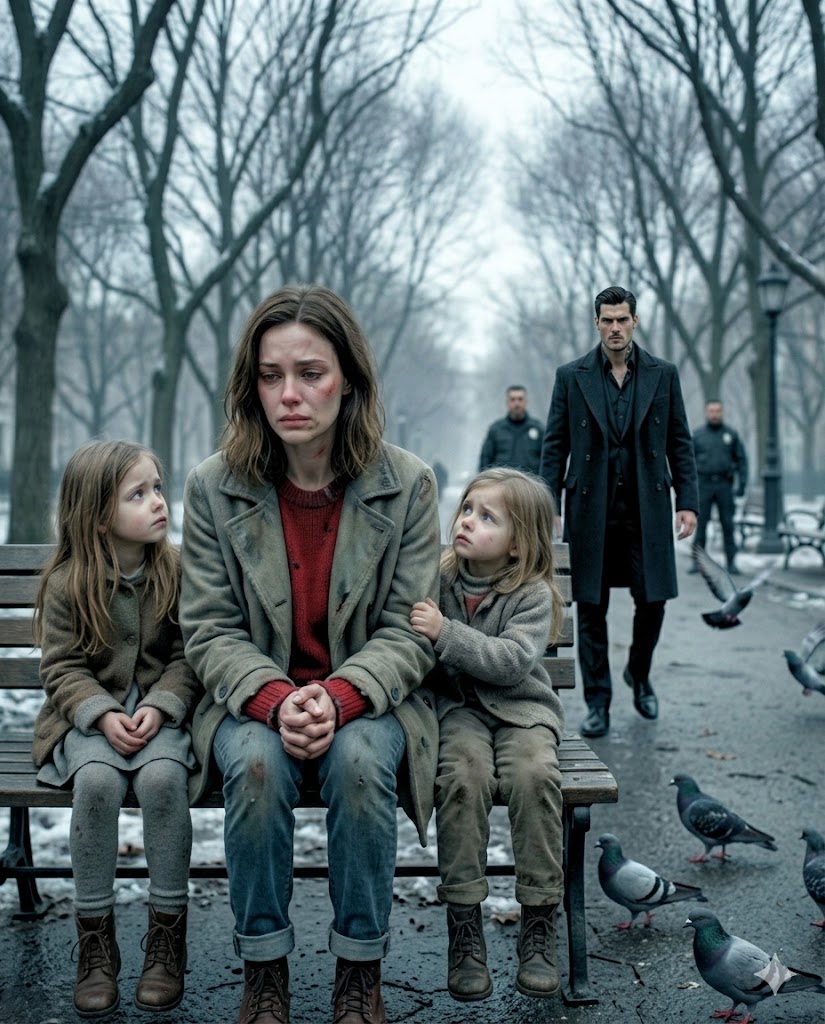
Before anyone in the park noticed the wind growing colder, before the pigeons scattered across the empty path, a small voice at a wooden bench asked a question no child should ever have to ask. “Mommy, if we eat today, will we starve tomorrow?” The mother froze. But the second question was worse. “And if we go back home, will Daddy hit you again?” Twenty feet away, a man who had built his reputation on fear slowly stopped walking. Grady Ashworth was not a man who dealt in emotions; he dealt in outcomes. He was used to hearing screams, the frantic pleas of men who knew they were in over their heads, but he was not used to whispers like that—whispers that sounded like the end of the world.
The park sat at the edge of Whitmore Heights, a neighborhood that had once been middle-class and was now something quieter, something more tired. The benches were weathered. The paint on the playground equipment had chipped away in patches, revealing rusted iron underneath. It was the kind of park where people came to sit alone, where mothers pushed strollers without looking up, and where old men read newspapers they’d already finished.
Shelby Prewit had chosen this bench because it was the farthest one from the road. She’d learned over the last nine days that the farther you sat from the street, the less likely someone was to notice you. Right now, not being noticed was the only form of safety she had left. She was thirty years old, with brown hair that hadn’t been washed in three days, tied back with a rubber band she’d found in her jacket pocket. Her eyes were the kind of tired that sleep couldn’t fix.
Beside her sat her daughters. Hadley was seven, wearing a pink zip-up that was too thin for the weather. Ruthie was five, in an oversized gray hoodie. Their shoes were clean but scuffed. Shelby’s fingers were shaking, but she still braided their hair with practiced, gentle precision. No matter how badly the world pressed against her, she braided their hair. She kissed their foreheads. She told them everything would be okay, then she turned away to count the money in her pocket and tried not to cry.
Today, the money said $11.40. Nine days ago, it had been $112. She’d taken what she could grab from the kitchen drawer the night she left. The night Trent had come home at 11:30 with whiskey still wet on his lips and an anger that had no direction until it found her face. He’d hit her before. That part wasn’t new. But that night, he’d done it in front of the girls. Hadley had screamed. Ruthie had stood frozen in the hallway, holding a stuffed rabbit, watching. And something inside Shelby had cracked.
She’d grabbed the emergency bag she kept in the back of the closet. She’d carried Ruthie on her hip and held Hadley’s hand, walking out the front door at midnight without shoes on. She hadn’t gone back. She hadn’t called anyone because there was no one to call. Trent had spent five years making sure she had no friends left, no connections, no safety net. That was the architecture of his control.
“Is this a restaurant?” Ruthie asked, looking at the gas station rice container.
Shelby forced a smile. “It’s better than a restaurant. It’s a park picnic.”
Hadley didn’t smile. She understood that picnics didn’t happen on cold Tuesday afternoons. She understood that her mother had been sleeping sitting up for four nights because the back seat of the car didn’t recline far enough. They ate slowly, because they had learned that eating slowly meant the food lasted longer. Then Hadley looked up. “Mommy, if we eat today, will we starve tomorrow?”
Shelby’s fork stopped. The air between them became heavy. Before she could answer, Ruthie asked the second question: “And if we go back home, will Daddy hit you again?”
Twenty feet behind them, Grady Ashworth felt his heart seize. He had been a boy who hid behind a couch while his father broke things. He knew those questions. He knew that look. And as he watched the mother try to hold back her tears, he made a silent vow.
Part 2: The Man in the Dark Coat
Grady didn’t sit down right away. He stood near a tree, his hands in his pockets, his face a mask of iron. He ran an organization that operated across three counties—men, lawyers, judges—but tonight, he wasn’t thinking about business. He was thinking about his mother, Colleen, whispering, “Don’t tell anyone, baby. We’re fine.”
He watched the way Shelby pulled her daughters close. He watched the way the older girl, Hadley, scanned the perimeter, her eyes darting like a trapped animal. She was seven years old, but she was already a lookout. Grady reached into his coat and texted Sullivan: Stay close. He sat on a bench across the path, a man who had been there for hours, watching the leaves.
“Listen to me,” Shelby whispered to her girls. “We are going to be okay. Do you hear me?”
“You said that yesterday,” Hadley murmured. “And the day before. Are we going back to the car tonight?”
“Hotels cost money, baby,” Shelby said, her voice strained.
“I don’t need a bed,” Hadley replied. “I can sleep sitting up like you do.”
That sentence hit Shelby like a physical blow. Her daughter had been watching her pretend to be safe, pretend to be fed, pretend to be anything other than terrified. Grady heard every word. The wind carried their voices, and every syllable felt like a serrated blade against his conscience. He stood up, his posture deliberately non-threatening. He approached them, keeping six feet of distance.
“I’m not going to bother you,” he said, his voice low and controlled. “But your girls look cold. There’s a diner two blocks east. I’d like to buy you a meal.”
“We don’t need—” Shelby started, her defensive instinct kicking in.
“I know you don’t need it,” Grady said, meeting her eyes. “I’m asking if you’ll accept it.”
There was no predation in his gaze, only a weary kind of recognition. Shelby hesitated, searching his face for the familiar signs of danger, but found only the heavy, quiet history of a man who had seen too much. “Okay,” she whispered.
Callahan’s Diner was warm and smelled of strong coffee. The waitress gave Grady a nod of recognition that told Shelby this man was not to be trifled with. They sat in a corner booth. The girls ate like they hadn’t seen food in a week. Shelby ate her sandwich slowly, her eyes constantly darting to the door.
“He called the police, Trent did,” Shelby finally confessed, her voice shaking. “He told them I kidnapped the girls. He told them I’m unstable. If they find me, they’ll send them back to him.”
Grady gripped the edge of the table until his knuckles went white. “He won’t find you,” he said. “You’re not alone anymore.”
He pulled out his phone and made a call. “Sullivan, I need two things. A room at the Western Arms. Clean, quiet, long-term. And I need Margaret Callaway’s number.”
Shelby stared at him. “Who is Margaret Callaway?”
“A family attorney,” Grady said. “She doesn’t lose. She’ll file an emergency protective order, document the abuse, and establish you as the sole custodial parent. You won’t be doing this alone.”
As the girls finished their meal, Grady looked at them with a protectiveness that seemed almost physical. He had set the machinery in motion. But even as the food brought a flicker of color back to the girls’ cheeks, Shelby knew the danger hadn’t evaporated. Trent was out there, and he was a man who didn’t lose his grip on what he considered his property.
“Why are you doing this?” Shelby asked.
Grady looked out the window. “My mother’s name was Colleen,” he said. “Nobody stopped my father. Nobody helped her. I’m not looking away.”
Part 3: The Fortress of Law
The room at the Western Arms was clean, secure, and had a deadbolt that Shelby turned until her fingers ached. When she heard the latch slide into place, she let out a breath she felt she’d been holding for five years. Hadley stood by the door, hand on the metal, feeling the solidity of the lock. For the first time, she smiled—not a cautious smile, but a real one.
Margaret Callaway called the next morning. Her voice was like cold water, refreshing and sharp. “I’m filing today, Elizabeth,” she said. “I need every detail. Dates, times, every bruise, every threat. We’re going to prove he’s a danger, and we’re going to prove that you are the only safe harbor these girls have.”
Shelby spent the next twelve hours writing. She wrote until her hand cramped, cataloging five years of terror. Every time Trent had slammed her into a wall. Every time he had threatened to take the girls. Every time he had isolated her from her friends. It was a history of violence that felt impossible to read, yet she couldn’t stop.
As she wrote, the girls played with the large stuffed bear Grady had arranged to be in the room. They were safe. The deadbolt held. But outside, the city was cold, and she knew Trent wouldn’t stay quiet. He would be searching. He would be calling the police, the schools, the neighbors.
“Don’t worry about the kidnapping report,” Margaret assured her later. “The courts see through it when the documentation is strong. And your documentation is going to be strong.”
Meanwhile, Grady wasn’t sitting idly by. He had Sullivan monitoring Trent Puit’s every move. He knew when Trent visited the local precinct, when he went to the bar, and when he finally read the protective order. When Trent had received the papers, he had thrown a chair through his kitchen window.
Grady received that report without expression. He made one more call—a short, precise instruction to a man who ensured that certain boundaries were not crossed. He didn’t make threats; he just ensured that Trent Puit understood that the rules had changed.
Shelby didn’t know what Grady was doing behind the scenes, but she felt the change. She slept for six hours straight, the first time in months. When she woke up, the sun was hitting the courtyard maple tree. She made breakfast for the girls—cereal and toast. Simple things that felt like a feast.
But then, the phone rang. It was an unknown number. Shelby’s heart hammered. She picked it up, expecting Trent’s voice. Instead, it was a social worker from CPS, asking for a meeting.
“I’m referring you to my attorney, Margaret Callaway,” Shelby said, her voice steady.
The social worker hesitated. “That’s fine, Mrs. Prewit. We just need to verify the children’s welfare.”
“I’m referring you to my attorney,” Shelby repeated, her voice firm.
She hung up, her hands shaking, but she felt a surge of pride. She hadn’t cowered. She had stood her ground.
Part 4: The Breaking Point
The meeting with CPS took place in a small, sterile room. Margaret sat beside her, a tiger in a power suit. The case worker, Dennis, reviewed the stack of documents Margaret had prepared. He read about the fractured ribs, the school reports, the frantic midnight flight.
“Mrs. Prewit,” he said, closing the folder. “I see no indication that these children are at risk in your care. In fact, it’s clear they were at extreme risk in the home they left. The kidnapping alert has been rescinded.”
Shelby didn’t sob this time. She let out a laugh that was half-gasp, half-sob. She felt the knot in her chest finally begin to untie. But as they walked out of the building, a dark sedan pulled to the curb. It was Trent.
He didn’t get out of the car. He just stared through the windshield, his eyes burning with a hatred that defied the law. He didn’t care about the protective order. He didn’t care about the judge. He just stared, waiting for Shelby to show a crack.
Shelby didn’t look away. She stood on the sidewalk, holding Hadley and Ruthie’s hands, and looked straight at the man who had tried to erase her. Trent revved the engine, the sound snarling through the street, but then a black SUV pulled up behind him, blocking his path. Sullivan stepped out, leaning casually against the door.
Trent turned back to Shelby, his face contorted with rage, then shifted his gaze to the SUV. He realized then that the game had changed. He couldn’t get to her. He couldn’t even get near her. He drove away, his tires screeching, leaving a cloud of exhaust behind him.
“Is he gone?” Hadley asked, tugging at her hand.
“Yes,” Shelby said. “He’s gone.”
But Grady knew Trent wouldn’t give up. He had Sullivan track Trent to a motel on the edge of town, where Trent had begun to drink himself into a stupor, calling every contact he had to try and find a way around the court order.
Grady sat in his office, his hands clasped, thinking about Colleen. He had the power now, but he also had a moral choice to make. Could he keep doing this—shadowing a man, protecting a woman he barely knew—or did he have to intervene more directly?
He picked up the phone. “Sullivan? Bring him in.”
Part 5: The Shadow of the Past
The warehouse was cold, the air smelling of oil and stagnant water. Trent Puit was shivering in the center of the room, his eyes darting toward the dark corners. He had been picked up without a word, bundled into a van, and dumped in front of the man he hated most.
Grady stood in the shadows, his face illuminated by a single hanging lightbulb. “You filed a kidnapping report,” Grady said, his voice barely a whisper. “You broke a protective order. And you have been terrorizing a woman and her two children for five years.”
“Who the hell are you?” Trent screamed, his voice cracking. “I’ll kill you! Do you know who I know?”
Grady stepped into the light. The scar behind his ear caught the glare. “I don’t care who you know. I know who you are. And I know what you did to your wife and your daughters. And I’m telling you, right now, that if you ever come within five miles of them again, you won’t need a lawyer. You’ll need a priest.”
“You’re threatening me?” Trent sneered, though his knees were shaking.
“I’m telling you a fact,” Grady said, leaning in. “You have lost your power. The court has seen you. The police have seen you. And I have seen you. You’re nothing, Trent. You’re just a bully who’s finally met someone who doesn’t fear him.”
Grady signaled to Sullivan. “Take him to the edge of the county line. Tell him if he crosses it, he’s not coming back.”
As they hauled Trent away, Grady felt a strange lightness. He wasn’t just a man of power; he was a man of his word. He had protected Colleen’s memory by protecting Shelby, and that was enough.
But Shelby’s fight wasn’t over. Margaret had informed her that Trent was contesting the protective order. He was claiming that he had been “set up,” that he was a misunderstood husband, and that Shelby had “brainwashed” the girls.
“He’s fighting back, Liz,” Daniel—no, Margaret—said on the phone. “He’s getting desperate.”
“Let him fight,” Shelby said, her voice stronger than it had ever been. “I have the truth on my side.”
She didn’t know that Trent had hired a PI to track them down, and that PI was currently standing across the street from their new apartment, watching them through a camera lens. The war was escalating, and the shadows were getting longer.
Part 6: The Final Standoff
The PI, a man named Varga, was hungry for the commission Trent had promised. He followed Shelby everywhere—to the grocery store, to the school, to the diner. He sent photos to Trent, who was becoming increasingly unhinged, planning a desperate move to “retrieve” the girls.
Grady heard about the PI from Sullivan. “We have a tail, Grady. Trent’s man.”
“Find out where he’s staying,” Grady said. “And make sure he realizes his client is a dead end.”
Sullivan handled Varga with the efficiency of a shark. The PI was visited in the middle of the night, his camera equipment confiscated and his laptop wiped clean. He left town by morning, terrified.
Trent, isolated and alone, decided he would go to the apartment himself. He didn’t care about the consequences anymore. He armed himself with a hunting knife, his mind lost in a fog of resentment and cheap whiskey.
He waited for Shelby to leave for school drop-off. As she walked toward the car with the girls, Trent stepped out from behind a parked van. “Shelby!” he screamed.
She froze, her heart stopping. Trent charged, his eyes filled with a blind, murderous intent. But he didn’t reach her.
Grady Ashworth stepped out from behind a nearby tree, his movements fluid and devastating. He didn’t use a weapon. He used Trent’s own momentum against him, slamming him into the pavement with a force that knocked the wind out of him.
Trent gasping, the knife skittering across the pavement. Grady pinned him, his knee on his back. “You’re done, Trent. The police are on their way.”
Shelby stood there, shaking, holding the girls, her eyes fixed on the man who had been her nightmare. Trent screamed, but it was the scream of a defeated man. The police arrived, sirens blaring, and the nightmare—the real, physical nightmare—was finally over.
Shelby walked up to Grady, her voice a tremor. “Thank you.”
Grady stood up, brushing off his coat. “You did this, Shelby. I just stood in the way.”
Part 7: The Home They Built
The aftermath was quiet. The courts officially severed Trent Puit’s parental rights, and he was sentenced to fifteen years for assault and harassment. Shelby and the girls moved into a house of their own—a real house, with a yard, a garden, and a deadbolt that they turned every single night.
The girls grew, Hadley’s face losing the haunted look of a lookout, Ruthie’s drawings becoming more vibrant, more free. Shelby went back to school, studying for the degree she’d put off for so long. She wasn’t the “useful” wife or the “victim” anymore. She was a mother, a survivor, and a woman who was building a life on her own terms.
Grady Ashworth watched from a distance, satisfied that the boy behind the wall had finally been vindicated. He continued his work, but the shadow he carried—the one of the kitchen in Decar, Georgia—was gone. He had looked, and he had acted.
One Saturday afternoon, Shelby saw Grady at the park, sitting on a bench near the east path. She walked over, the girls trailing behind her.
“Hello, Grady,” she said.
Grady looked up, a faint smile on his face. “Hello, Shelby.”
They sat together in the autumn air, the leaves falling in damp gold clusters, exactly where this had all begun. They didn’t need to speak. They didn’t need to explain. They had lived through the rain, and they had survived the cold.
As they sat there, the park didn’t seem like a place of forgetting anymore. It seemed like a place of beginning. The girls played in the sandbox, their laughter echoing against the trees. Shelby took a deep breath, the air clean and crisp in her lungs.
“I’m happy,” she said.
Grady nodded. “I know.”
And for the first time in her life, the future didn’t feel like a threat. It felt like a promise. The girls were safe, the past was buried, and the only person in the world who was watching was the one who had finally taught her that she was worth the fight. They sat until the sun dipped below the hills, a family who had learned that safety is not given—it is earned, built, and fiercely defended. And that was everything.