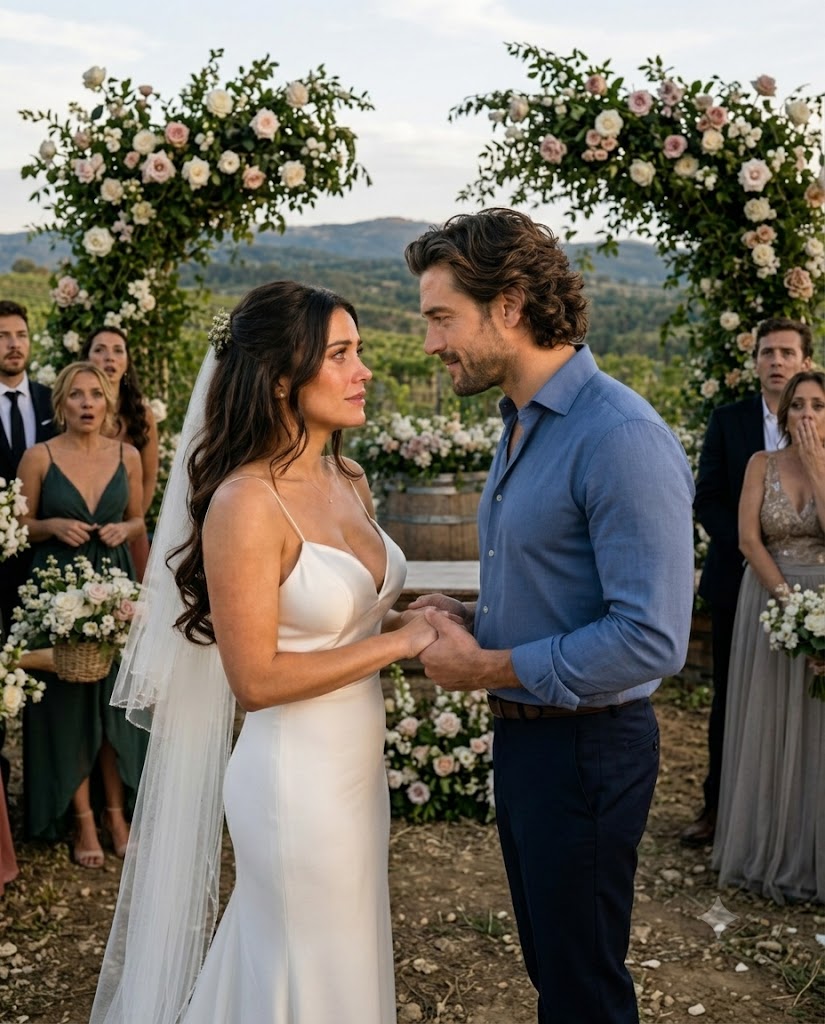
My Best Friend Was Left at the Altar… So I Stepped Forward and Said, “I’ll Marry Her!”
Part 1: The Last Row
The back row of a wedding is its own distinct country. Dela Marsh had learned that harsh truth in the first ten minutes, the way you learn the temperature of a blazing oven by simply holding your bare hand near the heavy metal door. She sat perfectly still at the very end of the last white folding chair in the last white row, where the large canvas marquee seemed to let in a thin, chilling thread of September air. She watched two hundred and forty guests she would never speak to arrange themselves toward the front of the aisle like iron filings finding a powerful magnet.
The undeniable magnet was waiting at the altar. Julian Crew, dressed in a morning coat the color of wet slate, stood with his hands neatly folded before him. His chin was lifted in the exact, arrogant way he had always lifted it right before saying something he desperately wanted everyone around him to believe. Two years ago, that very tilt of his sharp chin had been pointed exclusively at her, promising a future she had foolishly started to sketch out in her mind.
She pressed her thumb and forefinger together tightly in her lap. A classic baker’s pinch. The precise physical gesture her hands made when there was fresh flour to test for elasticity. And the exact gesture they made now, when there was no flour at all—only the cold, heavy weight of a printed ceremony program bearing someone else’s names.
She was not supposed to be here. That was the sickening reality that kept surfacing in her mind like a buoyant cork held forcibly underwater. She had not been invited to Julian Crew’s society wedding; she had been hired to it six weeks ago.
A frantic wedding planner with an expensive wireless headset and a gold-embossed clipboard had walked into Marsh and Honey, their small bakery on a neglected corner. The planner had taken exactly one bite of Dela’s signature brown butter honey cake, closed her eyes in pure rapture, and said the four words they all inevitably said: “It is absolutely exquisite.”
Before Dela knew whose high-society event she was catering, the retainer was signed. By the time the names of the marrying couple finally trickled through on the final contract riders, the non-refundable deposit was already spent. It was gone, swallowed whole by sacks of premium flour, three months of predatory commercial rent, and the emergency repair bill for their antique dough mixer—a machine she could not possibly have replaced if it had given out during the busy autumn season.
In the catering world, you simply did not cancel on the Vances. Wealthy, connected families had long memories, and suppliers who broke contracts on society events quickly found themselves blacklisted from the only accounts that kept the local economy turning.
Marsh and Honey sat on the wrong end of a decaying market street that the city kept promising to revitalize but never actually did. They were wedged precariously between a shuttered lingerie boutique and an independent bookstore that had already sold three different kinds of commercial failure in two short years. The storefront still bore Dela’s mother’s name over the chipped door frame in faded, peeling gold leaf. Dela had repainted the display windows twice because she could not afford a professional signwriter, and she simply could not bear the emotional weight of scrubbing her family’s name entirely off the glass.
The display window held whatever pastry she had baked that particular morning. The rich, buttery smell usually did ninety percent of the selling, and their fiercely loyal regulars came for the brown butter honey cake, staying because Dela remembered exactly how each of them took their morning tea. But the physical ledger sitting on the back shelf, where the unvarnished financial reality of the bakery was brutally kept, indicated in Reubin’s blunt, red-ink arithmetic that they had until roughly February to stay solvent. Maybe March, if the approaching winter was remarkably kind. But the winter in upstate New York was never kind.
The Vance contract was not just another wedding to Dela. It was the financial difference between repainting the storefront sign for a third time and watching a fourth commercial failure move into the empty space next door.
So, she had built the massive cake. Five tiers of structural perfection, glowing with ivory buttercream, edible gold leaf, and delicate sugar magnolias she had piped at 2:00 in the morning with the radio playing low and Reubin fast asleep on a pile of empty flour sacks because he steadfastly refused to leave her to tackle the monumental task alone. She had driven the heavy, refrigerated van out to the sprawling estate that very morning with her heart in her teeth, navigating every unexpected speedip over a silent, desperate prayer she didn’t fully believe in. She had carried the heavy tiers, tear by silent tear, through a service entrance and into the vast, pale catering kitchen of a historic house she had never set foot in before.
Her hands had been steady during the dangerous assembly under a Schonbek chandelier worth more than her entire retail block, because her hands were the one part of her life that had never once let her down.
And she had naively thought that once the last sugar magnolia was placed, and the towering confection stood glowing like a beacon from a life she would never be invited to share, she would be allowed to quietly pack up her vans and leave.
She had been profoundly mistaken.
“Oh, you’ll stay for the ceremony, of course,” the bride had commanded.
Camila Vance had drifted into the stainless-steel kitchen in a silk monogrammed robe, her dark hair half-pinned, radiating the untouchable confidence of immense generational wealth. She had looked at Dela the way a bored collector looks at a decorative chair they haven’t yet decided whether to keep in the foyer.
“Julian told me all about your little bakery,” Camila had said, her smile as warm and sweet as poured sugar, and just as quick to set into a hard, unyielding shell. “It would mean so much to us. We’re all so wonderfully grown up about everything now, aren’t we? Go sit at the back. Enjoy the day. You’ve more than earned it.”
You’ve earned it. The two words that practically ran Dela’s entire life dropped like an explosive charge in the middle of an otherwise polite interaction. She had not been able to summon the courage to say no. She never could say no to people who held a brass door over her head, and Camila was practically holding the gates of paradise. The promise of the final check, the professional photographs that would feature her bakery’s logo, and the potential high-society referrals were the only things keeping the bakery lights on through the looming frost.
So, Dela had aggressively scrubbed the sticky buttercream from her forearms, changed into the one respectable gray dress she kept folded in the back of her panel van for unexpected emergencies—a frock the color of a rainy Tuesday—and walked the long, humiliating way around the manicured gardens to the rear of the marquee, finding the very last chair in the very last row.
Her cheap smartphone buzzed sharply against the wool of her hip. She angled the device carefully under the shade of her folded program to read the screen.
Reubin: Did you escape yet? Blink twice if the cake is holding you hostage. Reubin ran the front counter at Marsh and Honey and possessed a sixth sense for impending retail catastrophes.
She thumbed back one-handed, her movements tight. Dela: Still here. They sat me with the ghosts. Reubin: Walk out immediately. The sugar magnolias will avenge you. Dela: Can’t. Need the photos. Need the Vance name on our website by November or we don’t make it to the spring thaws. The three little typing dots pulsed on the screen, stopped, and pulsed again.
Reubin: Then survive it. Come home when you can. We have an old man here trying to return a scone because he claims it’s too holy to eat. I am handling it very badly. Dela almost let out a genuine laugh. The near-laugh was the first warm, human thing that had happened to her all day, and she slipped the phone into her pocket before it could morph into an expression a guest in the front rows might turn around to investigate.
The classical string quartet abruptly shifted their tempo into the traditional wedding processional. Two hundred and forty heads snapped to attention, and the entire congregation rose in unison.
Dela stood up with them, not out of respect, but because remaining seated would have constituted a distinct, rebellious statement—and she had spent the last two years of her life learning how to make absolutely no statements at all. Peering over the sea of pale shoulders, extravagant fascinators, and perfectly blow-dried hair, she watched Camila Vance glide down the aisle on her father’s arm, draped in forty thousand dollars of imported French silk.
She watched Julian’s strong chin lift to receive his bride. Deep inside her chest, she felt a phantom ache, checking her emotional state the way you gingerly check whether a severe burn still throbs under the gauze. She was surprised to find that it didn’t hurt with the fiery devastation she had mentally braced for. It throbbed instead in a much flatter, infinitely lonelier place. It wasn’t a desperate I want him back. It was something much closer to I want to be a person someone excitedly walks toward.
She hadn’t known that specific want had a name or a shape until it suddenly stood up inside her ribs on its own. She sat back down heavily at the end of the aisle as the prayers began, folding her hands in her lap, and was, for the duration of a Christian marriage ceremony, entirely, profoundly alone in a tent full of smiling people.
She would have told you, if you had asked her in that quiet moment, that she vastly preferred it that way. But she would have been lying. She was exceptionally skilled at telling that particular lie to herself. She had been whispering it since she was nine years old, standing in a kitchen that smelled of someone else’s extravagant dinner, being quietly instructed by tired adults to make herself useful so they would let her stay.
Part 2: The Edge of the Orangery
Somewhere to the left of the massive white marquee, past the manicured rose beds, a man in a dark, unobtrusive suit stood at the open edge of a stone terrace and watched a wedding he had absolutely not been invited to attend.
Dela would not learn his name for another hour. She would not discover exactly what he owned in this county for much longer than that, but she had already partially noticed him on her way through the gravel paths. He had been a tall, solitary figure lingering near the edge of the estate’s iron gates, hands tucked deep into his trousers, studying the arrival of the wedding guests with the detached, analytical gaze of a man looking at a foreign country for which he possessed no valid passport.
She had mistakenly assumed he was just another wealthy guest taking a quiet moment for a cigarette before the open bar commenced. She had been entirely wrong, in the exact way that everyone in this valley was wrong about Adam Hail.
He was not watching the bride with dreamy eyes. He had zero personal interest in the Vances or the Crews. They simply rented his historic lawns, his restored stone terraces, and his grandmother’s prized rose gardens for a staggering sum of money that kept the copper roof on the estate’s east wing secure for another financial quarter.
The guests, when they referred to him at all over cocktails, called him simply “the owner,” using the indifferent tone you would use when discussing the property’s boiler or the unpredictable mountain weather. He had overheard the frantic wedding planner relaying his one polite request to the head florist early that morning, spoken through a wireless headset as though he were merely a legal clause to be managed: The owner asks that the heritage roses not be cut, if it isn’t too much trouble. He always tagged his reasonable demands with that self-deprecating phrase, even at a distance, even when communicating through terrified strangers. He had been raised by a weary man who constantly muttered, if it isn’t too much trouble, to pharmacists, landlords, and foremen who vastly outranked him. Adam had made enough millions to never need to utter the phrase again, yet he found himself saying it anyway. Some roots simply run too deep to be pulled out by financial success.
He had wandered down to the stone terrace for a private reason that had absolutely nothing to do with the marital pageantry. It was the last Saturday of September. Exactly forty years ago, his father had pushed a rusted wheelbarrow of cut turf along this very flagstone path, sweat stinging his eyes, while the gentry of the valley ignored him. Thirty years ago, a teenage boy named Adam had been turned away from the grand kitchen door with a flat ‘not for the likes of you’.
And just four years ago, that very same boy had quietly bought the entire estate out from under the bankrupt family who had uttered those words. Yet, he still could not walk past that heavy oak kitchen door without his pulse spiking in a rush of old, unforgotten humiliation.
He turned a small brass key in his trousers pocket—a useless heirloom belonging to an iron gate that had been demolished decades ago. He watched a tent full of smiling strangers legally bind their lives to one another, feeling the familiar, well-furnished loneliness settle over his broad shoulders like an expensive coat he had paid too much for and now could not figure out how to take off.
Then the ceremony concluded with a burst of brass music, the marquee seemed to exhale collectively, and the crowd began to spill toward the cocktail hour on the lawn.
A woman in a dove-gray dress emerged from the back service flap of the tent. She was walking fast—the specific, driven way people walk when they are trying to reach a private restroom or a parked car before their strained face finally stops cooperating with the day’s demands. She did not drift toward the champagne towers with the rest of the socialites. She walked the wrong way, heading directly toward his secluded stone terrace.
She was clearly operating under the assumption that the area was entirely deserted. She stopped abruptly at the edge of the stone balustrade, not six feet from where he stood in the shadows. She placed both trembling hands flat on the cold, weathered stone, tilted her head to the sky, and breathed out hard once—the universal, shuddering exhalation of a person setting down a massive, invisible weight they had carried much too far.
“They’re holding up,” Adam said quietly, breaking the silence.
She startled violently, gasping as she spun around to face him.
He nodded casually toward the garden beds, keeping his tone light and conversational because it was the only true thing he could think to offer a woman who clearly did not want an audience for her tears. “The roses… I assume you’re the floral designer. I overheard the planners giving you absolute fits about the height of the centerpieces this morning.”
For one half of one second, Dela Marsh looked at the tall stranger in the immaculate dark suit, taking in his quiet, unhurried, and completely unreadable face. In a flash of survival instinct, she made a split-second decision that would irrevocably unmake and remake the trajectory of her autumn.
She did not say, ‘I’m not the florist.’ She did not say, ‘I’m the pastry chef who survived two days of no sleep for this.’ She did not say, ‘I’m the back-row charity case.’ She looked at this man who knew absolutely nothing about her world, and she accepted the false identity with both hands.
“They always give me grief about the height,” she said, her voice husky. “Everyone wants the floral arrangements to be both invisible and completely overwhelming at the very same time.”
“That sounds remarkably like most things people demand from life,” he replied softly.
And Dela Marsh, who had not genuinely laughed once in eight agonizing hours, let out a sharp, genuine chuckle. It was not a large, booming laugh. It was the kind of short sound that escapes your throat before you have the chance to properly vet it, and it surprised her far more than it likely surprised him.
She pressed her lips together firmly after it, as if to apologize for her lack of professional decorum. Adam watched her do it, and something substantial shifted in his guarded, unyielding face—the way a massive oak door shifts on its hinges when someone leans on it from the far, unseen side.
“You shouldn’t be lingering out here,” she said, recovering her composure and reaching for the practical, task-oriented script of her station. “The cocktail reception is on the other side of the lawn.”
“I know where the reception is,” he said plainly, no judgment or mockery in his baritone. “I’m actively avoiding it.”
“You’re avoiding your own party?” she asked, a flicker of curiosity overcoming her caution.
“Yes,” he admitted.
“Then it seems we have a great deal in common, and we probably shouldn’t discuss any of it.”
He turned slightly so that they were both looking out over the pear orchard instead of staring directly at each other. Dela would understand much later that this was an act of profound, instinctive kindness—a gentleman’s way of allowing her to dry her wet eyes without requiring her to maintain eye contact.
“I’m Adam,” he said, breaking the quiet.
“Dela,” she replied. She did not offer her surname. Professional bakers, she reasoned in the haze of the moment, did not require surnames in a garden. Florists were untethered and entirely free.
They stood together at the stone balustrade while the late afternoon light shifted from bright gold to a rich, glowing amber. He asked her absolutely nothing about her personal life, which she noted with immense relief because everyone she normally interacted with inevitably asked, and the questioning always felt like a subtle, draining social audit.
Instead, he asked her what she thought of the espaliered pear trees trained along the south brick wall, and whether she thought the estate’s gardeners had under-pruned them for the season.
And she—who knew absolutely nothing about fruit arboriculture, but a great deal about blending sugar and the art of pure bluffing—declared that the trees looked both overfed and profoundly lonely, much like most of the attendees at a high-society wedding.
Adam made a sound that was almost a laugh of his own—a single, low note, slightly rusty, like a musical instrument taken out of its velvet case after years in the attic.
“The marquee is emptying out,” he noted, watching the distant figures move toward the dance floor. “They’ll be drinking and dancing early tonight, before anyone has had enough liquid courage to truly embarrass themselves.”
“I don’t dance,” Dela said, turning her gaze to the gravel. “I work weddings. I’m just functional furniture in the background.”
He turned his head and looked at her—fully, completely, for the first time since she had arrived. She felt his gaze the way you feel the morning sun break through thick cloud cover. It wasn’t a flattering, predatory look. It wasn’t an evaluation of her social standing. It was simply the look of a man truly seeing another human being. Which was, in its own way, both terrifying and intoxicating for a woman who had spent years making herself small.
“I find that highly difficult to believe,” he said softly.
“Believe it. I’m always the one stuck in the back row.”
“Then come dance with me at the back of the tent,” Adam said, his eyes locking onto hers. “No one looks at the back row. You said so yourself. It’s the safest country at the entire wedding.”
She should have said no. She had a five-tier cake to monitor, a stained dress to worry about, and an entire life meticulously arranged around the principle of never being noticed. This man was a total stranger, and strangers in her experience were dangerous. She had stopped trusting people somewhere around the second year of telling herself she preferred the loneliness of the perimeter.
But he had called the back row “a safe country,” as if it were a place a person might actually choose to reside rather than a punishment to be endured. No one had ever made the fringes of life sound like a valid choice before.
And so, when he slowly held out one large hand, palm up, unhurried and calm, asking a silent ‘May I?’, she quietly put down the invisible burdens she had been carrying, and took it.
Part 3: The Dance in the Shadows
They danced at the dim, shadowy edge of the orangery where the golden afternoon light finally gave out to the encroaching twilight, far away from the glaring center of the dance floor. Adam was not a showy, theatrical dancer. He was a careful, grounded partner—a man who steered by the simple virtue of not steering at all, leaving her plenty of personal space. He smelled of cold autumn air, high-end wool, and the faint, unmistakable trace of woodsmoke, as though he had been standing by a private hearth far away from the synthetic cheer of the wedding.
His hand at the small of her back was light enough that she could have effortlessly stepped away from his embrace at any second. And that lack of restriction, ironically, was the very thing that compelled her to stay.
The string quartet was playing a slow, sweeping waltz that carried faintly through the heavy canvas of the marquee. The last of the sunlight melted from amber into the deep, bruised blue that precedes the night, and the decorative lanterns strung along the orangery beams cast small, uncertain coins of golden light across the flagstone floor.
Dela, who had spent her entire adult life on the catering side of other people’s beautiful evenings, found herself for once on the lit, celebratory side of the equation, and she honestly did not know what to do with her hands or her face.
“You’re counting the steps,” he said quietly, his feet moving in perfect sync with hers, reading her internal tension like weather. “I can feel it. One, two, three… under your breath. It’s alright, you don’t have to be perfect here. I count too. I just do it internally where it doesn’t show.”
He turned them in a slow, unhurried arc. “My father taught me. He used to say, ‘A man who can’t dance can at least learn not to tread on anyone’s toes… which is most of dancing, and quite frankly, most of everything else in life.'”
“He sounds like he was a man who understood things,” Dela murmured.
“He knew everything worth knowing,” Adam said lightly, a shadow passing over his features. “And absolutely nothing that actually paid the bills.”
The lightness in his tone felt like a door being pulled almost shut on a room filled with complicated family history. Dela recognized the defensive cadence because she had built an identical door for herself at Marsh and Honey, and she did not push him for details.
For three uninterrupted minutes, Dela Marsh was not catering furniture. She was simply a woman in a dove-gray dress being held respectfully by a man who assumed she was just another local florist. The cruelest, sweetest thing about the illusion was how incredibly little it took to make her feel human. A warm hand on her back, a stranger’s implicit certainty that she belonged in the room. She had been starving so slowly she had entirely stopped calling it hunger, and now, here was a banquet set before her by a man who had no idea he was feeding a starving soul.
She accepted the temporary nourishment, telling herself with every rotation that she would step back after this measure, and then after the next. But then, the predictable social machinery of the wedding intervened.
The illusion could not last forever. A sharp, manicured hand suddenly closed firmly around Dela’s bare forearm.
“There you are, Camila,” a voice trilled, dripping with poisoned sugar. It was Julian’s mother, Margaret Crew—lacquered, wealthy, and entirely merciless.
Margaret had found Dela’s face across forty feet of parquet flooring, and Dela watched cold, class-based recognition wash over the older woman’s face like an unexpected winter frost.
From the head table, the bride had also half-risen, one hand planted aggressively on the white linen tablecloth. Camila Vance was watching the back-row florist dance with the one man in the entire county that the elite families had spent the afternoon trying and failing to impress.
The music didn’t stop, but it suddenly felt as though all the air had been sucked out of the tent.
“You’ve gone completely quiet somewhere,” Adam whispered, still moving, still entirely unbothered by the sudden shift in the room’s energy. “Where did your mind go just now?”
“They’re staring at us, Adam,” Dela breathed, her chest tightening.
“They stare at everything,” he said, turning them smoothly so that his broad back came between her and the glaring eyes of the high-society guests.
It was a wall—a protective courtesy that a stranger had offered her, a gesture she knew she would replay in her quiet kitchen for weeks. For one more bar of music, she remained hidden behind a man who had decided, for reasons she couldn’t fathom, that she was worth standing in front of.
But Margaret Crew was not easily deterred. She marched over, her silk skirt swishing loudly, and practically pried Dela away from Adam’s side.
“We have been looking everywhere for you, darling,” Margaret said, her eyes pinning Dela to the floor, her fake smile not reaching her cold, predatory eyes. “You’ve been working so tirelessly since dawn for the Crews. Why don’t I have one of the estate staff walk you out to your van so you can rest?”
She turned her gaze to Adam, switching to a completely different, breathy vocal register reserved for the billionaire. “Mr. Hail, I am so dreadfully sorry. I do hope this… this young woman hasn’t been making a nuisance of herself. She’s the baker, you see. From that little shop in town. Marvelous with sugar, I’m told, but terribly out of her depth in a place like this.”
The word baker dropped like an unexploded bomb in the center of the terrace. Dela felt the dove-gray dress instantly turn back into a flour-dusted apron. She felt the high-society crowd reassemble in her mind, placing her firmly at the bottom of their social hierarchy, exactly where the day had been engineered to put her.
She could not bring herself to meet Adam’s eyes. She had lied to the wealthy owner of Hartley Court, pretending to be a creative florist just to survive an awkward social interaction, and now she would have to watch his face do the small, polite recalculation that people of his class always did when they realized they’d been fraternizing with the help.
Oh, she’s just a baker. She braced herself for the inevitable brush-off, wishing the flagstone beneath her feet would just open up and swallow her whole.
Part 5: The Cake and the Owner
“Marsh and Honey,” Adam repeated slowly. His voice had not dropped in temperature, nor did it carry a tone of shock. He simply looked at the polished silver monogram on his cuff, and then back up. “The brown butter honey cake… Camila told me you were providing the dessert.”
Camila Vance, having drifted over from the marquee, blinked rapidly. “You… you know her, Adam?”
“I had a slice of her work this afternoon,” Adam said, his tone perfectly level. “Someone left a sample in the great kitchen for the catering staff. I ate it standing up, the way I eat most of my meals in this house.”
He turned his piercing gray eyes to Dela, and something in his expression was rapidly rearranging itself, shifting from casual curiosity into something much more profound. “I didn’t know until this exact minute whose hands had actually crafted it. But I am very glad to finally make your acquaintance, Miss Marsh.”
Camila’s perfect, porcelain smile slipped by one full inch, which on a woman of her social standing was the equivalent of a devastating avalanche. “Yes… well… she’s very reasonably priced for the charity circuit,” the bride stammered, clearly grasping for control of her wedding narrative.
Adam didn’t take the bait. He didn’t offer Camila the fawning deference she expected from her venue host. He just stared at the baker.
“It seems, Miss Marsh,” Adam said, ignoring the bride entirely, “that you are not the estate florist.”
“No,” Dela whispered, her throat burning, feeling incredibly small beneath the glittering lights. “I’m the cake.”
“Yes,” Adam Hail said, and the heavy weight of his declaration seemed to silence the surrounding gossips. “You’re the cake.”
The way he uttered those four simple words—as though the baker and her craft were the most consequential things in the county, as though the massive tent full of silk and old money were merely the cheap packaging surrounding the only real, authentic thing in the valley—made Camila’s jaw tighten. It made Margaret Crew look away in disgust.
And it made Dela Marsh, against two solid years of protective, defensive training, stop playing the background and look the billionaire owner of the estate directly in the eye.
“I should go check on the dessert table,” she said, her voice shaking but her posture proud. “Before they begin the service.”
She didn’t wait for his permission to leave. She turned and walked away from the stone terrace on legs that did not entirely feel like they belonged to her. She moved through the golden light of the setting sun, knowing without looking back that his eyes were following her every step. It was the very thing she had spent years training herself to avoid—being intensely watched—and yet, terrifyingly, it was exactly what she had secretly been starving for.
The five-tier cake was cut at eight o’clock. Dela watched the ceremonial slicing from the shadows of the catering doorway, the way she always watched her masterpieces disappear into other people’s noisy celebrations. She packed her heavy piping bags, her metal dowels, and her sugar craft tools into the back of her panel van by 9:00 p.m., telling herself that the ordeal was finally over.
She drove home through the dark, winding country lanes with the dashboard heater roaring against her cold shins. She kept her hands steady on the steering wheel, refusing to let her mind wander to the owner of Hartley Court. Thinking about Adam Hail was a dangerous door she had absolutely no business opening—a door behind which lay nothing but a long, unprotected drop into heartbreak.
The invoice payment from the Vance wedding cleared into her business account on Monday morning, but the anticipated high-society referrals from the guests failed to materialize. What arrived instead on Wednesday morning—while Reuben was aggressively kicking an unfortunate door-to-door salesman out of the bakery—was a physical letter.
It wasn’t an email, or a text message, or an automated bank notification. It was a thick, cream-colored stock envelope with no organizational crest. The handwriting on the front was square, certain, and slightly old-fashioned—the penmanship of a man who had taught himself cursive through sheer willpower.
Miss Marsh, it read simply. Hartley Court hosts a small harvest festival on the second Saturday of November. Three hundred patrons. The public is welcome, and the proceeds go directly toward the orchard restoration fund. We have always purchased our baked goods from a commercial supplier in the city who delivers them frozen. I would like, this year, to purchase them from someone who builds them at 2:00 in the morning with the radio playing low. The retainer fee is enclosed within. I have made it incredibly generous because I am reliably informed that is how one is supposed to behave in these matters, and because you will earn every single penny. If it isn’t too much trouble. A. Hail.
She read the bold, declarative sentences four distinct times. On the fourth read, she realized her thumb and forefinger had been pinched together in a baker’s pinch against the heavy paper the whole time, leaving a faint, flour-dusted ghost on the cream corner.
She noted that the retainer check wasn’t just “generous.” It was mathematically preposterous. It was six months of pure breathing room, folded neatly into a single envelope.
But most dangerously of all, she noted the line about 2:00 in the morning. Which meant, with absolute certainty, that he had not forgotten a single word of the intimate conversation they had shared while he was pretending to be an uninvolved bystander.
Reubin leaned over the counter, peering at the check with his mouth wide open. “Dela… that number there. That’s the winter heating oil. That’s the payroll. That’s me not having to sell my late uncle’s motorcycle.”
He looked up, his eyes sharp. “Why on earth is this man sending you a small fortune?”
It was the only rational question to ask. It was the exact question her mother’s voice was screaming inside her head before any romantic foolishness could take root.
What does he want? What’s the catch? What will you inevitably owe him? In the hardscrabble world where Dela had been raised, no wealthy man handed you six months of financial oxygen without expecting to collect a heavy toll at a later date.
“Pity,” she said, tossing the check onto the counter with a feigned casualness. “Or charity. It’s the exact same thing, just tailored in a much darker wool.”
“Or,” Reuben said, tapping the paper with a flour-stained finger, “hear me out, because I know I’m usually the village idiot… he actually liked you.”
She scoffed. “He thought I was the estate florist, Reubin.”
“And then he found out you were the baker covered in buttercream, and he sent you a love letter disguised as an orchard festival contract. I’m just a simple bread man, but I know a romantic overture when I see one.”
“I am not a romantic person,” Dela stated, though her cheeks betrayed her.
She took the festival contract. Of course she took the festival contract. She would have gladly taken it for a tenth of the exorbitant fee just to keep the bakery’s historical name on the glass through the winter. She told herself she was doing it strictly for the money.
She was lying to herself, of course. And she was about to pay a heavy, beautiful price for that deception.
Part 6: The Midnight Bake-a-Thon
Hartley Court in November was an entirely different animal than Hartley Court dressed for a high-society summer wedding. The sweeping white marquees were gone. The glossy gold fairy lights were gone. What remained was a long, honey-colored historic house with its architectural bones proudly showing. Scaffolding was erected along the east wing for masonry restoration, and the estate had the muddy boots, damp gravel, and rich woodsmoke smell of a working, pre-winter farm.
At the literal heart of the sprawling house sat a catering kitchen the size of Dela’s entire retail block. It was a masterpiece of flagstone flooring, gleaming copper pots hanging from the rafters, and a massive, cast-iron French range you could have comfortably roasted a full Thanksgiving feast inside.
It was in this impressive kitchen that she met Mrs. Adami, a formidable woman who had managed the historic house through four different owners and considered the current proprietor, Adam, a distinct improvement—though she would likely be boiled in oil before ever admitting that to his face.
“You’re the cake woman,” Mrs. Adami stated by way of greeting, not looking up from her ledger as Dela wheeled her crates of sugar through the heavy oak door. “He told me you were coming. He’s mentioned it three times this morning. Appropo of absolutely nothing regarding the weather.”
The housekeeper set a steaming mug of black tea down on the edge of the worktable without being asked. It was a gesture that revealed Mrs. Adami’s entire emotional vocabulary.
“I’ve kept this estate through four owners,” the older woman continued, wiping her hands on her linen apron. “The last one required me to announce his luncheon with a silver bell like an idiot. This one… I found him the week he legally took possession, standing right here at midnight, eating dry bread and yellow cheese in the dark.”
She paused, looking at Dela with the sharp, appraising eyes of a veteran appraiser. “I think he wanted to be absolutely sure no one would come in here and tell him he wasn’t allowed to eat in his own home. A grown man, a billionaire, hiding in the dark like a scared boy who’s just climbed through a broken window.”
Mrs. Adami gave a sharp, flat nod toward the copper pans. “I don’t typically share things like that, Miss Marsh. I’m telling you now for your own good. Draw your own conclusions.”
“I’m only here for the festival fee, Mrs. Adami,” Dela said quickly, feeling a sudden need to defend her boundaries.
“And why,” the housekeeper countered, pausing at the heavy door, “do you suppose a man decides a thing like that about a woman before she’s even given him real cause? It’s never about the baker, my dear. It’s about whatever the last person who held his trust taught him.”
She pointed a crooked finger. “He had a fiancée once, before my time here. She loved the idea of being the grand mistress of all this stone and copper quite a lot more than she ever loved the man rattling around inside it. He found out about her deceit at the worst possible moment. So now, he hands people the keys to the house first, just to see if they’ll grab them—calls it a test, calls it wisdom. But it’s neither. It’s just a deep, unhealed scar wearing an expensive theory.”
The heavy door clicked shut behind her, leaving Dela alone with her thoughts, the ticking of the ovens, and a warning that settled into her bones like cold flour. She told herself she had no intention of “grabbing” anything at Hartley Court.
But working in Adam Hail’s kitchen was going to prove much more complicated than she had bargained for.
By the end of the first week, Adam had learned to hover around the kitchen whenever she was prepping. He brought her a tall stool when her back ached from standing for six hours. He brought her a glass of water when she was too focused to remember to hydrate. He brought her a pot of terrible, sludge-like coffee that he had clearly brewed himself, and which she drank with a smile anyway.
Once, he left a single, late-blooming dark red rose on the cold marble counter, directly beside her scale, without offering a single word of explanation. The staff had been strictly forbidden from cutting the estate’s remaining autumn roses, which meant he had clipped the stem with his own hands.
“You’re the florist, I assume,” he said late that afternoon, strolling into the kitchen with a straight face, inspecting her sugar work. “I left a rose for you. I trust you’ll know exactly what to do with it.”
There it was. His very first attempt at a joke. Dry, subtle, and slightly rusty, like a piece of machinery taken out of an old case.
Dela looked at the velvet petals of the rose, and then at the guarded, intense man who owned an estate he was too traumatized to fully inhabit. She felt the safety of her back-row existence tilting dangerously toward a precipice with no railing.
“Florists charge extra for sarcasm, Mr. Hail,” she replied, keeping her eyes on her mixing bowl.
“Add it to the massive invoice, Miss Marsh,” he said, turning to leave. “Make it incredibly generous. I’m told that is how I’m supposed to behave.”
She let out a short, involuntary laugh as he disappeared down the hallway. And she understood, with a sudden, breathtaking lurch of her heart, that she was no longer entirely sure which of them was being observed, and which was doing the looking.
The safety of her invisible life had never felt so fragile.
Part 7: The Sugar Pear Press
The days leading up to the harvest festival were a blur of intense labor, flour dust, and emotional calibration. Dela had initially tried to keep Adam at arm’s length, managing him with the brisk efficiency one reserves for unpredictable clients. But Hartley Court was his territory, and he found countless administrative excuses to migrate to the flagstone kitchen.
On the evening before the festival, Mrs. Adami’s recruits had been sent home to rest, leaving the cavernous kitchen to the quiet hum of the massive refrigerators and the two of them. Dela was meticulously piping the final details onto the centerpiece—a massive, five-tier creation featuring sugar pears and apples. Her hands were cramping, her posture rigid from thirty hours of continuous standing.
Adam hovered near the edge of the marble island, watching her work with an intense, unblinking focus. He had shed his designer jacket hours ago, his white shirtsleeves rolled up to the elbows, exposing forearms corded with muscle from years of laboring on his own properties.
“You’re exhausted,” he said, not as a question, stepping slightly closer.
“I’m a baker, Mr. Hail. Exhaustion is just part of the uniform.”
“You don’t have to keep managing me, Dela,” he said, his voice dropping into a register that made the air in the room feel heavy. “I know you’re putting up a wall. You keep me at arm’s length, and you make that distance look like pure professional efficiency.”
He picked up a small metal spatula, turning it over in his calloused fingers. “I’m not complaining. I just want you to know that I see it. So when you decide to finally drop the act, you won’t have to feel embarrassed about the part where you were trying to fool me.”
Dela went perfectly still, the piping bag frozen over her sugar pear. It was the most anyone had ever said to her about the invisible defenses she had spent over a decade constructing around her heart—walls so thick that most people mistook them for her actual personality.
“And if I never drop the act?” she asked, turning slowly to face him.
“Then I’ll have had a wonderful fortnight of being well-managed by the best baker in the state,” Adam said, a faint, sad smile touching his lips. “Which is significantly more than most men in my position ever get to experience.”
He set the spatula down. “And then I will pay your preposterous invoice, and go back to eating dry cheese alone in the dark.”
The raw vulnerability in his statement caught her completely off guard. She saw the deeply buried shape of his childhood trauma—the janitor’s son who still couldn’t quite believe he was permitted to sit at the head of his own table.
“You don’t have to be alone, Adam,” she whispered, the words escaping her lips before she could censor them.
He took a sharp breath, his gray eyes darkening as he stepped completely into her space, close enough that she could feel the heat radiating from his chest. The carefully constructed armor of the billionaire property mogul had completely fallen away, leaving only a man who was desperately tired of hiding.
“I’ve waited a long time to hear a woman say that in this house,” he murmured, reaching out to gently tuck a stray lock of hair behind her ear. His fingers were warm, his touch incredibly tender. “Every other person who has walked through these doors wanted the mansion, the status, the glossy magazine spreads. You are the only person who just wanted the baker.”
Dela’s breath hitched in her throat. She looked up into his eyes, reading the profound sincerity written there. There was no hidden agenda, no test, no trap waiting to be sprung. Just a man offering his true, flawed self.
She lifted her hand, placing it gently over his chest, feeling the steady, rapid thud of his heartbeat. “I am not alone either, Adam,” she said, a tear of pure release spilling over her lashes.
He didn’t hesitate any longer. He cupped her face in his hands and leaned down, pressing his lips to hers. The kiss was slow, deep, and incredibly tender, washing away the bitter, lingering taste of Ethan’s betrayal and the hollow years of isolation. It was an unspoken promise between two people who had finally found safe harbor from the storm.
When they finally parted, his forehead rested against hers. “There’s an orchard festival in the morning,” he teased softly, wiping a tear from her cheek with his thumb. “And three hundred hungry guests demanding dessert.”
Dela laughed, a bright, musical sound that filled the cavernous kitchen. “Then I suppose we should get some sleep.”
“One room,” he said, a playful spark in his eyes. “The inn down the road. I’ve already booked it. And I promise you, there will be absolutely no towel swans.”
“Good,” she smiled, untying her dark linen apron. “Because I might have to attack you with a rolling pin if there were.”
Part 7: The Brave Eyes Country
The morning of the harvest festival dawned with crisp, golden autumn perfection. The mist cleared from the Blue Ridge Mountains, revealing a stunning vista of amber and russet foliage. Hartley Court was alive with activity. Three hundred patrons strolled through the manicured grounds, enjoying the artisan food stalls, the acoustic folk music, and the restored apple orchards.
The centerpiece of the festival was displayed in the grand, high-ceilinged banquet hall—a stunning five-tier creation that celebrated the local harvest with sugar-spun pears, apples, and delicate magnolia blossoms. It was the crown jewel of Marsh and Honey’s seasonal output, a testament to what can be achieved when a baker finally feels truly supported.
Dela stood near the French doors, sipping a hot cup of tea, watching the crowd admire her work. She was dressed in a simple, elegant navy dress, her natural hair framing her face with soft confidence.
The tension and self-doubt that had plagued her for years seemed like a distant memory, replaced by a deep, immovable sense of self-respect.
Adam appeared at her side, holding two plates of apple cider donuts. He wore his charcoal suit, tailored perfectly to his frame—the one she had threatened to cut with her sewing shears if it didn’t fit. He looked relaxed, completely at ease in his own home, the shadow of the janitor’s son finally laid to rest.
“The line for the cake is wrapping around the fountain,” he said, offering her a donut with a warm, intimate smile.
“Then I suppose we should get to work, Mr. Hail,” she teased, taking a bite. “Or rather, Mrs. Hail.”
He chuckled, his eyes shining with devotion. Just two months after the harvest festival, in a quiet, private ceremony attended only by Gloria, Dominique, Reubin, and Mrs. Adami, they had exchanged vows in the estate’s rose garden. There were no flashing cameras, no high-society snobs, and no performative pageantry. Just their two authentic selves, making a permanent choice to build a future together.
“You know,” Adam said, looking out at the lively crowd, “we could host the next private event in the restored stables. I’m thinking of converting it into a permanent tearoom.”
Dela rested her head against his shoulder, feeling the solid, reassuring beat of his heart. “A tearoom run by a baker?”
“Exactly,” he said, kissing the top of her head. “If it isn’t too much trouble.”
Dela laughed, the sound carrying out over the orchard and the beautiful, sprawling grounds. She had finally found her true north—not in the back row, not as invisible furniture, but standing proudly in the light, where she belonged.