“My Father Has Died… But I Came to Pay His Debt,” the Female CEO Said to the Single Father
The black sedan didn’t belong on Maple Row. It looked like a foreign object dropped into a landscape of cracked asphalt and rusted chain-link fences—too clean, too quiet, too aggressively composed. Curtains fluttered in nearby windows, and old Mr. Garfield, usually a fixture of constant, rhythmic sweeping on his porch, stopped mid-stroke. Even the pigeons on the telephone wire went silent.
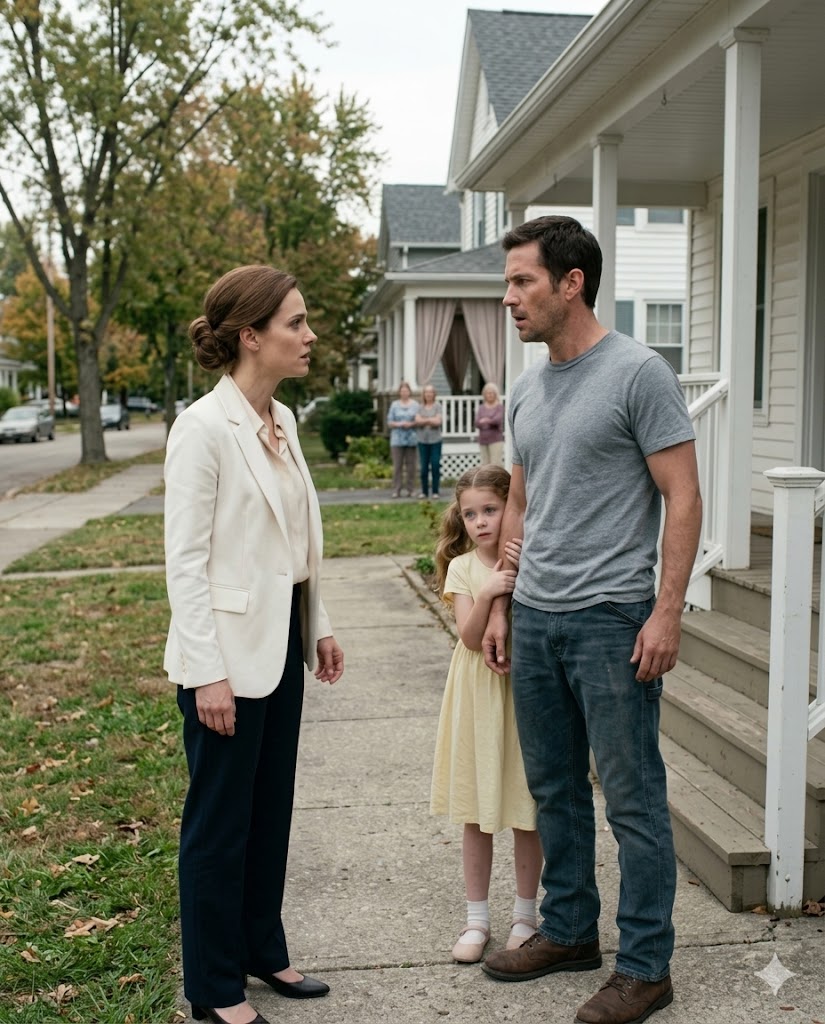
Dorian Price stood in his doorway, a worn dish towel draped over his shoulder, watching the vehicle idle in front of his home. Behind him, 8-year-old Marin pressed her face into his lower back, peering out with wide, wary eyes.
The woman who stepped out of the driver’s side wore a stark white blazer that seemed to pull the light from the dull afternoon. She didn’t have a briefcase, a lawyer, or a folder. She walked up the cracked concrete path with a measured, brittle steadiness. She stopped at the foot of the steps, looking up at Dorian.
“My name is Celeste Ror,” she said. “My father has died, but I came to pay his debt.”
Dorian felt the air leave his lungs. He knew the name. He had spent six years trying to bury it under the weight of working night shifts and holding his daughter through the long, quiet grief of losing his wife, Alina. Celeste looked terrified, though she wore it like armor. As the wind picked up, stirring dust along the curb, Dorian realized that whatever she had brought with her, his life on Maple Row was about to shatter.
Part 1: The Weight of Silence
Dorian Price was 42, with a face that had once been open and optimistic—the kind that spoke with genuine passion about structural integrity and the beauty of a well-poured foundation. Now, it was a face of hard lines and permanent alertness. He lived in the margins, cleaning houses, fixing roofs, and protecting Marin from the truth of why their life had collapsed.
Six years earlier, he had been the senior safety supervisor for the East Veil Bridge project. It was the crowning achievement of his career until he found the fractures. They were subtle, diagonal stress lines in the secondary support columns—the kind of silent, screaming indicators of disaster that only a trained eye would recognize. He had documented them, filed the warnings, and copied the regional safety board.
The response was a slow, systematic erasure. When the scaffolding collapsed two weeks later, injuring four men, the narrative had already been written: Dorian had failed to identify the risks. His documents were gone. His name was blackened. By the time the dust settled, he was unemployable, and his family was drowning in medical bills for Alina’s treatment.
Now, standing on his porch, he looked at Celeste, the daughter of the man who had ordered those lies. “What debt?” Dorian asked, his voice rough.
Celeste didn’t offer a platitude. She told him about the locked safe she had found in her father’s office, and the folder labeled East Veil. She told him she had seen the documents—his original reports, the ones that were never supposed to exist.
“I didn’t come to negotiate,” she said, her voice shaking slightly. “I came because I found the truth, and I don’t know how to live in a world built on top of your ruined life.”
Dorian felt a cold spike of adrenaline. He didn’t invite her in. He stood his ground, the screen door vibrating slightly in the breeze. “And what does the heir to the Ror empire want from me in exchange for this confession?” he asked.
Celeste looked at him, her eyes searching. “Nothing for me. Everything for you. I want to reopen the file.”
Dorian laughed, a dry, humorless sound. “You have no idea what you’re asking. You’re talking about tearing down a skyscraper, and I’m just a man trying to keep the roof over my daughter’s head.”
He turned away, leaving her standing on the path. But as he looked at Marin, who was watching him with an expression of profound, silent intensity, he realized the past wasn’t something you could just leave on the porch.
Part 2: The Echoes of the Past
Over the next week, the porch became a battlefield of confessions. Celeste returned every afternoon, sitting on the lower step while Dorian sat on the top, watching the street. Marin would do her homework between them, a quiet witness to the dismantling of a corporate myth.
Celeste spoke with a surgical precision that Dorian found both jarring and strangely compelling. She laid out the contents of the folder: the independent assessment that had been buried, the emails between Victor Ror and the chief legal counsel, and finally, the handwritten memo: Keep the timeline. Adjust documentation. I’ll manage the board.
Dorian listened, his jaw locked. The confirmation didn’t feel like vindication; it felt like a reopening of an old wound.
“Why now?” Dorian asked one evening, the sky bruising purple over the neighborhood. “Your father has been dead for months. Why not just burn the folder and go back to your boardroom?”
“Because every time I sign a document, I’m signing it with the ink of those four injured workers,” Celeste replied. “I can’t do it.”
Leon Vance, the owner of the local corner store, stopped Dorian the next morning while he was buying milk. “I’ve seen them before, Dorian,” Leon said, his voice low, his eyes fixed on the register. “They come down to the neighborhood, they look sad, they offer you a check to keep your mouth shut, and then they rezone the block and bulldoze us all into the dirt.”
“She hasn’t offered me a check, Leon,” Dorian replied.
“Not yet,” Leon countered. “They never start with the thing they want. They start by making you feel like they’re doing you a favor.”
Dorian left the store, his mind churning. He knew Leon was right about the world, but he couldn’t reconcile that cynicism with the look in Celeste’s eyes. That afternoon, a courier arrived at his house. It wasn’t an apology. It was a notice from a collection firm called Meridian Recovery Associates. They were claiming $14,000 in ‘administrative fees’ related to the original investigation.
It was a clear, sharp threat: Play ball, or we take the house. Dorian called Celeste from his backyard, his hand white-knuckling the phone. “Your people are trying to evict me,” he said, his voice dangerously low.
There was a silence on the other end, then a sharp, intake of breath. “I didn’t know,” Celeste said. “Dorian, please—I will handle this.”
“No,” Dorian said, hanging up. He stood in his small, overgrown yard, staring at the peeling paint of his back wall. He realized he was no longer just fighting for his name; he was fighting for a chance to finally stop being afraid. But even as he made the decision to push forward, he saw a black car idling down the street, watching his house. The game had started.
Part 3: The Price of Truth
The threats escalated. A local reporter who had been poking around the East Veil records had his tires slashed. A building inspector showed up at Dorian’s house, citing ‘unauthorized modifications’ to the porch, threatening heavy fines that would break his already thin budget.
Dorian and Celeste met on the porch, but the atmosphere had shifted. It was no longer a conversation; it was a conspiracy.
“They think they can wait me out,” Celeste said, her face drawn. She had been called into an ’emergency review’ by her board, and she looked like she hadn’t slept in days. “Warren Keane, the legal head, is tearing the house down from the inside. He knows about the safe.”
“Then you’re in danger, too,” Dorian said.
“I’m the CEO,” she replied with a thin smile. “The danger for me is social, financial, professional. For you, it’s existential. If we do this, there is no going back to the way things were. If we lose, they won’t just fire you again, Dorian. They will bury you.”
Dorian looked at Marin, who was drawing with colored pencils on the porch, unaware that her future was being gambled on a stack of yellowed papers. “She deserves to know that I didn’t fail,” he whispered. “She deserves to know that I was the one who saw it coming, and I was the one who tried to stop it.”
“Then we do it,” Celeste said. “We don’t go through the courts. We go to the press. A total, unfiltered release. No lawyers, no redactions.”
“And if they kill the story?”
“Then we make sure they have to kill us both to stop it.”
That night, Dorian sat at his kitchen table. He took out his old copy of his original report—the one he had painstakingly recovered from his own private archives. He looked at the signature of the man he had been six years ago. He felt a sudden, sharp clarity. The fear was still there, but beneath it was a bedrock of resolve.
He texted Celeste four words: Don’t leave yet. Please.
He wasn’t asking her to stay; he was asking for an ally. He knew that if he were to fall, he couldn’t do it alone anymore. The next day, he brought his daughter to the porch and told her they might have to move. He didn’t tell her about the lies or the bridges; he told her that sometimes, doing the right thing meant leaving a home you loved. She didn’t cry. She just held his hand, her grip surprisingly strong.
Part 4: The Sound of Guilt
The fourth meeting was the turning point. Dorian didn’t just sit and listen; he invited Celeste into the house. It was the first time she had been inside, and she moved through the living room with the hesitation of a trespasser.
Dorian brought out the USB drive. “You said you found a memo,” he said, setting the drive on the table. “You said there was more.”
Celeste took a deep breath. She didn’t use the computer. She had brought a small, portable speaker. “My father didn’t just write memos, Dorian. He recorded calls.”
She pressed play. The silence in the house was absolute as the voice of Victor Ror—a man who had once been a titan of the city—filled the room. It was conversational, casual, terrifyingly mundane. He was instructing his project manager to ignore the warnings.
“The supervisor’s report doesn’t exist officially, so it can’t be cited. Make sure Keane knows the timeline.”
Dorian sat motionless. His heart wasn’t racing; it was cold, still, and hard as stone. He heard the man who had destroyed his life treating the lives of his workers like a line item in a budget.
“He knew,” Dorian whispered. “He didn’t just suspect there was a risk. He knew.”
“Yes,” Celeste said, her voice barely a whisper.
Dorian felt a strange, hollow sensation in his chest. For years, he had wondered if he had been wrong. He had doubted his own memory, his own calculations, his own integrity. Hearing the voice of the man who had erased him was the final piece of the puzzle. It didn’t bring him joy. It brought him the devastating, final peace of absolute truth.
“What now?” he asked, looking at his hands.
“Now,” Celeste said, “we decide how to light the fire.”
They spent hours planning. They weren’t plotting a legal defense; they were plotting a public reckoning. They would hold a press conference, but not at the company headquarters. They would go to a neutral hotel, bring the journalists, and present the raw, unfiltered evidence.
As the sun set, casting long, orange shadows across the kitchen floor, Dorian realized that by the end of the week, the name ‘Dorian Price’ would either be a cautionary tale of failure or a symbol of vindication. He felt the weight of the last six years pressing down on him, and for the first time, he was ready to set it down.
Part 5: The Reckoning
The morning of the press conference was cold and gray. Dorian drove his beat-up sedan, with Marin in the back seat, to a downtown hotel that felt like a sanctuary of glass and steel. He felt like an intruder, his clothes worn, his hands calloused.
Celeste was already there, pacing the back of the meeting room. She looked pale, her hair pulled back tightly, her eyes bright with a dangerous, focused intensity. She wasn’t the CEO of Ror Meridian today; she was a woman trying to burn down her own empire.
The room was packed. Fourteen journalists, three camera crews, and a buzzing, nervous energy that signaled the gravity of the moment. Dorian sat in the back with Marin, who was sketching quietly, oblivious to the fact that their lives were about to change forever.
Celeste walked to the podium. She didn’t use notes. She didn’t use a teleprompter. She told the story—not as a corporate announcement, but as a personal failure. She spoke of her father, the safe, the memo, and finally, she played the recording.
When Victor Ror’s voice boomed through the speakers, the room went dead silent. You could hear the hum of the air conditioner and the distant siren of an ambulance.
“My father made a choice,” Celeste said, her voice echoing in the stillness. “It was a wrong choice. I am here because that choice has to be named for what it was.”
She finished, and for a long moment, nobody moved. Then, a reporter stood up. “Does the man responsible for the original report have anything to say?”
Dorian stood up. His legs felt like lead, but he moved to the front with a steady, deliberate pace. He reached the podium, looked into the lenses of the cameras, and felt the past fall away.
“I did my job,” he said. His voice wasn’t loud, but it was clear and resonant. “I identified a problem. I reported it. I was silenced. Today, I just want the record to reflect what actually happened.”
Marin watched him from the back. She didn’t cheer; she just nodded, a small, proud smile touching her lips. Dorian finished, walked back to his seat, and felt his daughter’s hand slip into his.
The press conference didn’t end the conflict; it ignited the firestorm. By the time they left the hotel, his phone was already buzzing with notifications. The truth was out, and it was screaming across every news channel in the city.
Part 6: The Aftermath
The response was a chaotic, violent backlash. Ror Meridian went into defensive lockdown, calling the evidence ‘selective’ and the recording ‘unverified.’ Warren Keane, the company’s legal bulldog, appeared on television with a face of stone, using the word ‘context’ until it lost all meaning.
But the truth had legs. Within forty-eight hours, forensic experts had verified the audio. The regional board was forced to open an investigation. Former employees, emboldened by Celeste’s courage, started leaking their own stories.
Dorian’s life didn’t instantly return to normal, but it began to heal. His license was restored. The collections notice was voided, and he was offered a job as a senior consultant at a firm that had watched the entire spectacle with respect.
Celeste, meanwhile, was being systematically dismantled by her board. They stripped her of her powers, put her on administrative leave, and eventually forced her to resign. But she didn’t look like a woman who had lost everything. She looked like a woman who had finally been set free.
One afternoon, three months later, Dorian and Celeste met at a small café near the site of the new community center she was consulting on.
“You lost your company,” Dorian said, sipping his coffee.
“I lost a structure that was built on a lie,” she corrected. “I gained a chance to build something that actually stands for something.”
“I never thanked you,” he said quietly.
“You don’t have to,” she replied. “We both paid the price, Dorian. You just paid it in installments over six years. I paid it in one lump sum.”
As they talked, Dorian saw the neighborhood through different eyes. It was still the same place, but the air felt clearer. He had his life back, his daughter was safe, and for the first time in his life, he didn’t have to look over his shoulder.
But the most profound change was in Marin. She was no longer just the quiet girl hiding behind her father. She had seen the truth brought to light, and she walked with a confidence that she had lacked since her mother passed away. She was the proof that even the deepest darkness could be pierced by the right, simple, and terrifying act of honesty.
Part 7: The Foundation of Tomorrow
A year later, the recreation center was complete. It was a beautiful, functional space filled with children and life. Celeste held a small dedication ceremony on a Saturday morning, the air crisp and bright with the promise of spring.
Dorian stood by the entrance, watching Marin run across the lawn. She wore a yellow jacket, bright and defiant against the green grass. She stopped, turned, and looked at the building, her expression deeply serious as she inspected the cornerstones and the columns.
Celeste joined him, standing in the morning sun. “It’s good, isn’t it?”
“It’s solid,” Dorian said.
Marin trotted back to them, looking up at the building with her hands on her hips. “Is the debt paid now?” she asked, her voice clear and earnest.
Dorian looked at Celeste, who smiled softly. He knelt down so he was eye-level with his daughter. “Some things can’t be fully paid, Marin. But we aren’t carrying it for someone else anymore. That’s the only debt that ever really mattered.”
Marin nodded, seemingly satisfied, and ran back toward the building to explore the interior.
Dorian and Celeste followed her. They walked slowly, the ground under their feet firm and level. They hadn’t won a war; they had simply survived a lie. They had learned that the truth was not a luxury, but a necessity—the only foundation upon which a human life could be built.
As they entered the recreation center, the laughter of children echoing against the walls, Dorian felt the final weight of the East Veil bridge lift. He had been a man who lost his home, his wife, and his reputation for the sake of a truth no one wanted to hear. But looking at the world he was helping to build, he knew he would do it all again.
The truth is a heavy burden, but it is also the only thing that sets you free. They had walked through the fire, and they had emerged on the other side, not as martyrs, but as survivors, builders, and custodians of a world that was, at long last, a little bit more honest.
Dorian watched Marin laugh as she played with other children. He took a deep, steady breath, filled his lungs with the fresh air, and for the first time in his life, he didn’t worry about the future. He just lived in the present, a man who had finally come home to himself.