My Father Said ‘Don’t Open This Until She Breaks You’ — After 7 Years, I Opened It…
Part 1: The Invisible Weight
At 38 years old, Malcolm Harris knew his precise worth in the world. It was $63,000 a year. He was a master electrician, a respected professional who could read the tangled guts of a building and bring it to life with light and power. But in his own home, in the meticulously curated spaces of the Germantown townhouse he shared with his wife, Rochelle, he often felt like a faulty appliance: functional, replaceable, and certainly not something to show off.
Tonight, the feeling was particularly acute. They were at Acre, a restaurant where the entrées started at $50 and the ambient lighting felt designed to obscure price tags. It was Rochelle’s mother’s birthday, and the table was a study in contrasts. On one side sat Rochelle, radiant in a deep blue dress that had cost $400—a gift from her to her mother. Next to her, Patrice wore a silk blouse and a diamond tennis bracelet that Malcolm knew approached $5,000. It shimmered under the single focused spotlight above their table, a tiny, cold star.
On the other side sat Malcolm. He wore his best navy blazer, a $150 purchase from five years ago. On his wrist was his $89 Timex watch, a gift from his late father. Its steady, humble tick felt a world away from the silent, ostentatious sparkle of Patrice’s diamonds. He felt the gulf between their worlds not as a distance, but as a pressure—an invisible weight pressing down on his shoulders.
“The sommelier was just telling me about this fascinating little vineyard in Napa,” Patrice said, swirling a glass of deep red wine. “They produce only 500 cases a year. This bottle alone is $200.” She smiled, a tight, proprietary expression. “Rochelle, darling, you have such exquisite taste.”
“I learned from the best,” Rochelle said, her voice smooth as cream. She reached across and squeezed her mother’s hand. Her own nails were perfect—a glossy almond shape that cost $80 every two weeks to maintain.
Malcolm took a slow sip of water. He had ordered the grilled chicken, the most modest thing on the menu at $32. He had already calculated the evening’s cost in his head. With the wine, the appetizers, and their three expensive main courses, the bill would likely exceed $600. That was nearly two full weeks of his take-home pay.
Patrice turned her gaze to him, a look that always felt like an appraisal. “Malcolm, Rochelle tells me you were on a big job this week. Something at the hospital?”
“Yes, ma’am,” he said, his voice quiet. “We’re rewiring the West Wing. It’s a major upgrade to the surgical suites.” He felt a flicker of pride. It was complex, important work.
Patrice nodded slowly, taking another delicate sip of her wine. “A trade is such a useful thing to have,” she said, her tone dripping with condescension. “It’s so tangible.” She paused, letting the word hang in the air. “My Gerard—Rochelle’s father—he was a surgeon. A profession, you see. The mind, not the hands. The income potential is just different.”
The air went still. Malcolm felt a familiar hot flush creep up his neck. He looked at Rochelle, waiting for her to say something—to defend him, to bridge the gap her mother had so casually blasted open. He hoped for a simple, Mother, please, or, Malcolm’s work is very skilled.
But Rochelle just smiled faintly, a placid, unreadable expression on her beautiful face. She adjusted the cuff of her dress. “Mother, you’ll embarrass him,” she murmured. It was not a defense; it was a confirmation of the insult. It implied he should be embarrassed.
The humiliation was a cold, metallic taste in his mouth. He looked down at his hands resting on the crisp white tablecloth. They were clean, the nails trimmed, but the calluses were permanent—a roadmap of his life’s work etched into his skin. These hands had paid for the $400 dress, for the $80 manicure, for his share of the $2,800-a-month rent. These hands were currently paying for this very meal, where he was being told they were lesser than.
He felt like a ghost at the table, the silent financier of a life he wasn’t truly welcome in. He had no idea in that moment how right he was. He had no idea that the money from his hands was flowing away from him in a secret, silent river, and that the woman smiling beside him was the one directing its current. He took another sip of water, his knuckles white, unaware that the evening was about to take a turn that would force him to look into the dark history of the woman he called his wife.
Part 2: The Foundation Crumbles
What Rochelle and her mother didn’t know was that Malcolm’s quiet nature wasn’t a weakness; it was a habit of observation. He had been taught by his father, a man of few words and profound wisdom, to watch and listen before acting. And he had been watching for a very long time.
Seven years ago, their life had been entirely different. It had been built not on the glossy pages of magazines, but on the solid foundation of shared dreams and a carefully managed budget. They had lived in a small, rented two-bedroom house in Orange Mound, a neighborhood rich with history and a sense of resilient community. The rent was a manageable $1,200 a month. The house had old bones—a screen door that squeaked, a floorboard that groaned—but to Malcolm, it was perfect. It was a home.
He remembered those early days with a clarity that felt painful now. He would come home from a long day, his work boots leaving dusty footprints on the mat, and the smell of Rochelle’s cooking would greet him. She made a chicken pot pie that could make a man forget every trouble he’d ever had. They would sit at their simple, secondhand wooden table—a $75 find from a thrift store—and talk for hours.
Their biggest shared project was the “house jar.” It was an old pickle jar, washed clean, sitting on the kitchen counter. Every Friday, without fail, they would each contribute $50 in cash. Malcolm would pull two 20s and a 10 from his wallet, and Rochelle would do the same. They’d fold the bills together and push them through the slot in the lid. Sometimes, when he got an overtime check, he’d add an extra hundred. “That’s another window for our future living room,” he’d say. And she would kiss him, her eyes bright with a future he believed they both wanted.
Life was measured in shared laughter and the slow, satisfying growth of the money in the jar. The change began subtly, a slow tide creeping in. It started with Rochelle’s new job as a junior account executive at a chic PR firm downtown. The office was in a sleek glass tower, a world away from the dusty construction sites where Malcolm spent his days. She started talking about her colleagues, their lives, their cars, their vacations.
“Jennifer’s husband just bought her a new Lexus for their anniversary,” she’d mention casually over dinner. Or, “Brenda and her family are summering in the Hamptons. Can you imagine?”
At first, Malcolm saw it as simple aspiration. “We’ll get there, baby,” he’d say, squeezing her hand. “One step at a time. We just have to stick to the plan.”
But the plan—their plan—began to feel like it was only his. The first major crack came with the car. Rochelle’s 10-year-old Honda Civic was starting to have problems. Malcolm, ever practical, spent a week researching. “I found a great deal on a three-year-old Toyota Camry,” he announced one evening, proud of his diligence. “Low mileage, great safety rating, only $16,000. We can pay for half from our savings and have a really small loan.”
Rochelle looked at the printout he handed her with a distinct lack of enthusiasm. “A Camry, Malcolm? It’s beige.”
“It’s reliable,” he countered. “It’ll last us ten years.”
“I don’t want to drive a beige car for ten years,” she said, her voice sharp. “My boss drives a Mercedes. The interns drive new Volkswagens. I can’t show up to client meetings in a used beige Toyota. It’s about image.”
The argument went on for days. Her mother got involved. Of course, a man should want his wife to have the best, Patrice had said to him over the phone, her voice dripping with judgment. In the end, Rochelle won. She found a gleaming white BMW 3 Series at a dealership in Germantown. It was certified pre-owned, but it still cost $43,000. To cover the significant down payment, she suggested they use the money from the house jar.
“But that’s for our house,” Malcolm protested, his heart sinking.
“A house is years away, Malcolm,” she’d said, her tone dismissive. “This is about my career right now. It’s an investment in our future.”
He had relented. He watched her count out the thousands of dollars in folded bills—the money he’d pictured as windows and doors and a backyard for their kids—and hand it over to a smiling car salesman. The day she drove the BMW home, she was ecstatic. He felt a cold knot of dread. It was the first time he realized they were heading in completely different directions. He didn’t know it then, but the house jar wasn’t just a symbol of their future; it was the first victim of a greed that would eventually consume everything he worked for.
Part 3: The Quiet Erosion
The move to the Germantown townhouse came a year later. Another “investment in their image,” it doubled their rent and moved them miles away from the community Malcolm loved into a sterile subdivision where neighbors never spoke. The old pickle jar was retired, replaced by a joint bank account—a decision Rochelle insisted would be more efficient. He had no idea how efficient it would truly become.
The years that followed were a masterclass in quiet erosion. The belittling wasn’t loud or overt; it was a series of a thousand tiny cuts. Each one was delivered with a placid smile or a tone of gentle concern that made him feel crazy for even noticing. Rochelle’s cruelty was an art form wrapped in the guise of helpfulness.
It began with the budget. One Saturday morning, Rochelle sat him down at their new $1,500 glass dining table, her laptop open to a spreadsheet. “Honey,” she began, her voice patient, as if speaking to a child. “I’ve been looking at our finances, and I think I found a way to optimize things.”
Malcolm, who had always been diligent, felt a prickle of unease. “Okay.”
She showed him the screen. She had categorized all their spending: the rent, the car payment for her BMW, her $200-a-month “personal care” budget. Then she pointed to a small line item at the bottom. “And this will be your weekly allowance,” she said brightly.
He stared at the number. “$75.”
“My allowance?” he repeated, the word tasting like ash. “Rochelle, I make $63,000 a year. I don’t need an allowance.”
“Oh, sweetie, it’s not like that,” she said, her condescension perfectly pitched. “It’s just that you deposit your whole paycheck into the joint account and then I’ll manage all the bills and the savings. This way, you don’t have to worry about a thing. It’s just walking-around money for you—for lunch, gas, whatever.”
“I’m capable of managing my own money, Rochelle.”
“I know you are,” she said, placing a cool hand on his arm. “But you’re not a numbers person, Malcolm. You think about wires and circuits. I think about the big picture—compound interest, investments. Let me handle this. It’s for us.”
He felt trapped. To argue would make him seem difficult or controlling. To agree felt like a surrender of his manhood. He looked around the pristine townhouse at the furniture he was paying for but hadn’t chosen, and he felt a profound sense of powerlessness. He agreed. From that day on, his entire paycheck was direct-deposited into an account she controlled, and he was handed a small amount of cash each week like a teenager.
The insults became more frequent, always veiled. When his work boots—which he always took off at the door—left a small smudge of dirt on the beige travertine tile, she sighed dramatically. “I just had the cleaners here, Malcolm. They cost $180, you know.” It was never, Honey, can you be more careful? It was always a reminder of the cost. A cost he was bearing.
Then came the incident with the promotion. Malcolm had worked tirelessly on a complex project for a new biotech firm. His boss had been impressed, and he was given a raise—an extra $5,000 a year. He came home that evening buzzing with pride.
“I have great news,” he said, unable to keep the excitement from his voice. “I got a raise today, $5,000.”
She looked up from her screen, her expression blank. She didn’t smile. “Oh,” she said, her focus already returning to the phone. “Is that all?”
The words hit him like a physical blow. He had expected a hug, a celebration, maybe an offer to go out to their old favorite pizza place. Instead, his achievement was dismissed in three words.
“Well, I mean, it’s nice, honey,” she added, as if sensing she’d gone too far. “But after taxes, it’s really not that much, is it? It won’t even cover the property tax increase if we ever buy a place in this neighborhood.”
Later that week, he overheard her on the phone with her mother. He was in the garage putting his tools away, and she was in the kitchen with the window open. “Yes, a raise,” she was saying, her tone weary. “I know, Mother. It’s a drop in the bucket. He works so hard for so little. Honestly, I don’t know how he does it. He’ll never make real money, you know—not professional money.”
Each word was a nail in the coffin of his pride. He stood in the dim light of the garage, surrounded by the tools that defined him, and felt a hollowness so vast it threatened to swallow him whole. He was just a funding source, a drop in the bucket for a lifestyle he wasn’t even enjoying. He didn’t know it, but the seeds of his reclamation were already starting to stir in the silence of his own mind.
Part 4: The Sealed Promise
The worst was the constant refrain about his dependence on her. He had friends, a good relationship with his brother, a solid community of guys he worked with. But Rochelle had systematically isolated him. His friends were “too rough.” His brother’s family lived “too simply.” She made it clear she didn’t enjoy their company, so he saw them less and less just to keep the peace.
“What would you do without me to manage everything?” she’d say with a little laugh. When the utility bill was paid or the car was registered, she framed his life as a chaotic mess that only her “superior intellect” could keep in order. He started to believe it. His world had shrunk to the walls of that cold, stylish townhouse and the woman who ruled it.
It was during one of these low moments, about a year after the move to Germantown, that his mind drifted to his father. Marcus Harris had been a plumber—a man with hands as calloused as Malcolm’s, with a quiet dignity that filled every room he entered. He had died three years prior, a swift and sudden heart attack that left a gaping hole in Malcolm’s life.
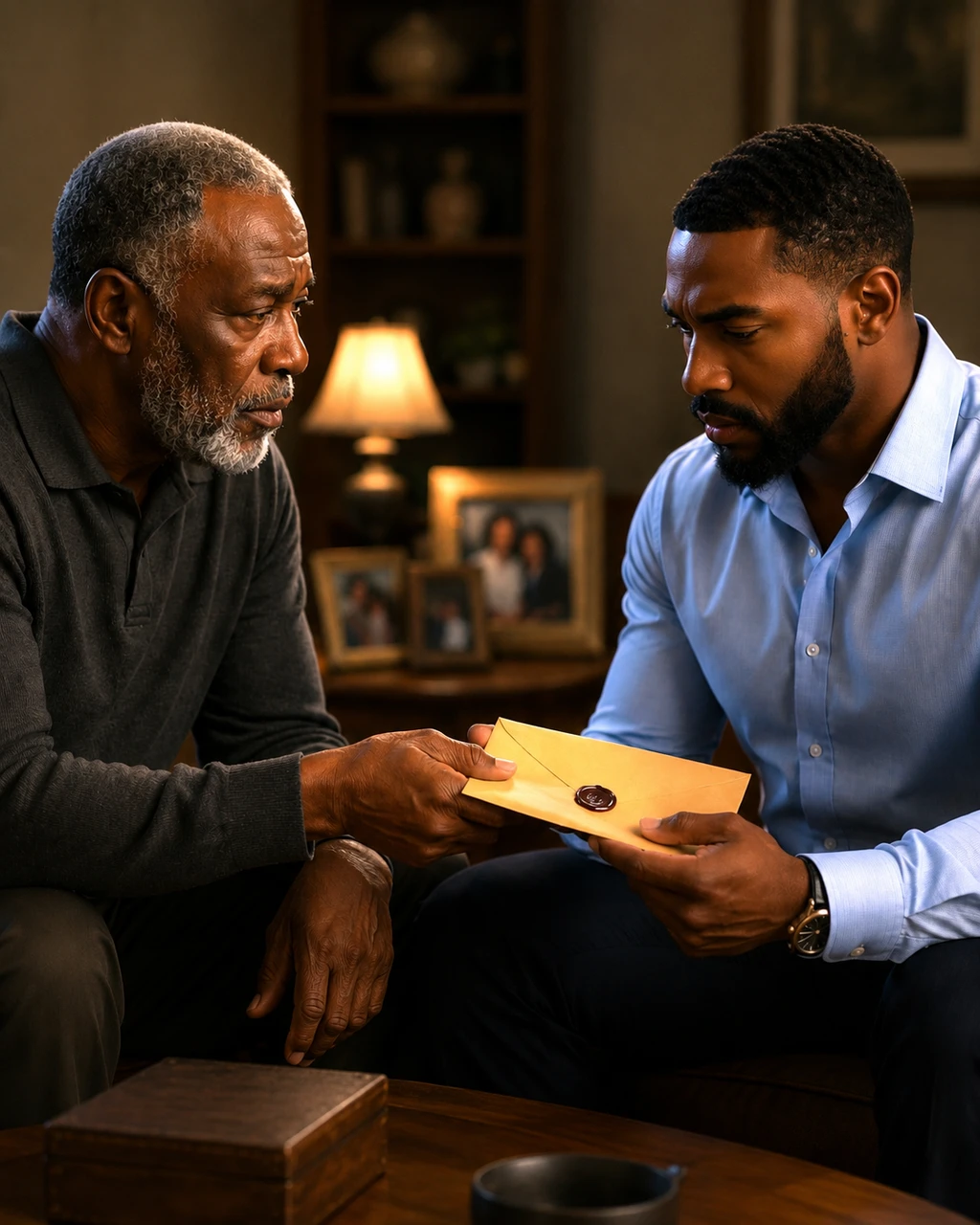
He remembered the last week in the hospital room, which smelled of antiseptic and fear. His father had been weak, his voice a dry whisper, but his eyes were sharp. He had motioned Malcolm closer. From the drawer of his bedside table, he’d pulled a thick, 9×12-inch manila envelope sealed with heavy-duty tape.
“Malcolm,” his father had rasped, pressing the envelope into his son’s hands. “I want you to take this, and you listen to me. Don’t you open this until she breaks you. You hear me? Not until you feel like you’ve got nothing left and nowhere to turn. I hope to God you never have to open it, son. But I’m not a gambling man. And I don’t like her odds.”
Malcolm had been confused, even a little offended on Rochelle’s behalf. “Dad, what are you talking about? Rochelle loves me.”
His father had just shaken his head, a look of profound sadness in his eyes. “Just promise me, son. Promise your old man.”
“I promise,” Malcolm had whispered. He took the envelope and, after the funeral, placed it in a safe deposit box at his bank. He tried to forget his father’s strange, unsettling words. He loved his wife. His father had been wrong. He had to be. For seven years, that envelope had sat in the dark, a forgotten promise, a testament to a faith Malcolm desperately wanted to be justified. He had no idea the breaking point was so close.
The breaking point arrived on a Tuesday night in late October. The air had a crisp chill that promised winter was on its way. Malcolm had been on an emergency call-out since 4:00 p.m., wrestling with a fried transformer at a downtown data center. It was grueling, high-pressure work, and he didn’t get home until 10:15 p.m. He was bone-tired, his clothes smelling of ozone and dust, his stomach growling. He parked his work van—a reliable 2012 Ford Transit with 187,000 miles on it—on the street, as Rochelle didn’t like its “commercial look” in their pristine garage next to her white BMW.
He let himself into the townhouse. The silence was immediate and absolute. The lights were low, casting long, elegant shadows from the expensive furniture. The air was cool, scented with a faint, artificial vanilla from a $90 plug-in diffuser. It never smelled like a home; it smelled like a hotel lobby.
He took off his steel-toed boots on the mat, his movements quiet by long habit. As he walked down the hall toward the kitchen, he heard the faint murmur of a voice. It was Rochelle in the living room. As he got closer, he realized she was on speakerphone. He paused at the edge of the hallway, hidden in the shadows—a sudden, inexplicable instinct telling him to stop and listen.
“I just don’t understand why he has to be so dramatic about money all the time,” Rochelle was saying. Her voice was laced with a familiar, weary annoyance. “He’s complaining about the savings again. I don’t know why he’s so stressed. I handle everything.”
Then another voice, tiny and sharp, came through the speaker. It was her mother, Patrice. “Is he getting suspicious?”
“No, no, he’s not smart enough for that,” Rochelle said with a short, dismissive laugh that cut Malcolm to the quick. “He just sees his little paycheck disappear and gets nervous. He has no idea how much things actually cost.”
“Just keep moving the money like we discussed,” Patrice instructed, her voice conspiratorial. “A little bit at a time, from the joint to your private account. He’ll never notice the small amounts. The important thing is to have your own nest egg, darling. You can’t be tied to a man who makes $60,000 a year forever.”
Malcolm’s blood ran cold. A private account? Moving money? His mind flashed to the house jar, to the $50 bills he’d so faithfully contributed. He felt a wave of nausea. He was about to step out, to confront her, to demand an explanation, when Rochelle spoke again. Her words weren’t angry or conspiratorial. They were delivered with a sigh of utter final dismissal, the sound of a person brushing away a piece of lint.
“Even if he did find out, what’s he going to do?” she said. “He’ll always come back. He has nowhere else to go.”
Part 5: The Steel Revealed
“Nowhere else to go.” The four words echoed in the silent hallway. They landed with the force of a physical blow, knocking the air from his lungs. It wasn’t just the betrayal of the money; it was the casual, confident cruelty of that statement. It was the summation of their entire life together. His love had been misread as weakness, his loyalty as desperation, his very presence as a matter of convenience.
She didn’t just think he was simple. She thought he was trapped. In her eyes, he was a stray she’d taken in, and he should be grateful for the shelter.
He didn’t make a sound. He backed away, his movements as silent as a shadow. He turned and walked out the front door, closing it softly behind him. The cool night air hit his face, but he barely felt it. He was numb, hollowed out. The man who had walked into that house ten minutes ago was gone. In his place was someone else—a stranger forged in the cold fire of those four words.
He got back in his work van. He didn’t drive aimlessly. He drove with a singular, chilling purpose. He drove to the First Fidelity Bank on Popular Avenue, the branch where he kept his safe deposit box. The lobby was closed, but the ATM vestibule was open 24/7, and it had the access terminal for the after-hours safe deposit vault.
The fluorescent lights of the vestibule hummed, casting a sterile, unforgiving glare. He swiped his card and entered his PIN. The heavy steel door to the vault room clicked open. He walked inside, the air still and cold. He found his box, number 34B. He slid his key into the lock, and the bank attendant’s master key was already in place. He turned it. The small metal door popped open.
He pulled out the long, rectangular box and carried it to the small, private viewing booth. He sat down, his heart hammering against his ribs. Underneath a few old car titles and his birth certificate was the envelope—the thick 9×12-inch manila envelope his father had given him. It felt heavy in his hands. Heavy with a significance he was only now beginning to comprehend.
His hands were trembling, not with fear, but with a cold, clarifying rage. He looked at his watch, the $89 Timex his father had worn for 20 years. The steady tick seemed to count down the seconds of his old life. The time was 11:32 p.m. He ripped the sealed edge of the envelope. The sound of the tearing paper was loud in the silent room. A final, definitive severing.
He pulled out the contents. On top was a single-page letter, handwritten in his father’s strong, clear script.
Son, it began. If you are reading this, it means my worst fears came true. I am sorry. I saw this in her from the day you brought her home—a hunger that has nothing to do with love and everything to do with what she can get. I know you loved her, and maybe she even loved you in her own way. But some people are just built broken. A man’s pride is a fragile thing, but his dignity is made of steel. This is your steel. Don’t let her or anyone ever make you feel small for the good, honest work you do with your hands. Now, read the rest of this and then you call Alistair Finch. He’s a good man. He’ll know what to do.
Beneath the letter were documents. The first was a thick, professionally bound portfolio. The cover read: The Harris Family Legacy Trust. He opened it. It was a legal trust, notarized and executed five years ago, shortly after his father’s death. His father had funded it with his entire life savings—$150,000. Malcolm was named as the sole beneficiary. A man named Alistair Finch was the trustee.
But it was the next set of papers that made his breath catch. They were bank statements from a secret savings account at a different bank, all in Rochelle’s name. The statements were from seven years ago, right after they were married. His father, on a gut feeling, had hired a private investigator for one month. The PI had documented small weekly transfers from their joint account to this secret one. It was the digital equivalent of her skimming from the house jar.
The final stack of documents was the most devastating. It was a series of recent printouts generated by a software program. A clause in the trust his father had established gave the trustee monitoring access to any joint account Malcolm was a part of. For five years, the trust had been silently, automatically logging every single transaction.
There, in black and white, was a clear, undeniable record. Every week, two days after his paycheck was deposited, a transfer was made. It started small—$100 a week—then it grew to $200, then $300. The destination account number matched the one his father’s PI had discovered seven years earlier. He did a quick, rough calculation in his head—his mind, the one Rochelle thought was only good for circuits, moving with lightning speed. It had been happening for years. Tens of thousands of dollars. An updated summary sheet from the trust put the current diverted total at $88,450.17.
He sat there in the cold, sterile light of the bank vault. The evidence of a seven-year lie spread out before him. He felt no sadness. The man who could have been heartbroken had died in the hallway of the townhouse an hour ago. The man sitting here now felt only a profound, chilling calm. He folded his father’s letter, placed it back in the envelope, and slid the damning evidence into his briefcase. He had a name: Alistair Finch. He had the steel his father had promised him, and he had a plan.
Part 6: The Architect of Retribution
The next morning, Malcolm woke up at 5:30 a.m. on the lumpy mattress of an $89-a-night extended-stay hotel room. He had not gone back to the townhouse. He never would. The man who had feigned ignorance for years out of love was gone. In his place was a strategist.
The temperature of his soul had dropped to absolute zero. He was no longer playing for peace; he was playing to win. The first phase of his plan was the most difficult: he had to pretend that everything was normal. He had to become the world’s greatest actor, playing the part of the oblivious, simple-minded husband Rochelle believed him to be.
He started by calling her at 7:00 a.m. He let the phone ring once, twice, then hung up. A minute later, he sent a text: Hey, sorry. Got called out for an emergency job last night. Major power surge at a warehouse. Just wrapping up now. I’ll be home in a bit.
It was a perfect lie—plausible and consistent with his work. He spent the next hour at a diner drinking coffee and meticulously planning his moves. He used a burner app on his phone to call the number his father had left for Alistair Finch.
A calm, professional voice answered on the second ring. “Finch and Associates.”
“I’d like to speak to Mr. Alistair Finch,” Malcolm said, his own voice steady. “My name is Malcolm Harris.”
There was a brief pause. “One moment, Mr. Harris.”
A moment later, a new voice came on the line—warm but firm. “Mr. Harris. Alistair Finch here. I’ve been expecting your call for a long time. Your father was a great man.”
“He was,” Malcolm said, a lump forming in his throat. He quickly swallowed it down. Emotion was a luxury he could not afford. “Mr. Finch, I’ve opened the envelope.”
“I see,” Finch said. There was no surprise in his voice, only a somber readiness. “The trust is armed and ready, Malcolm. Your father called it ‘the steel.’ He wanted you to have a tool that was sharper and stronger than any betrayal. We just need your word to proceed.”
“You have it,” Malcolm said. “But not yet. I need a few days. I need her to be comfortable. I need her to believe she has all the power.”
“A very wise strategy,” Finch said approvingly. “Let her walk deeper into the trap she set for herself. Call me when you’re ready to spring it. We will be prepared.”
That evening, Malcolm went home. He walked into the townhouse, braced for a confrontation, but Rochelle was distracted. She was planning a weekend trip to a spa with her friends.
“Oh, there you are,” she said, barely looking up from her laptop. “You look exhausted.”
“Long night,” he said, forcing a weary smile. He walked over and kissed the top of her head. He felt nothing. It was like kissing a marble statue. “Listen, for that emergency call-out, I got a pretty decent bonus. $500. I was thinking we should put it straight into our savings.”
He watched her face closely. Her eyes lit up. It was a flicker of pure, unadulterated greed. “Oh, that’s wonderful, honey,” she said, her voice suddenly full of affection. “That’s so responsible of you. See? You are getting better with money.”
He just nodded, the insult sliding off him like water off a duck’s back. “I’ll transfer it over now,” he said, pulling out his phone. Of course, he transferred it to his own new private account he’d opened that morning, but he showed her a faked confirmation screen. She beamed.
The next few days were a living hell of feigned normalcy. He made her coffee in the morning. He asked about her day. He listened to her complain about a colleague at her $120,000-a-year job. Each word of hers, each casual assumption of his ignorance, was another piece of evidence he stored away.
On Thursday night, he executed the centerpiece of his performance. “Let me take you out tomorrow night,” he said. “To celebrate my bonus. Anywhere you want.”
Her face lit up. “Really? Can we go to Erling Jensen?” It was one of the most expensive and exclusive restaurants in Memphis. A tasting menu there could cost $200 per person.
“Absolutely,” he said, smiling. “Whatever makes you happy, Rochelle.”
The dinner was surreal. He sat across from her, watching her enjoy a $120 bottle of Sancerre and a plate of seared scallops. She talked endlessly about her plans—about the $2,400 Burberry trench coat she was planning to buy, about a potential trip to Paris her mother had mentioned. She was expansive, confident, basking in the glow of her secret wealth and her husband’s apparent compliance. He played his part to perfection. He listened. He nodded. He smiled. He was the simple electrician, content in his ignorance, happy to fund a life he couldn’t comprehend.
Inside, he was a block of ice. He was watching a stranger, a woman he’d once loved with every fiber of his being, and he felt nothing but a cold, clean sense of purpose. As she described the coat, he said, “You should get it. You work hard. You deserve it.”
“You think so?” she asked, a little surprised.
“I do,” he said, meeting her eyes. “You should go get it this weekend.”
He was not just allowing her to walk into the trap; he was holding the door open. He wanted her to be at her most arrogant, her most confident, when the floor fell out from beneath her. His father had given him the steel; now he was sharpening it.
Part 7: The Final Short Circuit
The meeting with Alistair Finch took place the next morning, Friday, at 9:00 sharp. Malcolm took the day off work, telling Rochelle he had a “dentist appointment.” The lie came easily now.
Finch’s office was on the 20th floor of a glass tower on Front Street, with a panoramic view of the muddy, majestic Mississippi River. Alistair Finch was an impeccably dressed man in his late 60s. He had a warm, intelligent face and a handshake as firm as Malcolm’s father’s had been.
“Malcolm,” he said, gesturing to a leather chair. “Please sit. Your father talked about you a great deal. He was very proud of the man you are.”
“Thank you for seeing me, Mr. Finch,” Malcolm said.
“Call me Alistair,” he replied with a small smile. “We are on the same team here—the Harris team.”
For the next hour, they went over the trust documents. Alistair explained the legal framework in simple, clear terms. The Harris Family Legacy Trust was an ironclad instrument. The key provision—the one Alistair called Marcus’ masterstroke—was a specific clause that granted the trustee oversight and recovery rights over any joint financial accounts the beneficiary, Malcolm, entered into.
“Your father suspected this might happen,” Alistair explained, tapping a manicured finger on a highlighted paragraph. “He structured this so the trust wasn’t just a gift; it was a shield. When you signed the papers for that joint account with Rochelle, you unknowingly activated this clause. The trust became a silent legal partner in that account with the power to protect your interest.”
Alistair’s paralegal brought in a thick binder labeled Harris v. Harris Evidence. Inside, everything was meticulously organized: the PI reports from seven years ago, the transaction logs from the trust’s monitoring software showing 364 separate transfers, and the evidence of the laundered money used for the “gifted” Italy trip. The total clawed back by the trust now stood at over $92,000.
“So, what is the plan?” Malcolm asked.
Alistair leaned forward. “The plan is surgical. At 2:30 this afternoon, I will personally serve a notice of fiduciary audit and a temporary restraining order on the main branch of your bank. The bank’s legal department will be forced to comply immediately. They will place a hold on the primary joint account, which will extend to any accounts she is a co-signer on, or any to which a pattern of fraudulent transfers can be demonstrated—that includes her mother’s.”
“Rochelle will be at the mall,” Malcolm said, a cold certainty in his voice. “I told her to buy a coat. She wanted a Burberry. It costs over $2,000.”
Alistair nodded slowly, a flicker of something like admiration in his eyes. “Excellent. A public moment of consequence. Your father would have appreciated the poetry of that. She will attempt a large purchase, and her financial world will simply cease to function. She will have no access to cash, no credit, nothing.”
At 2:00 p.m. that Friday, Malcolm was on a scissor lift 20 feet in the air, methodically running armored conduit in a new warehouse. His hands moved with practiced grace. Down below, his colleagues were laughing, their voices echoing in the vast space. It was his world—a world of tangible creation. He felt more at home here than he ever had in the sterile Germantown townhouse.
At 2:45 p.m., a senior analyst in the bank’s fraud prevention unit received a red-flagged digital directive. He clicked a button. A digital lock slammed down. The system flagged the pattern of recurring transfers to Patrice Dubois and added her checking account to the freeze order.
At 3:05 p.m., Rochelle Harris was having a wonderful day at the Burberry store. She was wearing the $2,400 Kensington trench coat, admiring her reflection. She walked to the counter and handed over her primary debit card.
The associate swiped it. Transaction declined. He swiped again. Transaction declined.
“I’m so sorry,” he said, his smile wavering. “It seems there’s an issue with the card.”
Rochelle felt a flash of irritation. “That’s impossible. Try it again.” He did. Same result. She handed him her credit card. Declined. Now, the irritation turned to a hot flush of shame as people in line began to stare.
She stalked out of the store and called the bank. The agent’s voice was formal and distant: “Ma’am, a legal freeze was placed on all of your accounts at 2:45 p.m. today. The order was initiated by the trustee of the Harris Family Legacy Trust.”
Harris Family Legacy Trust. The words didn’t make sense. And then it hit her. Malcolm. But how? He wasn’t smart enough for this.
Malcolm finished his work at 5:00 p.m. As he walked to his van, he pulled out his phone. A cascade of messages and voicemails awaited him. He ignored them all until he heard the final one: her voice, a snarl of raw, unfiltered rage. “You think you’re so smart, don’t you? You broke electrician in your dusty boots. You have nothing without me. You’re nothing. You’ll come crawling back. You always do. You have nowhere else to go.”
He listened to her use those exact words—nowhere else to go—and a cold, serene smile touched his lips. He deleted the messages, started his van, and drove toward his simple hotel room.
Two years later, Malcolm stood on the front porch of his own home in Orange Mound. It was a 1940s bungalow he had resurrected from ruin. He had rebuilt his life, his business, and his soul. He held a letter from Rochelle, written in a shaky hand. I lost everything, it said. But it turns out I had already lost the only thing that was ever real.
He folded the letter and placed it on the table. He had forgiven her long ago—not for her sake, but for his. He looked out at the street, at the kids riding their bikes and his neighbors tending their gardens. He realized that a house resurrected from ruin was a mansion compared to a palace built on lies. The most important project he would ever work on was the construction of his own life, and finally, it was built to last.