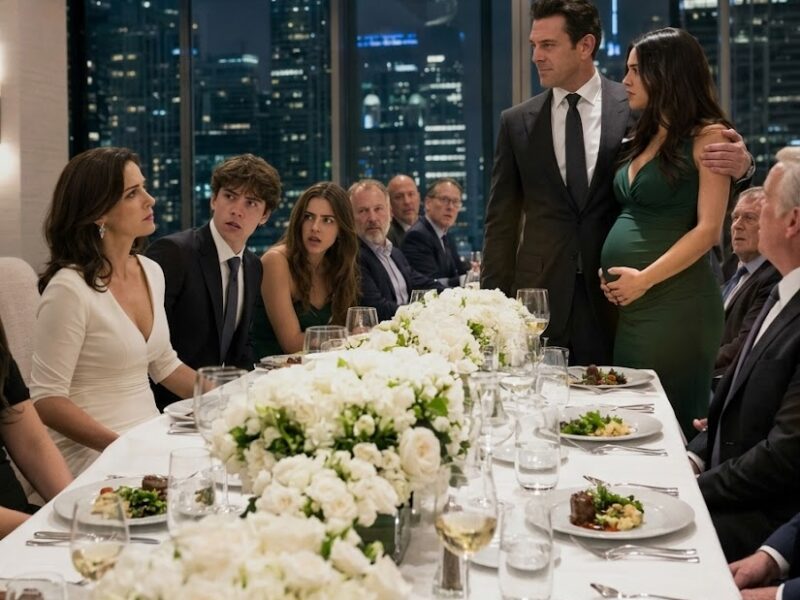
My Husband Brought His Pregnant Mistress To Dinner
Part 1: The Entrance
The top floor of the Whitmore Grand was a cathedral of glass and cold ambition, overlooking a Chicago skyline that glittered with the indifference of a billion-dollar machine. For eighteen years, I had been the silent architect of this empire, the one who remembered which investor suffered from shellfish allergies and which senator required bourbon neat. I was Mrs. Grant Whitmore, the woman who was always seen but rarely heard.
Tonight, my husband was forty-seven minutes late for our anniversary dinner. The board members shifted in their seats, their discomfort radiating in the sterile, high-end air. Across from me sat Eleanor, Grant’s mother—a woman of steel and pearls—who watched the clock with eyes that had seen empires rise and crumble. Beside me, my children, Mason and Clare, sat with a tension that made them look like statues waiting for a storm.
When the double doors finally swung open, the air in the room seemed to evaporate. Grant walked in, his suit impeccable, his smile smugly satisfied. But he wasn’t alone. On his arm was Sabrina Vale, his star vice president—Harvard-educated, sharp, and currently sporting a visible, protective hand over her pregnant stomach.
“Good evening, everyone,” Grant boomed, his voice hitting the room like a hammer. “I’m sorry to keep you waiting, but I think you’ll agree this was worth it.”
I felt the room freeze. I didn’t scream. I didn’t throw my wine. I simply smoothed the white linen napkin over my lap, feeling the familiar, icy calm that had sustained me for nearly two decades of being underestimated.
Grant leaned toward my children, his gaze lingering on Sabrina. “I’d like to introduce Sabrina properly. She isn’t just leading the Shanghai projects. She is also carrying my son. My heir.”
The silence was absolute. Mason’s chair scraped against the floor, but I caught his wrist, my grip firm. Grant expected me to shatter. He wanted the scene—the discarded wife, the public humiliation, the dramatic collapse of the quiet woman. Instead, I stood.
I walked toward Sabrina. Her eyes were wide, nervous, and beneath the expensive emerald silk, she was shaking. I extended my hand. “Welcome, Sabrina,” I said, my voice steady. “Please sit.”
Grant’s smile flickered, replaced by a momentary confusion. He had expected an explosion; he hadn’t prepared for grace. I wasn’t saving her, though. I was merely ensuring the stage was set exactly how I needed it. As I guided her to the seat beside me—not his side, but mine—I saw the flicker of doubt in her eyes. She hadn’t expected the wife to be kind. I knew then that she was just as much a victim of Grant’s ego as I was, only she didn’t realize the trap yet. I looked at the candle flickering between us and whispered, “He told you I wasn’t involved in the company anymore, didn’t he?”
She blinked, surprised. “Yes.”
I looked at the light. “Grant has always confused silence with absence.”
I knew the night was only beginning, but as I signaled the waiter to bring the wine, I felt the heavy, black leather folder resting beside my chair. The trap was ready to spring, but first, Grant needed to feel like he was the one in control.
Part 2: The Strategy of Silence
The first course was a ballet of forced pleasantries. Grant dominated the conversation, treating the table like a captive audience for his latest corporate conquest. He spoke of “Whitmore Pacific,” a separate entity he was crafting to ensure his new “heir” would inherit a platform free from the “old restraints” of our current holdings. It was a clear jab at the trust his father had built, and by extension, a jab at me.
Clare gave a bitter, sharp laugh that cut through Grant’s monologue. “Just the part where you call adultery a corporate strategy,” she said, her voice trembling.
Grant’s face hardened. “You are nineteen. You don’t understand business.”
Mason stood, his voice low and dangerous. “And you don’t understand shame.”
I lifted a finger, signaling Mason to sit. It wasn’t time yet. The board members looked down at their plates, the men who had spent their lives negotiating billion-dollar deals suddenly finding their own shoes to be the most interesting thing in the room. They were cowards, every one of them.
I waited until Grant took a long, arrogant sip of his wine. “How interesting,” I said, my voice cutting through the tension. “You want to talk about legacy, Grant. Perhaps we should clarify who actually controls the present.”
Grant’s eyes narrowed, his half-smile finally vanishing. “What is that supposed to mean?”
I reached down and placed the black leather folder on the table. It was heavy, packed with eighteen years of meticulous observation. I had waited nearly two decades to open this, and I was going to enjoy every heartbeat of the revelation. I slid the first document toward Harold Keane, the chairman. It was the Whitmore Family Voting Trust, signed by Grant’s father, Charles, three weeks after our wedding.
Harold’s face went from disbelief to a pale, sweating realization. “I remember this,” he whispered. “Charles said it was for stability.”
“It was,” Eleanor added, her voice chilling. “He knew my son loved applause more than judgment.”
Grant laughed, a nervous, jagged sound. “This is ridiculous. Margaret never controlled anything. She signed whatever I told her to sign.”
I leaned forward. “That is what you needed to believe, Grant. For eighteen years, I exercised the voting rights through a limited power of attorney that I allowed you to use. I am the controlling trustee. And as of tonight, that power is fully revoked.”
The room went so still I could hear the hum of the air conditioning. The transition of power hadn’t happened in a boardroom; it had happened in the mind of the man who thought he was the only one playing the game. Grant looked around for an ally, but for the first time, he found nothing but walls. I watched the color drain from his face, and I felt the first real spark of satisfaction. He was about to realize that while he had been playing CEO, I had been the one keeping the lights on.
Part 3: The Unraveling
“Jealousy,” Grant snapped, his voice recovering a veneer of bravado. “This is just a jealous stunt, Margaret.”
“No,” I replied calmly. “An affair is disgusting, but it is not why we are here.”
“Then why are we here?”
“Because seven months ago, I found irregular transfers from our international development accounts into shell companies registered in Singapore and Delaware. Companies not owned by Whitmore Hospitality, but controlled by you.”
Daniel Cho, our general counsel, stood up, his face grim. “My firm has reviewed the documents. The transfers total approximately $38.6 million.”
Sabrina’s face went white. She stared at the pages in front of her, her hand trembling. “You told me Whitmore Pacific was for our child,” she whispered, her voice cracking. “My name isn’t on any of this.”
“Sabrina, the baby’s name isn’t on any of this,” I noted, watching the realization dawn on her. She pulled her hand away from his touch, the emerald dress suddenly looking like a prison uniform rather than a statement. She had believed she was a partner, but she was just another asset to be moved around a chessboard.
Clare let out a cold, hollow laugh. “I think it’s the most honest thing you’ve ever done, Dad.”
Grant turned to her, his face twisting in rage, but Mason stood up, his height and posture mirroring the father he no longer recognized. “Don’t.”
Eleanor rose then. She pulled the sapphire ring from her finger—the Whitmore family seal—and placed it into my palm. It was cold, heavy, and carried the weight of generations. “This should have been yours a long time ago,” she said, ignoring Grant’s strangled protest.
“You do not get to call me Mother tonight as if blood is a password,” she told him, her voice slicing through his remaining defenses.
Daniel opened the final document. “As of 8:42 p.m. tonight, Mrs. Whitmore has formally revoked your authority to exercise voting control. You are suspended from all executive duties. Your office access, banking permissions, and signing authority are revoked effective immediately.”
Grant looked around the table, desperate for someone to step in, but the private equity men were looking at their water glasses, and the board members were staring at their phones. Security entered the room, their movements professional and quiet. That was the moment—not the documents, not the ring, but the sight of the security detail waiting for my nod—that broke him. He realized he wasn’t the king; he was a guest who had overstayed his welcome. As he was led toward the door, he shot me one last look of venomous hatred. “This isn’t over.”
“No,” I said, my voice steady. “You just lost the privilege of hiding it.”
Part 4: The Aftermath
The dinner didn’t end with a walk-out; it ended with the surreal atmosphere of a wake. The servers continued to clear the plates, the tension in the room so thick it felt like a physical pressure. I looked at Sabrina, who was weeping silently, her hands clutched around her stomach.
“Do you hate me?” she whispered, her voice small.
I looked at her, truly looking at her. She was ambitious, yes, but she had been played. Grant had used her brilliance to mask his own rot. “My problem isn’t that you loved him,” I said. “My problem is that he made your ambition useful to his greed.”
She cried harder, the realization of her own role in his chaos finally landing. I didn’t hate her. Hate required an energy I didn’t have to spare. I was too busy calculating the next move.
That night, the drive home with Mason and Clare was a study in silence. When we reached our Lake Forest house, the house Grant had bought to look like “old money,” it felt suddenly like a stage set being dismantled.
“Did you know?” Clare asked, her eyes swollen.
“For months.”
“And you didn’t tell us?”
“I needed you safe. If I warned you too early, he would have used your reactions against you.”
Mason slammed the door when he got out, but Clare stayed, leaning against the dashboard. “Is the baby really a boy?”
“I don’t know,” I said. “I care that your father tried to use him as a weapon. I care that he tried to erase you.”
Inside, Mason was staring at an old photo album. He had found a picture of Grant at twenty, smiling beside his father, both of them radiating the confidence of men who believed they were untouchable.
“Grandpa knew,” Mason whispered. “He knew what Dad would become.”
I took the sapphire ring and placed it on the kitchen island. It caught the light, a brilliant blue anchor in a sea of broken plans. “He trusted the person who would do the work,” I told my son.
The next morning, I arrived at Whitmore headquarters at 7:15 a.m. I wore the gray suit Grant had once insulted. I walked through the lobby, my heels clicking on the marble with a sound that felt like a gavel. The receptionist, Linda, saw the ring on my hand, and her entire posture changed.
“Good morning, Madame Chair.”
I didn’t smile. I walked to the boardroom. The board was full, the air heavy with the scent of coffee and anxiety. Grant’s attorney, Peter Halloway, was there, but he looked like a man who knew he was fighting a losing war.
“Today,” I said, taking the central chair, “we are not discussing whether Grant falls. We are deciding how Whitmore stands up.”
For three hours, I laid out the structure of his theft. I was precise, brutal, and undeniable. I didn’t need to yell; I only needed to present the numbers. By the end of the hour, the board wasn’t asking if the allegations were true—they were asking how quickly they could sign the papers to save themselves. When Harold Keane made the motion to appoint me interim CEO, the vote was unanimous. Grant was gone, and the empire was mine to save.
Part 5: The Hostage Strategy
The week following the board vote was a fever dream of legal maneuvers and public relations nightmares. Grant, true to his nature, didn’t go quietly. He hit the talk show circuit, playing the role of the “wounded patriarch.” He wore soft, knit sweaters, wept on command, and spun a narrative of a vengeful wife fueled by “female rage.”
It worked—for about five minutes.
Behind the scenes, we were systematically dismantling his defense. Sabrina, surprisingly, became our most valuable asset. She turned over a recording she had made when Grant visited her apartment after the dinner. It was a goldmine of admissions: he had coerced her, threatened her, and instructed her to lie to the press to make me look “unstable.”
But the real threat wasn’t his PR campaign; it was “Northstar.”
Eleanor provided the missing piece—the old letters from Charles Whitmore. They revealed that Grant hadn’t just been stealing; he had been building a secret entity designed to sabotage the company’s valuation. He wanted to drive Whitmore into a crisis so he could buy it back for pennies on the dollar with the help of Blackidge Capital.
When the DOJ and the SEC were notified, the reality of the situation hit me with a chilling clarity: Grant hadn’t just betrayed his family; he had betrayed the very foundation he claimed to love.
Grant came to the final board meeting armed with a court order, his face wearing that smug, familiar mask of superiority. He had Peter Halloway and Leland Price, a Blackidge Capital fixer, by his side. They sat there like they owned the room.
“I hope we can stop this madness,” Grant said, looking at me with a warmth that felt like a knife in the back.
“I hope so, too,” I replied, gesturing to the empty chair. “Sit.”
Peter Halloway argued for eleven minutes, a masterclass in obfuscation. I listened, my hands folded, letting him believe he was winning. When he finally stopped, I turned to Grant. “You’ve claimed publicly that I threatened Sabrina Vale.”
“I believe Sabrina is under tremendous pressure,” Grant replied smoothly.
The door opened. Sabrina walked in. Grant’s composure didn’t just break; it evaporated. He had thought she was bought, silenced, or hidden. She wasn’t any of those things. She was ready.
We played the recording. The sound of Grant’s voice filled the boardroom—arrogant, calculating, and cold. “Northstar is untouchable. She found the bait. She never finds the vault.”
When it ended, the silence was deafening. Grant’s skin had turned a sickly, transparent gray. I didn’t stop there. I clicked the remote and projected the Northstar structure—every hidden layer, every debt trigger, every signature. I watched the realization hit him that he hadn’t been playing a game against a wife; he had been playing against the woman who knew every bolt and wire of the company he thought he built.
Part 6: The Public Reckoning
The agents arrived not with a bang, but with the quiet efficiency of people who do this every day. They took Leland Price first. Peter Halloway followed, closing his laptop with a defeated click that signaled the end of his career.
Grant sat there, his mouth opening and closing like a landed fish. He looked at me, his eyes burning with a mixture of terror and disbelief. “You called the government on your own husband?”
“I called them on the man who tried to bankrupt fifteen thousand employees to win an argument with his wife,” I said, my voice cold.
The press conference that afternoon was the final nail. I didn’t give them a circus; I gave them a strategy. I stood before the cameras, wearing the gray suit, flanked by Sabrina, Patrice, and my children. I told the truth—not the scandal, but the reality. Whitmore Hospitality had been betrayed by leadership, and we were taking it back.
The clip of me saying, “His affair revealed his character; his crimes triggered this,” became the anthem of the week. My phone buzzed constantly with messages from women who had been in Sabrina’s position, in my position, in any position where they were asked to sacrifice their truth for a man’s comfort.
The next few weeks were a crucible. Grant fought, of course. His lawyers clawed at every contract and trust document, but the facts were a fortress. He was under federal investigation for securities fraud and conspiracy. By the time the dust settled, he was living in a rented penthouse, posting photos of books he didn’t read and coffee he didn’t drink, a relic of a life he had burned down himself.
Sabrina came to see me at the office three weeks later. She was exhausted, pale, and carrying the future Grant had used as a prop.
“Why are you doing this?” she asked, after I handed her a legal agreement for her independence and relocation.
“Because hating you wouldn’t give me back anything he took,” I told her. “And because no child should be born owing a debt for his father’s sins.”
She cried, not for the lost power, but for the realization that someone was actually treating her like a human being. When I told Clare and Mason about the agreement, they weren’t happy. Clare was furious.
“You’re helping her?”
“I’m helping a child, Clare. She was lied to. She walked into that dinner and believed the fantasy he sold her. We aren’t going to become cruel just because cruelty touched us first.”
Mason was quiet for a long time. “If that kid ever asks about Dad,” he said finally, “he gets the truth. Not the press version, not Dad’s version. The truth.”
“He will,” I promised. And for the first time in eighteen years, the house felt quiet—not because I was hiding, but because the secrets had all been spoken aloud.
Part 7: The Empire Rebuilt
A year later, the Whitmore Grand looked different. Not because of the marble or the gold, but because of the people. The portraits of the men who had once stared down with the arrogant certainty of ownership were gone. In their place were the photographs of the workers—the housekeepers, the maintenance crew, the front desk clerks who had kept the hotels running when the men in suits were busy playing visionary.
At the center was a candid shot of Charles Whitmore, sleeves rolled up, helping carry chairs for a banquet. Eleanor stood beside me, looking at the image with a faint, proud smile. “He would have liked that one.”
“I hope so.”
“He trusted you, you know,” she said, her voice dropping.
“I know.”
“No, I don’t think you do. Charles didn’t trust easily. He trusted the chance that someone might make us better than blood.”
The Whitmore Legacy Trust was formalized that night. It was my crowning achievement. No one could ever inherit power here again without the grueling, necessary work of proving they deserved it. I stood at the microphone, the room filled with the people who had kept the empire alive while Grant was stealing from it.
“A family name can open a door,” I told them. “Integrity decides whether you are allowed to walk through it.”
Sabrina watched from Hong Kong via video, the small boy named Daniel Veil sleeping in her arms. Mason lifted his glass, and Clare, after a moment of hesitation, did the same. It wasn’t forgiveness. It was something much more stable—a beginning that didn’t require the erasure of the past.
Grant didn’t attend. He was out there somewhere, still trying to reinvent himself, still trying to sell a story that no longer had a buyer. He occasionally sent messages to the kids, long, rambling texts about loyalty and blood. They answered when they felt like it, maintaining a distance that spoke volumes. When Daniel Veil was born, I sent the photo to Mason and Clare. Mason noted that the baby looked “mad,” and Clare saw the eyes of her own brother.
The world didn’t end. It just rearranged itself into something more honest.
I walked through the lobby on a rainy Tuesday, the same lobby where I had spent years being the “quiet wife.” Linda, the concierge, gave me a wink. The young trainee called me “CEO Whitmore,” and I didn’t correct him. I didn’t have to.
Grant had tried to bury me in front of everyone who mattered, thinking that the spectacle of his betrayal would be the end of my story. He didn’t understand that while he was busy standing at the top of the empire and shouting his own name, I had been learning every inch of the building. I had been making the alliances he was too arrogant to see, securing the assets he was too reckless to protect, and writing the history he was too selfish to read.
I won because I did the work. And as I stepped into the elevator, heading toward the boardroom, I didn’t think of Grant. I thought of the future—a future that was finally, truly, ours to build. The empire wasn’t his legacy. It was the result of everything he had tried to destroy, and as the doors slid shut, I realized I wouldn’t have changed a single second of the fall. It had cleared the way for the climb.