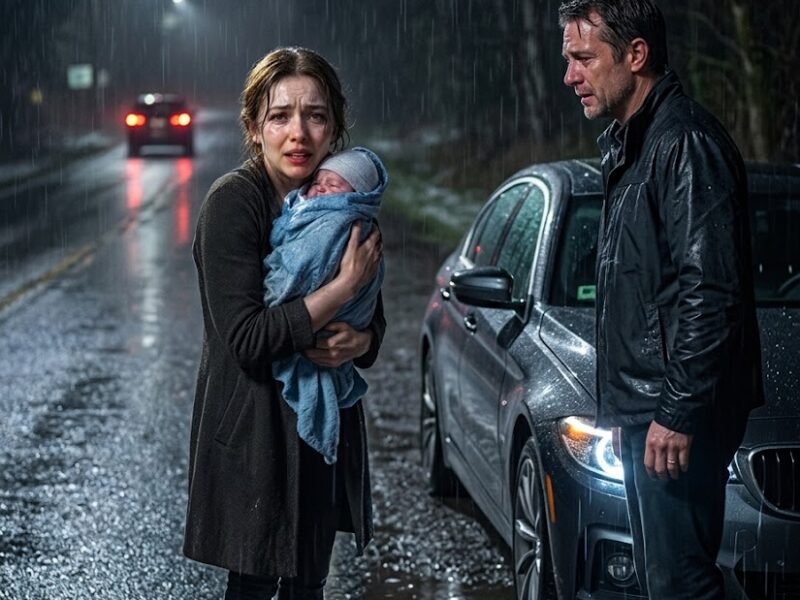
My husband left me and our child in the rain—Then a man appeared:’I’ve looked for you for 20 years.’
Part 1: The Road to Nowhere
“Get out and take that child with you.”
My husband shoved the car door open, and the cold rain hit me like a physical slap, sharp and unforgiving. I stumbled, my boots slipping on the muddy shoulder of the road. I stepped out with our three-week-old son in my arms, clutching him to my chest, and before I could even pull the blanket over his tiny, exposed face, Ryan’s taillights vanished into the dark, swallowed by the Pennsylvania night.
The first thing I remember from that night wasn’t Ryan’s voice, nor the violent slam of the heavy car door, nor even the roar of the departing engine. It was the sound of my son. It was a thin, frightened, breathless cry—the kind newborns make when the cold air touches their skin too fast. For a second, my entire world stopped. My body was shaking so violently I could barely feel my fingers, yet I wrapped both arms tighter around him, arching my back to turn away from the wind.
The road was almost empty. We lived outside Harrisburg in one of those Pennsylvania suburbs where houses sit far back from the road behind wet lawns and looming maple trees, where every driveway has two cars and every family looks respectable—at least until the lights go out and the doors are locked. It was late November, nearly midnight, and the rain had an icy bite that made it feel closer to sleep than to life.
Ryan had left my phone in the car. I knew he had done it on purpose; I had seen him watch me reach for it just before he shoved the door open. He had looked right at me, eyes devoid of everything but a cold, dark resolve, and he had driven away anyway. I stood there, shivering, trying to think through the blinding static of panic. My mother had been dead for most of my life. I had no father, no siblings, no aunt whose number I could still recite by heart. Foster care had a way of teaching you that every address is temporary, that you are always one suitcase away from being a ghost. The few friends I had were thirty minutes away, and I had no phone, no wallet, no diaper bag—nothing but the baby, the blanket, and the metallic taste of blood where I’d bitten the inside of my cheek to keep from crying in front of Ryan.
Then, headlights slowed behind me.
At first, I stepped farther off the road, hidden in the tall, wet grass. A woman alone at midnight with a newborn learns fear before she learns hope. But the car didn’t roll past. It stopped. The driver’s door opened, and a tall man stepped out, perhaps in his mid-forties, wearing a dark overcoat that was already heavy with rain. He moved quickly, but with a deliberate, controlled caution, keeping enough distance so I wouldn’t panic.
“Ma’am?” he called over the weather. “Are you hurt?”
I didn’t answer. My whole world had narrowed down to one instinct: protect the baby.
He came closer, then stopped again. The beam from the headlights caught my face, and I saw something in his expression shift. It wasn’t the usual pity I got from strangers, nor was it idle curiosity. It was shock. His eyes dropped from my face to the silver chain at my neck. The blanket had slipped, and with it, the small oval pendant that had belonged to my mother.
For a second, he looked like a man who had seen a ghost.
“That necklace,” he said, his voice barely audible over the rain. “Where did you get it?”
My throat felt raw, like sandpaper. “It was my mother’s.”
He took one slow, shaky breath. When he looked at me again, there was something almost unsteady in his face, a fragility I hadn’t expected. “What was her name?”
Every practical instinct told me to run, to lie, to hide. But there are moments when exhaustion lowers every wall you’ve built to survive. “Lena Carter,” I whispered.
He closed his eyes. Rain ran down the side of his face, mingling with what looked like a stray tear. When he spoke again, his voice had changed—it was shattered. “My God.”
He took another step, then stopped himself. “I’ve been looking for you for twenty years.”
Part 2: The Stranger in the Rain
For a second, I honestly thought I might faint. The cold was seeping into my marrow, and the weight of the baby in my arms felt like it was anchoring me to the earth while my mind spun. I tightened my grip on my son and backed away, my boots squelching in the mud.
“I don’t know you,” I said, my voice trembling.
“No,” he said immediately. “No, of course you don’t.” He lifted both hands slightly, palms open, an universal gesture of surrender. “My name is Daniel Mercer. I was a friend of your mother’s. I’m not asking you to trust me right now, but your baby is freezing, and you need to get him warm.”
My son whimpered again, a thin, pathetic sound that cut through every other thought. He was right. I hated that he was right. Daniel moved with a careful, measured calm. He opened the back door of his BMW—a car that smelled of expensive leather and heat—and stepped away so I could see the back seat. No one else was inside. A clean, folded wool blanket lay on the leather. He didn’t reach for me. He didn’t touch the baby. He simply stood in the rain and waited.
I climbed in. The heat hit my face so suddenly it almost hurt. My hands were trembling too hard to tuck the blanket around my son properly, so I just pressed him against my chest, his warmth the only thing keeping me anchored. Daniel climbed into the driver’s seat, turned the heater higher, and pulled away from the road.
“Nearest ER is twelve minutes,” he said.
I nodded but said nothing. For the first few minutes, only the windshield wipers spoke. My son began to settle against me, his breathing growing less sharp, less labored. I watched every movement Daniel made. The way he checked his mirrors. The way he kept both hands on the wheel. The way he didn’t try to fill the silence with comforting, hollow nonsense.
Finally, I asked, “How do you know my mother?”
He stared ahead for a long second. “I knew her twenty years ago,” he said, “and I owe her more than I can ever repay.”
That was not an answer, but there was something in the way he said it—a resonance of profound, heavy regret—that stopped me from pushing. The hospital was bright, overlit, and almost painfully warm. A nurse took one look at my soaked clothes and the baby and hurried us inside.
They checked Noah first—his temperature was a little low, but he was stable. They checked me next—mild exposure, elevated blood pressure, no serious injuries. I sat in a plastic chair in a quiet exam room with my son sleeping against my chest, while the adrenaline drained out of me and left me hollow. When I stepped into the hallway, Daniel was standing by the vending machines. He held a paper cup of coffee and looked like he had aged ten years since the roadside.
“Emily,” he said.
I froze. “How do you know that name?”
“Your bracelet,” he said quietly, nodding toward the hospital band on my wrist where the nurse had scribbled my information. He looked past me, his gaze fixed on a distant, painful memory. “There’s something you need to know,” he said.
My stomach tightened. “Twenty years ago, your mother called me for help. She told me she was leaving. She told me she was taking you with her.” He swallowed hard. “I told her I’d come.”
He stopped there. The hallway seemed suddenly very still, the low mechanical hum of the hospital sounding like a countdown. I asked, “And?”
His jaw tightened. “I was late.”
The words hung in the air between us. He looked past me, toward the sleeping child in my arms, and there was something heavier in his eyes now—something bordering on dread. “And Emily,” he said, “your husband didn’t just abandon you tonight. He reminded me of the man your mother was trying to escape.”
The words stayed in the air long after Daniel said them, and for a few seconds, I simply stood there with my son, listening to the hospital at 2:00 a.m. Somewhere, a nurse laughed softly. A cart rolled past. Fluorescent lights washed everything flat and pale. But inside me, the world had shifted. My first instinct was anger. Not because I believed him, but because I did not want to.
Part 3: The Boarded-Up Rooms
I had spent my entire life surviving by learning what not to touch. Foster care teaches you that. You board up rooms inside yourself early on—questions about your parents, about why nobody came back for you, about whether you were forgotten or simply not worth the trouble. You learn to live around those rooms. You learn to keep moving.
Now, a stranger had pried one of those boards off.
“What does that mean?” I asked, my voice barely a whisper. “What do you mean, he reminded you of the man my mother was trying to escape?”
Daniel’s face tightened as if he were physically restraining himself from saying too much. “Not here,” he said.
“You don’t get to say things like that and then walk away.”
“I’m not walking away. But I need you to understand that this is dangerous territory.”
“Explain,” I demanded.
He glanced at the sleeping baby in my arms. “You haven’t slept. Your son needs warmth. You need food. I’m asking for one hour, then I’ll tell you everything.”
I hated that he sounded reasonable. I hated even more that I had nowhere else to go. The social worker on night duty came by a few minutes later. She was kind, practical—a woman in her late fifties who had seen every version of disaster and no longer wasted words. She asked if I had somewhere safe to stay. I said no. She asked if I wanted the police called. My mouth opened, but nothing came out. I should have said yes. Ryan had left his wife and newborn on the side of a road in freezing rain. That should have been simple. But abuse rarely looks simple when you’re standing inside it.
I kept trying to explain him away: He was angry. He was stressed. He didn’t mean it. He’ll come back. Even after what he had done, part of me was still protecting the version of him I had spent four years loving.
The social worker gave me a look I understood immediately. She had seen women make that silence before.
Then Daniel spoke quietly. “I have a guest house. Separate entrance, separate key. The heat is already on. There’s formula, bottled water, clean towels. My housekeeper comes in twice a week, but nobody will come in unless you ask.” He set a small envelope on the kitchen counter. “There’s cash just in case.”
“I’m not taking your money.”
“That isn’t charity,” he said.
“Then what is it?”
“A man trying to make sure a woman and her child don’t stand in the rain again.”
He left before I could answer. I locked the door behind him and stood there for almost a minute, listening. Nothing. No footsteps at the window. No shadow under the door. No sound except Noah breathing. For the first time since Ryan had stopped the car, I let myself cry. Not loudly—just enough for the body to release what it could no longer carry. I fed Noah, changed him, and sat in the armchair by the window until dawn turned the sky a pale, sickly gray.
At 7:30 a.m., my phone rang. For one panicked second, I thought it was Ryan. It was the hospital. They had found my phone in the emergency intake bag; I must have dropped it there. Daniel had gone back at 6:00 a.m. and picked it up for me. I stared at the screen after the call ended. There were fourteen missed calls, all from Ryan. Then a text: “Where the hell are you?” Another: “Don’t do anything stupid.” And then, ten minutes later: “You made me lose my temper. We’ll talk when you calm down.”
I read that one three times. The room seemed suddenly very still. There it was. Not an apology. Not fear for his son. Not are you safe? Just the quiet, methodical rearranging of blame. I felt something inside me sharpen. At 10:00 a.m., Daniel knocked once and waited outside. He brought coffee, oatmeal, diapers, and a paper grocery bag from the pharmacy.
Part 4: The Truth About the Road
“You didn’t have to do that,” I said.
“Yes,” he said. “I did.”
He stayed near the doorway. “You asked me to explain.”
I nodded. He sat across from me, elbows on his knees, and for a long moment looked at his hands before speaking. “Your mother’s name was Lena Carter. I met her when we were both twenty-four. She worked part-time at a legal aid office in Harrisburg. I was a junior associate at a law firm—young enough to think I could fix the world if I just worked hard enough.”
There was no self-pity in his voice, only memory. “She was funny,” he said quietly. “Sharp. Braver than she knew.”
He told me she had married young—too young. The man had charm in public and a temper in private. By the time Daniel understood how bad it was, she was already trying to leave. One night, she called him. She said she had enough money for a bus ticket. She said she had me. She asked if he could meet her.
“I said yes.”
He stopped there. I already knew the next part.
“But you were late,” I said.
He nodded. “When I got there, police were outside. Lena was dead.”
I felt all the air leave my chest. “How?”
His eyes lifted to mine. “They ruled it an accident.”
“Was it?”
“No.” The word landed hard.
“Then why wasn’t he charged?”
“Because there wasn’t enough evidence. Because he had money. Because he had a lawyer who knew how to bury facts. Because twenty years ago, women lost cases like that every day.”
My hands tightened around Noah’s blanket. “And me?”
He looked like that question had haunted him for two decades. “You were gone. He told me that child services had taken you into emergency placement. Then there had been paperwork errors, county transfers, sealed files, foster homes. Every time I got close, the trail vanished. I hired investigators. I kept looking for years.”
“Why?”
He met my eyes. “Because I promised her.”
Silence stretched between us. Then I asked the question that had been forming since dawn. “What did you mean about Ryan?”
Daniel leaned back slowly. “I had someone look into him this morning.”
I stared. “You what?”
“You were thrown out of a car with a newborn in freezing weather. I needed to know whether he was a danger.”
“That was fair.” It still unsettled me. “What did you find?”
His face hardened in a way I had not seen before. “He has debt. More than he told you. Credit cards, personal loans, gambling losses.”
I felt heat rise to my face. “No, Ryan doesn’t gamble.”
“He does.”
I shook my head automatically, then stopped, because suddenly I remembered. Late nights, hidden screens, quick flashes of irritation when I walked into the room.
“And Emily,” he said, “he asked questions.”
“What kind of questions about your mother?”
My whole body went cold. How would he even know? “He requested public records six months ago.”
My voice came out barely above a whisper. “Why?”
Daniel did not answer immediately. When he finally spoke, it was very quiet. “Because he may have believed there was money tied to your family.”
I stared at him. “I don’t know exactly, but enough for someone desperate to care.”
I looked down at my hands. All at once, I remembered little things I had ignored. Ryan asking whether I had ever looked into my family history. Ryan offering to help me request sealed records “just in case.” Ryan asking if my mother had left jewelry, paperwork, deeds. At the time, it had sounded like curiosity. Now it sounded like inventory.
Part 5: The Sharpening of Resolve
The realization did not break me all at once. It entered quietly, then spread. The worst part was not that he had lied. It was that he had seen the most fragile part of me—the little abandoned child who had grown up wondering why nobody came back—and he had reached into that wound because he thought there might be something buried there worth taking.
I stood up so suddenly my chair scraped the floor. “I need air.”
Outside, the November night had turned clear and hard. The rain was gone. The cold had sharpened. I stood on the back porch, breathing until the air hurt. Daniel came out a minute later but kept his distance. “Emily.”
I didn’t turn around. “Did he ever love me?” It was the question I had not meant to say aloud.
Daniel took his time before answering. “Yes,” he said.
That surprised me enough to make me look at him. “You think so?”
“I do.”
“Then how does someone do this?”
He looked past me, out into the dark yard. “People don’t always become cruel because they never loved. Sometimes they become cruel because fear, greed, and weakness finally grow larger than whatever love they had.”
I stood there with that. Then my phone buzzed. A text from Ryan: “She’ll sign whatever I put in front of her. She always does.”
For one second, I didn’t understand. Then I saw the forwarded note from Margaret. She had intercepted it. It had been sent to another number—probably the woman he was sleeping with. My whole body went still. There it was. No guilt, no confusion, no regret—only certainty. He thought he already knew how this would end. I read it once more, then locked the screen. And for the first time since the night he left me in the rain, I felt something steadier than grief. I felt anger.
Cold, clean, useful anger.
For nearly a week after Margaret forwarded Ryan’s text, I said very little. That surprised Daniel at first. He had seen me frightened, shaken, exhausted. Now he watched something quieter happen. I stopped reacting and started paying attention.
Every morning, I fed Noah, changed him, walked the length of the small guest cottage while he slept against my shoulder. Then, I sat at the kitchen table with coffee gone cold beside me and went through documents: bank statements, credit records, insurance papers, tax returns, phone logs. The rhythm itself studied me. One page after another, one fact after another. Numbers had no charm. They did not apologize. They did not rewrite memory.
Margaret called every other day. “Don’t confront him yet,” she said. “Let him keep talking. People who think they’re still in control often hand you the rest.”
She was right. Ryan kept texting. At first, he was angry that I had not come home. Then, he became strategic. Then, almost tender. “We need to think about Noah. I know you’re emotional right now. You don’t have to make this ugly.”
Ugly. As if being thrown onto a road with a newborn hadn’t already defined the word.
By the second week, Margaret had built the first clear picture. Ryan’s gambling losses were real. The affair was real, too. A woman named Melissa Grant, thirty-two, who worked with him at the logistics firm in Carlisle. Their messages weren’t romantic in any meaningful sense; they were practical, transactional—impatient plans, complaints, money. He had been borrowing against future paychecks. He had used one of our credit cards to cover cash advances.
And three months before Noah was born, he had quietly downloaded forms for legal separation.
I read that line twice. Three months before our son was born, while I was buying diapers, while I was choosing paint for the nursery, while I was lying awake at night wondering whether I would be a good mother.
That evening, Daniel found me sitting at the kitchen table long after dark. He didn’t ask what was wrong. He simply sat down across from me.
“He planned it,” I said.
His face stayed still. “Yes.”
“I keep going back, trying to figure out where I missed it.”
“You didn’t.”
“I should have.”
“No.” His voice was gentle, but firm enough to stop me. “Trust isn’t stupidity, Emily. It’s what decent people offer before they have a reason not to.”
That sentence stayed with me.
Part 6: The Coffee Shop Encounter
The meeting with Ryan happened three days later. Margaret wanted it—not because she thought reconciliation was possible, but because she wanted to hear how he would frame the story when he still believed I was vulnerable.
He chose a coffee shop just outside Mechanicsburg. Neutral ground, public enough to look civilized. I arrived ten minutes early with Noah asleep in his carrier. Margaret sat two tables away, reading a newspaper. Ryan did not know she was there.
He walked in, wearing the gray wool coat I had bought him two Christmases earlier. For a second, I saw the man I had loved. Then, I saw the hesitation in his eyes when he noticed I was calmer than he expected. He sat down.
“You look tired.” That was his opening. Not are you okay? Not how’s Noah?
“You left your wife and newborn in freezing rain,” I said quietly. “That’s where we start.”
He exhaled sharply and rubbed his jaw. “I lost my temper. I didn’t think.”
“No, you didn’t.”
He looked down for a moment, then leaned forward. “Emily, listen to me. We were both under pressure. We’ve both been miserable for months.”
“Then why didn’t you leave before?”
He blinked. That landed.
“Because,” he said carefully, “I was trying to hold things together.”
“For who?”
His eyes hardened slightly. “You want honesty?”
“Yes.”
“You haven’t been yourself since the pregnancy. Everything became about the baby. Every conversation was stress, bills, sleep, fear. I felt like I was drowning.”
That would have hurt me once. Now I simply heard a man explaining why his own suffering mattered more than the people who depended on him.
“And Melissa?” I asked.
He froze. A very small thing, but enough. “What are you talking about?”
I held his gaze. “You tell me.”
His shoulders shifted. There it was: Calculation. He was reworking the map.
“Okay,” he said at last. “I made mistakes.”
“How long does that matter now?”
“Yes.”
He looked past me. “About six months.”
“Noah is three weeks old.”
He didn’t answer. He looked like he was bracing for a strike.
“And the separation papers?” I asked.
His eyes snapped back to mine. For the first time, genuine alarm. “How do you know about that?”
I almost smiled. That was the moment he understood something had changed. “You thought I’d sign whatever you put in front of me,” I said.
He went very still. “I never said that.”
“Yes,” I said. “You did.”
He opened his mouth, then closed it. Silence spread between us. At the next table, Margaret folded her newspaper once, slowly. Ryan saw her.
“You brought a lawyer?”
“I brought truth.”
He stood up too fast. “Jesus Christ, Emily, what are you doing?”
“No,” I said, “what did you do?”
His voice dropped. “You want to ruin me?”
I looked at him steadily. “I want you to stop pretending I ruined myself.”
Margaret came over then, calm as winter. “Mr. Carter,” she said, “from this point forward, all communication goes through counsel.”
He stared at her, then at me, and for the first time since the night of the rain, I saw fear—not anger. Fear. He sat down again. “What do you have?”
Margaret did not answer immediately. She opened a folder and laid out copies: bank withdrawals, credit records, phone logs, the hospital intake report, and finally the text message. He looked at the page, and all the color drained out of his face.
“My God,” he said. He wasn’t speaking to us. He was speaking to himself—the version of himself who had assumed no one would ever gather the pieces.
“Who did this?” he asked.
My voice was quiet. “You did.”
Part 7: The Unreachable Life
The divorce moved faster after that. Ryan’s attorney pushed for a quiet settlement. Margaret pushed back harder. The evidence of abandonment, the financial concealment, the debt exposure, and the documented risk to a newborn had changed the balance. In the end, he accepted terms he never would have imagined a month earlier.
Primary custody stayed with me. He assumed responsibility for the personal debt he had hidden. The joint accounts were divided under supervision. He kept the house.
I let him. By then, I understood something I had not known before: walls do not make a home if fear lives inside them.
I saw him one last time in family court. He looked older. Not broken, not destroyed, just older. That mattered to me. I had not wanted ruin; I had wanted truth. When we stepped into the hallway afterward, he stopped me.
“Emily?”
I turned. For a second, neither of us said anything. Then he asked, “Do you hate me?”
I thought about it honestly. “No,” I said.
He looked surprised. “Why not?”
“Because hate keeps you tied to the person who hurt you. Because rage can save you in the fire, but it is a terrible thing to build a house with. Because Noah deserved a mother who could walk forward.”
“You don’t get that much of me anymore,” I said.
He lowered his eyes. “That was the last time I saw him.”
Spring came slowly that year. Pennsylvania always takes its time with it. The trees stayed bare longer than you expect. Then, one morning, there were green tips on the branches, and the whole town felt as if it remembered how to breathe.
By April, I had rented a small, two-bedroom duplex ten minutes outside Harrisburg. Nothing fancy—a narrow porch, a tiny kitchen, a cracked mailbox. It was perfect. I found part-time work with a nonprofit legal aid office. Strange how life circles back. Mostly intake, paperwork, scheduling, answering phones—small work, honest work, work that paid enough to begin again.
Daniel helped with practical things when I let him. A crib, a used washer, a pediatrician recommendation—nothing extravagant. He never tried to rescue me. That was one of the reasons I trusted him.
One afternoon, he came by with coffee and sat on the porch while Noah slept inside. “I set something up,” he said.
“What kind of something?”
“A college fund.”
I opened my mouth to protest. He lifted a hand. “Not for you. For him, Daniel. It isn’t payment,” he said gently. “It’s a promise.”
I looked at him for a long moment. Then I nodded. That felt right. A promise carried forward instead of backward.
In early May, it rained again. Not hard, just steady spring rain. I stood at the front window holding Noah, watching drops move down the glass. For one second, I was back there—cold road, dark sky, taillights disappearing. But this time, the memory did not own me.
I looked down at my son. He was warm, safe, half-asleep, one small hand curled against my sweater, and suddenly I understood what had really happened that night. Ryan thought he had abandoned me. He had not. He had pushed me out of one life and, without meaning to, into the truth of another.
The rain had not ended me. It had ended the lie.
Daniel stepped onto the porch outside a minute later. I opened the door. He smiled at Noah. Then he looked at me. “You all right?”
I looked past him at the rain, then back at the warm little house behind me. “Yes,” I said. And for the first time in longer than I could remember, it was completely true.
Revenge, I learned, is not always destruction. Sometimes it is surviving long enough to become unreachable. Sometimes it is refusing to let the people who wounded you decide what your life will mean. And sometimes, the deepest justice is this: the child who once stood in the rain grows up, walks inside, closes the door, and finally feels safe.