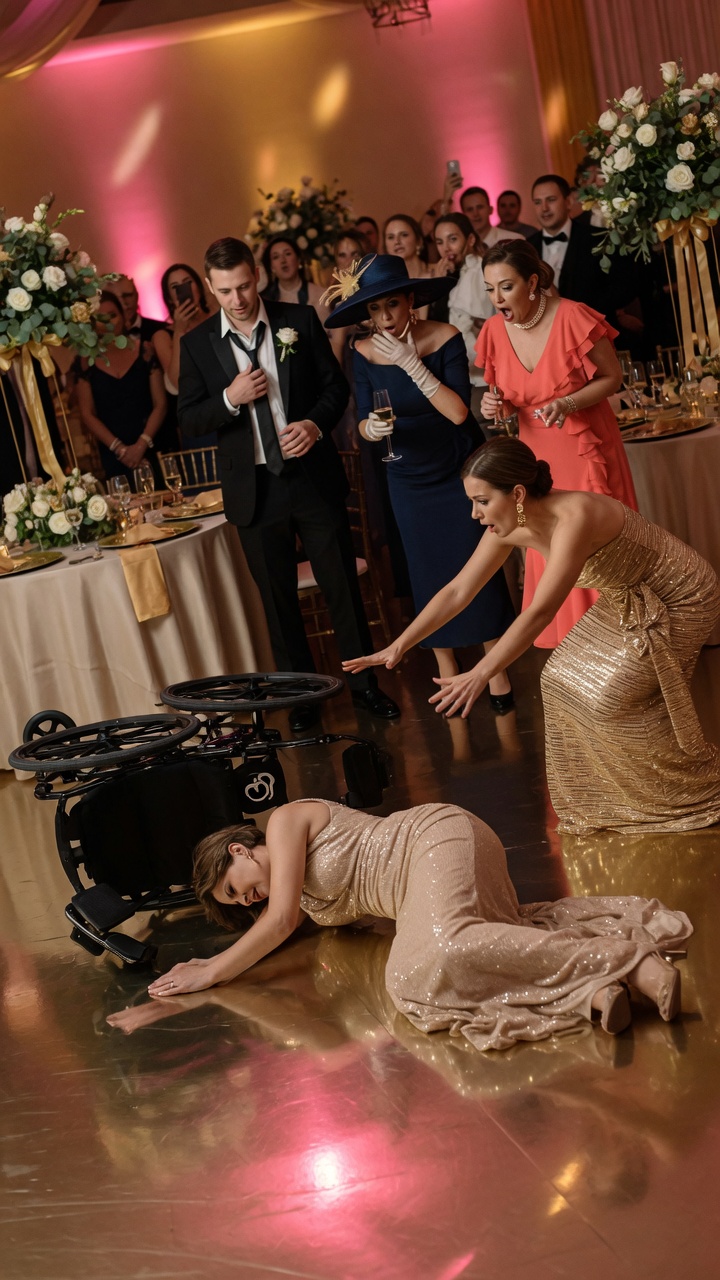
My Twin Sister Pushed Me Out of My Wheelchair at Her Engagement Party, “Stop Faking for Attention…
Part 1: The Echo of Pity
Amara Dlamini hated the sound of pity. Ever since the accident six months ago, people looked at her differently—too softly, too carefully, like she had already lost everything. Some mornings, even getting out of bed felt impossible. The pain in her spine never fully went away; it sat inside her body like fire, spreading from her lower back down into her legs. Physical therapy was slow, exhausting. Some days she could barely move without shaking, and the wheelchair—that part still broke her heart the most.
Before the accident, Amara had been independent, confident, and active. She loved dancing, late-night drives through Johannesburg, and taking random weekend trips with her twin sister, Ayanna. Now, she spent most of her time inside her apartment, watching life move without her.
Her phone buzzed on the kitchen counter. Ayanna calling.
Amara stared at the screen for a few seconds before answering. “What now?” she asked quietly.
Ayanna sounded excited. Too excited. “You’re still coming Saturday, right?”
Amara already knew what she meant. The engagement party. A huge rooftop celebration for Ayanna and her wealthy fiancé, Kletchi Okafor.
“I don’t know,” Amara admitted. “Crowds are hard for me right now.”
There was a short silence before Ayanna sighed dramatically. “Amara, please don’t do this again.”
“Do what?”
“Disappear. Everybody keeps asking where you are. You’re my sister, my twin. You have to come.”
Amara looked down at the blanket covering her legs. Part of her wanted to say no. The last few months had changed everything between them. Ayanna barely visited anymore. Their mother always sounded uncomfortable during phone calls. Even family dinners became awkward after the accident. But this invitation felt different somehow—softer, warmer, almost like Ayanna was finally trying.
“You really want me there?” Amara asked carefully.
“Of course I do,” Ayanna replied quickly. “For the first time in months.”
Amara felt something small rise inside her chest. Maybe things were finally getting better between them. Maybe this party wasn’t just about an engagement. Maybe it was Ayanna’s way of bringing her sister back into her life again.
“Okay,” Amara whispered. “I’ll come.”
She didn’t notice the cold expression on Ayanna’s face after the call ended. People always said Amara and Ayanna Dlamini looked identical. Same eyes, same smile, same face. But growing up inside the Dlamini house, they were never treated the same. Ayanna was the kind of person who filled every room the second she walked into it—loud laugh, big personality, always performing for attention. If guests came over, Ayanna made sure everybody noticed her first, and somehow, they always did.
At birthday parties, relatives handed Ayanna bigger gifts because she was more expressive. At school events, their mother and Kletchi proudly introduced Ayanna to everyone before even mentioning Amara standing beside her. “That one is going to be famous someday,” she used to say proudly while smiling at Ayanna. Amara would just stand there quietly, holding the bags.
Even as children, Ayanna knew exactly how to pull people toward her. If she cried, the whole house stopped. If she got angry, everybody rushed to calm her down. If she made a mistake, their parents instantly defended her: “She’s sensitive. She didn’t mean it. That’s just how Ayanna is.”
Meanwhile, Amara learned very early how to stay silent. When Ayanna broke their father’s expensive watch during an argument, Amara took half the blame just to stop the screaming in the house. When Ayanna bullied another girl at school and got suspended, their mother still blamed the teachers for targeting her. And every time Amara tried to explain how unfair things felt, her father, Themba, always gave the same answer: “Your sister needs more understanding than you do.”
At first, Amara believed him. She thought maybe being the easy child was supposed to hurt less, but it didn’t. The older they got, the more invisible Amara started feeling. At family dinners, Ayanna controlled every conversation. During holidays, every photo somehow became about Ayanna’s outfit, Ayanna’s achievements, Ayanna’s drama. And the strangest part? Amara still loved her. Because beneath all the jealousy and attention-seeking, Ayanna could sometimes be sweet, too. Sometimes they stayed up all night laughing together like real best friends. Sometimes Ayanna hugged her and promised, “Nobody understands me like you do.”
Those moments kept Amara hopeful for years. They were twins. She kept believing that one day, somehow, their relationship would finally become equal. But deep down, Amara had spent her entire life learning how to shrink herself so her sister could shine brighter. The rooftop hotel in Johannesburg looked beautiful that night. Golden lights hung across the open terrace. Expensive music played softly through hidden speakers. Waiters walked around carrying trays of champagne while guests laughed and took photos against the city skyline. Everything about the engagement party screamed luxury. And at the center of it all was Ayanna Dlamini. She looked perfect in her sparkling gold dress, smiling brightly every time another guest congratulated her.
Her fiancé, Kletchi Okafor, stood beside her proudly while cameras flashed around them. Ayanna loved every second of it. Amara noticed that immediately from her wheelchair near the corner table. She watched her sister move through the crowd like she owned the entire rooftop. Every laugh sounded louder than everyone else’s. Every conversation somehow turned back to her.
“Your ring is gorgeous! You two are such a power couple! Ayanna, you look stunning!”
Ayanna soaked in the attention like sunlight. Meanwhile, Amara quietly adjusted the blanket covering her legs and tried not to feel out of place. Coming there had already taken everything out of her. The elevator ride hurt her back. Sitting upright too long made sharp pain shoot through her spine. Even smiling at people felt exhausting tonight. Still, she tried. When guests came over, she greeted them politely.
Some people genuinely looked happy to see her. “Oh, Amara, it’s been so long. You look strong. We’ve been praying for your recovery.” One older woman even touched her shoulder gently and whispered, “I’m so sorry for what you’ve been through, sweetheart.”
Amara smiled softly. “Thank you.”
But every sympathetic glance slowly changed the atmosphere around Ayanna. First, it was small things. Ayanna’s smile tightened whenever people stayed too long talking to Amara. She kept looking across the rooftop toward her sister with an unreadable expression. Then, during family photos, one guest quietly asked, “Should we move closer to Amara so she’s included?”
Something flashed across Ayanna’s face instantly—No. It disappeared fast, but Amara noticed it. The rest of the night only became more uncomfortable. Whenever someone showed concern for Amara’s health, Ayanna suddenly interrupted the conversation or pulled attention back toward herself. At one point, Amara overheard Ayanna whispering sharply to their mother near the bar: “Why is everyone acting like this is some hospital fundraiser?”
The mother quickly glanced around nervously. “Lower your voice.”
“I’m serious,” Ayanna muttered. “This night is supposed to be about me.”
Amara looked away quietly after hearing that. A painful feeling settled in her chest. For a moment, she realized something heartbreaking. Maybe she had misunderstood the invitation completely. Maybe Ayanna hadn’t invited her because she missed her. Maybe she only invited her because people would talk if her disabled twin sister didn’t show up. The tension on the rooftop kept growing little by little.
Amara could feel it in every glance Ayanna gave her. At first, she tried to ignore it. She stayed quiet in her corner, sipping water while guests danced nearby. The city lights of Johannesburg glowed behind them. Music echoed across the rooftop and cameras flashed every few minutes around Ayanna and Kletchi. But then another guest walked over to Amara.
A middle-aged woman with kind eyes crouched beside her wheelchair and smiled softly. “You’re very brave for coming tonight,” she said gently. “Recovery like this isn’t easy.”
Amara gave a small smile. “I’m trying.”
The woman touched her hand kindly. “You should be proud of yourself.”
That was it. Something inside Ayanna snapped. “Oh my god,” Ayanna suddenly said loudly from across the rooftop.
The music was still playing, but her voice cut through everything. “Can everyone stop babying her for five minutes?”
The entire rooftop went silent. Guests froze mid-conversation. Even the DJ looked confused. Amara’s stomach dropped instantly.
“Ayanna,” their mother warned quietly.
But Ayanna was already walking toward Amara in her heels, her face tight with irritation. “I mean, seriously,” she continued loudly. “Every single conversation tonight has turned into some sympathy session.”
Nobody moved. Nobody spoke. Amara felt dozens of eyes suddenly land on her. Humiliation burned through her chest.
“I didn’t ask for that,” Amara whispered shakily.
Ayanna laughed bitterly. “Please, you don’t have to ask. People see the wheelchair and suddenly you become the center of attention.”
“Ayanna, stop!” Kletchi said under his breath, but she ignored him completely. For years, Amara had seen her sister angry before, but never like this. Never this cruel.
Ayanna stepped directly behind the wheelchair and grabbed the handles hard.
Amara immediately stiffened. “Ayanna,” she said nervously.
Then, suddenly, Ayanna shoved the wheelchair forward aggressively. “Stop faking for attention already!”
The world flipped instantly. One wheel caught against the edge of the floor decoration beside the table. The wheelchair tipped violently sideways. Amara screamed as her body crashed onto the marble floor. A sharp pain exploded through her spine so hard it stole the air from her lungs. The sound of her body hitting the ground echoed across the silent rooftop. Guests gasped in horror. Someone screamed. A glass shattered nearby.
Amara lay trembling on the cold floor, unable to move properly as pain shot through her back and legs. A terrified sound escaped her throat. “Ah, God, my back.”
The rooftop had gone completely silent now. No music, no laughter, no conversations—just shocked faces staring at Amara lying helplessly beside her overturned wheelchair.
Part 2: The Mask of Sisterhood
One guest covered her mouth in horror. Another whispered, “Oh my god!”
Kletchi moved first. “What the hell did you just do?” he shouted at Ayanna before rushing toward Amara. He dropped to his knees beside her carefully. “Amara, don’t move. Don’t try to move,” he said quickly, panic filling his voice.
Amara grabbed his sleeve weakly, crying harder now. “It hurts.”
Kletchi looked genuinely horrified. For the first time that night, the perfect, calm image he always carried completely disappeared.
“Ayanna pushed her,” someone in the crowd whispered loudly. “I saw it, too. She literally shoved the wheelchair!”
Ayanna stood frozen a few feet away, breathing heavily, like she suddenly realized what she had done. But before anybody could say more, their mother and Kletchi rushed forward desperately.
“She didn’t mean it,” their mother said immediately. Her voice sounded too fast, too defensive. “She was emotional.”
Everyone calmed down. Several guests looked at her in disbelief. “Emotional?” one woman repeated. “She pushed a disabled woman onto the floor.”
“They’re sisters,” Kletchi insisted nervously. “You’re all exaggerating the situation.”
Amara heard those words through the pain and felt something inside her crack. Even now, even after this, her mother’s first instinct was still protecting Ayanna. Not her.
Kletchi slowly stood up and stared at his future mother-in-law like he didn’t recognize her anymore. “She could have seriously injured her,” he said quietly.
Themba finally stepped forward, too, looking pale and uncomfortable. “Ayanna,” he muttered weakly. “You should apologize.”
But Ayanna still hadn’t moved. She looked around at the crowd, staring at her with disgust, and for the first time all night, she no longer looked like the glowing center of attention. She looked exposed.
One guest quietly pulled out their phone. Another person whispered, “Call an ambulance.”
Amara’s breathing became uneven again as another wave of pain hit her spine. She clenched her eyes shut, humiliated tears streaming down her face while strangers stared at her broken on the floor during her own sister’s engagement party. And deep inside, one heartbreaking realization finally became impossible to ignore: Ayanna had never wanted her there out of love. She wanted her there to stay invisible. And the second people started caring about Amara instead, Ayanna couldn’t handle it anymore.
As Amara lay trembling on the rooftop floor, flashes of the real accident kept replaying in her mind—not the fake version everyone knew, but the real one.
Six months earlier, Ayanna had begged Amara to go with her to a private after-party outside Johannesburg. Ayanna had been drinking that night, laughing loudly the entire drive while music blasted through the car speakers. Amara remembered feeling nervous almost immediately.
“Ayanna, slow down,” she had warned softly while gripping the seatbelt.
“I’m fine,” Ayanna laughed carelessly. “Relax.”
But she wasn’t fine. The car was moving too fast around the wet mountain road. Rain slammed against the windshield while Ayanna kept checking her phone every few seconds. Then came the argument. Amara still remembered every word.
“You think you’re better than me now?” Ayanna snapped suddenly.
“What are you talking about?”
“Everybody always acts like you’re so perfect and innocent.”
“Ayanna, keep your eyes on the road!”
But Ayanna was angry now—emotional, distracted. And then it happened. Headlights appeared suddenly around the sharp turn ahead. Ayanna panicked. The car swerved violently. For one terrifying second, they were heading straight toward the edge of the road.
Amara reacted on instinct. She grabbed the steering wheel hard and yanked it away from the cliffside. The car slammed directly into a concrete barrier instead. The impact destroyed everything. Metal crushed. Glass exploded. Pain ripped through Amara’s spine instantly. She still remembered hearing Ayanna scream beside her before everything went dark.
When Amara woke up in the hospital days later, she couldn’t feel her legs properly. Doctors were talking quietly outside the room. Her mother was crying.
“No,” Ayanna looked terrified. “Not guilty. Terrified. She’ll lose everything if people find out.”
Kletchi whispered desperately one night while Amara pretended to sleep. “Her reputation, her engagement opportunities, her career… everything.”
Themba sounded exhausted, but “the police report. We can say the rain caused it.”
Kletchi interrupted quickly. “No one needs to know she was driving recklessly.”
Then came the moment that changed Amara’s life forever. Ayanna walked into the hospital room, crying. “I’m sorry,” she whispered. “I didn’t mean for this to happen.”
Amara looked at her twin sister shaking with fear and shame. And even through unbearable pain, she protected her.
“I grabbed the wheel,” Amara later told investigators quietly. “It was my mistake.”
After that, the story became official. Tragic accident, bad weather, driver lost control. And Amara carried the blame silently while her entire life collapsed around her. Physical therapy, surgeries, wheelchairs, pain, medication. Meanwhile, Ayanna went back to normal life almost immediately. Parties, photos, luxury dinners. And somehow, over time, people stopped looking at Ayanna like the guilty one. They started looking at Amara like the tragedy instead.
But the truth had never disappeared. It had only been buried, and buried secrets always find a way back into the light.
Part 3: The Shattered Facade
The rooftop was filled with panic now. Some guests stepped back in shock while others crowded around Amara carefully, afraid to touch her. One waiter had already called emergency services. Another brought a blanket while Amara lay shaking on the floor, tears running down her face. Every small movement sent pain through her spine.
“I can’t… I can’t feel my back properly,” she whispered weakly.
The rooftop had gone completely silent now. No music, no laughter, no conversations—just shocked faces staring at Amara lying helplessly beside her overturned wheelchair. One guest covered her mouth in horror. Another whispered, “Oh my god!”
Kletchi moved first. “What the hell did you just do?” he shouted at Ayanna before rushing toward Amara. He dropped to his knees beside her carefully. “Amara, don’t move. Don’t try to move,” he said quickly, panic filling his voice.
Amara grabbed his sleeve weakly, crying harder now. “It hurts.”
Kletchi looked genuinely horrified. For the first time that night, the perfect, calm image he always carried completely disappeared.
“Ayanna pushed her,” someone in the crowd whispered loudly. “I saw it, too. She literally shoved the wheelchair!”
Ayanna stood frozen a few feet away, breathing heavily, like she suddenly realized what she had done. But before anybody could say more, their mother and Kletchi rushed forward desperately.
“She didn’t mean it,” their mother said immediately. Her voice sounded too fast, too defensive. “She was emotional.”
Everyone calmed down. Several guests looked at her in disbelief. “Emotional?” one woman repeated. “She pushed a disabled woman onto the floor.”
“They’re sisters,” Kletchi insisted nervously. “You’re all exaggerating the situation.”
Amara heard those words through the pain and felt something inside her crack. Even now, even after this, her mother’s first instinct was still protecting Ayanna. Not her.
Kletchi slowly stood up and stared at his future mother-in-law like he didn’t recognize her anymore. “She could have seriously injured her,” he said quietly.
Themba finally stepped forward, too, looking pale and uncomfortable. “Ayanna,” he muttered weakly. “You should apologize.”
But Ayanna still hadn’t moved. She looked around at the crowd, staring at her with disgust, and for the first time all night, she no longer looked like the glowing center of attention. She looked exposed. One guest quietly pulled out their phone. Another person whispered, “Call an ambulance.”
Amara’s breathing became uneven again as another wave of pain hit her spine. She clenched her eyes shut, humiliated tears streaming down her face while strangers stared at her broken on the floor during her own sister’s engagement party.
And deep inside, one heartbreaking realization finally became impossible to ignore: Ayanna had never wanted her there out of love. She wanted her there to stay invisible. And the second people started caring about Amara instead, Ayanna couldn’t handle it anymore.
As Amara lay trembling on the rooftop floor, flashes of the real accident kept replaying in her mind. When Amara woke up in the hospital days later, she couldn’t feel her legs properly. Doctors were talking quietly outside the room. Her mother was crying.
“No,” Ayanna looked terrified. “Not guilty. Terrified. She’ll lose everything if people find out.”
Kletchi whispered desperately one night while Amara pretended to sleep: “Her reputation, her engagement opportunities, her career… everything.”
Themba sounded exhausted: “But the police report. We can say the rain caused it.”
Kletchi interrupted quickly: “No one needs to know she was driving recklessly.”
Then came the moment that changed Amara’s life forever. Ayanna walked into the hospital room, crying. “I’m sorry,” she whispered. “I didn’t mean for this to happen.”
Amara looked at her twin sister shaking with fear and shame. And even through unbearable pain, she protected her.
“I grabbed the wheel,” Amara later told investigators quietly. “It was my mistake.”
After that, the story became official. Tragic accident, bad weather, driver lost control. And Amara carried the blame silently while her entire life collapsed around her. Physical therapy, surgeries, wheelchairs, pain, medication. Meanwhile, Ayanna went back to normal life almost immediately. Parties, photos, luxury dinners. And somehow, over time, people stopped looking at Ayanna like the guilty one. They started looking at Amara like the tragedy instead.
But the truth had never disappeared. It had only been buried, and buried secrets always find a way back into the light. The rooftop was filled with panic now. Some guests stepped back in shock while others crowded around Amara carefully, afraid to touch her. One waiter had already called emergency services. Another brought a blanket while Amara lay shaking on the floor, tears running down her face. Every small movement sent pain through her spine.
“I can’t… I can’t feel my back properly,” she whispered weakly.
The rooftop had gone completely silent now. No music, no laughter, no conversations—just shocked faces staring at Amara lying helplessly beside her overturned wheelchair. One guest covered her mouth in horror. Another whispered, “Oh my god!”
Kletchi moved first. “What the hell did you just do?” he shouted at Ayanna before rushing toward Amara. He dropped to his knees beside her carefully. “Amara, don’t move. Don’t try to move,” he said quickly, panic filling his voice.
Amara grabbed his sleeve weakly, crying harder now. “It hurts.”
Kletchi looked genuinely horrified. For the first time that night, the perfect, calm image he always carried completely disappeared.
“Ayanna pushed her,” someone in the crowd whispered loudly. “I saw it, too. She literally shoved the wheelchair!”
Ayanna stood frozen a few feet away, breathing heavily, like she suddenly realized what she had done. But before anybody could say more, their mother and Kletchi rushed forward desperately.
“She didn’t mean it,” their mother said immediately. Her voice sounded too fast, too defensive. “She was emotional.”
Everyone calmed down. Several guests looked at her in disbelief. “Emotional?” one woman repeated. “She pushed a disabled woman onto the floor.”
“They’re sisters,” Kletchi insisted nervously. “You’re all exaggerating the situation.”
Amara heard those words through the pain and felt something inside her crack. Even now, even after this, her mother’s first instinct was still protecting Ayanna. Not her.
Kletchi slowly stood up and stared at his future mother-in-law like he didn’t recognize her anymore. “She could have seriously injured her,” he said quietly.
Themba finally stepped forward, too, looking pale and uncomfortable. “Ayanna,” he muttered weakly. “You should apologize.”
But Ayanna still hadn’t moved. She looked around at the crowd, staring at her with disgust, and for the first time all night, she no longer looked like the glowing center of attention. She looked exposed.
One guest quietly pulled out their phone. Another person whispered, “Call an ambulance.”
Amara’s breathing became uneven again as another wave of pain hit her spine. She clenched her eyes shut, humiliated tears streaming down her face while strangers stared at her broken on the floor during her own sister’s engagement party.
And deep inside, one heartbreaking realization finally became impossible to ignore: Ayanna had never wanted her there out of love. She wanted her there to stay invisible. And the second people started caring about Amara instead, Ayanna couldn’t handle it anymore.
Part 4: The Truth Unmasked
As Amara lay trembling on the rooftop floor, the flashes of the real accident kept replaying in her mind—not the fake version everyone knew, but the real one. Six months earlier, Ayanna had begged Amara to go with her to a private after-party outside Johannesburg. Ayanna had been drinking that night, laughing loudly the entire drive while music blasted through the car speakers.
Amara remembered feeling nervous almost immediately. “Ayanna, slow down,” she had warned softly while gripping the seatbelt.
“I’m fine,” Ayanna laughed carelessly. “Relax.”
But she wasn’t fine. The car was moving too fast around the wet mountain road. Rain slammed against the windshield while Ayanna kept checking her phone every few seconds. Then came the argument. Amara still remembered every word.
“You think you’re better than me now?” Ayanna snapped suddenly.
“What are you talking about?”
“Everybody always acts like you’re so perfect and innocent.”
“Ayanna, keep your eyes on the road!”
But Ayanna was angry now—emotional, distracted. And then it happened. Headlights appeared suddenly around the sharp turn ahead. Ayanna panicked. The car swerved violently. For one terrifying second, they were heading straight toward the edge of the road.
Amara reacted on instinct. She grabbed the steering wheel hard and yanked it away from the cliffside. The car slammed directly into a concrete barrier instead. The impact destroyed everything. Metal crushed. Glass exploded. Pain ripped through Amara’s spine instantly. She still remembered hearing Ayanna scream beside her before everything went dark.
When Amara woke up in the hospital days later, she couldn’t feel her legs properly. Doctors were talking quietly outside the room. Her mother was crying.
“No,” Ayanna looked terrified. “Not guilty. Terrified. She’ll lose everything if people find out.”
Kletchi whispered desperately one night while Amara pretended to sleep: “Her reputation, her engagement opportunities, her career… everything.”
Themba sounded exhausted, but “the police report. We can say the rain caused it.”
Kletchi interrupted quickly: “No one needs to know she was driving recklessly.”
Then came the moment that changed Amara’s life forever. Ayanna walked into the hospital room, crying. “I’m sorry,” she whispered. “I didn’t mean for this to happen.”
Amara looked at her twin sister shaking with fear and shame. And even through unbearable pain, she protected her.
“I grabbed the wheel,” Amara later told investigators quietly. “It was my mistake.”
After that, the story became official. Tragic accident, bad weather, driver lost control. And Amara carried the blame silently while her entire life collapsed around her. Physical therapy, surgeries, wheelchairs, pain, medication. Meanwhile, Ayanna went back to normal life almost immediately. Parties, photos, luxury dinners. And somehow, over time, people stopped looking at Ayanna like the guilty one. They started looking at Amara like the tragedy instead.
But the truth had never disappeared. It had only been buried, and buried secrets always find a way back into the light.
The rooftop was filled with panic now. Some guests stepped back in shock while others crowded around Amara carefully, afraid to touch her. One waiter had already called emergency services. Another brought a blanket while Amara lay shaking on the floor, tears running down her face. Every small movement sent pain through her spine.
“I can’t… I can’t feel my back properly,” she whispered weakly.
The rooftop had gone completely silent now. No music, no laughter, no conversations—just shocked faces staring at Amara lying helplessly beside her overturned wheelchair. One guest covered her mouth in horror. Another whispered, “Oh my god!”
Kletchi moved first. “What the hell did you just do?” he shouted at Ayanna before rushing toward Amara. He dropped to his knees beside her carefully. “Amara, don’t move. Don’t try to move,” he said quickly, panic filling his voice.
Amara grabbed his sleeve weakly, crying harder now. “It hurts.”
Kletchi looked genuinely horrified. For the first time that night, the perfect, calm image he always carried completely disappeared.
“Ayanna pushed her,” someone in the crowd whispered loudly. “I saw it, too. She literally shoved the wheelchair!”
Ayanna stood frozen a few feet away, breathing heavily, like she suddenly realized what she had done. But before anybody could say more, their mother and Kletchi rushed forward desperately.
“She didn’t mean it,” their mother said immediately. Her voice sounded too fast, too defensive. “She was emotional.”
Everyone calmed down. Several guests looked at her in disbelief. “Emotional?” one woman repeated. “She pushed a disabled woman onto the floor.”
“They’re sisters,” Kletchi insisted nervously. “You’re all exaggerating the situation.”
Amara heard those words through the pain and felt something inside her crack. Even now, even after this, her mother’s first instinct was still protecting Ayanna. Not her.
Kletchi slowly stood up and stared at his future mother-in-law like he didn’t recognize her anymore. “She could have seriously injured her,” he said quietly.
Themba finally stepped forward, too, looking pale and uncomfortable. “Ayanna,” he muttered weakly. “You should apologize.”
But Ayanna still hadn’t moved. She looked around at the crowd, staring at her with disgust, and for the first time all night, she no longer looked like the glowing center of attention. She looked exposed.
One guest quietly pulled out their phone. Another person whispered, “Call an ambulance.”
Amara’s breathing became uneven again as another wave of pain hit her spine. She clenched her eyes shut, humiliated tears streaming down her face while strangers stared at her broken on the floor during her own sister’s engagement party.
And deep inside, one heartbreaking realization finally became impossible to ignore: Ayanna had never wanted her there out of love. She wanted her there to stay invisible. And the second people started caring about Amara instead, Ayanna couldn’t handle it anymore.
Part 5: The Shattering of Ties
The rooftop no longer felt like an engagement party. It felt like a disaster nobody could escape from. Guests stood in small groups, whispering to each other while the ambulance team carefully adjusted Amara onto the stretcher. Some people were openly staring at Ayanna now. Others looked uncomfortable just standing near her.
The beautiful music had been turned off completely. Only nervous whispers filled the rooftop. “Did you hear what happened? She caused the first accident, too! That poor girl protected her all these years!”
Phones buzzed non-stop as people quietly messaged others about the scene unfolding in front of them. Ayanna looked completely panicked now. “This is getting twisted,” she kept saying desperately. “People don’t know the full story.” But nobody was listening anymore.
For the first time in her life, Ayanna was losing control of the room. Kletchi stood several feet away from her with a look Amara had never seen on his face before: disgust. Real disgust.
“Ayanna,” she whispered shakily while tears filled her eyes. “Please say something.”
Kletchi stared at her for a long moment before speaking quietly. “You let your sister destroy her life for you.”
Ayanna immediately shook her head. “No, it wasn’t like that.”
“She protected you,” Kletchi interrupted coldly. “And tonight, you pushed her out of a wheelchair because people were showing her sympathy.”
Ayanna looked around desperately toward her parents. “Nobody understands!”
“No,” Kletchi said sharply. “I understand perfectly now.”
That silence afterward felt brutal. Guests stopped pretending not to listen anymore. Everybody was watching. Ayanna’s breathing became uneven as panic fully took over her face.
“This was supposed to be my night,” she whispered emotionally.
Amara heard that from the stretcher. And somehow, after everything, that sentence hurt more than the fall itself. Slowly, Amara lifted her tear-filled eyes toward her sister. For years, she had protected Ayanna, protected her reputation, protected her future, protected her secrets, and this was what it led to: humiliation, cruelty.
Amara swallowed hard before speaking softly. “I lost my legs protecting you.”
The rooftop became completely still. Even the paramedics paused. Ayanna’s face instantly crumbled.
Amara’s voice shook with heartbreak as tears rolled down her cheeks. “And you still wanted more.”
Dead silence. Nobody moved. Nobody spoke because suddenly, every single person there understood the full weight of what those words meant. Amara had sacrificed everything for her sister—her future, her body, her freedom—and even that had never been enough for Ayanna.
Kletchi slowly looked down at the engagement ring on his hand. Then, without saying a word, he pulled it off.
Ayanna’s eyes widened instantly. “Kletchi!”
But he stepped back from her like he couldn’t even recognize the woman standing in front of him anymore. And in that moment, surrounded by horrified guests and shattered family secrets, Ayanna finally realized the truth: the attention she spent her whole life fighting for had destroyed everything instead.
Everything collapsed after that night. The engagement was officially canceled less than 48 hours later. Kletchi never spoke publicly about Ayanna again, but people close to the family said he ended the relationship immediately after learning the truth.
The photos from the rooftop party disappeared from social media within days, but the gossip spread much faster than the family could control, especially after several guests shared what they witnessed. Soon, everybody was talking about the Dlamini family: the perfect daughter, the hidden accident, the disabled twin sister who sacrificed everything to protect her, and the parents who covered it all up for years.
The police quietly reopened the original accident investigation after new witness statements came forward. Lawyers started contacting the family. Reporters waited outside their business office more than once. For the first time in years, Themba and Thea could no longer hide behind excuses. People saw them differently now: not as loving parents, but as parents who chose protecting one child over saving the other.
Meanwhile, Ayanna completely disappeared from public events. Some said she moved out of Johannesburg for a while. Others claimed she was desperately trying to repair her ruined reputation. But Amara stopped paying attention. For the first time in her life, she was finally tired of sacrificing herself for people who never protected her back.
Months later, the rehabilitation center garden felt peaceful. Warm sunlight touched Amara’s face while soft wind moved through the trees around her. Recovery was still painful. Some days were still hard, emotionally and physically, but something inside her had changed. She no longer felt invisible.
Part 6: Choosing the Self
Dr. Zuri often told her, “Healing isn’t only about walking again. Sometimes it’s about finally choosing yourself.” And slowly, Amara was learning how to do that. Her phone buzzed again in her lap. Ayanna calling. Third time that morning.
Amara stared at the screen quietly for a few seconds before silencing the call and setting the phone aside without answering. Then she leaned back in her wheelchair and closed her eyes peacefully under the sunlight. Because after years of carrying everyone else’s secrets, she was finally carrying the only truth that mattered: her own.
The rehabilitation center was not just a place of recovery; it was a sanctuary. For the first time, Amara was surrounded by people who didn’t see her as a tragedy. They saw her as a survivor. She began to attend workshops, joined support groups, and even started a blog where she wrote about the reality of living with spinal trauma. Her writing was raw, honest, and surprisingly poetic. She didn’t hold back the anger, the fear, or the moments of overwhelming hopelessness.
She discovered that thousands of people across the country were reading her words, finding their own strength in her honesty. She was building a new community—not one built on superficiality or attention-seeking, but one built on shared struggle and genuine empathy.
One afternoon, Dr. Zuri found her in the garden. “You’re doing great, Amara. The physical progress is promising, but the mental progress is even better.”
“I feel like I’m finally breathing,” Amara said.
“It’s about time. Tell me, what’s next?”
Amara looked at the sunlight filtering through the leaves. “I want to start a foundation for others living with spinal injuries. Not just for the physical therapy, but for the psychological support. For the people who feel invisible.”
Dr. Zuri smiled. “You have the voice for it, Amara. You always did.”
That evening, Amara went back to her apartment. She opened her laptop and started typing a new draft. This time, she wasn’t writing about her pain. She was writing a roadmap for her future.
She realized that the accident had taken her legs, but it had also taken away the chains that had held her back. She was finally free to be the woman she was meant to be—independent, strong, and unapologetically herself. She didn’t need Ayanna’s approval, her parents’ validation, or Julian’s… no, that was a different life. She didn’t need anyone’s permission to thrive.
She caught her reflection in the darkened window. She looked older, yes, but her eyes held a spark that hadn’t been there before. It was the look of a woman who had finally learned to trust her own heart.
As she typed, a notification popped up on her screen. It was an email from a prestigious magazine. “We’ve been reading your blog. We would like to feature your story in our upcoming issue about resilience.”
Amara smiled. She didn’t want the fame. She didn’t want the spotlight. But she knew that by sharing her story, she could help others who were still trapped in the shadows.
She typed: “I would be honored.”
Part 7: The Unbreakable Truth
The magazine feature appeared in late summer, with a striking photo of Amara sitting in her wheelchair in the garden, looking directly at the camera with a gaze that refused to be pitied. It didn’t focus on the accident, or the betrayal, or the brokenness. It focused on the rebuilding.
People reacted differently than she expected. There were no pitying glances anymore. There were letters—hundreds of them—from people sharing their own stories, their own struggles, their own triumphs.
She spent hours reading them, responding to each one with genuine care. She was no longer shrinking herself; she was expanding, reaching out to others, becoming the person she had always dreamed of being.
Her parents finally called, not with excuses or defensiveness, but with a tentative, broken-hearted apology. Themba’s voice was barely a whisper when he finally spoke: “We failed you, Amara. We failed you, and we can never make that right.”
She didn’t forgive them immediately. She knew that forgiveness wasn’t something you just gave away like a gift; it was something that had to be earned over time. But she listened. She stood her ground when she needed to, and for the first time, they actually heard her.
Ayanna? She remained a ghost in the background, a cautionary tale of a life built on a foundation of sand. Amara didn’t seek her out, and she didn’t avoid her either. She simply moved on, leaving the past to bury itself.
One crisp autumn morning, Amara stood at her window, watching the leaves turn from green to gold. The garden below was thriving, vibrant and alive. She took a deep breath, the crisp air filling her lungs.
She wasn’t who she had been before the accident. She was stronger, wiser, and more complete. She had learned the hard way that the most dangerous thing you can do is let someone else decide who you are.
She turned away from the window and headed toward her desk. There were new projects to start, new stories to tell, and a life to live that was entirely, beautifully her own.
As the sun rose over the horizon, casting its golden light on the city of Johannesburg, Amara Dlamini started to work. She was no longer holding up the weight of anyone else’s house. She was building her own home, brick by brick, truth by truth, with a foundation that was finally, truly unbreakable. And for the first time in her life, she knew that she was exactly where she was meant to be. The story of Amara wasn’t a tragedy—it was a revolution. And the revolution, as it turned out, was just beginning.