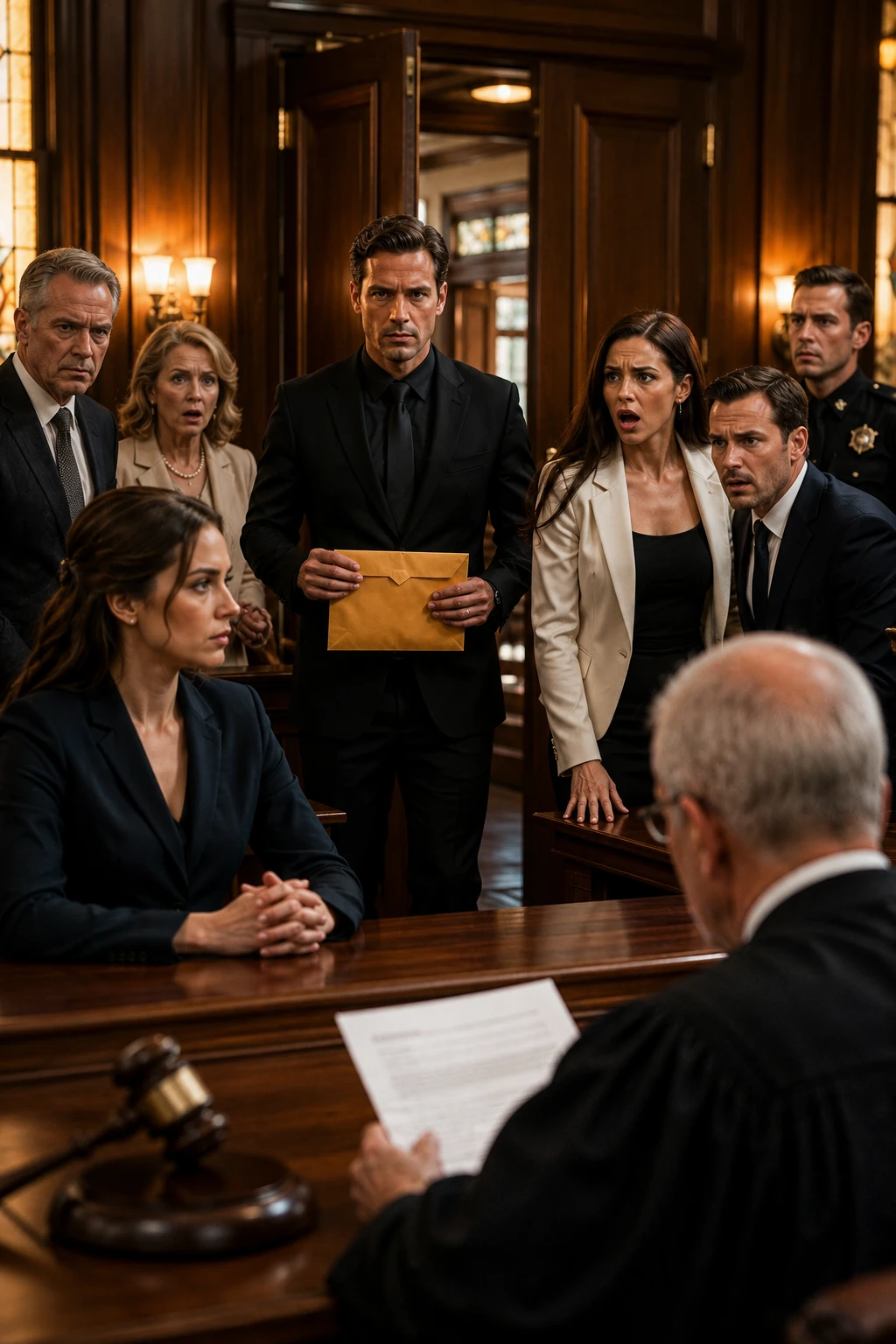
“My Wealthy Sister Demanded My Entire Inheritance in Court, But She Had No Idea What Grandpa Hid in a Sealed Envelope That Sent My Father to Prison and Made Her Bank Accounts Vanish in Ten Minutes”
The bailiff read out the case the way you might read a grocery list when you’re already thinking about dinner.
“Estate of Leonard Vale…”
His voice echoed off the high ceiling, bounced over the rows of wooden benches, and landed somewhere in the pit of my stomach. Before he even reached my name, my sister was on her feet.
Not out of grief.
Never grief.
Alyssa rose like someone standing to claim a promotion she’d already told everyone was hers. Her coat—ivory wool, sharply tailored—fell perfectly around her like a frame. Under it, a black dress, black heels, a black leather bag. It was the kind of quiet luxury that doesn’t shout, Look at me; it whispers, Of course I’m in charge.
Her hair was a smooth dark curtain pinned just so. Her makeup, immaculate. Her eyes… not red, not puffy. No trace of tears. Just calculation. A brisk, practiced brightness that said she’d done this sort of thing before: walk into a room, rearrange reality, walk out with the win.
Her attorney glided up beside her, all gleaming shoes and understated cologne, an expensive watch that flashed when he moved. He carried a slim folder of documents like they were a foregone conclusion. When he reached counsel table, he slid the papers forward with the motion of someone pushing a knife across a table.
“Your Honor,” he said, his voice smooth and confident, “we move for immediate transfer of the estate to my client, effective today.”
My parents sat directly behind him, slightly off-center like backup singers in a music video. They nodded at the exact same moment, like they’d rehearsed it in a mirror: solemn, united, righteous.
My father’s jaw was locked in that familiar, unyielding line—his boardroom face. His gaze fixed straight ahead, like this was a meeting and I was the problem he’d come prepared to remove.
My mother’s hands were folded delicately in her lap, fingers laced as if in prayer. She adopted the expression she favored at funerals and charity luncheons: dignified, put-upon, quietly suffering.
None of them looked at me.
The judge didn’t look at them either—not at first. He turned his attention to me, his expression neutral behind square glasses that might have been older than my law-school notebook.
“Ms. Vale,” he said, reading from the file. “Do you object?”
Alyssa’s lips tensed at the corners. She didn’t fully smile; that would have been tacky. But there was something there—a flicker of anticipation, as if she’d already seen this moment in her head: me folding, me pleading, the judge gently explaining why the grown-ups had to take over.
I didn’t beg.
I sat up straighter, placed both hands on the table so that I wouldn’t clench them in my lap, and made sure my voice didn’t tremble.
“Yes,” I said. “I object.”
Her attorney gave a polite, faintly amused smile—something you might offer a child insisting the rules of Monopoly were different at their house.
“On what grounds?” he asked, already certain he’d walk right through whatever I said.
He expected a legal argument. Or a messy emotional outburst he could point to as evidence of my “instability.” Or nothing at all.
I didn’t give him any of those.
“Not yet,” I said. “I want to wait until the last person arrives.”
The judge blinked once. “The last person?” he repeated.
“Yes, Your Honor.” I met his eyes and held them.
Behind me, my sister gave a small, incredulous laugh. There was no humor in it—just sharp disbelief.
“This is ridiculous,” she said, already annoyed. “There is no one else.”
She meant: Everyone that matters is already here.
She meant: We’ve locked the doors on you, Marin. This is a formality.
My father finally turned his head a fraction, just enough that I could see him in my peripheral vision. It was a familiar angle—the one he’d used when I was a teenager, when I’d said something inconvenient in front of his friends. That angled look that meant: You’re embarrassing us. Stop. “You always do this,” he muttered, just loud enough to bleed into the silence. “You make things harder than they need to be.”
The words landed like something thrown, but I didn’t turn.
The judge leaned back in his chair, adjusting his glasses, assessing whether this was a procedural issue or a family circus he wanted no part of.
“Ms. Vale,” he said evenly. “This is probate court, not a stage. If you have an objection, it needs to be legal.”
“It is legal,” I said, keeping my tone calm, almost conversational. “But it isn’t mine to explain.”
That earned me the smallest lift of his eyebrows. My sister’s attorney stepped forward again, seizing the opening.
“Your Honor,” he said in that soothing, reasonable tone that sounds like competence and billable hours, “we’re requesting emergency appointment because Ms. Vale has been uncooperative. There are assets that need protection and my client is the responsible party.”
When my parents called someone “responsible,” they meant, You understand the importance of control. You’ll do what we would do. You won’t ask questions.
“Oh, she’s not being difficult, she’s grieving,” my mother added with a soft sigh, as if my mere presence was tragic. “She doesn’t understand how these things work.”
I almost laughed at that. I understood exactly how these things worked. That was why I was sitting here at all.
Alyssa didn’t look at the judge as she spoke. Her attention stayed pinned to me, eyes bright and cold.
“I’m just trying to keep everything from falling apart,” she said. “Grandpa would want this handled properly.”
Handled. Managed. Controlled. In our house, all those words meant the same thing: Sign where we point or we’ll make you regret it.
As the attorney spoke, as my parents nodded on cue, as my sister performed her concerned-executive act, my brain kept drifting back to a different room. Not this oak-paneled courtroom with flags and seals and stiff benches—but the small, cluttered living room where my grandfather had first pressed an envelope into my hands and said, If it ever comes to it, you let the record talk.
I hadn’t understood how literal he was being.
The judge flipped a page in the file, scanning the petition.
“This motion requests full authority over the estate,” he said slowly. “It alleges the respondent”—his eyes flicked briefly to me—“is unfit to participate and may interfere.”
The attorney nodded. “Correct, Your Honor. And we’re asking you to grant that today.”
“Effective immediately?” the judge asked.
“Yes, Your Honor.”
His gaze returned to me. “Ms. Vale, what is your objection?”
This was the moment Alyssa expected me to crumble. To cry, maybe. To say something like, It’s not fair, she always gets everything, and prove her narrative about me being emotional and irrational.
Instead, I sat very still.
“My objection,” I said, “is that they’re asking you to act without the full record.”
Alyssa let out another sharp laugh. “There is no hidden record,” she snapped. “He’s dead. This is what happens.”
Her voice bounced in the quiet room, a little too loud, a little too fast. For the first time, the judge looked mildly irritated.
“Ms. Vale,” he said to her, “you will not speak out of turn.”
My father’s lips tightened. My mother’s eyes narrowed, like she hated watching anyone else scold her daughter. That was supposed to be her domain.
Her attorney tried to smooth the water with practiced politeness.
“Your Honor, if Ms. Vale wants to delay, we object. The estate can’t wait.”
I kept my eyes on the judge.
“It won’t be a delay,” I said. “It’ll be minutes.”
He exhaled once, a small sound, and glanced at the courtroom doors as if considering whether he was about to regret humoring me.
“Who are we waiting for?” he asked.
“The person who actually controls the inheritance,” I said.
The words hung there.
Alyssa’s face tightened, just for a heartbeat. “That’s me,” she said automatically—then caught herself when the judge’s head turned toward her.
He studied me for another moment.
“Ms. Vale, if this is some kind of tactic—”
“It isn’t,” I said quietly. “I’m asking you not to sign anything until the last piece of the record is here. That’s it.”
Silence. Long enough that I heard the rustle of paper from the row behind me, the faint squeak of leather as someone shifted.
Part 2: The Plain Black Suit
The double doors at the back of the courtroom didn’t swing open with a dramatic bang. They unlatched with a quiet, oiled click that only a few people near the back might have noticed. But the effect was immediate. All conversation died.
A man stepped through. He didn’t look like an attorney, nor did he carry himself like a process server. He wore an unpretentious, off-the-rack black suit that looked slightly too large for his lean frame. His hair was iron-gray, cropped close, and he moved with a deliberate, unhurried cadence that suggested he had nowhere else to be and answered to no one in this room.
He carried nothing but a thick, manila envelope tucked firmly beneath his left arm.
Alyssa’s lawyer turned, his expensive loafers pivoting on the carpet, an expression of mild annoyance on his face. He clearly expected to shoo away an interloper.
“Sir, this is a closed proceeding,” the attorney whispered loudly, stepping toward the aisle. “You can’t just walk in here.”
The man in the plain black suit didn’t stop. He didn’t even look at the high-priced attorney. He simply bypassed him as if he were a coat rack, his eyes fixed entirely on the bench.
“Excuse me!” the lawyer hissed, his professional veneer cracking. “Your Honor, I request that the bailiff remove this individual.”
The judge didn’t respond to the request. He was watching the newcomer with a look that had shifted from irritation to deep curiosity.
The man reached the wooden rail separating the gallery from the well of the court. He unlatched the swinging gate, stepped through, and stopped exactly six feet from my table. He reached into his breast pocket, produced an identification card, and laid it flat on the clerk’s desk without a word.
The clerk glanced at it, went pale, and nodded deferentially.
My sister was on her feet now, her polished nails digging into the mahogany table. “What is the meaning of this? Benjamin, do something! This is highly irregular!”
Benjamin—the high-priced attorney—cleared his throat and puffed out his chest. “Your Honor, my client’s patience is wearing thin. We have a motion on the floor. We are the legal representatives of the Vale estate.”
The man in the black suit finally turned his head. His eyes were the color of flint. He looked at Benjamin, then let his gaze drift to my father, whose boardroom face was beginning to show tiny beads of sweat near the temple.
“You were, counselor,” the man said.
The voice was low, gravelly, and carried the weight of absolute authority. It stopped Benjamin dead in his tracks.
The newcomer turned his attention up to the bench. He withdrew the manila envelope from beneath his arm, tapped it once against his palm, and spoke a single sentence that instantly rewrote the geometry of the room.
“The Estate of Leonard Vale is not subject to probate, Your Honor, per the irrevocable Disinheritance and Asset Protection Clause executed on January twelfth, twenty-eighteen.”
The courtroom seemed to drop ten degrees.
January 12, 2018. That was the date my grandfather’s health had started to decline rapidly. It was also the year my father and sister had started managing his affairs—or so they had told the rest of the family.
Benjamin’s face drained of color. The gleaming, tanned confidence vanished, leaving behind the gray, hollow look of a man who realized he had brought a butter knife to a drone strike. He slowly turned to Alyssa, his mouth moving soundlessly.
“Irrevocable what?” Alyssa gasped, her practiced brightness shattering into genuine panic. “That’s not possible. We have the trust documents! We have the power of attorney!”
My father half-rose from his bench, his face contorted in fury. “Who the hell are you? This is a scam! Benjamin, object!”
The judge ignored my father entirely. He had leaned forward, his spectacles sliding down the bridge of his nose as he stared at the identification card still resting on his clerk’s desk.
“Mr. Pendelton,” the judge said, using the man’s surname with a sudden, sharp clarity. “I assume you have the original instrument?”
“I do, Your Honor,” the man in the black suit replied. He slid the manila envelope across the table toward the clerk. “And I have the federal injunction freezing the administration of all assets currently under dispute.”
My mother let out a sharp, bird-like cry. She reached out and grabbed my father’s arm. “Richard? What is he talking about? Richard!”
My father didn’t answer her. He was staring at the plain black envelope like it was a venomous snake.
I sat still, feeling the warmth of vindication wash over me. I looked at the ivory-clad figure of my sister. For years, she had paraded her wealth, her connections, and her unearned authority around our family, treating me like an impoverished dependant. She had spent the last six months scheming to cut me out of the one thing Grandpa Leonard had left behind.
She had no idea what was inside that envelope.
The judge reached out, his hand steady, and picked up the envelope. He broke the wax seal.
Part 3: The Ghost of 2018
The rustle of the heavy parchment inside the manila envelope sounded like dry leaves in the dead quiet of the courtroom. The judge pulled out a thick stack of papers bound with a faded red ribbon. He didn’t just glance at the first page; he adjusted his square glasses, flipped to the back, and studied the notary stamp and the wet signatures.
I watched the color drain from Benjamin’s face. The expensive attorney leaned down, his forehead nearly touching Alyssa’s shoulder, whispering fiercely.
“What is this?” Alyssa hissed at him, her voice lacking all of its previous executive poise. “Tell me what this is!”
“I don’t know,” Benjamin muttered, his suave facade completely evaporated. “They didn’t file this with the county clerk. It’s not in the public registry.”
“That’s because it was filed under seal with the Federal District Court,” Arthur Pendelton said, his voice cutting through their frantic whispers like a scalpel. He hadn’t moved an inch from my table, standing sentinel over the proceeding. “Under the terms of Leonard Vale’s private asset protection trust, any attempt by immediate heirs to seize control of the manufacturing empire prior to a designated audit triggers an automatic forfeiture clause.”
Forfeiture. The word hung in the air like a death sentence for my family’s financial machinations.
My father lunged forward, gripping the wooden partition. “You’re lying! Leonard was of unsound mind in 2018! I had power of attorney! I have the medical records!”
The judge looked up from the parchment, his eyes cold and hard as flint. He leveled a withering stare at my father.
“Mr. Vale,” the judge said, his tone dropping to a dangerous register. “You will sit down and remain silent, or I will have the bailiff hold you in contempt. You are no longer in a boardroom. You are in a court of law.”
My father’s face purpled, but he slowly sank back down onto the bench, his chest heaving. My mother was trembling, her gloved hands fluttering uselessly against her coat buttons.
The judge turned the heavy pages. “This document,” he said, addressing the silent room, “designates Arthur Pendelton as the sole independent executor and special master of the Vale Enterprises holding company. Furthermore, it explicitly bars Richard and Alyssa Vale from accessing, liquidating, or transferring any shares or properties tied to the estate.”
He paused, looking directly at me. “And it names Marin Vale as the sole beneficiary with full veto power over the trust’s disbursements.”
Alyssa let out a sharp, breathless gasp, standing up so fast her chair screeched against the floor. “No! That’s insane! She’s twenty-four years old! She doesn’t know anything about running a multinational corporation! I’m the one who went to Wharton! I’m the one who sits on the boards! This is my birthright!”
“Sit down, Ms. Vale,” the judge barked, banging his gavel once. The sharp crack reverberated off the wooden walls, silencing her outburst. “Your petition for immediate transfer of the estate is denied. In fact, based on the exhibits presented in this sealed injunction, your petition is dismissed with prejudice.”
Dismissed. With prejudice.
Alyssa’s lawyer put his head in his hands. He knew exactly what that meant for their massive contingency fee.
“Your Honor,” Benjamin stammered, standing up with his hands raised defensively. “We were unaware of this secondary filing. We request a brief recess to review these… unconventional instruments.”
“You are free to review the public record once it is unsealed, counselor,” the judge said coldly. “But this court will not entertain any further motions from your firm regarding this matter.”
He signed his name at the bottom of the judge’s copy of the injunction with a heavy, black fountain pen. The scratch of the nib sounded like the tolling of a bell.
“Court is adjourned,” he declared, rising from his leather chair and disappearing into his chambers before anyone could draw another breath.
The courtroom erupted into immediate, chaotic noise. Spectators in the back benches began whispering and pointing at my family. Alyssa stood frozen by the counsel table, staring at me with a look of pure, unadulterated hatred. It was the face of a predator who had just realized the trap had snapped shut on her own neck.
“What did you do?” she hissed, stepping toward me, her knuckles white. “What did you do, you little parasite?”
“Step back, Ms. Vale,” Arthur Pendelton said, not raising his voice, yet projecting an aura of absolute danger that kept my sister rooted to the carpet.
Just as Alyssa opened her mouth to scream an obscenity, the side doors near the jury box swung open. Two men in dark, tactical-adjacent windbreakers walked briskly into the well of the court. They didn’t look like ordinary bailiffs or sheriff’s deputies. They walked with the purpose of federal agents.
One of them held a thick leather binder. He bypassed my sister, ignored her high-priced lawyer, and stopped directly in front of my father.
“Richard Vale?” the agent asked, his voice crisp and official.
My father blinked, trying to puff out his chest, but the sudden collapse of his reality had left him looking smaller, older. “Yes. What is this? I demand to know what is happening here.”
The agent opened the leather binder, extracted several blue-backed documents, and pressed them firmly against my father’s chest.
“You are being served with a federal criminal summons, Mr. Vale,” the agent said loudly enough for the departing spectators to hear. “You are ordered to appear before the District Court tomorrow morning on charges of corporate fraud, wire fraud, and the illicit diversion of estate assets.”
My mother let out a full, terrifying shriek and collapsed back onto the bench.
Part 7: The Final Gavel
The heavy, authoritative slam of the federal agent’s binder hitting the table seemed to suck the remaining air out of the grand, oak-paneled courtroom. My mother was weeping openly now, her carefully constructed facade of upper-class stoicism dissolving into ugly, ragged gasps.
“Corporate fraud?” my father choked out, his face turning an alarming shade of gray as he stared down at the blue-backed papers clutched in his trembling hands. “This is a civil matter! My father’s estate is a private family affair! You have no jurisdiction here!”
“The Vale Enterprises holding company is heavily tied to federal logistics contracts, Mr. Vale,” the lead agent said, his voice devoid of any emotion. “Diverting millions in liquid capital from a blind trust into shell corporations to fund personal luxury real estate acquisitions crosses the line from a family dispute into a federal felony. We have the forensic accounting right here.”
The agent tapped the leather binder. “You are restricted from leaving the state of Ohio. Your passports are surrendered to the U.S. Marshals as of this moment. Do you understand these terms?”
My father looked over at Benjamin, his high-priced attorney, silently begging for a miracle. But Benjamin was busy stuffing his expensive gold pen into his leather briefcase, aggressively avoiding eye contact with his suddenly toxic clients. The reality had set in—the gravy train had derailed, and anyone caught on the tracks was about to be pulverized.
While my father sputtered and my mother hyperventilated on the wooden bench, a sharp, high-pitched ping rang out from the leather bag resting on my table.
Then another ping. And another.
It was a cascade of notifications. I reached into my bag, pulled out my phone, and unlocked the screen.
A red banner blazed across the top of my display: BANK SECURITY ALERT: FRAUDULENT ATTEMPT BLOCKED. Below it, a notification from the private wealth management division of Vale Global: PRIMARY ACCOUNT ACCESS REVOKED FOR USER RICHARD VALE. EXCLUSIVE SIGNING AUTHORITY TRANSFERRED TO MARIN VALE. VERIFY BIOMETRICS TO CONFIRM. A second later, another text popped up from the property management firm handling my sister’s extravagant high-rise condominium in Chicago: NOTICE OF LEASE TERMINATION. SUBMITTED BY THE PRIMARY LESSOR (VALE ENTERPRISES). UNIT MUST BE VACATED WITHIN FORTY-EIGHT HOURS. I couldn’t help it. A small, humorless smile touched the corners of my lips. Grandpa Leonard hadn’t just protected his empire; he had built an automated financial guillotine, and he had programmed it to drop the second I gave the word.
Alyssa’s phone was buzzing violently now, vibrating against the polished mahogany of the counsel table like an angry insect. She snatched it up, her eyes wide with mounting terror as she read the texts pouring in from her credit card companies, her bank, and her husband’s finance firm.
“No, no, no,” she muttered, frantically tapping the screen. She looked up at me, her mask of immaculate sophistication entirely shredded, revealing the desperate, grasping child underneath. “Marin! Tell them! Tell them to stop this! We’re your family!”
“You had a strange way of showing it, Alyssa,” I said, my voice cutting through the ringing acoustic echo of the courtroom.
She lunged toward me, but Arthur Pendelton stepped seamlessly into her path, his broad shoulders blocking her trajectory. He didn’t touch her; he merely looked at her with the cold, detached pity one might reserve for a stray dog that had bitten the wrong hand.
“Your sister’s condo has been repossessed, Ms. Vale,” Arthur said smoothly. “Your corporate credit cards were cancelled ten minutes ago. I suggest you call an Uber, though I imagine your accounts will decline the fare.”
“Benjamin!” Alyssa shrieked, turning to her lawyer, who was already halfway to the swinging exit doors. “Do something! Sue them! Get an injunction!”
“Ms. Vale,” the lawyer said, holding his hands up defensively. “My representation of you and your father is terminated, effective immediately. I advise you to seek federal counsel.”
He didn’t walk out; he practically sprinted through the double doors, desperate to put as much distance between himself and the impending federal penitentiary as possible.
My father stumbled backward, dropping the leather binder onto the bench. He looked at me, his eyes wide and bloodshot, stripped of the unyielding boardroom arrogance he’d wielded against me for my entire adult life.
“Marin,” he wheezed, taking a shaky step forward. “Please. We can talk about this. We can share the assets. We can be a family. Just call whoever this man is off. We’ll drop the probate petition. We’ll give you whatever you want.”
I stood up, buttoning my coat. It wasn’t ivory wool, nor was it quiet luxury, but it was warm, and it was paid for by the only person in my family who had ever truly believed in me.
“You already gave me what I wanted, Dad,” I said, looking down at the federal summons scattered across the bench. “You let the record talk.”
The federal agents moved in then, flanking my father, their hands hovering near their utility belts. They weren’t rough, but they were absolute. My mother was sobbing uncontrollably, begging a clerk who had already turned his back to fetch her a glass of water.
I turned my back on them and walked down the center aisle of the courtroom.
Arthur Pendelton fell into step behind me, his heavy manila envelope tucked securely under his arm.
As we pushed through the heavy double doors into the bright, cold light of the courthouse lobby, my phone buzzed one last time.
DEPOSIT CONFIRMED: ESTATE OF LEONARD VALE LIQUIDITY DISBURSED. BALANCE: $42,500,000. I didn’t stop to look at the numbers. I didn’t need to. I took a deep breath of the crisp autumn air and stepped out onto the stone steps, leaving the ghosts of 2018—and the people who had tried to bury me with them—far behind.
The lesson of this long, agonizing journey is that you can never truly outrun the foundations you build. My father and sister spent years constructing a tower of deceit, convinced that their wealth, their high-priced lawyers, and their ruthless control would shield them from consequence. They thought they could rewrite my grandfather’s legacy just as easily as they rewrote my place in the family.
But true legacy is not about the ivory coats or the marble countertops. It is about character. Leonard Vale saw through the polished veneer of his eldest granddaughter and the boardroom posturing of his son. He knew that when the pressure mounted, greed would make them sloppy.
As I stood on the courthouse steps, waiting for the wind to die down, I realized I was finally free. The inheritance wasn’t just money in a bank account; it was the ultimate vindication of my mother’s memory and my grandfather’s trust. The grifters had been exposed, the fraudsters were facing justice, and for the first time in my life, I didn’t need anyone’s permission to walk into the future.