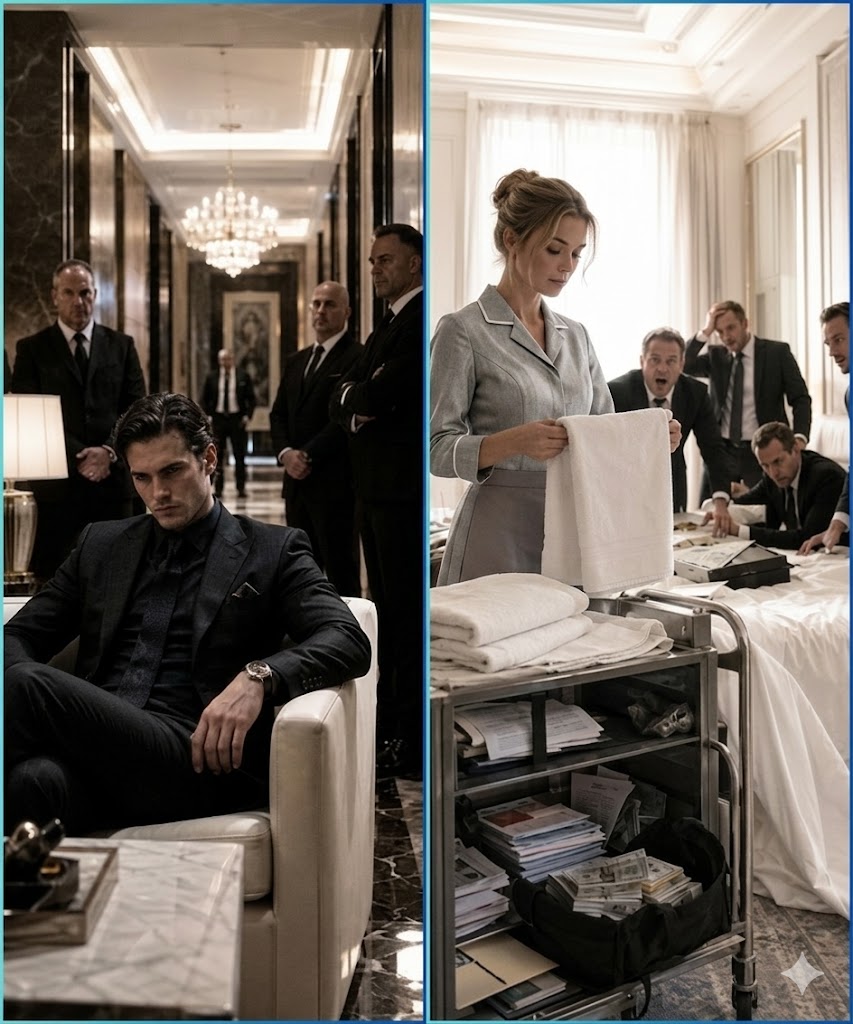
New York’s Most Powerful Man and the Secret Behind the Penthouse Door.
Part 1: The Rabbit on the Rug
The first sound Leo Vasari made in two years was not a word. It was a breath. It was a small, broken intake of air, pulled from the chest of a six-year-old boy who had forgotten how to live out loud. And it happened because a maid making $14.50 an hour walked past the open door of a billionaire penthouse, saw a child falling apart on a Persian rug, and did the one thing no doctor, therapist, priest, or bloodstained king of New York had managed to do.
She folded a towel into a rabbit.
Dominic Vasari was on one knee in the middle of the Atoria Grand’s forty-seventh-floor suite, his black shirt wrinkled, his cufflinks forgotten on the floor, his voice cracked open in a way none of his men had ever heard. “Leo,” he begged, his hands hovering in the air. “Son, please. Look at me.”
The boy did not look. He was pressed into the corner between a velvet sofa and a heavy marble side table, his hands clamped over his ears, his mouth wide in a silent, jagged scream. His face had gone a dangerous shade of red, and his small body shook with tremors. Forty-seven floors below, the sirens screamed through Fifth Avenue, and every wail of the city seemed to tear through Leo like glass.
Two bodyguards stood frozen by the door. These were men who had dragged bodies from dark alleys without blinking. Men who had broken jaws over debts smaller than a dinner bill. They stood motionless. Nobody moved when Leo got like this. Nobody knew how. Dominic had spent two years and nearly two million dollars trying to buy his son’s voice back. He had tried Johns Hopkins, Boston Children’s, private specialists in Switzerland, sensory deprivation rooms, speech boards, trauma therapy, and prayer. Nothing had worked.
Then the housekeeper stopped.
She was small enough that neither bodyguard noticed her at first. She wore a white uniform, brown hair pinned low, and rubber-soled shoes. A silver name tag identified her as Savannah Reeves. Her cart was stacked high with fresh towels and linens. She did not gasp. She did not ask for permission to enter, nor did she step into the room like she belonged there. She simply lifted one white towel from the stack, lowered her eyes to the floor, and began to fold.
One corner down. Then the other. A twist. A tuck. A smooth stroke of the fabric.
Long ears. A round body. Two thumbprint dents for eyes.
A rabbit.
Leo stopped screaming.
Dominic froze, his breath hitching in his throat. The boy’s hands slipped slowly from his ears. His eyes locked onto the soft, white shape resting on the carpet. Savannah placed the towel rabbit on the floor three feet from him, then sat back on her heels with her hands folded in her lap, making herself small.
She did not smile too big. She did not say, “Come here.” She did not say, “Good boy.” She just waited, an island of stillness in the chaos.
Leo crawled forward one inch. Then another. His trembling hand reached out and touched one long, terry-cloth ear. For the first time in seven hundred and thirty-one days, Dominic Vasari saw his son smile.
The room seemed to lose its air. Dominic lifted his head slowly, terrified that one sudden movement might shatter the miracle. “Who are you?” he asked, his voice rough.
The maid rose at once, smoothing her apron as if she had committed a grave offense. “Nobody, sir,” she said, keeping her eyes cast down. “I’m sorry to have disturbed you.”
Before Dominic could answer, she backed out with her cart and vanished down the hallway. That was the moment the most feared man in New York began to lose control of everything he thought he owned. And it was the moment a woman with a dead brother, an old tin box of secrets, and a heart she had tried to bury became the only person his son would let near him.
Part 2: The Investigation
That night, Dominic sat alone in his high-security office, replaying the hallway security footage over and over. The cart. The towel. The rabbit. The smile. Frankie Duca, his oldest friend and most trusted lieutenant, stood across the desk with a thick folder.
“She’s clean,” Frankie said, his voice clipped. “Savannah Reeves. Twenty-seven. From Akron, Ohio. No criminal record. No debt. No boyfriend we can find. She moved to New York eight months ago after her grandmother passed away. Works housekeeping and picks up night shifts whenever they’ll give them to her.”
Dominic did not look away from the frozen image of Savannah on his screen. “What about family?”
Frankie hesitated, his expression shifting. “Mother left when she was a child. Father was in and out of the picture. Younger brother drowned in 2014.”
Dominic’s hand stopped on the crystal glass of whiskey he had not yet touched. “The brother,” he said. “Was he autistic?”
Frankie paused. “Medical records are sealed. But I found an old local piece from Akron. Special-needs kid. Nonverbal. His name was Thomas.”
Dominic leaned back into the shadows. For two years, every expert had told him Leo’s mutism was “selective” or “trauma-layered.” They used expensive, clinical words that left Dominic feeling like a failure. But Savannah Reeves had not used words. She had used the language of hands.
“Bring her up tomorrow,” Dominic commanded.
Frankie frowned. “What if she refuses? She’s a maid, Dominic, not a soldier. You scare her, she’ll quit.”
Dominic looked at the screen, at the towel rabbit that had performed a miracle. “No,” Dominic said. “She won’t run. She knows what it’s like to lose a brother who couldn’t speak. She’s the only one who can help.”
The next morning, Savannah was escorted through two private elevators and two sets of security doors into an office larger than the entire apartment she shared with three other women in Queens. Dominic stood at the window, the Manhattan skyline blazing behind him. He looked different in the daylight—less like a ghost in a tailored suit, more like a man who had not slept since the day his world ended.
Savannah noticed his hands first. Clean nails, scarred knuckles, and a wedding ring he still hadn’t removed.
“Miss Reeves,” he said, not turning around. “Yesterday you did something seven specialists couldn’t do.”
“I folded a towel, sir.”
“Don’t insult me by pretending you don’t know what happened,” he said, turning to face her.
Her shoulders tightened, and she gripped her purse. “What do you want from me?”
“Your brother’s name was Thomas.”
Her face changed so quickly—the blood draining from her skin—that even Frankie, standing in the corner, looked away. “You investigated me.”
“I investigate everyone who walks into my home,” Dominic said.
“Thomas,” she said, her voice dropping to a whisper. “His name was Thomas.”
Dominic walked around the desk and sat in a chair opposite her instead of behind it. The gesture was calculated to put her at ease, though the cold intensity in his eyes made it impossible. “I want to hire you as a companion for my son. Not a nanny. Not a therapist. Four mornings a week. Two thousand dollars a week.”
Savannah blinked, her mouth opening in shock. “No.”
Frankie went stiff. Dominic’s eyes narrowed. “No?”
“I don’t have a degree. I’m a housekeeper.”
“I have hired the people with the degrees,” Dominic said. “Leo won’t look at them. He looks at you.”
“I also know who you are, Mr. Vasari,” she said, her voice growing stronger. “I know what people say your family does. I know what kind of men guard your doors. Women like me don’t enter homes like yours unless they’re desperate or stupid. I’m trying to be neither.”
Dominic nodded. “Fair enough.” He stood up, but instead of dismissing her, he opened a drawer and pulled out a small, heavy box. “But you aren’t here because you’re desperate. You’re here because you’re the only one who understands the silence.”
He pushed the box across the desk. Inside was a set of keys and a single photograph—a picture of Leo at the park, taken before the silence began. Savannah looked at the photo, and for the first time, she truly looked at Dominic. She saw the desperation, the raw, bleeding edge of a father who was running out of time.
Part 3: The Broken Language
“Two thousand a week is blood money,” Savannah said, though her hand hovered near the keys.
“It’s payment for a service that no one else can provide,” Dominic replied. “If you refuse, my son stays in that corner. If you accept, you get to decide how the terms work. I don’t care about the money. I care about the sound of his voice.”
Savannah looked at the keys, then back at Dominic. She thought of her tiny, shared apartment, the stack of overdue bills, and the memory of Thomas sitting on the back porch, staring at the sky, his own silence a universe she had never managed to fully map.
“Four mornings,” she said, her voice barely audible. “And no bodyguards in the room. I can’t work if they’re looming over us like gargoyles.”
Dominic looked at Frankie. “Deal.”
The following week, the penthouse became a site of quiet, meticulous reconstruction. Savannah didn’t try to force Leo to speak. She didn’t use flashcards or ask him to repeat sounds. She simply existed in his orbit. She cleaned, she folded, and she left small, tactile puzzles for him to solve. A bowl of colored marbles. A book of origami paper. A set of wooden blocks.
Dominic watched from the doorway, his chest tightening as he saw Leo interact with her. Leo wasn’t screaming. He wasn’t pressing his hands to his ears. He was watching Savannah, tracking her movements with the focus of a hawk.
“He trusts you,” Dominic whispered to her one afternoon as she was leaving.
“He doesn’t trust anyone yet,” Savannah corrected. “He’s just curious. There’s a difference.”
“What’s the difference?”
“Curiosity is the beginning of hope,” she said. “Trust is the end of the journey.”
As she walked toward the elevator, she passed Frankie. He looked at her with a mix of suspicion and grudging respect. “You’re doing good, kid,” he muttered. “But don’t get too comfortable. This house has ears.”
“I’m just here to fold towels,” Savannah said, pressing the down button.
“Everyone says that,” Frankie said. “Until they realize there’s nowhere to hide.”
That night, Dominic found something strange in Leo’s room. On the side table, where Leo had never allowed anyone to touch his things, there was a new arrangement of blocks. They weren’t just scattered; they were built. It was a tower, tall and precarious, leaning slightly to the left.
And at the very top, placed with deliberate care, was the rabbit. The towel rabbit.
Dominic reached out to touch it, but he stopped. He felt like an intruder in his own son’s life. He walked to the window and looked out at the city. He was the boss of the Vasari family, a man who could call in favors from mayors and judges, yet he was utterly powerless in the face of his son’s recovery.
He heard a soft click behind him. He turned and saw Leo standing in the doorway. The boy was wearing his pajamas, his eyes wide and bright. He wasn’t screaming. He was looking at his father.
Dominic held his breath. “Leo?”
Leo didn’t speak, but he walked across the room, his feet soft on the rug. He reached Dominic and grabbed the hem of his father’s shirt. It was the first time Leo had initiated physical contact in two years.
Dominic knelt, his heart hammering. “Are you hungry, son?”
Leo shook his head. He looked at the towel rabbit, then at the door. He was waiting for her. He was waiting for Savannah.
Dominic felt a sudden, sharp pang of jealousy—a dark, ugly emotion he didn’t want to feel. His son was reaching out, but he was reaching out for the maid.
“She’s not here, Leo,” Dominic said, his voice strained. “It’s just us.”
Leo’s face hardened. He pulled his hand away and walked back to the corner, turning his back on his father. The silence returned, colder than before. Dominic sat on the floor, defeated, watching the tower of blocks collapse as Leo knocked it down with a single, angry swipe.
Part 4: The Secret in the Walls
The tension in the Vasari household began to bleed into the streets. Dominic’s enemies, sensing a weakness in the boss’s armor, began to push back. Territory lines were being tested in Brooklyn, and rumors of a betrayal within his own ranks reached Dominic’s ears.
“It’s the timing,” Frankie warned him during their morning briefing. “Word is out that you’re spending all your time with the kid. They think you’ve gone soft.”
“Let them think it,” Dominic snapped. “Softness is just a different way of being sharp.”
Meanwhile, Savannah found herself caught in a web she hadn’t anticipated. One morning, while cleaning Dominic’s study, she noticed a loose panel behind the floor-to-ceiling bookshelf. It wasn’t intentional—the house was old, and the settling of the building had caused a gap. She reached in, curious, and pulled out a small, leather-bound diary.
She opened it. It belonged to Dominic’s wife, who had died in the same accident that had left Leo traumatized. She began to read, and the blood drained from her face. It wasn’t a diary of love; it was a log of threats. A detailed account of someone watching them, someone who knew their schedules, their habits, and the exact moment of the crash.
The last entry was dated two days before the accident: They know. Dominic thinks he’s built a fortress, but the doors were left open by the people he trusts most.
Savannah heard footsteps. She shoved the diary back and pushed the panel into place just as Frankie entered.
“Dominic wants you in the study,” he said, his eyes scanning the room. “You okay? You look like you’ve seen a ghost.”
“Just dust,” Savannah said, her heart pounding. “It’s a big house. Lots of dust.”
Frankie laughed. “Yeah. Lots of secrets, too.”
She walked toward the office, her mind spinning. The accident wasn’t an accident. And if the diary was true, the person who had orchestrated the crash was still close to Dominic. She walked into the office, where Dominic was pacing, a phone pressed to his ear.
“I don’t care what the price is,” he was saying. “Get me the location.”
He hung up and looked at Savannah. “Leo had a nightmare last night. He started talking in his sleep.”
“What did he say?”
“He said, ‘The bad man is in the walls.'”
Savannah felt the diary’s cold reality pressing against her memory. “Maybe you should listen to him,” she said.
Dominic looked at her, his eyes searching hers. “What do you know, Savannah?”
“I know that this house isn’t as empty as it looks,” she said, her voice trembling. “And I think you’ve been looking for the enemy in the wrong places.”
Dominic stepped closer, his presence looming. “Are you suggesting someone is here? In my own home?”
“I’m suggesting,” she said, choosing her words carefully, “that you should check the walls.”
Dominic froze. He looked at Frankie, who had followed her in. “Check the panels in the study,” Dominic said, his voice low.
Frankie moved to the wall, his hand running over the shelves. He stopped at the panel. He pulled it open, and the diary sat there, exposed. Frankie grabbed it, his face turning pale as he flipped through the pages.
“This,” Frankie whispered, “is impossible. This should have been destroyed.”
Dominic took the diary, his hands shaking as he read. The room went silent. The weight of the revelation changed everything. The betrayal wasn’t from the outside; it was from the inner circle.
Dominic looked at Frankie. “Who knew about this diary?”
Frankie stepped back, his hand moving to his holster. “I… I didn’t…”
“Who knew?” Dominic roared, his voice shaking the floorboards.
Frankie’s eyes darted toward the door. “I did what I had to do, Dominic. For the family. You were weak.”
Dominic moved, but Frankie was faster. He drew his weapon, pointing it directly at Dominic’s chest. Savannah stood paralyzed, the maid who had folded a rabbit now watching the execution of a king.
“You’re done, Dominic,” Frankie said, his voice cold. “The Syndicate wants a leader, not a babysitter.”
Part 5: The Glass House
The room felt like it was shrinking. Frankie, the man who had been Dominic’s shadow for twenty years, stood with a steady hand and a dead look in his eyes.
“You think you can take over?” Dominic asked, his voice deceptively calm. “You think these men will follow a rat?”
“They’ll follow the one who isn’t distracted by a six-year-old and a housekeeper,” Frankie sneered.
Savannah stood by the bookshelf, her heart hammering against her ribs. She was the witness. She was the one who had unlocked the door. She had to move. She glanced at the heavy brass lamp on the desk near her.
“You’re forgetting something, Frankie,” she said, her voice cutting through the tension.
Frankie glanced at her, distracted. “Shut up, Savannah. This doesn’t involve—”
That was the mistake.
Savannah lunged, grabbing the lamp and swinging it with all the force of a woman who had spent her life cleaning messes others left behind. The brass base slammed into Frankie’s temple. He staggered, the gun firing into the ceiling with a deafening, plaster-shattering boom.
Dominic was on him in an instant. He tackled Frankie to the floor, the two of them a tangle of limbs and rage. They crashed into the desk, scattering papers, pens, and the diary across the floor.
Savannah didn’t hesitate. She grabbed the gun that had skittered across the carpet. She held it, not knowing if she could pull the trigger, but ready to do whatever was necessary.
“Kill him, Dominic!” Frankie gasped, blood leaking from his forehead. “Kill him or he’ll kill you!”
Dominic pulled back, his hand around Frankie’s throat. “Why?” he shouted. “After everything!”
“Because,” Frankie wheezed, “you weren’t supposed to be human! We built you to be a monster, and you went and got yourself a heart!”
Dominic tightened his grip, his face contorted. “I’m not a monster, Frankie. And I’m certainly not a man who lets a traitor live.”
He slammed Frankie’s head against the floor, and the room went still. Frankie lay motionless.
Dominic stood up, his chest heaving, his shirt torn. He looked at the gun in Savannah’s hands. He walked toward her, slowly, his hands held out.
“Put it down,” he said, his voice soft. “It’s over.”
Savannah lowered the gun, her hands shaking so hard she nearly dropped it. “You killed your best friend.”
“He killed my wife,” Dominic said, looking down at Frankie’s body. “He broke my son. This wasn’t friendship. This was a slow-motion execution.”
He walked to the window and looked out at the city. The sirens were already approaching, the sound of the world coming to collect the debris.
“You need to go,” Dominic said, not looking at her. “Frankie has men. They’ll be here within minutes to ‘clean’ this.”
“What about Leo?” Savannah asked, the name feeling like a lifeline.
“He’s safe in the panic room,” Dominic said. “Take the back stairs. Go out the service entrance. Don’t go home. Don’t go to the apartment in Queens.”
“What are you going to do?”
“I’m going to finish the cleaning,” he said, looking at the diary on the floor.
Savannah didn’t want to leave, but she saw the look in his eyes—the look of a man who was no longer playing at leadership, but was finally, truly, in command. She turned and ran, her rubber-soled shoes silent on the carpet, the secrets of the Vasari empire now burning a hole in her mind.
Part 6: The Maid’s Gambit
Savannah didn’t go to Queens. She went to the only place she knew would be safe: the church where Thomas’s funeral had been held. It was a small, cold stone building in the Bronx, a place where people went to talk to the dead when they had no one else.
She sat in the back pew, shivering, the adrenaline leaving her body and leaving behind a hollow, aching dread. She had the diary in her bag—she had swiped it from the desk in the chaos—and she knew what it contained. It wasn’t just a log of threats; it was a roadmap. It listed every shell company, every offshore account, and every dirty judge in the city.
It was the key to the Vasari empire, and it was currently burning a hole in her pocket.
The doors opened. She braced herself, expecting Frankie’s men, but it was just Dominic. He looked different—older, harder, and covered in soot. He walked up the aisle and sat next to her.
“How did you find me?” she whispered.
“I have men who know how to find ghosts,” he said. He looked at her bag. “You have the diary.”
“I do.”
“Give it to me, Savannah.”
“No,” she said. “If I give it to you, you’ll burn it. You’ll bury it just like you buried your own life.”
Dominic looked at the altar. “And if you keep it?”
“If I keep it,” she said, her voice gaining strength, “I’m going to make sure the people who need justice get it. I’m going to burn the whole thing down.”
Dominic turned to her, his expression a mix of shock and admiration. “You’re a maid from Akron, Savannah. You have no idea what you’re dealing with.”
“I know exactly what I’m dealing with,” she said. “I’m dealing with men who think they can hide behind walls and money.”
Dominic reached out, but he didn’t try to take the bag. He rested his hand on the back of the pew. “If you do this, they will come for you. And I won’t be able to protect you.”
“I’m not asking for protection,” she said. “I’m asking for the chance to make it right for Thomas.”
Dominic flinched at the mention of her brother. “Thomas didn’t have to die like this.”
“No,” Savannah said. “He didn’t. And neither did your wife.”
They sat in the silence of the church, the weight of their combined losses hanging in the air. Outside, the city was moving on, oblivious to the fact that the two people who held the power to destroy it were sitting in a back pew in the Bronx.
“What do we do?” Dominic asked, his voice low.
“We stop playing their game,” Savannah said. “We show the world what’s inside the walls.”
Dominic looked at her—the maid who had folded a rabbit and destroyed an empire. He saw in her the same resilience he had once seen in his wife, and the same terrifying, quiet strength he had seen in his son.
“Then let’s start the fire,” Dominic said.
Part 7: The Ashes of Atoria
The gala was the perfect stage. It was where the elite gathered to congratulate themselves on their own survival. Dominic walked in, his tuxedo impeccable, his face a mask of iron-clad indifference. Savannah was beside him, not as a maid, but as a guest. She wore a simple black dress, but in her hand, she carried the truth.
The room was filled with the same faces that had been in the suite. The judges, the businessmen, the politicians. They watched Dominic with a mixture of fear and curiosity, wondering how he had returned from the dead.
Dominic walked to the podium. He didn’t speak of business or charity. He opened the folder.
“For years,” he said, his voice echoing through the ballroom, “we have operated in the shadows, believing that our walls were impenetrable, believing that our money could shield us from the consequences of our actions.”
He looked at the crowd. “But the walls have ears. And the secrets… they have a way of finding the light.”
Savannah stood by the light console. She gave the signal.
The screens in the room—the ones that usually displayed the progress of the charity—flickered. Then, they displayed the contents of the diary. Every corrupt name. Every offshore account. Every dirty deal.
The room erupted. People screamed, pushed, and tried to leave, but the exits were blocked by Dominic’s men.
“This isn’t a gala,” Dominic said, his voice booming. “This is a trial.”
Savannah walked to the front of the room, her hand on the microphone. “My name is Savannah Reeves,” she said, her voice steady. “And I am here to tell you that the era of the shadows is over.”
The people who had feared the Vasari family for years were now the ones trapped in their own hubris. The evidence was undeniable. The truth was absolute.
As the authorities arrived, led by the very people the Syndicate thought they had bought, Savannah looked at Dominic. He looked at her, and for the first time in his life, he didn’t look like a boss, or a killer, or a ghost.
He looked like a father.
“Leo?” he asked, his voice trembling.
“He’s outside,” Savannah said. “With his mother’s sister. He’s safe.”
Dominic closed his eyes. “Thank you.”
“Don’t thank me,” she said, walking toward the exit. “Just make sure he grows up to be a man who doesn’t need to build walls.”
She walked out of the ballroom, the cool night air hitting her face. She was the maid who had folded a towel, the woman who had buried her grief, and the person who had finally, truly, made the city breathe.
She walked down the steps of the Atoria Grand, the sirens of the city forming a symphony in the distance. She didn’t look back. She didn’t need to. The fire was burning, and the empire was nothing but ash. She took a breath—a real, deep, living breath—and started the walk toward a life that was finally, after everything, her own.