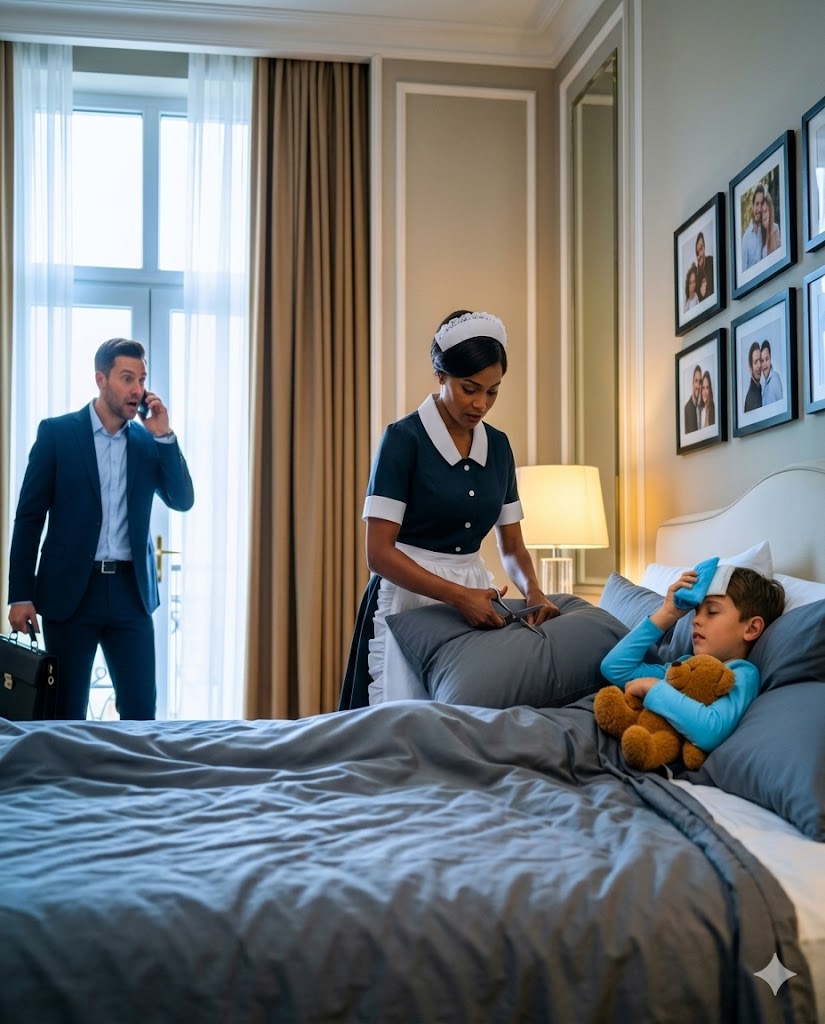
NO DOCTOR COULD CURE THE BILLIONAIRE’S SON — UNTIL THE MAID DISCOVERED SOMETHING TERRIFYING
Part 1: The Invisible Observer
The iron gates of the Walker estate opened slowly, as if they were tired of letting people in. Teresa Gray stood there for a moment, gripping the worn strap of her canvas bag, staring up at a house that looked more like a museum than a home. Glass and stone stretched across perfectly cut lawns. Everything was sharp, clean, cold. She had taken two buses to get here, leaving her apartment in New Haven at 5:30 in the morning, her coat pulled tight against the October chill. She couldn’t afford to be late. Not on her first day. Not when she needed this job so badly her stomach had been in knots all week.
The agency had called her three days ago. “Emergency placement,” they said. “Previous housekeeper quit without notice. Family needs someone immediately. Light housekeeping, private wing, pay is good.” Teresa didn’t ask why the last girl left. She needed the paycheck. But standing there now, looking at the Walker estate, something in her chest tightened. The house was beautiful, no question. But it felt wrong somehow—too quiet, like it was holding its breath.
She walked up the stone path, her sneakers barely making a sound. The front door opened before she could knock. A woman stood there, in her fifties, gray hair pulled back so tight it looked painful. Her eyes swept over Teresa like she was being appraised, measured, and found lacking in the same glance.
“You’re late,” the woman said. Teresa glanced at her watch; she was four minutes early.
“I’m Mrs. Callaway, estate manager. You’ll report to me. Come in.”
The entryway was massive. Marble floors, a staircase that curved up like something out of a movie. Everything was spotless, and everything was silent. Mrs. Callaway handed her a thick folder without ceremony. “Your duties are outlined here. Light housekeeping in the main wing and the private third floor. You’ll avoid the master bedroom, Mr. Walker’s office, and the medical suite, unless specifically instructed.”
Teresa took the folder. It was heavier than it looked.
“The third floor,” Mrs. Callaway continued, her voice flat, “is where the child stays. Oliver. He’s eight. He’s been ill for some time. You are not to move any of his medications. You are not to touch any medical equipment. You are not to engage him in conversations that might upset or excite him. And you are absolutely not to question Dr. Morse. Dr. Morse, the family’s nutritionist. She oversees Oliver’s care. She’s been with the family since his diagnosis. She knows what she’s doing.”
Teresa nodded slowly, but her mind caught on something. A nutritionist overseeing a sick child? “Where were the doctors?”
Mrs. Callaway’s eyes narrowed like she could read the question forming. “Mr. Walker has consulted with every specialist on the East Coast. Oliver’s condition is complicated. Dr. Morse has been the only constant, the only one who stayed.”
There was something in the way she said it, like staying was a virtue, like everyone else had failed by leaving.
“The previous housekeeper,” Teresa asked carefully, “why did she leave?”
Mrs. Callaway’s jaw tightened. “She asked too many questions. Overstepped. This family has been through enough without staff causing disruptions. You seem like a smart woman, so let me be clear. You’re here to clean. That’s all. The Walkers don’t need your opinions. They don’t need your concern. They need you to do your job and stay out of the way.”
Teresa felt her face flush, but she kept her expression neutral. She’d heard words like this before. All her life, really. Know your place. Don’t ask. Don’t question.
Five years ago, those words had cost her everything. Her sister, Janelle, had been nineteen, bright, full of life. Then she got sick. Stomach pain, fatigue, fevers that wouldn’t break. The doctors said it was stress, anxiety. They prescribed anti-depressants and sent her home. But Teresa knew her sister; she knew something was wrong. She could feel it in her bones. She just didn’t speak up. Because who was she to question the doctors? Who was she to push back against people with degrees and authority?
Three weeks later, Janelle collapsed. By the time they got her back to the hospital, the infection had spread too far. Sepsis, organ failure. She died two days later, holding Teresa’s hand, whispering, “It’s okay. It’s not your fault.”
But it was. Teresa had known, and she’d stayed silent. She’d made herself a promise at Janelle’s funeral, standing in the rain, watching them lower her baby sister into the ground: Never again. If I ever feel that pull in my gut again, that knowing, I will speak. I will fight. Even if it costs me everything.
Mrs. Callaway was already walking toward the stairs. “Follow me. I’ll show you the third floor.”
They climbed in silence. The house felt bigger the higher they went, colder too, like warmth couldn’t reach this far up. When they reached the third floor, Teresa noticed the change immediately. The walls here were different—lighter, softer, meant for a child—but the air felt heavy, stale.
Mrs. Callaway stopped outside a door covered in faded superhero stickers. Spider-Man, Batman, the Hulk. They looked old, peeling at the edges.
“This is Oliver’s room. He’s likely asleep. Don’t wake him. Just familiarize yourself with the space. Dusting, organizing. Nothing more.”
Mrs. Callaway handed her the keys, then paused. Her expression softened for just a second—something almost like sadness flickering across her face. “He’s a sweet boy. He’s been through more than any child should. Just remember that.”
And then she was gone, her footsteps echoing down the hall. Teresa stood there, staring at those superhero stickers. Her hand hovered over the doorknob. She didn’t know why her heart was pounding, didn’t know why every instinct in her body was screaming at her to pay attention, but she’d learned to trust that voice.
She opened the door. The smell hit her first. Antiseptic, sharp and clean, but underneath it, something floral—lavender, maybe, like someone was trying to cover up the scent of sickness.
The room was enormous, too big for one small boy. Medical equipment lined the walls—monitors, an IV stand, machines she didn’t recognize. The bed sat in the center, massive and white, surrounded by what looked like a dozen pillows. And there, almost swallowed by the blankets, was Oliver.
He was so small. Pale skin, thin arms, his brown hair stuck to his forehead, damp with sweat, even though the room was cool. But his eyes were open, watching her.
“Are you going to leave, too?” he whispered.
Teresa’s breath caught. His voice was so soft, so tired. She set down her cleaning supplies carefully and moved closer.
“Hi, sweetheart. I’m Teresa. I’m here to help keep your room nice.”
“The last lady left,” Oliver said. He wasn’t accusing, just stating a fact. “Everyone leaves.”
Teresa knelt beside the bed so they were eye-level. Up close, she could see how exhausted he looked. Dark circles under his eyes, lips chapped. But those eyes—hazel like autumn leaves—were watching her with something that broke her heart. Hope. Just a flicker of it, like he wanted to believe her but didn’t dare.
“I’m not going anywhere,” Teresa said gently. “Not unless you want me to.”
Oliver studied her for a long moment. Then, his gaze shifted to the table beside his bed. Teresa followed his eyes and felt her stomach drop. Bottles. So many bottles. Orange prescription containers lined up in neat rows. She started counting without meaning to. Forty-seven. Forty-seven medications for one eight-year-old boy.
Her nursing instincts kicked in—the ones she’d developed during those two years at community college before money ran out and she had to drop out, before cleaning houses became the only option. She recognized some of the labels: antibiotics, immunosuppressants, heart medication, anti-nausea pills, steroids.
But something was off. Some of these drugs counteracted each other. Others seemed redundant. It looked less like treatment and more like… she didn’t know what.
“Do you take all of these?” she asked softly.
Oliver nodded. “Four times a day. And the smoothies three times. Dr. Morse makes them special for me. Dr. Morse, she takes care of me. She’s really smart. She went to fancy schools.”
He said it like he’d heard it repeated many times.
“And the smoothies help?”
Oliver’s face changed just slightly. A shadow passing through those tired eyes. “They’re supposed to,” he whispered. “But they make my stomach hurt. And after I drink them, everything gets bad. But Dr. Morse says medicine has to hurt before it helps.”
Something cold slid down Teresa’s spine.
Part 2: The Bitterness of Truth
Over the next two weeks, Teresa fell into a rhythm. She arrived at the estate every morning just after 7:00, when the house was still quiet and the sun was just starting to burn through the fog rolling off the Long Island Sound. She’d make her way up to the third floor, her footsteps soft on the carpet, and she’d find Oliver exactly where she’d left him the day before—in that bed, surrounded by those pillows, waiting.
But something had changed since that first day. Something small but important. Now, when she opened the door, Oliver would smile. It wasn’t much—just a little lift at the corners of his mouth—but for a kid who’d been told he was dying for three years, a smile was everything.
They’d talk while she worked. Small conversations, safe ones. Oliver told her about his mom, the one he’d never met. How his dad kept a photo of her on his desk but never talked about her. How sometimes Oliver would find his father standing in front of it late at night, just staring.
“I think he’s mad at me,” Oliver said one morning, his voice so quiet Teresa almost missed it.
“Why would you think that, baby?”
“Because she died so I could be born. And now I’m dying anyway, so it was all for nothing.”
Teresa’s chest tightened. She set down the duster and came to sit beside him. “Oliver, look at me.” He did. Those hazel eyes were full of guilt. “No child should carry that. Your mama gave you life because she loved you, not because she had to. And your daddy? He’s not mad at you. He’s scared. There’s a difference.”
“How do you know?”
“Because I lost someone I loved, too. My little sister. And I spent years being angry at myself for not saving her. But anger and love, they get mixed up sometimes, especially when you’re hurting.”
Oliver was quiet for a moment, processing, like he’d already been carrying weight he was too young to hold.
“Miss Teresa?”
“Yeah, sweetheart.”
“Do you think I’m going to die?”
The question hit her like a punch. She wanted to say no. She wanted to promise him fifty more years, but she’d learned not to make promises she couldn’t keep.
“I think,” she said carefully, “that you’re stronger than anyone gives you credit for, and I think you’re going to surprise a lot of people.”
Oliver smiled again, a little bigger this time.
That was when Teresa started noticing the pattern. It was subtle at first, easy to miss if you weren’t paying attention. But Teresa was always paying attention now.
Every day around 10:00 in the morning, Dr. Morse would come in with Oliver’s first smoothie. She was tall, polished, always dressed like she’d just stepped out of a board meeting, her blonde hair pulled back in a tight bun, her smile professional but cold.
“Good morning, Oliver,” she’d say in that practiced voice. “Time for your vitamins.”
The smoothies were thick—purple or green, depending on the day. Oliver would drink them slowly, grimacing with each sip, and within two hours, he’d get sick. The first time Teresa saw it, she thought it was coincidence. Oliver doubled over, clutching his stomach, his face going pale. Then came the vomiting, the tremors in his hands, the way his whole body would shake.
Dr. Morse would rush in, all concern and efficiency. “It’s the disease progressing,” she’d say, checking his vitals, adjusting his medications. “His system is fighting itself.”
But the second time it happened, same pattern, same timeline. Teresa started taking notes in her head. Smoothie at 10:00, sickness by noon.
The third time, she was certain.
And then, one morning, something different happened. Oliver had fallen asleep before Dr. Morse arrived with his smoothie. Teresa watched from across the room as the doctor stood there, smoothie in hand, staring at the sleeping boy with an expression that made Teresa’s skin crawl. Not concern, not compassion—frustration.
Dr. Morse set the smoothie down and left without waking him. That day, Oliver slept until 2:00 in the afternoon. When he woke up, his color was better, his eyes brighter. He sat up without help.
“I feel good today,” he said, surprised.
Teresa’s heart started pounding. “Yeah, that’s wonderful, baby. Can we play a game?”
It was the first time he’d asked to play anything. They spent the afternoon building a tower out of blocks Teresa found buried in his closet. Oliver’s hands were steady. His laughter came easier. He looked like a regular kid.
By the time Dr. Morse came back for the evening smoothie, Oliver was tired, but happy. The doctor’s eyes swept the room, landing on the blocks scattered across the floor, and her jaw tightened.
“Oliver shouldn’t be exerting himself,” she said sharply, looking at Teresa. “Who authorized this?”
“We were just playing,” Teresa said evenly.
“He needs rest. Complete rest. You’re jeopardizing his recovery.”
Recovery? The word felt like a lie.
Dr. Morse prepared the evening smoothie right there, her movements precise and controlled. She watched Oliver drink every drop, her eyes never leaving him. Teresa stood in the corner, her mind racing.
That night, she couldn’t sleep. She kept seeing Oliver’s face—bright and alive when he skipped the smoothie, pale and sick after he drank it. She kept hearing her sister’s voice. That night in the hospital, “Something’s wrong, Ree. Tell them something’s wrong.”
And Teresa had been too scared to push, too afraid to question the doctors who knew better. Her sister died three days later.
At 2:00 in the morning, Teresa got out of bed in her small room on the first floor. She walked through the dark house, up the stairs, and stood outside Oliver’s door. She could hear him inside, restless, hurting.
She made herself a promise right there in that hallway. If her gut was right, if something was wrong, she wouldn’t stay quiet this time. Even if it cost her this job, even if it cost her everything.
Because some things are worth more than a paycheck. Some things are worth fighting for. And that little boy with the tired eyes and the superhero stickers—he was worth everything.
Part 3: The Proof in the Powder
Three weeks in, Teresa found the notebook. She was organizing Oliver’s bookshelf—picture books, mostly; some chapter books that looked like they’d never been opened. Dust had settled on everything, like the room itself had given up.
That’s when she saw it, wedged behind a copy of Where the Wild Things Are: a small spiral notebook with a superhero on the cover. Captain America’s shield, faded from being touched too many times. She pulled it out carefully. The pages were wrinkled. Some had water stains, or maybe tear stains.
She opened it, and her breath caught. Oliver’s handwriting. Shaky, childish. The letters slanted in different directions, like his hand had been trembling.
Day 247. The purple drink made me throw up again. Dr. Morse said that means it’s working, but it doesn’t feel like working.
Day 251. Dad came in today. He looked so tired. I pretended to be asleep because I don’t want him to be more sad.
Day 298. I heard Dr. Morse tell Dad I need more minerals. She says my body is fighting the medicine, but I don’t feel like I’m fighting. I just feel tired all the time.
Day 301. I don’t want the smoothies anymore, but Dad says I have to. Dr. Morse says I’ll get worse if I stop.
Day 317. I asked God why he made me sick. Mrs. Callaway says, “God has a plan,” but I don’t understand the plan. Maybe the plan is for me to die like Mama.
Teresa’s hands shook so hard she almost dropped the notebook. This wasn’t just poisoning. This was systematic, documented, calculated. Oliver had been documenting his own slow death, writing it down like he was taking notes, trying to make sense of something that didn’t make sense, and no one had listened.
She heard footsteps in the hall and quickly shoved the notebook into her apron pocket. Dr. Morse appeared in the doorway, smoothie in hand, that professional smile fixed in place.
“Teresa, I didn’t realize you’d be here this early.”
“Just getting a head start on the dusting.”
Dr. Morse’s eyes swept the room, pausing on the bookshelf. For a split second, something flickered across her face—suspicion, maybe—but it was gone before Teresa could be sure.
“Oliver needs his rest,” Dr. Morse said coolly. “Perhaps you could come back later.”
“Of course.”
Teresa gathered her supplies and left, but not before catching the way Dr. Morse locked the door behind her—locked it like she was keeping something in, or someone out.
That afternoon, Teresa made a decision that could cost her everything. She waited until Dr. Morse left for her daily walk—one hour every day at 3:00, like clockwork. Then she went to the medical suite. Her heart was hammering so hard she could feel it in her throat. The door was unlocked.
Inside, everything was exactly as it always was: sterile, organized, a place for everything and everything in its place. Except today, Teresa wasn’t just cleaning. She went to the locked cabinet first. The one Dr. Morse kept her specialized supplements in. The one she guarded like it held state secrets.
Teresa pulled a bobby pin from her hair, something she’d learned from her brother years ago. Her hands shook as she worked the lock. It clicked open.
Inside were rows of unmarked containers: powders, dried plant material, small vials of liquid, and a notebook. Teresa pulled it out, her breath catching. It was a journal. Dr. Morse’s handwriting, neat, clinical, precise.
October 12. Increased oleander extract to 0.3 mg. Patient showing appropriate symptoms. Vomiting episode lasted four hours. Father remains convinced of disease progression.
October 19. Patient refused morning smoothie. Had to administer evening dose at double concentration to maintain symptom consistency.
November 2. Minor setback. New housekeeper showing excessive interest in patient. Will monitor. May need to recommend termination if interference continues.
Teresa’s vision blurred. Her hands shook so badly she almost dropped the notebook. This wasn’t just poisoning. This was systematic, documented, calculated. Dr. Morse had been treating Oliver’s murder like a science experiment—recording dosages, tracking symptoms, adjusting her methods to keep him sick, but not dead. Not yet.
Teresa photographed every page with trembling fingers. Then she saw something else. A folder tucked in the back of the cabinet. Legal documents. She pulled them out and her blood ran cold.
James Walker’s will, updated eighteen months ago. And there, in black ink: In the event of Oliver Walker’s death, Dr. Helena Morse shall receive $2 million in recognition of her tireless dedication and attempt to preserve his life.
$2 million for trying, for failing, for watching a child die despite her best efforts. The motive wasn’t just greed. It was a retirement plan. A lottery ticket. Oliver’s death would cash in.
Teresa heard footsteps in the hallway. Her heart stopped. She shoved everything back into the cabinet, relocked it, and slipped out the side door just as Mrs. Callaway appeared at the main entrance.
“Teresa, what are you doing up here?”
“Just finished Oliver’s room,” Teresa said, forcing her voice steady. “Was about to head downstairs.”
Mrs. Callaway’s eyes narrowed slightly, but she nodded. “Dr. Morse will be back soon. Best not to be in her way.”
Teresa nodded and walked past her. Every step measured, her phone burning in her pocket with the evidence that could save Oliver’s life—or end hers. She made it to her room and locked the door. Then she sat on her bed and let herself shake. Let herself cry. Let the weight of what she’d found crash over her like a wave.
Dr. Helena Morse wasn’t just poisoning Oliver. She was documenting it, perfecting it, waiting for the exact right moment to let him die so she could collect her payment and walk away clean. And James Walker—exhausted, desperate, drowning in grief—had signed the papers that made his son’s murder profitable.
Teresa pulled out her phone and called Marcus. “I’ve got it,” she whispered when he answered. “I’ve got everything.”
Part 4: The Midnight Confession
The hallway felt longer at midnight. Teresa stood outside James Walker’s office, her hand raised to knock, frozen in the space between courage and terror. Behind that door was a man who’d spent three years trying to save his son. A man who’d poured millions into specialists and treatments. A man who’d built his entire hope on the one person who’d stayed when everyone else left. And Teresa was about to tell him that person was a murderer.
Her hand trembled as she knocked. Silence, then footsteps. The door opened. James stood there in a wrinkled shirt, tie long gone, eyes bloodshot and hollow. He looked at her like he was trying to remember who she was.
“Teresa? It’s past midnight. What?”
“I need to talk to you about Oliver.”
Something flickered across his face—irritation, maybe, or fear. “If this is about the medications again, please…”
“I know you think I’m overstepping,” her voice cracked. “I know you think I’m just the help, but I’m begging you. Just give me five minutes. That’s all I’m asking.”
He stared at her for a long moment. Then he stepped aside.
The office was a mess. Papers everywhere. Empty coffee cups. A photo of his wife on the desk—blonde hair, bright smile, holding a positive pregnancy test like it was the best news in the world.
“What is it?” James asked, his voice tired, defeated.
Teresa pulled out her phone with shaking hands. “Mr. Walker, I need you to look at something, and I need you to actually see it. Not as a father who’s desperate, but as a man who loves his son.”
She showed him the first photo: Oliver’s notebook. His small, heartbreaking handwriting. Day 247. The purple drink made me throw up again.
James’s face went pale. “Where did you get this?”
“His bookshelf. He was documenting what was happening to him. He knew something was wrong, Mr. Walker. Even when no one else did.”
She swiped to the next photo: Dr. Morse’s journal. October 12. Increased oleander extract to 0.3 mg. Patient showing appropriate symptoms. Vomiting episode lasted four hours. Father remains convinced of disease progression.
James took the phone from her hands, his fingers trembling. He read the entry once, twice, like he couldn’t make the words make sense. “What is this?”
“It’s Dr. Morse’s dosage log. She’s been poisoning Oliver for three years. Oleander extract. Small doses over time. It mimics degenerative illness perfectly. I had the residue from her blender tested. It’s all there.”
James’s breathing changed. Shallow. Quick. “No,” he shook his head. “No, this doesn’t… Dr. Morse has been trying to save him.”
“She’s been dedicated to keeping him sick,” Teresa interrupted, her voice breaking. “So she could collect two million dollars when he died.”
She showed him the will, the clause, the payment for failure. James stared at it like it was written in a language he didn’t speak.
“I wrote that will eighteen months ago,” he whispered. “I thought… I thought it would motivate her. I thought if she knew she’d be taken care of, she’d try harder. She’d stay.”
“She stayed because you made his death profitable.”
The words hung in the air like smoke. James sank into his chair, the phone slipping from his hands, his face crumbled—not with anger, with something worse. Grief and recognition.
“I did this,” he whispered. “I made him a target. I signed the papers that turned my son into…”
He couldn’t finish. His shoulders shook. Teresa knelt in front of him, her own tears falling freely now.
“You didn’t know. You were trying to help him. You were desperate.”
“I’m his father. I should have seen it.”
“Mr. Walker, she was always there. Every episode, every crisis, taking notes, adjusting treatments, and I thought she was trying to save him.”
He looked at Teresa with eyes full of horror. “I’ve been paying someone to kill my son.”
The words seemed to shatter something in him. He put his head in his hands and sobbed—deep, wrenching sounds that came from a place too broken for words. Teresa stayed there on her knees, her hand on his shoulder, letting him break. Because some truths don’t just change your mind; they destroy your heart.
After a long time, James lifted his head. His eyes were red but clear now, focused. “Where is he? Where’s Oliver?”
“Sleeping in his room.”
James stood, his movement sudden, desperate. “We’re taking him to the hospital right now. We’re not telling Dr. Morse. We’re not telling anyone.”
“Mr. Walker, if she knows we’re on to her, she could…”
“She could finish it. She could take him from me.”
Before she could stop him, he was already moving toward the door. Teresa followed, her heart pounding. They climbed the stairs together in silence. James pushed open Oliver’s door so carefully, like he was afraid the boy might disappear if he moved too fast.
Oliver was asleep, small and pale in that enormous bed, his breathing shallow but steady. James moved to his side, his hand hovering over his son’s face like he was afraid to touch him, like he didn’t deserve to.
“Hey, buddy,” he whispered, his voice breaking. “Wake up for me!”
Oliver’s eyes fluttered open, confused, groggy.
“Dad? We’re going on a trip? Okay, right now?”
“I know, but we need to go. Can you do that for me?”
Oliver nodded slowly, too tired to question. James lifted him carefully. His son barely weighed anything, and he held him close. Oliver’s head rested against his father’s shoulder.
“Miss Teresa?” Oliver’s voice was so quiet. “Are you coming, too?”
Teresa’s throat closed. “Yeah, baby. I’m coming.”
They moved through the dark house like thieves, past Mrs. Callaway’s room, past the medical suite where Dr. Morse’s poison sat in locked cabinets. James’s car was in the garage. He settled Oliver in the backseat, buckling him in with shaking hands. Teresa climbed in beside Oliver, and James got behind the wheel.
As they pulled out of the garage, Oliver stirred. “Dad, where are we going?”
James looked at his son in the rearview mirror, tears streaming down his face. “To save your life, buddy,” he whispered. “We’re going to save your life.”
And as they drove through the dark Connecticut night, leaving behind the house that had become a tomb, Teresa closed her eyes and said a prayer.
Thank you. Thank you for giving me the courage to speak. Thank you for making him listen. Thank you for this moment, this chance.
Because sometimes salvation comes at midnight. Sometimes it comes from a woman who refused to stay silent. And sometimes, just sometimes, the truth breaks through just in time.
Part 5: The Rescue
The emergency room lights were harsh and unforgiving—the kind that strip away pretense and show you exactly what’s real. James carried Oliver through the sliding doors at 3:00 in the morning, Teresa right behind him. The nurse at the desk looked up, started to say something routine, then saw James’s face and stopped.
“I need a doctor,” James said, his voice raw. “My son has been poisoned. Oleander, three years, please.”
The nurse was already moving, calling codes, bringing people. Within minutes, Oliver was on a gurney, being wheeled into a trauma bay. His small hand reached back for his father.
“Dad, I’m scared.”
“I know, buddy. I know, but these people are going to help you. Really help you this time.”
A doctor appeared, young, sharp-eyed, moving with purpose. “I’m Dr. Chen. Tell me everything.”
Teresa pulled out her phone with trembling hands and showed him the photos—Dr. Morse’s journal, the dosage logs, Marcus’s analysis. Dr. Chen’s expression shifted from professional to horrified in seconds.
“How long has this been happening?”
“Three years,” James whispered.
“Jesus.” Dr. Chen turned to the nurses. “Full toxicology panel, cardiac workup, get me digoxin levels, and a poison control consult. Now!”
They moved around Oliver like a choreographed dance. IVs, monitors, blood draws. Oliver looked so small, surrounded by all those people, so fragile.
“Am I dying?” he asked quietly.
Dr. Chen knelt beside him, his voice gentle. “No, son. You’re not dying. You’re going to be okay. We’re going to make sure of it.”
The words James had been desperate to hear from a doctor for three years, and now they came in the worst possible way. Because Oliver had never been dying of a disease. He’d been dying of trust.
The waiting room was empty at that hour. Just James and Teresa sitting in plastic chairs under fluorescent lights that hummed too loud. James hadn’t said a word since they’d taken Oliver back for tests. He just sat there, elbows on his knees, head in his hands.
“Mr. Walker,” Teresa said softly.
“I gave her a key to my house,” he whispered. “I let her into his room every single day. I watched her make those smoothies and I thanked her for her dedication.” His voice cracked. “I was paying her to kill my son and I thanked her.”
“You didn’t know.”
“I should have.” He looked at her, his eyes devastated. “You knew. In three weeks, you saw what I couldn’t see in three years. What does that make me?”
“Human,” Teresa said quietly. “It makes you human. You were drowning. You were desperate. You trusted the wrong person because she was the only one who stayed.”
“My wife died bringing him into this world,” James’s voice broke completely. “And I almost let him follow her because I was too blind to see the truth.”
Teresa reached over and took his hand. He gripped it like a lifeline. “But you listened when it mattered most. You listened. You got him out. You brought him here. That counts.”
“Does it?”
Before she could answer, Dr. Chen appeared in the doorway. His face was grim. “Mr. Walker, we have the preliminary results. They…”
They stood, James’s hand still gripping Teresa’s.
“Your son has dangerously elevated levels of cardiac glycosides. The pattern is consistent with chronic oleander poisoning. Based on what we’re seeing, this has been systematic and prolonged.” He paused. “If you’d waited another month, maybe less, his heart would have given out. The damage is extensive, but not irreversible. He’s going to need careful monitoring, chelation, therapy, time to heal, but he’s going to live.”
James’s knees buckled. Teresa caught him.
“He’s going to live,” Dr. Chen repeated gently. “You got him here in time.”
James pressed his fist against his mouth, trying to hold back the sound that wanted to break free. Relief and horror tangled so tight. They were the same thing.
“I’ve already contacted the police,” Dr. Chen continued. “This is a criminal matter. They’ll need your statement, and the evidence you brought.”
James nodded, unable to speak. Dr. Chen’s expression softened. “He’s asking for you—both of you.”
They followed him back to the bay where Oliver lay surrounded by machines, looking impossibly small, but somehow already better. Color was returning to his cheeks. His breathing was easier.
“Dad.” Oliver’s voice was clear. “The doctor said, ‘I’m not really sick.’ He said someone was hurting me on purpose.”
James moved to his son’s side, taking his hand carefully. “Yeah, buddy. Someone was. But they can’t hurt you anymore. I promise.”
Oliver was quiet for a moment, processing. Then, “Was it Dr. Morse?”
The question hung in the sterile air. James closed his eyes. “Yeah, it was.”
Oliver was quiet for a moment. Then, “Why would she do that?”
How do you explain evil to a child who still believes in superheroes?
“Because sometimes people get lost,” James said finally. “Sometimes they forget what matters and they make choices that hurt people who never deserved it.”
Oliver looked at Teresa. “You saved me, didn’t you?”
Teresa’s eyes filled with tears. “You saved yourself, baby. You wrote it all down. You knew something was wrong. You just needed someone to listen.”
“My sister didn’t have anyone to listen,” Teresa said softly. “So, I promised I’d always listen, even when it was hard.”
Oliver reached out his small hand. Teresa took it.
“Thank you for listening,” he whispered.
And in that moment, in that hospital bay, under fluorescent lights at 4:00 in the morning, something broken began to heal. Not Oliver’s body—that would take time—but something deeper. Something that had been dying in all of them. Hope. The belief that truth could win. That speaking up mattered. That one person refusing to look away could change everything.
James watched his son, really watched him, and saw something he hadn’t seen in three years: a future. And for the first time since his wife died, he let himself believe it was possible. That his son would grow up, that he’d run through fields and dream with his eyes open, that he’d live.
Because sometimes grace arrives at 3:00 in the morning in an emergency room. Sometimes it comes through a woman who refused to stay silent. And sometimes, just sometimes, God catches the ones who are falling just before they hit the ground.
Part 6: The Architect of Silence
By the time the sun rose over Long Island Sound, two police officers were standing in James Walker’s driveway. Dr. Helena Morse was packing her office. She’d noticed the disconnected medical equipment in Oliver’s room at dawn. The empty bed, the silence where machines used to beep, and she knew.
Mrs. Callaway found her loading boxes into her Mercedes, moving with the kind of calm efficiency that comes from planning an exit strategy long before you need it.
“Dr. Morse, what’s happening?”
Helena didn’t look up. “The boy took a turn. They’ve taken him to the hospital. I’m gathering my research to consult with the team there.” But her hands were shaking just slightly.
That’s when the police cars pulled through the gates.
Helena stopped moving. Her face went very still. The officers approached, badges out.
“Dr. Helena Morse?”
“Yes.”
“We need you to come with us. There are some questions regarding your treatment of Oliver Walker.”
“I don’t understand. I’ve done everything possible for that child.”
“Ma’am, we have evidence of systematic poisoning. Oleander extract administered over a three-year period. We have documentation in your own handwriting.”
For just a moment, one brief, unguarded moment, the mask slipped. Not shock, not confusion—rage. Cold, calculated rage.
“That maid,” she said quietly. “That ignorant, meddling…”
“Ma’am, you have the right to remain silent.”
But Helena was done being silent. Three years of performance, of playing the dedicated professional, of swallowing her resentment while James Walker threw money at specialists who wouldn’t know real science if it killed them. All of it came pouring out.
“Do you know how many degrees I have? How brilliant I am?” Her voice rose. “I spent three years playing nursemaid to a spoiled brat while his father paid millions to incompetent doctors. Three years of watching him grieve a woman who died bringing that child into the world. I earned that inheritance. I earned every penny.”
Mrs. Callaway stepped back, her hand over her mouth. “He was eight years old. He was a means to an end.”
No remorse, no shame, just cold calculation. “And he would have died peacefully if that woman had minded her own business.”
They put her in the car, drove her away, and the Walker estate—that beautiful, suffocating house—finally knew the truth it had been hiding for three years.
At the hospital, James stood outside Oliver’s room, phone pressed to his ear, talking to lawyers and police, giving statements, answering questions, but his eyes never left his son through the window.
Oliver was sitting up now, color in his cheeks, eating real food for the first time in weeks without getting sick. Dr. Chen had started the chelation therapy, slowly pulling the poison from his system. It would take time—weeks, maybe months—but every hour, Oliver looked more alive, more like the boy he was supposed to be.
Teresa sat beside him, reading, the same dragon book from his room. Oliver listened, his eyes bright and clear in a way they hadn’t been since he was five. When the chapter ended, Oliver looked at her.
“Miss Teresa, did they catch her?”
Teresa had been dreading this question. How do you tell a child that the woman who smiled at him everyday, who made his smoothies and called him sweetheart, had been trying to kill him?
“Yeah, baby. They caught her.”
“Is she going to jail?”
“Yes.”
Oliver was quiet for a long time. Then, “Good.” Not angry, not vindictive, just relieved. “She used to tell me I was lucky,” Oliver said softly. “That I had the best doctors and the best care and I should be grateful. But I never felt lucky. I just felt like I was drowning and nobody could see it.”
Teresa’s throat tightened. “I’m so sorry that happened to you.”
“It’s not your fault.”
He looked at her with eyes too wise for eight years old. “You’re the one who pulled me out.”
Teresa’s eyes filled with tears. “You saved yourself, baby. You wrote it all down. You knew something was wrong. You just needed someone to listen.”
“My sister didn’t have anyone to listen,” Teresa said softly. “So, I promised I’d always listen, even when it was hard.”
Oliver reached out his small hand. Teresa took it.
“Thank you for listening,” he whispered.
And in that moment, in that hospital bay, under fluorescent lights at 4:00 in the morning, something broken began to heal. Not Oliver’s body—that would take time—but something deeper. Something that had been dying in all of them. Hope. The belief that truth could win. That speaking up mattered. That one person refusing to look away could change everything.
James watched his son, really watched him, and saw something he hadn’t seen in three years: a future. And for the first time since his wife died, he let himself believe it was possible.
That his son would grow up, that he’d run through fields and dream with his eyes open, that he’d live. Because sometimes grace arrives at 3:00 in the morning in an emergency room. Sometimes it comes through a woman who refused to stay silent. And sometimes, just sometimes, God catches the ones who are falling just before they hit the ground.
Part 7: The Fragile Dawn
Six weeks later, the Walker estate learned how to breathe again. The medical equipment was gone. The locked cabinets were emptied. The curtains in Oliver’s room stayed open now, letting October sunlight spill across floors that had been dark for too long. And for the first time in three years, there was laughter—real laughter. The kind that echoes off walls and reminds a house what it was built for.
Oliver was running. Not far, not fast—not yet—but running through the gardens his father had forgotten existed. Past the flower beds that were finally being tended again. His legs were still weak, still learning how to carry him, but every day, he got a little stronger, a little more like the boy he was always meant to be.
Teresa watched from the porch, her hand shading her eyes against the afternoon sun. She wasn’t wearing her uniform anymore. James had asked her to stay, not as a housekeeper, but as Oliver’s caregiver. He’d set up a scholarship in her name, covering her nursing school tuition, giving her the future her sister never got.
“You gave my son his life back,” James had said. “Let me help you build yours.”
She’d cried when he said it. Cried for Janelle, cried for Oliver, cried for every moment she’d been too afraid to speak. And all the moments she’d found the courage anyway.
Oliver stumbled, caught himself, and kept going. Mr. Buttons was tucked under his arm. He still carried that bear everywhere. Some things don’t need to change.
James appeared beside Teresa, two glasses of lemonade in his hands. He’d taken a leave from work, decided some things mattered more than board meetings and quarterly reports—like watching your son remember how to be a child.
He sat at the table. No phone, no watch, no rush to get anywhere.
Sebastian yelled from the counter, “Dad, the pancakes are almost ready.” He still couldn’t say it right. And nobody in that kitchen was going to correct him, because that word—mispronounced, clumsy, with that four-year-old tongue still learning how the world works—was perfect.
Maria put the plate of pancakes in the center of the table. She sat in the chair that was now hers—the one between the twins, the one nobody else used, because that was her place and everyone knew it.
Robert looked at her. The children ate with their hands, sticky from syrup and chocolate. The kitchen smelled like cinnamon. Morning light came through the window and touched all four of their faces.
Maria no longer slept in the laundry room. She had her own room now, with a real bed, a small bookshelf, and fourteen books on early childhood development that she’d bought with her own money. Because Maria was studying. Every night after the twins fell asleep, she worked on her online degree.
Robert had changed, too. The man who came home at 11:00 p.m. and left at 6:00 a.m. no longer existed. Now he had dinner with his sons every night. He knew Matthew preferred apple slices. He knew Sebastian liked bananas with cinnamon. He learned that both boys liked to climb on top of him when he lay on the floor.
The divorce with Victoria was finalized. She moved to another state. She never called. And in that kitchen, at that table where nobody was missing and nobody was extra, Robert understood something with a clarity that no longer hurt.
Sometimes the person who saves your life isn’t the one who shares your last name. It’s the one who holds your children when you can’t.
Maria looked up from her coffee and caught Robert’s eyes. They didn’t need to speak. They didn’t need to explain. They just existed in the quiet grace of a morning that had almost never been.
And as the sun climbed higher, casting its golden light over the world, Robert knew that the real journey—the one that really mattered—was only just beginning.
He was home. Not in a building, not in a bank account, but in the truth they had finally, finally reclaimed.
The struggle was over. The redemption was earned. They were Robert and Maria, and they were finally free.
And as the first stars began to twinkle in the darkening sky—a symbol of everything that was beautiful and untamable—Robert knew that the light he had spent his life searching for had been right there in his kitchen all along.
He was home. And that, he realized, was the only sanctuary he would ever need.