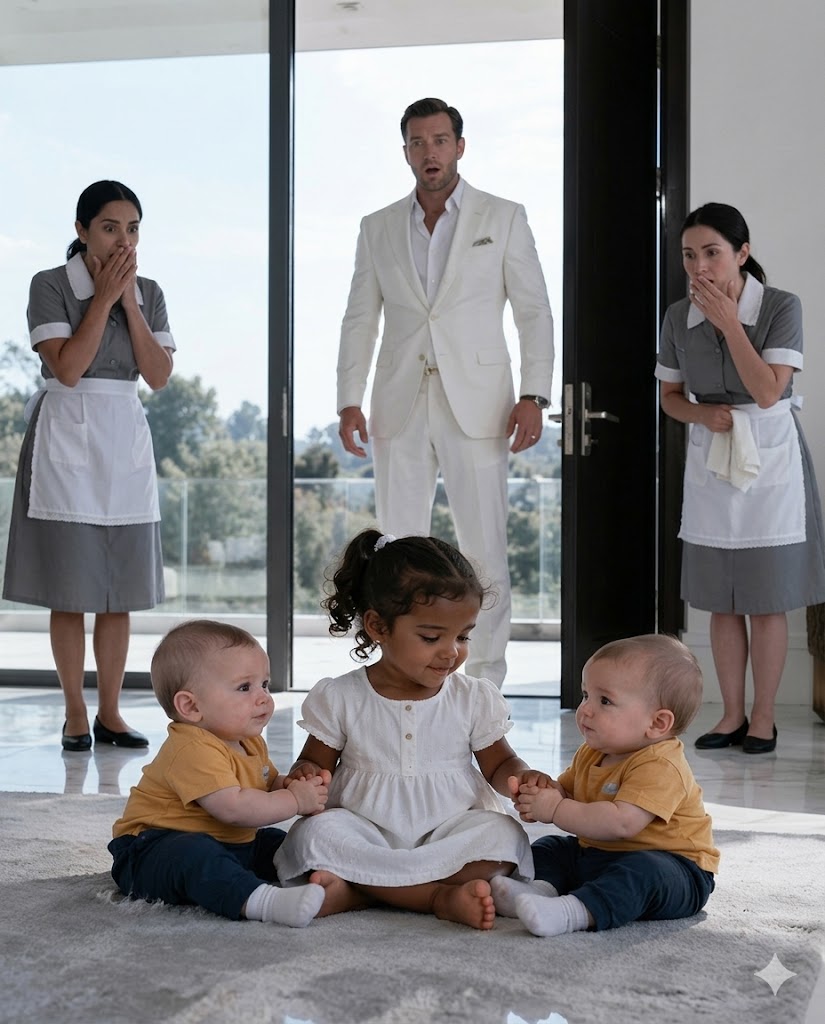
No One Could Calm the Billionaire’s Twins… Until the Maid’s Toddler Did What No One Expected
Part 1: The Heavy Curtains of Greenwich
The Hargrove mansion sat back behind twin iron security gates on twelve acres of perfectly manicured lawns in Greenwich, Connecticut. From the outside, passing drivers would slow their vehicles down to a crawl just to stare at the sheer opulence of it all. It looked exactly like a place where happiness had taken up a permanent lease. There were tiered marble fountains imported from Florence that cast crisp arcs of sparkling water into the morning light, a cobblestone driveway lined with mature oaks, and formal rose gardens that a disciplined team of six full-time landscapers kept trimmed to sub-millimeter perfection. It was a physical monument to what immense capital could secure from the earth.
But inside those towering limestone walls, there existed a grief so dense, so heavy, and so completely unyielding that it had systematically soaked straight into the velvet curtains, down into the imported oak floorboards, and into the absolute center of every single room in the house.
Ethan Hargrove was thirty-eight years old, possessed a straight, severe posture, and held significantly more liquid wealth than any human being could expend across three continuous lifetimes. He was the founder and primary shareholder of global technology conglomerates operating across seven separate countries, and his profile had occupied the front cover of Forbes magazine twice before his thirty-fifth winter. The international press routinely described his mind as brilliant, visionary, and entirely unstoppable inside the modern logistics markets.
But the stark reality behind the corporate ledger was that Ethan Hargrove had not cleared more than three continuous hours of sleep in a single night for almost two winters.
His twins, a boy named Noah and a girl named Nora, were exactly two winters old. And they cried. It wasn’t the standard, rhythmic crying of an ordinary infant that an adult could resolve with a heated bottle, a clean diaper change, or the comforting cadence of a familiar lullaby. They wept the specific way human beings weep when the absolute core of their inner system has been broken into pieces before they have even gathered the words to name the fracture.
They were long, breathless, and body-shaking sobs that filled the high ceilings of the mansion, bouncing off the polished marble arches until the acoustic pitch of the grief felt like a physical weight pressing directly against your ribs.
The premier child development specialists in New York had run every single diagnostic script available to modern medicine, concluding unanimously that the twins were physically healthy—perfectly healthy, growing cleanly along the upper percentiles, consuming their nutrient allocations, and developing their motor structures completely on track. But the exact micro-second the mansion reached its quiet cycles—the minute the administrative distraction of corporate movement and daily staff noise faded from the corridors—Noah and Nora would initialize their routine. First one tiny voice would break into a whimper, then the alternative would match the frequency, until both children were screaming together in a terrifying harmony of raw sorrow that absolutely no adult in the house could explain, and absolutely no professional could douse.
Ethan had retained twelve separate elite, live-in nannies over the previous eighteen months on the calendar. Twelve. Each candidate arrived at the front gate carrying glowing reference portfolios, impressive university credentials in early childhood education, and decades of high-net-worth experience. Each one lasted on an average historical scale of six weeks before they quietly packed their designer leather suitcases, signed their administrative exit logs, and cleared the property.
It wasn’t because their systems didn’t exhaust every single operational strategy on the floor. They tried everything known to the industry: advanced music therapy loops, strict behavioral sleep training cycles, high-frequency lavender oil diffusers in the humidifiers, white noise algorithms, weighted blankets designed specifically for toddlers, and pediatric sleep consultants who flew in from Switzerland to bill five hundred dollars an hour just to watch the sheets.
Absolutely nothing altered the frequency of the rooms.
The absolute truth—the dark ledger entry that Ethan buried so deeply inside his own conscience that he only allowed his eyes to look at the text at 3:00 in the morning when the entire twelve acres went dark—was that Noah and Nora were screaming for their mother.
Her name had been Clare. She was only thirty-four winters old when her timeline was terminated by a sudden, cruel, and completely un-warned brain aneurysm. She had been laughing at a casual television segment beside his shoulder one evening, and then her lips weren’t moving anymore, and then her breath had left the room completely before the medical response truck could clear the security gates.
The twins had been exactly four months old at the timestamp of her burial. They held zero conscious memory of her face, zero recollection of the scent of her skin, and zero data lines to map out her voice. But somehow, inside that mysterious, wordless, and almost spiritual mechanism through which very small children read the geometry of the world, they understood with an absolute certainty that their primary anchor was missing from the deck. They felt the vacuum of her absence the exact same way a man feels a freezing current of winter air leaking through an invisible crack in a concrete wall. You cannot point your finger at the crack behind the plaster, but your skin registers the chill every single hour of the day.
Ethan felt the freeze too. He felt it down inside the marrow of his bones every morning he adjusted his tie. But he was a man who had constructed an international empire around the singular discipline of solving complex technical problems. And this was the one definitive problem his capital could not negotiate with. He could not bring Clare back across the threshold. He could not explain to two-year-old minds why their mother’s arms would never clear the dark to hold their weight. He could not manufacture a shape that could fill the specific, echoing hole she had left behind inside the house.
So he worked. He exhausted his system with eighteen-hour days inside the city high-rises because his corporate office was the single location where his brain could force its focus onto a logistics spreadsheet rather than the sound of his children screaming through the floorboards. He told himself the distance was a necessary administrative strategy; he told himself he was constructing an unassailable financial future for their names; he told his reflection a massive line of convenient lies when the clock hit 3:00 AM.
His mother had flown in from Boston twice, but she spent the entire loop weeping into her tea before booking a return flight. His sister called every Sunday afternoon from Chicago, her voice a repetitive, critical frequency over the wire: “Ethan, your system requires a radical intervention. You need real human help inside those rooms. Not another credentialed nanny from a registry folder.”
His closest friend, Marcus, who had monitored his balance since their college terms, came to visit the estate once and cleared the front door looking shaken in a mechanism that held zero correlation with the mansion or the wealth.
“You are systematically disappearing from your own chart, Ethan,” Marcus had told him flatly as his car idled on the gravel path. “I can look straight through your skin. The business cannot support a ghost at the wheel.”
Ethan hadn’t formulated a response. He didn’t hold the vocabulary to clear the error.
The daily operations of the Greenwich estate ran on a strict, clinical schedule managed by his resident estate supervisor, a sharp, un-bending woman named Patricia. She was sixty winters old, possessed an iron spine, and had monitored every single dark transaction that cleared the high-rent districts over her career. She coordinated the culinary shifts, managed the property accounts, and hired and terminated the live-in nannies with a crisp, professional efficiency that kept the entire fragile, bleeding system from experiencing a total structural collapse.
It was Patricia who quietly authorized the interview ticket for Rosa Mendes.
Rosa was thirty-two years old. She had cleared her entry into the United States from Mexico exactly eleven winters ago, carrying nothing but forty dollars in cash, a single cardboard suitcase, and a quiet, un-yielding determination that held enough structural mass to move a mountain line. She had cleared back-to-back shifts as a hotel laundry assistant, a hospital baseline cleaner, and a public school janitor, and for the past four years, she had worked as a premier domestic worker for the high-end families along the coast.
She wasn’t the most credentialed candidate Patricia had ever audited; she didn’t possess a three-page portfolio of references from European royalty or Manhattan hedge fund directors. But Patricia possessed a natural, un-teachable gift for reading the fine print of a human character. And when Rosa sat across from her metal desk in the secondary kitchen room for her intake session, Patricia recorded an immediate anomaly.
Rosa didn’t allow her eyes to track the thickness of the marble counters, she didn’t look up at the crystal chandelier hanging above the kitchen island, and she held zero interest in the twelve-acre rose gardens displayed through the glass panes. She looked straight into Patricia’s eyes—warmly, cleanly, and with the kind of absolute, undivided attention that most modern human beings have completely forgotten how to deliver to another soul.
“I am required to inform your system before we sign the ledger, Rosa,” Patricia said, her voice dropping into a careful, low register, “that this is not an easy house to occupy. The walls hold a lot of friction.”
Rosa nodded her head slowly, her calloused fingers loose over her lap. “I hold the understanding that the children are running a dark cycle, ma’am.”
Patricia paused, her pen hovering over the contract lines as she sought the correct administrative phrase. “They carry an immense volume of raw grief for such small variables, Rosa. It fills the air slots.”
Rosa’s dark eyes softened instantly—not with the cheap, performative pity of a domestic applicant looking to secure a high wage, but with the deep, visceral recognition of a survivor who understood the weight of the dirt.
“The children always hold the data line, ma’am,” Rosa said quietly, her voice a smooth baseline. “They always understand the precise hour when the primary source has been cleared from the room.”
Patricia signed the contract page on the spot.
What the estate manager did not mention inside her report—what she considered writing onto the master sheet and then decided was entirely beside the administrative point—was that Rosa Mendes would not be clearing the front security gates alone.
Rosa possessed a daughter. Her name was Lily. She was exactly three winters old, and she was, inside Patricia’s careful, thirty-year professional estimation, the single most remarkable small human being her eyes had ever registered on the earth.
Lily Mendes was about to alter the structural frequency of the Hargrove mansion completely down to the floorboards, but absolutely nobody inside the twelve acres held the data to clear that calculation yet. Not Patricia, not the tech billionaire, and not even her own mother.
Part 2: The Logic of the Smile
The initial deployment initialized on a cold Tuesday morning in early November, the exact week when the mature oaks outside the mansion windows had turned the color of dried copper and the Greenwich sky held that specific, pale gray density of an impending winter freeze.
Rosa Mendes arrived through the service entry door for her first official shift, carrying a blue canvas bag of cleaning supplies over her left shoulder and balancing Lily flat against her right hip. The little girl’s thick, dark curls spilled loosely over her mother’s denim collar, her deep brown eyes wide, perfectly curious, and entirely clear of any standard childhood fear as she audited the high limestone ceilings of the foyer.
The twins were crying. They had been executing their synchronized screaming loop since 5:00 AM without a single minute of intermission.
Lily turned her head slowly toward the acoustic vibration echoing down the grand marble staircase, and then she executed a physical maneuver that made Patricia halt her boots completely flat against the linoleum tiles.
She smiled.
Absolutely nobody inside that architecture smiled when Noah and Nora initialized their frequency. In the eighteen months since Clare’s burial, Ethan Hargrove had watched grown, highly paid adults—individuals with decades of clinical development credentials listed on their resumes—visibly flinch the micro-second the twins started their whimpering loop. He had watched seasoned nannies develop a permanent, rigid tension inside their shoulder blades—a defensive bracing like sailors preparing for a toxic wave to strike the hull. He had watched Patricia herself, a woman who remained entirely unshakable across every domestic crisis, close her eyelids for two silent seconds whenever both twins started together, as if her inner system required an administrative recess before she could process the noise.
Everyone inside the twelve acres had learned, without ever being given a verbal directive, to treat the twins’ crying as a high-priority structural emergency—a catastrophic system failure to be stopped, managed, or papered over with technique.
Lily Mendes was three winters old, and her system had completely failed to log that rule. When her ears recorded Noah and Nora screaming from somewhere deep inside the upper nurseries of that massive, freezing mansion, her muscles didn’t tighten up. She didn’t flinch away from the pitch of the grief. She turned her head toward the stairs with her dark eyes wide open, her lips curling into a full, radiant smile.
It was the specific way a child smiles when she hears a line of music she recognizes from an old room—as if the sound made absolute structural sense to her skeleton, as if it were a frequency her soul already held the dictionary to decode.
“Baby holding the sad today,” Lily said simply, her small voice clearing the foyer air as she addressed no one in particular.
Rosa shifted her daughter’s weight against her hip, her face turning toward the estate manager with a quiet line of apology written into her eyes. “She is very… how do you clear the phrase… observant, Patricia. Her system tracks the rooms fast.”
“She is,” Patricia agreed, her spectacles reflecting the light as her vision remained pinned to the three-year-old’s smile. Lily was already leaning her center of gravity toward the marble steps.
Rosa’s initial shift layout was supposed to be perfectly straightforward. Patricia was scheduled to walk her through the floor plans, map out the cleaning protocols for the east wing, and introduce her name to the culinary staff. She wasn’t supposed to cross paths with Ethan Hargrove until later in the week; his schedule had him locked inside city board meetings until Thursday evening. And she held absolutely zero administrative responsibility for the twins’ schedule. That was the nanny’s exclusive domain.
The current live-in nanny was a patient, quiet Finnish specialist named Hannah, who had managed to stay on the payroll longer than most—three full months on the clock. She directed the twins’ daily cycles with a steady, unflinching Scandinavian commitment, even when their tantrums reached a non-compliant peak.
The master plan was explicit. The structure made perfect sense on paper. The plan survived until their shoes reached the upper landing of the nursery staircase.
Hannah was sitting flat on the hardwood floor of the main playroom—a vast, beautiful space painted in shades of soft primrose yellow, filled with imported educational toys, rows of designer picture books, and a hand-painted meadow mural that Clare had commissioned from an Italian artist weeks before her aneurysm cleared her seat. The nanny was resting her spine flat against the baseboards between the twin beds, her palms resting wide open against her knees in the exact, exhausted posture of a sentry who had been trapped inside a siege line for twelve hours and had finally made an internal peace with her own defeat.
Noah was backed into the far corner of the room, clutching a stuffed gray elephant against his ribs, his small shoulders executing a violent, rhythmic shaking as he wept. Nora was standing straight at the double window glass, both of her tiny palms pressed flat against the pane, crying in long, streaming, and utterly spent sobs as she stared out at a winter garden only her inner grief could trace.
The sound filled the corridor vacuum completely. It pressed against the limestone walls until the air felt heavy.
Patricia initialized a movement to guide Rosa’s cleaning bag quietly past the open door frame. This was not their operational problem; this was not what Rosa’s hand was paid to balance; this was not why her name had cleared the security gate today.
But Lily cleared her throat first. “Down,” she said, her voice a sharp, definitive baseline.
Rosa blinked down at her hip. “Lily, stay inside the shawl, mami—”
“Down, mami. Right now,” the three-year-old delivered the instruction with that absolute, un-hedged finality that belongs to a child who has just decoded an equation.
Rosa looked at Patricia. Patricia looked back at Rosa’s palms. Something passed between the two older women inside that corridor—the ancient, wordless communication of mothers who both understand that occasionally the smallest variable in the architecture is the single one holding the key to the fault line.
Rosa set her daughter’s shoes down against the oak floorboards.
Lily walked straight to the threshold of the yellow nursery. She stopped her boots flat in the center of the frame and looked inside. She audited Nora at the window pane, Noah inside his corner, and the Finnish nanny flat against the wall, her dark eyes measuring the coordinates with a serious, old-soul calculation.
Then she stepped her tiny red sneakers straight past the boundary line as if she had signed the deed to the room three winters ago.
Hannah raised her head from the baseboards, her face startled. “Oh… I am sorry, Patricia. I didn’t register the housekeeping shift change on the docket—”
“The docket is fine, Hannah,” Patricia whispered from the threshold, her hand automatically reaching out to touch Rosa’s forearm, stopping her from intervening. She didn’t hold a single logical explanation for her choice; she didn’t know what script her mind thought was about to play out on the floor. She simply held a visceral command inside her marrow that absolutely nobody inside that room should move an inch.
Lily walked straight to Noah’s corner first.
The little boy didn’t raise his eyelids from his stuffed elephant as her shadow crossed his knees. He was too deeply integrated into his own crying, too thoroughly wrapped up inside the metric of his sorrow to acknowledge an outside variable.
Lily stopped her shoes two inches from his knees and stood there in absolute silence for ten seconds, simply analyzing his shaking frame with that calm, open, and entirely unafraid expression. Then, she dropped her body down, sitting flat against the hardwood directly in front of his boots, crossing her small legs cross-legged the exact way children arrange themselves for a game.
She reached her hand down, picked up a soft blue alphabet block that was resting near her sneaker, and held the foam cube out across the space toward his chest.
He didn’t reach out his fingers to clear the block.
Lily didn’t alter her position by a fraction of a millimeter. She didn’t shake the toy to capture his focus, she didn’t form an artificial baby sound to distract his ears, and she didn’t use an adult line of persuasion. She simply sat there in the corner with her tiny arm extended out across the void, the blue block held loose in her palm.
She was patient in the specific, terrifying mechanism through which only very young children and very old souls hold the capacity to be patient—completely clear of personal frustration, entirely free of an administrative agenda, and without a single line of internal resistance suggesting that the immediate moment should be going differently than it was written.
Noah’s sobbing executed a sudden, violent deceleration. It was the specific way a coastal storm slows its wind speed before the eye clears the shore. He raised his wet lashes from the plush elephant. He looked straight into Lily’s face.
She smiled at his tears. A real smile—full, warm, and completely un-rehearsed, as if they were two old high-school friends meeting inside a park they both favored. As if his grief was the most ordinary, safe, and acceptable thing she had encountered all week.
Noah stared at her brown skin. His breath still hitched against his ribs; his small cheeks were still slick with scarlet fluid from his eyes. But the panic inside his pupils simply dissolved into the yellow light. He reached out his small, trembling fingers and took the blue block from her hand.
Across the yellow room, Nora turned her head away from the window pane. Rosa Mendes had her hand locked flat over her mouth from the hall; Hannah was completely motionless against the plaster.
Patricia stood inside the door frame, her heart executing a heavy, magnificent thumping as she felt something move through the house architecture that she would later describe to her husband as the explicit, unmistakable sensation of watching history alter its coordinates.
Lily turned her dark head slowly to audit Nora’s stance across the room. Nora looked back at her red sweater. Two small two-year-old variables measuring a three-year-old mind with that ancient, wordless, and forensic seriousness through which children decide whether another human soul is safe to trust inside the dark.
Lily patted the yellow floorboards directly beside her knee. “Come,” she said softly, her voice clearing the room’s vacuum. “Sit down near Lily. The sad is too big for one room.”
Part 3: The Warm Quiet
The yellow nursery went completely, beautifully silent. Nora walked across the hardwood floor boards slowly, her small feet in their bright yellow socks clicking a careful path across the sunbeams, and she dropped her mass down flat against the floor directly beside Lily’s knee.
Lily didn’t launch an aggressive line of childhood chatter; she looked at Nora with that identical, calm, and entirely un-frightened expression she had delivered to her twin. Then, she executed a physical maneuver that broke Rosa’s heart completely wide open and put the pieces back together down to the bone simultaneously.
She leaned her small curls over and rested her dark head flat against Nora’s tiny shoulder blade.
Just that. Absolutely nothing more was written onto the sheet. No nursery songs were cleared through the air, no strategic toy interventions were deployed from the boxes, and no therapeutic child care techniques were utilized to manage the baseline. There was nothing but the simple, radical, and magnificent act of a three-year-old body sitting flat inside the center of another human being’s sorrow, letting their skeleton register without words: “I see the shape of the hole inside your house. My hand is flat against the timber. You don’t have to carry the vacuum alone tonight.”
Nora let out one final, long shuddering pocket of air from her lungs, her small palms releasing their grip on her socks, and then her system went completely quiet.
Ethan Hargrove cleared the iron security gates of the Greenwich estate on Thursday evening at precisely 7:14 PM, his leather luxury interior completely silent around his shoulders. He was caved-in by the specific class of exhaustion that belongs exclusively to wealthy, high-powered, and deeply grieving operators—the immense psychological friction of pretending to be an unstoppable corporate engine inside boardrooms full of managers who require your name to be invincible so their own shares stay stable on the market.
His driver brought the black sedan to a smooth halt against the main limestone entryway. The mansion was fully illuminated from the interior spaces—warm, golden panels of light throwing long rectangles across the frozen rose gardens outside. And out of a two-year habit, Ethan sat motionless inside the rear leather cabin for three minutes, his hands locked over his charcoal briefcase, manually adjusting the straps of his mental armor before he threw the car door wide.
He loved Noah and Nora with a primitive, terrifying intensity that sometimes shook his entire baseline when he was alone inside an office elevator. That was the single data entry that absolutely nobody on the outside could parse from his Forbes covers or his international technical summaries. He loved his twins with a raw desperation that bordered on psychological panic. and precisely because he loved their names that much, and because his millions held zero capacity to negotiate with the aneurysm cells, and because he could not bring Clare’s warmth back across the threshold, the love held nowhere to discharge its current. It simply sat inside his chest cavity like a block of un-refined lead, heavy, aching, and turning slowly into a silent despair that was systematically clearing his skin of its life lines.
He got out of the sedan, walked through the heavy bronze front door, and stopped his shoes flat against the entry marble.
The mansion was quiet. But it wasn’t the traditional, held-breath vacuum of a staff waiting for the next screaming tantrum to break the walls. It wasn’t the spent, exhausted silence of after—when the twins had finally cried their vocal cords raw and dropped onto their mattresses from pure physical collapse, forcing the housekeepers to move through the rooms like sentries afraid to wake a landmine.
This was an entirely separate class of quiet. A warm quiet. A quiet that held a real texture inside the air columns.
Ethan stood inside the foyer and listened with his head tilted. And what his ears recorded coming from the secondary sitting room down the west corridor was a sound he hadn’t logged inside his house registries for six hundred days.
Laughter. Small, light, and perfectly bubbling child laughter.
He walked down the walnut hallway without even un-buttoning his heavy wool overcoat, his briefcase still hanging from his fingers, his boots silent against the Persian rugs. The scene his vision registered inside that sitting room layout would remain pinned to his memory until his own line went dark on the state chart. He knew the data instantly. He recorded the truth the exact way a man logs a terminal baseline change—not inside the processing centers of his head, but somewhere miles beneath that, inside the primitive vault where the permanent human variables are verified.
Noah and Nora were flat on the carpet. They weren’t crying. They weren’t even resting on the nervous margin of a whimper. They were laughing—both of them simultaneously, executing that full-body, unreserved toddler joy that has found something completely delightful inside the room.
Noah was flat on his spine, his yellow socks kicking the air in a state of absolute bliss. Nora was sitting up right, her small palms clapping a synchronized rhythm against her knees. And inside the dead center of their circle, executing a line of the most committed, ridiculous, and wholehearted facial distortions Ethan had ever seen a human being form, was the small girl in the red strawberry sweater.
She was crossing her dark eyes down to her nose, puffing her brown cheeks out until they looked like two balloons, and releasing a low, sputtering noise that sounded like a deflating tube—sending Noah into a fresh peel of full-body giggles every single time she dropped the sound.
Ethan stood frozen inside the door frame. His muscles refused to execute a movement. Something massive was happening behind his ribs—a sudden cracking and violent opening like river ice breaking apart under a March sun, and his system didn’t hold the data to clear whether he was about to weep, laugh, or fall flat onto his knees in front of the carpet.
Rosa Mendes emerged from the kitchen transition doorway with a dish towel between her fingers, her body freezing to granite the micro-second her eyes logged the billionaire’s overcoat.
“Mr. Hargrove… I am entirely sorry, sir,” she whispered, her voice tight with an immediate administrative panic as she reached for her daughter’s shoulder. “Lily cleared the kitchen latch while I was adjusting the sterling wash. I told her system to remain flat inside the service room—”
“Don’t,” Ethan said, his voice coming out strange, rough, and sounding like stone sliding over sand. He raised his large palm two inches into the light. “Do not… do not execute an apology, Rosa.”
Part 4: The Secret of the Secret
Rosa Mendes went completely silent against the door molding, her fingers holding the checked towel like an anchor. Ethan Hargrove walked three slow steps into the sitting room carpet, his heavy overcoat unbuttoned, his gray eyes fixed onto the three children flat under the lamp light.
Nora had crawled her small frame straight across the wool until her yellow socks were touching Lily’s sneakers. She raised her tiny palms and placed them flat against Lily’s brown cheeks, squishing her skin into a soft, misshapen circle with that gentle childhood curiosity. Lily submitted to the physical audit with an absolute, un-bending good humor that looked entirely impossible for a three-year-old mind, her eyes twinkling with a brilliant warmth. Noah was currently attempting to climb his entire mass onto her back, his gray elephant abandoned in the corner, his lips clear of any tear lines.
“How long has this… how long has this frequency been active inside the house, Rosa?” Ethan asked, his face turned completely away from the kitchen door.
“Since Tuesday morning, Mr. Hargrove,” Rosa whispered, her dark eyes watching his profile with a cautious respect. “The initial hour we cleared the gate security line. I could not block her momentum toward the stairs, sir. She heard the loops from the hall, and… and they just stopped the crying within three minutes of her shoes hitting the yellow rug. I don’t hold the legal vocabulary to explain the calculation to your office.”
“Don’t explain the mathematics, Rosa,” Ethan said softly, his voice cracking on her name. “Please… do not attempt to format the explanation.”
Then, he executed a physical maneuver that surprised his own corporate managers significantly more than an international acquisition strategy. He dropped his large, six-foot frame straight down onto the sitting room carpet—sitting flat inside his three-thousand-dollar overcoat, his leather briefcase clattering against the sofa leg, his boots stretched out across the wool like a child joining a sandbox circle. He had zero administrative choice left in his muscles; his leg joints had simply decided that this specific coordinate was where his history was going to sit down.
Lily Mendes stopped her facial distortions the micro-second his wool trousers hit the carpet. She turned her dark, serious brown eyes to audit his spectacles, measuring his broad shoulders with a long, un-hurried old-soul evaluation that went straight through his corporate armor.
She reached her small fingers down, picked up a small plush bear that was resting near Nora’s sock, and held the stuffed animal out across the empty space toward his chest.
It was the identical, unconditional gesture she had delivered to Noah inside the yellow corner—the same patient, un-hurried, and magnificently generous extension of an empty palm.
Ethan stared at the plush fur, his throat closing up so tightly he couldn’t formulate a single baseline syllable to clear the air. His hand executed a slow, heavy tremor as he reached out his fingers and took the toy from her hand.
Lily gave him her smile. The real one—open, warm, and carrying that deep recognition that suggested she had logged his coordinates in an old room before the winters started. She looked at his face and saw nothing but a father who was drowning inside a dark vault, and she delivered her lifeline straight across the mahogany.
Rosa Mendes, standing inside the kitchen door frame, pressed her checked dish towel hard against her lips and turned her face straight toward the plaster molding to keep from weeping aloud in front of the owner.
There is an ancient, magnificent secret that very small children hold inside their skeletons that the rest of the adult world spends three decades of frantic labor attempting to remember. They understand with a visceral clarity that the human being standing directly in front of their pupils is the entire universe on the board. They don’t analyze a soul as a complex technical problem to be managed; they don’t see a high-priority situation to be handled through an economic strategy. They log a person who is hurting inside the room, and their system understands that the single thing required from their hand is the simplest and hardest variable to clear on the ledger: to stop running your engine, to sit your boots down flat inside the mud of their sorrow, and to remain close enough that their skin can verify they are not navigating the darkness alone.
Lily Mendes was three winters old. She had never opened a single child psychology text; she had never cleared a seminar on childhood grief indices; she held zero credentials listed on an entry folder. What her system possessed was the blueprint of Rosa.
Rosa Mendes had grown up poor inside a small, dusty mountain flat in Oaxaca, where human life was hard, close, and entirely honest down to the clay. She had watched her own father’s line go permanently dark when her system was only seven winters old. She had monitored her strong mother’s grief—watched her weep into the wash tubs, watched her survive the freeze, and watched her keep her boots moving forward through the mud without a single backup note from a bank. And her child had learned the exact same way the children of strong women always learn through the centuries—by watching the palms and absorbing the frequency. She understood without a dictionary that grief is not a corporate error you fix with a budget line. It is a historical monument you witness with your presence. You do not stand outside the wire trying to make the person stop their noise; you pull your own shawl off and you sit down inside the dust beside their knees until the light comes back up over the pines.
Part 5: The Blue Cup Logic
In the short winter weeks that cleared out of the calendar after that Thursday evening, a quiet, extraordinary re-structuring occurred across the Greenwich estate’s daily logs.
Ethan Hargrove initialized a routine of clearing his city logistics tower earlier on the clock—not dramatically, not in a loud corporate announcement to his managers, but the standard 9:00 PM vehicle returns slowly adjusted to 8:00 PM arrivals, then 7:00 PM clearings, and once, on a grey Wednesday afternoon, his car cleared the main iron gates at precisely 5:30.
Patricia recorded the timestamps into her log book and said absolutely nothing to the staff, but her inner system registered the initial lines of an authentic hope moving through the house for the first time in eighteen months.
The tech billionaire spent two full hours that Wednesday sitting flat on the playroom carpet while Lily Mendes organized an elaborate, non-negotiable tea party layout for Noah, Nora, and a collection of six stuffed animals—assigning each entity a very specific, structural coordinate on the sheets that could not be modified by an adult’s logic. He didn’t run the meeting; he didn’t manage the balance sheets; he didn’t solve a single logistics error for the company. He sat inside a tiny plastic child’s chair that was significantly too small for his six-foot frame, held a miniature pink plastic teacup between his large, calloused fingers, and watched his children’s faces until his own jawline slowly and imperfectly began to remember how to do something other than hold its walls together against a panic.
Lily talked to his overcoat continuously. That was simply the baseline grammar of her character. She narrated her immediate movements, asked raw questions about his tie, and held exceptionally powerful, un-bending opinions about the district metrics. She cleared long briefs regarding which stuffed bears were operating as friends today and which parameters were “not being nice to Nora’s elephant”; she delivered executive statements confirming that crackers held a vastly superior yield to cookies on the afternoon schedule; and she spent ten minutes explaining the specific, massive distinction between the color blue and the color blue, but different.
She also spoke of human feelings with that total, un-filtered sincerity of a small child who has not yet learned to treat an emotion like an embarrassing administrative liability to be hidden behind a desk. If Noah’s system was running a sad frequency, her lips named the data point to the room: “Noah holding the dark eyes today, Ethan.” If Nora’s vitals required an intervention, she stated the requirement flat: “Nora requires the hand hug right now.”
And occasionally, without holding a single line of awareness regarding the scope of the wound she was touching, she would press her small palm straight against the center of his scar tissue—sending long, rolling rings of white light out across the still water of his grief.
On a freezing evening in late January, she climbed her small frame up onto the leather couch cushions directly beside his shoulder, uninvited as was her daily custom, and sat so close her red strawberry sweater was rubbing the wool of his vest. He was watching Noah stack blocks on the carpet—the room calm, quiet, and holding the fragile, new normalcy that had slowly written itself into their timeline.
Lily studied Noah’s jawline, turned her head to audit Ethan’s frames, and delivered her baseline summary with an absolute seriousness. “The boy holds your eyes, Ethan.”
Ethan’s entire physical system went completely, terrifyingly still over the leather. “The… the data line matches, Lily?”
“Noah,” the three-year-old continued, her finger pointing at the carpet. “He holds your exact eyes. Same color block. My mami says the eyes are the single mechanism through which you track the identity of a person. Like you look straight into the pixels and you know the soul is safe inside the clothes.”
Ethan looked down at her small, dark curls, his gray eyes catching the amber light of the reading lamp. This tiny variable from the Brixton flats was sitting on his couch as if she had signed the lease thirty winters ago. “Your mami holds an exceptionally advanced intelligence line, Lily,” he whispered, his throat tight.
“I hold that data fully, Ethan,” Lily agreed without an ounce of false modesty, reaching down to clear her blue cup from the table.
Part 6: The Secret in the White Morning
The realization arrived on a freezing Saturday morning in middle February—the specific class of winter morning where the Greenwich sky is a solid sheet of un-moving white cloud, the twelve acres of lawn are frozen into iron plates, and the bare oak branches look like grey fingers reaching for an altitude they can’t locate on the map. The entire universe felt like it was holding its breath inside the dark.
Ethan Hargrove woke up at precisely 5:00 AM. That timestamp wasn’t unusual for his routine. But this morning, his fingers didn’t reach out to clear his smartphone display; he didn’t flip his laptop terminal open to check the Tokyo market opening ticks. He simply lay flat against his sheets, his eyes open toward the dark ceiling panels, and he listened to his house.
What his ears recorded coming through the vents was nothing.
The good kind of nothing. The magnificent, warm kind of nothing that meant his children were resting peacefully inside their cots, the daily staff loops hadn’t initialized their noise yet, and there was, for just this single micro-second on the calendar, zero emergency running through his halls.
He cleared his sheets, walked down the grand marble stairs in his robes, and initialized the coffee machine with his own two hands—a baseline domestic task he hadn’t executed since the spring Clare passed off the chart. He stood flat against the wide glass kitchen window pane, his fingers wrapped around his hot mug, watching the pale golden dawn lines clear the frost from the rose hedges.
And he thought about Clare. He allowed his mind to run her file completely, clear of the old panic. He thought about the specific, musical way her lips moved when she laughed; he thought about the acoustic pitch of her voice when she called his name across a crowded room to tell his ego he was being ridiculous about a business contract—which occurred often on their timeline, and which his system had loved with a desperate, burning intensity. He thought about the exact expression on her face when the ultrasound display had cleared the data that there were two individuals inside the vault: “Ethan, it’s two whole human lives we’re bringing across the border. Two whole people.”
He thought about how he had spent seven hundred days running his engine at top speed inside the city high-rises because his conscious logic had been terrified that if he stopped his momentum for a single afternoon, the grief would catch his heels and liquidate his system completely to the concrete. He understood his error now. You cannot outrun a dead woman’s shadow inside a twelve-acre mansion. It waits for your shoes at the gate. The single mechanism that actually cures the freeze—the data line a three-year-old child had known without a degree—is to halt the truck, drop the armor onto the floorboards, and allow another human soul to sit flat beside your knees inside the dark.
Small, bare feet executed a light clicking sound against the kitchen tiles behind his shoulder. He turned his face around.
Lily Mendes was standing inside the kitchen door frame in her pajamas—little yellow flannel pajamas with tiny ducks printed across the cotton, her dark curls wild and sticking out from her sleeping hours, one small fist rubbing the moisture from her gray eyes. She looked up into his spectacles with that direct, un-ashamed Woodward gaze that never failed to reach the center of his skeleton.
“You cleared your sheets before the sun, Ethan,” she said softly, her voice clearing the room’s chill.
“Your own shoes cleared the mattress early too, Lily,” he said, his baritone voice a gentle wave as he knelt down to her level. “Do your parameters require a cup of milk before breakfast?”
She considered the asset allocation with a massive three-year-old seriousness. “Yes. Inside the blue cup with the handle.”
He retrieved the blue cup from the lower shelf. He warmed the liquid under the burner exactly the way Rosa had demonstrated to his office, his movements careful, deliberate, and showing that he had been paying attention to the details when nobody was tracking his sightline. He set the blue handle flat on the oak kitchen table, and she climbed her small frame up onto the chair cushions, wrapping both palms around the clay to drink.
He took his seat directly across from her sneakers. They remained quiet for three minutes while the morning sunlight turned the window glass from gray to bright copper. Outside, a winter bird initialized its song line somewhere near the fountains.
Then, Lily set her blue cup down flat against the oak, looked straight through his lenses, and delivered an expression so earnest, so serious, it made his chest cavity lock up instantly.
“I logged your voice line through the wall last night, Ethan,” she said simply.
He went entirely rigid against the wood. “Your system tracked my room from the west wing, Lily?”
“Through the plaster,” the three-year-old confirmed, her dark eyes un-blinking. “You were running the cry loop inside your sheets, Ethan. You were holding the sad very loud.”
He hadn’t known his lungs were releasing a single line of acoustic code inside the dark. He had thought his silence was absolute; he had spent two winters ensuring his walls were soundproofed against the staff.
“It’s completely okay to clear the tears, Ethan,” Lily told him with a magnificent, ancient sincerity, her small hand reaching across the table margin. “My own mami runs the cry loop sometimes at midnight when her system calculates that my eyelids are closed for the shift. I hold the evaluation that grown-up people believe the tears are a corporate secret to hide behind a door.”
He couldn’t form a syllable. His vocal lines were dead.
“The secret holds zero validity, Ethan,” Lily stated, her thumbs tracing the blue cup handle. “Noah and Nora cry because their maps miss their mommy’s arms. You run the cry loop because your map misses her skin. Everyone inside the world misses an anchor, Ethan. That is just the baseline on the sheet. It’s entirely okay.”
Part 7: The Final Ledger Sheet
Ethan Hargrove had sat across the table from international sovereign directors; he had negotiated technical asset acquisitions worth billions of dollars; he had maintained an absolute, frozen composure inside rooms where an entire multinational market was falling apart down to the bedrock because that was his primary operational skill. That was who he was on the chart. That was the single thing his name was best at executing on the earth.
He placed his elbows flat against the oak kitchen table, pressed his large palms straight over his spectacles, and he wept.
He really wept for the absolute first time in two calendar winters—with zero tactical armor left over his ribs, zero public relations audience to track his margins, and zero corporate image to maintain for the shareholders. He let the raw, screaming waves of his grief clear his throat in front of a three-year-old girl in duck pajamas, who watched his broad shoulders shake with those calm, kind, and completely un-frightened eyes.
When he finally took his fingers away from his wet lenses, her shoes had already cleared the chair. She walked around the margin of the table, stood flat beside his wool sleeve, and raised her small palm to place it flat against his forearm. Not patting his skin, not rubbing the cloth with a technique—just resting her hand there. Just establishing her presence inside his furnace.
“Nora and Noah hold your baseline inside their eyes, Ethan,” she said quietly, her curls touching his elbow. “And your name holds their chart. That is an exceptionally good allocation for the house.”
He looked down at her small brown hand resting against his sleeve, his throat wrecked, his eyes catching the sunlight breaking full across the Greenwich lawns outside. He thought about Clare’s voice saying “It’s two whole people, Ethan,” and he understood the immense, terrifying depth of what his corporate engine had failed to look at while he was running his eighteen-hour days to outrun the ghost.
“Yeah, Lily,” he whispered, his voice a broken current against the blue cup. “Yeah… that is an exceptionally good allocation.”
Rosa Mendes appeared inside the kitchen doorway frame, her face soft with that complicated, magnificent line of maternal love that belongs exclusively to a mother who has just watched her child be the exact anchor she raised her frame to become. Ethan raised his spectacles to look at her denim collar; he didn’t hold the vocabulary to clear the debt, but she saw every single digit of the calculation written across his face—the open, bleeding wound of his history, and the initial, fragile foundations of an authentic human healing.
“Thank you, Rosa,” he said, the words a rough whisper against the light.
Rosa shook her head slowly, her hand resting over her checked dish towel. “She completed the installation herself, Mr. Hargrove. She always clears the gate that way.”
Lily had already climbed her frame back up onto the oak seat, finishing her milk clearance with a complete, blissful un-concern for having just cracked open a billionaire’s whole heart and let the light into the vault. She held an immense line of operational projects to clear on her afternoon dockets; Noah and Nora would be waking up from their sheets within ten minutes, and there were matching games to evaluate, stuffed animals to organize into their proper administrative seats, and exceptionally high-priority decisions to clear regarding whose turn it was to hold the gray plush elephant.
The natural world outside was full of silent, lonely human entities who simply required another soul to sit down flat inside their dust. Lily Mendes had understood that mathematics before her fingers could tie her sneakers, before her brain could read a single line of print, before she held a single word of language to explain the calculation to the board.
Six months cleared out of the Greenwich calendars like a single, cloudless morning breaking over the pines. The Hargrove mansion still sat back on its twelve acres of perfectly manicured land, but the internal frequency of the architecture had completely altered its parameters. Ethan Hargrove worked reasonable hours now, his laptop closed by 6:00 PM every evening, his large hands learning slowly and imperfectly how to remain flat on the sitting room carpet while his twins climbed over his shoulders in a chaos of raw full-body laughter. He spoke to their wide gray eyes about their mother’s face—gently, smoothly, in the simple, beautiful vocabulary of a father who was no longer running from the ghost, ensuring Clare’s name remained a warm, active character inside their living room so that love didn’t have to exist like a corporate secret behind a door.
Rosa stayed inside the mansion infrastructure, her role evolving by slow, natural degrees into something that held zero correlation with a servant’s contract—a sovereign relationship of mutual respect and deep human alignment for which the English language holds zero precise dictionary font, but which every single soul who has ever been pulled out of a dark vault by an unexpected kindness will recognize instantly on the earth.
And Lily—Lily grew up running in and out of those high limestone arches with her sneakers smudged with garden dirt, her red strawberry sweater a permanent fixture inside the house that had once vibrated with a silent sorrow. She grew up alongside Noah and Nora, who expanded from two grieving toddlers into bright, wholehearted, and magnificent children who understood exactly what a human loss felt like, and understood too, down inside the marrow of their bones, that the darkness never holds the final word on the ledger if someone loves you enough to sit down inside the room.
THE END.