No One Could Handle the Billionaire’s Daughter — Until a Waitress Did the Impossible…
Part 1: The Untouchable
The Obsidian was not just a restaurant; it was a fortress of privilege. Located on a prime stretch of Fifth Avenue, it operated under a veil of total exclusivity. The menu featured no prices, and the reservation list was managed by a former MI6 operative who vetted every guest with the scrutiny of a background check for a classified clearance. Here, senators brokered deals in the shadows of velvet booths, and tech moguls celebrated IPOs with bottles of Chateau Margaux that cost more than a family sedan.
The staff at the Obsidian were legends in their own right—stoic, invisible, and terrifyingly efficient. They had endured rock stars throwing televisions and politicians having full-blown affairs at the dinner table without batting an eye. But nothing—absolutely nothing—prepared them for Jessica Sterling.
Jessica was nineteen, the only daughter of Arthur Sterling, the man who effectively owned the shipping routes between the Pacific and the Atlantic. Arthur was a ghost, a titan of industry who moved global markets with a single directive. His daughter, however, was a force of nature. She was loud, destructive, and possessed a sense of entitlement so profound it made grown men—security guards, managers, even her own father’s handlers—tremble. They called her “the Untouchable.”
At 7:15 p.m. on a Tuesday, the dinner rush was swelling. The heavy oak door swung open, and the temperature in the room seemed to drop ten degrees. Jessica walked in, flanked by two bodyguards who looked more like exhausted, shell-shocked babysitters. She wore a vintage Chanel dress that likely cost more than the general manager’s car, and she was already screaming.
“I said a window seat,” she drawled, her voice low, venomous, and carrying across the velvet carpet. “Do you need me to spell it out for you, or are you just incompetent by birth?”
The maitre d’, a man named Julian who had spent thirty years in the finest establishments in Paris and London, looked as though he might faint. “Miss Sterling, please. We have your usual booth prepared in the VIP section. It’s more private.”
“I don’t want private. I want the window,” she snapped, clicking her fingers in his face. “Move them.” She pointed a manicured finger at Table 4, where an elderly couple was celebrating their golden anniversary.
The couple froze. Julian felt the heat rise to his face. “Miss Sterling, that table is occupied. I cannot—”
“Buy their dinner. Buy their car. I don’t care. Move them now.”
It wasn’t just bratty behavior; it was psychological warfare. Jessica thrived on humiliation. In the kitchen, the line cooks paused, the heavy silence punctuated only by the distant clatter of pots. Everyone knew the protocol: give her whatever she wants. Do not make eye contact. Do not speak.
Except for Sarah.
Sarah was thirty-four, though the dark, hollow circles under her eyes made her look older. She had been at the Obsidian for only three weeks, a “floater” waitress used to fill gaps. She was invisible to the management, a ghost who carried trays and refilled water glasses. Standing near the service station with a pitcher of ice water, Sarah watched the elderly couple being shuffled to a dark corner near the kitchen. Her expression wasn’t fear; it was a detached, weary precision.
As Jessica sat down, smirking at her victory, she didn’t look at the view. She just wanted to know she had won. “Menu,” she demanded, eyes fixed on her phone.
“Miss Sterling, your father said—” Davis, her bodyguard, began.
“Daddy isn’t here, Davis. Sit down and shut up.”
The room was held hostage. And Sarah, tightening her apron strings, felt a cold, familiar spark of intuition. She knew the game was rigged, and tonight, she decided she was done playing by the house rules.
Part 2: The Nuclear Lie
By 8:00 p.m., the atmosphere in the Obsidian was brittle, like dry leaves ready to ignite. Jessica had already rejected three courses. The soup was “swill,” the risotto was “glue,” and the Wagyu beef—flown in from Japan that morning—was dismissed as “dog food.”
With every rejection, she savored the humiliation of the staff. She had reduced a young law student named Timothy to tears in the hallway simply by telling him he “smelled like cheap detergent and failure.” The general manager, Mr. Henderson, was hiding in his office, frantically trying to reach Arthur Sterling’s assistant in Zurich, but the billionaire was in a complete communication blackout.
Then came the wine incident.
Jessica, despite being nineteen, demanded a bottle of the 1996 Dom Perignon.
“Miss, I cannot serve alcohol to a minor,” the sommelier, Henry, said, his voice trembling but firm. It was the one line the staff was trained never to cross.
Jessica stared at him. She picked up a glass of sparkling water and poured it slowly onto the white tablecloth. “Oops,” she said, deadpan. “Clean it up and bring me the champagne, or I’ll call my father and tell him you touched me.”
The room went silent. It was a nuclear lie. An accusation like that could end a man’s career, ruin his reputation, and leave him legally dismantled. The sommelier went pale, his breath catching in his throat. The bodyguards shifted uncomfortably but stayed silent; they were paid for physical protection, not to police her morality.
“I—I,” Henry stammered.
“Do it,” she hissed. “Open the bottle.”
Sarah, watching from the service station, felt a cold, sharp knot in her stomach. She recognized that look in Jessica’s eyes. She had seen it years ago, in a life she had tried desperately to bury. It wasn’t power; it was pain masquerading as power. But it was no less dangerous.
Sarah set her water pitcher down and smoothed her skirt. She walked over to Henry, who looked like he was seconds away from a collapse.
“I’ll take this table, Henry,” Sarah said softly.
Henry grabbed her arm. “Sarah, don’t. She’ll eat you alive.”
“Go to the kitchen, Henry. I’ve got this.”
Sarah walked to the table. She didn’t bow or avert her eyes. She stood with a straight, grounded spine, looking directly into Jessica’s cold, blue eyes.
“The champagne isn’t coming,” Sarah said, her voice calm and maddeningly even. “What would you like instead? A Diet Coke or perhaps an iced tea?”
Jessica blinked, genuinely confused by the normal volume of Sarah’s voice. “Do you know who I am? I will have you fired before you finish that sentence. I want the champagne.”
“No,” Sarah said.
Jessica’s face reddened. She slammed her hand on the table, rattling the crystal. “Get me the manager! You are finished!”
“Mr. Henderson is busy,” Sarah replied, not moving an inch. “And the sommelier is busy. You have me. And I’m telling you, you aren’t drinking tonight. The chef has prepared a lovely sea bass. I can put that order in, or you can sit here and starve. It’s your choice.”
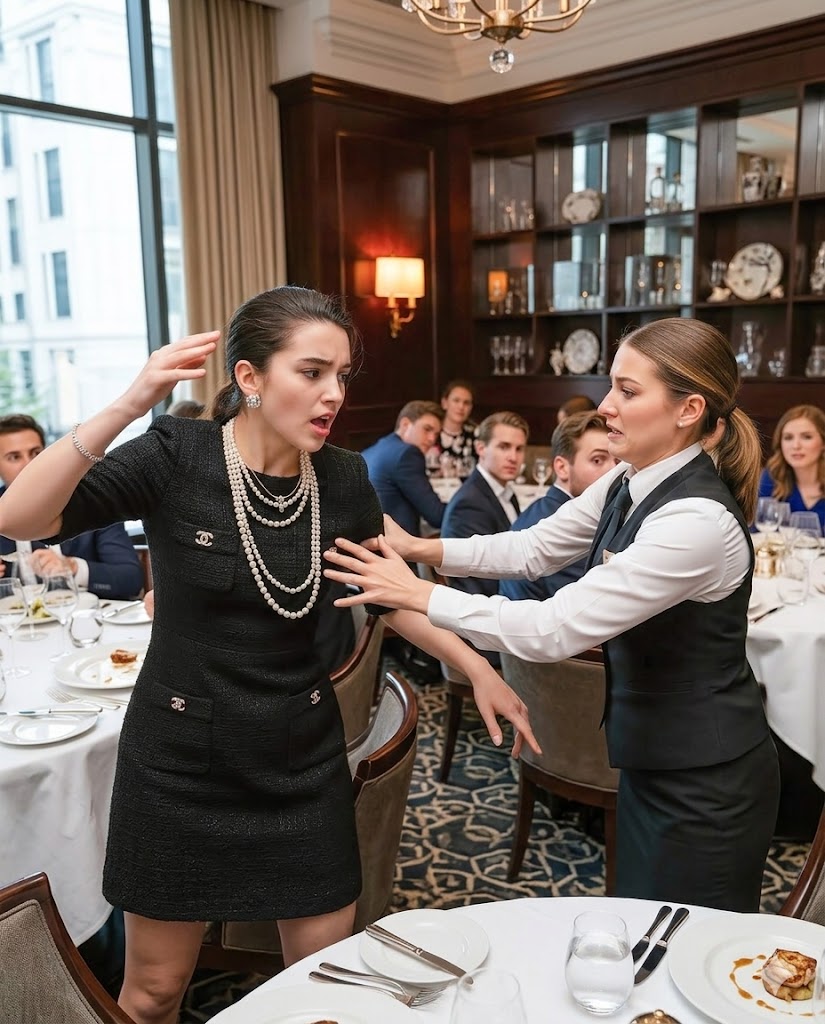
The bodyguards looked at each other, stunned. Jessica stood up, towering in her heels, and hurled the bread basket at Sarah. The basket struck Sarah in the shoulder; a roll bounced off her cheek.
The restaurant gasped. It was assault. Sarah didn’t flinch. She didn’t wipe the crumbs away. She just stared at Jessica. “Pick it up,” Sarah said.
Part 3: The Unbreakable Waitress
“What?” Jessica breathed, her chest heaving. “Pick it up.”
Sarah’s voice dropped an octave, carrying a weight of authority that felt ancient. It wasn’t a request.
Jessica laughed, though her voice wavered. “You’re insane. I’m a Sterling. People like you pick things up for people like me.”
“Not tonight,” Sarah said, taking a step closer, violating every service industry rule. She entered Jessica’s personal space with a steady, predatory grace. “You threw it, you pick it up, and then you are going to apologize to Henry.”
“I will destroy you,” Jessica shrieked. She grabbed her phone to call her father. “I’m going to buy this building and turn it into a parking lot just to fire you!”
“Go ahead,” Sarah said. She reached into her apron, pulled out her own cheap, cracked smartphone, and tossed it onto the table. “Use mine. It has better reception in here.”
Jessica froze. The lack of fear was baffling her. Bullies operate on the currency of fear, and when the bank runs dry, they panic. “Who do you think you are?”
“I’m the person telling you the truth,” Sarah said. “And the truth is, you’re not angry. You’re bored, you’re lonely, and you’re acting like a toddler because it’s the only way you know how to get attention.”
“Shut up!” Jessica raised her hand to slap Sarah. Davis, the bodyguard, lunged forward, but Sarah caught Jessica’s wrist in mid-air.
The silence in the restaurant was absolute. Sarah didn’t squeeze or hurt her; she just held the wrist firm, grounding it.
“Don’t,” Sarah said. Her eyes were profoundly, hauntingly sad. “I know you think hitting me will make you feel better. It won’t. I’ve been hit by people much stronger than you, Jessica. It never fixed their problems, and it won’t fix yours.”
Sarah released her gently. “My name is Sarah. I’m a waitress. I make twelve dollars an hour. I have rent due in three days that I don’t have. My life is hard. Real hard. But I wouldn’t trade places with you for all the money in your father’s bank account.”
Jessica stared at her, her hand trembling. “Why?” she whispered.
“Because I know who I am,” Sarah replied. “You’re just a reflection of your father’s money. You don’t even know what you like to eat, do you? You just order what’s expensive and send it back to feel something.”
Sarah crouched and picked up the bread rolls, one by one. “I’m picking this up because I respect the cleaning crew, not because I fear you. Now, I’m going to get you a burger. A greasy, cheap cheeseburger with fries. Because I bet that’s what you actually want.”
She walked toward the kitchen, leaving Jessica standing there, stunned. When Sarah entered the kitchen, she looked at Chef Marco, a man with three Michelin stars and a temper shorter than a fuse.
“A cheeseburger,” Sarah said. “Medium-well. American cheese. Brioche bun.”
“We don’t serve burgers!” Marco spat.
“She’s going to come back here and throw your copper pots at you if you don’t,” Sarah said calmly.
Marco cursed in Italian but grabbed a slab of Wagyu beef. “American cheese on Wagyu,” he grumbled. “It is a sin.”
When Sarah returned, Jessica ate the burger with a ferocity that was heartbreaking. She didn’t look like an heiress; she looked like a starving, lonely girl. She didn’t demand the manager afterward. She paid with a titanium card and left a massive wad of cash.
But as she walked out, a man at Table 7 was watching. He had recorded the entire interaction.
Part 4: The Convoy
By the time Sarah clocked out at 11 p.m., the video had two hundred thousand views. By the next morning, it had four million.
The storm arrived at 10 a.m. the next day. It didn’t come with rain; it came with a convoy of three black Cadillac Escalades that screeched to a halt in front of the Obsidian. The restaurant wasn’t even open yet. Mr. Henderson, the general manager, stood on the sidewalk, his hands shaking so hard he nearly dropped his phone as he watched the center door of the lead SUV open.
Arthur Sterling stepped out.
He was fifty-five, but he looked like he was carved out of granite. He wore a bespoke suit that cost more than a small home. He didn’t walk; he marched, his cold blue eyes scanning the restaurant with the detached precision of a predator. He didn’t care about the food or the reputation of the Obsidian. He cared about one thing: the Sterling brand. And a video of a “common waitress” manhandling his daughter made the Sterling brand look weak.
“Mr. Sterling!” Henderson scrambled forward, bowing. “What an honor! We—we didn’t expect—”
“Where is she?” Arthur’s voice was like grinding stones.
“Who, sir?”
“The waitress. The one who touched my daughter. The one who humiliated my family on the internet.”
“Sarah? She—she’s not scheduled until four, sir. But I assure you, I am drafting her termination letter as we speak!”
Arthur held up a hand, silencing him instantly. “Get her here. Now.”
“But sir, I don’t know if she—”
Arthur stepped closer, his shadow falling over Henderson. “I own the building this restaurant is in. I own the bank that holds your mortgage. If that woman is not standing in front of me in thirty minutes, the Obsidian will be a Spirit Halloween store by next week. Do you understand?”
Henderson didn’t argue. He made the call.
Sarah was in her small studio apartment in Queens, drinking black coffee and watching the rain, when the call came. She had seen the video. She knew exactly who was waiting for her. She didn’t put on her uniform. She wore jeans, boots, and a gray sweater. She wasn’t going to work; she was going to settle a debt.
When she walked into the restaurant, the air was suffocating. The staff had been cleared out. Arthur was sitting at the table where Jessica had sat the night before, reading a manila folder.
“You’re late,” Arthur said, not looking up.
“I took the train,” Sarah said. She walked to the table and stood there, weight distributed evenly, hands loose. “Mr. Henderson said you wanted to see me.”
Arthur closed the folder. He looked at her, his eyes narrowing. He was used to people cowering. He was used to tears. Instead, he saw a woman standing like a soldier.
“Do you know what you did?” Arthur asked softly.
“I served your daughter a burger and stopped her from crying.”
Arthur slammed his hand on the table. “You assaulted her! You humiliated her in public! And then you fed her garbage.”
“I stopped her from throwing a bread basket at a sommelier,” Sarah corrected. “And I fed her because she was starving—not for food, Mr. Sterling. For attention. She’s a lonely kid acting out because her father is too busy buying shipping routes to have dinner with her.”
The silence that followed was deafening. Arthur slowly stood up. He towered over her. “You think you know my family? You are a waitress. You carry plates. You are nothing.”
He tossed the manila folder toward her. “I had my team run a background check on you. High school dropout, no college, drifting from city to city, no history.” He circled her like a shark. “You’re a ghost. A loser. And you made the mistake of touching a Sterling. I’m going to bury you in so much legal debt you’ll be in prison by Christmas.”
He leaned down to whisper in her ear. “Beg me for mercy, and maybe I’ll let you leave town.”
Sarah looked at the folder, then at Arthur. A small, sad smile played on her lips. “You didn’t look deep enough, Arthur.”
Part 5: The Prague Secret
Arthur frowned. “What?”
“The background check is a standard civilian sweep,” Sarah said, her voice dropping to that same low, commanding tone she had used on Jessica. “It only goes back to public records. You didn’t check the redacted files.”
Arthur stepped back, genuinely confused. “What are you talking about?”
Sarah reached into her pocket. The security guards lunged forward, hands on their holsters, but Arthur held up a hand. Sarah didn’t pull out a weapon. She pulled out a cheap plastic lighter. She flicked it on, watching the flame dance.
“My name isn’t Sarah Miller,” she said. “And I didn’t drop out of high school. I was recruited out of MIT when I was nineteen.”
Arthur stared at her. “Recruited by who?”
“You know who,” she said. “Because ten years ago, in a warehouse in Prague, you paid a team of mercenaries three million dollars to extract a defector named Kroo. A man who knew too much about your shipping lanes.”
Arthur’s face went white. He staggered back, gripping the back of a chair. “That… that is impossible. No one knows about Prague. That file was burned.”
“I didn’t just read the file, Arthur,” Sarah said, snapping the lighter shut. “I was the one who breached the warehouse. I was the one who got Kroo out.”
She took a step toward the billionaire. And for the first time in twenty years, Arthur Sterling looked terrified.
“I’ve been hiding for a long time,” Sarah said. “Trying to live a quiet life, trying to forget what people like you make people like me do. But if you want to go to war over a cheeseburger… if you want to dig into my past… be careful, Arthur. You might not like what comes out of the dark.”
The security guards looked between the two, utterly lost. They were trained for threats, but they didn’t know how to fight a ghost.
Arthur slowly sank into his chair. He looked older, the granite facade finally cracking. “Everyone out,” he croaked.
“Sir?” the lead guard asked.
“I said get out! Wait in the cars, all of you, now!”
The guards retreated, and the heavy doors clicked shut.
“Sarah Miller,” Arthur muttered. “That’s the alias they gave you after the Vienna Accords fell apart. I thought you were dead. The report said the whole unit was burned.”
“The report was written to protect you, Arthur,” Sarah said, pulling out a chair and sitting opposite him. “If the world knew that Sterling Logistics was moving illegal arms through the Czech Republic to secure mining rights, you wouldn’t be sitting here. You’d be in a federal supermax.”
Arthur flinched. “I did what I had to do for the company. For my legacy.”
“And look at your legacy,” Sarah gestured to the empty seat where Jessica had sat. “She’s nineteen. She treats people like garbage because she thinks that’s what strength looks like. She learned that from you.”
Arthur looked down at his hands. “I gave her everything. The best schools, the best clothes, unlimited credit.”
“You gave her things,” Sarah corrected. “You didn’t give her a father. You gave her fear. You showed her that money solves problems and that people are disposable. Last night, I didn’t see a monster. I saw a kid begging for boundaries. She threw that bread basket because she wanted someone to tell her ‘no’—because you never do.”
Arthur looked up, his eyes wet. “She hates me.”
“She doesn’t hate you,” Sarah said softly. “She’s testing you. She’s trying to see if you care enough to stop her. And every time you send a lawyer or a fixer to clean up her mess, you prove to her that she’s just a business expense to you.”
“What do you want?” Arthur asked, his voice breaking. “Money? I can wire you ten million right now. Just keep the Prague file buried.”
Sarah laughed, a dry, humorless sound. “I don’t want your blood money, Arthur. I have enough money buried in offshore accounts to buy this whole block. I work here because I need the noise. I need the simplicity. I serve burgers so I don’t have to think about the people I killed for men like you.”
Part 6: The Reset
“Here is the deal,” Sarah said. “This is the price of my silence.”
Arthur braced himself.
“You are going to take Jessica to dinner,” Sarah said.
Arthur blinked. “What?”
“Tonight. Not at the Obsidian. Not at some gala. You’re going to take her to a diner in Jersey or a pizza place in Brooklyn. Somewhere nobody knows your name. You’re going to leave the bodyguards in the car. You’re going to leave your phone in the car. And you are going to talk to her. You’re going to tell her about your childhood. You’re going to ask her what music she likes. You are going to be a dad.”
“That’s… that’s it?” Arthur asked, bewildered.
“No,” Sarah said. “And you’re going to cut her off.”
“Cut her off?”
“The credit cards, the private jets, the staff. It’s poison, Arthur. It’s killing her. Tell her she has to finish college or get a job. Tell her you love her too much to watch her turn into a monster. She will scream. She will cry. She will hate you for six months. But in five years, she might actually respect you.”
Arthur stared at Sarah. He looked terrified. The idea of emotional vulnerability was scarier to him than an indictment. “I don’t know if I can,” he whispered.
“You built a global shipping empire,” Sarah said, standing up. “I think you can eat a slice of pizza with your daughter. If you don’t… well, I still have the contact info for the Hague. It’s your choice.”
Arthur stood up. He buttoned his jacket. He looked at the waitress—the woman who had been a ghost, a weapon, and now a savior. He extended his hand. “Thank you, Sarah.”
Sarah didn’t shake it. She just nodded. “Go be a father, Arthur, before it’s too late.”
Arthur turned to leave. As he reached the door, it opened. Jessica was standing there. She had been standing just outside the glass vestibule. She had heard the yelling. She had seen her father sitting with his head in his hands.
“Dad?” she asked, her voice small.
Arthur looked at his daughter. He saw the fear behind the heavy makeup. “Jessica,” Arthur said, his voice trembling. “Get in the car. We’re going to get pizza.”
“Pizza?” Jessica frowned. “But I have a fitting for Fashion Week.”
“Cancel it,” Arthur said. “We have a lot to talk about.”
Jessica looked at Sarah. Sarah gave her a small, imperceptible wink.
Jessica didn’t argue. She walked out with her father. For the first time ever, they walked side by side, not in a phalanx of security.
The drive to Brooklyn was quiet. The three Escalades had been dismissed, much to the horror of the head of security. Arthur drove his vintage Porsche 911, an engine sound that seemed too loud in the silence.
They ended up at Sal’s, a hole-in-the-wall joint in Williamsburg that smelled of oregano, yeast, and old wood. It was the kind of place Arthur had gone to when he was twenty-two, before the billions, before the logistics empire, before he forgot how to be a human.
They sat in a red vinyl booth. “This is gross,” Jessica muttered, wiping the table. “The table is sticky.”
“It’s character,” Arthur said, his voice stiff. He looked at the menu. “Pepperoni? Or do you still like… what was it? Hawaiian?”
“I haven’t liked Hawaiian since I was seven, Dad. I’m nineteen.”
“Right,” Arthur said. He swallowed hard. “Right. Pepperoni.”
When the waitress brought the drinks, Arthur stared at the paper straw. “Jessica,” he started, his hands clasping together. “We need to talk about Sarah.”
“She’s crazy,” Jessica snapped, though there was no heat in it. “She grabbed me. She should be in jail.”
“She was right,” Arthur said.
Jessica froze. Her father never admitted anyone else was right.
“I have failed you,” Arthur continued, looking her in the eye. “I thought if I gave you everything I never had, you’d be happy. But I just made you miserable. I turned you into someone who throws bread at people.”
“I was angry,” Jessica defended herself.
“You’re spoiled,” Arthur said, his voice heavy with sadness. “And it’s my fault. But that ends tonight.”
Part 7: The Ghost Moves On
The next morning, at the Obsidian, the staff prepared for the lunch rush with a sense of impending doom. They expected police, lawsuits, or the restaurant to be bulldozed. Instead, at 10 a.m., a courier arrived with a package.
Inside was a typed letter on heavy Sterling Logistics stationery, along with a check for fifty thousand dollars to cover the “disturbance” and a bonus for every staff member who had worked that shift—especially Timothy and Henry.
Furthermore, Arthur wrote: I am withdrawing any complaints regarding the employee known as Sarah. She is to be considered resigned in good standing.
Henderson stared at the check. He nearly fainted. The staff cheered, but Henry, the sommelier, asked the question that mattered: “Where is Sarah?”
They went to the locker room. Locker 14 was open. It was empty. Her apron was folded, her name tag placed neatly on top. There was no note, no forwarding address.
Julian, the maitre d’, called the number on her file. “This number is no longer in service.”
She was a ghost, the landlord said. She never got mail, never had visitors, just gone.
The legend of Sarah began to grow in New York, but the reality was playing out in the Bronx. Jessica was living in a fourth-floor walk-up with a radiator that clanked like a dying engine. The first month was a disaster; she blew through the five thousand dollars her father had given her, but when the money ran out, she didn’t call him for more. She got a job at a chain bookstore. She stocked shelves. She rode the subway. She learned what a sandwich tasted like when you paid for it with your own sweat.
It took three months for the anger to fade, replaced by a strange, quiet contentment.
One Tuesday, six months later, Jessica was shelving books when a photo in a Cold War history book caught her eye. It was a grainy photo of a summit in Prague. In the background stood a woman. The hair was shorter, the uniform military, but the eyes were unmistakable. It was Sarah.
Jessica bought the book. That night, she called her father. “Dad? I got my first paycheck today. I wanted to know if you wanted to get pizza. My treat.”
There was a long silence, then a sound Jessica had never heard: her father was crying. “I would love that, honey.”
The reunion at the Obsidian happened a week later. Jessica didn’t come to eat; she came to close the circle. She walked into the restaurant wearing jeans and a simple sweater. When she asked Julian about Sarah and he told her she was gone, the disappointment was physical. She handed Julian an envelope. “If she ever comes back, please… I will keep it safe.”
“Where are you going?” Julian asked.
“I don’t know,” Jessica said, looking out the window. “She saved my life. I was drowning because I was rich. She was the only one who cared enough to pull me out.”
Two thousand miles away, in a small diner off a dusty highway in New Mexico, a woman was wiping down a counter. Her name tag said Betty. She had dark hair and moved with a terrifying efficiency.
On the TV in the corner, a segment played about the “New Face of Sterling Logistics.” Jessica was speaking at a community center. “My father and I learned recently that true value isn’t in what you keep, but in what you serve.”
The woman named Betty stopped wiping the counter and watched the screen. A small smile touched her lips.
“You know them?” the trucker at the counter asked.
“No,” she said, turning off the TV. “Just some rich folks.”
She looked out the window at the vast, empty desert. The file on Arthur Sterling was buried deep in an encrypted server. The name Sarah Miller was dead. But the work—the work of fixing the broken things that nobody else could see—that never ended.
She was a ghost. She was a waitress. She was the karma that walked through the door when you least expected it. And she was ready for the next shift.