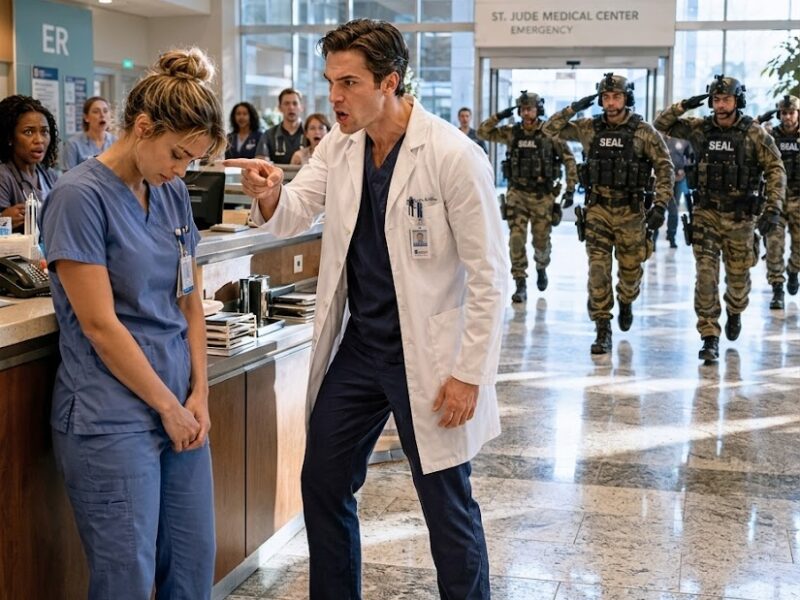
No One Knew the Rookie Nurse Was a Black Ops Veteran — Until Her Old Unit Came to Thank Her
Part 1: The Mouse in the Meat Grinder
The screaming of a chaotic emergency room is nothing compared to the roar of incoming artillery. When trauma alarms shriek, civilian nurses brace for panic. Fiona Hastings simply checks her pulse. Mocked as a timid rookie, nobody realizes her gentle hands once stitched up elite operators under heavy enemy fire. St. Jude Medical Center in downtown Chicago was a meat grinder on Friday nights. The emergency room smelled perpetually of bleach, stale coffee, and the metallic tang of copper. It was an environment that broke seasoned medical professionals, chewing them up and spitting them out with frayed nerves and hollow eyes. To Fiona Hastings, it was a vacation.
At thirty-two, Fiona was the oldest rookie nurse on the floor. She kept her dirty blonde hair pulled back in a severe, joyless bun. Her scrubs were always one size too large, hiding the athletic, coiled-spring tension of her shoulders and the jagged white shrapnel scars that snaked up her left rib cage. To the rest of the staff, she was a mouse. She rarely spoke above a whisper, never argued, and always took the worst shifts without a single complaint.
“Hastings, are you deaf or just incompetent?”
Dr. Harrison Miller’s voice echoed across the nurse’s station, cutting through the din of beeping monitors and groaning patients. He was a second-year attending physician with an Ivy League pedigree, a god complex, and a profound lack of patience. He slammed a metal clipboard onto the counter, right over Fiona’s charting notes.
“I asked for a 12-lead EKG and a chem panel on Bed 4 ten minutes ago,” Miller barked, running a hand through his perfectly styled hair. “If you can’t handle the pace of a real trauma center, Hastings, I suggest you transfer to a suburban dermatology clinic. People actually die here.”
Fiona didn’t flinch. She simply looked down, her face a mask of practiced submission. “I apologize, Dr. Miller. The EKG is already done and uploaded to his chart. The phlebotomist is drawing his blood now. I prioritized it because his radial pulse felt weak and thready upon admission.”
Miller blinked, his ego momentarily derailed by her efficiency. He scowled, refusing to give her an inch. “Just stay out of my way,” he muttered, spinning on his heel to bark at a resident.
Brenda Walsh, the veteran charge nurse with thirty years of ER experience, walked up and bumped her hip against Fiona’s. “You let him walk all over you, honey. You’ve got to bear your teeth around here, or the Millers of the world will eat you alive.”
“It’s fine, Brenda,” Fiona said softly, her eyes darting instinctively to the main sliding doors. She noted two men in heavy coats entering—too heavy for a mild October evening. She scanned their waistlines. No unnatural bulges, no printing of weapons; just two drunk college students. She relaxed her shoulders. “I don’t mind the yelling.”
And she didn’t. Dr. Miller’s yelling was nothing compared to the screaming of incoming mortar fire in the Korengal Valley. His insults lacked the genuine, soul-crushing terror of an al-Qaeda interrogator.
Fiona Hastings wasn’t a timid nursing school graduate. Four years ago, she was Operator Wraith, a Tier 1 combat medic and signals intelligence specialist attached to a highly classified Joint Special Operations Command unit known informally as Task Force Orange. She had patched up Delta Force operators under heavy machine-gun fire in Mosul. She had performed emergency field tracheotomies in the pitch black of the Helmand province using nothing but night vision goggles and muscle memory. She had spent a decade operating in the shadows, ghosting in and out of hostile nations until a catastrophic IED blast in Syria wiped out half of a Ranger chalk she was attached to.
Fiona had survived, dragged three men out of a burning Stryker vehicle despite having a punctured lung, and was quietly awarded a Navy Cross that she could never wear in public. When she was honorably and medically discharged, the Department of Defense scrubbed her file. As far as the civilian world was concerned, Fiona Hastings spent her twenties working as an administrative assistant for a logistics firm in Virginia. Nursing was supposed to be her quiet retirement, a way to still save lives, but in a clean, brightly lit room where nobody was actively trying to kill her. She deliberately played the role of the slow, timid rookie. It kept her invisible. It kept her safe from the memories.
“Hey, Hastings,” Tyler, a twenty-three-year-old fellow rookie nurse, jogged past her carrying a stack of IV bags. “We’ve got a belligerent drunk in Bay 6. He’s throwing things. Security is five minutes out. Don’t go in there.”
Fiona nodded. But as Tyler walked away, she heard a crash and a sharp yelp from Bay 6. Maya, a young female orderly, was in trouble. Moving with a sudden, fluid grace that betrayed her frumpy scrubs, Fiona slipped into Bay 6.
A massive man, easily pushing 250 pounds, was cornering Maya, his fist raised, spit flying from his lips. “I said, get me out of these damn restraints!” he roared.
Before the man could swing, Fiona stepped into his peripheral vision. She didn’t shout or posture. She simply reached out with her right hand, her thumb and middle finger finding the precise cluster of nerve endings behind his clavicle and the brachial plexus. She applied exactly thirty pounds of targeted pressure. The man’s eyes rolled back. His knees buckled instantly as his central nervous system received a massive, agonizing reset signal.
Fiona caught him by the collar, easing his massive frame onto the Stryker gurney as gently as a mother putting a child to bed. Maya stood trembling in the corner, staring in absolute shock. “What? What did you do?”
Fiona immediately dropped her posture, hunching her shoulders back into the timid rookie persona. She let out a breathy, nervous laugh. “Oh my goodness. I think he just passed out. He must have stood up too fast and had a vasovagal syncope. Can you help me get his legs up?”
Maya nodded slowly, still staring at Fiona’s hands. “Yeah, right. Passed out.”
Fiona went back to the nurse’s station, quietly picking up a stack of fresh charts. She was perfectly content being the invisible gray woman of St. Jude Medical. But the universe, it seemed, had other plans. The shift from chaotic to catastrophic happened at exactly 2:14 a.m.
The trauma radio on the wall crackled to life with a frantic screech. “St. Jude ER, this is Chicago Fire Rescue Unit 44. We are declaring a mass casualty incident. Multi-vehicle collision on the I-90 bridge, compounded by an active shooter situation at the scene. We have multiple criticals inbound. ETA three minutes. I repeat, brace for mass casualties.”
The ER froze for a split second before erupting. Brenda hit the overhead alarm. The flashing red lights of a Code Black bathed the hallways in a sinister, rhythmic glow.
“Clear the bays!” Dr. Miller shouted, his voice cracking slightly as the reality of the situation hit him. “Move all non-criticals to the waiting room. I need crash carts and Bays 1 through 4 now.”
Fiona felt a familiar, icy calm wash over her. The adrenaline hit her bloodstream not as a chaotic panic, but as a sharply focused drug. Her heart rate actually slowed down. The civilian hospital vanished, replaced by the muscle memory of the battlefield triage protocols she had written for the Pentagon. The double doors of the ambulance bay exploded open. Paramedics rushed in, pushing gurneys slick with blood. The noise was deafening—screams, the screeching of wheels, the rapid-fire shouting of EMTs.
“Male, mid-30s, multiple gunshot wounds to the chest and abdomen. GCS is eight, BP is 70 over palps, dropping fast,” a paramedic yelled, shoving a gurney into Trauma Bay 1.
Dr. Miller rushed to the bedside, snapping on gloves. “Transfer on three. One, two, three.” They moved the patient onto the hospital bed. The man’s chest was a mess of torn flesh and arterial blood. He was gasping for air, his lips turning a terrifying shade of cyanotic blue.
“He’s got a tension pneumothorax,” Miller said, his hands visibly shaking as he stared at the expanding chest cavity. “We need a chest tube. Hastings, get me a chest tube tray!”
Fiona stood on the opposite side of the bed. She looked at the patient’s neck. The jugular veins were severely distended and his trachea was visibly deviating to the left. He didn’t have minutes for a surgical chest tube setup. He had seconds.
“Dr. Miller, we need to decompress him right now! He’s going into cardiac arrest!” Fiona said. Her voice was no longer a whisper. It was an unnervingly calm, commanding baritone that belonged to a combat veteran, not a timid nurse.
“I said, get me the tray!” Miller screamed, panic setting in as the heart monitor began to wail in an erratic rhythm. He grabbed a scalpel, his hand trembling so violently he nearly dropped it. He was freezing. The Ivy League doctor was completely overwhelmed by the sheer, brutal violence of the trauma.
Fiona didn’t hesitate. The rookie persona evaporated. She shoved Dr. Miller’s arm out of the way with enough force to send him stumbling back against the counter.
“Hey, what the hell are you doing?” Miller shouted, furious and bewildered.
Fiona ignored him. From the deep pocket of her oversized scrubs, she pulled out a 14-gauge, 3.25-inch needle, standard issue for a J-SOC medic. She didn’t bother with a sterile drape. She found the second intercostal space on the right mid-clavicular line with her bare fingers, and in one swift, brutal, and perfectly calculated motion, she plunged the needle deep into the man’s chest cavity.
There was a loud, audible hiss as trapped air rushed out of the pleural space. The patient immediately took a deep, ragged breath. His heart rate on the monitor stabilized instantly.
The room went dead silent, save for the rhythmic beeping of the machines.
“BP is coming up,” Fiona stated mechanically, not looking at them. “But he’s bleeding out from a severed femoral artery. The field dressing failed.”
Before anyone could speak, Fiona grabbed a pair of trauma shears, cut the man’s blood-soaked jeans away, and exposed the massive leg wound. Dark arterial blood was pulsing rapidly. She didn’t reach for the hospital-grade clamps. She reached into her other pocket, retrieving a black, military-issue CAT Combat Application Tourniquet. She whipped it around the man’s thigh, routed the band, and twisted the windlass rod with terrifying mechanical strength until the bleeding stopped completely. She locked it in place and noted the time on the strap with a Sharpie she produced from thin air.
“Airway is secure. Bleeding controlled. He needs an OR right now. Page General Surgery.” Fiona ordered, looking up.
Dr. Miller was pale. “Who? What did you just do?”
“I kept him alive, Doctor,” Fiona said, her eyes dead and cold. “Do you want to do your job now, or should I wheel him up to surgery myself?”
Before Miller could formulate a response to his rookie nurse’s insubordination, a loud commotion erupted at the main entrance of the ER. It wasn’t the police. It wasn’t more paramedics. The electronic sliding doors jammed, and a heavy-booted foot kicked them off their tracks with a violent crash. Five men strode into the brightly lit ER. They looked entirely out of place among the scrubs and lab coats. They were wearing faded denim, rugged Merrell hiking boots, and lightweight Arc’teryx tactical jackets. Despite their civilian clothing, the way they moved—covering each other’s blind spots, scanning the room with predatory, hyper-vigilant eyes—screamed Tier 1 military operators. They carried heavy black tactical duffel bags.
The hospital security guard, an older man named Frank, stepped forward, his hand resting nervously on his taser. “Hey, you can’t come in here. We’re on a Code Black.”
The leader of the group didn’t even break stride. He was a tall, heavily muscled man with a thick beard and a brutal, jagged scar cutting through his left eyebrow. He moved past the guard like he wasn’t even there.
“Back off, friend,” muttered the man behind him, a massive, barrel-chested guy wearing a faded Chicago Bears cap. “We aren’t here for medical attention.”
The leader stepped into the center of the chaotic ER, his steel-gray eyes cutting through the panicked medical staff. He ignored the blood on the floor. He ignored Dr. Miller. His eyes locked onto the trauma bay. They locked onto the blonde nurse with the oversized scrubs whose hands were still covered in blood. A slow, fierce grin spread across the bearded man’s face.
“Captain Rollins,” Fiona whispered, her tough exterior shattering for the first time as she stared at the men she hadn’t seen in four years.
Captain Eric Rollins came to a halt. Behind him, Sergeant First Class Jackson “Brick” Hayes and Medic Wyatt Cole stood at attention. Slowly, deliberately, amidst the chaos of a civilian hospital emergency, the five deadliest men on the planet snapped a crisp, perfectly synchronized military salute to the rookie nurse.
“We heard the unit’s best ghost was hiding out in Chicago,” Captain Rollins said, his voice carrying over the din of the machines. “Figured it was about time we came to say thank you, Wraith.”
Part 2: The Ghost of Wraith
The silence in Trauma Bay 1 was so profound, you could hear the hum of the fluorescent lights. Dr. Harrison Miller stared at the five heavily armed men, his mouth opening and closing like a landed fish. Brenda, the veteran charge nurse, had her hands pressed over her mouth, her eyes darting between the formidable soldiers and the quiet, frumpy rookie who always took the Tuesday night graveyard shifts.
Fiona’s hands, still slick with Arthur Pendleton’s blood, dropped to her sides. The timid, nervous hunch of her shoulders vanished entirely. When she stood up straight, she seemed to grow two inches, her spine aligning into the rigid posture of a Tier 1 operator.
“Put your hands down, Cap,” Fiona said, her voice stripped of its gentle nursing cadence. It was a voice used to cutting through the deafening roar of Blackhawk rotors. “You’re in a sterile field, and you’re compromising my cover.”
Captain Rollins dropped the salute, a grim smile playing on his lips. “Cover is already blown, Wraith. We didn’t come all the way from Fort Bragg just to bring you a fruit basket.”
“What is the meaning of this?” Dr. Miller finally found his voice, stepping forward with his chest puffed out, trying to reclaim his kingdom. “This is a secured medical facility! You cannot just storm in here dressed like… like mercenaries! I am calling St. Jude security and the Chicago Police Department immediately.”
Jackson “Brick” Hayes stepped directly into Miller’s personal space. The sheer mass of the operator eclipsed the Ivy League doctor. “I wouldn’t do that, Doc,” Brick rumbled, his voice like grinding granite. “Jude security is currently taking a nap in the broom closet. And the local PD is busy dealing with the decoy bombs on the I-90 bridge.”
Fiona’s blood ran cold. She looked down at the patient she had just saved. “Decoy bombs? Rollins? What the hell is going on? The scanner said this was a mass casualty accident.”
“It was a coordinated ambush,” Rollins said, unzipping his Arc’teryx jacket to reveal a modular plate carrier and a compact Sig MCX Rattler rifle strapped to his chest. The other men began pulling identical weapon systems from their duffel bags, tossing loaded magazines to each other with practiced ease. “Your patient isn’t just a random commuter, Fiona. That’s Arthur Pendleton. He’s a former DARPA engineer who just blew the whistle on a multi-billion-dollar defense contract fraud involving a real private military firm, Constellis International. He was supposed to testify before a congressional committee tomorrow morning.”
Fiona looked at Pendleton’s pale face.
“The crash was a hit,” Rollins confirmed, pulling a topographical blueprint of the hospital from his pocket and spreading it over a vacant steel counter. “A kill squad from a rogue Constellis splinter cell ran his motorcade off the bridge. They didn’t finish the job because the first responders arrived too fast. We intercepted their radio chatter. They know Pendleton is here, and they are coming to finish the job.”
Miller let out a high-pitched, hysterical laugh. “Hit squads? Rogue military contractors? This is a hospital, not a war zone! I demand you leave!”
Fiona moved so fast that Miller didn’t even see her pivot. She grabbed the doctor by the lapels of his pristine white coat and slammed him against the glass door of the trauma bay. The impact rattled the hinges.
“Listen to me very carefully, Harrison,” Fiona whispered, her face inches from his, her eyes burning with an intensity that made the doctor’s blood freeze. “In about sixty seconds, highly trained men with automatic weapons are going to walk through those doors to execute this patient, and they will slaughter every single doctor, nurse, and civilian in this ER who gets in their way. You are no longer the senior attending. I am the commanding officer of this floor. Do you understand me?”
Miller, terrified by the apex predator that had just shed her mouse disguise, could only nod rapidly.
“Good.” Fiona released him. “Brenda, the charge nurse jumped. Yes, Fiona. Initiate Code Silver. Active shooter protocol. Lock down the elevators, cut the main hallway fire doors, and get every patient out of the waiting room and into the interior radiological imaging suites. The lead-lined walls will stop 5.56 caliber rounds. Go now.”
Brenda didn’t hesitate. She ran for the PA system. Fiona turned to her old unit. “Status on the perimeter.”
“Wyatt secured the loading dock. Brick has the ambulance bay,” Rollins said, handing Fiona a spare Kevlar vest and a sleek, matte-black Glock 19. “But they cut the hard lines. Cell service is jammed. We have no comms with local law enforcement, and we’re blind on the security cameras. It’s just us, Wraith.”
Fiona strapped the Kevlar over her oversized scrubs. She racked the slide of the Glock, checking the chamber with muscle memory that felt like coming home. She looked around the chaotic, brightly lit emergency room. It wasn’t the deserts of Syria, but a battlefield was a battlefield.
“They have to come through the main lobby or the south stairwell,” Fiona calculated, her eyes tracing the choke points. “They’ll be wearing night vision. They’ll cut the power before they breach to disorient the civilian staff.”
Right on cue, the lights above them violently flickered and died. The ER was plunged into absolute, suffocating darkness, save for the eerie glowing red “EXIT” signs and the faint, battery-powered green screens of the heart monitors. Screams began to echo from the hallways.
“Night vision on,” Rollins commanded. The four operators flipped down the four-tube panoramic NVGs mounted to their bump helmets, their eyes becoming glowing green insectoid lenses in the dark.
“I don’t have nods,” Fiona said, gripping her weapon. “But I don’t need them. I know every inch of this floor.”
“Here they come,” Wyatt called out from the hallway. “South stairwell door just breached. I’ve got multiple footfalls, heavy gear.”
“Let’s welcome them to Chicago,” Fiona said.
The heavy, reinforced fire doors of the south wing blew open with a deafening crack of breaching charges. Smoke billowed into the dark emergency room corridors. Through the haze, six figures dressed in tactical black advanced in a perfect diamond formation. They moved with silent, lethal precision, their rifles raised, infrared lasers cutting through the smoke. These weren’t street thugs. They were highly paid professionals here to do a surgical job and leave no witnesses.
From the shadows behind the nurse’s station, Fiona waited. She didn’t have heavy armor or a rifle, but she had the deadliest weapon of all: home-field advantage. The point man of the hit squad swept his rifle toward Trauma Bay 1, tracking the beep of Arthur Pendleton’s heart monitor. As he stepped past the crash cart, Fiona struck.
She didn’t use her gun. She grabbed a massive, steel D-cylinder oxygen tank. With a vicious horizontal swing, she brought the tank crashing down onto the point man’s helmet. The sheer weight of the steel shattered his night vision goggles and crumpled his skull with a sickening crunch. The operator dropped like a stone.
“Contact left!” the second man yelled, pivoting his rifle toward Fiona. Before he could pull the trigger, two suppressed bursts of gunfire echoed from the ceiling. Rollins, positioned atop the ceiling grid above the radiology bay, dropped the shooter with two rounds to the chest armor and one to the face.
The hallway erupted into absolute chaos. The remaining four contractors opened fire, their unsuppressed weapons turning the hospital corridor into a deafening echo chamber of violence. Drywall exploded. Glass shattered into a million diamonds. Medical equipment sparked and caught fire.
Fiona dove behind the reinforced concrete pillar of the triage desk just as a volley of rounds chewed through the wood where she had been standing. She blindly reached up, grabbing a defibrillator unit from the counter. She ripped the paddles from their holsters, cranked the dial to 360 joules, and tossed the activated machine into a puddle of IV saline that was rapidly pooling across the linoleum floor from a shattered supply closet.
“Brick, drop the hammer!” Fiona screamed over the gunfire.
Brick Hayes, hiding behind a flipped Stryker gurney, slammed his boot into the main water pipe running along the floorboard. The pipe ruptured, sending a massive wave of water flooding down the corridor, meeting the saline puddle. The two advancing contractors stepped into the water just as the defibrillator discharged into the conductive pool.
Three hundred sixty joules of raw, unadulterated electrical current surged through the water and straight into their boots. The men seized violently, their muscles locking up as the electricity scrambled their nervous systems. They collapsed backward, their rifles clattering to the floor.
Two left.
Fiona drew her Glock. She popped out from the pillar, firing three rapid shots. Her first bullet missed, shattering a computer monitor. Her second and third caught the fifth contractor in the shoulder and thigh, sending him crashing into a glass partition.
The final contractor, the squad leader, realized the ambush was failing. He abandoned the formation, sprinting wildly toward Trauma Bay 1 to finish the job on Pendleton. He kicked the door open. Standing directly in his path, completely paralyzed by fear, was Dr. Harrison Miller. The doctor had been trying to hide under the supply sink.
The contractor raised his rifle, aiming directly at Miller’s head to clear the obstacle. Miller squeezed his eyes shut, letting out a pathetic whimper.
Bang!
A single gunshot echoed through the small room. Miller didn’t feel anything. He slowly opened his eyes. The contractor stood frozen for a split second. A neat, precise hole had appeared perfectly in the center of his throat. He dropped to his knees, his hands clawing at his neck, before collapsing face-first onto the linoleum.
Fiona stood in the doorway, her Glock still raised, a wisp of smoke curling from the barrel. Her face was as cold and unreadable as carved marble. She lowered the weapon, stepping over the dead man, and checked Pendleton’s vitals on the battery-powered monitor.
“Heart rate is steady at 85,” Fiona reported mechanically, not looking at them. “Patient is secure.”
Part 3: The Aftermath
The emergency backup generators finally kicked in. The ER was flooded with harsh white light. The devastation was absolute. The pristine hospital floor looked like a war zone. Bullet holes riddled the walls. Water poured from the ceiling, and five highly trained mercenaries laid dead or incapacitated on the floor.
Rollins, Brick, and Wyatt emerged from the smoke. Their weapons lowered, but still scanning for threats.
“Clear,” Rollins called out.
“Clear,” Wyatt echoed.
Fiona cleared the chamber of her Glock, engaged the safety, and handed it back to Rollins. “Thanks for the loan, Cap.”
Rollins looked at her, his eyes softening. “You haven’t lost a step, Wraith. The DoD was stupid to let you walk away.”
“I didn’t walk away, Eric. I crawled away,” Fiona said softly, the adrenaline fading, leaving her feeling exhausted and deeply hollow. “This—this is exactly what I was trying to escape.”
“You can take the medic out of the war, Fiona. But you can’t take the war out of the medic,” Rollins said. He reached into his pocket and pulled out a small velvet box. He pressed it into her bloodstained hands. “The Pentagon couldn’t give this to you in public. But the boys and I wanted to make sure you had it. You earned it in Syria, and you earned it again tonight.”
Fiona opened the box. Resting on the black velvet was a gleaming Navy Cross.
Sirens began to wail in the distance. Dozens of them. The jamming signal had died with the contractors. The real police, SWAT, and the FBI were finally arriving.
“We need to ghost,” Brick said, checking his watch. “Feds are two minutes out. We cannot be here when they breach.”
Rollins nodded. He looked at Fiona one last time. “Take care of yourself, kid.”
With a final, crisp salute, the J-SOC team melted into the shadows of the loading dock, disappearing as quickly and silently as they had arrived. Fiona stood alone in the center of the ruined trauma bay. She quietly slipped the velvet box into her deep scrub pocket.
Slowly, Dr. Miller crawled out from beneath the sink. His pristine white coat was soaked with dirty water and blood. He was trembling violently, his god complex utterly annihilated. He looked at the dead mercenary, then up at the blonde nurse in the oversized scrubs. He realized with absolute certainty that he had spent the last six months bullying a woman who could have killed him with her bare hands in a dozen different ways.
“Hastings,” Miller choked out, his voice a pathetic whisper. “I… I don’t…”
Fiona didn’t look at him. She grabbed a clean towel, wiped the blood from her hands, and picked up a fresh clipboard.
“Dr. Miller,” Fiona said, her voice dropping back into its quiet, subservient whisper. “The police will need statements, and Bay 4 still needs that chem panel reviewed. I’ll go check on the phlebotomist.”
She walked out of the trauma bay, leaving the shattered doctor staring at her back. St. Jude Medical would never be the same. The staff would whisper the rumors forever. But one thing was absolutely certain: nobody on the floor would ever yell at the quiet rookie nurse again.
If Fiona’s unbelievable transformation from quiet rookie to elite J-SOC operator had you on the edge of your seat, smash that like button. We all know a hero hiding in plain sight. Share this incredible story with your friends to remind them that the person in the oversized scrubs might just be the one person you want in your corner when the world ends.
But as the police swarmed the hospital, Fiona realized her life as an invisible nurse was over. The media was already buzzing about the “unknown hero” who had repelled the hit squad. And worse—the private military firm, Constellis, was not known for letting their failures go unpunished.
The morning sun was rising over the Chicago skyline as Fiona exited the hospital’s rear entrance, avoiding the crush of cameras at the front. She didn’t look like a nurse anymore. She looked like a woman with a target on her back. She had spent four years building this quiet, safe life, and in four hours, it had been dismantled by the ghosts of her past.
She walked toward her beat-up sedan in the staff lot, her keys digging into her palm. She needed to leave the city. She needed to vanish again. She was halfway to her car when a black SUV, sleek and unmarked, pulled up alongside her, blocking her path. The window rolled down to reveal a man in a sharp, grey suit. He wasn’t military. He wasn’t police. He was the kind of man who dealt in secrets.
“Wraith,” he said, and the name sounded like a death sentence. “You’ve caused a significant amount of noise tonight. The Director would like a word.”
Fiona didn’t reach for a weapon. She didn’t even look scared. She just stared at him. “The Director can wait until I’ve had breakfast.”
The man smiled, but his eyes remained cold. “The Director doesn’t like to wait. And he knows about the Navy Cross in your pocket.”
Fiona’s heart skipped a beat. They hadn’t just blown her cover; they had been watching her for a long time. She realized then that the hospital hadn’t been a hiding place at all. It had been a controlled environment. She had been on a leash, and the leash had just snapped.
“What do you want?” she asked, her voice steady.
“A clean-up job,” the man said. “Arthur Pendleton isn’t just a whistleblower. He has something the agency needs, and the people who sent that hit squad are about to double down. We need you to escort him to the committee hearing tomorrow.”
“I’m done with the agency,” she said.
“That wasn’t a request, Fiona,” the man replied. “If you don’t do this, Constellis will find you. If you work for us, we provide the protection you clearly can’t manage on your own.”
It was an ultimatum. But as she stood there, looking at the black SUV, she realized the truth: the life she had wanted—the quiet life of a nurse—was gone. She was Wraith again.
“One escort,” she said. “And after that, I’m out for good.”
“That’s what they all say,” the man replied, gesturing to the door. “Get in.”
Fiona looked back at the hospital, at the place where she had felt safe for four years. She took one last look, then opened the door of the SUV. The game was back on, and this time, the stakes were far higher than the life of a single engineer.
Part 4: The Pendulum Swings
The SUV sped through the deserted streets of Chicago, the city lights a blur of neon and shadow. Fiona sat in the back, her hands folded neatly in her lap, watching the man in the suit—the one who called himself “Agent Miller”—as he tapped rhythmically on his tablet. He wasn’t the kind of man who tolerated silence, yet he didn’t try to fill it.
“We’re taking him to a safe house,” Miller said without looking back. “Pendleton has the decryption keys for the Constellis server. If he survives the night, the whole house of cards comes down.”
“If he survives,” Fiona repeated, her voice flat.
“The hit squad wasn’t just local,” Miller continued. “They were sent from a private facility in Kentucky. They don’t take kindly to failure. They’ll be at the hospital within the hour to clean up the mess left behind by their first team.”
Fiona felt the familiar, cold creeping sensation of a mission gone sideways. “You sent me into that hospital knowing they were coming.”
Miller finally looked at her, his expression unreadable. “We sent you there because we knew you were the only one who could stop them.”
“You used me as bait,” she said.
“We used you as an asset,” he corrected. “There’s a difference.”
“Not to the people in that ER,” Fiona shot back.
“They’re alive, aren’t they?” Miller turned back to his tablet. “That’s the definition of a successful mission.”
Fiona looked out the window. She had traded her safety for the lives of those nurses and doctors. She had blown her cover, revealed her identity, and now she was back on the payroll of a government that had abandoned her years ago. She had lost the only peace she had ever managed to craft for herself.
They reached the safe house—a nondescript suburban home in the northern outskirts, surrounded by a high, impenetrable fence. The interior was stripped down, filled with high-end tech and guards in tactical gear who didn’t look up as they entered.
They found Pendleton in the basement, hooked up to a portable monitor, his breathing shallow. He looked small, a man who had thought his life would be spent behind a desk and had instead been thrust into the middle of a global conflict.
“He’s been asking for you,” Miller said.
Fiona walked over to the bed. Pendleton looked up, his eyes wide with a mix of terror and awe. “You’re the one from the ER,” he whispered. “You saved me.”
“I’m the one who did her job,” Fiona said, her voice soft but firm. She checked his bandages, the makeshift tourniquet she had applied at the hospital. “How are you feeling?”
“Like I’m going to die,” he said.
“Not tonight,” she promised.
Suddenly, a series of muffled explosions rocked the house. The ceiling dust drifted down like snow.
“Contact!” a guard shouted from upstairs. “North side! Breach!”
The safe house wasn’t so safe anymore. The Constellis squad had arrived, and they hadn’t brought a small team this time. They had brought everything.
“Miller, get him to the extraction vehicle,” Fiona commanded, her voice changing instantly into the voice of the operator.
“You’re not coming?”
“I’m the distraction,” Fiona said, grabbing a spare rifle from the rack on the wall. She didn’t hesitate. She ran toward the stairs, toward the sound of gunfire, toward the one thing she knew how to do better than anyone else on the planet.
She hit the living room floor just as the front window exploded. She rolled, coming up behind a couch, and fired two precise shots at the silhouettes pouring through the frame. Two bodies dropped.
“Wraith!” Rollins’s voice crackled over her comms. “We’re two blocks out! Hold them for ninety seconds!”
“Ninety seconds,” Fiona said, her pulse drumming in her ears. “Piece of cake.”
She was no longer the nurse in the oversize scrubs. She was the ghost of the battlefield, the one who moved through the smoke and fire and left nothing but silence behind her. She moved from cover to cover, a lethal shadow, picking off the attackers one by one. She was fighting for Arthur Pendleton, for the people in the St. Jude ER, and for the life she had just lost.
But as the battle intensified, she realized there was one more person she had to protect—the girl, Sophia, who had unknowingly started all of this in Naples, and whose father was still missing.
“Rollins,” she called out. “Do you have eyes on Renzo?”
“Not yet, Wraith. But we’re looking.”
Fiona fired again, the recoil of the rifle steady against her shoulder. If she didn’t find him, this wouldn’t end tonight. It would only be the beginning.
Part 5: The Shadow of the Past
The gunfight at the safe house was a symphony of professional carnage. Every shot Fiona took was a calculated effort to preserve the life of the man she had sworn to protect, but her mind was elsewhere. It was in the basement with Pendleton, and it was in Naples, with the man who had been the first to show her that some debts are paid in blood.
“Rollins! Keep the fire on the door!” Fiona yelled, switching magazines with practiced speed.
She vaulted over the back of the sofa, firing a burst that forced the remaining attackers to retreat into the kitchen. She wasn’t just fighting for Pendleton anymore; she was fighting for the truth about what had happened to the gardener. If Constellis was involved in the kidnapping of Renzo, then this was bigger than a whistleblower. This was about a trail that led straight to the heart of the corporate-military industrial complex.
“We have an exit!” Wyatt shouted from the back. “Vehicle is idling!”
Fiona checked her ammo. She had enough for one more push. She stood up, stepped into the light of the kitchen, and unleashed everything. The remaining attackers, caught by surprise by her audacity, scrambled to cover.
“Go!” Fiona screamed at the team. “I’ll cover the retreat!”
She fired until the clip clicked empty. The room was deathly still for a second. Then, a single figure emerged from the kitchen pantry—a man wearing a tactical mask and a patch that identified him as the leader of the squad. He looked at Fiona, then at the empty hallway.
“Wraith,” the man said, his voice distorted by the mask. “We’ve been hunting you for years.”
Fiona dropped the empty rifle and drew the Glock she had kept strapped to her leg. “And here I am.”
The two of them exchanged fire, the bullets tearing through the kitchen cabinets, the refrigerator, the table where they had eaten. It was a dance she knew by heart, a choreography of death that had defined her entire adult life.
She felt a hot tear across her shoulder—a graze—but she didn’t stop. She moved with a speed that defied the physical toll of her past injuries. She was a shadow, a whisper of wind, a blade in the dark.
She fired three shots. The squad leader fell, his mask clattering on the tile floor.
Silence rushed back in.
Fiona stood in the wreckage of the kitchen, panting, the smell of gunpowder mixing with the scent of spilled cooking oil. She walked over to the squad leader and pulled off the mask. He was young—too young to be this good.
“Who sent you?” she asked.
The man gasped, his hand clutching his chest. “You’ll… you’ll never stop them,” he choked out. “They’re everywhere. Even inside… the agency.”
He died before he could finish.
Fiona leaned against the counter, her breath hitching. Inside the agency. Miller wasn’t just an agent; he was part of the problem.
She heard footsteps, heavy and deliberate, coming from the back door. She tightened her grip on the Glock, but it was just Rollins.
“Pendleton is out,” he said, breathing hard. “But we lost the connection to the extraction team.”
“Miller?” Fiona asked.
Rollins nodded. “He’s gone. He took the vehicle. He took the decryption keys.”
Fiona felt a cold, sharp realization. The whole safe house mission hadn’t been about protecting Pendleton. It had been about removing him from the protection of the team and getting those keys into the hands of someone who could make them disappear—or sell them to the highest bidder.
“We’ve been played,” she whispered.
“Not quite,” Rollins said, a dangerous glint in his eye. “Because I put a tracker on Miller’s vehicle before we entered the house.”
“Then let’s go,” Fiona said, picking up a fresh rifle from the floor. “The war isn’t over.”
She stepped over the bodies, the adrenaline surging again. They had betrayed her, used her, and tried to kill her. Now, she was going to burn their house of cards down.
Part 6: The Architect of Shadows
The tracking signal led them to a private airfield on the outskirts of the city, a place where private jets sat idling on the tarmac, ready to disappear into the night. Miller’s vehicle was parked near the hangar, the doors wide open.
“He’s preparing to fly,” Rollins said, observing through his scope. “There’s a jet fueling. That’s our exit strategy.”
Fiona watched the scene. Miller was standing by the steps of the plane, holding a briefcase. He looked impatient, checking his watch the way Alessio had done in Naples.
“He’s not just taking the keys,” Fiona said. “He’s taking the evidence.”
“What’s the move, Wraith?”
“We don’t take the plane,” Fiona said, her eyes narrowing. “We take the keys.”
She knew the layout. She had scouted this airfield years ago, when she was still a ghost in the agency’s employ. There was a blind spot in the radar, a drainage pipe that led directly to the center of the tarmac.
“Rollins, take the snipers on the hangar roof. Wyatt, you’re on the fuel trucks. Brick, you come with me.”
They moved with the silence of predators. The airfield was vast, the wind whipping across the open space, carrying the smell of jet fuel and cold rain. They crawled through the drainage pipe, the water cold against their tactical gear, their breathing muffled.
When they emerged, they were right beneath the nose of the private jet.
“Now,” Fiona whispered.
They surged forward, using the darkness to their advantage. They neutralized the ground crew in seconds—fast, silent, and efficient. Fiona climbed the stairs of the jet, her rifle held high.
Miller was sitting in the cabin, the briefcase on his lap. He looked up, his face pale, his eyes wide.
“Fiona,” he said, his voice trembling. “I was just… I was taking these to a secure location.”
“You were taking them to a black market sale,” she said, stepping into the cabin.
She reached for the briefcase. Miller scrambled back, his hand darting to his side. Fiona was faster. She pinned him to the seat, the muzzle of her rifle pressed against his forehead.
“The keys, Miller. Now.”
He handed them over, his hands shaking so violently he almost dropped them.
“You can’t do this,” he whispered. “The agency will find you.”
“The agency is currently busy answering to a congressional inquiry,” Fiona said. “I tipped them off before we left the safe house.”
Miller’s face went white. “You what?”
“You aren’t the only one who knows how to play the long game, Agent.”
Outside, the first police sirens started to wail. The airfield was suddenly flooded with lights. Men in uniform swarmed the tarmac, surrounding the jet.
Rollins stepped into the cabin, his rifle raised. “Clear.”
Fiona stepped off the plane, the briefcase in her hand. The cold night air felt like a blessing. She watched the officers handcuff Miller, the man who had thought he could outmaneuver a ghost.
She walked toward the police line, her head held high. She saw a familiar figure standing near the lead cruiser. It was the man from the cafe, but not the one who had hit her. It was an investigator she had worked with years ago.
“Wraith,” he said, a note of respect in his voice. “We’ve been looking for you for a long time.”
“I’m done,” she said.
“The file on Renzo,” she added. “He was taken by a Constellis unit. I need to know where he is.”
The investigator looked at the briefcase, then at Fiona. “We’ll find him. But you need to stay in the light now, Fiona. You can’t go back into the shadows.”
“I’m not going back,” she said. “I’m moving forward.”
She left the airfield, the night finally beginning to turn toward the morning. The war might not be over, but for the first time in fifteen years, she was finally in control of her own destiny.
Part 7: The Final Stand
Fiona returned to St. Jude Medical, but not as the rookie nurse. She arrived at the doors of the ER and stepped inside, her presence immediately changing the room. Dr. Miller—the real one, the arrogant, Ivy League attending—looked at her, his face a complex mixture of fear, confusion, and something that looked almost like shame.
She didn’t offer a subservient look. She didn’t bow her head. She walked to the nurse’s station and pulled out her resignation letter.
“I’m done here, Dr. Miller,” she said, her voice clear and carrying across the quiet room.
Miller opened his mouth to say something—a retort, an insult, a demand—but when he looked into her eyes, he stopped. He saw something in them that was deeper than a career, deeper than a medical degree, deeper than anything he would ever know.
“Good luck, Doctor,” she said.
She walked out of the ER, out of the hospital, and into the sun.
She drove to her small apartment, a place she had lived in for only a few weeks, and began to pack. She had no intention of staying in Chicago, or anywhere else that reminded her of the lies she had lived.
She sat on the bed, looking at the small velvet box on the nightstand. She opened it. The Navy Cross gleamed in the light. It wasn’t just a medal. It was the proof of everything she had survived.
Her phone buzzed. A message from Sophia.
I found the elephant. Peanut is back. Thank you.
Fiona smiled—a real, genuine smile. The debt was paid.
She picked up the box, put it in her bag, and walked to the door. She didn’t know where she was going, but for the first time, it didn’t matter. She was no longer a ghost. She was no longer a nurse, or a soldier, or a pawn.
She was Fiona. And the world was waiting for her to finally, truly live in the light.
As she walked down the stairs, she didn’t hear the sound of the shadows anymore. She heard the sound of her own life, a steady, rhythmic, beautiful heartbeat. She walked into the morning, and the darkness—the long, cold, endless darkness—was finally, irrevocably, gone. The city around her was just waking up, the traffic humming, the people starting their ordinary days, and for the first time in her life, she felt like she was one of them. She was a woman who had survived the fire, and in the ashes, she had found everything she had ever needed to start again. The door behind her closed with a soft, final sound, and she didn’t look back. She walked into the sun, and the light was finally, finally warm.









