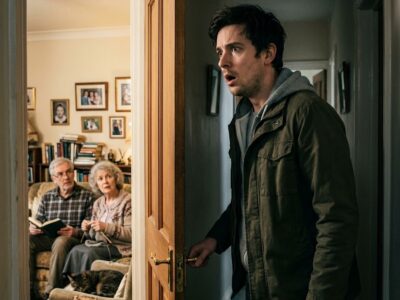
“Please let me stay. I won’t let you down” the poor Black girl said to the unfeeling billionaire.
Part 1: The Threshold of Mercy
The wind outside the Whitmore estate didn’t just howl; it hunted. It tore through the manicured hedges and clawed at the slate roof of the mansion, turning the driveway into a treacherous, icy path. Annie Carter stood at the front entrance, her knuckles white as she gripped the straps of her thin, fraying backpack. She had been walking for six miles. Her shoes, once decent sneakers, were now just soggy, frozen shells that held the shape of her feet in the slush.
She hadn’t planned to knock on a door this big. She hadn’t planned to knock on any door, really. But when the town’s only emergency shelter had turned its “Full” sign to the street, and Marcus Reed’s voice was still echoing in her mind—promising that he would find her, promising that he would make her “pay”—the Whitmore lights had looked like the only fire in a dying world.
She pressed the doorbell. It wasn’t a chime; it was a deep, resonant tone that seemed to vibrate through the stone of the house. A few moments later, the massive oak door creaked open, revealing a man who looked like he had been carved out of the very winter he was trying to keep at bay.
Nathaniel Whitmore.
He stood in the entryway, a glass of amber liquid in one hand, his eyes scanning Annie with a detachment that was sharper than the cold. He was tall, wearing a charcoal robe over tailored trousers, and he possessed the kind of stillness that made others feel like they were making too much noise simply by breathing.
“How did you get in?” he asked, his voice low and dry. “Are the guards at the gate not doing their jobs?”
Annie shivered, the cold finally breaking through her adrenaline. “The outer gate wasn’t locked, sir. I… I just followed the path with the lights.”
Nathaniel didn’t step aside. He didn’t offer a towel or a seat. He took a slow, calculated sip of his drink. “This is not a charity house, young lady. Get out before I call the police.”
“I tried, sir,” Annie said, her voice a fragile reed. “The shelter was full. I can work. I can clean. I can wash dishes. I don’t need a bed, a chair is fine.”
“You came to the wrong house,” he said, his tone final. “You want money, don’t you? Don’t stand here making trouble.”
“I don’t need money,” Annie countered, taking a desperate half-step forward. “I can cook. I know how to keep quiet. I won’t bother you. Just a corner in the basement—or the storage room.”
Behind him, a woman with a kind, lined face and a starched apron—Mrs. Evelyn Brooks—stepped into the hall. Her eyes widened as she took in the sight of Annie, blue-lipped and trembling. “Mr. Whitmore, she’s freezing,” Evelyn said softly.
Nathaniel didn’t turn. “People survive worse, Evelyn.”
“Yes,” Evelyn replied, her voice gaining a steely edge. “But not everyone remains human afterward.”
Nathaniel looked back at Annie. His gaze traveled down her frame, stopping at the dark, purplish bruise encircling her wrist—a mark left by a hand that had gripped too hard. He stiffened. “You’re running from something,” he stated, not as a question, but as a diagnosis. “I hate unnecessary trouble.”
“I’m not bringing trouble,” Annie pleaded, a tear tracking through the dirt on her cheek. “I just… I have nowhere else.”
He sighed, a sound of profound annoyance, and turned toward the dark stairway. “The servant’s room is at the end of the first-floor hall,” he muttered, not looking back. “One night. You eat in the kitchen, you sleep where Mrs. Brooks puts you, and you leave in the morning. You will not wander. You will not go upstairs. Understood?”
“Yes, sir,” Annie breathed.
As he walked away, he didn’t see the way she collapsed against the doorframe. He didn’t see the way she looked at the warm, golden light of the hallway as if it were a miracle. He was already gone, disappearing into the shadows of his own house, leaving Annie alone with the woman who held the only kindness she had found in years. But as she stepped inside, she felt a sudden, sharp vibration in her pocket. Her phone, which she thought was dead, had flickered to life. A single text message glowed on the screen: I know where you are.
Part 2: The Silent House
The servant’s room was small, clean, and felt like a sanctuary. But the message on the phone sat in Annie’s pocket like a live grenade. She didn’t turn it on. She couldn’t. Marcus was out there, and he was patient.
Evelyn Brooks had been the one to bring her soup. It was a simple broth, but as Annie ate, she felt the life returning to her stiff fingers.
“Mr. Whitmore,” Annie began, hesitant to even speak his name. “Is he always this cold?”
Evelyn slowed her movements. “He is not cold, child. Cold things don’t hurt. That man is frozen around a wound he never let bleed.”
Annie didn’t fully understand, but she felt the truth of it. The mansion was a museum of grief. Every room she’d glimpsed was polished to perfection, yet utterly devoid of the messy, vibrant evidence of a life being lived. There were no coats draped over chairs, no half-finished coffee cups, no shoes left by the door.
The next morning, the house woke up with a quiet, efficient rhythm. Annie had cleaned the kitchen before Nathaniel even came downstairs. When he arrived, he found the smell of toasted bread and dark roast coffee waiting for him. He paused in the doorway, staring at the breakfast service.
“I didn’t steal anything,” Annie said quickly, her heart skipping a beat as she wiped the counter. “Mrs. Evelyn said I could use the kitchen.”
Nathaniel looked at the table, then at her. He seemed about to bark an order, but then his phone rang. He ignored it, his eyes tracking the way Annie stood—ready to bolt, ready to be told she was wrong.
“You were told to leave this morning,” he said.
“I know,” she replied. “I just didn’t want to leave the dishes half done.”
He walked over to the counter, his cane tapping rhythmically on the floor. He picked up a piece of toast, took a bite, and set it down. He looked like he wanted to say something, but the words died in his throat. Before he could turn away, Annie’s phone rang again. She flinched, knocking a spoon to the floor with a loud clang.
Nathaniel saw the screen before she could hide it. Marcus.
“Give it to me,” he said, his voice flat.
“No,” Annie backed away, her face draining of color. “It’s mine. I’ll turn it off.”
“Annie,” he said, and the use of her name shocked them both. “I’m not stealing it. I’m going to see who is calling.”
He grabbed the phone, looked at the screen, and his expression hardened. He didn’t call the police. Instead, he pulled out his own phone and typed a message to someone—not an officer, but someone who sounded like a man of business.
“This man,” Nathaniel said, looking at her, “he’s been bothering you for how long?”
“Since my mother died,” Annie whispered. “He says I owe him.”
“You owe him nothing,” Nathaniel said, his eyes turning to flint. “Stay in the kitchen. Do not answer that phone again. If he shows up at the gate, we will handle it.”
He walked out, and Annie was left in the kitchen with Evelyn. “He’s going to find out, isn’t he?” Annie asked.
“He already knows,” Evelyn said. “And for the first time in a decade, Mr. Whitmore has decided that he dislikes a bully more than he dislikes having his privacy disturbed.”
But just as the house seemed to settle into a rhythm, the security alarm system began to wail—a deep, rhythmic thrumming that shook the walls.
Part 3: The Breach
The alarm system in the Whitmore mansion was a symphony of modern paranoia. It didn’t just beep; it vibrated in the floorboards.
“Greenhouse,” Nathaniel’s voice came over the house intercom, sharp and urgent. “Evelyn, take her to the safe room. Now.”
Annie didn’t argue. She followed Evelyn through the labyrinthine halls, her breath coming in short, ragged gasps. They reached the safe room—a disguised vault behind a bookshelf in the library. As the door hissed shut, leaving them in the dim, reinforced light, Annie felt the terror of the past few years culminating in this one moment.
“What is happening?” she asked, her voice a tremor.
“Mr. Whitmore is dealing with a visitor,” Evelyn said, her eyes fixed on a monitor built into the wall.
Annie looked at the screen. Outside, in the falling snow, a gray pickup was idling near the service gate. A man—Marcus—was outside the glass, his face twisted in a mask of rage, holding a crowbar as if he were trying to pry open the very air.
Nathaniel stood on the other side of the glass, a double-barreled shotgun held with practiced, calm precision. He wasn’t yelling. He wasn’t flinching. He looked like a man watching a pest try to enter his garden.
“You’re not welcome here, Reed,” Nathaniel’s voice was amplified by the external speakers.
“She’s my property!” Marcus roared, his voice thin against the wind. “She stole from me! She’s a thief!”
“She is a guest in my home,” Nathaniel countered. “And if you cross that line, you won’t be walking away. I have the police on the line, and I have a clear shot.”
Annie watched, paralyzed, as Marcus hesitated. For a second, the predator looked uncertain. He saw the cold, unyielding iron of Nathaniel’s resolve. He saw that he wasn’t dealing with a soft-hearted target; he was dealing with a man who had already lost everything and had nothing left to fear.
Marcus threw the crowbar at the gate, turned, and scrambled back to his truck. He peeled away, the tires spitting gravel and snow into the night.
The house grew silent again, but the vibration of the alarm remained in the air.
The vault door opened. Nathaniel stood there, his face pale, his hands steady. He looked at Annie, then at Evelyn.
“Is he gone?” Annie whispered.
“For tonight,” Nathaniel said. “But he knows where you are now. He’s forced my hand.”
“I’m sorry,” she said, her voice hollow.
“Stop apologizing,” he snapped, though his eyes weren’t unkind. “You didn’t bring him here. His own obsession did. But we need to change how this ends.”
“What does that mean?”
Nathaniel turned back toward the library. “It means we start using the law the way he does—as a weapon.”
Part 4: The Legal Siege
Daniel Price, the attorney, arrived before the snow had even finished melting. He was a man of suits and ink, carrying a leather briefcase that looked like it held the secrets of the universe.
He sat across from Annie in the library, his glasses perched on his nose. “Annie, I need the truth. Every transaction, every threat, every moment he exerted control. We are going to build a cage for this man, and we are going to use the law as the bars.”
Annie spoke for three hours. She talked about the way Marcus would stand over her while she cooked, the way he would “accidentally” lose her mail, the way he had isolated her from her school friends, and the way he had finally torn up the college applications.
As she spoke, Nathaniel sat in the corner, listening. He wasn’t reading. He wasn’t working. He was just listening, his face a monument of concentrated fury.
When she finished, Daniel closed his laptop. “This is a domestic assault and harassment case, coupled with illegal detainment. But we need more. We need to tie him to the gate breach.”
“I have the footage,” Nathaniel said.
“Good. This will be enough to get a restraining order, but I want to go further. I want to look into his finances. He’s claiming she stole from him? Let’s see what he’s been doing with his own accounts.”
Annie looked at them, her world shifting. She had spent years believing she was a criminal, a thief, a burden. Now, she was a plaintiff, a victim with rights.
“I just want to go to school,” she said, her voice quiet. “I want to finish the program.”
Nathaniel leaned forward. “You will. I’ll make sure of it.”
“Why are you doing this, Nathaniel?” she asked.
He looked at the empty space in the room where Grace’s portrait used to hang. “Because for too long, I’ve watched monsters move through the world while I stood in the dark. It’s time to turn on the lights.”
That night, Annie felt a flicker of something she hadn’t felt in a long time. It wasn’t happiness, but it was hope. She looked at her phone, the one Marcus had given her, and she felt a surge of defiance. She didn’t turn it off. She waited.
And then, it rang.
She stared at the name Marcus on the screen. She didn’t answer. She let it ring, watching the name flash in the darkness of her room, until it finally stopped. She felt like she had just won a war.
Part 5: The Unmasking
Marcus Reed didn’t go away, but he changed tactics. He started posting videos online, weaving a tale of a “delusional” stepdaughter being “kidnapped” by a wealthy recluse.
He had thousands of views. People commented, accusing Nathaniel of terrible things. They called Annie a runaway, a thief, a drug addict.
“Look at this,” Daniel said, showing them the comments. “He’s trying to poison the public perception. If he can turn the public against you, he can force a police intervention.”
“Let him,” Nathaniel said.
They released the video of the greenhouse attack. Not the whole video—just the part where Marcus was caught mid-assault, his voice threatening, his hand raised.
The public reaction was immediate. The narrative of the “worried father” collapsed instantly. Marcus was revealed for what he was: a violent, desperate man using his stepdaughter for profit.
Within hours, his social media accounts were flooded with hate. People who had sympathized with him were now calling for his arrest.
Annie sat in the kitchen, watching the feed. She saw a comment that said: She’s just a girl. Leave her alone.
She started to cry. Not from sadness, but from the sheer, overwhelming relief of being believed.
Nathaniel walked in, holding a cup of tea. He saw her crying and stopped. “Is he back?”
“No,” she said, wiping her eyes. “People are… they’re on my side.”
“They were always on your side,” Nathaniel said, sitting down. “They just didn’t know the truth yet.”
He looked at her, his expression softening in a way that made her feel seen. “Annie, Daniel is filing for full legal emancipation for you tomorrow. We are going to wipe Marcus Reed from your history.”
“You don’t have to,” she said.
“I want to.”
She saw it then—the man behind the coldness. He wasn’t looking for a daughter; he was looking for a way to fix the world he had failed to save years ago. He was looking for redemption, and she was the only one who could provide it.
But just as they started to breathe, a new threat emerged. A process server arrived at the gate, serving Nathaniel with a lawsuit—not from Marcus, but from an anonymous group alleging that he was harboring a minor.
The game was changing. They weren’t just fighting Marcus now; they were fighting the system.
Part 6: The Hearing
The courtroom was a sterile, unforgiving box. Annie sat between Nathaniel and Daniel, her heart hammering against her ribs. She was wearing a new dress, one that Evelyn had helped her pick out. It felt like armor.
The judge was a woman with a sharp gaze and an even sharper mind. She looked at the documents, then at the assembled lawyers, and finally at Annie.
“Miss Carter,” the judge said. “You have requested legal emancipation from Marcus Reed. Can you explain why?”
Annie stood up. She felt the eyes of the entire courtroom on her—the reporters, the lawyers, even Marcus, who was sitting in the back row with a smarmy, confident grin on his face.
“He never protected me,” Annie said, her voice clear and ringing. “He used me. He kept my documents, he controlled my money, and he used his position as my stepfather to isolate me from everyone who could help.”
Marcus stood up, his face reddening. “Your Honor, that is a complete lie! She’s mentally unstable!”
“Sit down, Mr. Reed,” the judge snapped.
She turned back to Annie. “And why are you currently residing with Mr. Whitmore?”
“Because he was the first person who asked me if I was safe instead of asking me what I could do for him,” Annie said.
The courtroom fell silent. Even the reporters paused their typing.
Nathaniel looked at her, his eyes shining. He had been through hell, he had lost everything, but in this moment, seeing Annie stand up to the system that had failed her, he felt a strange sense of peace.
Daniel presented the evidence—the footage of the greenhouse, the phone logs, the financial records that proved Marcus had been living off Annie’s meager earnings for years.
Marcus tried to argue, but every time he opened his mouth, the evidence cut him down. The judge’s expression shifted from skepticism to outright disgust.
“Mr. Reed,” the judge said, her voice like iron. “I am granting this emancipation. Furthermore, I am issuing a permanent restraining order against you. If you come within a mile of Miss Carter or the Whitmore estate, you will be arrested immediately.”
Marcus slumped in his chair, his face losing its color.
As they walked out of the courtroom, the reporters swarmed them. They asked questions, they clamored for a statement, but Nathaniel stopped them all with one look.
“She is done speaking,” he said.
They walked to the car, the air cold but clean. Annie looked at the sky, feeling the weight of the last few years finally lifting.
“I’m free,” she whispered.
“You’ve always been free,” Nathaniel said. “You just needed someone to help you find the door.”
Part 7: The New Beginning
Six months later, the house on the estate was finally quiet, but it was a good quiet. The curtains were always open, the kitchen smelled like fresh bread, and the piano in the music room had been tuned.
Annie was at university now, studying culinary arts. She was the top of her class. She was building a life—real, messy, beautiful life.
Nathaniel was different too. He was still quiet, still meticulous, still a businessman, but the ice had melted. He was still the man who owned the city, but he was also the man who made sure the girl who had changed his life had everything she needed to reach her dreams.
One afternoon, he walked into the kitchen and found Annie humming a tune while she prepared dinner. He stood in the doorway, just watching her.
“You look happy,” he said.
Annie turned, a smile lighting up her face. “I am.”
“I have something for you,” he said, handing her a small box.
She opened it. Inside was a key—not to a door, but to a small, charming restaurant space in the heart of the city.
“It’s yours,” he said. “For your dream.”
“Nathaniel, I can’t take this,” she said, her eyes filling with tears.
“You’re not taking it,” he said gently. “You’re building it. I’m just providing the foundation.”
She walked over and hugged him. It was a hug that contained all the fear, all the loss, and all the hope of the past year.
“Thank you, Dad,” she whispered.
Nathaniel held her for a moment, the word “Dad” resonating in his heart like a homecoming. He wasn’t the man who had lost his family anymore. He was the man who had found one.
Outside, the sun was beginning to set over Chicago, casting a warm, golden glow over the city. It was a city of towers, of business, of secrets, and of shadows. But in this house, the shadows were gone.
The story had started with a girl knocking on a door, terrified, cold, and alone. It had started with a man who had built a life of stone to hide his own heart. But they had both learned that sometimes, the only way to save yourself is to let someone else in.
And as they sat down to dinner, the smell of fresh food filling the kitchen, Nathaniel realized he had finally found what he had been looking for all along—not the company, not the money, not the reputation.
He had found a reason to live, and she had found a reason to thrive.
The nightmare was over. The life was just beginning.