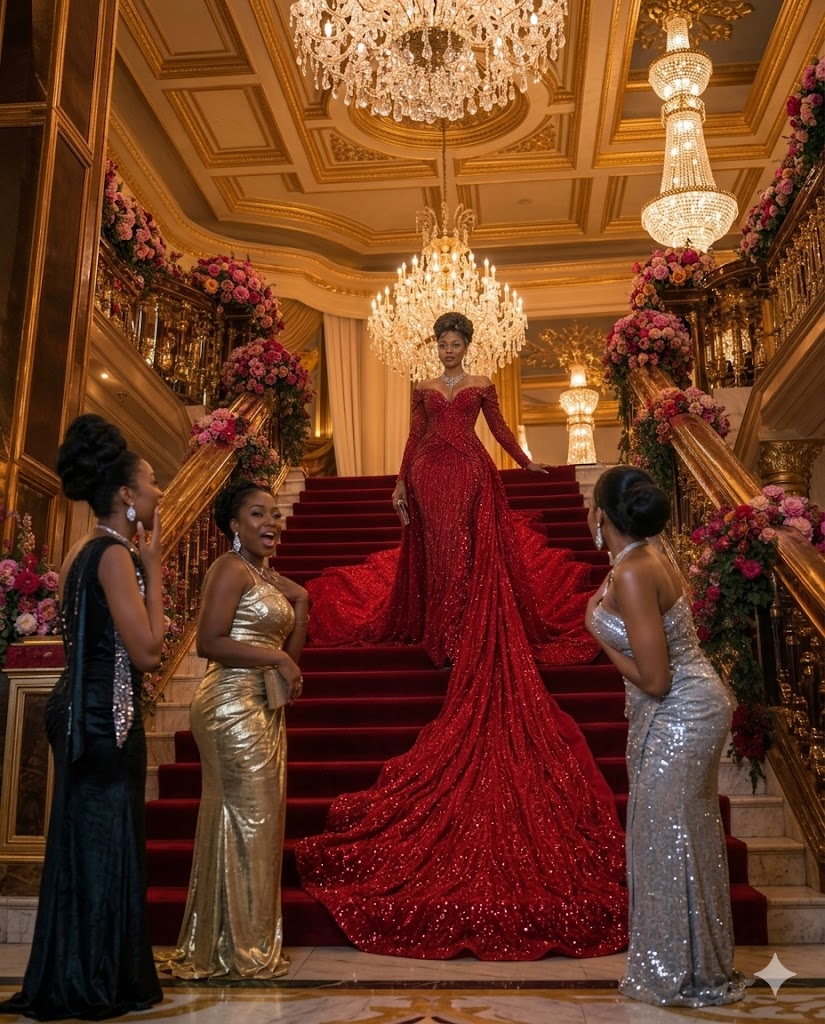
Rich Lady Invited Poor Maid To A Birthday Party As A Joke, She Walked In Wearing A Stunning Dress
Part 1: The Throne of Glass
Ogi Anukam sat alone in her father’s expansive sitting room, the silence pressing against her eardrums like deep water. Everything around her was meticulously curated to project power: chairs upholstered in imported velvet, heavy drapes that blocked out the frantic pulse of the city, and a marble floor so polished it reflected her own hollow expression. The wall was a museum of her father’s influence—framed photographs of Chief Benson Anukam shaking hands with senators, governors, and international business titans. Any stranger walking into this house would assume Ogi lived a life of enviable fortune. But they only saw the perimeter; they never saw the person.
To her father, Ogi was not a daughter to be cherished; she was a legacy to be maintained. He loved her, certainly, but his love was a tactical maneuver, a series of directives designed to maximize the family’s prestige.
“Ouchi!” the voice boomed from the hallway, cutting through the silence.
“Yes, Daddy,” she replied, her posture stiffening.
Chief Benson Anukam entered the room with the measured stride of a man who owned the very air he breathed. He didn’t sit; he stood by the fireplace, an imposing silhouette against the dying light of the afternoon. “We must discuss your future. This is for the good of the family. The time has come to explain the arrangement.”
Ogi felt the familiar coldness grip her stomach. “The arrangement.” The phrase was a familiar poison.
“I have spoken with Chief Nosu,” her father continued, his tone devoid of room for argument. “His son is back from abroad. His name is Bumma. I want you to meet him tomorrow. He is responsible, educated, and from a good family. This is not one of those boys who will waste your time.”
“Daddy, another blind date?” Ogi felt a spark of resistance, though she knew it would be snuffed out before it could catch.
“Don’t say it like that,” he scolded.
“But that is what it is,” she countered, finally meeting his gaze. “A meeting with a man you want me to marry.”
“I want you to know him first.”
“I don’t want to know him like this.”
“It is not about what you want,” he said, the finality of his words hitting the marble floor with the weight of a gavel. “It is your duty. You are not a child, Ogi. Marriage is not only about feelings. Family matters. Character matters. Background matters. Future matters.”
“I know all that,” Ogi said, her voice trembling. “But what about what I want?”
“You will thank me one day,” he promised. It was the standard refrain for every decision he made for her. Before he could elaborate, Mama Ngozi, Chief Anukam’s elder sister, bustled into the room. She was a woman who moved through life as if every room were a stage she had been hired to judge. Having heard the tail end of the conversation from the hallway, she didn’t wait for an invitation to weigh in.
“What is your problem again?” she demanded, marching toward Ogi. “Do you know how many women are praying for this kind of opportunity? You sit there with that tired face as if this is a burden. You must learn to be grateful.”
“Auntie, I said I don’t want another arranged meeting,” Ogi whispered, desperate for an ally.
“Arranged meeting?” Mama Ngozi huffed. “In our time, some women did not even see the man until the wedding day. You people of nowadays want love to fall from the sky like rain.”
“Times have changed,” Ogi insisted. “I am not saying love should fall from the sky. I am only saying I want to choose.”
“Choose?” Mama Ngozi laughed, a dry, dismissive sound. “You think this is a game? And what have your choices brought you so far?” She moved closer, her tone shifting from sharp to patronizing. “My daughter, pride is not good. You are beautiful, yes. Your father has money, yes. But time does not wait for any woman.”
Ogi looked from her aunt to her father and felt the walls closing in. To them, she was a lucky girl in a gilded cage. To her, she was a prisoner with a life sentence.
“I will go,” Ogi said, the words tasting like ash. Chief Anukam relaxed, his mission accomplished, while Mama Ngozi beamed as if she had just won a war. But Ogi’s voice was flat when she added, “I will meet him.” She did not say she would behave. She did not say she would give him a chance. And deep inside, she had already started thinking of how to make sure the meeting failed, a plan born of desperation and the burning need for a choice that was truly her own. She stood up, her legs feeling unsteady, and hurried out of the room before her father could offer any more “wisdom.” As she reached the safety of her bedroom, her phone vibrated in her pocket, a message from a number she didn’t recognize, asking a question that sent a chill down her spine: Are you ready to disappear?
Part 2: The Parallel Struggle
In another part of the city, in a house just as opulent as the Anukams’, Bumma Nosu was having an almost identical argument. He was the only son of Chief Raymon Nosu, a man whose ego was as vast as his business empire. Bumma was handsome, quiet, and possessed a serious mind that didn’t align with his father’s relentless pursuit of social advancement. He stood in the private sitting room, his hands stuffed deep into his pockets, his face tight with the effort of holding back an explosion.
“You will attend the meeting tomorrow,” Chief Nosu stated, his voice a decree that admitted no appeal.
“Daddy, I don’t want this,” Bumma replied, his voice strained.
“You have not even met the girl.”
“That is the point. I don’t know her.”
“You will know her when you meet her.”
“So, because you and her father are friends, I should start looking at her as my future wife?”
“Watch your tone,” the Chief warned, his hand thumping the armrest of his chair. “I am not trying to disrespect you, but I don’t want to marry a woman chosen through business friendship.”
Bumma’s mother, Mrs. Nosu, a woman who treated her family’s image like a piece of priceless porcelain, sat beside her husband, her face composed in a mask of elegant disapproval. “Bumma is from a good home,” she said, her voice smooth. “Her father is respected. She’s educated. What exactly is your problem?”
“My problem is that nobody is asking what I want,” Bumma shouted. “All of you are saying the same thing. What about what is wise? I want someone who will love me when there is no money attached, no family name, no business connection—just me.”
“My son, poverty is not a romantic movie,” his father said dismissively.
Bumma’s jaw tightened. “Nobody is asking you to marry poverty. We are only asking you to meet a decent girl.”
“You are asking me to meet a girl because her father is useful to this family!”
“Enough!” Chief Nosu rose, his presence dwarfing the room. Bumma looked at his parents and felt a crushing sense of isolation. They didn’t understand, or worse, they understood and didn’t care. To them, Ogi was an asset; to him, she was a stranger being forced into his life like a line item in a ledger.
“I will go,” Bumma said, the words heavy and resentful. Mrs. Nosu looked relieved, and Chief Nosu gave a single, satisfied nod.
As Bumma walked out, he felt a dark resolve. If his parents were going to play games with his future, he would ensure the game was rigged in his favor. He walked to his room and pulled out a burner phone he’d kept hidden—a tool from a side of his life his parents were entirely ignorant of. He dialed a contact labeled ‘Shadow’. “The meeting is tomorrow,” he said quietly. “Prepare the disguise. I’m going to show them that who I am isn’t what they think.” He didn’t know that Ogi, miles away, was making an identical call to her best friend, Amaka. The trap was set, but the architects of the trap had no idea that their prey was already rewriting the rules of the hunt.
Part 3: The Deception Begins
The day of the meeting was agonizing for Ogi. She woke up at dawn, but she didn’t reach for the silk gowns or the designer shoes her mother had laid out. Instead, she dug into the back of her closet for an old, oversized shirt and a pair of worn-out pants she used for gardening. She rubbed a bit of dirt under her nails and tied her hair back with a piece of twine. She looked into the mirror, and for the first time, she liked the reflection. She looked like a woman who worked for a living, not a woman who was owned by a bank account.
She arrived at the venue—a discreet, high-end cafe—and slipped into the restroom. She emerged as a cleaner, the uniform she’d borrowed from Amaka fitting her perfectly. She began to sweep the floor near the reserved tables, her head down, her movements rhythmic and practiced. She wanted to see Bumma before he saw her. She wanted to observe the man her father had chosen without the artificial gloss of a blind date.
Meanwhile, Bumma was at the hotel entrance, but he wasn’t the man his parents expected. He had arrived in a plain sedan, dressed in a simple, generic security uniform he’d acquired through a private contact. He stood by the staff gate, watching every person who walked in. He wanted to see if Ogi was the type of woman to arrive with a parade of vanity and expectation.
When Ogi walked past the staff gate, mop in hand, Bumma’s eyes locked onto her. He saw the way she carried herself—not like a girl who had been waited on her whole life, but like a woman who knew the value of hard work. He felt a sudden, inexplicable curiosity. Who is she? he wondered.
Ogi saw the security guard and felt a strange tug of interest. He was handsome in a grounded, rugged way, and his eyes… there was a kindness there she hadn’t seen in the men her father usually brought around. She paused for a moment, and he held her gaze. It was a silent conversation between two people who were both hiding in plain sight.
Then, Musa—the man Bumma had hired to play him—arrived. He was dressed in one of Bumma’s most expensive suits, looking like a man who was desperately trying to outrun his own shadow. He walked into the restaurant with a flourish, his chin tilted high. Ogi watched him and felt a surge of triumph. There he is, she thought. The proud, entitled son of a billionaire. Look at him, acting like he owns the floor.
Bumma, watching from the security gate, felt a surge of anger. “Look at him,” he whispered to himself. “Musa is doing a terrible job. He looks like a waiter on a dare.” But then he saw Ogi watching Musa, and he saw the disgust on her face. He felt a weird, complicated relief. If she hated Musa—the man she thought was Bumma—then maybe she wasn’t the shallow socialite he feared. But the lie was already weaving itself into a knot, and he was the one who had tied it. He started toward the restaurant, intending to pull Musa out of the fire, when Ogi suddenly tripped near a table, her bucket wobbling. He moved without thinking, catching her by the arms, his hands large and warm.
“Careful,” he said, his voice deep and steady.
She looked up, her eyes wide, and for a second, the world stood still. They were two people acting out a lie, but in that touch, the truth felt dangerous and close. Suddenly, a wealthy-looking man bumped into her, sneering, “Are you blind?”
Bumma didn’t think. He stepped between them, his voice cold. “She didn’t bump into you. You walked into her. She apologized. You’re the one making a scene.”
The man turned, red-faced. “Who are you? Just a security guard!”
“It concerns me if someone is being blamed unfairly,” Bumma said.
Ogi stared at him, stunned. He had defended her. She was a cleaner in his eyes, and yet he had risked his job to stand by her side. Something inside her began to shift, the walls of her own deception starting to crumble. She didn’t know who he was, but she knew she wanted to find out.
Part 4: The Poison of Pride
The aftermath of the encounter left Ogi’s heart in disarray. She couldn’t stop thinking about the security guard—his steadiness, his eyes, the way he had stepped in for her when she was “just a cleaner.” She returned home, her mind swirling with the impossibility of her situation. She had planned to humiliate Bumma, but instead, she had found herself drawn to a man who, by all accounts, was simply a guard.
Bumma, meanwhile, was struggling to reconcile the woman he saw at the cafe with the rumors about Ogi Anukam. Musa, the fake Bumma, had been a disaster, but the real mystery was Ogi—or Chioma, as he knew her. He felt a burgeoning, terrifying attraction to her that he couldn’t explain. He found himself patrolling the area where the restaurant was located, hoping for a glimpse of the cleaner who had looked at him with such haunted, beautiful eyes.
But the poison was spreading. Kemi, Ogi’s cousin, had witnessed the exchange at the hotel. She had seen the way Ogi looked at the guard, and she had seen the way the guard had held her. Kemi wasn’t just jealous; she was calculating. She saw the potential for a social catastrophe that could elevate her own standing in the family.
“Do you know who she was with?” Kemi asked Femi, a rival suitor of Ogi’s who was just as obsessed with the Anukam fortune as he was with Ogi herself.
“The security guard?” Femi laughed. “I saw it. It’s pathetic. Chief Anukam will have a heart attack when he finds out.”
“We need proof,” Kemi said, her eyes gleaming with malice. “If we catch them together, we can turn the Chief against Ogi forever. Then, when she’s disgraced, he’ll look for someone else to carry the family name. Someone like me.”
Femi nodded slowly, a dark smile forming. “I have contacts. I’ll make sure she’s followed.”
Unaware of the vipers in their garden, Ogi and Bumma continued their dance. They met again, not as the wealthy heiress and the billionaire heir, but as Chioma and the security guard. They shared roasted corn by the roadside, their conversations moving from simple, surface talk to the aching, honest exchanges of people who were starving for connection.
“I keep waiting for someone to want me only for what I can offer them,” Ogi admitted one evening, staring into the flickering embers of a small fire. “And you keep waiting for someone to want the surname, not the man underneath.”
Bumma laughed, a sound of genuine relief. “Maybe the name is just a costume.”
“And the uniform?” she asked, glancing at his security gear.
He looked at her, his expression serious. “A disguise. I wanted to see if I was more than the money I stood on.”
They sat in the quiet of the night, both of them holding onto their secrets with white-knuckled desperation. They were falling in love, but they were building their foundation on a shifting, treacherous sand. The air felt heavy with the promise of a breaking point, and in the shadows, Kemi and Femi were waiting for the wind to pick up.
Part 5: The Unmasking
The breaking point came with a cruelty that was almost systematic. Femi and Kemi had orchestrated a trap, using a network of contacts to ensure that both fathers—Chief Anukam and Chief Nosu—would be present at a supposedly “casual” family dinner. They had invited Kemi and Femi to stir the pot, promising a night of clarity.
The dining room was a battlefield of forced smiles and clinking silver. Chief Anukam sat at the head of the table, his demeanor brittle. Chief Nosu sat opposite, his frustration with his son’s “stubbornness” radiating off him like heat. When Bumma and Ogi entered, the room went cold.
“So,” Femi began, his voice smooth and oily, “we have something for the table to see.” He pulled out his phone and cast a video onto the television screen. It was grainy footage of Ogi in her cleaning uniform, talking to the security guard—to Bumma—and looking at him with an intimacy that left no room for interpretation.
The room erupted. Chief Anukam gasped, clutching his chest. “Ogi! Explain yourself!”
Mrs. Nosu covered her face, horrified. “A cleaner? My son is with a cleaner?”
Bumma stood, his face a mask of cold fury. He looked at Kemi, then at Femi, and finally at his father. “It isn’t what you think.”
“Oh, it’s exactly what I think,” Femi sneered. “I think you’ve been lying to us all. You’ve been living a double life.”
Ogi looked at the screen, her heart fracturing. She had wanted to test them, but the test had turned into a public execution of her reputation. She looked at Bumma, hoping for a sign, but he was staring at his father, his eyes burning with a defiance she had never seen before.
“I didn’t lie to disgrace you,” Bumma said to the room, his voice calm, dangerous. “I lied because you gave me no choice but to be a stranger to you. I wanted to know if I was a person or just a name on a check.”
“And you?” Chief Anukam glared at Ogi. “What is your excuse?”
“I wanted to see if anyone would see me if I stopped wearing the name,” she whispered.
“You’re both mad!” Chief Nosu roared. “Marriage is not about ‘finding yourself’ or ‘testing hearts’! It’s about building a future!”
“Then build it with someone else,” Bumma shouted. “Because I’m done living in this tomb!”
He grabbed Ogi’s hand, pulling her toward the exit. The guests stared in shock, Kemi smirking, Femi looking satisfied with the chaos he had caused. But as they hit the door, Ogi stopped. She looked back at her father, her eyes wet with tears. “You had a daughter,” she said, her voice steady despite the trembling of her hands, “but you spent so much time building your walls that you forgot to look inside.”
They walked out, but the scandal was already out there. Phones were buzzing. Social media was catching fire. They were standing on the sidewalk, the night air cool against their burning skin.
“Where do we go?” Ogi asked.
Bumma looked at her, his eyes searching hers for the first time without the lens of the lie. “We go away from here. Far away. And we find out who we are when there’s no one watching.”
Part 6: The Exile of Truth
The exile was quiet at first. They moved to a city where no one knew their names, no one cared about their fathers, and no one expected them to be anyone but themselves. It wasn’t the glamorous getaway of a billionaire heir; it was a humble apartment, a shared grocery bill, and the terrifying, exhilarating process of becoming two people who actually liked each other.
They didn’t tell their families where they were. For weeks, the only sounds they heard were the ones they made themselves—the clinking of plates, the soft murmur of laughter, and the quiet, honest conversations that finally happened without the specter of their surnames hovering over them.
But Femi wasn’t finished. He had lost his chance to be the family hero, and he had been humiliated by their escape. He used his contacts to leak their location. One morning, they were woken up by a pounding on their door—not by police, but by reporters. Kemi had orchestrated a story about the “Billionaire and the Cleaner” on the run.
“We need to leave,” Bumma said, his jaw tight as he watched the cameras from the window.
“No,” Ogi said, stepping beside him. “We’ve been running for months. Let them come.”
They opened the door. The flashbulbs were blinding. They were swarmed by voices—accusations of fraud, questions about money, mockery about their “disguise.” Ogi stood in the center of the storm, holding Bumma’s hand.
“Yes,” Ogi told the reporters, her voice ringing clear over the chaos. “He was a security guard. I was a cleaner. We lied to you because you wouldn’t have listened to us if we were anything else.”
Bumma stood beside her, his head held high. “I am Tom King,” he said, his voice quiet but carrying the weight of authority. “And she is Ogi Anukam. We are not who you think we are. We are two people who decided that the only way to find love was to lose everything else.”
The shock was total. The story shifted from a tawdry scandal to a revelation. The world watched, stunned, as a billionaire heir and an heiress reclaimed their own lives from the expectations of their fathers. The scandal didn’t destroy them; it freed them.
Part 7: The True Wealth
Years later, the silence in their home was no longer the oppressive quiet of the Anukam sitting room or the cold, sterile distance of the Nosu household. It was a silence filled with the sounds of children playing, the clatter of a kitchen, and the soft, steady hum of two lives that had finally found their anchor.
The empires they had inherited were restructured, not for control, but for the betterment of the community. They had launched scholarship programs, built schools that prioritized empathy over status, and dismantled the rigid hierarchies that had once kept them trapped.
Bumma—now Tom, though he preferred the name he had used as a guard—sat on the porch of their modest farmhouse, watching Ogi tend to the garden. She wore a simple dress, her hair loosely tied, her face radiant with a contentment that no diamond could ever capture.
He walked over, his boots crunching on the gravel, and wrapped his arms around her waist from behind. “Still think I’m a security guard?” he whispered into her hair.
She leaned back against him, her laughter soft and genuine. “I think you’re the man who saved me.”
“And you,” he replied, turning her around to face him, “are the woman who proved that love isn’t about the name you wear, but the person you choose to stand next to when everything else burns down.”
They looked out over the fields, the vast expanse of their future unfolding before them. The names, the titles, and the expectations were just ghosts now. The only thing that mattered was the steady beat of their hearts against one another, a promise kept in the quiet, and the profound, beautiful realization that they had finally, truly, come home.