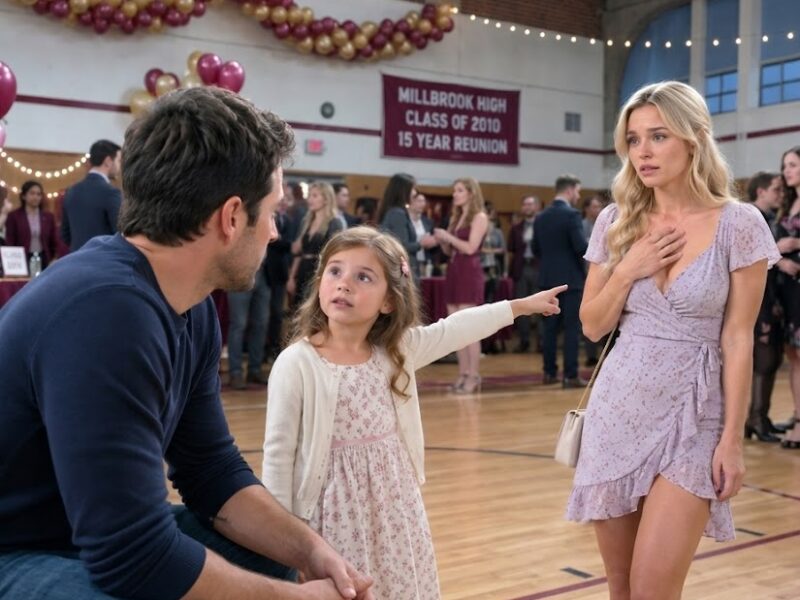
She Came Back To Our Reunion A Widow… Her Daughter Looked Up At Me And Said, ‘Mommy Said You’d Come’
Part 1: The Weight of Structural Integrity
I spend my life reinforcing things that are one bad storm away from collapsing. People in my line of work call it structural remediation, but stripped of the engineering jargon, it just means I look at a building, figure out exactly where it’s lying to itself about its own strength, and shove enough steel into the marrow of it to keep gravity from winning. It’s meticulous, quiet, and dirty work. It takes me to places like the outskirts of Tulsa, sleeping in a rusted-out construction trailer, checking my phone maybe once a week if the site happens to catch a stray bar of roaming signal. I liked the silence of it. I liked that a beam didn’t have feelings, didn’t have a memory, and didn’t care about the motives of the man holding the torque wrench.
But people back home always told me it was a strange career choice for a man who once left his own hometown without saying a single true thing he actually meant to say.
Three days ago, I drove my truck back into Milbrook Falls. The occasion was a fifteen-year high school reunion—an event I had spent months telling everyone, including the reflection in my own bathroom mirror, that I had absolutely no intention of attending. Yet, there I was. The human mind is an unstable foundation; it shifts under pressure, and somehow, a series of wrong turns and sudden impulses landed me right back where my story had stalled out a decade and a half ago.
I was standing in the center of the high school gymnasium. It smelled exactly the same: an aggressive combination of floor wax, old sweat, and the faint, sweet rot of damp wood beneath the bleachers. It was the same varnished cedar floor where I used to run suicide drills until my lungs burned like hot coals, pushed by a coach who was probably sitting in a recliner somewhere now, retired and completely oblivious to the ghosts he’d left behind.
The organizers had tried hard, or maybe they hadn’t tried at all, which was worse. Somebody had tracked down the exact same shade of faded crepe paper we’d used for our senior prom, stringing it limply from the basketball hoops. A playlist of songs from our senior year—melancholic acoustic tracks and overproduced pop anthems—looped through a single Bluetooth speaker that someone had propped precariously right on the free-throw line. It hummed with a tiny, irritating distortion every time the bass hit.
I stood near the periphery, my fingers clamped around a flimsy paper cup of red punch. I had no plans of drinking it. It was merely a prop, a tactical shield to keep my hands occupied so I wouldn’t look as entirely out of place as I felt. I had spent twenty minutes nodding at faces that had grown soft around the jawlines, listening to stories about mortgages and regional sales targets, when the heavy double doors at the far end of the gym swung open.
The air in the room didn’t disappear, but it compressed. June Marsh walked back into my life.
She didn’t arrive alone. Clamped hard to her right hand was a little girl, maybe six years old, wearing bright yellow rubber boots that looked like they had seen actual, honest-to-god mud that afternoon, not just suburban puddles.
The room did that specific, terrible thing rooms do when everyone recognizes a person simultaneously, but nobody wants to be caught being the first one to react out loud. The collective volume of the gym didn’t drop; instead, it curdled. Conversations kept moving, but their tracks slipped. Pitch levels wavered. People continued to mouth words to the person in front of them, but their eyes—stubborn, heavy things—slid immediately toward the doors.
I was standing near the refreshments table, close enough to catch the stray debris of small-town gossip. A woman in a tailored blazer murmured a low, sharp sentence to her husband. I didn’t get the whole thing, but three words detached themselves from the noise and landed squarely in my ear: Daniel and terrible. It was pitched low, the precise frequency used when you want to be heard by the person next to you but aren’t ready to own the weight of the statement if it travels any further.
I didn’t catch the rest of it. Not yet. Not the whole story.
June didn’t look at any of them. She held her head at an angle that bypassed the crowd entirely, scanning the perimeter of the gym the exact way a soldier or a building inspector checks the exits of a structure they’ve already decided isn’t structurally sound. She looked exhausted, but it wasn’t the kind of tiredness that a night of sleep fixes. It was a deep, structural fatigue, carved into the skin around her eyes and the tight, defensive set of her shoulders.
And then her eyes found mine.
The scanning stopped. The room around us didn’t fade into a cinematic blur—I could still smell the punch and hear the buzzing speaker—but my focus narrowed down so violently that everything else became meaningless background data. We stayed like that for three seconds, maybe four. Long enough for me to become acutely, uncomfortably aware of my own pulse thumping against the wall of my throat.
The fifteen years between us didn’t disappear. They didn’t vanish into some romantic illusion of timelessness. Instead, they just went completely quiet, like a machine that had been screaming in the basement for years suddenly losing power.
Then, the little girl let go of June’s hand.
She didn’t hesitate. She started walking straight across the twenty feet of open gym floor that separated us, moving with a bizarre, practiced certainty, as if she had rehearsed this exact route in her head a hundred times before. She marched right past a long folding table covered in custom name tags that nobody had bothered to alphabetize. She walked past two of my old varsity teammates, who went entirely silent mid-sentence, their beers lowering slightly as they watched her pass.
She didn’t stop until she was exactly two feet in front of me.
She tipped her chin all the way back, her neck straining so she could look directly into my face. Up close, I could see she had a wide gap where one of her top front teeth used to be, and her face carried that total, unblinking seriousness that little kids get when they believe they are executing an incredibly important piece of state business.
I didn’t make a conscious decision to move. My knees just gave way, and I crouched down until we were at eye level.
She studied me for a long, quiet second, her small brow furrowing as if she were comparing the physical reality of my broken nose and lined forehead against a photograph or a drawing she had already memorized.
Then, she opened her mouth and changed everything.
“Mommy said you’d come,” she said.
My tongue felt thick, dry from the gym air and the sudden pressure in my chest. I finally managed to force a sound out, though my voice came out much rougher and more cracked than I intended it to be. “Come where?”
She looked at me like the question was fundamentally stupid, her eyes rolling a fraction of an inch toward the ceiling. “Here,” she said, as if the logistics of the universe were obvious. “To the dance. Mommy said the boy from her story might be here tonight. And I found you, so I win.”
She delivered that last sentence with the flat, unassailable satisfaction of a person who considered the entire matter legally and logically closed.
I didn’t have an answer for her. I’m not sure I had anything left inside me at that moment that qualified as a coherent thought, let alone a reply.
Behind her, across the expanse of the varnished floor, I saw June. The color had completely drained from her face, leaving her the exact, stark white of the paper cup I was still white-knuckling in my left hand. She crossed the distance between us in four incredibly fast, desperate steps, her boots clicking sharply against the cedar, her mouth already open to issue an apology before she had even fully arrived.
“I’m so sorry,” June gasped, her hands reaching out. “She talks to everyone—she doesn’t know—”
She cut herself off mid-sentence. She didn’t finish the thought. Instead, she just reached down and grabbed the little girl’s hand, her fingers trembling slightly as she pulled her back. “Ren, honey. We talked about this. We don’t just run up to people.”
The girl, Ren, didn’t argue. She allowed herself to be turned around toward the heavy double exit doors, but as June began to pull her away, she twisted her head back over her shoulder. She gave me one final, lingering look—quick, sharp, and loaded with the absolute certainty of a child who had just confirmed something she already knew to be a universal truth.
And then, just like that, the two of them were gone. The heavy wooden doors swung shut behind them with a dull, pneumatic hiss, and the ambient noise of the high school gymnasium rushed back in to fill the vacuum, louder and more suffocating than before.
June hadn’t looked back once.
I stood up slowly, my joints popping in the quiet. I was still holding that cup of warm, untouched punch, my brain working at a fraction of its normal speed, trying to calculate the structural math of what had just occurred and coming up entirely short.
“Well,” a voice rumbled directly into my left ear. “You always did know how to draw a crowd, Hart.”
I cleared my throat, turning my head. It was Teddy Okafor. He had found me exactly ninety seconds after the doors closed, because Teddy always possessed a supernatural radar for finding you precisely when you would rather be buried six feet under the earth with your own thoughts.
Teddy had changed. He had gone soft around the middle, his varsity frame now hidden beneath a generous plaid shirt, and the hair at his temples had turned the color of wet sidewalk slate. But he still had the exact same low, mischievous laugh that used to get both of us thrown out of Mr. Harrison’s chemistry class three times a week.
He didn’t look at me. He followed the line of my stare, looking toward the closed exit doors, and let out a long, low whistle through his teeth.
“You didn’t hear, did you?” Teddy said, his voice dropping into a register that lacked all of its usual humor.
“Hear what?” I asked, my fingers tightening around the paper cup until the cardboard began to buckle. “Hear what about Daniel?”
Teddy looked at me, really looked at me, realizing for the first time that I was completely in the dark. “Daniel Marsh, man. He died. About a year and a half ago.”
Part 2: The Silent Fracture
A physical sensation dropped through my chest—not pain, exactly, but a sudden, heavy vacancy, the way a floorboard feels when the joist beneath it snaps without warning. I hadn’t heard a single word of it. I had spent the entirety of that year on a high-consequence remediation job three hours outside of Tulsa, living like a hermit in a silver casing of a construction trailer, working twelve-hour shifts and checking my phone only when the wind blew hard enough to catch a signal from the tower over the ridge. I had disconnected myself so thoroughly from Milbrook Falls that the town could have slid into the river and I wouldn’t have known until the water hit my boots.
Teddy kept talking, his voice dropping into that rhythmic, practiced cadence people use when they’ve delivered the same piece of bad news twenty times before. He was filling in the empty spaces of the timeline, but my brain was only catching every third or fourth word.
“Ice storm,” Teddy said, nodding slowly. “Out past the orchard road. He was driving the old flatbed. Car went into the ditch on that sharp curve right past the creek—you know the one, everyone in this damn town has slid on it at least once. Only Daniel didn’t slide out. Hit an old-growth oak head-on. That was it. Died before the sheriff’s truck even cleared the bypass.”
The grease on my hands from the morning’s truck maintenance felt suddenly cold. “And the kid?” I asked.
“Ren,” Teddy said, confirming the name I’d just heard from the girl herself. “That’s his kid. Theirs. She’s six now, I think. Sweet kid, smart as a whip. The whole town’s watched June try to hold that entire orchard together on her own since the funeral. And from what I hear through the grapevine, it hasn’t exactly been an easy ride. Daniel didn’t leave much in the way of a safety net.”
I didn’t tell Teddy what happened fifteen years ago. I didn’t tell him that the night before I packed my life into a single duffel bag and left for basic training, June Calder and I had sat on the lowered tailgate of my Chevy truck, parked in the gravel lot right behind this exact gymnasium.
I had built a sentence in my head that entire week. I had structured it like a bridge, balancing the load of every word, practicing it in the shower that morning like a complete idiot—out loud, but quiet enough that my mother wouldn’t hear me through the thin drywall of our hallway. I love you. Don’t let me leave this town alone.
But when the actual moment arrived—when the gravel stopped crunching under our sneakers and June turned her head to look at me, the yellow porch light of the gym casting long, amber shadows across her face, asking me what I was thinking so hard about—the bridge collapsed. My chest went tight, and instead of the truth, I offered her a handful of dust.
“I’ll call you instead,” I had said.
It’s what a coward says when the real sentence is too heavy for him to lift.
And I didn’t call. Not that week in the barracks, not that month during field exercises. By the time I finally found the nerve to even look at a payphone, enough silence had accumulated between us that a phone call felt like it would require a massive, structural apology stitched to the front of it—an apology I had no idea how to design or write. So, I did what I always did back then: I let it stay quiet. I told myself that the silence was the kinder option for both of us, that it allowed her to move on without the anchor of a guy who spent his life moving from one temporary job site to another.
It wasn’t the kinder option. It was just the easiest one for me.
I understood that fully, with a sudden, burning clarity, standing in that noisy gymnasium fifteen years later. I had just watched a six-year-old girl with her mother’s exact, stubborn chin tell a room full of staring strangers that her mother had been talking about me in her bedtime stories.
“Hey, Wesley? You still with me?” Teddy asked, rapping his knuckles gently against the side of the folding table.
I didn’t answer him. I set my crumpled paper cup of warm punch down on the nearest surface, turned on my heel, and walked away from the reunion. Teddy called out something behind me—probably a question, maybe an invitation to a bar down the road—but I didn’t catch the words, and I didn’t turn around to ask for a repeat.
The night air outside the gym hit me like a physical slap. The parking lot was dark, lit only by a few flickering sodium lights that hummed with a low, electrical rattle. I found June’s car near the back fence—an older model station wagon with a faded bumper sticker from the local apple cooperative.
She was there, her keys already out, wrestling with the plastic buckle of a child’s car seat through the open rear door. She was working with the specific, terrifying fury of a person who desperately needs her hands to stay busy so the rest of her body doesn’t start shaking apart. Inside the car, Ren was already half-asleep, her chin tucked into the collar of her jacket, completely worn out from the brief exertion of being the most honest person in the entire building.
“June,” I said.
She didn’t turn around immediately. She froze for three full seconds, her fingers still clamped onto the car seat strap, her back straight and rigid under her wool coat. When she finally turned to face me, she had that exact same apology face back on—the polite, distant mask she’d worn in the gym.
And as I looked at her under the dim parking lot light, a sickening wave of recognition hit me. I had seen that exact expression on her face once before. A long time ago, right around the moment I had broken her heart in the gentlest, most cowardly way a person could possibly manage.
“I’m sorry about Ren, Wesley,” she said, her voice tight, clipped, and completely devoid of the warmth it used to carry. “She’s been asking about you for years. Well, not you, exactly. She’s been asking about the stories. I genuinely never thought you’d actually walk through that gym door tonight, so I never prepped her for what to do if you did. I didn’t think I’d have to.”
“It’s fine,” I told her, and for the first time in fifteen years, I meant a sentence completely. “June, really. It’s fine.”
She studied my face, her eyes moving over the features that had changed since we were nineteen, trying to decide whether to believe the tone of my voice. Something in her posture shifted; her shoulders came down maybe half an inch, the defensive iron leaving her spine just enough for her to lean back against the frame of the open car door.
“What did you tell her?” I asked, the question slipping out before I could think to censor it. “About me. What was the story?”
June looked past my shoulder, her gaze drifting toward the high school gym doors, which were leaking gold light and the faint, tinny thud of a mid-tempo song into the gravel lot. She let out a long breath—a sound with a sharp, dry laugh caught somewhere deep inside it that didn’t quite make it all the way past her lips.
“There’s a story I used to tell her when she couldn’t sleep,” June said softly. “About a boy who climbed the town water tower on a dare during junior year, and got his name put on the town’s civic website for three days straight because the volunteer fire department couldn’t figure out how the hell he’d gotten back down without a extension ladder.”
She looked back at me, her eyes dark and steady. “I told her he was somebody I used to know. I left out the second part of the story, Wesley. I left out the part where he left town two weeks later and never picked up a phone. Kids don’t need the second half of stories. They just need the part where people are brave.”
I remembered that water tower. I remembered the cold steel of the rungs under my sneakers, the wind howling off the ridge, and exactly how much trouble I’d been in when the principal called my mother the next morning. And I remembered that June had been the only person in Milbrook Falls who thought it was funny instead of reckless.
“Can I walk you the rest of the way to your car?” I asked, though we were already standing right next to it. What I really meant was that I wasn’t ready for the silence to take over again. I wasn’t ready to let her drive away into the dark.
June hesitated, her fingers tracing the edge of her car key. “Okay,” she managed, her voice dropping into a register that told me she wasn’t ready either, even if she would have died before admitting it out loud to the guy who had abandoned her.
We didn’t even make it halfway around the vehicle before the status quo broke. Headlights swung violently into the parking lot off the main county road—moving far too fast for ten o’clock at night in a school zone. The car, a late-model black SUV with tinted glass, skidded slightly on the loose gravel and came to an abrupt, angled stop that completely boxed June’s station wagon against the concrete curb.
The driver’s side door flew open before the engine had even finished its first downward tick. A woman stepped out into the light of the sodium lamp.
I didn’t know her name yet, but twenty years in the construction trade means you learn to read a person’s gait before they even open their mouth. She walked with the specific, aggressive weight of someone who has already won the argument she hasn’t even started yet.
She didn’t look at me. She didn’t so much as glance at the truck parked three spots down. She fixed her eyes entirely on June.
“We need to talk about Friday,” the woman said, her voice cutting through the damp night air like a buzzsaw through drywall.
Part 3: The Rotten Beam
June’s entire posture shifted instantly. It was a physical bracing, the exact way a structure handles a sudden, lateral load—straight, careful, and rigid, the way you prepare for a wave when you’ve already been knocked flat by the first one.
“It’s ten o’clock, Constance,” June said, her voice dropping into a flat, dangerous calm. “My lawyer sent your lawyer everything this afternoon. There is absolutely nothing left for us to discuss in a parking lot tonight.”
Constance Marsh looked at June with an expression I’ve seen on regional project managers when they’re deciding whether a piece of old timber is worth the effort of scrubbing the mold off, or if it’s cheaper to just throw it in the burn pile. Finally, her eyes slid sideways, catching me in the amber glow of the sodium light.
“And who is this?” Constance asked. The question wasn’t an inquiry; it was an assessment of an obstacle.
“A friend of June’s,” I said before June could interject or protect me. I didn’t care for the tone of the question, and I cared even less for the way she was leaning into June’s personal space.
Constance’s perfectly drawn eyebrows rose a fraction of an inch, her eyes tracking the grease under my fingernails and the faded canvas of my work jacket. She was filing the data away, and I had the distinct, unpleasant sensation that I had just become a brand-new complication in a legal case I didn’t even understand yet.
“Friday, ten a.m. Courthouse annex,” Constance said, turning her shoulder back toward June, dismissing my presence as easily as a stray gust of wind. “Bring the financials this time. All of them. Not the abbreviated version your attorneys decided looked pretty on paper.”
She didn’t wait for a reply. She slammed her car door, threw the SUV into reverse with a sharp spray of gravel against the fence, and vanished around the dark corner of the gym building, her red taillights cutting hard through the night.
June stood perfectly still against the side of her wagon. Her keys were pressed so hard into her palm that I could see the metal edges biting through the skin of her hand. She didn’t say anything for a full minute, and I didn’t push. Some things you learn on a job site: when a wall is under immense tension, you don’t hit it with a hammer unless you want the whole thing to take your face off.
Finally, she let out a long, ragged breath and leaned her head back against the cold glass of the rear window.
“Daniel’s father set up a family trust thirty years ago,” she said, her voice carrying the flat, over-rehearsed cadence of someone who had explained a nightmare to too many people who couldn’t help her fix it. “The trust owns the orchard land outright. The house, the cider equipment, the tasting room—those are mine. Clean title, no argument from anyone. But the land underneath the trees? That belongs to the trust. And Constance is the surviving co-rustee.”
She turned her head to look at me, her eyes hollow. “Which means every major decision about that property, every single dollar spent out of the capital account, requires her signature. Since Daniel died, she’s decided I’m completely incapable of running the business without him. She’s petitioning the county court for partial guardianship of Ren.”
My chest went cold. “On what grounds?”
“On the grounds that I am financially unstable and maintaining an unsafe environment for a child,” June said, her fingers tracing the edge of the car door. “And if the guardianship goes through, the trust rules state that sole discretion reverts back to her. I don’t have to draw you a map of what happens to the orchard after that. She’s already had three developers from Portland out there measuring the road frontage.”
“What does ‘unsafe environment’ mean specifically?” I asked, the engineer in me automatically looking for the load-bearing point of the lie. “A farm has risks, but that’s not enough to take a kid.”
“The cider barn,” June said, lifting her hands to perform small, bitter air quotes. “Structural concerns. Constance says it’s a hazard for a six-year-old to be within fifty yards of it. She claims the roof is failing. I’ve had three separate local contractors out there this spring. None of them found anything wrong with the main timbers, but Constance won’t accept their reports. She says they’re small-town guys doing me a favor.”
Something clicked in the back of my mind—the tiny, sharp gear that gets paid to notice when a building is lying to the city inspectors. “Who did the original inspections for the insurance company?”
“I don’t know, Wesley,” June said, her voice cracking slightly under the weight of her exhaustion. “Look, my hands are shaking too much to drive this thing home right now. Can you just… can you get us out of here?”
I didn’t ask another question. I got into the driver’s seat of her station wagon, adjusting the mirrors to fit my frame, and followed her quiet directions out past the western edge of Milbrook Falls. The road turned from blacktop to packed gravel, lined on both sides by long, neat rows of apple trees whose branches were just beginning to sag under the weight of unripe, green fruit.
The Marsh Orchard was beautiful in the dark, but it felt isolated, like an island holding out against a rising tide. I parked near the main farmhouse. June carried Ren inside without waking her, moving with the unglamorous, practiced grace of a mother who had done this exact chore every single night for eighteen months.
When she came back out onto the porch to walk me back down to my truck—which I’d have to retrieve from the school tomorrow—she stood near the railing, her arms crossed tightly against the drop in temperature.
“Thank you for staying tonight, Wesley,” she said quietly. “For not being weird about the whole gymnasium thing.”
“I was planning on being at least a little bit weird about the gymnasium thing eventually,” I told her, keeping my voice low so it didn’t travel through the screen door. “Just not necessarily tonight.”
That got the first real, unforced laugh out of her I’d heard since I came back to town. It was a good sound—low, slightly husky, and familiar. I’d forgotten how much of my junior year had been spent trying to figure out how to cause that exact sound.
The next morning, I lied to my mother. I told her I was staying in Milbrook Falls for an extra week to spend some quality time around the house, which was technically true, the way a lot of things I say are technically true. But by Wednesday morning, I had the GPS coordinates for the Marsh Orchard programmed into my truck’s dashboard before I’d even fully admitted to myself why I was turning the key.
Tuesday had been quiet. June had called me that evening, ostensibly to apologize again for Ren’s behavior, but neither of us hung up when the apology was finished. We ended up talking for forty minutes about nothing that mattered, our voices falling into that specific, easy rhythm you can only achieve with someone who already knows the exact shape and duration of your silences.
She told me about the one hundred and forty trees on the north ridge, and how she still couldn’t tell a Honeycrisp branch from a Gala branch without checking the aluminum tags Daniel had stamped by hand. I told her about a bridge inspection I’d done three years ago outside of Reno, where the entire steel superstructure had been perfectly sound except for one single bolt—a bolt some subcontractor had swapped out for an inferior grade to save twelve dollars a decade earlier.
“Something that small,” I told her over the line, “can just sit there in the dark, quietly failing for seven or eight years before anyone notices the deck is tilting.”
The phone went completely silent for five seconds. Then June said, “That sounds familiar, Wesley.” I didn’t ask her to explain what she meant.
When I pulled up the gravel driveway on Wednesday morning, June didn’t look surprised to see my truck. She walked out of the tasting room and handed me a heavy ceramic coffee mug without asking if I wanted one.
“Ren’s around back,” she said, squinting against the morning sun. “She’s trying to feed cracked corn to a chicken named Detective. Don’t ask for an explanation, because I don’t have one.”
Ren found me before I even reached the chicken coop. She was crouching in the weeds, her yellow boots covered in a fresh layer of gray dust. She looked up when my shadow crossed her, her face instantly locking back into that severe, courtroom gravity she’d used at the reunion.
“You came back,” she said. It wasn’t an exclamation; it was a verification of an experimental result.
“I did,” I said, leaning against the wire fence.
She considered my answer for a moment, then looked down at the corn in her palm. “Do you want to help me name the new one? The orange one by the waterer?”
For the next twenty minutes, I stood in a poultry run debating the relative historical merits of Nugget versus Waffles with a six-year-old child. It was, without a single shred of exaggeration, the most honest, high-stakes conversation I had engaged in with another human being in over ten years.
Then, out of nowhere, while we were looking at the orange hen, Ren looked up at my belt loop. “Did you love my mom before my dad did?”
My jaw tightened. I didn’t lie to her, and I didn’t give her an over-engineered explanation either. “Yes,” I said. “A long time ago. Before either of us knew what we were supposed to do with it.”
Ren nodded once—a sharp, decisive drop of her chin that suggested the answer satisfied some internal ledger she was keeping—and went right back to negotiating the chicken’s name as if the universe hadn’t just paused.
June found us there five minutes later. Once she was satisfied that Waffles had been properly and legally christened, she walked me around the rest of the property, pointing out the different blocks of trees. She talked about Daniel easily, without that careful, brittle flatness people use when they’re trying to protect an open wound. She told me how he used to hum completely off-key while he was pruning the lower branches, swearing up and down that the fruit grew sweeter if it heard a human voice, and how he’d once spent an entire three-day weekend building Ren a treehouse in the old Pippin orchard.
“He refused to let anyone help him,” June said, looking up at the small wooden structure nestled between three heavy limbs. “Pure, stubborn pride.”
“I know the type,” I said. But as I looked at the clean joinery of the ladder and the heavy lag bolts he’d used to secure the platform, I realized I liked the man from what she was telling me. That surprised me—how easy it was to respect a dead man who had married the woman I’d spent fifteen years trying to forget.
June caught me staring at the timber support under the platform. “He would have liked you, Wesley,” she said, her voice dropping into a register so quiet the wind almost took it before it reached me.
Before I could figure out what to do with that sentence, she checked her watch, muttered something about opening the tasting room for the three o’clock customers, and told me to shout if I found anything wrong with her barn. She said it in a tone that made it perfectly clear she expected me to find absolutely nothing.
I walked over to the cider barn alone. It was a massive, timber-framed structure from the late nineteenth century, its red paint oxidized into a soft, dusty pink. From fifty yards away, the roofline looked straight enough, but as I got closer, my eyes—trained by hundreds of hours of municipal failure analysis—started picking up the micro-telegraphing of a structural fault.
The gravel along the north foundation wall was damp. Too damp for a dry July morning.
I stepped inside the cool, sweet-smelling dark of the barn, my boots switching from gravel to old concrete. It took me exactly four minutes of actual, methodical looking—not just glancing—to find the fracture.
The main load-bearing support beam on the north wall was a massive fourteen-by-four piece of old-growth pine. Near the concrete footing, where the timber met the floor, a dark, bruised discoloration traveled eight inches up the grain. I reached out and pressed my thumb against the wood.
The timber gave way under my skin like wet cardboard. Rot. Advanced, structural water intrusion.
It was a cheap fix if someone had caught it three years ago—a simple flashing replacement and a five-dollar tube of silicone would have diverted the runoff. But nobody had caught it. Or rather, somebody had allowed it to sit through two consecutive freezing winters until the core of the timber had turned to mush.
I’ve seen this exact signature before. A grain elevator in Missouri whose owner ignored a small roof leak because fixing it meant the state inspectors would dig into the unpermitted electrical work in the basement.
I took out my phone and began taking photos—methodically, precisely, the way I would for a forensic engineering report for a federal court. Close-ups on the fungus growth, wide shots of the entire wall line, and a high-resolution image of the water stain on the concrete footing that proved the water wasn’t coming from a current leak, but from a persistent, long-term drainage failure outside.
My fingers were cold as I scrolled through the images. Something about the pattern didn’t look like simple farm neglect. It looked too specific.
I walked back toward the tasting room, my boots heavy on the dirt. June was behind the counter, sealing a case of dry cider for an older couple from town. I waited until they carried their box out to their sedan, then stepped up to the cedar bar.
“Where do you keep the historical maintenance logs for the buildings?” I asked. “The ones that go through the trust account.”
June blinked, her hand pausing over the receipt book. “In the gray filing cabinet in the back office. Second drawer down, behind the old recipes. Why? Did you find something?”
“Just let me look at the paperwork first,” I said.
It took me less than ten minutes to locate what I was looking for. The trust records were kept in a standard manila folder, wedged right next to a shoebox full of Ren’s old crayon drawings of three-legged horses. I flipped back through the last two years of receipts and authorizations until I hit the section labeled Capital Improvement Requests.
There were three separate forms, spaced out over a fourteen-month period. Each one was typed up cleanly in Daniel’s handwriting before his accident, and the last one had been submitted by June six months ago.
Item 1: North wall drainage remediation and sill plate replacement. Estimated cost: $4,200.
Every single request fell comfortably under the trust’s five-thousand-dollar threshold—the amount that allowed the resident manager to perform emergency repairs without a full board meeting. But each of the three forms had been returned with a single, brutal line of black ink drawn through the authorization box.
And at the bottom of each denial, written in a tight, pinched, aggressive hand that I recognized from the high school parking lot, were the same two initials: CM.
Part 4: The Transient Influence
I carried the manila folder out of the office and set it flat on the kitchen table in the main house, where June was making a fresh pot of coffee. I didn’t say a word at first. In my line of work, you don’t interpret the data for the client until they’ve had a chance to look at the crack in the concrete with their own eyes. It makes the reality of the situation stick better.
June walked over, her brow furrowing as she saw the official trust letterhead. She leaned over my shoulder, her breath caught in her throat as her eyes moved down the three separate dates and those two small, inked initials at the bottom of the pages.
The kitchen went completely quiet—that deep, heavy silence where you can hear the refrigerator motor humming three rooms away.
“She knew,” June whispered, her voice losing all its air. “She denied the money for the timber repairs. Every single time Daniel asked.”
“She didn’t just deny it,” I said, pointing to the dates with the tip of my carpenter’s pencil. “Look at the timing. She denied the repair requests, and then six months later, she filed a legal petition claiming the barn was structurally unsound due to your negligence. June, this isn’t a case of an old lady being careful with a bank account. This is a deliberate, engineered sabotage with an official paper trail attached to it.”
June sat down hard in one of the wooden kitchen chairs, her knees giving out the exact same way mine had in the gym three days ago. She stared at the manila folder as if it contained an unexploded mortar shell.
She didn’t cry. She just locked her fingers together until her knuckles went white. “I need to call Priya,” she said.
Priya turned out to be June’s attorney, but within twenty minutes of her arrival at the farmhouse, it was obvious she was also the kind of friend who had been waiting in the weeds for a single piece of leverage to present itself. She was a sharp, compact woman with dark hair pulled into a no-nonsense bun, carrying a leather briefcase that looked like it had seen its share of high-stakes mudfights.
Priya read through the three denied maintenance requests twice, her eyes moving back and forth across the ink like a codebreaker at a terminal. She didn’t say a word until she reached the final signature page.
“This doesn’t just help our defense, June,” Priya said, slamming the folder shut with a sound like a pistol shot. “This is the entire case. Constance’s entire argument for guardianship relies on proving that you are an unfit custodian because you’ve allowed a commercial structure to become a hazard to a minor. This paperwork proves the barn is unsafe because she personally refused to release the trust funds to fix it. That’s not maternal negligence on your part. That’s bad-faith fiduciary conduct and malicious litigation on hers.”
June looked up at me from the table, her face pale under the kitchen’s fluorescent light. “You weren’t even supposed to be in this state for any of this, Wesley,” she said softly.
I wasn’t sure if the statement was a complaint or an observation, so I chose not to treat it like either. “I’m glad I was,” I told her, and the words felt solid, like a properly cured concrete footer. “I’m very glad I was.”
She stared at me for a long, heavy moment—the kind of look where you can actually watch a person calculating the exact exchange rate of truth versus safety, deciding whether it’s safe to invest a single feeling in a man who had already proven himself to be a flight risk once before.
“I don’t have enough room left in my life to lose someone else, Wesley,” she said, her voice dropping so low Priya had to look out the window to give us the illusion of privacy. “Not the way I’d have to lose them if I let myself actually feel anything in this house again.”
I understood exactly what she meant. I didn’t have a clever, smooth answer for her, so I didn’t reach into my pocket for one. I just nodded.
That night, back at my mother’s small house in town, I sat on the edge of my old twin bed and opened my laptop. There was a fresh message sitting in my corporate inbox from my regional supervisor. A major retaining wall system outside of Bakersfield had suffered a catastrophic shear failure during an unexpected summer flash flood; they needed a lead remediation engineer on the ground by Friday night—someone who didn’t require three weeks of onboarding to figure out where the tiebacks had snapped.
The contract was lucrative. It came with a per diem that would cover three months of my mother’s mortgage and a guaranteed extension through the winter.
I read the text of the email twice. My fingers hovered over the keyboard, my brain automatically beginning to construct the version of myself who would take the assignment. It was a familiar, comfortable script: pack the duffel bag, leave a note on the kitchen counter, be on a six a.m. flight out of Portland, and let the silence handle the rest. It was the same part of me that had looked at June fifteen years ago and said, I’ll call you instead, before driving my truck into the dark.
I hated how incredibly easy it still was to picture that exit.
Thursday morning arrived with a brutal shift in the weather. A low-pressure system had rolled in off the coast, turning the sky the color of zinc and dumping a cold, steady drizzle over the valley.
Around nine o’clock, my phone buzzed with an email from Priya. She had forwarded an amended motion that Constance’s legal team had submitted to the court clerk at midnight—a last-minute addition to the guardianship petition.
I scrolled down to paragraph four, my eyes widening as I hit the formalized legalese.
“…Furthermore, the respondent has recently permitted an unstable and transient male influence into the primary residence; an individual with no established legal, familial, or economic ties to the minor child, thereby exacerbating the erratic and unsafe conditions of the domestic environment…”
It took me a full, processing minute to realize that the “unstable and transient male influence” they were describing in a county court document was me.
Priya called my cell phone three minutes later. “It’s a classic scare tactic, Wesley,” she said, her voice brisk over the speakerphone. “It’s the legal equivalent of throwing a metal chair across a room to see who flinches during a deposition. They saw you in the parking lot, they ran a quick background check, saw your employment history listed across four different states in thirty-six months, and they’re using it to paint June as impulsive.”
But when I drove out to the orchard an hour later, June didn’t look like someone who was unbothered by chairs being thrown. She was sitting at her kitchen table, her jaw set so tight I could see the muscles in her cheek twitching, staring at a printout of the amendment.
“I am so sorry, Wesley,” she said, not looking up as my boots clicked on the linoleum. “I’m sorry they dragged your name into this mess. You came back for a high school reunion, not a custody battle.”
“I’ve been called a lot worse things by people whose opinions mattered a whole lot more to me than Constance Marsh,” I told her, pulling up a chair across from her. “I don’t scare that easily, June. My name can take the weight.”
She almost smiled at that. Almost.
Priya arrived ten minutes later, her trench coat wet from the drizzle. She sat down and laid her palms flat on the table. “Look, the formal hearing is tomorrow morning at ten. But given this maintenance log, I think a private conversation before we walk into that courtroom might resolve this whole thing faster and cleaner than a public judge would. June, I know you don’t want to humiliate Constance in a public record. She’s still Ren’s grandmother.”
June looked down at her hands. She spent a rough, agonizing hour standing by the kitchen sink, nearly talking herself out of the meeting entirely. She kept turning the manila folder over and over, her voice cracking as she suggested that maybe it was safer to just let the lawyers handle everything from a distance through standard mail.
“It’s safer that way,” she muttered, looking out at the gray rows of apple trees. “Less risk. If we go to her house and she digs her heels in, it’s just… there’s more to lose.”
I stood up from the table and walked over to the counter. “Ren came out to the barn while I was packing up my tools yesterday afternoon,” I said quietly. “She asked me if grown-ups ever get brave on purpose, or if it only happens by accident when they’re not looking.”
June turned her head, her eyes fixed on mine.
“I told her that sometimes, grown-ups choose to be brave on purpose,” I said. “And I’d really appreciate it if you went to that house today and proved to both of us that I wasn’t lying to her.”
June looked at the maintenance log for five long seconds. Then she reached out, snatched her car keys off the magnetic hook by the door, and tucked the manila folder under her arm. “Let’s go,” she said.
Part 5: The Foundation Settles
The drive to Constance Marsh’s residence was conducted in total silence, save for the rhythmic, hypnotic slap of the windshield wipers against the glass. Constance lived on the eastern ridge of the valley, in a large, pristine mid-century modern house that overlooked the entire town of Milbrook Falls. It was a cold, sharp design—all glass, stone, and iron—with a manicured lawn that looked like it had been trimmed with a pair of surgical scissors.
Constance answered her own front door before Priya could even press the brass buzzer. She was already dressed for an argument—wearing a sharp, tailored gray suit, her silver hair pulled back into a flawless, rigid twist. She looked completely unsurprised to see us standing on her porch in the rain.
She didn’t offer any small talk. She just turned her shoulder and walked back into her wide, slate-floored living room, leaving the door open behind her—a silent command to follow.
Priya didn’t waste time with a legal preamble. She walked straight to the long mahogany coffee table in the center of the room, unzipped her briefcase, and laid the original maintenance logs flat on the wood. She didn’t narrate the contents; she didn’t issue a threat. She just gestured down at the three denied authorizations with her pen and stepped back.
“Take a look, Constance,” Priya said softly.
I watched Constance’s face as her eyes dropped to the paper. For the first ten seconds, her expression remained locked in that stone-faced, dismissive mask she’d perfected over decades of dealing with local suppliers and contractors. But as her eyes traveled down the list of dates—matching the exact weeks Daniel had begged for the timber repair money against the weeks she had filed her own court documents—something fundamental shifted in her jawline.
The room went entirely, violently quiet. It was that specific type of silence that has a physical weight to it, the kind of atmospheric pressure that makes your ears pop right before a severe storm hits the roof.
When Constance finally spoke, her voice had lost that sharp, metallic edge it had carried in the school parking lot. It sounded suddenly thin, dry, and old.
“I kept telling myself the trust needed to stay solvent,” she said. She wasn’t looking at June, and she wasn’t looking at me. She was speaking directly to the manila folder on the table, her fingers tracing the edge of her own signature. “I told myself that if I held a hard line on the capital expenditures, there would actually be something substantial left for Ren when she grew up. Something Daniel would have wanted me to protect.”
She closed her eyes for a brief second, her shoulders dropping. “I told myself that June wasn’t being careful enough with the property… and that if I just held onto the reins tighter, I could keep one more piece of my son from disappearing into the background noise.”
Her hands stayed flat on the dark wood of the table, completely still. “I didn’t think… I didn’t tell myself that I was the one who was making that barn dangerous for my granddaughter.”
It’s an incredibly hard thing to hear about yourself in a room full of people who are watching you fail. For a fraction of a second, I thought she might dig her heels in anyway—because that’s what people do when they’ve been caught in a structural lie; they double down on the error to avoid the shame of the collapse.
A sharp, defensive flicker returned to her eyes as she lifted her head to look directly at June. “Even if I made a mistake regarding the facility maintenance, June… that doesn’t automatically mean you are financially equipped to raise that little girl alone out there. I’ve watched the monthly statements. I’ve seen how hard you’re struggling to clear the interest on the equipment loans.”
Priya opened her mouth to issue a sharp legal counter-strike, but June got there first. She stepped past her lawyer, her boots leaving a faint track of rain-water on Constance’s slate floor, her voice steadier and more resonant than I had heard it all week.
“I have struggled, Constance,” June said clearly. “I have struggled every single single day for a year and a half, and I am still standing right here. Ren is still fed, she is still safe, she is still completely loved, and she is currently spending her afternoons asking me about chicken names instead of asking me why the adults in her life won’t let her just be a little kid.”
She stepped closer to the table, her eyes unblinking. “Struggling is not the same thing as failing, Constance. And my guess is that you would remember that truth if you let yourself look back at the years right after your own husband died in this valley.”
June didn’t gloat, and she didn’t soften the blow with a polite lie either. “Ren asks about her dad every single day,” she added softly. “She could ask about her grandmother, too. If her grandmother would actually let her.”
Something in Constance’s face came completely apart for a single, unedited second before she managed to pull the pieces back together.
And right then, as if the universe were operating on a cue from a terrible director, the heavy oak front door of the house creaked open. Ren—who was supposed to be completely asleep in the backseat of Priya’s car under the care of a paralegal—appeared in the wide entryway. She was wearing her flannel pajamas, her hair sticking up wildly on the left side of her head, her yellow boots completely unbuckled.
She marched right into the center of the living room, completely ignoring the tension, and stopped right in front of Constance’s chair.
“Waffles won,” Ren announced, her hands firmly on her hips. “By a landslide. Can I show you her picture on Wesley’s phone?”
Constance looked down at the little girl for a long, agonizingly quiet moment. And then, the last of the rigid, defensive iron left her spine all at once. Her shoulders slumped forward, and she looked like what she actually was: a lonely woman who had run out of structural options.
“Fine,” Constance whispered, her voice cracking on the vowel. “Show me the chicken, Ren. I’ll… I will notify my attorneys to withdraw both petitions first thing tomorrow morning before the court opens.”
Part 6: The Regional Post
We drove back to the Marsh Orchard a little after ten o’clock that night. Ren was completely out cold before the truck had even cleared Constance’s gravel ridge road, entirely worn out from the emotional exertion of being proven right about a poultry election.
June carried her into the farmhouse, tucked her beneath her quilt, and came back out onto the wide wooden porch where I was still sitting on the top step. The rain had stopped, leaving the night air clean, sharp, and smelling of damp cedar and wet orchard soil.
For a long time, neither of us said a word. The orchard at night possesses its own specific, low-frequency sound—the wind moving through rows of trees that are planted just close enough together to argue with one another when the breeze picks up. We just sat there, letting that sound fill up the spaces between our chairs.
“I have until tomorrow morning at nine o’clock to tell my supervisor if I’m taking that structural assignment outside of Bakersfield,” I said, my eyes fixed on the distant silhouette of the old water tower against the ridge line. “It’s two thousand miles away from here.”
June didn’t answer me right away. Her silence told me more than a structural calculation ever could.
“Fifteen years ago,” I said, my voice dropping into that rough, honest register I’d been avoiding since high school. “The night before I left for basic training, when we were sitting on my tailgate behind that gym… I had the entire sentence built in my head, June. I love you. Wait for me. I had every single girder of that bridge ready to go. And when you looked at me and asked what I was thinking, I gave you four easy words instead because they cost less upfront.”
I turned my head to look at her. “I never called you. Not because I stopped feeling it, but because I was a total coward about a nineteen-year-old’s version of forever. I let the silence do the breaking up so I wouldn’t have to look at the damage myself.”
June stayed perfectly still, her face half-hidden by the shadow of the porch roof. When she finally spoke, her voice was softer than I’d ever heard it—the kind of soft that only happens when a person has made a conscious, deliberate choice to stop protecting her own vulnerabilities.
“I waited four months for that phone call, Wesley,” she said. “I used to check the cassette answering machine in the hallway before I even took my winter coat off after class. Then, one day, I just stopped checking. I told myself that stopping was healthier for me, and mostly, it was.”
She turned her face toward me, her eyes catching a stray glint of light from the kitchen window. “I loved Daniel completely. I want to say that to you clearly right now because it’s the absolute truth, and it doesn’t get one bit smaller just because of what I’m about to say next. I loved him. But there was always a door in the back of my mind that I never managed to close all the way. And it didn’t take a single thing away from Daniel that it was there. It just meant that some part of me kept telling our daughter bedtime stories about a boy who climbed a water tower on a dare for six years… without ever letting myself ask why I was still keeping his name alive.”
She didn’t add anything else. Neither did I. We just sat on that wooden step while the orchard breathed around us. And at some point—I’m not sure exactly when—her hand found mine on the rough porch boards between our chairs. Her fingers slid into mine, and neither of us made a single move to pull away.
The next morning, at eight forty-five, I opened my phone and called my regional supervisor.
“Bakersfield is out,” I told her before she could open her daily planner. “Hand the retaining wall contract over to Alvarez. He’s been ready for a lead role on a emergency site for two years anyway, and he knows the California code better than I do.”
“Wesley, you’re turning down a prime project,” her voice crackled over the line, laced with professional irritation. “What am I supposed to do with you?”
“I want to talk about that vacant regional post out of the Portland office instead,” I said, looking out at the green rows of apple trees through the truck’s windshield. “The one that covers the upper valley inspections. It’s four hours away from Milbrook Falls instead of four states.”
She wasn’t thrilled about the change of plans at first. She spent five minutes lecturing me about career trajectories and corporate momentum, but by the time she hung up at lunch, the paperwork was already moving through human resources.
Constance kept her word. She withdrew both legal petitions in writing before nine a.m., and the county courthouse annex saw exactly none of us that Friday morning—which Priya later told me over a celebratory cider was the best possible outcome for any domestic case; the one where nobody has to sit in a witness box at all.
On Saturday afternoon, I sat down with Ren on the bottom step of the porch. It seemed like the kind of data she deserved to receive directly from the source, rather than overturning it through a half-closed door later on.
“I’m not taking that job out west, Ren,” I told her, adjusting the strap of her yellow boot. “I’m going to be staying around this valley a whole lot more than I used to be.”
She considered the information with her standard, unblinking gravity, her small brow furrowing as she worked through the implications. “Does that mean you’re going to be at Waffles’ next birthday party? She’s turning one in September.”
“I didn’t know chickens had official birthdays,” I told her, “but I am agreeing to attend immediately and without any conditions.”
Then, her face softened just a fraction, her voice dropping into a quieter, more vulnerable register. “Are you going to leave again? Like the first part of the story?”
I looked her straight in the eyes—those dark, honest eyes she’d inherited from her mother. “I used to be the exact kind of person who did that, Ren,” I said. “But I don’t want to be that person anymore. Wanting to change isn’t the same thing as a perfect promise, but I am going to work at staying right here every single day if you and your mom will let me try.”
She thought about that answer for a long, processing moment—the exact way she handles every piece of structural data. Then, she held her small hand out toward me, her palm flat and formal, like a surveyor closing a municipal land deal.
I took her hand and shook it.
Behind the screen door, I could see June watching us from the kitchen window, her arms crossed over her chest, not even pretending not to be listening to every single syllable. When I walked back inside a few minutes later, she didn’t say a word. She just handed me a fresh cup of coffee and allowed her fingers to rest against mine for a half-second longer than the handoff actually required.
Part 7: The Final Flashing
The town of Milbrook Falls had its own sluggish, predictable way of absorbing the change. The high school reunion committee ended up uploading a massive photo gallery from that Friday night to the alumni page online. One of the shots—a candid, slightly blurry photograph taken by someone near the DJ booth—happened to catch Ren mid-stride, her yellow boots bright against the cedar floor as she crossed the gym toward my stool.
The caption some anonymous committee member wrote underneath it, half-joking, read: Something in the water here. Milbrook Falls just keeps raising main characters.
I didn’t care much for the digital attention. June thought the whole thing was absolutely hilarious.
Six months later, the cider barn had a completely new north wall. I spent my weekends out there in the dirt, my tool belt heavy on my hips, running the calculations and sistering heavy new cedar joists alongside the old, rotted pine timbers. Ren spent most of those afternoons sitting on an overturned plastic bucket nearby, helping me by handing me the completely wrong-sized socket wrench on purpose because she’d decided that watching me crawl back out from under the sill plate to exchange it was the height of comedic genius.
To be entirely fair to her, it kind of was.
Constance started coming out to the orchard most Sundays by then. She wasn’t a completely transformed human being—not entirely. People don’t change their core engineering overnight. She was still incredibly sharp-edged, still carried herself with that rigid, terrifying precision of a woman who had held a multi-million-dollar agricultural trust together through sheer force of will after her son’s truck went into a ditch.
But she had started bringing boxes of old children’s books that had belonged to Daniel when he was six years old, handing them over to Ren on the porch with stiff, awkward movements that gradually grew smoother over the weeks. And she had started asking June actual, honest questions about the cider production targets instead of handing down unilateral financial verdicts from her ridge house. On some Sundays in the valley, that turned out to be more than enough.
By the time the autumn leaves started to turn, I had officially moved my things into the converted loft apartment right above the tasting room. It was an ideal arrangement for the timeline we were building. It was close enough that Ren could run across the gravel path in her socks when she desperately needed an immediate audience for a newly mastered cartwheel, but just far enough away that June and I still had to make a conscious, active choice to walk across the yard and see each other every single evening instead of just defaulting into a routine.
“It matters to me that we keep choosing,” June told me one night on the porch, her head resting against my shoulder.
And once she explained the structural math of why that mattered to her, it mattered immensely to me, too. Some promises are loudest precisely because nobody ever says them out loud into a microphone.
I had spent fifteen long years operating under the assumption that the sentence I had swallowed behind that high school gymnasium had simply evaporated into nothingness—gone the exact moment I chose four easier, smaller words instead of the weight of the truth. But it hadn’t vanished. It had just been sitting quietly in the dark, safely stored inside a bedtime story about a boy on a water tower, told to a little girl over and over again until she grew big enough and brave enough to carry it across a crowded gymnasium floor and hand it right back to the one person who needed to hear it most.
It was a crisp Sunday morning in late October, and I was up on an extension ladder, checking the aluminum flashing along the new roof line of the cider barn before the first real frost hit the valley. The air smelled of woodsmoke and crushed, fermenting apples from the presses below.
“Wesley!” a voice hollered from the bottom of the rungs.
I looked down over my shoulder. Ren was standing at the base of the ladder, her hands planted firmly on her hips, her gap-toothed grin wide and entirely serious as she looked up into the sky.
“I told my whole kindergarten class that I’m bringing two people for career day on Tuesday instead of just one,” she shouted, her voice carrying across the quiet orchard rows. “Mommy said I had to check with you first because you have a real job with a hard hat.”
Down in the yard, June was sorting wooden fruit crates near the loading dock. She called up to me without even looking over, a bright, clear laugh caught in her throat. “I hope you cleaned your safety vest, Hart! Kindergarten audiences do not forgive a boring presentation!”
“I think I can manage it,” I called back down to them, and the sentence felt completely solid all the way through to the foundation. I meant it the way I meant every single word I told her these days.
Three weeks earlier, right there on that exact wooden porch, June had finally said yes to a question I’d spent fifteen years practicing in the dark. Ren had been our only official witness, and my grandmother’s old diamond ring was currently sitting just a little bit crooked on June’s finger because I had guessed the millimeter sizing entirely wrong during the measurement—and neither of us cared enough about the error to send it back to the jeweler to be fixed yet.
Ren was still waiting patiently at the bottom of the ladder when I finally slid down the aluminum rails, my boots hitting the dirt with a solid thud. She looked up at me, her face locking back into that total, unblinking seriousness that always meant she was about to deliver a critical piece of operational strategy.
“You have to tell them the water tower story, Wesley,” she said, her fingers catching the edge of my tool belt. “The whole thing. Even the part where you forgot how to call.”
I looked out at the rows of apple trees, then back down at her stubborn, familiar chin.
“Okay,” I told her, lifting the hard hat off my head and placing it gently over her hair until it slid down past her ears. “We’ll tell them the whole story this time. Right until the end.”