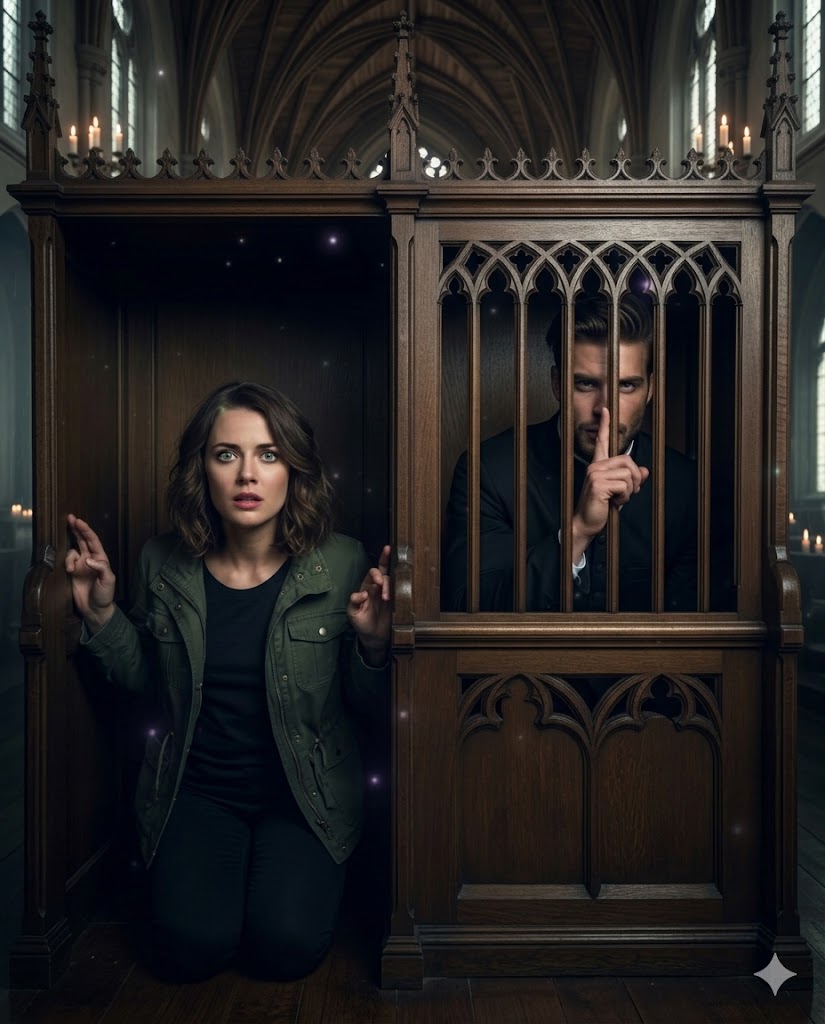
She Confessed to a “Priest” — He Was Actually The Mafia Boss Hiding…
Part 1: The Confessional Shadow
Six months of dead ends had brought me to this moment, standing outside Santa Maria della Vittoria on a Tuesday night in October. Rain turned the cobblestones of Boston’s North End into black mirrors, reflecting the flickering neon signs of pastry shops and Italian delis that refused to sleep. The church loomed above me, a jagged silhouette of dark stone and Gothic arches, its windows empty and hollow at eleven PM. Any sensible person would have been home, tucked under a warm duvet. But three women had walked through those heavy oak doors over the last year and never walked out again. I was done being sensible.
Rachel, my editor at The Vanguard, had approved the story three weeks ago, though her eyes had been clouded with worry. “Just be careful, Megan,” she’d said, pushing her reading glasses into her messy gray hair. “Missing persons cases in the North End have a way of getting messy. If there’s really something wrong with that parish, you’re walking into the mouth of a lion.” I’d promised to check in every hour. I’d promised not to do anything stupid. Two out of three wasn’t a bad track record for me.
I pulled my waterproof jacket tighter against a wind that cut down Hanover Street, carrying the scent of garlic, rain, and old salt. My camera bag felt like a lead weight on my shoulder. I wasn’t here for photos—not yet—but the equipment was a security blanket. The last woman to vanish, Lauren Scott, had been captured on a grainy bodega security feed across the street. At 9:47 PM on a Friday, she’d climbed the stone steps and disappeared inside to find a confessional. She was twenty-six, a software engineer with a bright future and zero reasons to run away. She never came out the front door.
The police had done their sweep. Father Antonio, the seventy-six-year-old priest, had a heart of gold and joints of rust. He’d been in the rectory sleeping during all three disappearances. The church had no side exits that weren’t bolted from the inside, save for a sacristy door that led to a dead-end alley. The case had gone cold, filed away under “unexplained” while the families fell apart.
I tested the iron handle of the main door. It turned with a heavy, oiled groan. It shouldn’t have been unlocked. North End churches usually shuttered by nine. I slipped inside, the sudden silence of the nave hitting me like a physical blow. The air was thick with the smell of centuries: beeswax, cold marble, and frankincense. A few votive candles flickered near the altar, their orange tongues casting long, dancing shadows of saints against the peeling plaster.
My sneakers squeaked on the marble floor as I moved toward the left aisle. The confessionals stood there like three dark, wooden sentinels. They were old-school: heavy oak structures with velvet curtains and carved screens. I headed for the middle one—Lauren’s booth. I pulled out my phone, using the dim light of the screen to guide my way.
I stepped into the penitent’s side. It was cramped, smelling of dust and old prayers. I ran my hands over the wood, searching for the impossible. A trapdoor? A sliding panel? My fingers traced the molding, the baseboards, the floor beneath the kneeling cushion. Nothing. It was solid wood.
Then, I heard it.
A breath. Not mine. It came from the other side of the carved wooden screen, in the priest’s chamber. My heart hammered against my ribs so hard it felt like it would bruise. I wasn’t alone. Someone was sitting in the darkness of the booth at eleven o’clock on a Tuesday night.
“Have you come to confess?” The voice was male, deep and resonant, but it didn’t have the thin, shaky timber of Father Antonio. This voice was young. It was sharp. It sounded like a blade being drawn from a sheath.
Every survival instinct I’d honed covering war zones told me to bolt. But the journalist in me—the part that demanded to know why Lauren never went home—kept me pinned to the kneeler.
“Yes, Father,” I whispered, keeping my voice steady. “I’ve come to confess.”
“Then tell me your sins,” the voice replied. The ritual words were right, but the delivery was wrong. There was no pastoral warmth, only a focused, predatory stillness.
“I’ve lied to get the truth,” I improvised, drawing on childhood memories of Sunday school. “I’ve put myself in danger without thinking of the people who love me. I’ve searched for things that were meant to stay hidden.”
There was a long silence from the other side of the screen. I could barely make out a silhouette through the lattice—a dark shape that didn’t move.
“What kind of truth is worth such a high price, Megan?”
He used my name.
Cold dread flooded my stomach. I hadn’t introduced myself. He couldn’t see me through the screen. Before I could process the terror of being known by a stranger in the dark, the main doors of the church were thrown open with a violent crash.
Heavy footsteps thundered onto the marble. Voices shouted in Mandarin—sharp, aggressive commands that echoed off the vaulted ceiling. Flashlights cut through the darkness, the beams sweeping the pews like searchlights.
“Don’t move,” the voice in the booth hissed. It wasn’t a request; it was a command. “Lower your head. If they find you, we’re both dead.”
Through the gaps in the confessional door, I saw four men in dark tactical gear moving down the center aisle. The light glinted off the barrels of suppressed submachine guns. They weren’t looking for a priest. They were hunting.
I pressed myself into the corner of the booth, my lungs burning as I tried to breathe without making a sound. The footsteps grew louder. One of the men stopped right outside my door. I could see the tips of his combat boots. My phone vibrated in my pocket—Rachel checking in. The buzz sounded like a chainsaw in the silence.
The shadow in the priest’s side of the booth shifted. I heard the faint metallic snick of a safety being flicked off.
The man outside the door reached for the handle.
Part 2: The Verciani Protocol
The handle turned. The wooden door of the confessional creaked open an inch, letting in a sliver of harsh white light from the hunter’s flashlight. I squeezed my eyes shut, bracing for the impact, for the hands that would drag me out.
Suddenly, a massive crash erupted from the far side of the altar. A heavy candelabra had been toppled, the sound echoing like a grenade through the empty church. The man outside my booth shouted something in Mandarin and sprinted toward the noise, joined by his three companions.
“Now,” the voice in the booth whispered.
The center partition of the confessional—the wall I thought was solid oak—slid sideways with the silent grace of a precision-engineered machine. A hand reached through the darkness, gripping my arm with fingers like iron. Before I could scream, I was pulled through the opening and into the priest’s chamber.
But we didn’t stay there. The floor beneath the priest’s seat was already tilted down, revealing a stone staircase that descended into the bowels of the North End. We slipped through, and the floor leveled above us just as a hail of gunfire chewed into the wooden booths upstairs.
The man didn’t let go of my arm. He dragged me down the steps, his movement confident and fast. We were in a tunnel, the walls made of old brick and damp earth, smelling of the harbor and rot. He finally stopped twenty feet down, clicking on a small tactical light.
He wasn’t a priest. He was wearing a black cassock, but it was unbuttoned at the top, revealing a white t-shirt stained with what looked like fresh blood. He was in his early thirties, with a jawline that could have been carved from the marble upstairs and eyes so dark they looked like ink. They weren’t the eyes of a holy man. They were the eyes of someone who lived in the shadows of the world’s rules.
“Who are you?” I gasped, shaking his hand off my arm. “Who were those men?”
“I’m the reason you’re still breathing,” he said, his voice flat. “As for them, they’re the Green Dragon Triad. And you just walked into the middle of a territorial execution.”
“The missing women,” I said, my journalistic brain finally catching up to my adrenaline. “Lauren Scott. Did you take them? Is this tunnel how you did it?”
He leaned against the brick wall, the light from his torch illuminating a jagged scar running from his ear to his throat. “I didn’t take them. But I know who did. And if you want to find them, you need to stop acting like a reporter and start acting like a ghost. Because if the Triad finds out you saw their faces tonight, there won’t be a fourth missing woman. There will just be a body in the Charles River.”
“I’m Megan Foster,” I said, trying to reclaim some shred of my dignity. “I cover the crime beat for The Vanguard. You used my name in the booth. How?”
“I’ve been following you for three days, Megan. Ever since you started asking questions at the docks.” He checked a heavy watch on his wrist. “My name is Christopher Verciani. And whether you like it or not, you’re now under my protection.”
Verciani. The name hit me like a bucket of ice water. The Verciani family was the shadow government of the North End. They were old-school Italian mafia, the kind people whispered about but never dared to name in print.
“I don’t need protection from the mob,” I hissed.
“You do when you’re being hunted by people who don’t have a code,” Christopher replied. He gestured down the tunnel. “This way. This passage leads to a warehouse near Long Wharf. We need to move before they find the override.”
We walked in silence, the only sound the rhythmic dripping of water and our echoing footsteps. The tunnel was a marvel of colonial engineering, reinforced with modern steel beams in places. It was part of the “Secret Boston” legends, the smuggling routes used by rum runners and patriots alike.
“Why do you care?” I asked after a mile. “Why rescue me? Why look for these women?”
Christopher stopped, turning to look at me. The harsh light of the torch made him look like a demon in the dark. “Because Santa Maria della Vittoria is on my family’s land. People don’t vanish from my streets without my permission. The Triad is using my church as a recruitment center for a human trafficking ring. They’re stealing from my neighborhood. And in the North End, that’s a sin no priest can forgive.”
“Where are they?”
“I think they’re being held on a cargo ship currently docked at Pier 7,” he said. “But the Triad has a mole in the BPD. Every time I move, the cops show up or the ship prepares to sail. I needed someone they wouldn’t expect. A civilian. Someone with enough grit to go where my men can’t.”
“You want me to go in there?” I asked, incredulous.
“I want you to use that camera you’ve been lugging around. I need proof of the women’s location to trigger a federal response. A Verciani call to the FBI gets ignored. A front-page photo by Megan Foster? That brings the cavalry.”
We reached a heavy metal door at the end of the tunnel. Christopher pulled a key from his cassock and turned the lock. As the door opened, the smell of salt and diesel fuel flooded in. We were in the basement of a shipping warehouse.
Two men in dark suits stood there, weapons drawn. When they saw Christopher, they lowered their guns instantly.
“Christopher,” one said, looking at me with suspicion. “The scouts say the Triad is sweeping the church. They’re pissed.”
“Let them be pissed,” Christopher said, stepping into the room. He turned to me, his expression unreadable. “You have one hour to decide, Megan. I have a car waiting to take you to a safe house. You can hide there until this blows over, or you can get in the back of my SUV and we go to Pier 7. You get your story. I get my streets back. But I can’t guarantee you’ll walk out of that harbor alive.”
My phone buzzed again. It was a text from Lauren Scott’s mother. Please tell me you found something. Please.
I looked at Christopher Verciani, the man who represented everything I’d spent my career fighting against. And then I looked at my camera bag.
“I’ll need a fresh battery,” I said.
Christopher nodded, a ghost of a smile touching his lips. “Welcome to the family, Megan.”
But as we moved toward the elevator, a frantic voice crackled over the guard’s radio. “Boss! We’ve got a problem. The ship at Pier 7… it’s not a freighter. It’s a decoy. They’re moving the women to the old North End tunnels right under the police station.”
Christopher froze. The trap wasn’t for him. It was for everyone.
Part 3: The Labyrinth of the Law
The air in the warehouse basement suddenly felt fifty degrees colder. Christopher Verciani’s face hardened into a mask of granite. He grabbed the radio from his man’s hand.
“Repeat that, Leo. Where are they?”
“The old sub-basement of the Saltonstall building,” the voice crackled. “The tunnels that connect to the old courthouse. We saw a transport van enter the loading dock ten minutes ago. It didn’t come out. The women are being moved into the city’s own foundation.”
Christopher swore under his breath, a string of Italian that sounded like a prayer for violence. He looked at me, his eyes searching my face for the moment I’d break. “The police station? That’s not just the Triad. That’s a high-level play. If they’re under the courthouse, they’re using the ‘Blue Shield’ as a literal fortress.”
“You said they had a mole in the BPD,” I reminded him, my voice tight. “But this sounds like the whole damn building is in on it.”
“Not the whole building,” Christopher said, shedding the black cassock to reveal a tactical vest underneath. He grabbed a heavy handgun from a locker and checked the chamber with a practiced, three-count rhythm. “But enough of the brass to make it work. The tunnels under the courthouse were supposed to be sealed during the Big Dig. If they’re open, it’s because someone with a badge wanted them open.”
He turned to his men. “Get the Breaching Kit. And call Joseph. Tell him we’re going in through the sewer main on Sudbury Street. We don’t use the Verciani cars. Use the plumbers’ van.”
“What about her?” the guard asked, pointing at me.
“She’s the witness,” Christopher said. “If we go in there and shoot up a government basement, we’re the terrorists. If Megan captures them holding Lauren Scott in a cage under the Sheriff’s office, we’re the heroes of the week.”
He grabbed my bag and tossed it to me. “Stay behind me. If I tell you to drop, you hit the floor. If I tell you to run, you don’t look back for me. Understood?”
“Understood,” I said, though my hands were shaking as I checked my SD cards.
We piled into a beat-up white van labeled North End Plumbing & Gas. The drive through the narrow, rain-slicked streets was a blur of neon and adrenaline. Christopher sat in the back with me, the dim light of the van’s interior making his features look sharp and dangerous.
“Why are you really doing this, Megan?” he asked quietly as we turned onto Congress Street. “You could have stayed in that safe house. This isn’t just a story for you.”
“Lauren Scott was my friend’s sister,” I admitted, looking at the silver compass rose necklace at my throat. “I told her mother I wouldn’t stop. I’ve spent my life watching powerful men take things that don’t belong to them because they think no one is looking. I’m tired of being the person who just writes the obituary after the fact.”
Christopher studied me for a long moment. “My father used to say that the only difference between a saint and a sinner is who’s telling the story. Tonight, you’re the one with the pen.”
The van jolted to a stop. We were in a dark alley behind a row of brutalist government buildings. The rain was coming down in sheets now, masking the sound of the van’s doors opening. Christopher and three of his men slipped out, carrying heavy bags. They moved with the terrifying, synchronized grace of professional soldiers.
We reached a heavy iron grate in the pavement. Within seconds, one of the men had it open. We descended into the dark, the smell of storm runoff and old stone rising to meet us. This wasn’t the clean, historical tunnel from the church. This was the city’s gut—slimy, echoing, and freezing.
We waded through ankle-deep water for what felt like miles. Christopher led the way, his tactical light cutting through the gloom. He stopped at a brick wall that looked like a dead end. He felt along the mortar, found a loose brick, and pressed it. A heavy iron door, hidden behind a layer of faux-masonry, swung inward.
“Welcome to the Tombs,” Christopher whispered.
We were in a corridor of vaulted stone. To the left were holding cells that looked like they hadn’t been used since the nineteenth century. But as we moved deeper, the air changed. It became warm. I heard the low hum of high-end air conditioners and the rapid-fire clack-clack-clack of keyboards.
Christopher signaled for us to stop. He peeked around a corner and then pulled back, his face grim. He leaned into my ear. “There are six guards. Triad enforcers. And there’s a man in a suit talking to them. Captain Miller from the Organized Crime Task Force.”
My blood ran cold. Miller was the man who had been giving me the “dead end” updates for months. He was the one who had comforted Lauren’s mother.
“Take the shot,” Christopher whispered. “The photo. Not the bullet.”
I crept to the edge of the corner, my heart in my throat. I raised my camera, adjusted the ISO for low light, and peered through the viewfinder.
There they were. In a room that looked like a high-tech server farm, three women—Lauren, Samantha, and Brittany—were chained to workstations. Their faces were hollow, their eyes red-rimmed from exhaustion. They were speaking into headsets in Mandarin, their fingers flying across screens filled with cryptocurrency ledgers.
Captain Miller stood over Lauren, his hand on her shoulder in a way that made my skin crawl. He was laughing with a man whose neck was covered in green dragon tattoos.
Click.
The silent shutter of my professional camera went off. I moved the focus to Miller’s face, capturing the badge on his belt and the Triad leader’s hand on a stack of cash.
Click. Click.
“I’ve got it,” I breathed, pulling back. “I’ve got Miller. I’ve got the women.”
“Good,” Christopher said. He looked at his men. “Now we do it my way.”
He didn’t wait. He stepped around the corner, his suppressed weapon raised. “Captain Miller! I believe you’re in violation of your oath of office.”
The room exploded into motion. Miller lunged for his holster. The Triad guards scrambled for their rifles. Gunfire—muffled thuds and the whine of ricochets—shattered the high-tech silence.
Christopher pushed me behind a server rack. “Stay down!”
I watched through the gaps in the hardware as the Verciani men moved with lethal efficiency. It wasn’t a fight; it was an extraction. Christopher reached Lauren first, his knife flashing as he cut the zip-ties on her wrists.
“Megan! Help them!” he roared over the noise of the skirmish.
I ran to Lauren, pulling her to her feet. She looked at me, her eyes wide with shock. “Megan? How…?”
“Don’t talk, just move!” I grabbed Samantha and Brittany, urging them toward the tunnel door.
But as we reached the exit, a heavy iron gate slammed down, cutting us off from the way we came. Red emergency lights began to pulse, and a siren wailed through the sub-basement.
“The building’s on lockdown!” Brittany screamed.
Christopher stood in the center of the room, his weapon pointed at the wounded Captain Miller. From the speakers above, a distorted voice rang out.
“Mr. Verciani. You were a fool to come here. You’ve just walked into the state’s most secure vault. And now, none of you are ever leaving.”
The walls began to hiss.
“Gas!” Christopher shouted. “Megan, the vents! Get the women into the server cooling room—it’s airtight!”
He looked at me, his face pale under the red lights. “The camera, Megan. You have to get those photos out. If we die here, the truth dies with us.”
He threw me a small, encrypted satellite transmitter. “Sync the SD card! Do it now!”
I fumbled with the tech, my lungs beginning to sting. Just as the bar hit 99%, the door to the cooling room was kicked open from the inside.
But it wasn’t a rescuer. It was Father Antonio, holding a shotgun.
Part 4: The Judas Priest
The sight of Father Antonio—the gentle, arthritic priest I’d dismissed as a non-player—standing in the server room with a double-barreled shotgun was the final fracture in my reality. He didn’t look seventy-six anymore. He stood tall, his eyes clear and devoid of the “holy fog” he’d projected for months.
“Megan,” he said, his voice surprisingly deep. “I told Father Verciani over there that you were a persistent little bird. I should have clipped your wings at the church.”
Christopher didn’t lower his gun from Miller, but his eyes flicked to the priest. “Antonio. My father trusted you. He gave you that parish to keep the neighborhood safe.”
“Your father was a dinosaur, Christopher,” Antonio spat. “He believed in territory. The Triad believes in the world. They pay in digital gold that doesn’t need to be laundered through a bakery or a construction site. They don’t care about the North End. And neither do I.”
The gas was thickening now, a pale yellow mist rolling across the floor. My chest felt like it was being squeezed by an invisible hand. I looked at the satellite transmitter. Upload Complete.
“Rachel has the photos,” I croaked, the words burning my throat. “It’s over, Antonio. The magazine is going live in five minutes.”
“Then you’ll be a martyr for the press,” Antonio replied, leveling the shotgun at my chest. “And Christopher will be the mobster who went crazy and murdered a cop and three innocents in a courthouse basement. The narrative is already written.”
Christopher moved. He didn’t fire at the priest; he fired at the overhead fire-suppression pipes.
The room was instantly plunged into a torrential downpour of freezing, chemically-treated water. The water hit the hot servers, creating a wall of steam that blinded everyone. In the chaos, I heard the boom of the shotgun, the lead shot whistling past my ear and shattering a glass monitor.
A hand grabbed the back of my jacket and hauled me into the cooling room. Christopher slammed the heavy steel door, locking the priest and the gas outside. Lauren, Samantha, and Brittany were already inside, huddled in the corner near the massive intake fans.
“You okay?” Christopher asked, his breath coming in ragged gasps. He was bleeding from a graze on his forehead.
“I can’t… breathe…” I wheezed.
He grabbed an oxygen canister from an emergency kit on the wall and pressed the mask to my face. The first hit of pure O2 felt like liquid life. I handed the mask to Lauren, then to the others.
“We’re trapped,” Samantha whispered, her voice trembling. “There’s no other way out of here. This is a dead end.”
Christopher was looking at the floor. Not the marble, but the heavy-duty reinforced concrete. He moved to the center of the room where the main cooling pipes descended into the ground.
“The church tunnels,” he muttered. “The colonial maps showed a branch that ran under the old jail. This server room was built on top of the old foundation.”
He looked at me, a desperate, wild light in his eyes. “Megan, the Breaching Kit. Give me the C4.”
“You’re going to blow up the courthouse?” I asked, my voice high and thin.
“I’m going to blow a hole into the eighteenth century,” he replied.
He moved with the speed of a man who knew his minutes were numbered. He packed the plastic explosives around the base of the cooling intake. He wired the detonator to his watch.
“Everyone! Against the far wall! Cover your ears and open your mouths!”
We huddled together—a journalist, a mafia boss, and three terrified tech experts. Christopher counted down. Three. Two. One.
The explosion didn’t sound like a bang. It was a deep, bone-shaking thud that felt like the world was being torn in half. The floor vanished in a cloud of gray dust and pulverized stone. For a second, there was only silence and the ringing in my ears.
Then, the intake fans groaned and fell through the hole.
Christopher peered over the edge. “It’s open! The old drainage vault!”
He helped the women down first. They disappeared into the dark abyss. Then he looked at me. “Give me the camera bag, Megan. I’ll carry it.”
“No,” I said, clutching it to my chest. “It stays with me.”
He nodded, a flash of respect in his dark eyes. “Then jump.”
I dropped into the darkness. I hit cold, stagnant water with a splash that sent a foul stench into my nose. I was in a stone tunnel, the roof barely a foot above my head. Christopher landed beside me a second later.
“Move!” he hissed. “The building above us is going to be unstable. We have five minutes before the tactical teams find the hole.”
We waded through the waist-deep sludge, the women holding onto each other in front of us. The tunnel was narrow and curved, a relic of a Boston that had been forgotten by time. We turned a corner and saw a glimmer of light—not orange like the church candles, but blue.
A flashlight.
“Stop,” Christopher signaled. He raised his gun.
“Christopher? Is that you?” The voice was Teresa’s.
We emerged into a wide, dry chamber. Teresa was there, along with Joseph and three other Verciani men. They were holding rifles and high-powered torches. They were in the secret passages under the North End wharves.
“We saw the police activity on the scanners,” Joseph said, his face pale. “We knew you’d use the drainage route if things went bad. The SUV is waiting at the end of the slip.”
“The women?” Christopher asked.
“Safe,” Joseph confirmed. “We have a medical team waiting at the Cape Cod house.”
Christopher turned to me. The adrenaline was finally leaving him, and he looked ancient. “Go with them, Megan. Get your story out. Give the names to the feds. All of them. Miller, Antonio, the Triad leaders.”
“What about you?” I asked, looking at the blood on his shirt.
“I have business to finish in the North End,” he said. “A priest needs to be defrocked. And a family legacy needs to be cleaned.”
“Christopher, wait,” I said, reaching out to touch his arm. “If I tell the truth… I have to tell it all. I can’t leave you out of it.”
He looked at my hand, then up at my face. The rain from upstairs had washed away the “priest” act, leaving only the man. “I know. My father always told me the truth is a debt that always gets paid. Just make sure you spell my name right, Megan.”
He turned and disappeared back into the darkness of the tunnels.
Joseph led us to the surface. As I stepped out into the cold October rain on the wharves, my phone erupted. Hundreds of notifications. The Vanguard website had crashed from the traffic. The photos of Captain Miller were on every news station in the country.
I looked at the water of the harbor, dark and churning. Lauren hugged me, her tears mixing with the rain. “You did it, Megan. You found us.”
“We found you,” I whispered.
But as I watched the blue and red lights of the police cruisers converge on the wharves, I realized I hadn’t seen the last of Christopher Verciani.
Because three days later, my editor Rachel called me into her office. “Megan, the FBI wants to talk to you. But they’re not interested in the Triad anymore.”
“What are they interested in?”
She slid a file across the desk. It was a photo of Christopher, taken ten years ago in Italy. “They want to know why a man who died in a Sicilian prison in 2014 is currently running the North End of Boston.”
Part 5: The Resurrection of the Dead
The FBI interrogation room was a windowless box of beige paint and fluorescent lights that buzzed with a headache-inducing frequency. Across from me sat Agent Vance—a man who looked like he’d been ironed flat, from his crisp white shirt to his humorless expression.
“Mr. Verciani is a ghost, Ms. Foster,” Vance said, tapping a pen against a grainy black-and-white photo. “Christopher Verciani died in the Ucciardone prison in Palermo. There’s a death certificate. There’s a grave in a little town outside Corleone. So, who was the man who rescued you from that basement?”
I leaned back, the silver compass rose necklace cool against my skin. I remembered the way Christopher had checked his magazine—the three-count rhythm. I remembered the scar on his throat.
“He’s a man who saved three women from a human trafficking ring when your department was busy ignoring the case,” I said, my voice level. “He’s the man who exposed a high-ranking BPD captain and a corrupt priest. Does it really matter what name he uses?”
“It matters to the international community,” Vance replied. “Because if he’s who we think he is, he’s not just a North End mobster. He’s the heir to the Verciani-Corso alliance. He’s the man who disappeared with forty million dollars of laundered Interpol funds right before his ‘death’.”
I felt a prickle of unease. “What if he was framed?”
“In his world, everyone is framed, Megan.” Vance leaned forward. “He used you. He needed a legitimate voice to blow the lid off the Triad so he could seize their territory without the feds breathing down his neck. You weren’t his partner. You were his PR firm.”
“Is that why Captain Miller was trying to kill us?” I countered. “Because he was part of Christopher’s PR plan?”
Vance didn’t blink. “Miller was a loose end. A man who got greedy and played both sides. Christopher didn’t save you out of the goodness of his heart. He saved you because you were the only shield he had left.”
They kept me for six hours. They threatened me with obstruction. They questioned my ethics. But they didn’t have the one thing that mattered: Christopher’s location. I’d told them the truth—that he’d disappeared into the tunnels. I just hadn’t told them about the Summer House in Cape Cod.
When I was finally released, the sun was setting over the Charles River, painting the water in bruises of purple and gold. I walked back to my apartment, scanning every face in the crowd. I was looking for him, but I was also looking for the men who might be looking for him.
My apartment had been tossed. Not a violent, messy ransacking, but a professional sweep. My files were in order, but the dust patterns were wrong. My back-up hard drives were gone.
On my pillow sat a small, handwritten note.
The FBI is right about one thing, Megan. I am a ghost. But even ghosts have things they care about. Meet me at the Old North Church at midnight. Come alone. – C
I didn’t call Rachel. I didn’t call Detective Mitchell. I grabbed my camera bag and my mother’s compass and walked out the door.
The Old North Church stood silent and regal in the heart of the district, its white steeple a beacon against the dark sky. Midnight in October was freezing, the air smelling of old wood and the approaching winter. The doors were locked, but I remembered the “Verciani Protocol.” I moved to the side entrance, the one near the gardens.
A shadow detached itself from the brick wall.
“You’re late,” Christopher said.
He wasn’t wearing a cassock or a tactical vest. He was in a well-tailored dark suit that made him look like the businessman Vance had described. His forehead was bandaged, and his eyes were tired, but they held that same piercing intensity.
“The FBI thinks you’re a dead man from Sicily,” I said, my voice echoing in the small courtyard. “They think you stole forty million dollars.”
“I did,” he said, stepping into a pool of yellow streetlight. “But I didn’t steal it from Interpol. I stole it from the men who killed my family. The men who used that money to fund the very Triad you just helped me destroy.”
“Vance says you used me.”
Christopher stepped closer, the scent of his cologne—sandalwood and expensive tobacco—filling my senses. “I used your courage, Megan. I needed someone who cared more about those women than about their own safety. If I’d told you the whole truth, you would have hesitated. And hesitation would have gotten Lauren killed.”
“Why the church?” I asked, looking up at the steeple. “Why are we here?”
“Because it’s the only place in this city where I can show you the beginning,” he said.
He led me inside, his key turning the lock with the same practiced ease. We didn’t go to the nave. We went to the crypt—the dark, silent space beneath the floorboards where the city’s founders lay in rest.
He stopped at a tomb marked Verciani – 1892. He pressed a stone on the side, and the slab slid away to reveal a hidden compartment. Inside wasn’t gold or money. It was a stack of ledgers, old and new.
“This is the real history of the North End,” Christopher said. “My family didn’t just build these streets; we protected them. Every business that paid ‘protection’ money was actually paying into a fund that kept the Triad, the cartels, and the corrupt politicians out. We were the wall.”
He handed me the top ledger. “Look at the last five years.”
I opened it. The entries weren’t for “protection.” They were for school tuitions. Hospital bills. Legal fees for people who couldn’t afford a defense. The “stolen” forty million hadn’t been hoarded. It had been distributed, dollar by dollar, into the veins of the neighborhood.
“You’re a social worker with a gun,” I whispered, the absurdity of it hitting me.
“I’m a man who knows that the law is a luxury the poor can’t afford,” he replied. “But now, the wall is crumbling. The FBI is here, the Triad is regrouping in New York, and my name is on every agency’s watch list.”
He took my hand, his palm warm and steady. “I’m leaving tonight, Megan. For good. I’m going back to the shadows where ghosts belong. But I want you to have this.”
He handed me a small, encrypted flash drive. “Everything. Every name, every bank account, every corrupt official in Boston and beyond. It’s the story of a lifetime. It will make you the most famous journalist in the world. And it will protect you. Because as long as you have this, they can’t touch you.”
“Why give it to me?”
“Because you’re the only one I trust to tell the story right,” he said. He leaned in, his forehead resting against mine for a fleeting, intense second. “And because I want you to remember that not every monster is what he seems.”
“Christopher—”
“Don’t,” he whispered. “The FBI is two blocks away. They tracked your phone.”
He turned and melted into the darkness of the crypt, disappearing through a passage I couldn’t see.
I stood there alone, the ledgers of a hundred years at my feet and the secrets of a city in my hand. Seconds later, the doors burst open. Flashlights flooded the room.
“FBI! Hands in the air!”
I raised my hands, the flash drive clutched tightly in my palm.
Vance stormed in, his face red with fury. “Where is he? Where’s Verciani?”
I looked at the empty tomb, then at the man who thought he knew everything.
“He’s gone,” I said, a slow smile spreading across my face. “But he left you a message.”
“What message?”
I raised my camera, which I’d been recording with the whole time. “He said you should have checked the metadata.”
Part 6: The Long Game of Justice
The following six months were a blur of courtrooms, subpoenas, and the kind of fame that feels like a prison. My article, “The Architects of the Shadow,” didn’t just land like a bomb; it leveled the entire political landscape of Massachusetts.
The flash drive Christopher had given me was a map of a cancer that had been eating the city for decades. Fourteen judges resigned. The Lieutenant Governor was indicted. Captain Miller took a plea deal that put him away for forty years. And Father Antonio? He vanished the night of the warehouse explosion, his parish left empty and cold.
The FBI never found the forty million dollars. And they never found Christopher Verciani.
I’d moved to a new apartment, one with a view of the harbor and a security system that Joseph—who was now “retired” and running a legitimate security firm—had personally installed. I still wrote for The Vanguard, but my stories were different now. They weren’t just about crime; they were about the people left behind in the wake of it.
Lauren, Samantha, and Brittany had recovered, their lives slowly knitting back together. They’d started a non-profit for trafficking survivors, funded by an anonymous donor in Sicily. I visited them every week, our bond forged in the steam of that server room.
But every night, I still scanned the crowds. I still looked for a man in a dark suit with ink-black eyes.
On a rainy Tuesday in April, exactly six months after the night at Santa Maria della Vittoria, I received a package at the office. No return address. Inside was a single, vintage film reel and a note.
History is a circle, Megan. Sometimes you have to go back to the beginning to see the end. Meet me where the bells first rang. – C
The bells. The Old North Church.
I went there at midnight, the district quiet and smelling of spring rain. The church was dark, but the steeple bell began to toll—a slow, rhythmic sound that echoed through the empty streets.
I climbed the narrow wooden stairs to the bell tower, my breath hitching as the air grew thinner and colder. At the top, standing among the massive bronze bells, was a figure.
He was wearing a simple pea coat and jeans. He looked younger, his face tanned by a sun that didn’t shine in Boston. The scar on his throat was still there, a white line against his skin.
“You came,” he said, the tolling bell vibrating through his voice.
“I always come for a good story, Christopher,” I said, my heart pounding with a joy I didn’t want to admit.
“The FBI thinks you’re in Brazil,” I continued, stepping into the tower’s center. “They spent three months searching the favelas for a ‘dead’ Italian.”
“I like Brazil,” he smiled, and for the first time, it reached his eyes. “But it’s too loud. I missed the quiet of the North End.”
“You can’t stay here. The warrant is still active. Vance is obsessed with you.”
“I know. I’m not staying.” He walked to the edge of the tower, looking out at the city lights. “I’m here to say goodbye. Properly this time.”
“Where are you going?”
“To a place where ghosts can be useful,” he said. He reached into his pocket and pulled out a small silver key. “This belongs to a house in the mountains of Abruzzo. It’s quiet. There are no Triads. No corrupt priests. Just olive trees and the wind.”
He handed me the key. “It’s titled to Megan Foster. A gift for the woman who saved my soul.”
“Christopher, I can’t take this. I have a life here. I have a career.”
“I’m not asking you to leave, Megan. I’m asking you to have a place where you can be safe. A place where the world can’t find you if the stories get too dangerous.”
He stepped closer, his hand cupping my cheek. His skin was rough, smelling of salt and the sea. “You’re the bravest person I’ve ever known. And the most stubborn. Promise me you won’t stop looking for the truth.”
“I promise,” I whispered.
He leaned in and kissed me—a slow, lingering kiss that tasted of rain and regret and a future that could never be. When he pulled away, his eyes were wet.
“Spell my name right, Megan,” he said.
Then he turned and climbed over the railing, disappearing into the dark. I ran to the edge, looking down, but there was nothing but the shadows of the graveyard below.
I stood in the bell tower for a long time, the wind whipping my hair and the silver key heavy in my hand. I looked out at the city—my city—and realized that the story wasn’t over.
It was just starting a new chapter.
Because when I got back to my apartment, my phone buzzed with an alert. A new missing persons case. A woman vanished from a subway station in East Boston.
I grabbed my camera bag and my mother’s compass. But as I reached for the door, I noticed a small detail I’d missed on the silver key.
Engraved on the back were three numbers. 4-0-2.
The tomb in the crypt.
I didn’t go to the subway station. I went back to the church. I went to the crypt, my heart racing as I found the Verciani tomb. I used the key on the stone I’d seen Christopher press months ago.
The slab slid away. Inside wasn’t a ledger.
It was a passport. A new identity for me. And a ticket to Rome, departing in four hours.
Next to it was a photo of the house in Abruzzo. And a note in his angular hand.
The woman in the subway? She isn’t missing, Megan. She’s waiting for you at the airport. She has the rest of the Interpol funds. And she has a story that will burn the world down.
I looked at the photo, then at the passport. Then I looked at the dark tunnels stretching out into the heart of the city.
“Two out of three isn’t bad,” I whispered to the ghosts of the crypt.
Then I turned and ran toward the light.
The End.









