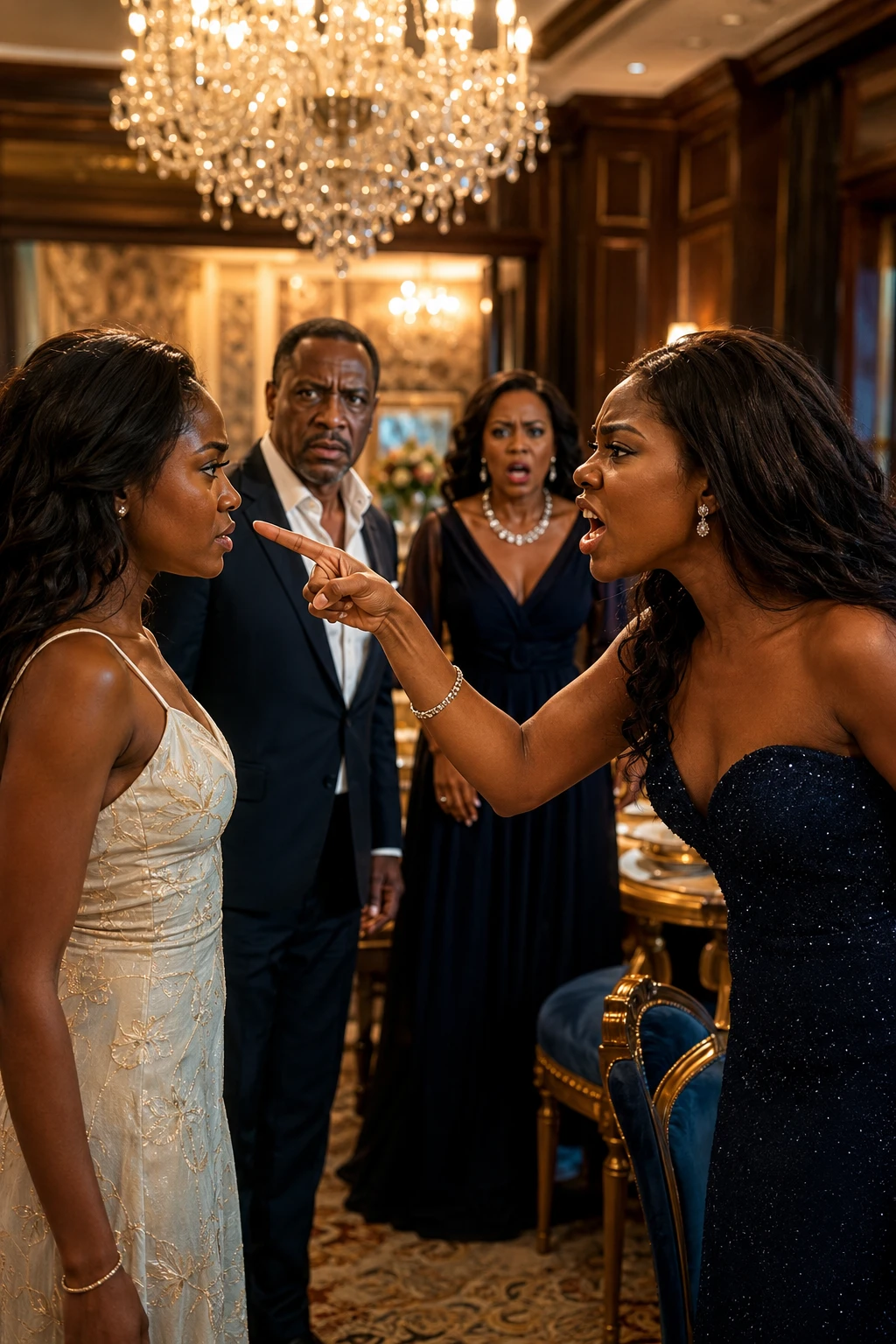
She Was Forced To Marry A Poor Village Farmer Unaware He Is The Richest Man Alive
Part 1: The Dying Wish and the Midnight Decree
Before she drew her last breath, Mrs. Obiora bound her household with a double vow. It was not a traditional betrothal, but a heavy debt of the past. One daughter, she decreed, would marry into the Bellow family—a name synonymous with city wealth, concrete empires, and untouchable prestige. The other would marry the son of a humble village woman, a stranger who had physically shielded baby Kemi when a sudden fever threatened to extinguish her fragile life decades ago.
Years dissolved into memory. The mother passed, but the shadow of her promises hung over the Obiora estate like an unshakeable fog.
Chica, the first daughter, sat at her father’s antique mahogany desk. At twenty-six, she was the quiet anchor of the house—soft-spoken, diligent, and accustomed to bearing the silent weight of family expectations. Her eyes were deep, carrying a sorrow that predated her mother’s death.
Mr. Obiora cleared his throat, breaking the heavy silence of the study. His face was etched with exhaustion. “Chica, you know of your mother’s dying requests. The time has come to fulfill them.“
“Yes, Daddy,” she replied, her voice barely a whisper.
“I have decided. You will marry into the Bellow family. Kemi will marry the son of the village farmer.“
Chica blinked, her heart tightening—not out of a desire for city luxury, but because she knew the storm her sister would unleash. Before she could voice a warning, the heavy oak door swung open.
Kemi stood in the threshold. At twenty-four, she was a masterpiece of sharp angles and fiery ambition. Her beauty was undeniable, but it was edged with a fierce, demanding pride that commanded the room—rarely in a gentle way.
“Why is Chica called in alone?” Kemi demanded, her eyes darting between father and daughter.
Mr. Obiora sighed. “You are here just in time, Kemi. I am finalizing the marriage arrangements.“
Kemi crossed her arms, her posture defensive. “What arrangements?“
“The Bellow family will take Chica,” their father said deliberately. “You will marry the farmer’s son.“
Kemi stared at him, then threw her head back, her laughter brittle and mocking. “You must be losing your mind. I am not joking,” Mr. Obiora warned, his expression darkening.
“There is absolutely no way,” Kemi hissed, stepping forward. “No way Chica gets to live in a mansion in the city while I am banished to the mud and huts of a village!“
“Mind your tone, young lady,” Mr. Obiora snapped.
“How should I speak? You want to throw me into poverty to give Chica the golden life?“
“This is not about a golden life,” he said, his voice straining. “That village promise exists because of you. That woman saved your life when you were born premature. Your mother never forgot it.“
Kemi’s lip curled. “So, because some nameless village woman once held a blanket over me as a baby, I should pay with my entire future? Marry a man smelling of manure and soil? No.“
Mr. Obiora’s jaw tightened. “The Bellow family is not as golden as they appear. There is deep trouble there.“
“Trouble? Enough trouble for me to say no? I don’t care.” Kemi’s eyes blazed with avarice. “The Bellows are rich. They have class, comfort, and a name that opens doors. Why should Chica get that while I go and suffer?“
Chica finally spoke, her tone conciliatory. “Kemi, please. Daddy is trying to explain—”
“Stay out of it, Chica! You’re just happy you’re the one benefiting!” Kemi snapped, turning her wrath onto her older sister.
Chica fell silent, retreating into her quiet shell. Mr. Obiora looked at his youngest daughter with profound disappointment. “You are being profoundly selfish.“
“You have always favored Chica!” Kemi shouted. The pitch of her voice climbed, teetering on hysteria, before dropping into something shockingly cold and calculating. “Maybe it’s better this way. What if the Bellow family finds out Chica is barren? Will they still want her?“
The room plunged into absolute stillness. The words struck Chica squarely in the chest, stealing the breath from her lungs.
Part 2: The Coerced Swap and the Departure
The memory of why she could not bear children was an old scar, but Kemi had just ripped it wide open with surgical precision.
Years ago, during a scorching summer, Kemi—then a teenager—had fallen violently ill with mysterious internal bleeding. Their mother was dead, their father away on business. It was Chica who had carried her through the doors of the municipal hospital, weeping and begging the doctors to save her sister’s life. In the frantic, terrifying hours of that medical crisis, Chica had ignored her own escalating, agonizing stomach cramps. She had spent the last of their emergency cash on Kemi’s life-saving treatment, starving her own body of care until she collapsed on the hospital linoleum.
The resulting internal damage was catastrophic. Complications left Chica permanently unable to conceive. Kemi knew this. She knew exactly what Chica had sacrificed to save her life. Yet, here she stood, weaponizing that profound trauma to steal a husband.
Chica’s voice was barely audible. “You threw those words out very easily, Kemi.“
Kemi lifted her chin, devoid of remorse. “Was it a lie?“
Mr. Obiora pointed a shaking finger at the door. “Leave this room. Now.“
Kemi stood her ground, her jaw set. “No. I will not leave until you change the arrangement. Chica goes to the village. I will marry Tundello.“
It was the first time she dared utter the name of the Bellow heir—a man her ambitious heart had already claimed in secret.
Mr. Obiora shook his head, looking broken. “No.“
Kemi’s face morphed into desperation. She darted to the side table, snatching up the small, sharp fruit knife resting beside her father’s medicine tray.
“Kemi, no!” Chica screamed.
Mr. Obiora froze, paralyzed by terror. “Put that down!“
Kemi’s eyes were wet, but her grip on the serrated steel remained steady. “If I do not marry Tundello, I will end my life right here in this room. I swear it!“
“Stop this childish nonsense,” her father pleaded, though the color had drained from his face.
“I mean it!” she sobbed, pressing the cold tip against her own throat. “Choose Chica again, and watch what happens to me!“
Chica took a cautious half-step forward. Kemi flinched. “Don’t come near me!“
Mr. Obiora raised both hands in surrender. “Put the knife down first!“
“No! Say it first!“
The father looked at Kemi, then at Chica. Chica already knew the tragic script of their lives. He would fold. He always folded when Kemi turned violent.
After an excruciating pause, Mr. Obiora closed his eyes. “Fine. You… you will marry Tunde Bellow.“
Kemi lowered the blade, breathing heavily. Chica did not look at her father. She couldn’t. The last fragile thread of her respect for him snapped. She turned her gaze to her sister. “You win.“
Kemi wiped her tears, her lips curving into a victorious sneer. “As I should.“
Chica nodded once, a hollow motion. “Yes. As always.“
She turned on her heel and walked out of the room. That night, she packed her modest suitcase in the quiet dark. No one came to help her. No one offered a genuine apology for the emotional execution she had just endured.
By dawn, she was in the back of a town car, watching the concrete skyline of the city recede in the rearview mirror. She was being discarded to a rural outpost because her sister’s greed required a gilded cage.
After hours of winding roads, the car shuddered to a halt. The driver turned around apologetically. “Madam, this is as far as I can take you. The roads ahead are too degraded for this vehicle.“
Chica looked out the window. The path ahead was a ribbon of red dirt, choked with overgrown weeds and deep ruts. For a long moment, she sat frozen in the backseat, the weight of her suitcase mirroring the crushing despair in her soul.
Then, she pushed the door open and stepped out into the humid village air. As she stood by the desolate road, a gentle voice called out.
“You must be Chica.“
She turned. A woman in her late fifties stood there, dressed in simple, faded Ankara, but her eyes held a profound warmth.
“I am Grace,” the woman said softly, folding her hands. “Obina’s mother. Welcome, my child.“
Part 3: The Humble Home and the Billion-Dollar Farmer
The village of Umu-ogwu was a tapestry of rustling plantain leaves, small dirt compounds, and distant bleating goats—a world entirely divorced from the gleaming towers of the city.
Mama Grace efficiently flagged down a passing local motorcycle taxi, strapping Chica’s heavy suitcase across the fuel tank. The ride to the house was a jarring, bumpy affair that rattled Chica’s bones, but the sheer serenity of the landscape began to soothe her frayed nerves.
The house itself was modest. Whitewashed mud brick under a corrugated iron roof, shaded by massive mango trees. It was small, unpretentious, and undeniably simple. Sensing the shadow of disappointment crossing Chica’s face, Mama Grace patted her hand.
“It isn’t fancy, my dear, but it is home.“
Chica offered a tight, respectful smile. “I understand, Ma.“
The interior was immaculate—swept clean, smelling of local herbs and beeswax. Mama Grace immediately fussed over her, insisting she sit while she prepared a hot meal of yam pottage.
“You are far too thin,” the older woman clucked, moving around the small kitchen with practiced grace. “Did you eat before embarking on such a long journey?“
Chica shook her head.
“Ah, my son’s wife cannot enter this house with an empty stomach.” The words were spoken with a casual sincerity that made a tear slip down Chica’s cheek.
As they ate, Mama Grace spoke with disarming candor. “Village life is not easy. If, after a few weeks, you find you cannot cope, you must tell us. There is no shame in it.“
Chica looked up, her eyes wide. There was no manipulation here, no hidden daggers, just pure, radical honesty. It nearly undid her. “I don’t have anywhere else to go back to, Mama.“
Mama Grace stopped stirring the pot, walked over, and sat beside the young woman, wrapping an arm around her shoulders. “From today, you are my daughter. You have a home here.“
A profound shift occurred in Chica’s chest. It was not euphoria, but it was safety.
Later that evening, heavy footsteps crunched on the gravel outside. A deep, resonant voice called out from the doorway, “Mom? Mama, I’m home.“
Mama Grace smiled. “Obina, you are back.“
Chica stood up and froze. The man who ducked under the low lintel was not the rustic, unpolished stereotype she had braced herself for. Obina was tall, broad-shouldered, with calm, intelligent eyes and a clean-shaven face. His linen shirt sleeves were slightly rolled, revealing strong forearms. There was an aura of quiet authority and neatness about him that defied the rustic setting. He looked self-controlled, striking, and deeply grounded.
Obina’s eyes found Chica, and the hard lines of his face melted into an instant, welcoming smile. “So, this is Chica.“
“Yes, she arrived not long ago,” his mother beamed.
Obina stepped forward, his posture respectful. “I apologize for not being at the roadside to receive you. Work delayed me.“
“It’s completely fine,” Chica managed, her breath catching in her throat.
He set down his leather satchel and reached inside. “I brought something for you.“
Chica braced herself. Knowing Kemi’s narrative of the “poor village farmer,” she expected a carved wooden trinket or a cheap beaded necklace, items she would have to feign delight over. She accepted the small velvet box carefully. “Thank you.“
“Open it,” Mama Grace encouraged.
Chica lifted the lid and her breath hitched. Resting on the white satin was a heavy, intricate gold bracelet. It wasn’t costume jewelry; the weight and luster screamed unimaginable luxury. She looked up at Obina, bewildered.
“This… this must have cost a fortune. I can’t accept—”
Obina misread her hesitation. “You don’t like it? The design is simple, but I have other options if it isn’t to your taste.“
Mama Grace chuckled, stepping toward an antique cabinet. “I told him not to overwhelm the girl on her first day, but he never listens.” She pulled out a smaller, leather-bound case. “Try this one, too.“
Chica took the case, her hands trembling. When she flipped the latch, a flawless pink diamond caught the dim light of the kerosene lamp, scattering fiery pink reflections across the mud walls. Chica felt dizzy.
“If you don’t like gold, perhaps diamonds suit you,” Obina said with casual, terrifying wealth.
Chica looked from the diamond to the old chairs and the thatched roof outside. Nothing made sense. “I don’t understand,” she whispered. “I thought… I was told you were farmers.“
“We are,” Obina replied calmly.
“Then how—how can you afford this?“
Mama Grace smiled. “My son farms a lot of land.“
“How much land?” Chica asked, squinting.
“Not one or two plots,” the mother waved her hand. “Several across many communities.“
Obina offered a clarifying nod. “Farming is only the foundation. There is livestock, commercial fisheries, tourism infrastructure, and real estate investments.“
Chica stared at him. He listed multi-billion-naira industries with the same inflection one uses to describe buying groceries.
Part 4: The Gilded Cage and the Sinking Ship
While Chica was discovering that her “village farmer” was a stealth titan of industry, Kemi was experiencing the rude awakening of the urban elite.
Her wedding to Tunde Bellow had been a spectacular display of opulence—flashing cameras, crystal chandeliers, imported champagne, and a sea of high-society guests. Kemi had soaked in every second of it, viewing the marriage as the ultimate conquest over her sister. She was now Mrs. Bellow. She had the status, the name, and the wealth.
But the morning after the spectacle, the gloss began to peel away.
Stepping into the Bellow family mansion, Kemi anticipated being treated like a prized crown jewel. Instead, she was met with a glacial chill masked behind flawless, cosmetic smiles. Tunde was outwardly handsome, but hollow at the core. Even during their first dance, his eyes had scanned the crowd for influential business contacts rather than looking at his bride.
Worse was her mother-in-law, Mrs. Bellow. The older woman was an elegant, sharp-eyed matriarch whose kindness felt measured in milligrams. Her compliments were transactional, her gaze always assessing what Kemi’s family could offer their sinking empire.
Servants tiptoed through the halls, whispering in hushed, terrified tones. By day two, Kemi noticed the cracks. Billions in unpaid debts were discussed behind closed study doors. Staff members were abruptly fired for taking long phone breaks.
One evening, Kemi cornered her husband in their walk-in closet. Tunde was loosening his tie, his face tight with stress.
“You said your finances were untouchable,” Kemi challenged, crossing her arms. “Why does your mother keep interrogating me about my father’s land documents and assets?“
Tunde didn’t even look at her. “She’s just trying to understand the family we allied with.“
“Don’t patronize me, Tunde! It feels like everyone in this house is living a lie.“
Tunde let out a harsh, cynical laugh. “That’s because everyone is living a lie. You wanted this status badly enough to step on your own sister. Well, welcome to the big leagues.“
Kemi’s blood ran cold. “Are you saying you didn’t want this marriage?“
Tunde turned, his eyes locking onto hers with ruthless clarity. “I’m saying marriage at this level isn’t about love, Kemi. It’s a hostile merger. Status for liquidity. Your father has land; my family has the name. Now, stop whining and figure out how to squeeze more cash out of your old man.“
The illusion shattered. The pink-tinted glasses fell away, leaving Kemi staring at the naked, ugly truth: her marriage was a desperate, loveless transaction built on mutual greed.
Downstairs, Kemi tried to assert the dominance she was losing in her marriage by taking it out on the staff. She berated a maid for bringing her tea two minutes late, insulted a driver’s accent, and sneered at a cleaner’s worn-out shoes, loudly proclaiming, “Some people should never be allowed to step foot in a house like this.“
Instead of reprimanding her, Mrs. Bellow merely sipped her wine, validating Kemi’s cruelty. The Bellows were drowning, but they were determined to drown with their noses in the air.
Yet, as Kemi lay in her massive, cold bed at night, with Tunde turned rigidly away from her, a terrifying thought began to gnaw at her sanity: What if her father was right? What if she had chosen the wrong life?
Part 5: The Village Showdown and the Tycoon’s Wrath
A week later, the storm rolled back into Umu-ogwu. Word reached the village that Tunde and Kemi would be attending his maternal grandfather’s annual remembrance ceremony.
Chica’s chest tightened when she heard the news, praying their paths wouldn’t cross, but Umu-ogwu was a small, interconnected community. That afternoon, while Chica and Mama Grace were picking fresh peppers and tubers at the local market square, a glossy black SUV pulled up with aggressive authority.
Kemi emerged first, draped in expensive Italian silk, wearing sunglasses despite the overcast sky, and carrying herself like an empress visiting a leper colony. Tunde followed, adjusting his designer cuffs with a sneer.
Kemi’s eyes locked onto Chica. She looked away, turning to her husband with deliberate volume. “So, this is the bush-path you dragged me down? No wonder the air smells like wet earth. How do animals—I mean, humans—even exist here?“
Tunde chuckled dryly. “They manage.“
Kemi wrinkled her nose. “It’s completely backward.“
Several market women within earshot dropped their baskets, their faces hardening into dark scowls. Mama Grace stepped forward, her voice level and unbothered. “My daughter, there is a vast difference between not liking a place and insulting the people who feed you.“
Kemi glared at the older woman. “And who are you supposed to be?“
“I am Obina’s mother,” Grace replied with dignity.
“Oh,” Kemi laughed, a high, piercing sound. “The farmer’s mother.“
Chica’s grip on her woven basket turned white-knuckled. Tunde’s gaze flicked to Chica. “So, you actually stayed in this wasteland? I guess beggars can’t be choosers.“
Kemi smiled without warmth. “Of course she stayed. Where else would a barren woman go?“
Mama Grace’s eyes flared. “You will show respect in this square!“
“Respect? For what?” Kemi’s voice escalated, drawing a crowd. “For peasants who equate poverty with holiness? Money is the only thing that separates the people who matter from the dirt we’re standing on!“
Tunde nodded in agreement, his mouth twisted in a condescending smirk. “Come on, Kemi. Let’s go inspect the tragic little hut your sister calls a home. I need a good laugh before the reception.“
Kemi and Tunde marched down the red dirt path toward Obina’s compound, flanked by a curious, murmuring crowd. By the time Chica and Mama Grace reached the house, Kemi was already standing in the courtyard, cackling.
“This is it?” Kemi yelled, throwing her hands up. “Four mud walls and a tin roof? This is the grand life you traded a city empire for, Chica?“
“I didn’t choose it,” Chica said, her voice shaking with adrenaline. “You forced it upon me at knifepoint.“
“And I did you a massive favor,” Kemi retorted.
Mama Grace stepped between them, her aura radiating a quiet, dangerous power. “Enough. You have insulted this village, this house, and the peace we have built. Get off our property.“
Kemi sneered. “Please. Don’t speak to me like we belong to the same species.“
The sheer audacity of the insult hung heavily in the air. Even Tunde looked slightly taken aback by his wife’s venom.
Chica’s eyes locked onto Kemi. A switch flipped inside her. The years of swallowing her pain, of yielding her ground, of playing the martyr—all of it dissolved. “Watch how you speak to her, Kemi.“
“Or what?” Kemi challenged, stepping into Chica’s personal space. “You’ll sick your dirt-poor farmer husband on me?“
As if summoned by the tension, the wooden gate creaked open. Obina walked into the compound. He took in the jeering crowd, the sneering city couple, and his distressed wife, instantly assessing the situation.
He didn’t yell. He didn’t puff his chest out. He simply walked to Chica’s side, his presence acting as a lightning rod. He looked at Kemi, his eyes cold as glass. “You came into my home and disrespected my mother.“
Kemi, high on her illusion of Bellow-family invincibility, crossed her arms. “I only spoke the facts.“
Obina’s voice was soft, but it carried the chilling weight of an executioner. “No one speaks to my mother that way in my presence.“
Tunde stepped forward, attempting to intimidate the rural man. “Watch your tone, farmer. You don’t know who you’re talking to.“
Obina didn’t break eye contact with Tunde. “Then take your wife and get off my land. Now.“
Kemi scoffed, turning to the gathering crowd of villagers. “Look at him! The bush-king giving orders! He probably bought that gold bracelet with stolen money!” She pointed wildly toward the pink diamond case resting on the outdoor table. “Look at that diamond! Chica, you thief! You stole that from our father’s estate! Poor people trying to play royalty—it’s pathetic!“
Before Obina could utter a word, the crowd parted. Chief Emecha, the revered traditional head of Umu-ogwu, stepped into the compound, leaning on his carved staff. “What is the meaning of this noise in my village?“
Kemi rushed to the Chief, eager to spin the narrative. “Chief, these people are criminals! My sister stole family heirlooms, and this farmer is running a scam operation—”
Chief Emecha held up a weathered hand, silencing her. He turned his gaze past Kemi, looking directly at Tunde and his new bride. His eyes were filled with profound disappointment.
“Kemi Obiora… or should I say, Mrs. Bellow,” the Chief rumbled, his voice echoing across the courtyard. “You come from the city with loud words and empty pockets, yet you stand in the compound of the man who owns this entire region.“
Kemi blinked, her smirk freezing. “What?”
The Chief turned to the crowd. “Who built the modern clinic in this village? Obina. Who paid the tuition for fifty youths to attend the university? Obina. Who funded the electrification project and brought tractors to our farms, saving hundreds of families from starvation? Obina.”
Murmurs of agreement rippled through the locals.
“He is not just a farmer,” Chief Emecha stated coldly. “He is the largest agricultural exporter in the country. He is the quiet investor who holds the debt of half the conglomerates in your city. He has done more for this state than all your fancy city politicians combined.”
Tunde’s face drained of all color. He looked at Obina, then at Henry Cole—Obina’s chief assistant, whom Tunde suddenly recognized standing near the rear of the crowd in a sharp suit.
Kemi staggered back, the reality crashing down on her chest like a collapsing building. The man she was supposed to marry—the village farmer—was not a peasant. He was the ultra-wealthy, reclusive tycoon high society had spent years trying to identify. He was richer than the Bellows. He was more powerful than Tunde’s entire bloodline.
Chief Emecha glared at Tunde. “Let your city money teach you manners and respect before you speak in Umu-ogwu again. Get out of our village.”
Part 6: The Inheritance Scams and the Grand Revelation
The humiliation of that afternoon burned Kemi to her core, but it did not cure her malignancy. Back in the city, the walls were closing in on the Bellow household.
Creditors were chaining the gates of their secondary warehouses. Tunde’s desperation morphed into outright financial abuse as he began demanding Kemi sign over her signature to the Obiora family land deeds.
Simultaneously, word began circulating of a lavish, ultra-exclusive society wedding. A shadowy billionaire was finally taking his bride, and the guest list was restricted to the absolute upper echelon of wealth. Tunde desperately schemed to secure an invitation, hoping a connection to this phantom tycoon could bail his family out of bankruptcy. Kemi pushed just as hard, desperate to reclaim her evaporating social dominance.
Meanwhile, in Umu-ogwu, preparations for Chica and Obina’s formal wedding were underway. Despite her growing respect and affection for her husband, a deep, agonizing insecurity still plagued Chica. Her father had recently sent a court summons, demanding she return to the city to sign away her maternal inheritance so that Kemi could be financially secured in her failing marriage.
Chica, dreading the confrontation, traveled back accompanied by Obina. Stepping into her father’s house, she was treated like a pariah. Mr. Obiora pushed the legal documents across the desk without looking her in the eye.
“Sign them, Chica,” her father ordered, his voice laced with fatigue. “Kemi needs the protection more. She married into high society. You are safely tucked away in the village; you don’t need these assets.”
The injustice of it brought tears to Chica’s eyes, but her voice was steel. “That property was left to me by my mother. You have no right to steal it and give it to Kemi.”
“Don’t use that tone with me!” Mr. Obiora shouted, pounding his fist on the desk.
Before the argument could escalate, Obina stepped into the study. He looked at the frail, manipulative old man with quiet pity. “As her husband, I need to know why you are attempting to rob her.”
Mr. Obiora scoffed, waving a dismissive hand. “This is a family matter, village boy. It doesn’t concern you.”
“It concerns me,” Obina said, his voice dropping an octave, “because my wife’s rights are non-negotiable.”
Mr. Obiora laughed bitterly. “You think because you managed to buy a few cows and a flashy diamond that you have a voice in my house? You are a peasant beneath my notice. Kemi was right; you are nothing but a controlling parasite.”
Chica felt the familiar wave of inadequacy wash over her. Once again, her father was publicly discarding her for Kemi. Under the crushing weight of betrayal and exhaustion, Chica picked up the pen and signed the deed away. Her hand shook violently, but she finished it.
She set the pen down, looked at her father, and then at Kemi, who was hovering in the doorway with a triumphant smirk.
“From today,” Chica said, her voice eerily calm, “act as if you never had a first daughter. I have endured, I have forgiven, and I have bled for this family long enough. You have only Kemi now. Let it stay that way.”
She turned and walked out of the house. Obina followed her, his face an unreadable mask of quiet fury. In the car, the dam broke, and Chica wept bitterly, mourning the father who could never love her.
Mama Grace and Obina enveloped her in warmth upon her return, refusing to let her feel weak for bleeding. Mama Grace pressed an ancient, priceless family heirloom into her palms—not as a transaction, but as an adoption into true love.
A few days later, the day of the grand wedding arrived. The venue was breathtaking—a sprawling, glass-walled pavilion overlooking the emerald hills, surrounded by top-tier security and international florists.
High-society guests arrived in Ferraris and bespoke attire, mingling seamlessly with the humble villagers of Umu-ogwu who had come to bless the couple. Henry Cole orchestrated the event with military precision.
Kemi and Tunde arrived, having finagled an invitation through a desperate connection, expecting a trashy rural ceremony. Stepping into the foyer, Kemi sneered at the high-end catering. “Unbelievable. They let villagers into a five-star venue.”
Tunde shook his head. “It’s clearly a front. Some scam artist trying to emulate the elite.”
Chica, radiating an ethereal glow in a custom French lace gown that had mysteriously been waiting for her, walked into the reception hall and froze upon seeing her sister.
Kemi burst into loud, derisive laughter. “Wait, don’t tell me this is your wedding, Chica? Stop this madness. The man behind this is obviously a powerful, ultra-wealthy tycoon, not your dirt-farming husband!”
Henry Cole stepped forward, his expression carved from granite. “Watch your mouth, madam. You are speaking about my principal.”
Tunde frowned. “Your principal?”
Henry stepped aside as Obina, dressed in a flawless, tailored tuxedo, walked toward them. The aura of absolute power radiated from him, eclipsing the glittering chandeliers.
Henry bowed his head. “Sir, should I have these uninvited guests removed?”
The words struck Kemi like a physical blow. The blood drained from her face, leaving her chalk-white. Tunde staggered backward, his mouth opening and closing soundlessly. Principal. Boss. The phantom billionaire tycoon high society had been hunting for was standing right here. The village farmer. The stealth investor. The man who held the notes on Tunde’s failing concrete empire.
Obina looked at the trembling couple with cold detachment. “You were warned to stay away from my wife.”
He snapped his fingers, and heavy-set security guards materialized, gently but firmly escorting the protesting, shrieking Kemi and the ruined Tunde out the glass doors, tossing them into public disgrace.
Part 7: The Final Reckoning and the Ultimate Miracle
As the pavilion doors shut out the noise of Kemi’s ruined life, the string quartet struck up a triumphant melody. The village elders danced, the city elites applauded in respectful awe, and Mama Grace wept tears of pure joy.
Chica stood beside Obina, looking into his calm, steady eyes. She realized she hadn’t been exiled to a wasteland; she had been rescued from a prison. When he slipped the platinum band onto her finger, it felt like the first time in her life she was truly chosen.
Outside the gates, Kemi and Tunde’s marriage instantly detonated. Tunde screamed at Kemi for provoking the billionaire, while Kemi attacked Tunde for being a weak, bankrupt failure. Within weeks, the Bellow empire was systematically dismantled. Obina, using his quiet corporate leverage, simply called in their outstanding loans, dissolving their conglomerate into dust. The divorce was messy, public, and humiliating, leaving Kemi stranded in poverty without a single ally.
Three months later, the high gates of Obina’s sprawling city mansion parted to reveal a pathetic sight. Mr. Obiora and Kemi stood at the security checkpoint, their clothes rumpled, their expressions hardened by desperation.
Chica received them in the grand, marble-tiled parlor. Her father looked aged, broken by the collapse of his favorite daughter. Kemi looked worn, though her eyes still spat venom.
“Things… things are difficult in the city, Chica,” Mr. Obiora stammered, avoiding his daughter’s gaze.
Kemi cut in, her entitlement refusing to die. “We need a bailout, Chica. Stop acting so righteous. You’re filthy rich now, and your husband bought half the city. Throw us a few billion to clear Tunde’s name and get us an estate.”
Chica stared at them, feeling absolutely nothing. The distance between them was now an ocean. “I told you to act as if you never had me. Blood didn’t matter when you were robbing me to feed Kemi’s greed.”
“Are you still crying over that land?” Kemi shrieked, jumping to her feet. She pointed a manicured, chipped fingernail around the palatial room. “This should have been my life! I am the one who deserves to be the wife of the richest man! I should have married Obina, not you!”
Mr. Obiora nodded heavily. “To be brutally honest, Chica… that was my intention all along. I wanted Kemi to have the better match.”
The words hung in the air, cruel and sharp. But this time, they didn’t leave a mark. Chica’s heart was wrapped in an armor of absolute love and self-worth. She didn’t flinch.
Just then, the double doors opened and Obina strode in. He walked directly to Chica, placing a protective, grounding hand on the small of her back. He looked at the pathetic pair.
“I chose Chica,” Obina stated, his voice ringing with absolute authority. “I chose her when she was a teenager offering me a kind word by the roadside when my own life was collapsing. I chose her over your manipulations, and I choose her now. Nobody is taking her place.”
Kemi, realizing her weapons had all rusted, reached for the darkest, most malicious dagger she had left. “She is barren!” Kemi yelled, tears of madness streaming down her face. “No matter how much you defend her, she can never give you an heir! She is broken!”
Chica stiffened, the phantom pain of that old hospital room threatening to surface.
Obina didn’t even blink. He looked Kemi dead in the eye. “You are wrong. Whether we have biological children or not changes nothing. If we want a family, we will adopt. If we don’t, she is still more than enough. She has always been enough.”
Mama Grace stepped into the room, having observed from the hall, her presence commanding. “A woman’s worth is not defined by her womb, Kemi. Get out of our house, and never bring your poison near my daughter again.”
Defeated, stripped of all power and delusion, Mr. Obiora turned and shuffled toward the exit. Kemi glared at Chica with pure, unadulterated hatred before turning and following her father into the cold afternoon. The massive oak doors clicked shut behind them, sealing away the toxic past forever.
That evening, Chica and Obina sat together on the terrace, watching the city lights twinkle below them. The air was warm, sweet, and quiet. Chica leaned her head on her husband’s shoulder, a profound peace washing over her soul.
“My love,” she whispered softly, saying the words without a shred of hesitation.
Obina turned, his face illuminating with a radiant, deep joy. He tilted her chin up and kissed her—a kiss of absolute devotion.
Two weeks later, feeling strangely fatigued and dizzy, Chica visited the family physician accompanied by an anxious Obina. The doctor reviewed the charts, looked up with a brilliant smile, and uttered the words Chica had long ago given up on hearing.
“Congratulations, Mrs. Obiora. You are pregnant.”
Chica gasped, her hands flying to her mouth as tears of absolute, miraculous joy cascaded down her cheeks. Obina went still, his eyes welling with tears as he pulled her tightly against his chest. Medicine had its limits, but peace of mind and the restorative power of true, unconditional love had performed the impossible.
The girl who was forced to swap grooms did not end up cursed. She had walked down a lonely, red dirt road only to find that she was finally, unreservedly, and miraculously chosen